
English has many words that sound alike but have very different meanings. Some are easy to tell apart, while others can cause confusion even for experienced writers. The difference between flair vs flare is a good example. Both words are spelled correctly, both are pronounced the same way, and both appear in everyday English. However, they cannot usually replace each other.
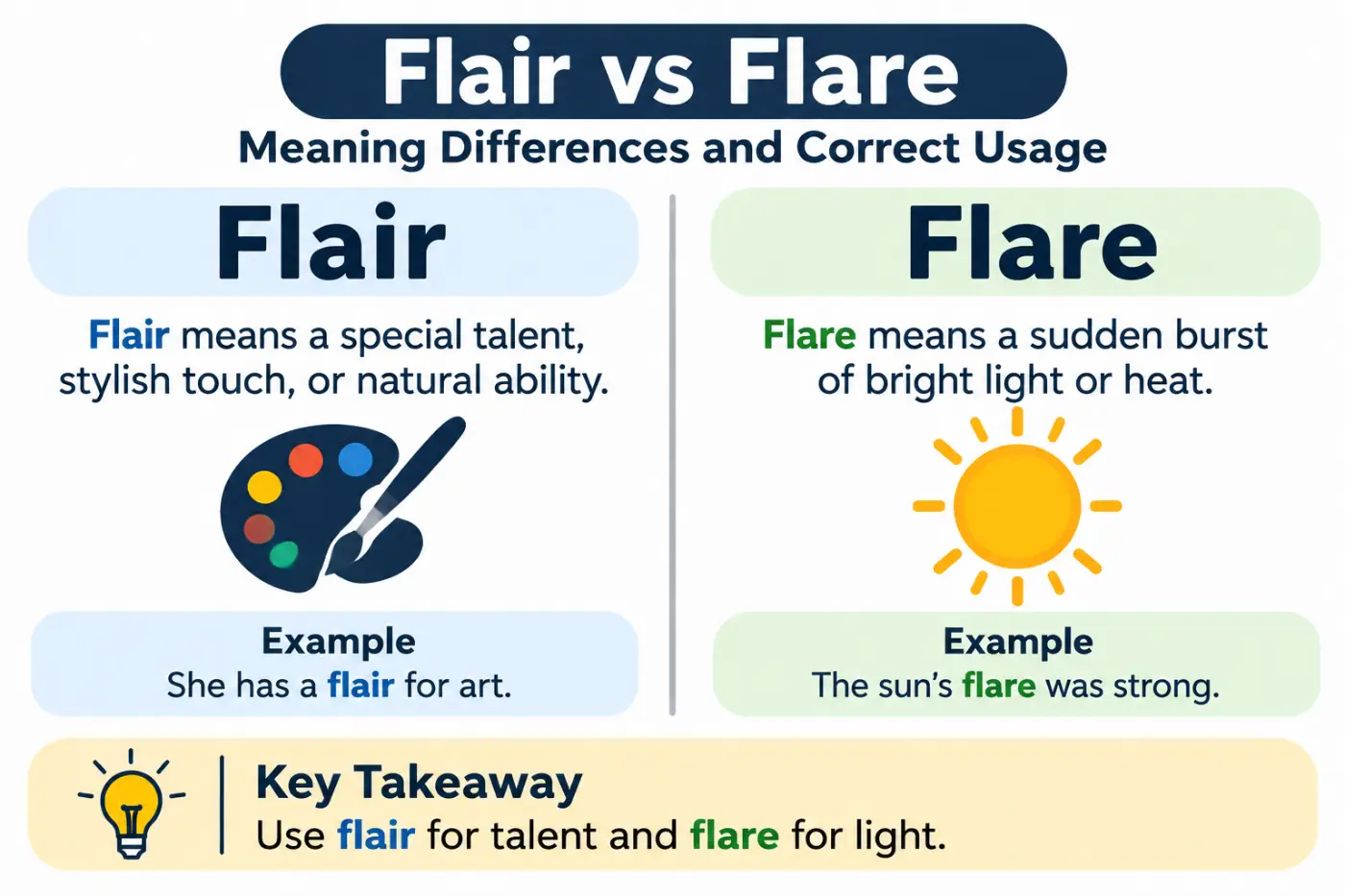
Flair describes a natural talent, distinctive style, or special ability to do something well. Flare refers to a sudden burst of light, fire, or emotion, and it can also describe something that spreads outward or becomes wider.
The confusion often happens because the two words are homophones. They share the same pronunciation but have different spellings and meanings. A small spelling change can completely alter the message of a sentence. Understanding their definitions, common expressions, and grammatical patterns will help you choose the right word in emails, schoolwork, professional documents, and everyday conversations.
For another common grammar confusion, see Peek vs Peak vs Pique Meaning and Usage Explained.
Quick Answer
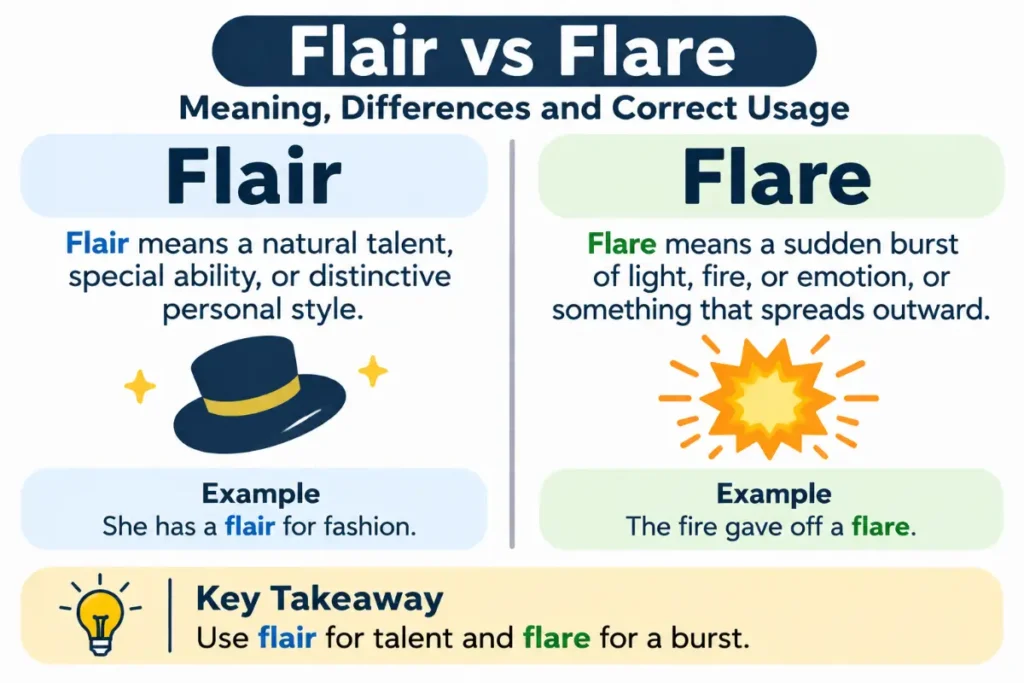
Flair means a natural talent, special ability, or distinctive personal style. Flare means a sudden burst of light, fire, or emotion, or something that spreads outward. Both are correct English words, but they have different meanings. Use flair when discussing someone’s abilities or style and flare when describing a burst, outbreak, or widening shape.
Comparison Table: Meaning and Usage
| Feature | Flair | Flare |
|---|---|---|
| Main meaning | Natural talent or distinctive style | Sudden burst, outbreak, or widening |
| Part of speech | Noun | Noun and verb |
| Pronunciation | /flɛər/ | /flɛər/ |
| Syllables | One | One |
| Origin | From French flairer, meaning to smell or sense | From a Germanic root associated with spreading or expanding |
| Common contexts | Creativity, fashion, writing, communication, personal ability | Fire, light, anger, medical symptoms, clothing, signals |
| Formality | Standard in formal and informal English | Standard in formal and informal English |
| Example | She has a flair for interior design. | The emergency flare lit up the sky. |
Meaning and Definition
What Does Flair Mean?
Flair is a noun that describes a natural ability, special talent, or distinctive way of doing something. It often suggests that someone performs an activity with creativity, confidence, skill, or personal style.
A person with flair does not simply complete a task. They bring something special to it. Their work may look more creative, sound more engaging, or feel more original than ordinary work.
For example:
- She has a flair for writing engaging stories.
- The designer added a touch of flair to the living room.
- His flair for public speaking makes him a strong presenter.
The word commonly appears with the preposition “for” when describing someone’s natural ability.
Common expressions include:
- A flair for languages
- A flair for business
- A flair for fashion
- A flair for creativity
- A natural flair
- A touch of flair
It can also describe a distinctive quality or attractive style. For example, a restaurant may serve traditional food with a modern flair. This means the restaurant presents familiar dishes in a distinctive or creative way.
Flair is generally positive. It suggests talent, originality, elegance, or an interesting personal touch.
What Does Flare Mean?
Flare has several meanings. It can function as both a noun and a verb, depending on how it appears in a sentence.
As a noun, it can describe:
- A sudden burst of bright light or flame.
- A device that produces a bright signal.
- A sudden increase in anger or emotion.
- A temporary worsening of a medical condition.
- A shape that gradually becomes wider toward the bottom or end.
As a verb, it describes an action or change that happens suddenly or becomes more noticeable.
For example:
- The pilot saw a bright flare in the distance.
- Her anger began to flare during the argument.
- The patient’s symptoms may flare up under stress.
- The skirt flares out below the waist.
- His nostrils flared when he became angry.
The word often suggests something sudden, expanding, intensifying, or becoming more visible.
Unlike its sound-alike counterpart, this word can describe physical objects, emotional reactions, natural events, and changes in health.
Is Either Word Incorrect?
No. Both are established English words with separate meanings. Neither is a misspelling of the other.
The mistake occurs when someone uses one word in a sentence where the meaning requires the other.
For example:
Incorrect: She has a natural flare for painting.
Correct: She has a natural flair for painting.
In the first sentence, the writer intends to describe artistic ability. Therefore, the noun referring to talent is needed.
Another example:
Incorrect: The rescue team launched a bright flair.
Correct: The rescue team launched a bright flare.
Here, the sentence describes a signaling device that produces light, so the second spelling is appropriate.
Key Differences Explained
Although these words sound identical, several important differences separate them.
1. Difference in Meaning
The most important distinction is meaning.
Flair relates to talent, creativity, and distinctive style. It describes something a person possesses or brings to an activity.
Flare relates to a sudden burst, expansion, or increase in intensity. It often describes an event, physical change, or reaction.
Compare:
- She has a flair for decorating homes.
- The flames began to flare in the wind.
The first sentence describes someone’s ability. The second describes the behavior of fire.
2. Difference in Grammar
Flair is primarily a noun. It names a quality, ability, or characteristic.
Flare can be a noun or a verb.
As a noun:
- The flare was visible from several miles away.
- His temper had another flare-up.
As a verb:
- The flames flare when the wind increases.
- Her symptoms may flare after exercise.
This grammatical difference is useful when checking a sentence. If you need an action word describing something suddenly increasing or spreading, the verb form of flare may be appropriate.
3. Difference in Pronunciation
Both words are pronounced identically in standard American English.
Their pronunciation is generally represented by the International Phonetic Alphabet as /flɛr/ in American English. In British English, the vowel and final sound may be represented differently depending on the accent.
Both are single-syllable words. The stress falls naturally on the only syllable.
Because their pronunciation is the same, listening alone cannot help you identify the correct spelling. You must consider the meaning and context.
4. Difference in Context
Flair is common in discussions about:
- Personal talents
- Creative work
- Fashion
- Communication
- Design
- Leadership
- Artistic ability
Flare is common in discussions about:
- Fire and flames
- Emergency signals
- Sudden anger
- Medical symptoms
- Clothing shapes
- Light and brightness
- Sudden increases in activity
The surrounding words often make the intended meaning clear.
For instance, “flair for mathematics” describes an ability, while “flare of anger” describes a sudden emotional reaction.
5. Difference in Formality
Both forms are acceptable in professional, academic, and casual English.
Flair works naturally in a job recommendation, performance review, creative portfolio, or academic discussion about artistic ability.
Flare is appropriate in medical reports, safety instructions, news articles, technical writing, and descriptions of physical changes.
Neither word is inherently more formal than the other. Their suitability depends on the subject.
6. Difference in Regional Usage
There is no major difference in spelling between American, British, Australian, and Canadian English. Both forms are recognized in these varieties.
Pronunciation can vary because of regional accents, but the distinction in meaning remains the same.
Which Form Is Correct?
Both words are correct. The right choice depends entirely on what you want to communicate.
Use flair when referring to:
- Natural talent
- Special ability
- Creative skill
- Personal style
- Distinctive presentation
Use flare when referring to:
- A burst of light or fire
- A sudden emotional reaction
- A worsening of symptoms
- Something spreading outward
- A signaling device
Established English dictionaries treat these as separate entries rather than alternative spellings of one word. Their definitions and grammatical functions support the distinction.
A useful way to check your writing is to replace the word with a simple synonym.
If you mean talent, style, or ability, choose flair.
If you mean burst, blaze, outbreak, or widen, choose flare.
This meaning-based test is more reliable than trying to remember which spelling looks right.
Sentence Examples
The following examples demonstrate how both words work in natural English.
10 Examples Using Flair
- My sister has a natural flair for photography and can make ordinary places look beautiful.
- The new employee showed a real flair for solving difficult problems during her first week.
- He decorated the office with a creative flair that made the space feel warm and welcoming.
- Our English teacher has a flair for explaining complex grammar rules in simple language.
- The fashion designer is known for combining classic clothing with a modern flair.
- She demonstrated her flair for leadership by bringing the entire team together.
- The restaurant serves traditional Italian dishes with a unique local flair.
- His presentation stood out because of his confidence and flair for storytelling.
- The author brings humor and personal flair to every chapter of the book.
- Although she had little experience, her natural flair for business helped her build a successful company.
5 Examples Using Flare
- The emergency team released a bright flare to help rescuers locate their position.
- His temper began to flare when he realized that the meeting had been canceled.
- The doctor explained that certain foods might cause her symptoms to flare up.
- The candle began to flare when a strong breeze entered the room.
- The trousers have a slightly wider shape because they flare below the knees.
Common Mistakes and Misspellings
Writers often confuse these forms because they sound identical. Here are five mistakes worth watching for.
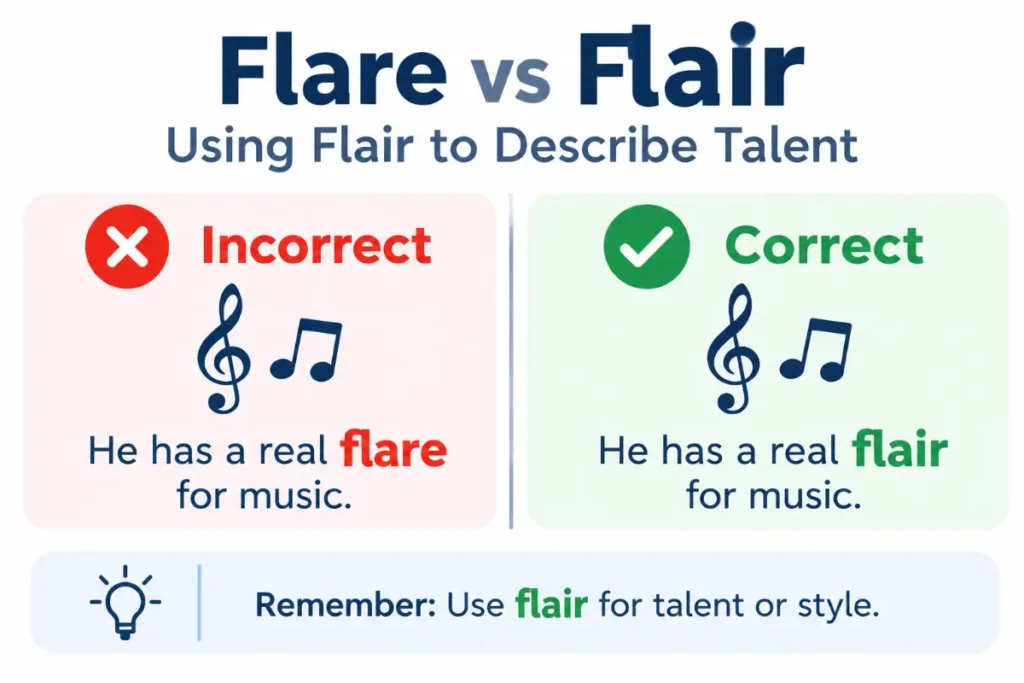
1. Using Flare to Describe Talent
Incorrect: He has a real flare for music.
Correct: He has a real flair for music.
Why it happens: The writer hears the correct pronunciation but selects the spelling associated with light or expansion. Remember that natural ability is expressed with the noun referring to talent.
2. Using Flair to Describe Fire
Incorrect: The fire produced a sudden flair.
Correct: The fire produced a sudden flare.
Why it happens: The two words share the same pronunciation. However, a sudden burst of flame requires the spelling associated with burning or bright light.
3. Confusing a Medical Flare With Personal Style
Incorrect: The patient’s arthritis flair became worse.
Correct: The patient’s arthritis flare became worse.
Why it happens: Medical language often uses the expression “flare-up” to describe a period when symptoms become more severe.
4. Using the Wrong Word in Fashion Descriptions
Incorrect: The pants have a wide flair at the bottom.
Correct: The pants have a wide flare at the bottom.
Why it happens: Flair can describe style in a broad sense, but flare specifically describes a shape that widens outward. The second form is the more precise choice when discussing clothing construction.
5. Confusing the Noun and Verb Forms
Incorrect: The flames began to flair as the wind increased.
Correct: The flames began to flare as the wind increased.
Why it happens: Writers may remember the general sound but forget the grammatical function. The sentence requires a verb describing the flames spreading or burning more intensely.
Pronunciation Guide
Both words have the same pronunciation in English. This makes them homophones, which are words that sound alike but have different meanings or spellings.
IPA Pronunciation
- Flair: /flɛr/ in a common American English transcription.
- Flare: /flɛr/ in a common American English transcription.
In many British English accents, the final r is not pronounced unless the following word begins with a vowel sound. The exact vowel quality can also vary by accent.
Syllable Breakdown
Both words contain one syllable:
- Flair: flair
- Flare: flare
Easy Pronunciation Guide
You can pronounce both words approximately like “flair” in the expression “flair for fashion.”
Start with the /fl/ sound, followed by the vowel sound in “air” as commonly pronounced in your accent.
Common Pronunciation Mistakes
Some learners try to pronounce the two words differently because their spellings are different. This is unnecessary in standard English.
The pronunciation does not change simply because the final letters are arranged differently.
A better learning method is to practice them in context:
- She has flair for design.
- The emergency flare was bright.
Reading these examples aloud helps connect each spelling with its meaning.
Learn the difference in Quieter vs More Quiet Which Form Is Correct.
Etymology and Word Origin
Understanding the history of these words can make their meanings easier to remember.
Origin of Flair
The word flair entered English through French. It is connected with the French verb flairer, meaning to smell or detect by smell.
The historical connection relates to the ability to sense or recognize something. Over time, the meaning developed toward a person’s special instinct, natural ability, or distinctive talent.
In modern English, the original connection with smelling is no longer the ordinary meaning. Instead, the word commonly describes an instinctive ability or special style.
For example, someone with a flair for business seems to have a natural ability to recognize opportunities and make good decisions.
Origin of Flare
Flare has a different linguistic history. It is generally traced to a Germanic source associated with spreading out or expanding.
Its modern meanings developed around ideas of widening, spreading, and suddenly becoming brighter or more intense.
This helps explain its use in expressions such as:
- Flames flaring up
- A flare of anger
- A flare of symptoms
- Flared trousers
The historical development of the word connects naturally with its modern meanings.
Although the two words now sound alike, their separate origins reflect their different meanings.
Regional Usage
The spellings and core meanings remain consistent across major English varieties.
American English
Both words are standard in American English.
Flair commonly appears in phrases such as “a flair for design,” “personal flair,” and “creative flair.”
Flare is widely used in phrases such as “a flare gun,” “a flare-up,” and “flared jeans.”
American speakers generally pronounce the two words alike.
British English
British English uses the same spellings and basic definitions.
There is no standard British spelling that replaces one with the other. Writers should choose according to meaning rather than regional preference.
Pronunciation differs in non-rhotic accents, where the final r is generally not pronounced unless followed by a vowel sound.
Australian English
Australian English also recognizes both words with the same basic meanings.
A person may have a flair for cooking, while a fire or emergency signal may produce a flare.
There is no established spelling difference between the two in Australian usage.
Canadian English
Canadian English follows the same distinction.
Both forms are accepted, and the correct choice depends on whether the writer is discussing talent and style or a burst, outbreak, or widening shape.
Grammar Rules and Part of Speech
Knowing how each word functions in a sentence is one of the easiest ways to avoid mistakes.
Flair as a Noun
Flair is a countable or uncountable noun depending on how it is used.
It is commonly used in the following patterns.
1. Flair for + noun or gerund
This pattern describes a natural ability.
Examples:
- She has a flair for mathematics.
- He has a flair for communicating with customers.
- They have a flair for creative problem-solving.
2. A natural flair
This expression describes an ability that seems instinctive.
Example: The young artist has a natural flair for painting.
3. A touch of flair
This describes a small but noticeable amount of distinctive style.
Example: The designer added a touch of flair to the simple outfit.
4. Personal flair
This refers to an individual’s recognizable style or approach.
Example: Every room in her home reflects her personal flair.
Flare as a Noun
As a noun, this word identifies a burst, signal, expansion, or sudden increase.
Common grammatical patterns include:
1. A flare of + noun
Examples:
- A flare of anger
- A flare of light
- A flare of pain
2. A flare-up
This is a compound noun describing a sudden worsening or outbreak.
Examples:
- A flare-up of symptoms
- A sudden flare-up of violence
3. Send or launch a flare
These expressions describe releasing a signaling device.
Example: The crew launched a flare to attract attention.
Flare as a Verb
The verb form describes something becoming brighter, stronger, wider, or more intense.
Examples:
- The flames flare in the wind.
- His anger flared unexpectedly.
- Her symptoms flared after the long journey.
- The fabric flares toward the bottom.
Its common forms include:
| Verb Form | Example |
|---|---|
| Base form | Flare |
| Third-person singular | Flares |
| Past tense | Flared |
| Past participle | Flared |
| Present participle | Flaring |
Punctuation and Sentence Position
Neither word requires special punctuation.
Both can appear at the beginning, middle, or end of a sentence, depending on their grammatical role.
Examples:
- Flair is one of her strongest qualities.
- A sudden flare appeared in the distance.
- The flames began to flare.
- With considerable flair, he completed the presentation.
The main rule is to select the spelling that matches the intended meaning.
Real-Life Usage Examples
Seeing these words in different situations makes their distinction easier to remember.
Daily Conversation
People often use the word associated with talent when talking about hobbies, interests, and personal abilities.
- My brother has a flair for fixing old computers.
- She has always had a flair for choosing beautiful clothes.
The other word appears when describing sudden reactions or visible changes.
- His temper began to flare during the discussion.
- The flames flared when someone added more wood.
Email and Workplace Communication
Professional writing often uses the talent-related noun when discussing an employee’s strengths.
- Maria has demonstrated a strong flair for customer communication and problem-solving.
- Your team has a real flair for developing creative marketing ideas.
The other form is more suitable for describing sudden developments or increases.
- The system experienced a brief flare-up of activity after the update.
- Please report any flare-ups in the equipment’s operating temperature.
Academic Writing
In academic and educational contexts, the first word may describe a person’s creative or intellectual ability.
- The student demonstrated a flair for analytical writing throughout the semester.
- Her research presentation showed a flair for organizing complex information.
The second word may appear in scientific, medical, or technical descriptions.
- The report examined factors associated with flare-ups of inflammatory symptoms.
- The researchers observed a brief flare of light during the experiment.
News and Journalism
Journalists may use the first spelling when describing a person’s distinctive style or talent.
- The young musician has developed a flair for combining traditional and modern sounds.
- The chef is known for his flair for presenting familiar dishes in creative ways.
The second spelling is common in reports about emergencies, conflict, and sudden events.
- Rescue workers spotted a flare over the coastline.
- Tensions flared after the announcement was released.
Literature and Storytelling
Writers use the first form to describe a character’s personality, abilities, or distinctive approach.
- The detective had a flair for noticing details that everyone else overlooked.
- Her flair for conversation made even the quietest gatherings enjoyable.
The second form can create a stronger sense of movement or emotion.
- Anger flared in his eyes as he read the letter.
- A bright flare illuminated the dark road for a moment.
Related and Confused Terms
Several other English words share similar meanings or appear in the same contexts.
Understanding these terms can improve vocabulary and help you choose more precise expressions.
1. Talent
Talent refers to a natural ability or skill in a particular area.
Example: She has a talent for playing the piano.
Difference: Talent and flair can overlap, but flair often adds a sense of personal style, creativity, or instinctive ability.
2. Aptitude
Aptitude means a natural ability to learn or perform a particular activity.
Example: He has an aptitude for learning foreign languages.
Difference: Aptitude focuses more on potential or ability, while flair often suggests a distinctive and creative way of using that ability.
3. Style
Style describes the particular way someone does something or presents themselves.
Example: The artist developed a recognizable painting style.
Difference: Style describes how something is done, while flair often suggests a special quality or talent behind that approach.
4. Panache
Panache means confident, stylish, and impressive presentation.
Example: She delivered the speech with remarkable panache.
Difference: Panache usually emphasizes confidence and elegance, while flair can also describe natural skill and creative ability.
5. Burst
A burst is a sudden release or increase of something.
Example: A burst of light filled the room.
Difference: Burst is closely related to one of the meanings of the second word, but it is a broader term and does not describe widening shapes in every context.
6. Blaze
A blaze refers to a large or intense fire or a strong display of light.
Example: The firefighters worked to control the blaze.
Difference: Blaze describes intense burning or brightness, while flare can describe a smaller or more sudden burst of light or flame.
7. Flare-Up
A flare-up is a sudden outbreak or worsening of something, especially a medical condition, conflict, or emotional situation.
Example: The patient experienced a flare-up of back pain.
Difference: This expression is a compound noun formed from the second word. It is not a synonym for personal talent or style.
8. Outbreak
An outbreak is a sudden start or occurrence of something, often a disease, conflict, or other serious event.
Example: Health officials investigated an outbreak of infection.
Difference: Outbreak generally describes the beginning or spread of an event, while flare can emphasize a sudden increase in intensity.
Expert Editor Insight
An experienced English editor checks meaning before correcting spelling, especially when working with homophones. These two words are both legitimate, so a spelling checker may accept either one even when the wrong choice changes the sentence’s meaning. For example, a sentence about someone’s artistic ability needs the word for talent, while a sentence about a sudden burst of light needs the other form. The best editing technique is to read the entire sentence and ask what the writer intends to describe. Grammar tools can identify many spelling problems, but context-based word choice still requires careful human review.
Conclusion
Understanding flair vs flare becomes simple once you remember that the two words describe different things. Flair refers to natural talent, creative ability, or distinctive personal style, while flare describes a sudden burst of light, fire, emotion, or an outward expansion. Both spellings are correct, and neither should be treated as a general replacement for the other.
The easiest way to remember the difference is to connect flair with talent and style, and flare with flames, bursts, and flare-ups. Before submitting an email, assignment, or professional document, check the meaning of the sentence rather than relying only on pronunciation. This small habit will help you write with greater accuracy and confidence.
Need another quick comparison? Read Felt or Feel Which Word Is Correct.
FAQs
Is flair a real word?
Yes. Flair is a standard English noun that describes natural talent, special ability, or distinctive style. It is commonly used in expressions such as “a flair for writing” and “a flair for business.” It is not an alternative spelling of the word used for a burst of light or fire.
Is flare a real word?
Yes. Flare is a standard English word that functions as both a noun and a verb. It can describe a sudden burst of light, a signaling device, an increase in anger, or a widening shape. It can also describe something becoming more intense, such as flames or medical symptoms.
What is the main difference between the two words?
The main difference is their meaning. Flair describes natural talent, creative ability, or distinctive style. Flare describes a sudden burst, outbreak, or expansion. Although they sound the same, they perform different grammatical functions and cannot usually be substituted for each other.
How do you pronounce flair and flare?
Both words have the same pronunciation in standard English. In American English, they are commonly represented by the IPA transcription /flɛr/. Each contains one syllable. Their identical pronunciation is why writers sometimes confuse their spellings, but their meanings remain different.
Can flare be used as a verb?
Yes. Flare can function as a verb meaning to burn brightly, become more intense, widen outward, or increase suddenly. For example, flames may flare in strong wind, someone’s anger may flare during an argument, and symptoms may flare after a period of improvement.
What is a synonym for flair?
Useful synonyms include talent, aptitude, ability, style, creativity, and panache. The best replacement depends on the sentence. Talent and aptitude emphasize natural ability, while style and panache focus more on presentation. The expression “a flair for” is often best retained when describing a person’s particular strengths.
Why do people confuse these spellings?
People confuse them because they are homophones, meaning they sound identical but have different spellings and meanings. When someone hears either word in conversation, pronunciation alone does not reveal which spelling is correct. Writers must use the sentence’s meaning and grammatical context to select the appropriate form.
Is either word appropriate in formal writing?
Yes. Both words are appropriate in formal writing when used correctly. Flair can describe someone’s creative abilities or distinctive approach in a professional report, while flare is suitable for medical, scientific, technical, and journalistic contexts. Neither spelling is informal or incorrect. Accuracy depends on matching the word to its intended meaning.