
Have you ever paused while writing because you could not decide between cue and queue? These two words sound exactly alike, but they have different meanings and uses. The confusion is understandable because both contain unusual spelling patterns, and their pronunciation gives you no clue about which one belongs in a sentence.
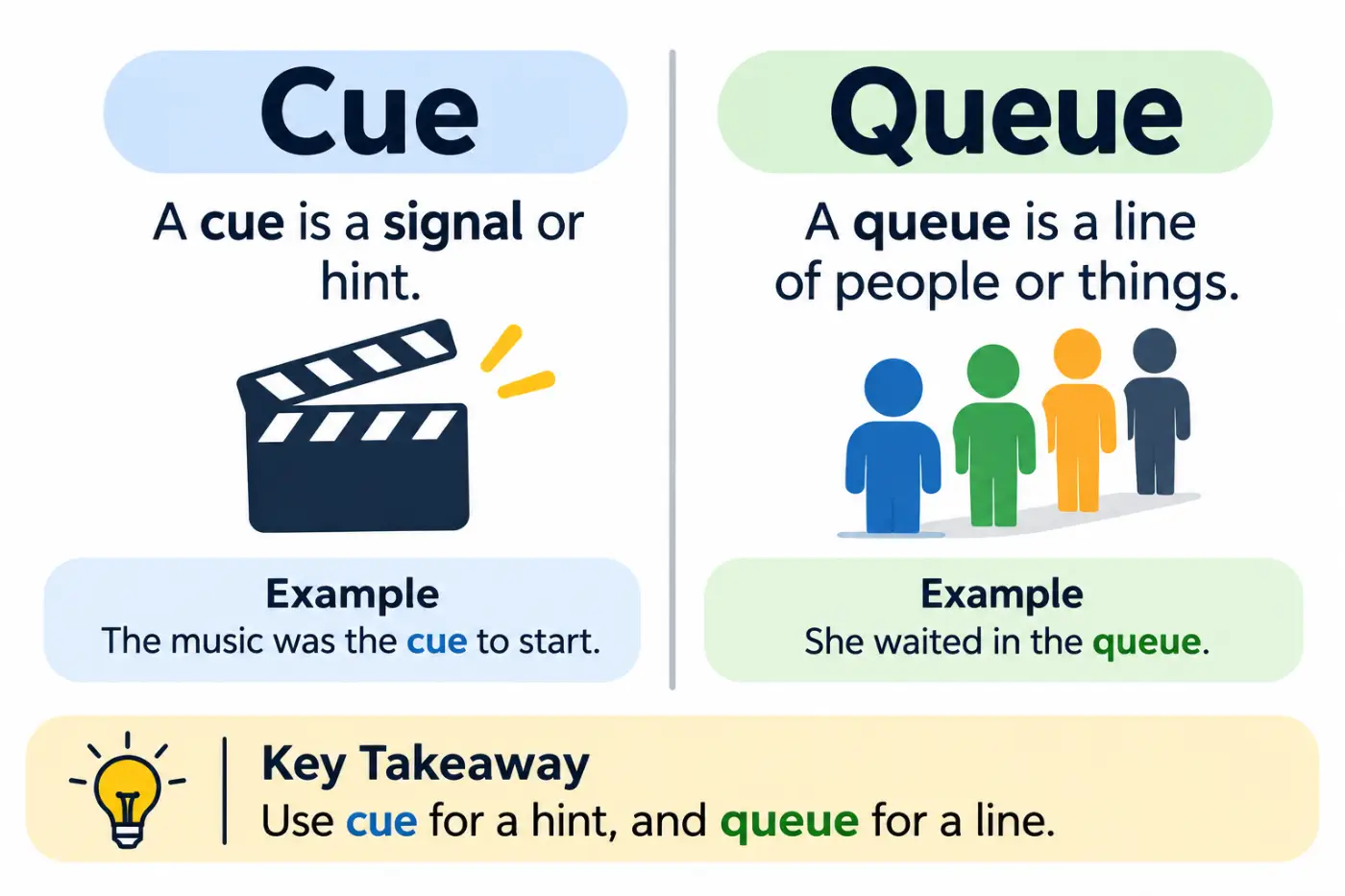
The main difference is simple. A cue is a signal, hint, prompt, or sign that tells someone to do something. A queue is a line of people or things waiting for their turn, or a sequence arranged for processing. For example, an actor waits for a cue to speak, while customers stand in a queue to buy tickets.
Learning the difference helps you avoid spelling mistakes in emails, school assignments, workplace messages, and everyday writing. It also makes it easier to understand phrases such as take your cue, cue the music, join the queue, and queue up. The key is to focus on the meaning you want to express, not the sound of the word.
Need another quick comparison? Read Naive vs Nieve: Meaning, Usage, and Differences 2026..
Quick Answer
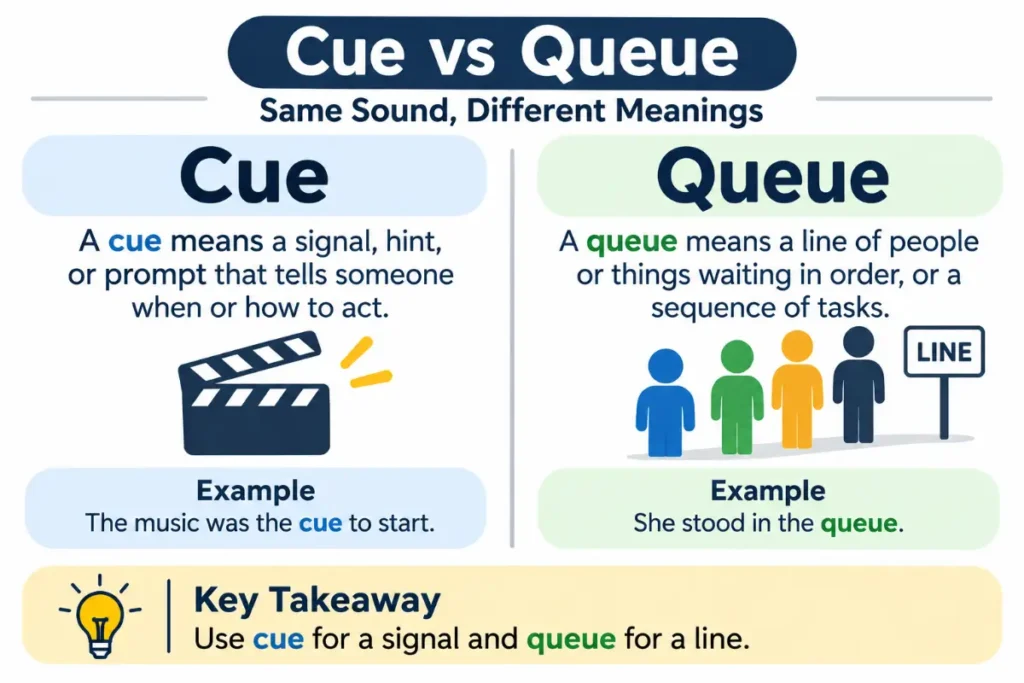
Cue means a signal, hint, or prompt that tells someone when or how to act. Queue means a line of people or things waiting in order, or a sequence of tasks waiting to be processed. Both words are correct and are pronounced the same way, but they cannot usually replace each other.
Quick Answer: Which Word Should You Use?
Use cue when you mean a signal, reminder, prompt, or indication. Use queue when you mean a waiting line or an ordered list of items waiting for attention or processing.
For example, the actor received a cue to enter the stage. The audience joined the queue outside the theater. The correct choice depends on the meaning of your sentence.
Comparison Table
| Feature | Cue | Queue |
|---|---|---|
| Main meaning | A signal, hint, or prompt | A line or waiting sequence |
| Part of speech | Noun and verb | Noun and verb |
| Pronunciation | /kjuː/ | /kjuː/ |
| Syllables | One | One |
| Common noun use | A signal to act | A line of people or items |
| Common verb use | To prompt or signal | To arrange in a waiting line |
| Origin | Has historical links to French and theatrical usage | From French queue, meaning tail |
| Formality | Standard in formal and informal English | Standard in formal and informal English |
| Common contexts | Theater, music, sports, conversation, performance | Stores, transportation, computers, customer service |
| Example | The director gave the actor a cue. | We joined the queue at the entrance. |
Meaning and Definition
The two words share a pronunciation, but their meanings are quite different. Understanding each definition separately is the easiest way to use them correctly.
What Does Cue Mean?
Cue is a noun or verb. As a noun, it means a signal, hint, prompt, or indication that tells someone when to act or gives them information about what to do next.
For example:
- The actor waited for his cue before speaking.
- Her smile was a cue that the conversation was welcome.
- The coach gave the players a cue to begin.
- The music provided a cue for the dancers to enter.
A cue does not always have to be a spoken instruction. It can be a sound, movement, gesture, word, or event. A raised hand might tell a speaker to begin. A change in music might signal that a scene is about to end. A person’s facial expression might give you a hint about how they feel.
As a verb, cue means to give someone a signal or prompt, or to prepare something to begin at the right moment.
Examples:
- Please cue the music when the lights go down.
- The host cued the next speaker.
- The technician cued the video before the presentation.
The word also appears in common expressions such as cue someone in, take your cue from someone, and cue the music.
What Does Queue Mean?
Queue is a noun or verb. As a noun, it usually means a line of people or vehicles waiting for their turn. It can also describe an ordered sequence of things waiting to be handled.
For example:
- We waited in a queue outside the bank.
- There was a long queue at the airport.
- My support request is still in the queue.
- The printer has several documents in its queue.
In American English, people often use the word line for a row of people waiting. Queue is still correct and widely understood, especially in formal situations, public services, transportation, and computing.
As a verb, queue means to form or arrange a line, or to place something into a sequence so it can be handled later.
Examples:
- Customers queued outside the store.
- The files were queued for printing.
- The application queued the requests for processing.
You may also see the expression queue up. It means to form a line or arrange items in a sequence.
Is the Second Word a Misspelling?
No. Queue is not an incorrect spelling of cue, and cue is not a shortened or misspelled version of queue. They are separate words with established meanings.
The mistake happens when someone chooses the wrong word because both have the same pronunciation. For example, writing “Please queue me when it is my turn” is usually incorrect if you mean “Please give me a signal.” In that sentence, cue is the right choice.
Likewise, “I stood in the cue” is incorrect when you mean a waiting line. The correct sentence is “I stood in the queue.”
Both forms deserve a place in standard English. The important thing is to match the spelling to the intended meaning.
Key Differences Explained
The difference becomes easier to remember when you compare how each word works in everyday situations.
1. Spelling
The most visible difference is the spelling.
- Cue has three letters: C, U, and E.
- Queue has five letters: Q, U, E, U, and E.
The second word contains several letters that do not represent separate sounds in its pronunciation. This unusual spelling can make it harder to remember, especially for people learning English.
2. Meaning
Cue refers to a signal or prompt. Queue refers to a line or an ordered sequence.
Compare these sentences:
- The teacher gave the class a cue to start reading.
- The students formed a queue outside the classroom.
The first sentence describes an instruction. The second describes a group of people waiting in order.
3. Grammar
Both words can function as nouns and verbs.
As a noun, cue identifies a signal. As a verb, it describes giving that signal. Queue can identify a waiting line as a noun and describe joining or arranging that line as a verb.
This means you cannot choose the correct form by looking only at the grammatical role. You need to understand the meaning as well.
4. Pronunciation
Both words are pronounced /kjuː/. They sound like the letter name Q.
The pronunciation is identical in standard American English, so listening alone will not help you choose the correct spelling. You must use the surrounding sentence to identify the intended meaning.
5. Context
The words usually appear in different settings.
Cue is common in:
- Theater and acting.
- Music and performance.
- Sports and games.
- Presentations and speeches.
- Everyday conversations about signals or hints.
Queue is common in:
- Stores and public services.
- Airports and transportation.
- Customer support systems.
- Computer programming.
- Tasks waiting to be completed.
6. Formality
Both words are suitable for formal and informal writing. Neither is slang or an incorrect variation.
However, American speakers often prefer line in everyday conversation instead of queue. For example, someone might say, “There is a long line at the checkout.” In a more formal context, queue may sound natural: “Customers must join the queue at the service desk.”
7. Regional Usage
There is no major spelling difference between American and British English. Both varieties use cue and queue with the same basic meanings.
The more noticeable difference is preference. British English commonly uses queue for a line of people. American English often uses line in everyday conversation, although queue remains familiar and standard.
Which Form Is Correct?
Both forms are correct. The right choice depends on what you want to say.
Use cue when the sentence refers to a signal, prompt, or indication. Use queue when it refers to a line or an ordered group waiting for its turn.
Consider these examples:
- Correct: The singer waited for her cue.
- Correct: The singer joined the queue for the audition.
- Incorrect for the intended meaning: The singer waited for her queue.
- Incorrect for the intended meaning: The singer joined the cue for the audition.
The last two sentences use real English spellings, but they do not express the intended meanings. This is a word choice error rather than a case in which one spelling is universally wrong.
A useful editing habit is to replace the word temporarily with its meaning. If you can replace it with signal or prompt, choose cue. If you can replace it with line or waiting list, choose queue.
10 Sentence Examples
The following examples show how both words work in natural English.
Examples With Cue
- The director gave the actor a cue to enter the room.
- A loud bell served as the cue for students to leave the classroom.
- Please cue the opening video after the speaker introduces the topic.
- Her friendly expression was a cue that I could ask another question.
- The coach used a hand signal to cue the players to begin the drill.
Examples With Queue
- We joined the queue outside the movie theater before the doors opened.
- There was a long queue at the airport security checkpoint.
- The customer service team placed my request in a queue.
- Please queue the documents so the printer can process them in order.
- Several cars began to queue near the entrance after the traffic light changed.
These examples demonstrate the main distinction. A cue gives someone a signal or prompt. A queue places people or items in an order.
Common Mistakes and Misspellings
People often confuse these words because they sound identical. The following mistakes are worth watching for when writing.
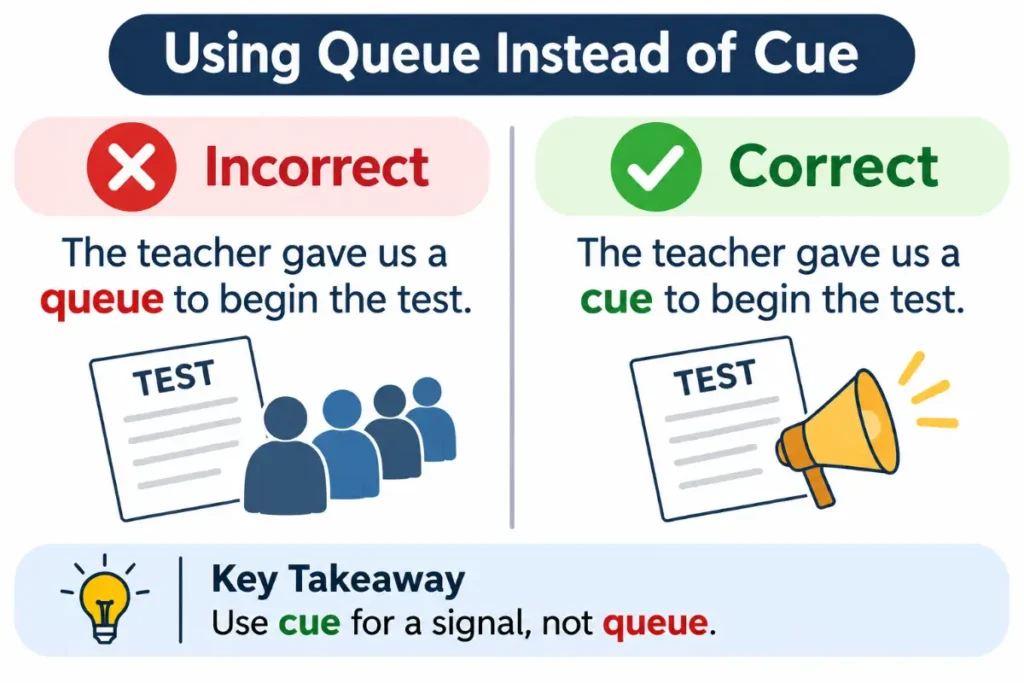
1. Using Queue Instead of Cue
Incorrect: The teacher gave us a queue to begin the test.
Correct: The teacher gave us a cue to begin the test.
The sentence refers to a signal or instruction, not a waiting line. The shorter spelling is correct because the teacher is prompting the students to begin.
2. Using Cue Instead of Queue
Incorrect: We waited in the cue for our tickets.
Correct: We waited in the queue for our tickets.
The sentence describes people standing in line. Queue is the correct word because the group is waiting for its turn.
3. Writing Que Instead of Queue
Incorrect: There was a long que outside the store.
Correct: There was a long queue outside the store.
Que is not the standard spelling of the English noun for a waiting line. The full spelling is queue. In American conversation, line may be a simpler alternative.
4. Writing Q Instead of Cue
Incorrect: The actor missed his Q.
Correct: The actor missed his cue.
The letter Q is pronounced like both words, but it does not replace the standard spelling of the noun in ordinary writing. Use cue when referring to an actor’s signal.
5. Confusing a Cue With a Waiting List
Incorrect: My application is waiting for its cue.
Correct: My application is waiting in the queue.
A cue is a signal to act. A queue is an ordered group of requests waiting to be processed. In a computer system or customer service setting, queue is the appropriate choice.
Many readers also check Hoping or Hopeing Which Spelling Is Correct..
Pronunciation Guide
One reason people confuse these words is that they sound exactly alike. Their spelling is different, but their standard pronunciation is the same.
IPA Pronunciation
| Word | IPA | Syllables | Simple Guide |
|---|---|---|---|
| Cue | /kjuː/ | One | Kyoo |
| Queue | /kjuː/ | One | Kyoo |
Both words rhyme with words such as blue, true, and shoe.
How to Pronounce Them
Follow these simple steps:
- Begin with the /k/ sound, as in cat.
- Move directly into the /j/ sound, which is similar to the beginning of yes.
- Finish with the long /uː/ sound, as in blue.
- Keep the pronunciation in one smooth syllable.
The result sounds like the letter name Q.
Common Pronunciation Mistakes
Some learners try to pronounce every written letter in queue. That creates an incorrect pronunciation because the spelling contains more letters than the spoken word has sounds.
Do not pronounce the final letters as separate syllables. Queue is not spoken as “kwee-you-ee.” It has one syllable.
Cue is also one syllable. Both forms have the same vowel sound and the same stress pattern. There is no pronunciation difference that can reliably tell you which spelling to use.
Etymology and Word Origin
The history of these words helps explain why their spellings look unusual. Their histories are connected to older French forms, although their modern uses have developed in different ways.
Origin of Queue
Queue entered English through Old French, where queue meant tail. Its older history can be traced to Latin cauda, which also meant tail.
The original sense referred to something extending behind another thing. Over time, the word developed its modern meaning of a line or row of people waiting in order. The idea of people standing one behind another is closely connected to the older meaning.
Today, the word is used for physical lines as well as ordered groups of digital tasks.
Origin of Cue
The history of cue is more complex because the word has several uses. The noun for a signal or prompt is associated with theatrical and performance language. It has also been linked historically to the French word queue, meaning tail, though the development of the theatrical sense is not entirely simple.
In modern English, cue refers to a signal that tells someone when to speak, move, begin, or perform an action. It also appears in sports and everyday speech.
The word for the stick used in billiards is another use of cue and has a historical connection to the idea of a tail or end.
Why Their Spellings Are Different
The two words have different spelling histories and different modern meanings. Their shared pronunciation does not make them interchangeable.
English has many words that sound alike but have separate spellings and definitions. These words are called homophones. Cue and queue are a useful example because their pronunciation is identical, yet their written forms serve different purposes.
Regional Usage
The basic meanings and spellings remain consistent across major English varieties. The main regional difference is how often speakers choose queue instead of line.
American English
Both cue and queue are standard in the United States.
Cue is widely used for signals, prompts, acting instructions, and indications. You may hear phrases such as cue the music, wait for your cue, and take your cue from someone.
Queue is also used, especially in technology, customer service, and formal descriptions of waiting systems. However, Americans often say line in casual conversation.
For example:
- The audience waited in line outside the theater.
- The technician gave the performer a cue.
British English
British English uses both words in the same way. Queue is especially common when describing people waiting in order.
For example:
- We joined the queue at the ticket office.
- The actor missed his cue and entered too early.
British speakers also use queue as a verb. Someone might say, “People were queuing outside the shop.” This is a standard form in British English.
Australian English
Australian English follows the same basic distinction. Queue is a familiar term for a waiting line, while cue refers to a prompt or signal.
For example:
- Customers formed a queue near the counter.
- The presenter waited for the cue to begin.
There is no special Australian spelling rule that changes one word into the other.
Canadian English
Canadian English also uses both forms with their standard meanings. Speakers may use line in everyday situations and queue in more formal or technical contexts.
Cue remains the usual word for a signal or prompt. The spelling does not change based on the country.
Grammar Rules and Part of Speech
Both words can work as nouns and verbs. Their grammatical roles are similar, but their meanings determine how they fit into a sentence.
Cue as a Noun
As a noun, cue refers to a signal, hint, or prompt.
Common patterns include:
- A cue for something.
- A cue to do something.
- Take your cue from someone.
- Wait for a cue.
- Give someone a cue.
Examples:
- The change in lighting was a cue for the next scene.
- I took my cue from the manager.
- She waited for a cue before speaking.
A cue can be specific or indirect. A spoken instruction is a clear signal, while a person’s expression may provide a less direct hint.
Cue as a Verb
As a verb, cue means to signal or prompt someone, or to prepare an event or recording to begin.
Examples:
- Cue the music.
- The host cued the next guest.
- The stage manager cued the lights.
The verb changes form according to tense.
| Form | Example |
|---|---|
| Base form | Please cue the recording. |
| Third person | She cues the performers. |
| Past tense | He cued the music. |
| Present participle | They are cueing the next scene. |
| Past participle | The video has been cued. |
Queue as a Noun
As a noun, queue refers to people or items arranged in order while waiting.
Common patterns include:
- Stand in a queue.
- Join a queue.
- Wait in a queue.
- Move to the front of the queue.
- Put something in a queue.
Examples:
- We joined the queue at the entrance.
- My request is at the front of the queue.
- There are three files in the print queue.
The noun can describe a physical line or a digital sequence. In both cases, the central idea is an ordered group waiting for attention or action.
Queue as a Verb
As a verb, queue means to form a line or arrange something in a sequence.
Examples:
- Visitors queued outside the building.
- The system queued the files for printing.
- The cars began to queue near the bridge.
The verb also changes according to tense.
| Form | Example |
|---|---|
| Base form | Please queue the files. |
| Third person | The system queues each request. |
| Past tense | The files queued successfully. |
| Present participle | Customers are queuing outside. |
| Past participle | The requests have been queued. |
Is Queue Up Correct?
Yes. Queue up is a standard phrasal verb. It means to form a line or arrange items in a sequence.
Examples:
- Please queue up outside the classroom.
- The customers queued up before the store opened.
- The software queued up several tasks.
In American English, line up is often more common in everyday speech. Both expressions are correct, but queue up may sound more formal or more natural in certain technical and public service settings.
Is Cue Up Correct?
Yes. Cue up is also a correct expression, but it has a different meaning. It usually means to prepare a recording, song, video, or other item so it is ready to play at the right time.
Examples:
- Cue up the next song.
- The technician cued up the presentation.
- She cued up the video before the meeting.
Remember the distinction: cue up prepares something to begin, while queue up places people or items in a line or sequence.
Real Life Usage Examples
These words appear in several areas of everyday life. The examples below show how their meanings change with the situation.
Daily Conversation
In ordinary conversation, cue often refers to a signal or hint. Queue can describe a group of people waiting.
- “That was my cue to leave the party,” said Mark.
- “The queue at the coffee shop is moving slowly,” said Anna.
The first speaker uses cue to explain what prompted an action. The second uses queue to describe people waiting to order.
Email and Workplace Communication
At work, cue may refer to a prompt during a meeting or presentation. Queue often refers to tasks waiting for attention.
- Please give me a cue when it is time to share the quarterly report.
- Your support request is in the queue and will be reviewed soon.
The first sentence asks for a signal. The second explains the status of a request.
Academic Writing
In academic writing, cue can describe an indicator or signal in an experiment, study, or learning activity. Queue can describe an ordered process or waiting system.
- The visual cue helped participants identify the correct response.
- The research team placed the submitted records in a queue for review.
These examples use both terms in clear, precise ways.
News and Journalism
News reports may use queue to describe crowds waiting for public services or transportation. Cue may appear when a signal or event triggers a response.
- Long queues formed outside polling stations before voting began.
- The announcement served as a cue for emergency workers to begin the next stage of the response.
The correct spelling follows the intended meaning, not the topic of the report.
Literature and Storytelling
Writers use cue to describe a gesture, sound, or event that prompts a character to act. Queue may describe people or objects arranged in a line.
- At the sound of the bell, the guard took it as his cue to open the gate.
- A queue of travelers stretched along the narrow road.
Both words can help create a clear picture for the reader.
Related and Confused Terms
Several English words and expressions are closely connected to these two terms. Learning them can make your vocabulary more precise.
1. Signal
A signal is a sign, sound, movement, or message that communicates information or tells someone to act. It is closely related to cue.
Example: The coach gave a signal for the players to stop.
A signal may be a cue, but the two words do not always fit every sentence in the same way.
2. Prompt
A prompt is something that encourages or reminds a person to respond or take action. It can be a written instruction, spoken reminder, or signal.
Example: The teacher gave the students a prompt to begin their discussion.
Prompt is often a useful substitute for cue when the meaning involves an instruction or reminder.
3. Hint
A hint gives someone indirect information or helps them understand something without explaining it fully.
Example: Her expression gave me a hint that something was wrong.
A hint can function as a cue, but a cue may be more direct and may specifically tell someone when to act.
4. Line
A line is a row of people or things arranged in order. It is one of the most common alternatives to queue in American English.
Example: We stood in line to buy concert tickets.
In everyday American conversation, line is often more natural than queue.
5. Waiting List
A waiting list is a list of people waiting for a place, service, appointment, or opportunity.
Example: The clinic added my name to its waiting list.
A waiting list is related to a queue, but it does not always mean people are standing in a physical line. It may also describe an organized record of people waiting.
6. Take Your Cue
Take your cue is an expression that means to use another person’s behavior or a particular situation as a guide.
Example: I took my cue from the host and started the discussion.
The expression does not refer to a line of people. It refers to guidance or an indication.
7. Queue Up
Queue up means to form a line or arrange items in order.
Example: Passengers queued up near the boarding gate.
In American English, line up is often a familiar alternative. In computer systems, queue up can describe placing tasks in a sequence.
8. Cue Up
Cue up means to prepare a recording, song, video, or other item so it is ready to begin.
Example: The DJ cued up the next track.
This expression is especially useful in music, broadcasting, presentations, and video production. It should not be confused with queue up, which refers to forming a line or arranging items in a sequence.
Expert Editor Insight
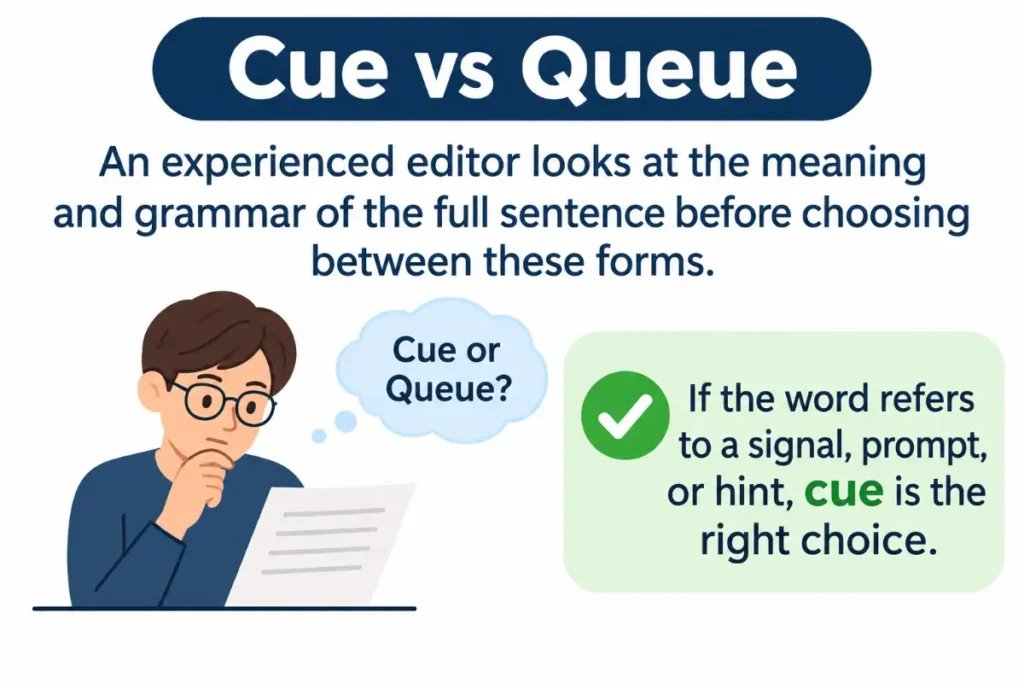
An experienced editor looks at the meaning and grammar of the full sentence before choosing between these forms. If the word refers to a signal, prompt, or hint, cue is the right choice. If it refers to a line or an ordered sequence, queue is correct. Spelling tools may not catch the mistake because both words are valid English terms. A grammar checker may accept either spelling when it appears in a sentence, even if the meaning is wrong. The best editing tip is to replace the word with signal or line and see which meaning fits.
Learn the difference in Ensure vs Insure Meaning, Usage and Key Differences 2026.
Conclusion
The difference between cue vs queue comes down to meaning. Cue refers to a signal, prompt, or hint that tells someone when to act. Queue refers to a line of people or an ordered sequence waiting to be handled. Both are correct English words, and both have the same pronunciation, so sound alone cannot guide your choice.
Use a simple memory trick when writing: a cue gives you a clue, while a queue is a line. Before submitting an email, assignment, or report, check the meaning of the sentence. That small step will help you choose the right spelling every time.
FAQs
Which Is Correct: Cue or Queue?
Both spellings are correct, but they have different meanings. Cue refers to a signal, hint, or prompt that tells someone to act. Queue refers to a line of people or things waiting in order. Choose the word that matches your intended meaning. For example, an actor waits for a cue, while customers wait in a queue.
What Does Cue Mean?
Cue means a signal, prompt, or hint that tells someone when to act or provides information about what to do. It can be a spoken instruction, hand gesture, sound, or change in a situation. For example, a stage manager may give an actor a cue to enter, or a bell may signal the end of class.
What Does Queue Mean?
Queue means a line of people or things waiting for their turn. It can also describe a sequence of tasks waiting to be processed by a computer or system. For example, customers may stand in a queue at a store, while a printer may have several documents waiting in its print queue.
Are Cue and Queue Homophones?
Yes. Cue and queue are homophones because they have the same pronunciation but different spellings and meanings. Both are pronounced /kjuː/, which sounds like the letter name Q. Their identical sound is the main reason writers confuse them. You need to use the meaning of the sentence to decide which spelling is correct.
Is Queue a Real Word in American English?
Yes. Queue is a standard English word in the United States. Americans often use line in casual conversation when describing people waiting, but queue is common in technical, formal, and service related contexts. It can refer to a physical line, a waiting list, or tasks arranged for processing.
Can Cue Be Used as a Verb?
Yes. Cue can work as a verb meaning to give someone a signal or prepare something to begin. For example, a stage manager may cue an actor to enter, or a technician may cue a video before a presentation. Its past tense is cued, and its present participle is cueing.
What Is the Difference Between Cue Up and Queue Up?
Cue up means to prepare a recording, song, video, or other item so it is ready to play. Queue up means to form a line or arrange people or items in a sequence. For example, a DJ cues up a song, while customers queue up outside a store. The expressions sound similar but describe different actions.
Why Do People Confuse These Two Words?
People confuse them because both words are pronounced exactly alike. Their spellings also contain letter patterns that do not clearly show their sounds. Someone may remember the pronunciation but forget the spelling that matches the meaning. Reading the sentence for context is the most reliable way to avoid this error.