
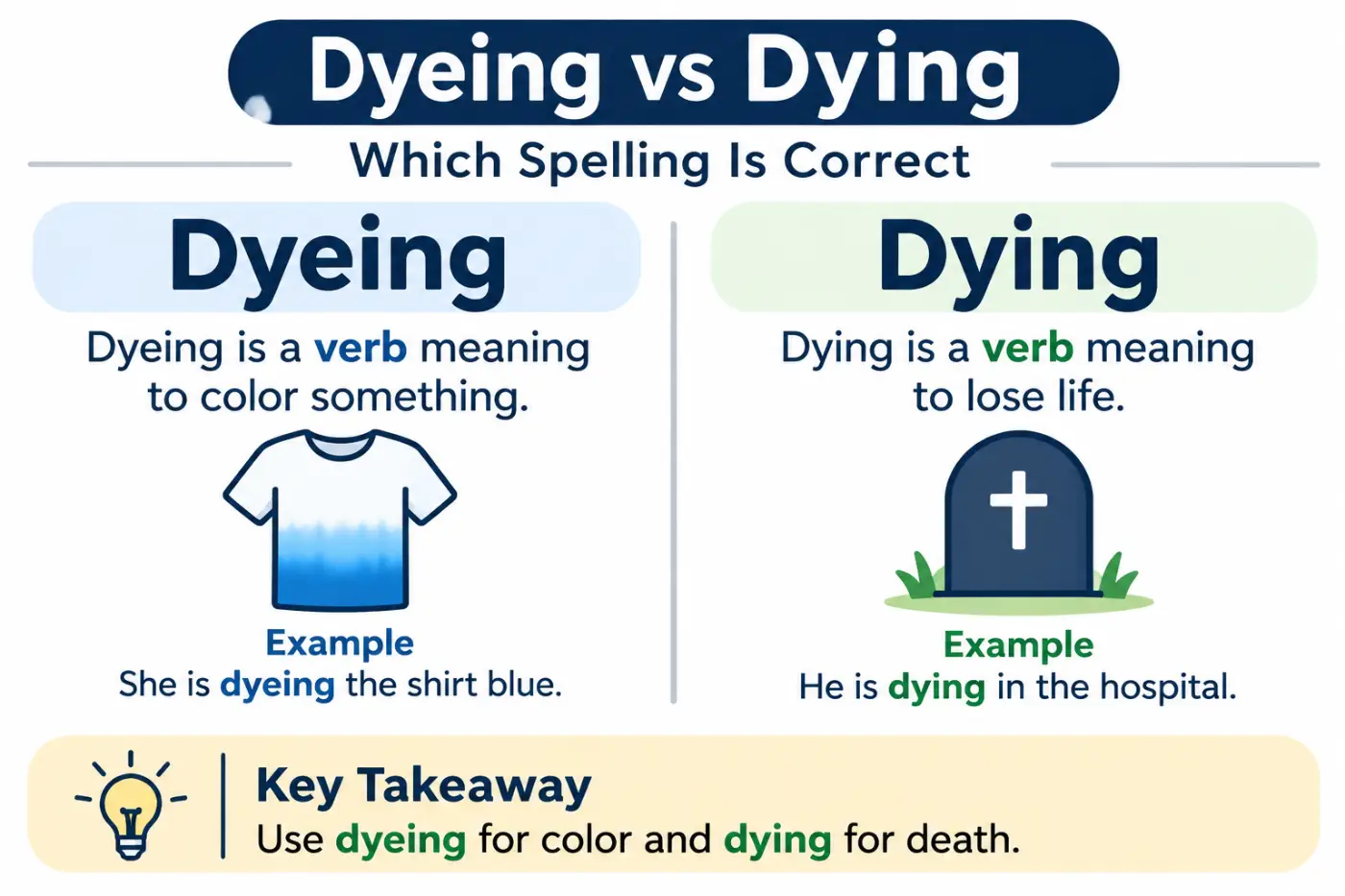
Have you ever stopped while writing because you weren’t sure if the right word was dyeing vs dying? The two spellings look almost identical, and they sound exactly the same in everyday English. However, they describe very different actions. One relates to changing the color of fabric, hair, or another material. The other relates to death, fading, or something coming to an end.
The difference between dyeing vs dying comes down to meaning and spelling, not pronunciation. Both are correct words, so neither is automatically a mistake. You simply need to choose the one that matches your message. The confusion often happens because both words come from verbs that end in the letter combination ie, which changes when you add ing. This guide explains their definitions, grammar, pronunciation, origins, and regional usage. You’ll also find practical examples and simple memory tips to help you choose the right spelling in everyday conversations, schoolwork, emails, and professional writing.
Many readers also check World Class vs World-Class Which Form Is Correct.
Quick Answer
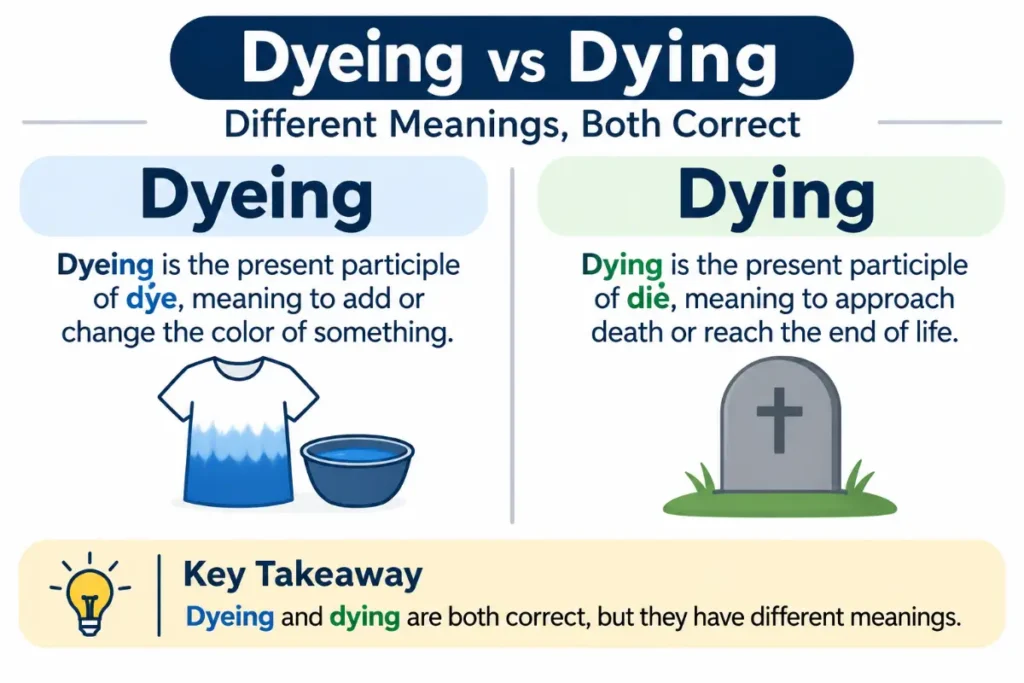
Dyeing is the present participle of dye, meaning to add or change the color of something. Dying is the present participle of die, meaning to approach death or reach the end of life. Both words are correct, but they cannot replace each other because their meanings are different.
Comparison Table
| Feature | Dyeing | Dying |
|---|---|---|
| Base verb | Dye | Die |
| Meaning | Adding or changing color | Approaching death or ending |
| Part of speech | Present participle or gerund | Present participle or gerund |
| Pronunciation | /ˈdaɪ.ɪŋ/ | /ˈdaɪ.ɪŋ/ |
| Syllables | Two | Two |
| Spelling pattern | Removes the final e and adds ing | Changes ie to y and adds ing |
| Common contexts | Hair, clothing, fabric, textiles | Health, life, plants, machines, trends |
| Example | She is dyeing her hair brown. | The old tree is dying. |
The table shows why the words cause confusion. They share the same pronunciation, but their spelling reflects two different base verbs and meanings.
Meaning and Definition
What Does Dyeing Mean?
Dyeing means adding color to a material or changing its existing color with a dye. It is the present participle of the verb dye. The process can involve fabric, clothing, hair, leather, yarn, paper, or other materials that can absorb or hold color.
A dye is a coloring substance used to change the appearance of an object. Depending on the material, the coloring process may involve soaking, applying, spraying, or using heat to help the color settle.
For example:
- My sister is dyeing her hair red.
- The company is dyeing cotton fabric for its new clothing line.
- He spent the afternoon dyeing wool for a knitting project.
- The artist is dyeing paper to create a vintage effect.
The word also works as a noun when it describes the process itself. For example, Fabric dyeing requires the right temperature and coloring solution. In this sentence, the word names an activity rather than describing something currently happening.
Common forms include:
| Word | Grammatical Form | Example |
|---|---|---|
| Dye | Base verb or noun | I want to dye my shirt. |
| Dyes | Third person singular verb or plural noun | She dyes her hair at home. |
| Dyed | Past tense or past participle | They dyed the curtains blue. |
| Dyeing | Present participle or gerund | He is dyeing the fabric. |
The central idea is always related to color.
What Does Dying Mean?
Dying is the present participle of die. Its most direct meaning is approaching the end of life. It can describe a person, animal, or living organism that is close to death.
However, the word has several other meanings. It can describe something losing its strength, disappearing, becoming less active, or reaching the end of its useful life.
For example:
- The patient is dying from a serious illness.
- The flowers are dying because they haven’t received enough water.
- The old battery is dying and needs to be replaced.
- Interest in the outdated fashion trend is dying.
The word also appears in informal expressions. Someone might say, I’m dying of laughter, to explain that something is extremely funny. This is an exaggeration, not a literal statement about death.
Similarly, I’m dying for a cup of coffee means the speaker really wants coffee. These expressions are common in casual conversation.
Here are the main forms of the verb die:
| Word | Grammatical Form | Example |
|---|---|---|
| Die | Base verb | Plants die without water. |
| Dies | Third person singular verb | The battery dies quickly. |
| Died | Past tense or past participle | The plant died last week. |
| Dying | Present participle or gerund | The plant is dying. |
The central meaning is related to death, decline, or an ending.
Is Either Spelling Incorrect?
Neither spelling is incorrect. Both are established English words with separate meanings. The mistake happens when a writer uses one in place of the other.
For example, She is dying her hair blonde is incorrect if the writer means changing the hair color. The correct sentence is She is dyeing her hair blonde.
Likewise, The flowers are dyeing is incorrect if the writer means that the flowers are losing their life. The correct form is The flowers are dying.
The right choice depends on the intended meaning and the base verb.
Key Differences Explained
The two words differ in several important ways. Understanding these differences makes it easier to use them correctly.
1. Spelling
The spelling changes because the base verbs follow different patterns when you add ing.
The verb dye ends in a silent e. English spelling rules usually remove that final e before adding ing.
– Dye + ing = Dyeing.
The verb die ends in ie. In this case, the ie changes to y before adding ing.
– Die + ing = Dying.
These patterns explain why the words look different even though they sound alike.
2. Meaning
The most important difference is what each word describes.
- Dyeing refers to adding or changing color.
- Dying refers to approaching death, losing life, or coming to an end.
Think about the sentence before choosing the spelling. If it involves a coloring process, use the form based on dye. If it involves death or decline, use the form based on die.
3. Grammar
Both words are present participles and can also function as gerunds.
A present participle commonly appears with a form of be to create a continuous verb tense.
For example:
- She is dyeing her dress.
- The leaves are dying.
A gerund functions as a noun.
For example:
- Dyeing is a useful skill.
- Dying is a natural part of life.
The grammatical function depends on how the word works in the sentence.
4. Pronunciation
Both words have the same standard pronunciation: /ˈdaɪ.ɪŋ/.
They sound like DYE-ing. This makes them homophones, meaning words that sound alike but have different spellings and meanings.
You cannot reliably choose between them by listening alone. You need to understand the context.
5. Formality
Both forms are appropriate in formal and informal English. Neither is slang or an outdated spelling.
Dyeing appears in professional fields such as textile production, fashion, hair care, and manufacturing. Dying appears in medical discussions, literature, science, and everyday speech.
The level of formality depends on the sentence and subject, not the spelling.
6. Context
The surrounding words often make the intended meaning clear.
Words such as fabric, hair color, cotton, yarn, and pigment usually point toward the coloring process.
Words such as death, illness, fading, plant, battery, and decline often point toward the other meaning.
Context provides the strongest clue when the pronunciation offers no help.
7. Regional Usage
American, British, Australian, and Canadian English use both spellings with the same basic meanings. There is no standard regional spelling difference between these two forms.
Which Form Is Correct?
Both are correct. The right spelling depends on the verb you want to use.
Use dyeing when you mean changing the color of something. Use dying when you mean approaching death or reaching an end.
This distinction follows established English spelling rules. The verb dye drops its final e before taking the ing ending. The verb die changes its final ie to y before taking the same ending.
A simple way to check your spelling is to remove ing and look at the remaining base verb.
- If the sentence needs dye, write dyeing.
- If the sentence needs die, write dying.
For example, consider these two sentences:
The stylist is dyeing the customer’s hair.
The stylist is changing the hair color, so the base verb is dye.
The customer’s houseplant is dying.
The plant is losing its life, so the base verb is die.
This method works in everyday writing, academic assignments, business communication, and professional editing.
Sentence Examples
The following examples show how each spelling works in natural English.
10 Examples Using the Correct Forms
- My mother is dyeing her white curtains a soft shade of blue.
- The salon is dyeing my hair brown for the wedding.
- She enjoys dyeing cotton fabric for her handmade clothing business.
- The artist is dyeing pieces of paper before creating the final design.
- Our school is dyeing old T shirts for the annual art project.
- The flowers are dying because the weather has been extremely hot.
- The doctor explained that the patient’s condition was getting worse and he was dying.
- My phone battery is dying, so I need to find a charger.
- Public interest in the old television show is slowly dying.
- I was dying of laughter after hearing his funny story.
These examples show that the first form belongs to activities involving color. The second form can describe literal death or a gradual loss of life, energy, or popularity.
5 Incorrect Examples and Their Corrections
These sentences demonstrate common spelling mistakes. The incorrect versions are included only to show what to avoid.
| Incorrect Sentence | Correct Sentence | Reason |
|---|---|---|
| She is dying her hair black. | She is dyeing her hair black. | Changing hair color requires the verb dye. |
| He is dyeing from a serious illness. | He is dying from a serious illness. | The sentence refers to approaching death. |
| I am dying this fabric red. | I am dyeing this fabric red. | The fabric is receiving a new color. |
| The flowers are dyeing in the garden. | The flowers are dying in the garden. | The flowers are losing their life. |
| The old battery is dyeing. | The old battery is dying. | The battery is losing power. |
A useful editing habit is to identify the action before checking the spelling. That small step prevents most errors.
Common Mistakes and Misspellings
Writers often confuse these words because they sound alike. Their spelling patterns can also be difficult to remember, especially for people learning English.
Here are five common mistakes and ways to avoid them.
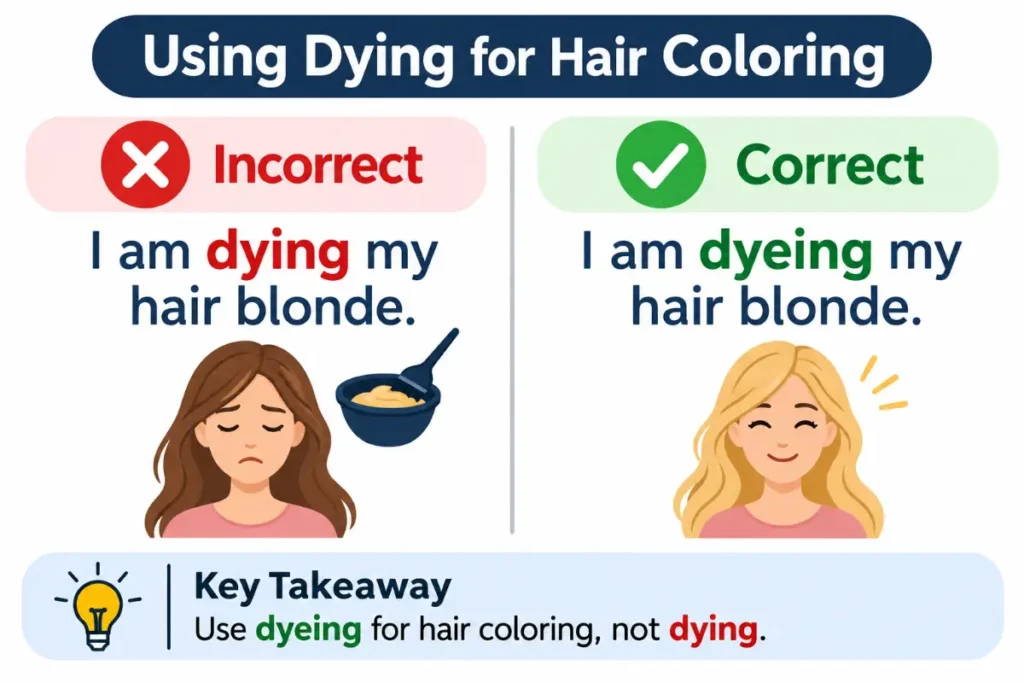
1. Using Dying for Hair Coloring
Incorrect: I am dying my hair blonde.
Correct: I am dyeing my hair blonde.
The sentence describes a change in hair color, so it needs the verb dye. The word dying would suggest that someone is approaching death.
2. Using Dyeing for Death
Incorrect: The injured bird is dyeing.
Correct: The injured bird is dying.
The bird is losing its life, not receiving a new color. Use the form that comes from die.
3. Applying the Same Spelling Rule to Both Words
Incorrect: Dieing and dyeing are treated as interchangeable.
Correct: Dying and dyeing have separate meanings.
Some writers assume that adding ing always means keeping the original spelling. However, English has different spelling patterns for verbs ending in silent e and verbs ending in ie.
4. Relying Only on Pronunciation
Incorrect approach: Choosing a spelling based only on how the word sounds.
Correct approach: Use the sentence’s meaning to decide.
Since the two forms sound the same, pronunciation cannot tell you which spelling to use. Read the full sentence and identify the action.
5. Forgetting the Base Verb
Incorrect: The company is dyeing out.
Correct: The company is dying out.
The expression die out means to disappear or stop existing. Its present participle is dying out. Remembering the original phrase helps you select the correct form.
Learn the difference in excelerate or accelerate Correct Spelling and Meaning.
Pronunciation Guide
Both words are pronounced exactly alike in standard American English.
IPA pronunciation
\[ /ˈdaɪ.ɪŋ/ \]
Easy pronunciation
DYE ing
The pronunciation has two syllables:
- DYE.
- Ing.
The stress falls on the first syllable. The first sound is the long I sound, as in my, try, and sky. The second syllable sounds like the ending in running or playing.
Common Pronunciation Mistakes
Some speakers may try to pronounce the words differently because their spellings are different. However, the standard pronunciation is the same.
Avoid adding an extra sound to distinguish them. There is no separate standard pronunciation for the coloring process and the act of approaching death.
You can remember the sound easily by saying DYE-ing. The meaning comes from context, not from a difference in pronunciation.
Etymology and Word Origin
The two words have different histories because they come from different base verbs.
Origin of Dyeing
The verb dye has roots in Old English, where related forms referred to coloring or staining. Its history is connected to the use of natural coloring materials for cloth, wool, and other objects.
For centuries, people used substances from plants, minerals, and other natural sources to give materials different colors. As textile production developed, the process became more specialized.
Today, dye is used for many coloring methods, from traditional fabric treatment to modern industrial and cosmetic applications.
The spelling dyeing follows the normal pattern for a verb ending in silent e. The final e disappears when the ing ending is added.
Origin of Dying
The verb die comes from Old English dēag, a historical form associated with death. Its development reflects the long history of English words describing the end of life.
Over time, the verb developed into the modern form die. Its present participle follows a different spelling rule from the verb dye.
When ing is added, the final ie changes to y, creating dying.
Why Their Histories Matter
The spelling difference reflects the separate roots of the words. Although they now sound alike, they developed from different verbs and kept distinct meanings.
This is why the two forms should never be treated as alternate spellings of the same word.
Regional Usage
There is no major difference in the use of these words across the main English varieties. Both spellings are standard in the United States, the United Kingdom, Australia, and Canada.
American English
American English uses dyeing for changing color and dying for approaching death or reaching an end.
Examples:
- She is dyeing her hair for the summer.
- The grass is dying because of the heat.
Both spellings are appropriate in schoolwork, business writing, news reports, and casual conversations.
British English
British English follows the same spelling distinction.
Examples:
- The factory is dyeing wool for the clothing industry.
- The old tree is dying after years of disease.
British English has some spelling differences from American English, such as colour and color. However, those regional differences do not affect these two words.
Australian English
Australian English uses both forms in the same way.
For example, someone might write She is dyeing a dress for the event or The plants are dying in the dry weather.
There is no special Australian spelling rule that changes the distinction.
Canadian English
Canadian English also follows the same standard forms.
A Canadian writer uses dyeing for coloring materials and dying for death or decline. The meanings and spelling patterns remain the same.
Grammar Rules and Part of Speech
Understanding how each word functions in a sentence makes the distinction even clearer. Both can act as present participles or gerunds, but their meanings remain tied to their original verbs.
Present Participle
A present participle is commonly used with a form of be to create a continuous tense.
For example:
- She is dyeing her wedding dress.
- They are dyeing the fabric in large batches.
- The patient is dying.
- The flowers are dying in the garden.
The words describe actions or processes that are happening over time.
Gerund
A gerund is a verb form ending in ing that functions as a noun.
Examples:
- Dyeing requires patience and careful preparation.
- Dying is a natural part of life.
- She learned dyeing as part of her textile course.
- The book explores the process of dying in old age.
In these examples, each word names an activity or process.
Use With Helping Verbs
Both forms can follow helping verbs such as am, is, are, was, and were.
Examples:
- I am dyeing my shirt.
- He is dyeing the fabric.
- The plant is dying.
- The leaves were dying before the rain arrived.
The helping verb establishes the tense, while the present participle provides the main action.
Use in Passive Constructions
The form dyed is commonly used in passive sentences to describe something that has received color.
For example:
- The fabric was dyed blue.
- The wool has been dyed with natural pigments.
The form dying does not usually work in the same way to describe a completed coloring process. It describes an action in progress.
Common Grammar Errors
One frequent mistake is using a continuous verb form when the writer needs a past participle.
Incorrect: The shirt was dyeing blue yesterday.
Correct: The shirt was dyed blue yesterday.
The first sentence suggests that the shirt itself was performing an action. The second correctly describes the result of the coloring process.
Another mistake is confusing a literal meaning with an expression.
For example, I am dying to see you is grammatically correct. It is an informal expression meaning that the speaker is very eager to meet someone.
Real Life Usage Examples
These words appear in different areas of daily life. The surrounding subject usually makes the intended meaning clear.
Daily Conversation
In everyday speech, the coloring form often appears in conversations about hair, clothes, and crafts.
- I’m dyeing my old jeans black this weekend.
- The flowers are dying because I forgot to water them.
The first sentence describes a planned activity. The second describes a problem with living plants.
Email and Workplace Communication
In professional communication, the spelling should be clear because the two meanings can change the message.
- Our team is dyeing the new fabric samples before the product review.
- The technician reported that the backup battery is dying and needs replacement.
The first belongs to manufacturing or design. The second describes equipment that is losing power.
Academic Writing
Academic writing may use the words in scientific, historical, or technical discussions.
- Traditional dyeing methods often used plant based pigments to color natural fibers.
- The study examines how environmental conditions affect dying plants.
In the first sentence, the word describes a textile process. In the second, it describes the loss of life in plants.
News and Journalism
Journalists use both forms to describe events and developments.
- The textile company is dyeing recycled materials as part of its new production process.
- Researchers warn that several native plant species are dying because of prolonged drought.
The subject of the report determines the spelling.
Literature and Storytelling
Writers use the words to create different images and emotions.
- She spent the afternoon dyeing the fabric while sunlight filled the room.
- The old tree stood beside the house, slowly dying as the seasons passed.
The first sentence creates an image of color and creative work. The second suggests decline and the passage of time.
Related and Confused Terms
Several words are connected to these forms through meaning, spelling, or pronunciation. Learning them can help you build a stronger understanding of the vocabulary.
1. Dye
A dye is a substance used to add color to something. It can be used for fabric, hair, leather, paper, and other materials.
Example: This natural dye comes from plants.
2. Dyed
Dyed is the past tense and past participle of dye. It describes something that has already received color.
Example: She wore a beautifully dyed silk scarf.
3. Dying Out
The expression dying out means gradually disappearing or becoming extinct.
Example: Some traditional crafts are dying out.
It is based on the verb die, not the verb dye.
4. Death
Death is the noun connected to the verb die. It refers to the end of life.
Example: The family was deeply saddened by his death.
5. Coloring
Coloring means adding color or changing the appearance of something. It can be used as a general term for different coloring methods.
Example: The children enjoyed coloring the paper.
Dyeing is more specific when a dye is used to color a material.
6. Staining
Staining means applying a substance that changes the color or appearance of a surface. It is common in woodworking, laboratory work, and fabric treatment.
Example: The carpenter is staining the wooden table.
Unlike dyeing, staining often refers to treating a surface rather than coloring material throughout.
7. Fading
Fading means gradually losing color, brightness, strength, or importance.
Example: The red curtains are fading in direct sunlight.
Fading can happen after an object has been dyed, but it describes the loss of color rather than the process of adding it.
8. Deceased
Deceased is a formal adjective meaning dead. It is often used in official documents, news reports, and respectful discussions.
Example: The deceased person’s family received support from the community.
It relates to the meaning of dying, but it describes a person who has already died rather than someone approaching death.
Expert Editor Insight
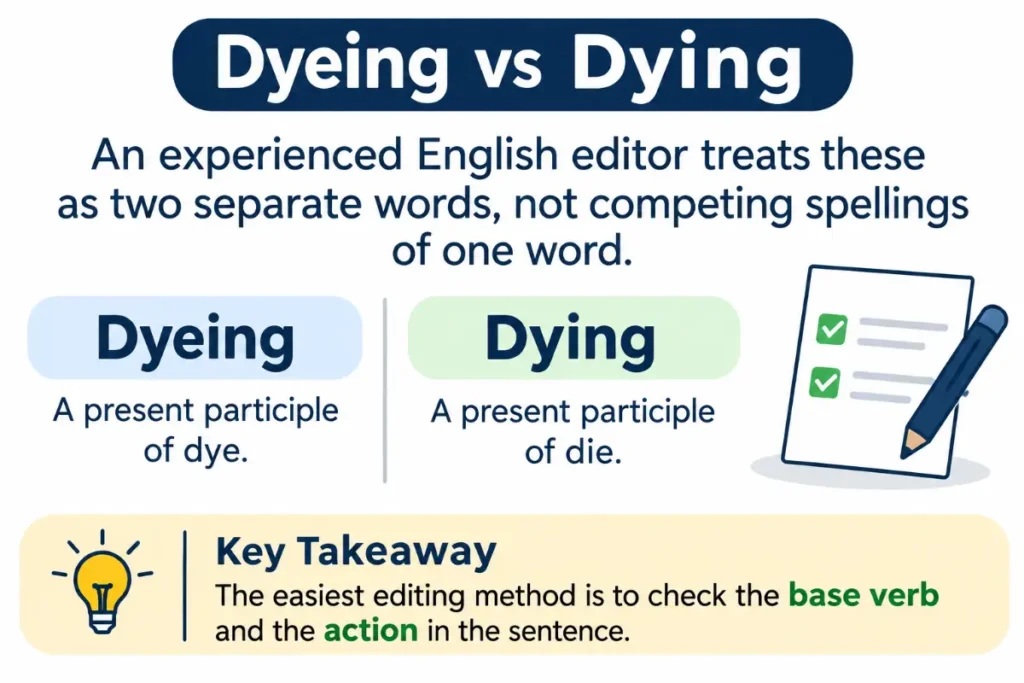
An experienced English editor treats these as two separate words, not competing spellings of one word. The easiest editing method is to check the base verb and the action in the sentence. If the subject is receiving color, the spelling should come from dye. If the subject is approaching death or disappearing, use the form from die. Spellcheckers may miss the mistake because both words are correctly spelled. A grammar tool can also accept the wrong choice if the sentence remains grammatically possible. Reading the full sentence for meaning is more reliable than trusting an automatic spelling check.
For another common grammar confusion, see Born vs Borne Which Form Should You Use.
Conclusion
The difference between dyeing vs dying becomes simple once you connect each spelling to its meaning. Dyeing describes adding or changing color, while dying refers to approaching death, losing life, or coming to an end. Both forms are correct, and both sound alike, so context is the best way to choose the right one.
Remember the base verbs: dye becomes dyeing, while die becomes dying. Before submitting an email, assignment, or article, read the sentence and check the action it describes. That quick habit will help you avoid one of English’s most common spelling mix-ups.
FAQs
Is Dyeing a Real Word?
Yes. Dyeing is a standard English word and the present participle of dye. It describes the process of adding color to fabric, hair, wool, or another material. It can also function as a noun when naming the coloring process. For example, Dyeing fabric at home requires the right materials and preparation.
Is Dying a Real Word?
Yes. Dying is the standard present participle of die. It describes a person, animal, or plant approaching the end of life. It can also describe something losing power, strength, or importance. For example, The flowers are dying without enough water. It is also common in expressions such as dying of laughter.
What Is the Difference Between Dyeing and Dying?
Dyeing means changing the color of something, while dying means approaching death or reaching an end. Both words sound the same, but their meanings and spelling patterns are different. Use the first form for hair, fabric, and other coloring activities. Use the second for people, animals, plants, machines, and things that are declining.
How Do You Pronounce Dyeing and Dying?
Both words have the same pronunciation: /ˈdaɪ.ɪŋ/. They sound like DYE ing and contain two syllables, with stress on the first. The pronunciation does not change based on meaning. Since they are homophones, you must use the sentence’s context to decide which spelling belongs in your writing.
Why Does Dyeing Have an Extra E?
The spelling comes from the base verb dye. English usually removes the final silent e from a verb before adding ing. As a result, dye becomes dyeing. This differs from die, where the final ie changes to y before the same ending is added, producing dying.
Can Dyeing and Dying Start a Sentence?
Yes. Both words can start a sentence when they function as gerunds or when the sentence structure allows them to act as participles. For example, Dyeing fabric takes time and care uses the word as a noun. Dying without support can be frightening also uses a gerund to name a process.
Are Dyeing and Dying Spelled the Same in British and American English?
Yes. American and British English use the same spellings and meanings. The same distinction also applies in Australian and Canadian English. Some English words have regional spelling differences, but these two forms do not. Writers in all four varieties use the coloring form for changing color and the other form for death or decline.
What Is an Easy Way to Remember the Difference?
Connect each word to its base verb. If you can replace the action with color, use dyeing. If you can replace it with approaching death or coming to an end, use dying. You can also remember that dye loses its final e, while die changes ie to y before adding ing.