
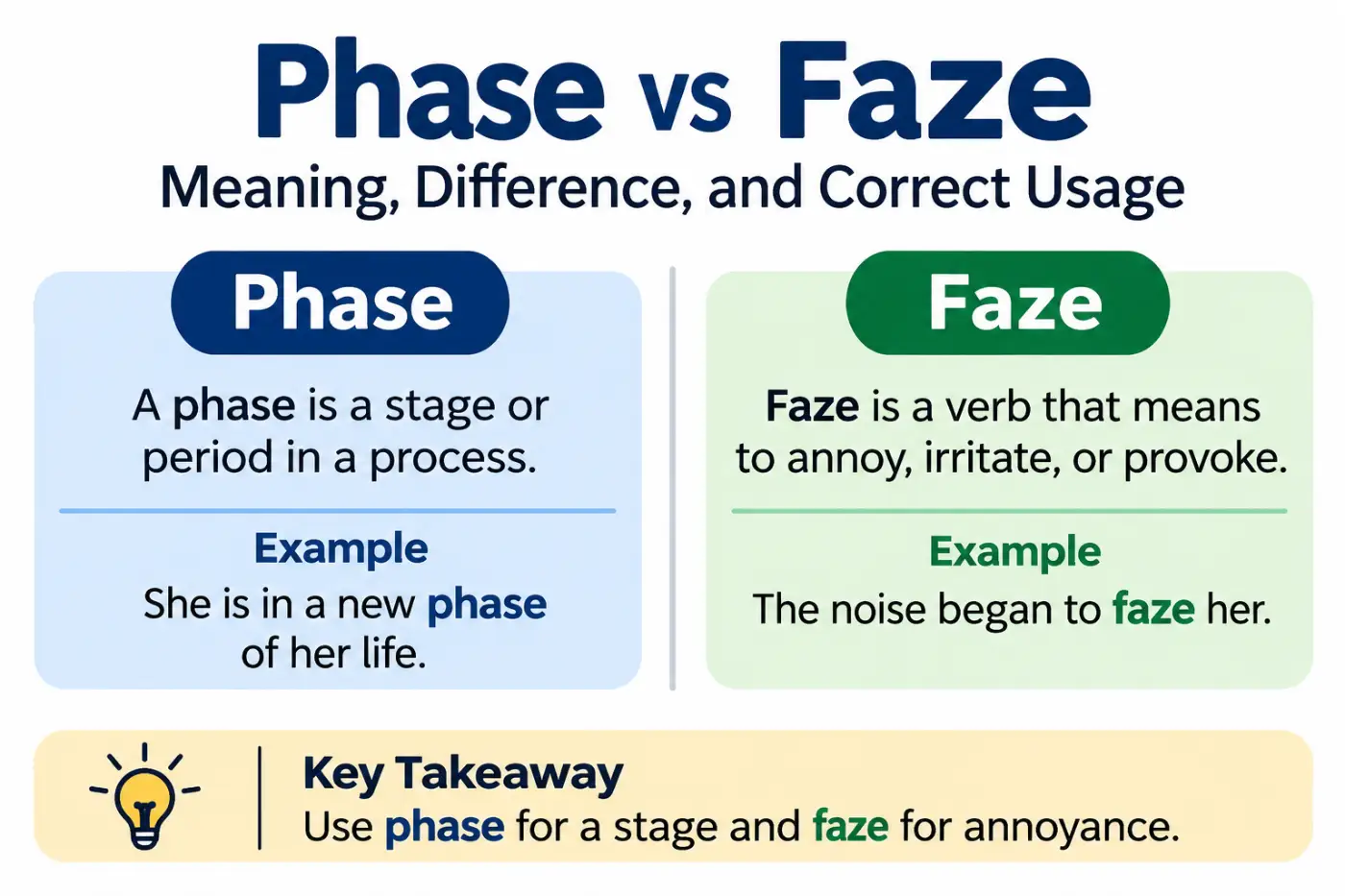
Have you ever paused while writing because you weren’t sure if the right word was phase vs faze? You’re not alone. These two words sound exactly alike, but they have different meanings. Choosing the wrong one can change the meaning of your sentence.
The difference is simple once you understand what each word does. Phase is usually a noun that means a stage or period in a process. It can also work as a verb when something is divided into stages. Faze is a verb that means to disturb, worry, or unsettle someone.
For example, you might say that a child is going through a difficult phase, but a loud noise doesn’t faze an experienced musician. Both spellings are correct, so neither is a general misspelling of the other. The key is matching the word to your intended meaning. This guide explains their definitions, grammar, pronunciation, origins, and everyday uses so you can choose the right one with confidence.
Learn the difference in Borrow vs Barrow Explained With Examples.
Quick Answer
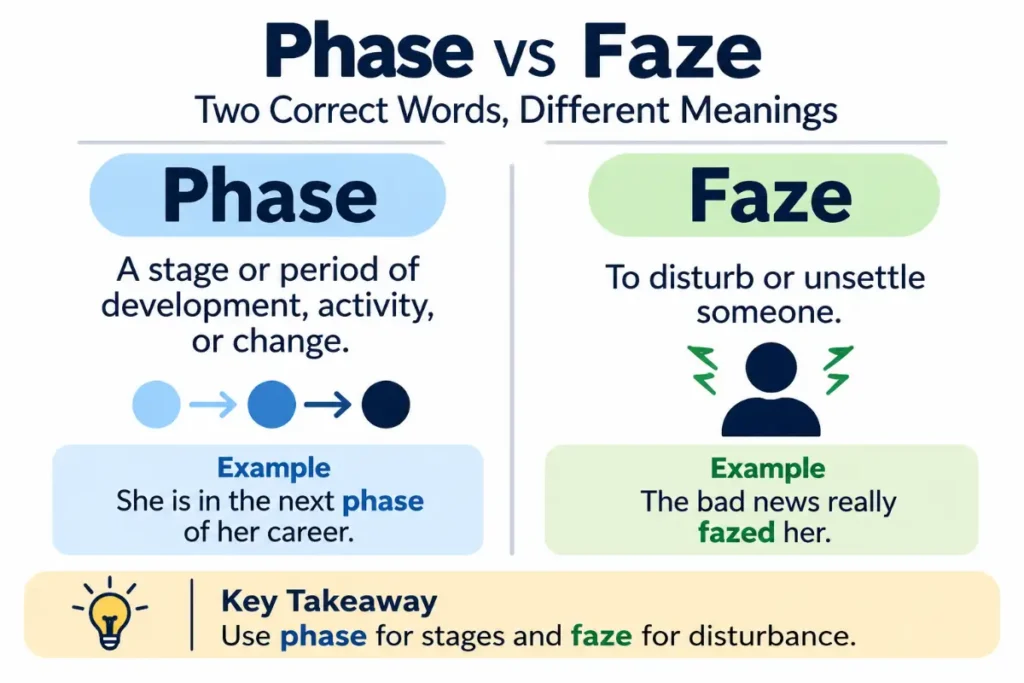
Both words are correct, but they are not interchangeable. Phase means a stage or period of development, activity, or change. Faze means to disturb or unsettle someone. Use phase when discussing stages and faze when describing something that affects a person’s confidence or composure.
Comparison Table
| Feature | Phase | Faze |
|---|---|---|
| Meaning | A stage or period in a process | To disturb or unsettle someone |
| Part of speech | Noun and verb | Verb |
| Pronunciation | /feɪz/ | /feɪz/ |
| Main use | Describing stages, periods, and transitions | Describing emotional reactions |
| Origin | Greek through French and Latin | Probably from English dialect usage |
| Formality | Standard in formal and informal English | Standard in formal and informal English |
| Common contexts | Life stages, projects, science, development | Stress, pressure, challenges, unexpected events |
| Example | The project entered its final phase. | The criticism did not faze her. |
Meaning and Definition
Although these words share the same pronunciation, they perform different jobs in a sentence. Understanding their definitions is the easiest way to use them correctly.
What Does Phase Mean?
Phase is a noun that refers to a distinct stage, period, or part of a larger process. It often describes something that changes or develops over time.
For example, a person may go through different phases of life. A construction project may have several phases, and a scientific process may involve multiple stages.
Here are some common meanings:
- A stage of development: A period in which a person, object, or situation has particular characteristics.
- A part of a process: One section of a larger activity or project.
- A temporary period: A condition or interest that may change over time.
- A scientific stage or condition: A particular state in a physical or chemical process.
- A verb meaning to introduce or arrange in stages: To gradually begin, change, or stop something according to a planned schedule.
Examples include:
- My son is going through a quiet phase.
- The company plans to introduce the new system in phases.
- The moon goes through different phases during its monthly cycle.
- The school has entered the second phase of its renovation.
As a verb, the word appears in expressions such as phase in and phase out.
Phase in means to introduce something gradually.
Example: The company will phase in the new rules over three months.
Phase out means to gradually remove or discontinue something.
Example: The manufacturer plans to phase out the older model.
What Does Faze Mean?
Faze is a verb that means to disturb, unsettle, embarrass, or make someone feel uncomfortable. It usually describes an emotional or mental reaction to a situation.
When something fazes you, it affects your confidence or peace of mind. It might make you nervous, confused, worried, or uncomfortable.
For example:
- The unexpected question did not faze the speaker.
- Loud crowds never faze the experienced performer.
- The criticism seemed to faze him.
- She remained calm even when the plan changed.
The word often appears in negative sentences because people use it to describe someone who stays calm under pressure.
For instance, saying that nothing fazes a person suggests that the person is difficult to upset or intimidate.
However, the word also works in positive statements:
- The sudden delay fazed the passengers.
- His manager’s angry response fazed him.
In both examples, something caused a person to feel unsettled.
Is Faze a Real Word?
Yes. Faze is a legitimate English verb, not a spelling mistake or an informal substitute for phase. It has a distinct meaning related to disturbing or unsettling someone.
Its spelling may look unusual because the letter z appears in the middle. However, that spelling is standard. You should use it whenever you mean that something affects someone’s confidence or composure.
Key Differences Explained
The main difference is meaning. One word describes a stage or period, while the other describes an emotional effect. Their pronunciation is identical, but their spelling and grammar help distinguish them.
1. Difference in Meaning
Phase refers to a stage in a process or period of development. Faze refers to an action that disturbs someone.
Compare these examples:
- The difficult phase lasted several months.
- The difficult situation did not faze her.
The first sentence describes a period of time. The second explains how someone reacted to a situation.
2. Difference in Grammar
Phase can function as both a noun and a verb.
As a noun:
– The first phase of the project is complete.
As a verb:
– We will phase in the changes gradually.
Faze functions as a verb.
– The sudden announcement did not faze the team.
You cannot use faze as a noun to describe a stage of development. Similarly, phase does not normally mean to upset or disturb someone.
3. Difference in Pronunciation
Both words sound the same in standard American English. They have one syllable and rhyme with words such as days, plays, and maze.
Because pronunciation cannot help you distinguish them, you need to focus on the meaning of the sentence.
4. Difference in Spelling
The spelling difference is small but meaningful.
- Phase contains the letters ph.
- Faze begins with f and contains z.
The unusual ph spelling represents an f sound. This is why both words sound identical despite looking different.
5. Difference in Context
Use phase when talking about:
- Stages of life.
- Project development.
- Business plans.
- Scientific processes.
- Temporary interests or behaviors.
- Gradual changes.
Use faze when talking about:
- Emotional reactions.
- Unexpected problems.
- Stressful situations.
- Embarrassment.
- Pressure or criticism.
- A person’s ability to remain calm.
6. Difference in Formality
Both are accepted in standard English. Neither is limited to slang, casual conversation, or informal writing.
Phase appears frequently in professional, scientific, academic, and everyday contexts. Faze is also suitable for professional writing, especially when describing someone’s reaction to pressure or difficulty.
Which Form Is Correct?
Both forms are correct English words. The correct choice depends on the meaning you want to express.
Use phase when you mean a stage, period, or part of a process. Use faze when you mean to disturb or unsettle someone.
The distinction comes from their established meanings and grammatical functions, not from a regional spelling rule. Standard English dictionaries recognize both forms as separate entries.
Consider these examples:
- Correct: The company is entering a new phase of growth.
- Correct: The difficult questions did not faze the candidate.
- Incorrect for the intended meaning: The company is entering a new faze of growth.
- Incorrect for the intended meaning: The difficult questions did not phase the candidate.
The last example needs a little explanation. In casual writing, people sometimes use phase when they mean faze because the words sound alike. However, the standard expression is did not faze the candidate.
Sentence Examples
The following examples show how to use both words in natural American English.
10 Examples Using Phase
- Everyday conversation: My daughter is going through a phase where she wants to read every book she can find.
- Text messages: I think this is just a temporary phase, so give it a little time.
- Workplace communication: We will begin the next phase of the project on Monday.
- Business writing: The company completed the first phase of its expansion plan.
- School: Students learn different skills during each phase of their education.
- Academic writing: The researchers examined each phase of the experiment separately.
- Science: The moon appears to change shape as it moves through its phases.
- Formal writing: The organization will phase out its outdated procedures over the next year.
- Social situations: His interest in collecting old coins was a short phase.
- Online communication: The website redesign is still in its testing phase.
10 Examples Using Faze
- Everyday conversation: Don’t let one bad day faze you.
- Text messages: That comment wouldn’t faze me at all.
- Workplace communication: The unexpected deadline did not faze the project manager.
- Business writing: The experienced team was not fazed by the sudden change in requirements.
- School: The difficult exam did not faze the students who had prepared well.
- Academic writing: The unexpected results did not faze the research team.
- Formal writing: The public criticism failed to faze the official.
- Social situations: She wasn’t fazed by the awkward silence.
- Online communication: Nothing seems to faze that comedian.
- Storytelling: The storm grew stronger, but the captain remained unfazed.
Notice the forms in the last example. Fazed is the past tense and past participle of faze. Unfazed is an adjective that describes someone who remains calm and unaffected.
Common Mistakes and Confused Spellings
Because the two words sound alike, writers often select the wrong spelling without noticing. These mistakes are easy to correct once you connect each word with its meaning.
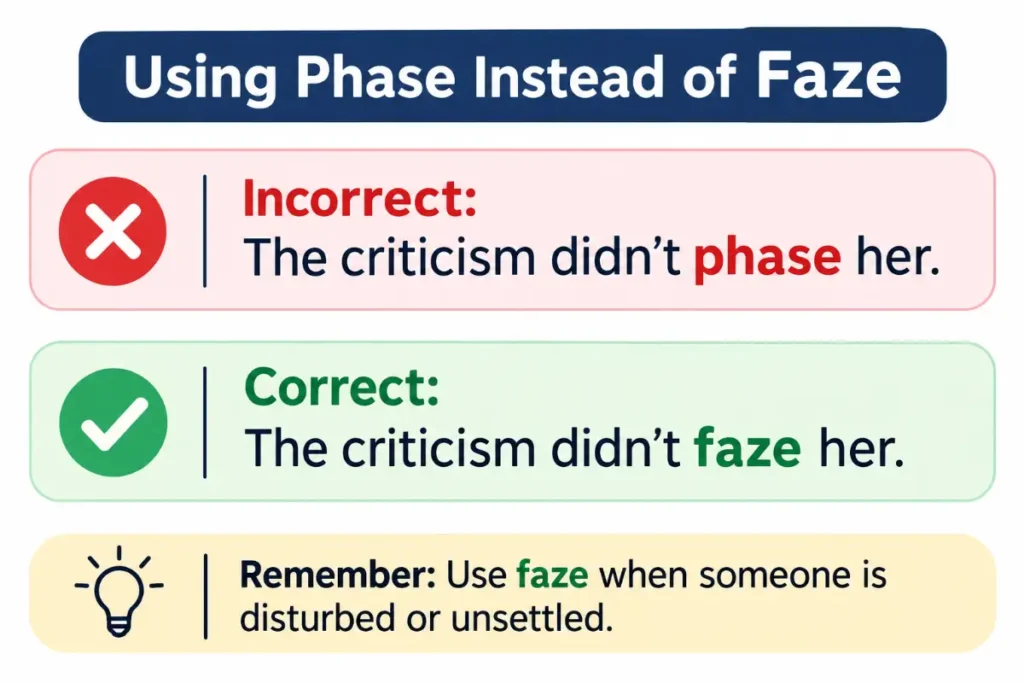
1. Using Phase Instead of Faze
Incorrect: The criticism didn’t phase her.
Correct: The criticism didn’t faze her.
The sentence describes an emotional reaction, so the verb faze is needed. Phase refers to a stage or period, not the act of unsettling someone.
2. Using Faze Instead of Phase
Incorrect: He is going through a difficult faze.
Correct: He is going through a difficult phase.
The sentence describes a period of life or behavior. That meaning requires the noun phase.
3. Confusing Faze With Phased
Incorrect: The announcement didn’t phased him.
Correct: The announcement didn’t faze him.
After did or didn’t, use the base form of the verb. The correct spelling is faze, not phased.
4. Confusing Phase With Phased
Incorrect: The company will phased out the old system.
Correct: The company will phase out the old system.
A modal verb such as will must be followed by the base form of the main verb. The correct expression is will phase out.
5. Using Unfazed Incorrectly
Incorrect: She was unphase by the noise.
Correct: She was unfazed by the noise.
Unfazed is the correct adjective for someone who remains calm or unaffected. It comes from faze, not phase.
For another common grammar confusion, see lessen vs lesson Meaning, Spelling and Usage Explained.
Pronunciation Guide
Both words have exactly the same pronunciation in standard American English.
| Feature | Pronunciation |
|---|---|
| Phase | /feɪz/ |
| Faze | /feɪz/ |
| Syllables | One |
| Stress | Single syllable |
| Rhyming words | Days, plays, maze, praise |
How to Pronounce These Words
Say both words like the word days, but begin with an f sound.
Break the pronunciation into two parts:
- Start with the /f/ sound, as in fun.
- Follow it with the long /eɪ/ sound, as in day.
- Finish with the /z/ sound, as in zoo.
Put the sounds together: /feɪz/.
There is no difference in stress because each word contains only one syllable.
Common Pronunciation Mistakes
Some readers may expect the ph combination to sound different from an ordinary f. However, the letters ph represent the same /f/ sound in this word.
Another mistake is pronouncing the final s in phase as an /s/ sound. It actually sounds like /z/. The same final sound appears in faze.
The most reliable approach is to learn both words as homophones. They sound alike, but their meanings are different.
Etymology and Word Origin
The words have different histories, even though modern English speakers pronounce them alike.
Origin of Phase
Phase entered English through French and Latin from the Greek word phasis, which is related to showing or appearing. The term originally had connections with the appearance of celestial bodies, especially the changing appearance of the moon.
Over time, its meaning expanded. It came to describe stages or distinct conditions in a wider range of processes.
Today, the word appears in science, business, education, psychology, and everyday conversation. Expressions such as the phases of the moon and the final phase of a project show how its meaning developed from a particular appearance or condition to a general stage in a process.
Origin of Faze
Faze has a different background. It is generally traced to an older English dialect form associated with frightening or disconcerting someone.
Its modern meaning focuses on making someone feel disturbed, unsettled, or uncomfortable. The spelling with z is part of the established English form.
Unlike the word phase, its history is not connected to Greek scientific terminology. The two words developed separately and only appear similar because English spelling and pronunciation brought them together in this particular sound pattern.
Why Do They Sound the Same?
English contains many words that share a pronunciation but have different spellings and meanings. These words are called homophones.
In this case, the ph in phase produces an /f/ sound, while the f in faze produces the same sound. Both words also end with the /eɪz/ sound.
Their different origins explain why their spellings do not follow the same pattern.
Regional Usage
There is no major regional spelling difference between these words. American, British, Canadian, and Australian English generally use the same forms and meanings.
American English
In the United States, both spellings are standard.
Americans commonly use phase to describe stages of life, work, development, and scientific processes. Faze appears in expressions such as don’t let it faze you and nothing fazes him.
Examples:
- The project is entering its final phase.
- The unexpected delay didn’t faze the staff.
British English
British English follows the same distinction. Phase refers to a stage or period, while faze means to disturb or unsettle someone.
The spelling does not change between American and British English.
Australian English
Australian English also uses both forms with the same meanings. A person might describe a temporary interest as a phase or say that a difficult situation did not faze them.
There is no special Australian spelling rule that changes either word.
Canadian English
Canadian English follows the same standard usage. Both words are recognized, and the intended meaning determines the spelling.
For Canadian writers, the same memory rule applies: phase is a stage, and faze is an emotional disturbance.
Grammar Rules and Part of Speech
Understanding how each word functions in a sentence will help you avoid mistakes beyond spelling.
How to Use Phase as a Noun
As a noun, phase identifies a stage, period, or part of a larger process.
It can appear as a singular or plural noun.
Examples:
- The first phase begins tomorrow.
- Several phases of the plan have been completed.
- This phase of childhood can be challenging.
The word often follows adjectives such as first, final, early, later, difficult, and temporary.
Common expressions include:
- A new phase.
- An early phase.
- A difficult phase.
- The final phase.
- A transitional phase.
- A testing phase.
How to Use Phase as a Verb
As a verb, phase describes the gradual introduction, removal, or arrangement of something.
It is often followed by in or out.
Examples:
- The school will phase in the new schedule.
- The business phased out its older products.
- The company is phasing in a new training program.
The common verb forms are:
| Form | Example |
|---|---|
| Base form | phase |
| Third person singular | phases |
| Present participle | phasing |
| Past tense | phased |
| Past participle | phased |
How to Use Faze as a Verb
Faze is a transitive verb. This means it generally takes an object, often a person who experiences the disturbance.
Examples:
- The sudden noise fazed the baby.
- The criticism didn’t faze him.
- Nothing fazes her.
- The unexpected result has not fazed the researchers.
The person affected is usually the object of the verb.
Common Grammatical Patterns
Several expressions appear frequently in everyday English.
Don’t faze someone: Describes something that fails to upset a person.
Example: The negative comments don’t faze her.
Be fazed by something: Describes a person who feels disturbed by an event or situation.
Example: He was fazed by the sudden change.
Remain unfazed: Describes someone who stays calm.
Example: The teacher remained unfazed by the interruption.
Go through a phase: Describes a temporary period of behavior, interest, or development.
Example: I’m going through a phase of waking up early.
Phase something in or out: Describes a gradual introduction or removal.
Example: The store will phase out plastic bags.
Punctuation and Sentence Position
Neither word has a special punctuation rule. Both can appear at the beginning, middle, or end of a sentence, depending on their grammatical function.
Examples:
- During this phase, the team will test the new system.
- The team will phase in the changes next month.
- Despite the pressure, the manager was not fazed.
Use ordinary commas and sentence punctuation according to the structure of your sentence.
Real Life Usage Examples
The following examples show how these words work in different settings.
Daily Conversation
People often use phase to describe temporary habits, interests, or changes in life.
- I’m going through a phase where I prefer staying home.
- Don’t worry about his new hobby. It might just be a phase.
Faze is useful when discussing someone’s reaction to an event.
- The loud music didn’t faze the neighbors.
- She looked completely unfazed by the surprise.
Email and Workplace Communication
In professional settings, phase often describes project stages and planned changes.
- We have completed the initial phase of the hiring process.
- The updated policy will be phased in over the next six weeks.
Faze can describe how someone responds to a challenging situation.
- The unexpected client request did not faze the support team.
- The manager remained unfazed during the difficult meeting.
Academic Writing
Academic writing frequently uses phase to describe stages in research, development, and scientific processes.
- The study examined each phase of the learning process.
- The researchers recorded the results during the final phase of testing.
Faze is less common in highly technical academic writing, but it can still appear in discussions of human behavior or emotional responses.
- The unexpected findings did not faze the experienced research team.
- The participants appeared unfazed by the changes in the testing environment.
News and Journalism
Journalists may use phase to describe a stage of a larger event or plan.
- The city has entered a new phase of its redevelopment program.
- Officials announced the next phase of the public transport project.
Faze can describe reactions to pressure, criticism, or unexpected events.
- The mayor was not fazed by questions from reporters.
- The company said the sudden market changes had not fazed its leadership team.
Literature and Storytelling
Writers use phase to show changes in a character’s life or development.
- It was a difficult phase in her childhood, but she eventually found her confidence.
- The village entered a peaceful phase after years of conflict.
Faze can reveal a character’s emotional strength or vulnerability.
- The warning did not faze the brave explorer.
- For the first time, the strange sounds seemed to faze him.
Related and Confused Terms
Several words and expressions have meanings connected to these two forms. Learning their differences can help you express ideas more accurately.
1. Stage
A stage is a particular point or period in a process. It is one of the closest synonyms for phase.
Example: The project has reached its final stage.
2. Period
A period refers to a length of time or a particular part of history, life, or activity.
Example: She went through a difficult period after moving.
A period can describe time broadly, while a phase often suggests a stage within a larger process.
3. Step
A step is an individual action or part of a sequence.
Example: The first step is to complete the application.
A phase may contain several steps, so the two words are related but not identical.
4. Stage of Development
This expression describes a particular point in someone’s or something’s growth.
Example: Learning to read is an important stage of development.
It can replace phase in many discussions about childhood, education, and progress.
5. Unsettle
Unsettle means to make someone feel worried, nervous, or uncomfortable.
Example: The sudden announcement unsettled the employees.
It is a useful alternative to faze when describing an emotional reaction.
6. Disturb
Disturb means to interrupt someone’s peace, comfort, or concentration.
Example: The unexpected noise disturbed the sleeping child.
Faze and disturb can overlap, but disturb has a wider range of meanings.
7. Rattle
Rattle means to make someone nervous, upset, or less confident.
Example: The difficult interview questions rattled the candidate.
It is close to faze in situations involving pressure or unexpected challenges.
8. Unfazed
Unfazed is an adjective that describes someone who remains calm despite a difficult or surprising situation.
Example: She remained unfazed by the negative feedback.
It is a particularly useful related word because it appears frequently in everyday speech and writing.
Expert Editor Insight
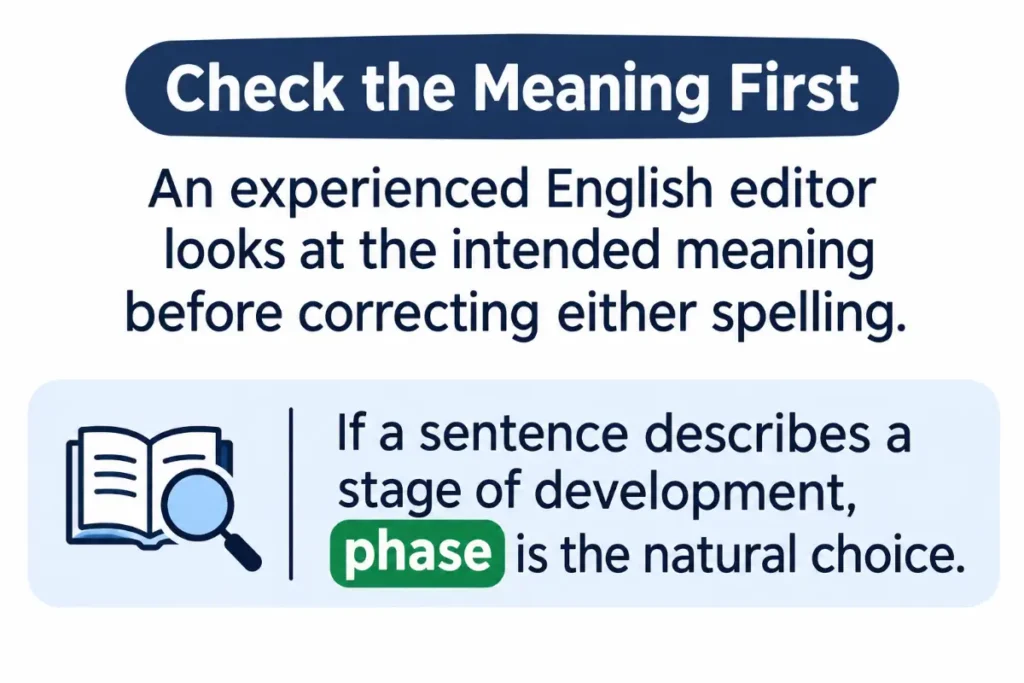
An experienced English editor looks at the intended meaning before correcting either spelling. If a sentence describes a stage of development, phase is the natural choice. If it describes someone’s reaction to pressure or surprise, faze is the correct verb. The confusion happens because both words sound alike, not because their spellings are interchangeable. Grammar tools may suggest a correction based on context, but they can miss subtle meaning differences. A useful editing habit is to replace the word temporarily with stage or disturb. If stage fits, use phase. If disturb fits, use faze.
Still confused? Compare Quieter vs More Quiet Which Form Is Correct.
Conclusion
The difference between phase vs faze comes down to meaning, not pronunciation. Both words sound alike, but they serve different purposes in English. Use phase for a stage, period, or gradual change. Choose faze when something disturbs or unsettles a person.
Remember this simple editing trick: if you can replace the word with stage, write phase. If you can replace it with disturb, write faze. Once you connect each spelling with its meaning, you’ll find it much easier to use both words correctly in everyday conversation, schoolwork, and professional writing.
FAQs
Is Faze a Real Word?
Yes, faze is a real English word. It is a standard verb meaning to disturb, unsettle, or make someone feel uncomfortable. It is not a misspelling of phase. For example, the sentence The sudden criticism did not faze her uses the word correctly because it describes her reaction to an unpleasant situation.
What Does Phase Mean in Simple English?
Phase means a stage or period in a process, activity, or person’s life. For example, a child may go through a difficult phase, or a business may enter a new phase of growth. The word can also function as a verb, as in phase out, which means to gradually stop using something.
Which Is Correct: Phase or Faze?
Both spellings are correct, but they have different meanings. Phase refers to a stage or period, while faze means to disturb or unsettle someone. Use phase in a sentence about development or progress. Choose faze when describing an emotional reaction. The meaning of your sentence determines the correct spelling.
How Do You Pronounce Phase and Faze?
Both words are pronounced /feɪz/. They have one syllable and rhyme with days, plays, and maze. The ph in phase produces an f sound, while faze begins with the letter f. Since their pronunciation is identical, you must use context and meaning to select the correct spelling.
Can Phase Start a Sentence?
Yes, phase can begin a sentence as a noun or part of a longer expression. For example, The final phase of the project begins next week is grammatically correct. It can also start a sentence as a verb, such as Phase out the older system before introducing the replacement.
What Is a Synonym for Faze?
Useful synonyms for faze include unsettle, disturb, rattle, disconcert, and unnerve. The best choice depends on the situation. Unsettle suggests discomfort or worry, while rattle often describes a loss of confidence. Faze is especially useful when explaining that something does or does not affect a person’s composure.
Why Do People Confuse These Two Words?
People confuse them because both words have the same pronunciation. Their spelling differs, but the sounds are identical in standard English. This makes it easy to choose the wrong word while typing quickly. Remembering that phase means a stage and faze means to disturb can prevent most errors.
Is Faze Appropriate in Formal Writing?
Yes, faze is a standard English verb and is suitable for formal writing when its meaning fits the sentence. For example, The unexpected findings did not faze the research team is grammatically correct. In highly technical writing, a more precise term such as unsettle or affect may sometimes communicate the intended meaning more clearly.