
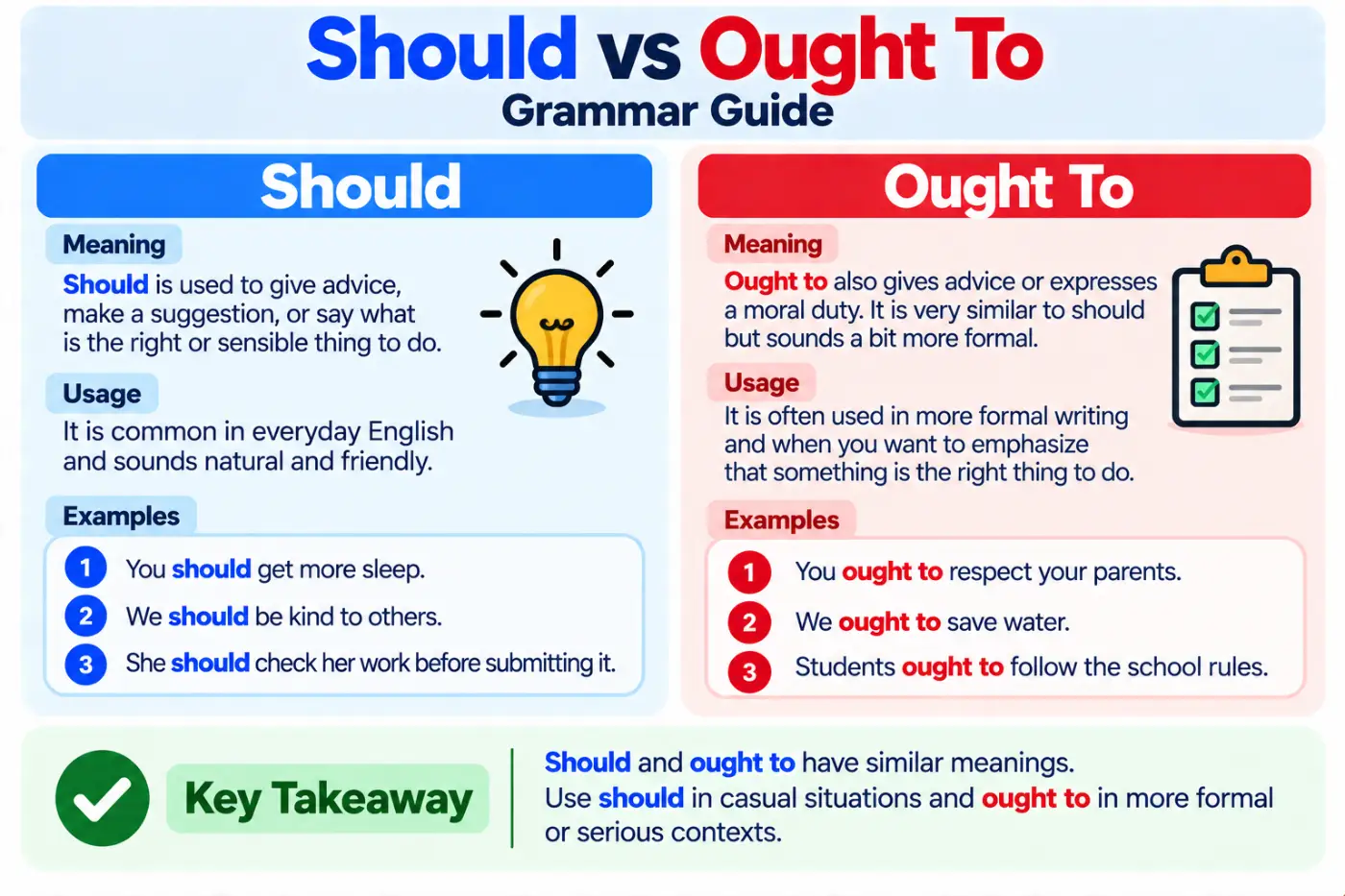
Choosing between should and ought to can be confusing because both expressions often communicate advice, duty, or what someone thinks is the right thing to do. The good news is that neither expression is wrong. Both are correct English forms, and in many sentences, they mean almost the same thing.
The main difference comes down to tone, usage, and grammar. Should is more common in everyday American English. Ought to can sound slightly more formal, traditional, or focused on moral duty. However, the two expressions often overlap, so you can use either one in many situations without changing the basic message.
Understanding should vs ought to helps you make better choices in conversations, emails, school assignments, and professional writing. You’ll also learn why one expression sounds more natural in certain situations, how each one works in a sentence, and which common grammar mistakes to avoid.
You may also want to read alr meaning in Texting and Online Chat.
Quick Answer
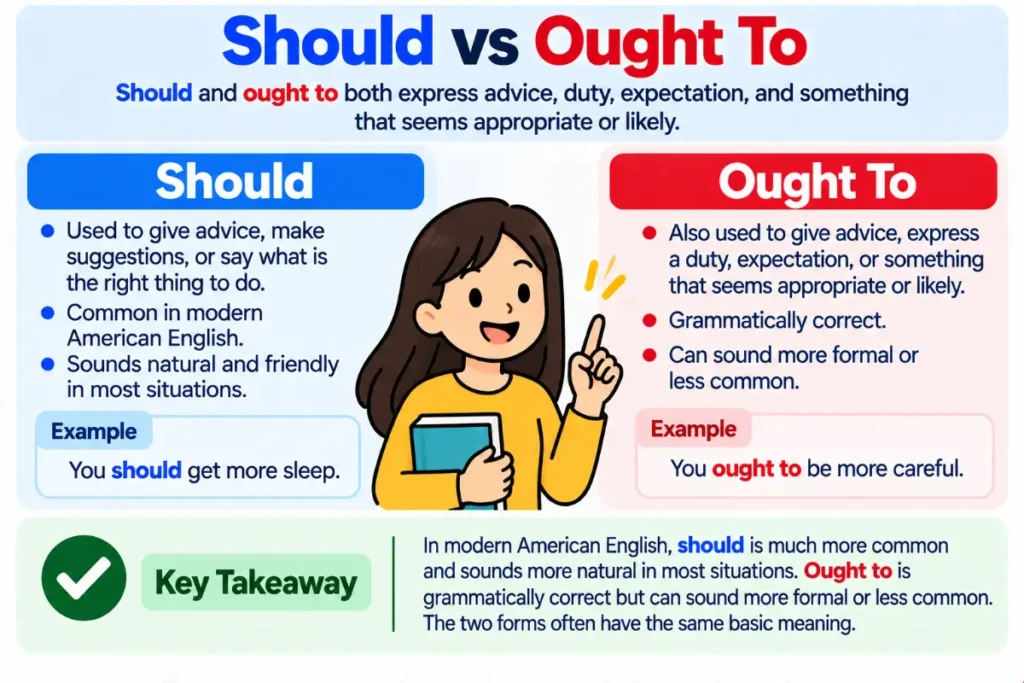
Should and ought to are both correct modal expressions used to give advice, express duty, or describe what is expected. Should is more common and flexible in modern American English, while ought to can sound more formal or emphasize moral responsibility. Both usually take the base form of a verb.
Comparison Table
| Feature | Should | Ought to |
|---|---|---|
| Meaning | Advice, expectation, or recommendation | Advice, duty, or expectation |
| Grammatical form | Modal auxiliary verb | Semi modal expression |
| Verb pattern | Should + base verb | Ought to + base verb |
| Pronunciation | /ʃʊd/ | /ɔːt tuː/ |
| Formality | Neutral and widely used | Slightly more formal or traditional |
| Common usage | Everyday speech and writing | Advice and moral responsibility |
| Negative form | Should not or shouldn’t | Ought not to |
| Question form | Should I go? | Ought I to go? |
| American English | Very common | Less common |
| Main difference | Flexible and conversational | Sometimes emphasizes duty |
Meaning and Definition
To understand these expressions, it helps to look at the meaning of each one separately. Both can express similar ideas, but they have slightly different tones and grammatical patterns.
What Does Should Mean?
Should is a modal auxiliary verb. It expresses advice, recommendations, expectations, duties, and things that are likely or desirable.
You use it when you want to tell someone what you think they need to do without giving a direct command.
For example:
- You should get some rest.
- We should leave before traffic gets worse.
- Students should review their notes before an exam.
- She should apologize for her mistake.
In each sentence, the speaker expresses a recommendation or expectation. The expression does not usually create a strict command. Instead, it suggests a sensible or preferred action.
Should also appears in situations involving probability and expectations.
For example:
- The package should arrive tomorrow.
- The meeting should finish by noon.
- He should know the answer by now.
Here, the speaker expects something to happen. They are not giving advice.
This makes the word especially flexible. It works in casual conversations, professional emails, academic writing, instructions, and many other settings.
What Does Ought To Mean?
Ought to is a semi modal expression that communicates advice, responsibility, duty, or something considered right or proper.
It often suggests that an action is morally correct, sensible, or expected.
For example:
- You ought to tell the truth.
- We ought to help people in need.
- Everyone ought to respect other people’s opinions.
- He ought to apologize for his behavior.
These sentences communicate more than simple suggestions. They can also express a sense of responsibility or what someone believes is the right thing to do.
However, the expression does not always carry a strong moral meaning. It can also describe ordinary expectations.
For example:
- The train ought to arrive soon.
- This plan ought to work.
- She ought to be home by now.
In these examples, it expresses an expectation rather than a moral duty.
The phrase is grammatically different from a regular modal verb because it includes the word to before the main verb. You say “ought to leave,” not “ought leave.”
Are Both Expressions Correct?
Yes. Both are accepted forms of standard English.
Neither one is a misspelling, a grammatical error, or an informal substitute for the other. The choice depends on your intended meaning, preferred tone, and the type of sentence.
In most everyday situations, should is the more natural choice for American speakers. Ought to remains useful, especially when you want to express duty, responsibility, or a thoughtful recommendation.
Key Differences Explained
The two expressions overlap, but several differences can help you choose the right one.
1. Difference in Meaning
Should often expresses general advice, recommendations, expectations, and practical decisions.
Ought to can communicate the same ideas, but it sometimes places more emphasis on responsibility or moral duty.
Compare these sentences:
- You should visit your grandmother.
- You ought to visit your grandmother.
The first sounds like ordinary advice. The second may suggest that visiting her is something you have a responsibility to do.
The difference is subtle. Context and the speaker’s tone can matter more than the expression itself.
2. Difference in Formality
Should is suitable for nearly every type of communication. It works in casual conversations, business emails, reports, and academic writing.
Ought to can sound slightly more formal, old fashioned, or traditional. Some speakers also use it to create a thoughtful or serious tone.
For example:
- You should check the figures again.
- You ought to check the figures again.
Both sentences are correct. The second may sound more deliberate, but it is not automatically more professional.
For modern business writing, should is usually the safer and more natural choice.
3. Difference in Grammar
Should is a modal auxiliary verb. It is followed directly by the base form of another verb.
Correct:
- You should study.
- They should wait.
- She should call.
Incorrect:
- You should to study.
- They should waiting.
- She should calls.
Ought to follows a different pattern. The word to must appear before the main verb.
Correct:
- You ought to study.
- They ought to wait.
- She ought to call.
Incorrect:
- You ought study.
- They ought waiting.
- She ought calls.
Remember that both expressions take the base form of the main verb.
4. Difference in Strength
Neither expression is always stronger than the other. Their strength depends on context, emphasis, and the speaker’s intention.
However, ought to can sometimes sound more serious because it may suggest a moral or social responsibility.
For example:
- You should return the money.
- You ought to return the money.
The first can sound like practical advice. The second may suggest that returning the money is the right thing to do.
Still, this distinction is not fixed. A speaker can use should to express a strong obligation, too.
5. Difference in Everyday Usage
Should is much more common in everyday American English. People use it naturally when discussing plans, offering suggestions, and explaining expectations.
Ought to is less common in ordinary conversation. Some speakers use it regularly, while others prefer should in almost every situation.
Examples:
- You should try this restaurant.
- You ought to try this restaurant.
Both sound natural, but the first is more typical in modern American conversation.
6. Difference in Negative Sentences
The usual negative form of should is should not or shouldn’t.
Examples:
- You should not ignore the warning.
- You shouldn’t drive when you’re tired.
The negative form of ought to is ought not to.
Examples:
- You ought not to ignore the warning.
- We ought not to waste this opportunity.
Ought not to is grammatically correct, but it can sound formal or old fashioned. In everyday American English, shouldn’t is more common.
7. Difference in Questions
Should forms questions by placing it before the subject.
Examples:
- Should I call her?
- Should we leave now?
- Should they attend the meeting?
Ought to can also form questions, but this structure is less common.
Examples:
- Ought I to call her?
- Ought we to leave now?
These questions are grammatically correct, but they may sound stiff or traditional in modern conversation.
Most American speakers would use should in these situations.
Which Form Is Correct?
Both expressions are correct. There is no general grammar rule that makes one wrong and the other right.
The main distinction involves how people use them in real communication. Should is the standard, everyday choice for advice, recommendations, expectations, and mild obligations. Ought to is also standard, but it appears less often and can carry a stronger sense of duty or moral responsibility.
Consider these examples:
- You should respect your parents.
- You ought to respect your parents.
Both sentences are grammatically correct. The second may place more emphasis on a person’s responsibility, but the meaning remains close.
For a natural American English sentence, choose should in most situations. Use ought to when its slightly more formal or duty focused tone suits your message.
Sentence Examples
The following examples show how both expressions work in everyday communication.
10 Natural Examples Using Both Forms
- Everyday conversation: You should drink more water during the day.
- Friendly advice: We ought to invite Sarah to dinner because she helped us last weekend.
- Workplace communication: You should review the report before sending it to the client.
- School: Students ought to complete their assignments before the deadline.
- Academic writing: Governments should invest in education to support long term economic growth.
- Formal writing: Every employee ought to follow the company’s safety guidelines.
- Social situations: You should thank your friend for helping you move.
- Online communication: You should update your profile picture when you get a chance.
- Planning: We ought to book the tickets before prices increase.
- Expectations: The repair work should be finished by Friday.
These examples show that both forms can express advice and expectations. The best choice depends on the tone you want and the meaning you intend to communicate.
Common Grammar Mistakes
Although both expressions are simple, learners sometimes mix their sentence patterns or use the wrong verb form.
Here are five common mistakes to avoid.
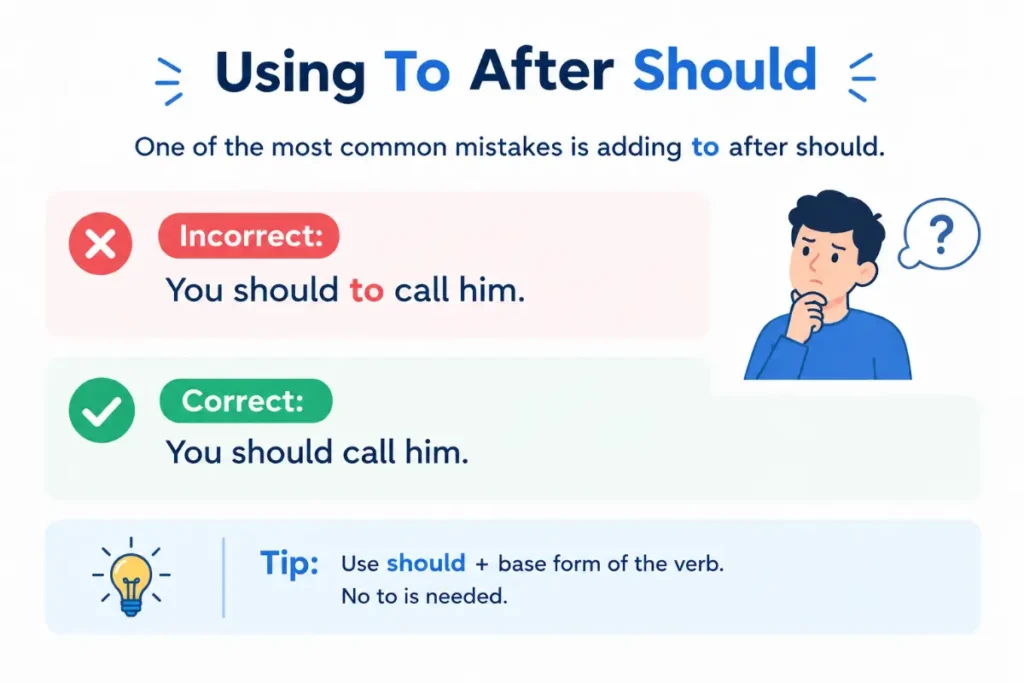
1. Adding To After Should
Incorrect: You should to call your manager.
Correct: You should call your manager.
The modal verb should takes the base form of the main verb directly. It does not need to.
2. Removing To After Ought
Incorrect: You ought visit your doctor.
Correct: You ought to visit your doctor.
The expression requires to before the main verb. Leaving it out creates a grammatical error in standard English.
3. Using the Wrong Verb Form
Incorrect: She should goes home early.
Correct: She should go home early.
Incorrect: He ought to studies harder.
Correct: He ought to study harder.
Both forms take the base form of the main verb. Do not add an ending such as s, ed, or ing.
4. Using the Wrong Negative Structure
Incorrect: You don’t should ignore the instructions.
Correct: You shouldn’t ignore the instructions.
Incorrect: You ought not ignore the instructions.
Preferred: You ought not to ignore the instructions.
The negative form of should uses not after the modal. The standard negative pattern with ought keeps to after not.
5. Treating the Two Forms as Completely Different in Meaning
Incorrect assumption: Should always means advice, while ought to always means a strict moral duty.
Better understanding: Both forms can express advice, expectation, and responsibility. Ought to may place more emphasis on duty in some contexts, but the distinction is not absolute.
Pronunciation Guide
Pronunciation can help you recognize both expressions in spoken English.
How to Pronounce Should
- IPA: /ʃʊd/.
- Syllables: One syllable.
- Easy pronunciation: shood.
- Stress: The single syllable receives the stress.
The opening sound is the same as the sh sound in “shoe.” The vowel is short, similar to the vowel in “book” for many speakers.
The letter l is silent. You do not pronounce it as “shuld” with a clear l sound.
How to Pronounce Ought To
- IPA: /ɔːt tuː/ in a common British style.
- Common American pronunciation: /ɔt tu/.
- Syllables: Usually two spoken parts, though the words may blend in connected speech.
- Easy pronunciation: awt too.
- Stress: The first word often receives the main emphasis.
In fast conversation, the final vowel in to may become weaker, depending on the speaker and sentence rhythm.
For example:
“You ought to listen.”
In natural speech, the words may flow together rather than sound like separate, carefully pronounced units.
Common Pronunciation Mistakes
- Pronouncing the l in should clearly.
- Giving should a long vowel sound.
- Pronouncing ought with an extra syllable.
- Overemphasizing to in a sentence where it is naturally unstressed.
The best way to improve is to listen to natural spoken examples and repeat the full sentence rather than practicing each word in isolation.
You may also want to read Bougie or Boujee Meaning, Usage and Examples 2026.
Etymology and Word Origin
The history of these expressions helps explain why their modern forms look different.
Origin of Should
Should developed from an Old English form related to the verb shall. Its earlier forms expressed ideas connected with obligation, duty, and future action.
Over time, its meaning expanded. Modern English uses it for advice, expectation, probability, and responsibility.
The word no longer functions exactly like its historical relative, but the connection remains visible in English grammar.
Origin of Ought To
Ought comes from Old English āhte, the past form of āgan, meaning to own or possess. Its historical development became connected with ideas of duty, obligation, and what someone is expected to do.
The expression gradually developed into a way of talking about what is right, proper, or advisable.
Modern English treats ought as a semi modal expression. Its structure differs from most ordinary modal verbs because it normally requires to before another verb.
Both expressions have long histories, but their modern uses have become more flexible than their earlier meanings.
Regional Usage
The basic grammar is the same across major English varieties. However, speakers in different regions may prefer one expression over the other.
American English
Should is the more common choice in the United States. It appears naturally in conversations, professional communication, education, and formal documents.
Ought to is also correct American English, but it can sound slightly old fashioned or formal to some speakers.
Examples:
- You should check your email.
- We ought to help our neighbors.
The first is more typical in everyday American speech.
British English
Both forms are standard in British English. Ought to may sound more familiar or natural to some British speakers than it does to many Americans.
However, should remains widely used across the United Kingdom.
Examples:
- You should speak to your teacher.
- You ought to speak to your teacher.
The second may sound a little more traditional, depending on the speaker and setting.
Australian English
Australian English follows the same general grammar rules. Should is widely used in everyday communication, while ought to is less common.
There is no special Australian spelling or grammatical rule that changes the basic distinction.
Canadian English
Canadian English also uses both expressions. Should is the more common everyday option, while ought to can sound more formal or traditional.
The difference is mainly about preference and tone rather than regional grammar.
Grammar Rules and Sentence Structure
Understanding the sentence patterns makes it easier to use both expressions correctly.
Using Should in Positive Sentences
The basic structure is:
Subject + should + base verb + rest of sentence.
Examples:
- I should exercise regularly.
- You should check the address.
- They should arrive soon.
- We should discuss the problem.
The subject does not change the form of should. It remains the same with I, you, he, she, it, we, and they.
You do not say “she shoulds” or “he shoulds.”
Using Ought To in Positive Sentences
The basic structure is:
Subject + ought to + base verb + rest of sentence.
Examples:
- I ought to exercise regularly.
- You ought to check the address.
- They ought to arrive soon.
- We ought to discuss the problem.
Unlike should, this expression includes to before the main verb.
Using Should in Negative Sentences
The basic structure is:
Subject + should not + base verb.
You can also use the contraction shouldn’t.
Examples:
- You should not skip breakfast.
- He shouldn’t drive so fast.
- We shouldn’t waste our time.
Shouldn’t is especially common in casual conversations and everyday writing.
Using Ought To in Negative Sentences
The standard negative structure is:
Subject + ought not to + base verb.
Examples:
- You ought not to lie.
- We ought not to ignore the problem.
- They ought not to break their promise.
This form is less common than shouldn’t, but it is grammatically correct.
Forming Questions With Should
Place should before the subject.
Structure:
Should + subject + base verb?
Examples:
- Should I apply for the job?
- Should we wait here?
- Should she call the office?
These questions are natural in both formal and informal English.
Forming Questions With Ought To
Questions with ought to usually place ought before the subject.
Structure:
Ought + subject + to + base verb?
Examples:
- Ought I to apologize?
- Ought we to leave now?
- Ought they to pay for the damage?
This pattern is correct but less common in modern American conversation. Many speakers would use should instead.
Talking About Past Actions
Both expressions can describe a past action using a perfect infinitive.
The structure is:
- Should have + past participle.
- Ought to have + past participle.
Examples:
- You should have called me earlier.
- You ought to have called me earlier.
- She should have checked the document.
- She ought to have checked the document.
These structures often express regret, criticism, or an action that was expected but did not happen.
For example, “You should have called me” suggests that calling was the better choice, but it did not happen.
Talking About Future Expectations
Both expressions can describe something expected to happen.
Examples:
- The bus should arrive in ten minutes.
- The bus ought to arrive in ten minutes.
- The results should be available tomorrow.
- The results ought to be available tomorrow.
Should is usually the more natural choice in everyday American English.
Real Life Usage Examples
Seeing both expressions in different settings can help you understand how they sound in real communication.
Daily Conversation
People use should to give quick advice, suggest plans, or discuss expectations.
- You should bring a jacket because it might get cold tonight.
- We ought to visit your uncle while we’re in town.
The first sounds like a practical suggestion. The second may suggest that visiting the uncle is something the speaker feels they should do.
Email and Workplace Communication
In professional settings, should is often the clearest choice for recommendations and instructions.
- You should review the attached report before our meeting.
- Managers ought to provide clear feedback to their teams.
The first gives a direct recommendation. The second expresses a broader responsibility.
For most workplace emails, should sounds natural and professional. Ought to can work in policy discussions or formal statements about responsibility, but it may sound unnecessarily traditional in a short message.
Academic Writing
Both forms can appear in academic writing, depending on the purpose.
- Schools should provide students with access to reliable learning resources.
- Researchers ought to consider the limits of their data before drawing conclusions.
The first makes a general recommendation. The second emphasizes a responsibility in research practice.
Academic writers should choose the expression that best reflects their argument. They should also avoid using either form when a more precise statement is needed.
News and Journalism
News writing often uses should to report recommendations, expected outcomes, and public advice.
- Officials said residents should avoid the affected roads.
- Public agencies ought to provide clear information during emergencies.
The first sounds like a practical instruction. The second expresses an expectation about public responsibility.
Journalists usually favor clear, direct language. As a result, should is often the more natural option.
Literature and Storytelling
Writers may choose either expression to create a particular voice or mood.
- “You should go before the storm arrives,” she whispered.
- He knew he ought to tell the truth, but fear kept him silent.
The first sounds like direct advice. The second adds a sense of personal duty and inner conflict.
In fiction, the choice can also help shape a character’s personality. A character who regularly says ought to may sound more traditional, serious, or formal than one who uses should.
Related and Confused Terms
Several English expressions have meanings close to these two forms. However, they are not always interchangeable.
1. Must
Must expresses a strong obligation, requirement, or logical conclusion.
Example: You must wear a seat belt.
Compared with should, must usually communicates a stronger requirement. It is common in rules, instructions, and situations involving firm necessity.
2. Have To
Have to expresses a requirement or necessity, often because of an external rule or situation.
Example: I have to submit this form by Friday.
It often describes an obligation created by a job, law, schedule, or practical condition.
3. Had Better
Had better gives strong advice and often suggests a possible negative result if someone ignores it.
Example: You had better leave now, or you’ll miss the train.
It can sound more urgent than should.
4. Could
Could expresses possibility, ability, or a suggestion.
Example: You could ask your teacher for help.
This sounds more optional than should. It presents an idea rather than clearly recommending one action.
5. May
May can express permission or possibility.
Example: You may leave after completing the assignment.
It does not usually express advice in the same way as should.
6. Shall
Shall can express future action, offers, or formal instructions, depending on the context and variety of English.
Example: Shall we begin the meeting?
It has a different grammatical role from should, even though the two words share a historical connection.
7. Need To
Need to expresses necessity.
Example: You need to finish the report today.
It often sounds more direct than should because it highlights a requirement rather than a recommendation.
8. Be Supposed To
Be supposed to describes an expectation, arrangement, rule, or responsibility.
Example: Employees are supposed to arrive before 9 a.m.
This phrase often refers to an established expectation. Should can express a similar idea, but the two structures do not always carry the same meaning.
Expert Editor Insight
An experienced English editor usually chooses should for everyday advice, recommendations, and professional communication because it sounds clear and natural to a broad American audience. Ought to is not incorrect, but its tone can feel more traditional or serious. The most common editing problems involve adding to after should or leaving it out after ought. Grammar tools may flag these errors, but they cannot always judge the subtle difference in tone. A useful editing tip is to read the full sentence aloud. If the phrase sounds stiff, replacing ought to with should may make the writing smoother without changing the main idea.
Key Takeaways
- Should and ought to can both express advice, duty, expectation, and appropriateness.
- Should is much more common in everyday American English.
- Ought to is grammatically correct but can sound more formal, traditional, or deliberate.
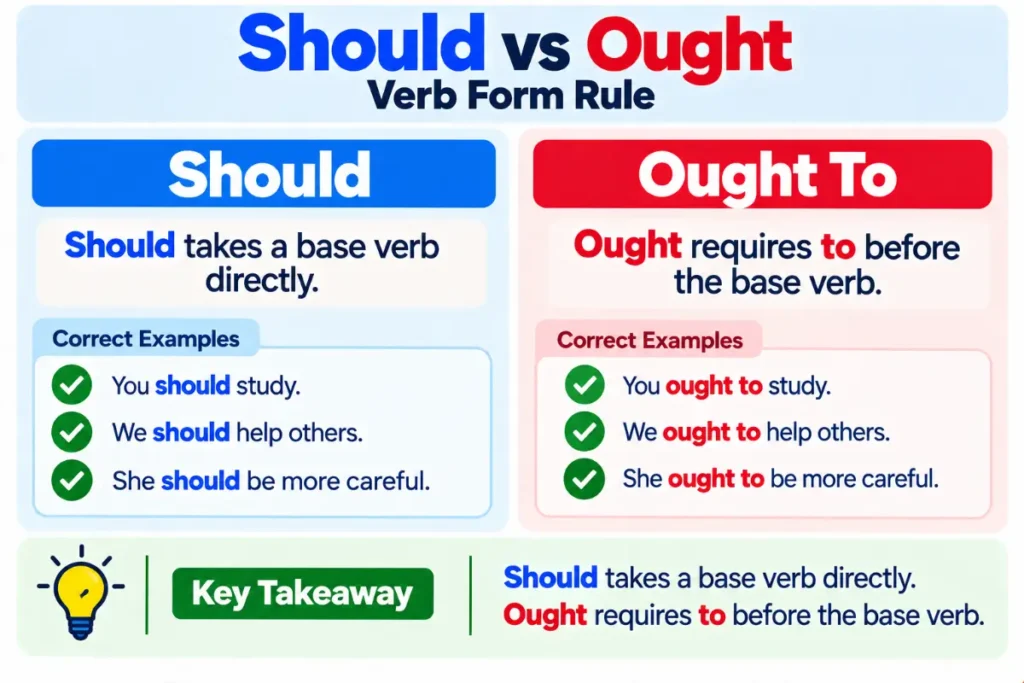
- Should takes a base verb directly.
- Ought requires to before the base verb.
- Say you should go.
- Say you ought to go.
- For questions, should is usually the natural choice.
- For negative sentences, use should not or shouldn’t.
- The usual negative form of ought to is ought not to.
- For past situations, use should have or ought to have.
- Should works well in both casual and professional writing.
- Ought to can emphasize duty or what seems proper.
- Neither form normally expresses an obligation as strong as must.
- When you want natural everyday American English, should is usually the easiest choice.
Learn the difference in Shiny Vs Shiney Meaning Usage And Examples2026.
Conclusion
The main lesson about should vs ought to is that both expressions are correct, but they do not always sound the same. Should is the more common choice in modern American English and works naturally in everyday speech, professional writing, and academic communication. Ought to can add a slightly more formal or traditional tone and sometimes emphasizes moral responsibility.
To avoid grammar mistakes, remember the basic patterns: should plus the base verb, and ought to plus the base verb. When you’re unsure, choose should for clear, natural communication. Read your sentence aloud to check that its tone fits the situation.
FAQs
Is Should or Ought To More Correct?
Both are grammatically correct. Neither expression is better in every situation. Should is more common in modern American English and works well for everyday advice, recommendations, and expectations. Ought to is also standard English, but it may sound more formal or traditional. Choose the form that best matches your intended tone and sentence structure.
Is Ought To a Real English Expression?
Yes. Ought to is a recognized English expression used to communicate advice, duty, responsibility, and expectation. It is not a mistake or an informal substitute for should. Although it appears less often in everyday American speech, it remains a valid part of standard English and can be useful when discussing responsibility or what is considered right.
What Is the Main Difference Between Should and Ought To?
The main difference involves tone and usage. Should is more flexible and common in everyday English. Ought to can sound slightly more formal or emphasize moral responsibility. However, both expressions can communicate advice, expectations, and obligations. In many sentences, replacing one with the other does not significantly change the basic meaning.
Can I Use Ought To in Formal Writing?
Yes. Ought to is grammatically acceptable in formal writing, especially when discussing duty, responsibility, or what someone is expected to do. However, should is often more natural in modern professional and academic writing. If your goal is clear, direct communication, should is usually the better choice. Use the other expression when its tone serves a clear purpose.
Is Should To Grammatically Correct?
No. In standard English, should must be followed directly by the base form of the main verb. You should say “You should leave,” not “You should to leave.” The word to is part of the structure with ought, as in “You ought to leave.” Remembering this difference prevents one of the most common mistakes.
Can Ought To Be Used in Questions?
Yes. You can form questions by placing ought before the subject, as in “Ought I to call her?” or “Ought we to wait?” These structures are grammatically correct, but they sound less natural to many modern American speakers. In ordinary conversation, “Should I call her?” is usually the more familiar choice.
Which Expression Sounds Stronger?
Ought to can sometimes sound stronger because it may suggest moral duty or personal responsibility. However, this is not a fixed rule. A sentence using should can also express a serious obligation, depending on the situation and the speaker’s tone. Look at the full context rather than assuming one expression always carries more force.
Can Should and Ought To Be Used Interchangeably?
They can replace each other in many sentences, especially when giving advice or describing expectations. For example, “You should apologize” and “You ought to apologize” communicate similar ideas. However, the second may sound more traditional or duty focused. In questions and negative sentences, their grammatical patterns differ, so you must use the correct structure.