
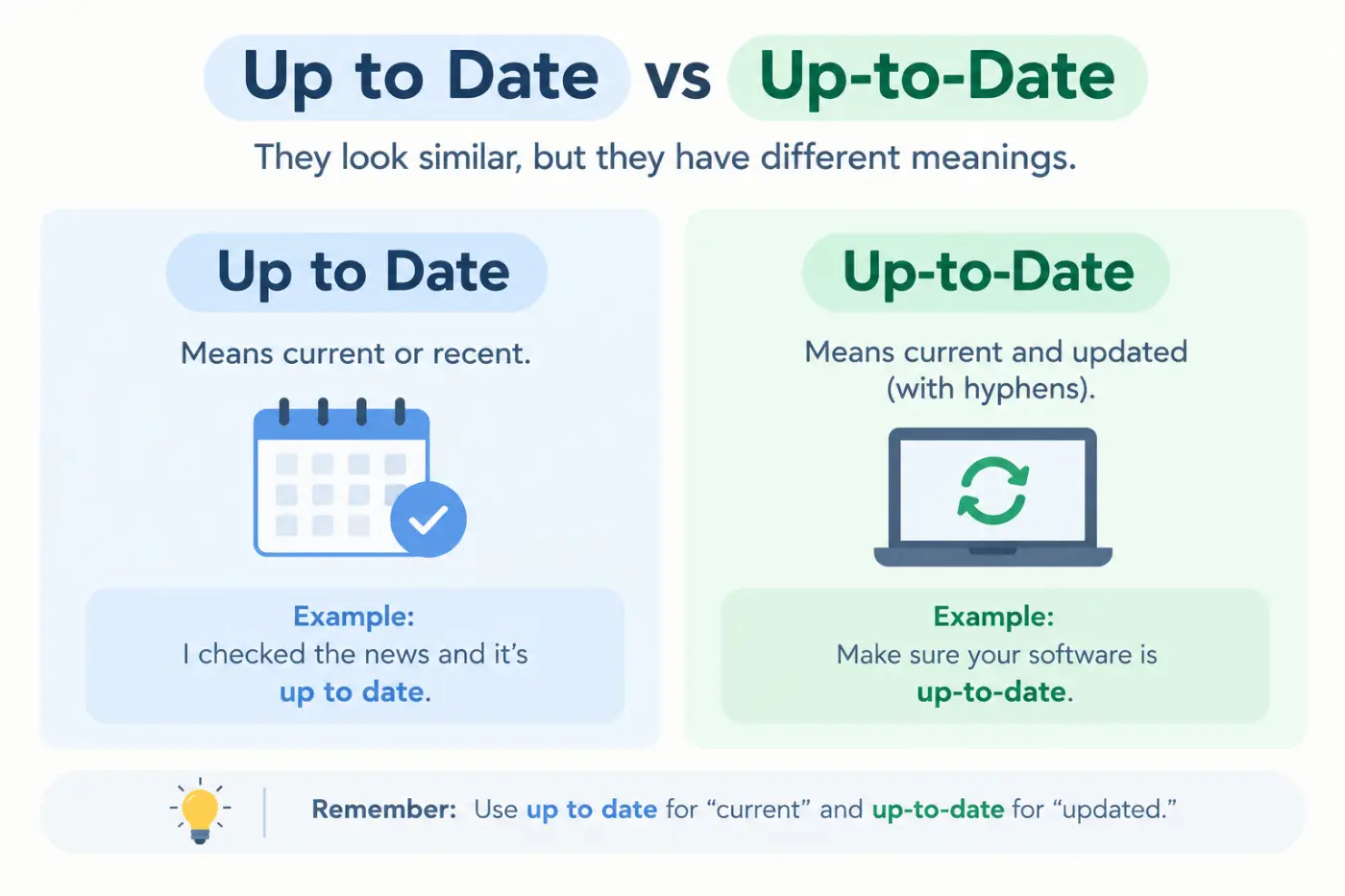
A missing hyphen can change how a phrase works in a sentence, and this often causes confusion with “up to date” and “up-to-date.” The good news is that both forms are correct. The difference depends on the phrase’s grammatical job: use the open form after a linking verb, and usually use the hyphenated form before a noun as a compound adjective.
For example, you can say, “The information is up to date,” but write, “We need up-to-date information.” The meaning stays nearly the same, yet the punctuation changes because the phrase has a different role in each sentence. This is a common pattern in English compound modifiers, where words work together to describe a noun.
Once you understand the rule, the choice becomes simple. This guide explains the meaning of both forms, shows how to use them in different sentence structures, and covers common mistakes, pronunciation, regional usage, and practical examples. You will also learn how to check the phrase quickly when editing emails, reports, articles, and other writing.
A related grammar guide is Busyness Vs Business Which Word Should You Use in 2026?.
Quick Answer
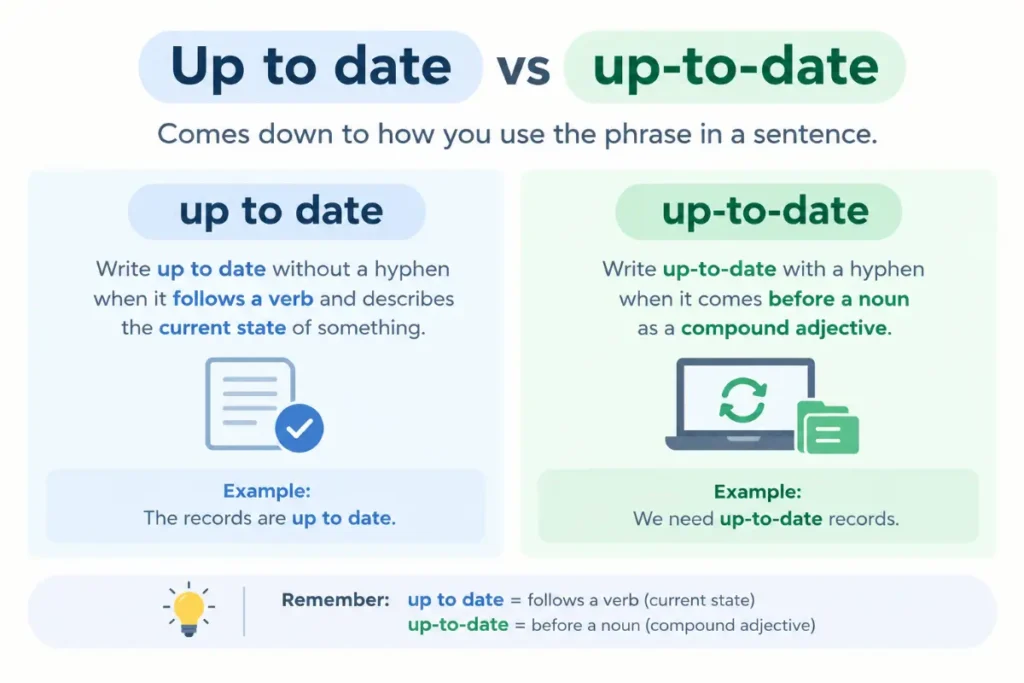
Both forms are correct. Write “up to date” without hyphens when it follows a linking verb, as in “The records are up to date.” Use “up-to-date” with hyphens when it comes before a noun and describes it, as in “up-to-date records.”
Comparison Table
| Feature | Up to date | Up-to-date |
|---|---|---|
| Correctness | Correct | Correct |
| Main grammatical role | Adjective phrase used after a linking verb | Compound adjective before a noun |
| Meaning | Current, recent, or containing the latest information | Current, recent, or containing the latest information |
| Hyphenation | No hyphens | Two hyphens |
| Common position | After verbs such as is, are, seem, and remain | Before a noun |
| Formality | Standard in formal and informal writing | Standard in formal and informal writing |
| Common contexts | Status updates, records, knowledge, information | Reports, data, software, records, research |
| Example | The database is up to date. | We use an up-to-date database. |
Meaning and Definition
What Does Up to Date Mean?
“Up to date” means current, modern, or containing the latest available information. It describes something that reflects recent changes rather than outdated facts, records, or details.
For example, if your contact list includes everyone’s latest phone number, it is up to date. If a website reflects the latest prices and product details, its information is up to date. The phrase can also describe a person’s knowledge of a subject, such as someone who stays up to date with new technology.
The open form commonly appears after a linking verb. These verbs connect the subject to a description rather than showing a direct action.
Examples include:
- The employee records are up to date.
- Her medical file is up to date.
- The website seems up to date.
- We need to keep our knowledge up to date.
- The schedule remains up to date.
In these sentences, the phrase describes the subject’s condition or status. It does not directly sit in front of a noun as a compound modifier.
What Does Up-to-Date Mean?
“Up-to-date” has the same basic meaning: current, recent, or reflecting the latest information. The difference is its position and grammatical function. It is usually hyphenated when it comes directly before a noun and works as a compound adjective.
A compound adjective is made of two or more words that work together to describe a noun. The hyphens show readers that the words belong together as one descriptive unit.
Examples include:
- We need an up-to-date contact list.
- The company published an up-to-date safety guide.
- She uses up-to-date research in her report.
- The school purchased up-to-date computer equipment.
- The article includes up-to-date information about the new rules.
In each example, the phrase appears immediately before the noun it describes. The hyphens make the relationship between the words clear.
Are Both Forms Adjectives?
Yes. Both forms describe a state of being current, but their sentence positions differ. The open form is often called a predicative adjective phrase because it follows a linking verb and describes the subject. The hyphenated form is a compound adjective used attributively, meaning it appears before the noun it modifies.
Compare these examples:
- The software is up to date.
- The company uses up-to-date software.
The first describes the software after the linking verb “is.” The second places the description before the noun “software.” The meaning is closely related, but the grammatical structure changes the punctuation.
Does the Phrase Have More Than One Meaning?
Its main meaning is consistent across both forms. It refers to something current, recent, or brought in line with the latest information or standards. The exact sense depends on what the phrase describes.
For example, an up-to-date phone may have current software, while an up-to-date employee record may contain the latest personal details. A person who is up to date on industry news knows about recent developments. In all these cases, the central idea is that the information or condition is not outdated.
Key Differences Explained
The main difference is not meaning. It is how the phrase functions in a sentence. English often uses hyphens to connect words that act together as one description before a noun. When the same description follows a linking verb, those hyphens are generally unnecessary.
1. Hyphenation
The open form has no hyphens: “up to date.” The compound form has two hyphens: “up-to-date.”
Compare:
- The employee handbook is up to date.
- The company released an up-to-date employee handbook.
The phrase means the same thing in both sentences. Its position determines the usual spelling.
2. Position in a Sentence
The open form commonly appears after a linking verb, such as “be,” “seem,” “remain,” or “stay.” The hyphenated form commonly appears directly before the noun it describes.
Examples:
- Her training is up to date.
- She completed an up-to-date training course.
- The figures remain up to date.
- The report contains up-to-date figures.
This is a useful pattern, but it is not a rule that applies mechanically to every possible sentence. The most important point is to identify the phrase’s role.
3. Meaning
Both forms communicate the idea of being current. Neither one means more current than the other, and the hyphen does not change the basic definition.
For example, “The records are up to date” and “The up-to-date records are ready” describe records containing current information. The difference lies in sentence structure, not in the degree of freshness.
4. Grammar
The open phrase is commonly used as a subject complement after a linking verb. A subject complement describes the subject.
In “The website is up to date,” the phrase describes the website. In “The website has an up-to-date design,” the hyphenated phrase describes the noun “design.”
This distinction helps explain why both forms are standard rather than treating one as an error.
5. Formality
Both forms are suitable for formal and informal writing. You can use either in business emails, school assignments, news articles, reports, and everyday messages.
The choice is grammatical, not a matter of choosing a more formal spelling. Adding a hyphen does not make a sentence more professional. Using the correct form simply makes the writing easier to read.
6. Pronunciation
The two forms are pronounced the same way. The hyphen is a written punctuation mark, so it does not create a different spoken form.
You do not need to pause between the words in the hyphenated version. Say the phrase naturally as one connected expression.
7. Regional Usage
American, British, Canadian, and Australian English generally follow the same distinction. There may be differences between individual style guides, publishers, and dictionaries in how they treat some compound modifiers, but the basic pattern remains widely understood.
For most general writing, use the open form after a linking verb and the hyphenated form before a noun.
8. Standard Versus Nonstandard Usage
Neither spelling is inherently incorrect. A sentence can be wrong because the writer uses the wrong form for its grammatical position, not because one version is always wrong.
For example, “The files are up-to-date” is generally written without hyphens in standard edited prose. “The files are up to date” is the usual form. By contrast, “up-to-date files” is the standard compound adjective pattern before a noun.
Which Form Is Correct?
Both are correct, but they are not interchangeable in every sentence. The usual rule is based on where the phrase appears and what it describes.
Use “up to date” when it follows a linking verb and describes the subject. Use “up-to-date” when it comes before a noun as a compound adjective.
| Sentence | Preferred form | Reason |
|---|---|---|
| The website is up to date. | Up to date | Follows the linking verb “is.” |
| We need an up-to-date website. | Up-to-date | Describes the noun “website.” |
| Her training remains up to date. | Up to date | Follows the linking verb “remains.” |
| He completed an up-to-date training course. | Up-to-date | Describes the noun “course.” |
| The information seems up to date. | Up to date | Follows the linking verb “seems.” |
Why Does English Use the Hyphen?
A hyphen can connect two or more words that work together as a single modifier. In a phrase such as “up-to-date information,” the words combine to describe the noun “information.” The punctuation helps readers understand that the complete phrase acts as one unit.
Without the hyphens, readers may still understand the meaning, but the compound structure is less clearly marked. Edited English therefore commonly uses the hyphenated form before the noun.
Does the Rule Apply After Every Verb?
No. The open form is common after linking verbs, but you should also consider the full sentence. For example, “Keep your records up to date” uses the open form after the verb “keep.” The phrase describes the condition in which the records should be maintained.
Similarly, “Bring the information up to date” uses the open form after “bring.” The phrase describes the result of the action. These examples show why it is better to understand the phrase’s grammatical role instead of relying only on a simple before or after test.
Sentence Examples
The following examples show how to use both forms in everyday and professional writing. Notice how the hyphenated version usually comes before a noun, while the open version often follows a verb.
Ten Natural Examples
- Everyday conversation: My phone is up to date, so I don’t need to install another update.
- Text message: Is your address still up to date?
- Workplace communication: Please make sure the customer records are up to date before Friday.
- School: The teacher shared an up-to-date list of recommended books.
- Academic writing: The paper uses up-to-date research to support its main argument.
- Formal writing: All financial statements must be kept up to date.
- Social situations: I try to stay up to date with local events and community news.
- Online communication: The website provides up-to-date details about product availability.
- Technology: The computer’s security software is up to date.
- News and reporting: The newspaper published an up-to-date account of the investigation.
Five Examples of the Open Form
These examples show the phrase without hyphens in different grammatical settings.
- The employee directory is up to date.
- Her knowledge of the subject is still up to date.
- We need to keep our contact details up to date.
- The figures appear to be up to date.
- The company brought its safety procedures up to date last year.
Five Examples of the Hyphenated Form
These examples show the compound adjective before a noun.
- The clinic uses an up-to-date patient database.
- I found an up-to-date guide to filing taxes.
- The team reviewed the up-to-date project schedule.
- Students need access to up-to-date learning materials.
- The website includes an up-to-date list of available services.
Comparing Both Forms in Similar Sentences
Sometimes you can express almost the same idea in two different sentence structures.
- The product information is up to date.
- The website displays up-to-date product information.
- The employee records are up to date.
- The manager checked the up-to-date employee records.
- The safety guidelines are up to date.
- The company issued up-to-date safety guidelines.
These pairs are useful because they show how the phrase changes its written form as the sentence changes. You do not need to change the meaning or choose a different vocabulary word. You only need to adjust the hyphenation to fit the grammatical structure.
Common Mistakes and Misspellings
The most common problem is using the hyphenated form in every sentence or removing the hyphens when the phrase directly modifies a noun. Here are five mistakes to watch for.
1. Adding Hyphens After a Linking Verb
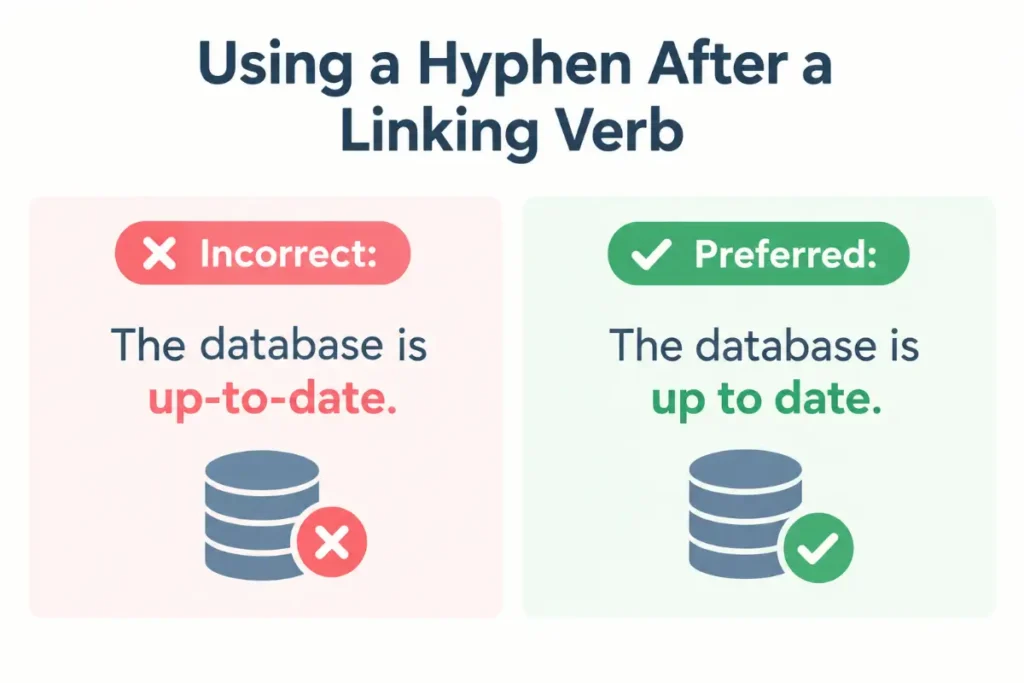
Incorrect: The database is up-to-date.
Preferred: The database is up to date.
The phrase follows the linking verb “is” and describes the database. In this position, the open form is the usual choice in standard edited English.
2. Leaving Out Hyphens Before a Noun
Incorrect: We need an up to date employee list.
Preferred: We need an up-to-date employee list.
The phrase comes directly before “employee list” and works as one compound modifier. The hyphens connect the words and make the structure easier to follow.
3. Using Only One Hyphen
Incorrect: The company released an up-to date report.
Correct: The company released an up-to-date report.
The compound modifier contains three words joined into one descriptive unit. If you use the hyphenated form, place a hyphen between “up” and “to” and another between “to” and “date.”
4. Confusing the Phrase With Update
Incorrect: Please keep the customer records update.
Correct: Please keep the customer records up to date.
“Update” is a different word. It can be a noun, as in “I received an update,” or a verb, as in “Please update the records.” The phrase “up to date” describes the condition of being current.
5. Hyphenating Every Compound Expression
Incorrect: The report is well-written and up-to-date.
Preferred: The report is well written and up to date.
This example includes two separate compound expressions. The usual form of “up to date” after the linking verb “is” is open. Hyphenation rules vary across compounds, so do not assume that every multiword description needs hyphens in every position.
A Quick Editing Check
Before you finish a sentence, look at the words immediately around the phrase.
- If the phrase comes before a noun and describes it, use the hyphenated form.
- If it follows a linking verb and describes the subject, use the open form.
- If it follows an action verb such as “keep” or “bring,” check how it functions in the sentence. The open form is generally appropriate.
- If a house style guide gives a specific instruction, follow it consistently throughout the document.
This short check can prevent most hyphenation errors.
Pronunciation Guide
How Do You Pronounce the Phrase?
Both spellings have the same pronunciation. In American English, “up to date” is commonly pronounced /ˌʌp tə ˈdeɪt/. The phrase has three spoken parts: “up,” “to,” and “date.”
A simple guide is:
- Up: rhymes with “cup.”
- To: often sounds like “tuh” in natural connected speech.
- Date: rhymes with “late.”
The main stress usually falls on “date.” The hyphen in the written form does not change the sound.
Common Pronunciation Mistakes
Some speakers give every word equal stress or pronounce “to” too strongly in ordinary conversation. Natural speech often reduces this small word, making the phrase sound smooth and connected.
Another possible mistake is confusing “date” with “data.” They are different words with different vowel sounds in American English. In this expression, “date” rhymes with “late.”
Learn the difference in The Ballot Or The Bullet Meaning And Why It Still Matters in 2026.
Etymology and Word Origin
Where Does Up to Date Come From?
The phrase combines three familiar English words: “up,” “to,” and “date.” Its modern meaning developed around the idea of reaching or matching the present point in time. Something that is current has been brought forward to the latest relevant date or state of information.
The word “date” entered English through French, with roots in Latin “datum,” meaning something given. Over time, it came to refer to a particular day or point in time. “Up” and “to” are much older English words with long histories in the language.
The exact development of the full expression is less useful for everyday grammar than its modern function. Today, it describes information, knowledge, records, equipment, or conditions that reflect the latest available state.
Why Is the Hyphen Used?
The hyphen does not change the phrase’s history or basic meaning. It shows that the words are working together as a compound adjective before a noun.
English uses this kind of punctuation in many expressions. For example, “a well-known author” uses a hyphen before the noun, while “the author is well known” usually does not. The same general pattern helps explain the difference here.
Regional Usage
American English
In American English, both forms are standard. Writers generally use the open form after a linking verb and the hyphenated form before a noun.
Examples:
- The software is up to date.
- The company installed an up-to-date security system.
This distinction is common in school writing, business documents, news articles, and online content. American style guides may differ in their treatment of some compound expressions, but this pattern is a reliable general rule.
British English
British English follows the same broad convention. A British writer would normally write “The records are up to date” and “up-to-date records.” There is no major spelling difference between the two varieties for this expression.
Individual publishers may have house rules about compound modifiers, so professional writers should follow the style guide used by their publication. For ordinary writing, the standard distinction is clear.
Australian English
Australian English also uses both forms. The open version commonly follows a linking verb, while the hyphenated version commonly appears before a noun. There is no widely recognized regional spelling change that alters this basic distinction.
Canadian English
Canadian English generally follows the same usage. Writers can use “up to date” after a linking verb and “up-to-date” before a noun. The choice is based on grammar rather than a special Canadian spelling rule.
Does Region Affect the Hyphen?
Not in any major way. Differences are more likely to come from a publication’s editing policy than from national English conventions. If you are writing for an American audience, the standard open and hyphenated forms described here are appropriate.
Grammar Rules and Part of Speech
The expression works as an adjective phrase or compound adjective. It describes the condition of something that reflects current information, recent developments, or the latest available state.
1. Use the Open Form After Linking Verbs
Linking verbs connect a subject to information that describes it. Common examples include “be,” “seem,” “remain,” and “stay.”
Examples:
- The employee handbook is up to date.
- The figures seem up to date.
- Our records remain up to date.
- Her knowledge stays up to date.
The phrase describes the subject in each sentence. No hyphens are generally needed.
2. Use the Hyphenated Form Before a Noun
When the expression comes directly before a noun, it commonly works as a compound adjective.
Examples:
- an up-to-date calendar
- an up-to-date price list
- up-to-date medical records
- an up-to-date software system
The hyphens connect the three words so the reader understands them as one modifier.
3. Use the Open Form After Certain Action Verbs
The open form also appears after verbs that describe keeping or bringing something current.
Examples:
- Please keep your profile up to date.
- The office brought the records up to date.
- We need to get the website up to date.
- She works hard to stay up to date.
In these sentences, the phrase describes the resulting condition. It does not directly modify a noun placed immediately after it.
4. Use It With Prepositions
The phrase can appear in longer expressions with prepositions. For example, “up to date with” and “up to date on” are both used to describe staying informed about a subject.
Examples:
- I am up to date with the latest company news.
- She is up to date on the new safety rules.
- Are you up to date with your training?
- He keeps his team up to date on project changes.
The choice between “with” and “on” often depends on the wording and context. Both can be natural when the sentence is clear.
5. Do Not Confuse It With a Verb
The phrase is not a substitute for the verb “update.” Use “update” when describing the action of adding new information or making something current.
Compare:
- Please update the contact list.
- Please keep the contact list up to date.
- We published an up-to-date contact list.
The first sentence asks someone to perform an action. The second describes the condition you want to maintain. The third uses a compound adjective to describe the list.
6. Punctuation in Questions and Statements
The hyphenation rule stays the same in questions, statements, and commands.
Examples:
- Is your account up to date?
- Do you have an up-to-date account?
- Please bring the records up to date.
- Where can I find an up-to-date schedule?
A question mark does not affect the hyphen. Choose the form based on its grammatical role.
Real Life Usage Examples
The expression appears in many areas of daily life. It often describes information, records, knowledge, technology, or rules that reflect the latest available details.
Daily Conversation
In casual conversation, people often use the open form when talking about something’s current condition.
- “My calendar is up to date, so I know which days I’m free.”
- “Are you up to date on the latest changes to the schedule?”
These sentences sound natural because the phrase follows a linking verb or appears in a common expression about staying informed.
Email and Workplace Communication
In professional messages, the phrase can describe records that need attention or documents that contain current details.
- “Please make sure your employee profile is up to date before the review.”
- “I’ve attached the up-to-date project schedule for everyone to review.”
The first sentence describes the profile’s condition. The second uses the compound adjective before “project schedule.”
Academic Writing
Students and researchers use the expression to describe current research, recent evidence, and reliable information.
- “The literature review includes up-to-date studies on childhood development.”
- “The references are up to date and reflect recent work in the field.”
The hyphenated form works before “studies,” while the open form follows the linking verb “are.”
News and Journalism
News organizations need current information, so this expression often appears in reporting and public updates.
- “The news website provides up-to-date information about the storm.”
- “The evacuation instructions are up to date, according to local officials.”
The first example describes the information provided by the website. The second reports the current status of the instructions.
Literature and Storytelling
In stories, the phrase can describe a character’s knowledge, a record, or the state of a place or object.
- “Before leaving town, Lena made sure the family address book was up to date.”
- “He opened an up-to-date map and searched for the nearest road out of the valley.”
Both examples use the expression naturally. The sentence structure determines the punctuation.
Related and Confused Terms
These eight expressions are closely connected to the idea of current information. Some are useful alternatives, while others have different grammatical roles.
1. Current
“Current” means happening now or belonging to the present time. It is a direct alternative in many sentences.
Example: “Please check the current prices before placing your order.”
You could also say, “Please check the up-to-date prices.” The two expressions are close in meaning, though “current” is shorter.
2. Updated
“Updated” means changed to include newer information or details. It often describes something that has recently been revised.
Example: “I downloaded the updated employee handbook.”
The distinction is small but useful. Something can be updated through a recent action, while something that is up to date describes its current condition.
3. Latest
“Latest” refers to the most recent item, version, or development in a series.
Example: “The website has the latest product information.”
It does not always mean that every detail is complete or accurate. It simply identifies something as the most recent available version or information.
4. Recent
“Recent” means that something happened or appeared not long ago.
Example: “The report includes recent sales figures.”
Recent information may be up to date, but the terms are not identical. A recent report could still be missing a later change.
5. Outdated
“Outdated” means old, no longer current, or no longer suitable for present needs.
Example: “The company replaced its outdated training materials.”
This is a useful opposite of the central expression. An old document is not always outdated, but information that no longer reflects current facts usually is.
6. Current Information
“Current information” means details that reflect the present situation. It is a clear alternative in formal writing.
Example: “Employees should use current information when preparing their reports.”
This expression can replace “up-to-date information” without changing the basic meaning.
7. Keep Up With
“Keep up with” means to remain informed about changes or developments.
Example: “She reads industry news to keep up with new regulations.”
This expression describes the action of staying informed. It does not simply describe the condition of a document or record.
8. Update
“Update” can be a verb or a noun. As a verb, it means to make something more current. As a noun, it means new information about a person, situation, or project.
Examples: “Please update the website” and “I received an update from the manager.”
Use this word when describing the act of making changes. Use the adjective phrase when describing the result.
Expert Editor Insight
An experienced editor checks the phrase’s position before changing its punctuation. The most reliable general pattern is to write it open after a linking verb and hyphenated before a noun. Confusion often happens because the meaning stays the same, so writers assume the spelling should stay the same too. Grammar tools may suggest a correction based on sentence structure, but they can miss context. A useful editing habit is to find the noun being described. If the phrase sits directly before that noun as one modifier, the hyphens usually belong there.
Key Takeaways
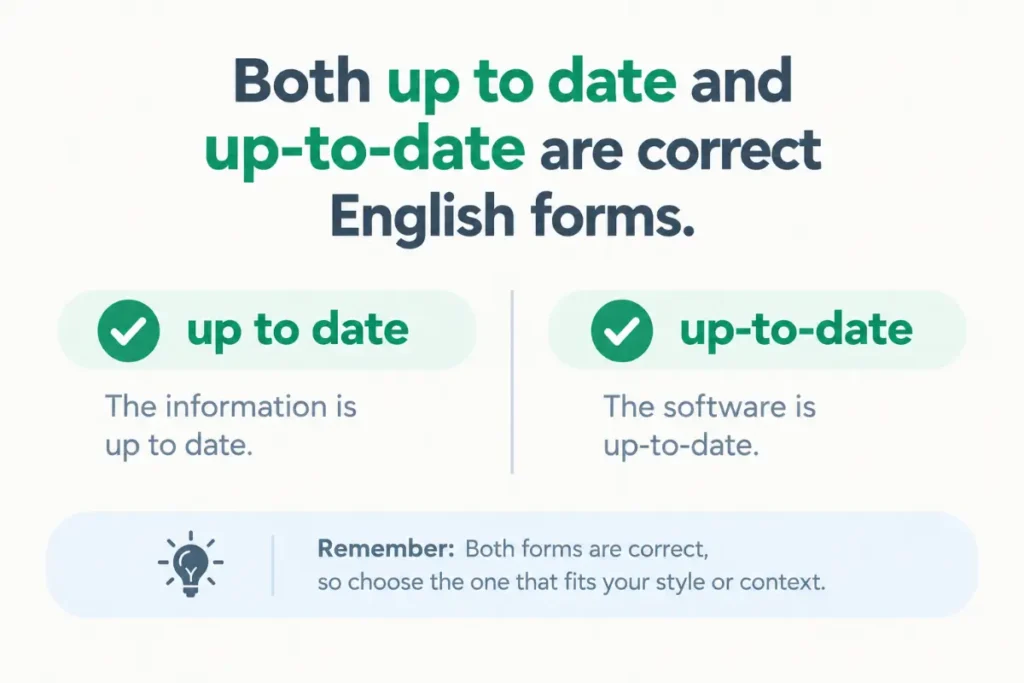
- Both up to date and up-to-date are correct English forms.
- Use up to date after linking verbs such as is, remain, and stay.
- Use up-to-date before a noun when the phrase works as a compound adjective.
- The hyphen helps readers recognize that the words work together as one modifier.
- American and British English generally follow the same pattern.
- Up to date describes a current state, while updated describes a change.
- Always check the phrase’s grammatical role instead of assuming one spelling works in every sentence.
Many readers also check Skull or Scull Which Spelling Is Correct..
Conclusion
The difference between “up to date vs up-to-date” comes down to grammar, not meaning. Both forms describe something current, but the open version usually follows a linking verb, while the hyphenated version usually comes before a noun as a compound adjective. Write “The records are up to date” and “up-to-date records.”
A simple editing tip is to check the noun being described before adding punctuation. If the phrase directly modifies that noun, use the hyphens. If it describes the subject after a linking verb, leave them out. This small check will keep your writing clear and consistent.
FAQs
Is Up to Date One Word or Three Words?
The open form contains three separate words: “up to date.” The hyphenated form also contains three words, but hyphens connect them when they work together as a compound adjective before a noun. It is not normally written as one unhyphenated word. Choose the form based on its position and function in the sentence.
Should I Write Up-to-Date Information or Up to Date Information?
Write “up-to-date information” because the phrase comes directly before the noun “information” and describes it as one compound modifier. The hyphens connect the words and make the relationship clear. If you move the phrase after a linking verb, write “The information is up to date.”
Is It Correct to Say the Information Is Up-to-Date?
The usual form in standard edited writing is “The information is up to date,” without hyphens. Here, the phrase follows the linking verb “is” and describes the subject. Save the hyphenated form for a position before a noun, as in “up-to-date information.”
Can Up to Date Start a Sentence?
Yes. You can begin a sentence with the phrase when the structure calls for it. For example, “Up to date, the records show no errors” is possible, though “So far, the records show no errors” may sound more natural. The hyphenated form can also begin a sentence when it directly describes a noun.
Is Up-to-Date Appropriate in Formal Writing?
Yes. The hyphenated form is appropriate in formal writing when it appears before a noun, as in “up-to-date research.” The open form is also suitable for formal writing after a linking verb, as in “The research is up to date.” Neither form is more professional by itself. Correct placement is what matters.
What Is Another Word for Up to Date?
Useful alternatives include “current,” “updated,” “latest,” and “modern,” depending on the meaning. “Current” is often the closest substitute when describing information or records. “Updated” emphasizes that something has been revised, while “latest” points to the most recent version. Choose an alternative that preserves the exact meaning of your sentence.
Why Do People Confuse the Two Forms?
People often confuse the spellings because both forms have the same meaning and pronunciation. The difference appears in writing, where hyphens help show how the phrase functions. Writers may also apply the hyphenated form everywhere after learning that compound adjectives often take hyphens. Checking the phrase’s position usually solves the problem.
Is Up to Date the Opposite of Outdated?
In many situations, yes. Something that is up to date reflects current information or conditions, while something outdated no longer reflects the latest facts or needs. However, the exact opposite depends on context. A current schedule may be up to date, while an old schedule may be outdated if important changes have occurred.