
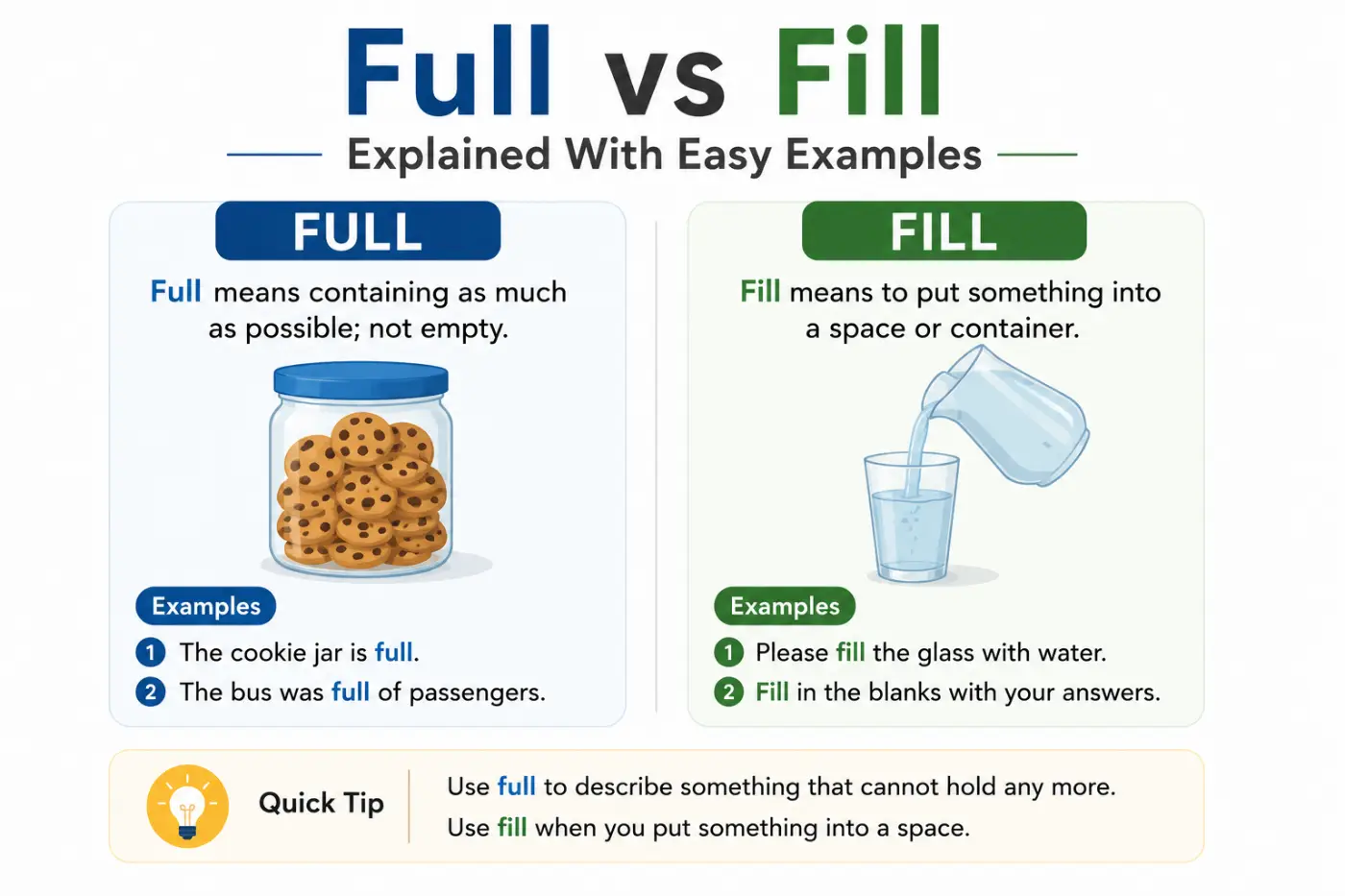
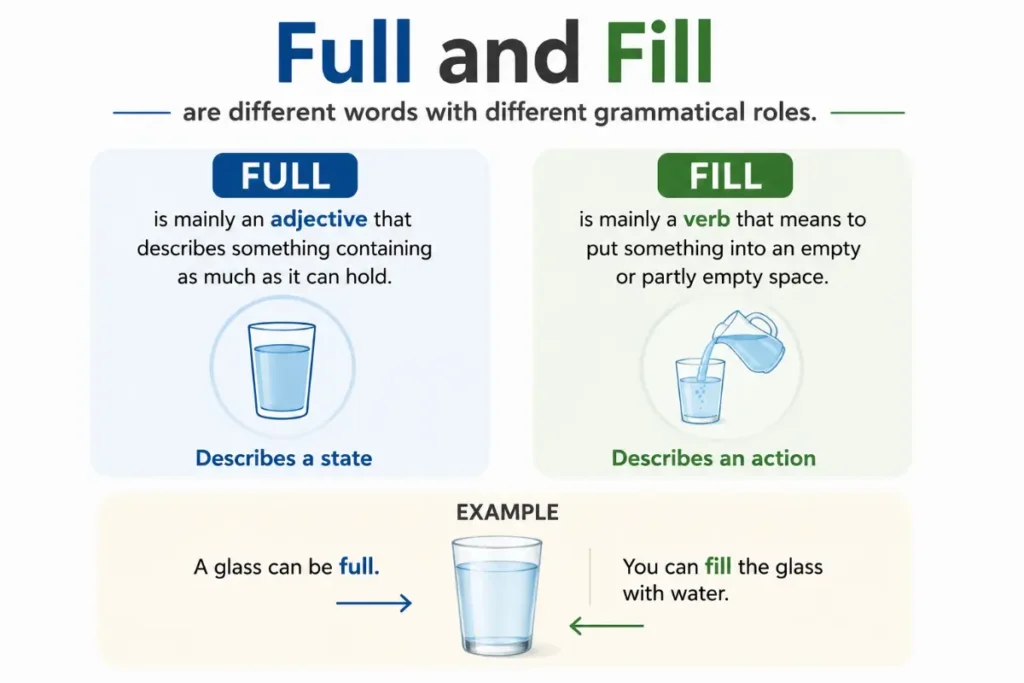
Do you write that a glass is full or that you need to fill a glass? The difference between Full vs Fill is simple once you understand how each word works. Both are correct English words, but they have different meanings and grammatical roles. Full is usually an adjective that describes something containing as much as it can hold or having no space left. Fill is mainly a verb that means to put something into an empty space or make something complete.
The confusion often comes from their similar sounds and close connection in meaning. You fill a glass with water, and the glass becomes full. One word describes the condition, while the other describes the action that creates it. This small difference matters in everyday conversation, school assignments, emails, and professional writing.
You will learn how to use both words correctly, recognize common mistakes, understand their pronunciation, and choose the right form in different sentences. The examples will also show how these words work in phrases such as full of, fill up, fill in, and fill out.
Many readers also check girlie or girly Which Spelling Should You Use.
Quick Answer
Full is an adjective that describes something complete, filled to capacity, or containing a large amount. Fill is a verb that means to put something into a space, make something full, or complete a form or position. Use full to describe a state and fill to describe an action.
Comparison Table
| Feature | Full | Fill |
|---|---|---|
| Main meaning | Complete or containing as much as possible | Put something into a space or make it complete |
| Part of speech | Mainly adjective | Mainly verb; also noun |
| Pronunciation | /fʊl/ | /fɪl/ |
| Main grammatical role | Describes a noun or subject | Expresses an action |
| Common phrases | Full of, full capacity, full time | Fill up, fill in, fill out |
| Example | The bottle is full. | Please fill the bottle. |
| Everyday use | Describing amount or condition | Describing an action or task |
| Formality | Standard in all types of writing | Standard in all types of writing |
| Common context | Containers, schedules, feelings, completeness | Forms, containers, jobs, spaces, gaps |
Meaning and Definition
What Does Full Mean?
Full is mainly an adjective. It describes something that has reached its capacity, contains a lot of something, or has all the parts needed to be complete. The exact meaning depends on the noun or situation being described.
For example, a full glass contains as much liquid as it can hold without spilling. A full parking lot has no available spaces. A full schedule has many planned activities, and a full report contains all the necessary details.
The word also describes feelings, experiences, and amounts. You might say that you are full after eating a large meal, that a room is full of people, or that a person has a full understanding of a topic.
Common expressions include:
- Full of water.
- Full of people.
- Full capacity.
- Full name.
- Full attention.
- Full time.
- Full refund.
- Full responsibility.
In each expression, the word describes a condition, amount, or level of completeness. It does not usually describe the action of putting something somewhere.
For example:
- The basket is full of apples.
- My calendar is full this week.
- She gave the project her full attention.
- The restaurant was full by seven o’clock.
In these sentences, the word describes the condition of a basket, calendar, person, or restaurant.
What Does Fill Mean?
Fill is mainly a verb. It means to put something into an empty space, container, or area until it reaches a desired level. It can also mean to complete a document, take an available position, or make something complete.
For example, you fill a glass with water, fill a box with books, or fill a room with furniture. You can also fill out a job application, fill in a missing word, or fill a vacant position at work.
Common expressions include:
- Fill a bottle.
- Fill a container.
- Fill a gap.
- Fill in a form.
- Fill out an application.
- Fill a position.
- Fill a room.
- Fill up a tank.
The verb often describes a change. Something starts empty or incomplete, and an action makes it full or complete.
For example:
- Please fill the bucket with clean water.
- I need to fill out this application.
- The company plans to fill the vacant position.
- The children filled the room with laughter.
In these examples, the subject performs an action that changes a space, document, position, or situation.
Can Fill Also Be a Noun?
Yes. Although fill is most often used as a verb, it can also function as a noun in certain expressions. A fill may refer to material used to fill a space, or to the act or amount of filling something.
For example, a pillow may contain a soft fill made from synthetic fibers. In construction, fill can refer to material used to raise or level an area of land.
These noun uses are less common in everyday conversation than the verb. Most people encounter the word in expressions such as fill a glass, fill in a form, and fill up a tank.
Can Full Be a Verb?
In standard modern English, full is not normally used as a verb in everyday writing. You should not write full the bottle when you mean put water into the bottle. The correct verb is fill.
However, full can appear as a noun in some specialized expressions, and the word has historical or uncommon uses beyond its main adjective role. For ordinary communication, remember that full describes a condition while fill expresses an action.
Key Differences Explained
1. Meaning
The clearest difference is that full describes a state, while fill describes an action.
Consider these sentences:
- The glass is full.
- Please fill the glass.
The first sentence describes the glass after it contains liquid. The second tells someone to put liquid into it. The words are related, but they do not perform the same job.
You can remember the difference by thinking about a simple sequence. First, someone fills the glass. After that, the glass may be full.
2. Part of Speech
Full is mainly an adjective. It describes nouns and can appear before a noun or after a linking verb.
Examples:
- A full container.
- The container is full.
- We booked a full day of activities.
Fill is mainly a verb. It describes an action and can appear in different tenses.
Examples:
- Fill the container.
- She fills the container every morning.
- They filled the container yesterday.
This grammatical difference is one of the strongest clues when choosing between the words. If you need to describe something, full may fit. If you need to describe an action, fill is usually the right choice.
3. Spelling
The words differ by one vowel. Full contains the letter u, while fill contains the letter i.
Although the spelling difference is small, it changes the pronunciation and meaning. Full has the vowel sound heard in book, while fill has the short i sound heard in sit.
Do not choose the spelling based only on how quickly you say the word. Read the whole sentence and decide if you need an adjective or a verb.
4. Pronunciation
Full is pronounced /fʊl/. Fill is pronounced /fɪl/. Both words have one syllable and begin and end with the same consonant sounds, so the vowel is the main difference.
The sound in full is like the vowel in put. The sound in fill is like the vowel in sit. These sounds are different even though they may be difficult to hear for some English learners.
5. Sentence Structure
Full commonly appears before a noun or after a linking verb such as is, are, was, and seems.
Examples:
- The full bottle is on the table.
- The bottle is full.
- The room seems full.
Fill commonly takes an object because the action affects something.
Examples:
- Fill the bottle.
- She filled the room.
- They are filling the boxes.
The sentence structure can help you identify the correct word before you even think about its meaning.
6. Formality
Both words are standard and appropriate in formal and informal English. You can use full in a business report, academic paper, casual conversation, or text message. The same applies to fill.
For example, a formal report might say, The facility is operating at full capacity. A workplace instruction might say, Please fill in the missing information before submitting the document.
Neither word is more formal than the other. The choice depends on the message.
7. Context
Full appears in many contexts involving amount, completeness, capacity, and availability. You might describe a full schedule, full payment, full name, or full container.
Fill appears in contexts involving actions and completion. You might fill a schedule, fill a container, fill a vacancy, or fill out a document.
Some expressions overlap in meaning but use different grammatical forms. For example, a room can be full of guests, while guests can fill the room.
8. Regional Usage
There is no major spelling difference between American and British English for these words. Full and fill are standard in the United States, the United Kingdom, Canada, and Australia.
The pronunciation may vary slightly between accents, but the basic meanings and grammatical roles remain the same.
Which Form Is Correct?
Both forms are correct, but you must choose according to the meaning and grammar of your sentence. Full is the adjective used to describe something complete or at capacity. Fill is the verb used to describe putting something into a space or making something complete.
Here are some correct examples:
- The water bottle is full.
- Please fill the water bottle before leaving.
- The hall was full of students.
- Volunteers helped fill the hall with chairs.
- I need to fill out this form.
- The application is full of useful information.
The correct word is not determined by which one sounds more natural on its own. It depends on the role it plays in the sentence.
A useful test is to ask yourself if you are describing something or doing something. If you are describing a condition, use full. If you are describing an action, use fill.
Sentence Examples
Ten Natural Examples Using Full
- Everyday conversation: My glass is full, so I do not need more water.
- Text message: My schedule is full today, but I can meet tomorrow.
- Workplace communication: The conference room is full, so we need another space.
- School: The student wrote a full explanation of the science experiment.
- Academic writing: The research paper provides a full account of the methods used.
- Formal writing: Please provide your full name on the application.
- Social situations: The restaurant was full when we arrived for dinner.
- Online communication: The website has a full list of available courses.
- Personal experience: I felt full after eating a large lunch.
- News or journalism: The stadium reached full capacity before the match began.
These examples show how the adjective describes different kinds of completeness. It can refer to physical space, information, time, food, or the number of people in a place.
Ten Natural Examples Using Fill
- Everyday conversation: Can you fill my glass with water?
- Text message: Please fill the car with gas before you come home.
- Workplace communication: Fill in the missing details before sending the report.
- School: The teacher asked students to fill the blanks with the correct words.
- Academic writing: Researchers filled the containers with equal amounts of liquid.
- Formal writing: Applicants must fill out every section of the registration form.
- Social situations: The guests helped fill the dining room with chairs.
- Online communication: Click here to fill in your account information.
- Home activity: I need to fill the empty jars with rice.
- News or journalism: The organization hopes to fill hundreds of vacant positions.
The verb describes an action in each example. The object may be a container, document, space, position, or gap.
Examples Using Both Words Together
These sentences show how the two words can work together without repeating the same grammatical role.
- Fill the bottle until it is full.
- She filled the room with flowers, making it look full and bright.
- The workers filled the tank to its full capacity.
- I filled out the application, but one section was still not full.
- Fill the basket with fruit until it is nearly full.
The relationship is easy to see. The verb describes the action, and the adjective describes the result or condition.
Common Mistakes and Misspellings
The most common errors happen when writers confuse the adjective with the verb or choose a word based on sound rather than sentence structure.
1. Using Full Instead of Fill
Incorrect: Please full the bottle with water.
Correct: Please fill the bottle with water.
The sentence gives an instruction to put water into a bottle. Because it describes an action, it needs the verb fill. Full cannot replace the verb in this sentence.
2. Using Fill Instead of Full
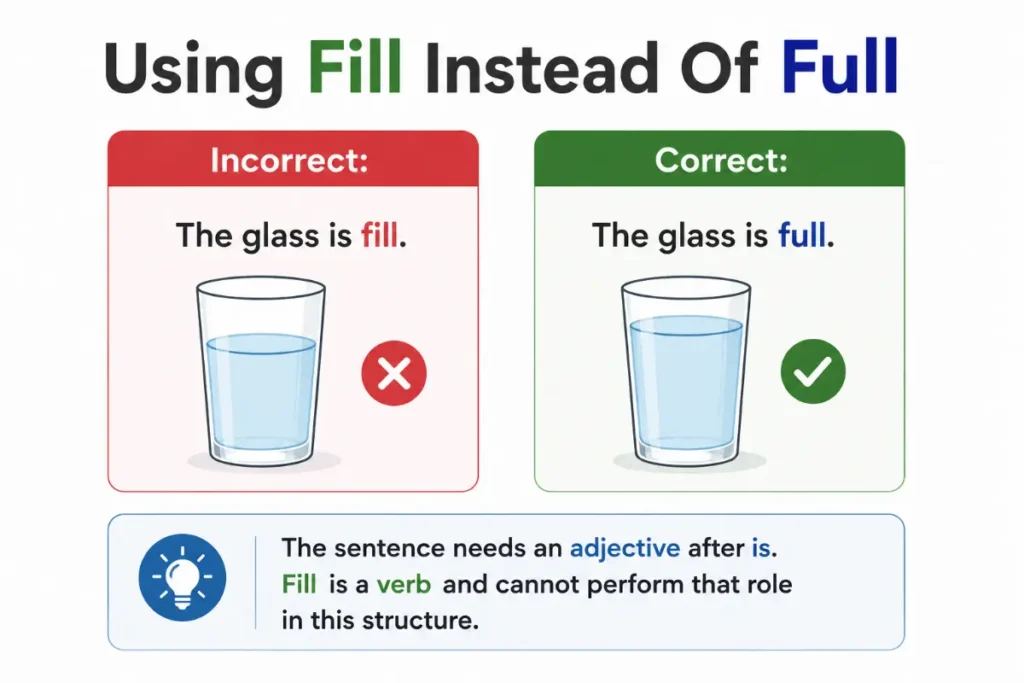
Incorrect: The bottle is fill.
Correct: The bottle is full.
The sentence describes the condition of the bottle. After the linking verb is, you need an adjective. Full describes the bottle’s condition, while fill expresses an action.
3. Confusing Full With Filled
Incorrect: The container is fill with sand.
Correct: The container is filled with sand.
Filled is the past participle of fill. It can work as an adjective to describe something that has had material placed inside it. Full is also correct in a similar sentence: The container is full of sand. The structures differ slightly, but both are natural.
4. Writing Full Out Instead of Fill Out
Incorrect: Please full out the application.
Correct: Please fill out the application.
Fill out is a phrasal verb that means complete a form or document by adding the required information. Full out is not the standard expression for this meaning.
5. Confusing Full Of With Fill With
Incorrect: The room is fill of people.
Correct: The room is full of people.
Also correct: People filled the room.
The adjective pattern is full of something. The verb pattern is fill something with something. These expressions describe similar situations but use different grammatical structures.
A Simple Way to Avoid These Errors
Use this quick check when editing your sentence.
- If you need an adjective after is, are, was, or were, full may be correct.
- If you need an action word, fill may be correct.
- If you are describing a completed action, filled may be the right form.
- If you mean complete a document, use fill in or fill out.
- If you describe what a space contains, use full of.
Pronunciation Guide
How Do You Pronounce Full?
The word full is pronounced /fʊl/ in standard American English. It has one syllable and uses the short vowel sound found in words such as book, good, and put.
A simple pronunciation guide is fuhl. The sound is not the same as the vowel in feel or fill. Keep the vowel short and relaxed.
How Do You Pronounce Fill?
The word fill is pronounced /fɪl/. It has one syllable and uses the short i sound heard in sit, bit, and little.
A simple pronunciation guide is fih l, spoken as one smooth syllable. The vowel is slightly different from the one in full, even though the two words share the same beginning and ending consonants.
Common Pronunciation Mistakes
Some learners pronounce both words with the same vowel because the spelling difference is small. This can make the words harder to distinguish in conversation.
To practice, say these pairs slowly:
- Full and fill.
- Pull and pill.
- Look and lick.
- Could and kid.
Listen carefully to the vowel in each word. The vowel in full is /ʊ/, while the vowel in fill is /ɪ/. Practicing these sounds can improve both pronunciation and listening skills.
A related grammar guide is Molding or Moulding Which Spelling Is Correct.
Etymology and Word Origin
The Origin of Full
Full comes from Old English full, which carried the meaning of being filled, complete, or containing as much as possible. It has Germanic roots and is related to similar words in other Germanic languages.
The word has remained close to its earlier meaning. In modern English, it describes containers at capacity, complete amounts, crowded spaces, and satisfied states. Expressions such as full of joy and full capacity show how the meaning extends beyond physical objects.
The Origin of Fill
Fill also comes from Old English, where forms related to fyllan meant to make full or put something into a space. It shares a historical connection with the adjective full.
This connection explains why the two words are closely related in meaning. One describes the condition of being complete or at capacity, while the other describes the action of making something reach that condition.
How Their Meanings Developed
Over time, fill gained several uses beyond putting liquid or material into a container. People began using it for completing forms, occupying jobs, supplying missing information, and taking up spaces.
Full also developed wider uses. It can describe a complete schedule, a satisfied person, a detailed explanation, or a place with no available room.
Their shared history explains the relationship between the words, but their modern grammatical roles remain different.
Regional Usage
American English
In American English, both words are standard and widely used. Full describes a condition or amount, while fill describes an action.
Common American expressions include:
- The tank is full.
- Fill up the car.
- I am full.
- Fill out the form.
- The room is full of people.
American English commonly uses fill out when referring to completing a form. Fill in is also correct, especially when referring to missing information or individual spaces.
British English
British English follows the same basic distinction. Full describes something complete or at capacity, while fill describes putting something into a space or completing something.
Both fill in and fill out are understood, but fill in is especially common in British usage for completing forms. The choice can vary by context and personal preference.
Australian English
Australian English uses both words in the same standard ways. People may describe a container as full, ask someone to fill a glass, or tell a person to fill in a form.
There is no major spelling difference from American English.
Canadian English
Canadian English also follows the same grammatical rules. Full describes a condition, while fill describes an action. Both fill in and fill out are used, depending on the type of document and the speaker’s preference.
Is There a Difference Between American and British Spelling?
No. Both varieties spell the adjective as full and the verb as fill. The main differences are related to some expressions and regional preferences, not the spelling of the words themselves.
Grammar Rules and Part of Speech
Understanding the grammatical role of each word will help you use it correctly in almost any sentence.
Full as an Adjective
An adjective describes a noun or gives information about a subject. Full can appear before a noun or after a linking verb.
Before a noun:
- We booked a full day of activities.
- She carried a full basket of vegetables.
- He submitted a full report.
After a linking verb:
- The basket is full.
- The restaurant looks full.
- My schedule seems full.
In these examples, full describes a noun or subject. It does not express an action.
Fill as a Verb
A verb expresses an action or state. Fill usually describes putting something into a space or making something complete.
Examples:
- Please fill the bottle.
- They fill the shelves every morning.
- She filled the form yesterday.
- The workers are filling the empty boxes.
The verb can be used with different subjects and tenses. It may take a direct object, as in fill the bottle, or appear in a phrase such as fill with water.
Verb Forms of Fill
| Verb Form | Example |
|---|---|
| Base form | Fill the container. |
| Third person singular | She fills the container. |
| Past tense | He filled the container. |
| Present participle | They are filling the container. |
| Past participle | The container has been filled. |
Fill is a regular verb. You form its past tense and past participle by adding ed. When adding ing, remove the final e only if the base form ends in e. Since fill does not end in e, the spelling becomes filling with a doubled l.
Comparative and Superlative Forms of Full
Full is an adjective, so it can take comparative and superlative forms in some contexts.
- Fuller: This bottle is fuller than the other one.
- Fullest: The tank is at its fullest level.
In everyday writing, people often use more full or most full in some special contexts, but fuller and fullest are the usual forms when making a direct comparison.
Full and Filled
These words are related but not identical.
Full describes a condition. Filled describes something that has been made full or had something put into it.
Compare:
- The glass is full.
- The glass is filled with water.
Both sentences are correct. The first describes the glass’s condition. The second emphasizes that water has been put into it.
Common Phrases With Fill
The verb appears in several phrasal expressions. The particle changes the meaning slightly, so it helps to learn each phrase as a unit.
Fill in means to add missing information or complete empty spaces.
Example: Please fill in your date of birth.
Fill out means to complete a form by providing the requested information.
Example: You must fill out the registration form.
Fill up means to make something full, often a container or vehicle.
Example: We stopped to fill up the gas tank.
Fill in for means to take someone’s place temporarily.
Example: Maria will fill in for the manager during her vacation.
Fill someone in means to give someone information they do not have.
Example: Can you fill me in on what happened at the meeting?
Common Phrases With Full
Full also appears in many common expressions.
Full of means containing a lot of something.
Example: The garden is full of flowers.
Full time describes work or study done for the standard complete schedule.
Example: She works full time at a hospital.
Full capacity means the maximum amount or number that something can hold or handle.
Example: The theater is operating at full capacity.
Full name means a person’s complete name.
Example: Please write your full name on the form.
Full attention means giving complete focus to something.
Example: The teacher gave the student her full attention.
Sentence Position and Punctuation
Neither word has special punctuation rules. Use punctuation according to the sentence structure.
For example, a command such as Fill the bottle needs a period or an exclamation mark depending on the tone. A statement such as The bottle is full needs a period. The choice of word does not change the basic punctuation rule.
Real Life Usage Examples
Daily Conversation
In casual speech, these words often appear together when people talk about containers, food, and space.
- My cup is full, so I do not need another drink.
- Can you fill the ice tray before you leave?
The first describes a condition. The second requests an action. These are common examples of how the words work in daily life.
Email and Workplace Communication
At work, full often describes capacity, time, or completeness. Fill is common in instructions, reports, and administrative tasks.
- The meeting schedule is full for the rest of the afternoon.
- Please fill in the missing details before submitting the file.
Both expressions are clear and professional. You do not need a more complex word to communicate these ideas.
Academic Writing
Academic writing uses full to describe complete information, capacity, or extent. Fill appears when researchers describe adding material, completing spaces, or supplying missing data.
- The report provides a full explanation of the research process.
- The researchers filled each container with the same amount of liquid.
The adjective describes the level of detail, while the verb describes an action performed during the experiment.
News and Journalism
News writers use full to describe crowded places, complete details, or capacity. They use fill to describe occupying positions, spaces, or areas.
- The stadium was full before the final match began.
- The company plans to fill more than one hundred open positions.
These examples are direct and easy to understand. The correct choice depends on the action being reported.
Literature and Storytelling
In stories, full can describe emotions, surroundings, and experiences. Fill can describe how a person or event changes a space or feeling.
- Her heart was full of hope as she entered the room.
- The sound of music filled the quiet street.
The first describes an emotional state. The second describes an action that spreads through a place.
Related and Confused Terms
These eight words and expressions are useful because they share meanings or appear in similar sentence patterns.
1. Filled
Filled is the past tense and past participle of fill. It can also function as an adjective.
Example: The basket is filled with fresh fruit.
Unlike full, filled often emphasizes the action or result of putting something into a space.
2. Empty
Empty is the opposite of full in many situations. It describes something that contains nothing or very little.
Example: The bottle is empty.
Full describes a container at capacity, while empty describes a container without its contents.
3. Complete
Complete means having all necessary parts or details. It is close to one meaning of full, but the words are not always interchangeable.
Example: The application is complete.
Full may describe the amount of information, while complete emphasizes that nothing necessary is missing.
4. Load
Load means to put items, goods, or material into a vehicle, container, or machine.
Example: They loaded the truck with boxes.
Load and fill can overlap, but load often focuses on placing items into something for transport or use.
5. Pack
Pack means to put items into a bag, box, or other container, often in an organized way.
Example: She packed her suitcase for the trip.
You may fill a box with books, but you pack a box when you arrange items inside it for storage or transport.
6. Occupy
Occupy means to take up space, time, or a position.
Example: The new equipment occupies half the room.
It can be related to fill when describing space, but it does not always mean making something completely full.
7. Capacity
Capacity means the maximum amount that something can hold, contain, or handle.
Example: The stadium has a capacity of 20,000 people.
Full capacity describes a condition in which that limit has been reached.
8. Fulfill
Fulfill is a different verb from fill. It means to meet a requirement, carry out a promise, or satisfy a need.
Example: The company fulfilled its promise to customers.
The words look related and share a historical connection, but they are not interchangeable. You fill a container, but you fulfill a promise.
Expert Editor Insight
An experienced editor looks at the grammatical role of the word before checking its spelling. Full usually describes a condition, while fill usually expresses an action. The confusion is common because the words share similar sounds, spelling, and meanings connected with capacity. Spellcheckers may accept both forms because both are correct English words, so they may not catch a wrong choice in context. A useful editing tip is to identify the sentence’s main verb first. If the sentence needs an action such as putting water into a glass, use fill. If it describes the glass after the action, use full.
Key Takeaways
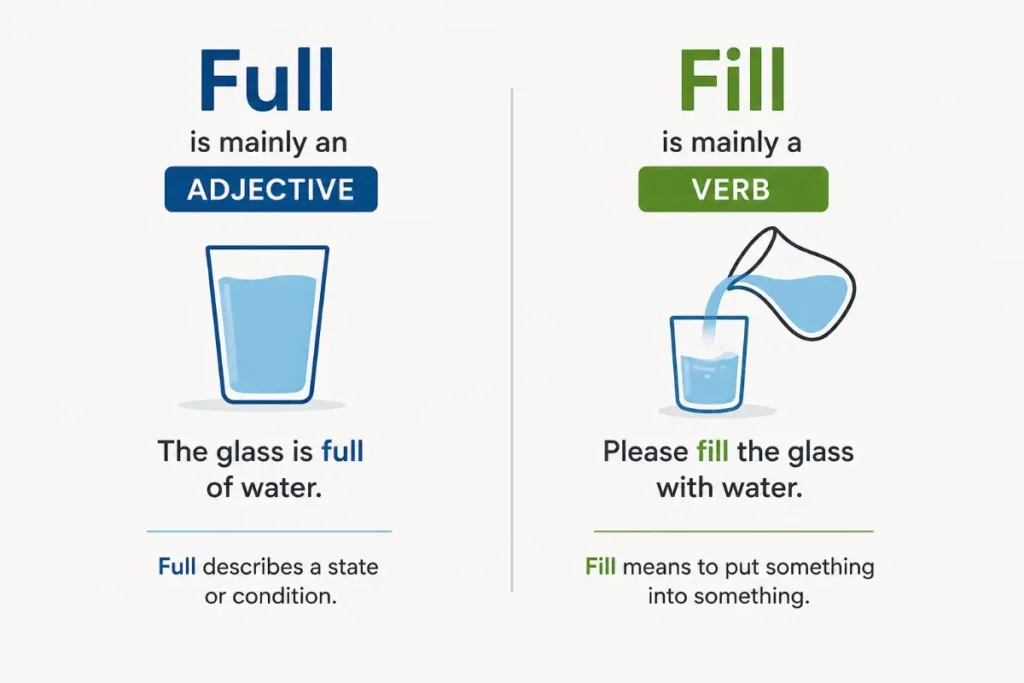
- Full is mainly an adjective.
- Fill is mainly a verb.
- Full describes a condition.
- Fill describes an action.
- A glass can be full.
- You can fill a glass.
- Filled is the past form of fill.
- Filling is the present participle of fill.
- Full can mean complete or abundant.
- Fill can describe physical actions and abstract ideas.
- Fill out is especially common in American English for completing forms.
- Full and fill have different vowel sounds.
- Empty is the most direct opposite of full.
- The easiest memory rule is full describes while fill does.
A related grammar guide is Phase vs Faze Meaning, Difference, and Correct Usage.
Conclusion
The difference between Full vs Fill is mainly a difference in meaning and grammar. Full is an adjective that describes something complete or at capacity, while fill is a verb that describes the action of putting something into a space or making it complete. Both words are correct, but they cannot replace each other in every sentence.
Remember this simple tip: you fill a glass, and the glass becomes full. If you are describing a condition, choose full. If you are describing an action, choose fill. This small distinction will help you write more naturally and avoid common usage errors.
FAQs
What Is the Main Difference Between Full and Fill?
Full is mainly an adjective that describes something complete or containing as much as it can hold. Fill is mainly a verb that describes putting something into a space or making it complete. For example, you fill a glass with water, and the glass becomes full. The difference is mainly grammatical and depends on the sentence’s meaning.
Is Full a Verb or an Adjective?
Full is mainly an adjective in modern everyday English. It describes a person, place, object, or situation that is complete or at capacity. For example, you can say the room is full or the bottle is full. It is not normally used as a verb in standard sentences such as full the bottle.
Is Fill a Noun or a Verb?
Fill is most commonly a verb, meaning to put something into a space or make something complete. It can also function as a noun in specialized contexts, such as describing material used inside a product or material used to raise land. In everyday writing, however, you will most often use it as a verb.
Should I Write Full or Fill the Form?
Use fill when you are telling someone to complete a document by adding information. The correct expressions are fill in the form and fill out the form. Full does not work as the verb in this instruction. You can say the form is full of information, but that describes the document rather than the action of completing it.
Is It Full of Water or Fill of Water?
The correct expression is full of water when you are describing something that contains water. For example, the bottle is full of water. You can also say fill the bottle with water when describing the action of putting water into it. Use full of for a condition and fill with for an action.
What Is the Difference Between Full and Filled?
Full describes a condition, while filled usually describes something that has had material or information put into it. You can say the container is full or the container is filled with sand. Both sentences are correct. The first emphasizes the container’s condition, while the second highlights the result of the filling action.
How Do You Pronounce Full and Fill?
Full is pronounced /fʊl/, with the vowel sound found in book and put. Fill is pronounced /fɪl/, with the vowel sound found in sit and little. Both words have one syllable and share the same beginning and ending consonants. The main difference is the vowel sound in the middle.
What Is the Opposite of Full?
The most common opposite of full is empty. Full describes something that has reached its capacity or contains a lot, while empty describes something that contains nothing or very little. For example, a full glass contains liquid, while an empty glass does not. In some contexts, words such as incomplete or vacant may also express an opposite idea.