
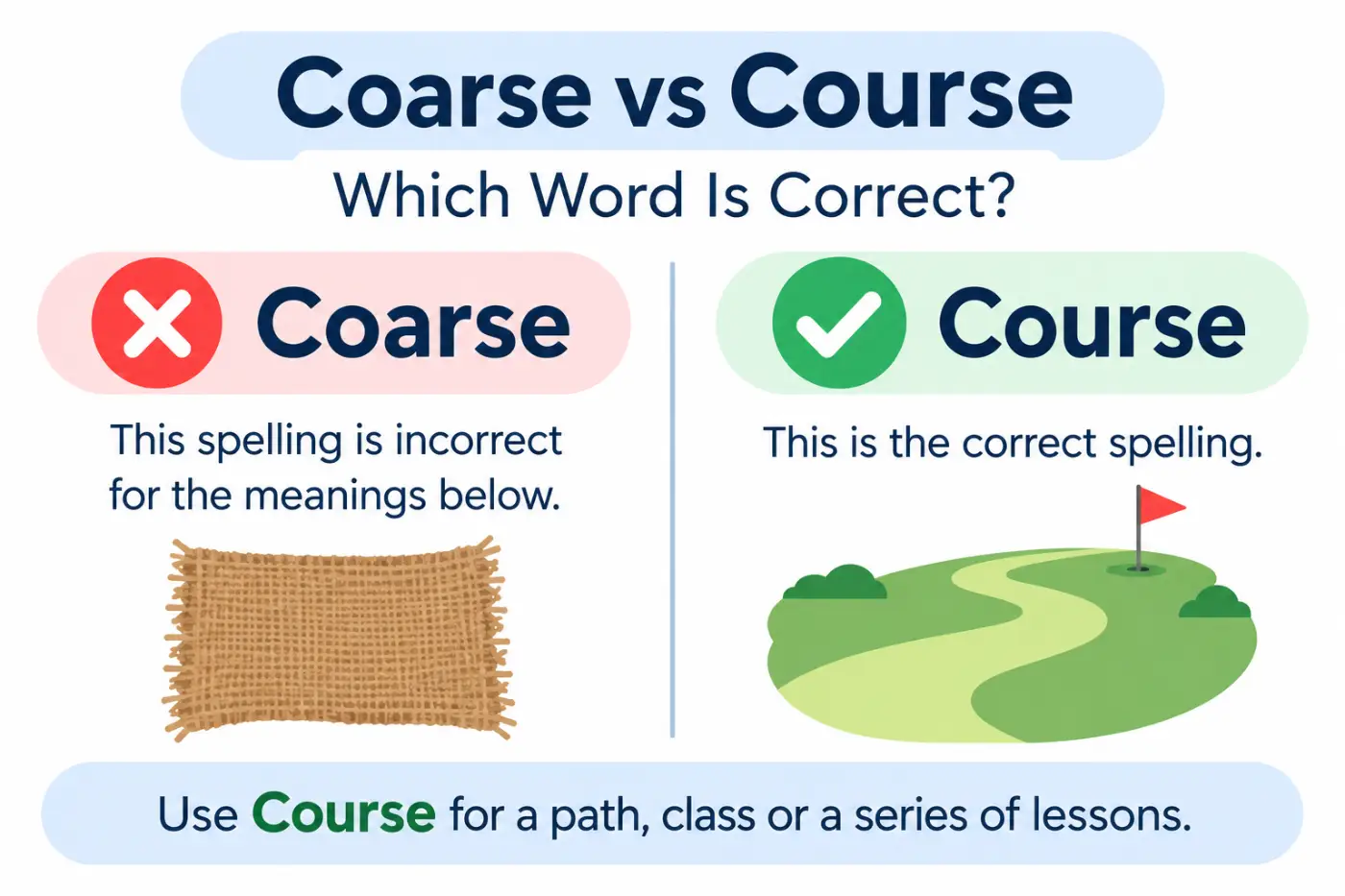
Have you ever paused while writing because you could not decide between coarse vs course? These two words sound exactly alike in standard English, but their meanings are very different. Coarse describes something rough, harsh, or lacking refinement, while course usually refers to a class, a route, a direction, or a series of actions. Both spellings are correct, but using one in place of the other can change the meaning of your sentence.
The confusion is understandable because English has many words that share the same pronunciation but have different spellings and meanings. These words are called homophones. Since you cannot hear the spelling difference when someone speaks, you need to understand the context to choose the right form when writing.
A rough fabric has a coarse texture, but a student takes a course in mathematics. A ship follows its course across the ocean, while a person might make a coarse remark during a conversation. Learning the difference will help you avoid spelling mistakes and use both words naturally.
You may also want to read Lay vs Lie Explained With Grammar Rules and Examples.
Quick Answer
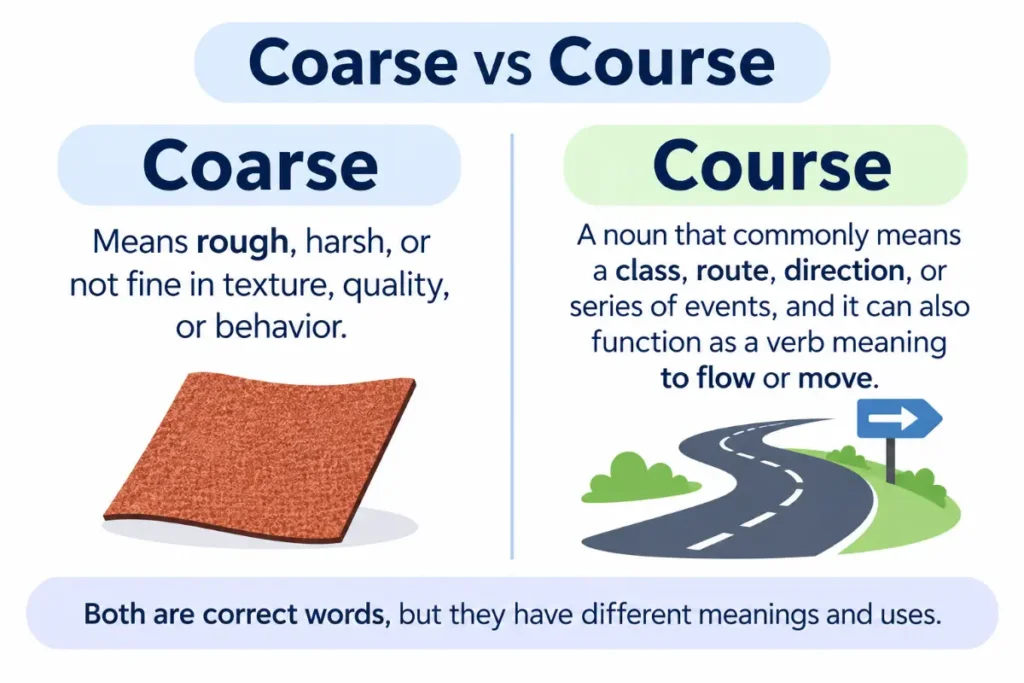
Coarse means rough, harsh, or not fine in texture, quality, or behavior. Course is a noun that commonly means a class, route, direction, or series of events, and it can also function as a verb meaning to flow or move. Both are correct words, but they have different meanings and uses.
Comparison Table
| Feature | Coarse | Course |
|---|---|---|
| Main meaning | Rough, harsh, or lacking refinement | Class, route, direction, or sequence |
| Part of speech | Adjective | Noun and verb |
| Pronunciation | /kɔːrs/ | /kɔːrs/ |
| Spelling | Ends in se | Ends in rse |
| Common contexts | Fabric, texture, language, behavior, particles | Education, travel, sports, meals, plans |
| Formality | Standard in formal and informal English | Standard in formal and informal English |
| Example | The towel has a coarse texture. | She enrolled in a writing course. |
| Related expressions | Coarse sand, coarse language, coarse material | Course of action, golf course, main course |
Meaning and Definition
What Does Coarse Mean?
Coarse is an adjective that describes something rough, harsh, thick, or lacking refinement. It can refer to the physical texture of an object, the size of particles, or the quality of someone’s language and behavior.
When you touch a rough surface and notice that it feels uneven or scratchy, you can describe it as coarse. For example, coarse fabric may feel uncomfortable against the skin, while coarse sand contains larger grains than fine sand.
The word also has meanings beyond physical texture. It can describe speech, humor, manners, or behavior that seems rude, vulgar, or offensive. A coarse joke may contain inappropriate language, while a coarse manner may suggest a lack of politeness.
Common uses include:
- Coarse fabric.
- Coarse sand.
- Coarse hair.
- Coarse language.
- Coarse manners.
- Coarse particles.
- Coarse texture.
- Coarse material.
The exact meaning depends on the noun being described. When it refers to a physical object, it often means rough or made of large particles. When it describes speech or behavior, it usually means crude, rude, or lacking refinement.
What Does Course Mean?
Course is a noun with several common meanings. It can refer to a series of lessons, a path or route, a direction of movement, or a planned series of actions. It also has a less common verb use, meaning to move or flow quickly through or along something.
The word appears in education, travel, sports, dining, medicine, and everyday conversation. Its meaning depends on the situation.
For example, a student may take a course in English, a runner may follow a course during a race, and a ship may change its course to avoid a storm. At a restaurant, the main course is the central part of a meal.
Common expressions include:
- College course.
- Online course.
- Course of action.
- Course of events.
- Golf course.
- Main course.
- Training course.
- Course correction.
In each expression, the word points to a class, route, sequence, or planned direction. This makes it very different from the adjective that describes something rough or crude.
Different Meanings of Course
The noun has several important meanings. Understanding them will help you recognize the word in different situations.
A class or program of study.
A course is a series of lessons designed to teach a subject or skill. For example, a student might enroll in a computer science course or complete an online course in business writing.
A route or path.
A course can describe the route followed by a person, vehicle, ship, or moving object. For example, a river follows its natural course through a valley.
A direction or plan.
The phrase course of action refers to a decision or plan for dealing with a situation. For example, the manager considered several options before choosing the best course of action.
A series of events.
Course can describe how something develops over time. For example, the course of history changed after the invention of the printing press.
A part of a meal.
At a restaurant, a course is one part of a meal served at a particular time. A traditional meal may include an appetizer, a main course, and dessert.
A sports area or route.
A golf course is an area designed for playing golf. A race course is the route used for a competition.
These meanings may seem unrelated, but they share the idea of a sequence, route, or organized part of something.
Is Coarse a Real Word?
Yes. Coarse is a standard English adjective, not a misspelling of course. It describes rough texture, large particles, crude language, or behavior that lacks refinement.
For example, coarse flour has a rougher texture than finely ground flour. Coarse language refers to rude or offensive words. The spelling is correct in both cases.
A common mistake occurs because people hear the same pronunciation and choose the more familiar spelling. If the sentence describes a class, route, or sequence, use course. If it describes roughness or crude behavior, use coarse.
Is Course a Real Word?
Yes. Course is a standard English word with several meanings. It can describe a class, a route, a direction, a sequence of events, or one part of a meal. It can also appear as a verb in expressions such as tears coursing down someone’s cheeks and It is not an alternative spelling of coarse. The two words have different grammatical roles and meanings, even though they sound alike.
Key Differences Explained
1. Meaning
The most important difference is meaning. Coarse describes a quality, usually roughness, harshness, or a lack of refinement. Course refers to a class, route, direction, or sequence.
Compare these sentences:
- The blanket feels coarse against my skin.
- I signed up for a cooking course.
The first sentence describes the texture of a blanket. The second identifies a class that teaches cooking. The words cannot be exchanged without changing the meaning.
2. Part of Speech
Coarse is an adjective. It describes a noun and gives information about its quality or condition.
Examples:
- Coarse sand covered the beach.
- The speaker used coarse language.
- This fabric feels coarse.
Course is mainly a noun, although it can also function as a verb.
Examples:
- The course begins next Monday.
- The river follows its natural course.
- Water coursed through the narrow channel.
This grammatical difference is a useful clue. If you need an adjective to describe texture or behavior, coarse may be the word you want. If you need a noun for a class, route, or sequence, course is usually correct.
3. Pronunciation
The two words are homophones. In standard American English, both are pronounced /kɔːrs/. They sound the same when spoken, so pronunciation alone cannot tell you which spelling to use.
The best way to choose is to consider the meaning of the sentence. If you are describing rough material, use coarse. If you are referring to a class, route, or plan, use course.
4. Spelling
The words differ by the order of their final letters.
- Coarse ends with se.
- Course ends with rse.
The spelling difference is small, but it changes the meaning completely. Writers often make errors because they type the word based on sound rather than checking its role in the sentence.
A helpful memory tip is to connect the word coarse with roughness. You can remember that coarse material is not smooth or fine. Connect course with a class or route, such as a school course or a race course.
5. Formality
Both forms are standard English and suitable for formal and informal writing. Neither is slang or an informal spelling.
Coarse is common in descriptions of materials, language, and behavior. Course appears in education, business, travel, sports, and many everyday expressions.
For example, a scientific report may describe coarse particles in a sample. A university document may list the courses available to students. Both words are appropriate in professional writing when used correctly.
6. Context
Context provides the strongest clue when choosing between these homophones.
If the sentence refers to texture, material, or crude behavior, coarse is likely correct. If it refers to education, direction, a sequence, or a meal, course is likely correct.
Compare:
- The chef used coarse salt to season the vegetables.
- The chef prepared the main course for dinner.
The first sentence describes the size of the salt grains. The second refers to the central dish in a meal.
7. Regional Usage
There is no major spelling difference between American and British English. Both words are spelled coarse and course in the United States, the United Kingdom, Canada, and Australia.
The pronunciation may vary slightly across regional accents, but the words remain homophones in standard varieties of English. Their meanings and basic grammatical roles also remain consistent.
8. Standard and Nonstandard Usage
Both spellings are standard. The mistake happens when writers use the correct word in the wrong context.
For example, writing I enrolled in a coarse in biology is incorrect because a class is a course. Writing the fabric has a course texture is also incorrect if you mean rough, because the adjective should be coarse.
Neither spelling is inherently wrong. Accuracy depends on matching the word to its intended meaning.
Which Form Is Correct?
Both coarse and course are correct words. The correct choice depends on what you want to say.
Use coarse when describing something rough, thick, harsh, crude, or lacking refinement. Use course when referring to a class, route, direction, series of events, meal section, or organized plan.
Consider these examples:
- Correct: The artist used coarse paper for the drawing.
- Correct: I am taking a photography course this semester.
- Correct: The hikers followed the marked course through the forest.
- Correct: The comedian apologized for making a coarse joke.
- Correct: The river changed its course after the storm.
The first and fourth examples use the adjective to describe texture and language. The other examples use the noun to describe a class, route, or path.
A useful editing method is to replace the word with a simple definition. If you mean rough, try replacing it with rough. If the sentence still makes sense, coarse is probably correct.
Sentence Examples
Here are ten natural sentences showing how to use both words correctly.
Examples Using Coarse
- The old blanket felt coarse against my skin.
- The gardener mixed coarse sand into the soil to improve drainage.
- His coarse language made several people uncomfortable.
- This towel is made from coarse cotton fibers.
- The chef sprinkled coarse salt over the roasted potatoes.
These examples show the main uses of the adjective. It can describe physical texture, the size of particles, or language that sounds rude or offensive.
Examples Using Course
- My brother enrolled in a computer programming course.
- The runners followed the course marked by the event organizers.
- We chose grilled chicken as the main course.
- The company changed its course after receiving customer feedback.
- The course of events surprised everyone in the room.
These sentences demonstrate the word’s range. It can refer to education, a route, a meal, a plan, or the way events develop.
Five Examples Showing Common Mistakes
The following sentences show how a wrong spelling can change the meaning.
1. Incorrect: I need to complete a coarse in mathematics.
Correct: I need to complete a course in mathematics.
2. Incorrect: The towel has a course texture.
Correct: The towel has a coarse texture.
3. Incorrect: We followed the coarse marked on the map.
Correct: We followed the course marked on the map.
4. Incorrect: The chef added coarse salt to the main coarse.
Correct: The chef added coarse salt to the main course.
5. Incorrect: His course remarks offended the audience.
Correct: His coarse remarks offended the audience.
The fourth example is especially useful because both words belong in the same sentence. Salt can be coarse, while the main part of a meal is a course. Their meanings make the spelling choice clear.
Common Mistakes and Misspellings
These errors often happen because the two words sound identical. The best way to avoid them is to look at the meaning and grammar of the sentence before choosing a spelling.
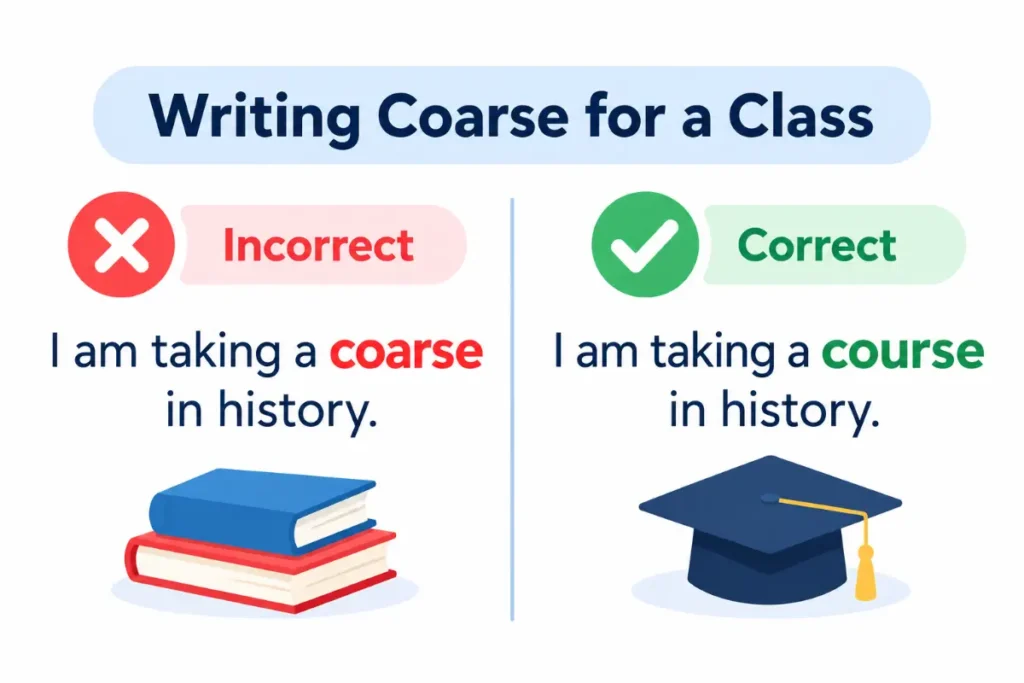
1. Writing Coarse for a Class
Incorrect: I am taking a coarse in history.
Correct: I am taking a course in history.
A class or program of study is called a course. The adjective coarse describes roughness or a lack of refinement, so it does not fit this sentence.
2. Writing Course to Describe Texture
Incorrect: The fabric feels course.
Correct: The fabric feels coarse.
When describing a rough or uneven surface, use the adjective coarse. The noun course does not describe the physical quality of the fabric.
3. Confusing Course of Action With Coarse of Action
Incorrect: We need to choose a coarse of action.
Correct: We need to choose a course of action.
The expression course of action refers to a plan or decision about what to do next. It is a common phrase in business, education, and everyday communication.
4. Using Course for Crude Language
Incorrect: The comedian used course language.
Correct: The comedian used coarse language.
The adjective coarse can describe speech that is vulgar, rude, or offensive. Course has no such meaning in this context.
5. Mixing Both Words in the Same Sentence
Incorrect: The coarse included a lesson about coarse materials.
Correct: The course included a lesson about coarse materials.
The first word refers to a class, so it should be course. The second describes the materials, so coarse is correct. This example shows why checking each use separately matters.
Why These Errors Happen
The main reason is pronunciation. Since the words sound the same, a listener cannot identify the spelling from speech alone. Writers may also rely on the spelling they see most often or choose the first version suggested by a typing tool.
Autocorrect and grammar software can help, but they may not catch every mistake. Both forms are valid English words, so a spelling checker may accept the wrong choice if it does not understand the sentence’s intended meaning.
A related grammar guide is Lended vs Lent Which Form Is Correct.
Pronunciation Guide
How Do You Pronounce Coarse?
In standard American English, coarse is pronounced /kɔːrs/. It has one syllable and rhymes with words such as horse, force, and source in accents where these words share the same vowel sound.
An easy way to remember the pronunciation is to say it like the word course. Both have the same spoken form in standard American English.
How Do You Pronounce Course?
Course is also pronounced /kɔːrs/ in standard American English. It has one syllable, beginning with the /k/ sound and ending with /rs/.
The words are homophones because they share the same pronunciation but have different spellings and meanings. You cannot hear the difference between them in ordinary speech.
Syllable Breakdown and Stress
Both words contain one syllable.
| Word | IPA | Syllables | Stress |
|---|---|---|---|
| Coarse | /kɔːrs/ | 1 | Single syllable |
| Course | /kɔːrs/ | 1 | Single syllable |
Since each word has only one syllable, there is no separate syllable stress to learn. Pronunciation is not the best way to tell them apart. Meaning and sentence context provide the reliable clues.
Common Pronunciation Confusion
Some speakers may have regional vowel differences, but this does not create a separate meaning for either word. In many American accents, the vowel in both words sounds like the vowel in horse.
Do not try to pronounce the r in one word differently to create a distinction. The correct spoken form is the same. Focus on spelling and meaning when writing.
Etymology and Word Origin
Origin of Coarse
Coarse developed through Middle English and has connections to Old French forms related to the idea of something ordinary, rough, or not refined. Its spelling and meaning changed over time before becoming the modern adjective used for rough texture and crude behavior.
Today, the word can describe physical materials as well as speech and manners. Coarse sand, coarse fabric, and coarse language all show how the idea of roughness can apply to different kinds of things.
Origin of Course
Course entered English through Anglo French and Old French forms related to running or movement. These forms trace back to Latin cursus, meaning a running, course, or journey, from currere, meaning to run.
The word developed several meanings over time. Its use for a route or path connects closely with its historical sense of movement. Its meaning as a class or sequence developed around the idea of an organized progression through lessons or stages.
Why Their Origins Are Different
The two words have separate histories, even though their modern pronunciations are alike. Their shared sound is a result of changes in English pronunciation, not evidence that they mean the same thing.
Knowing the word origins can make the distinction more interesting, but the practical rule is simple. Coarse describes roughness, while course refers to a route, class, sequence, or related idea.
Regional Usage
American English
In American English, both spellings are standard. Coarse describes rough materials, large particles, or crude language. Course refers to classes, routes, plans, meals, and sequences.
For example, an American student may enroll in a college course, while a cook may use coarse salt in a recipe. The words are pronounced alike in many American accents.
British English
British English uses the same spellings and basic meanings. A person may describe a rough fabric as coarse or refer to a university course. There is no standard British spelling that replaces either form.
Pronunciation can vary across British accents, but the distinction remains a matter of meaning and context.
Australian English
Australian English follows the same standard usage. Coarse describes roughness or crude behavior, while course refers to a class, route, or sequence. There is no widely recognized Australian spelling difference between the words.
Canadian English
Canadian English also uses both forms with the same meanings found in American and British English. A college course and coarse material are standard expressions. The spelling choice depends on the sentence rather than the region.
Across these varieties, the main rule stays the same. Use the adjective for roughness and the noun for a class, route, or sequence.
Grammar Rules and Part of Speech
Understanding the grammatical role of each word makes it easier to avoid mistakes. One is mainly an adjective, while the other is mainly a noun with an additional verb use.
Coarse as an Adjective
An adjective describes a noun. Coarse can appear before a noun or after a linking verb.
Before a noun:
- The workers removed the coarse material.
- She bought a coarse wool sweater.
- The chef used coarse pepper.
After a linking verb:
- The fabric feels coarse.
- His language was coarse.
- The surface became coarse over time.
The adjective does not change to match a plural noun. You write coarse sand, coarse grains, and coarse materials. The spelling stays the same.
Course as a Noun
A noun names a person, place, thing, or idea. Course can name a class, route, plan, stage of a meal, or sequence of events.
Examples:
- The course starts in January.
- We walked around the golf course.
- The doctor explained the course of treatment.
- The main course arrived after the salad.
- The company changed its course.
The word can be singular or plural. Its plural form is courses.
For example, “She is taking three courses this semester” is correct. Do not write coarses when referring to multiple classes.
Course as a Verb
Course can also function as a verb, although this use is less common than its noun use. It means to move or flow quickly through or along something.
Examples:
- Tears coursed down her cheeks.
- A sudden wave of excitement coursed through the crowd.
- Water coursed through the damaged pipe.
The verb form is usually used to describe movement or flow. Its forms include course, courses, coursed, and coursing.
Sentence Position
Coarse usually appears before the noun it describes or after a linking verb such as feel, look, or seem.
Examples:
- The coarse fabric irritated his skin.
- The fabric seemed coarse.
Course commonly appears as a noun after articles, possessive words, or adjectives.
Examples:
- The course was difficult.
- Her biology course begins tomorrow.
- This course of action seems sensible.
These patterns can help you identify the intended word before you finish typing.
Punctuation and Formal Usage
Neither word requires special punctuation. Use standard sentence punctuation based on the structure of the sentence.
Both words are suitable for formal and informal writing. In an academic paper, you may describe coarse particles in a sample or refer to a course of study. In a casual conversation, you might discuss a cooking course or complain about coarse fabric.
The important point is accuracy, not formality.
Real Life Usage Examples
Daily Conversation
People use both words in everyday speech, although the meaning usually becomes clear from context.
- This blanket is too coarse for a baby’s skin.
- I signed up for a short course in photography.
The first describes a physical texture. The second refers to a class. Since both words sound alike, the surrounding words help listeners understand the intended meaning.
Email and Workplace Communication
In professional writing, these words may appear in reports, training plans, product descriptions, and instructions.
- Please review the course schedule before Monday.
- The supplier sent coarse material that does not meet our requirements.
The first sentence refers to a planned series of lessons. The second describes the quality of a supplied material. A spelling mistake could create confusion in either message.
Academic Writing
Academic writing often uses course to describe a subject or program of study. Coarse may appear in science, engineering, geography, and other fields to describe particles, surfaces, or broad categories.
- Students must complete a research methods course before graduation.
- The experiment used coarse particles to compare filtration results.
In scientific writing, coarse can have a more specific meaning related to particle size or level of detail. The intended definition should be clear from the subject being discussed.
News and Journalism
News reports may use course to describe political developments, travel routes, or a sequence of events. Coarse can describe language, materials, or behavior.
- Officials changed the course of the investigation after receiving new evidence.
- The report criticized the speaker for using coarse language during the meeting.
The first sentence describes a change in direction. The second describes the tone of someone’s speech.
Literature and Storytelling
Writers can use both words to create clear descriptions and set a scene.
- The traveler followed the river’s course through the quiet valley.
- The old rope felt coarse in his hands.
The first sentence gives a sense of direction and movement. The second helps readers imagine the rough texture of an object.
Related and Confused Terms
These eight words and expressions are useful because they share meanings or appear in similar contexts.
1. Rough
Rough is a close synonym of coarse when describing texture. A rough surface feels uneven or not smooth. However, rough has a wider range of meanings and can also describe difficult conditions, behavior, or an approximate estimate.
Example: The rough wooden table had several scratches.
2. Fine
It is often the opposite of coarse when describing texture or particle size. Fine sand contains smaller grains, while coarse sand contains larger grains. The word fine can also mean excellent, delicate, or precise, depending on context.
Example: The recipe requires fine sugar rather than coarse sugar.
3. Crude
Crude can describe something rough, basic, or lacking refinement. It is close to coarse when referring to rude language or behavior. However, crude can also describe something made without much skill or detail.
Example: His crude joke made the audience uncomfortable.
4. Course of Action
A course of action is a plan or decision about what to do. It refers to a chosen path for dealing with a situation.
Example: The team discussed the best course of action after the system failed.
5. Curriculum
A curriculum is the full set of subjects or learning experiences offered by a school or educational program. A course is usually one individual class or unit within a broader curriculum.
Example: Biology is part of the school’s science curriculum.
6. Class
A class is a teaching session or group of students learning together. A course may contain several classes or lessons spread over a period of time.
Example: I have a math class today as part of my college course.
7. Route
A route is a path from one place to another. It can be similar to one meaning of course, especially when describing travel or movement. However, course can also refer to a sequence or direction that is not a physical road.
Example: The driver chose a safer route through the mountains.
8. Course Correction
A course correction is a change in direction or plan to reach a goal more effectively. The phrase is used in travel, business, project planning, and everyday discussions.
Example: The company made a course correction after reviewing customer feedback.
Expert Editor Insight
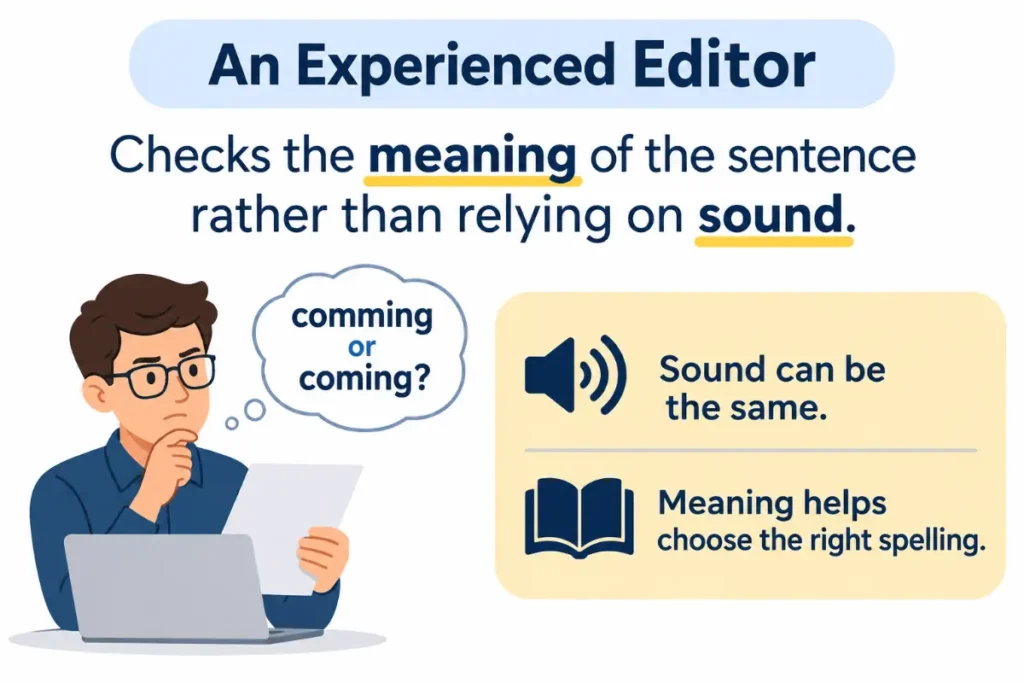
An experienced editor checks the meaning of the sentence rather than relying on sound. Native speakers pronounce these two words alike in many accents, so even skilled writers can select the wrong spelling while typing quickly. A spelling checker may accept both because each is a valid word. The best editing tip is to replace the word with its intended meaning. If you mean rough, use coarse. If you mean a class, route, or sequence, use course. Also check common phrases such as course of action, main course, and coarse language because their established forms make the choice easier.
Still confused? Compare incite vs insight Meaning, Difference and Correct Usage.
Conclusion
The difference between coarse vs course is based on meaning and grammar, not pronunciation. Coarse is an adjective that describes rough texture, large particles, or crude behavior. Course is mainly a noun referring to a class, route, direction, meal section, or sequence, although it can also function as a verb.
Both spellings are correct, but they cannot replace each other. To remember the distinction, connect coarse with rough materials and course with classes or paths. Before submitting an important piece of writing, read the full sentence and check which meaning you intend. This simple habit will help you choose the correct word.
FAQs
What Is the Main Difference Between Coarse and Course?
Coarse is an adjective that describes something rough, harsh, thick, or lacking refinement. Course is usually a noun that refers to a class, route, direction, or sequence. For example, coarse sand has large grains, while a science course is a series of lessons. Both words are correct, but their meanings are different.
Is Coarse a Real Word?
Yes. Coarse is a standard English adjective used to describe rough texture, large particles, crude language, or behavior that lacks refinement. You can describe fabric as coarse, sand as coarse, or a rude remark as coarse. It is not a misspelling of course, even though the two words sound the same.
Is It Course or Coarse of Action?
The correct expression is course of action. It refers to a plan or decision about what someone should do in a particular situation. For example, the manager considered several options before choosing a course of action. Coarse is incorrect in this phrase because it describes roughness or a lack of refinement.
Are Coarse and Course Homophones?
Yes. They are homophones because they have the same pronunciation but different spellings and meanings. In standard American English, both are pronounced /kɔːrs/. Their spelling difference does not create a pronunciation difference, so you must use context to identify the intended word when reading or writing.
How Do You Remember the Difference Between Coarse and Course?
Connect coarse with roughness. Coarse sand, coarse fabric, and coarse language all describe something rough, thick, or crude. Connect course with a class or route. A college course teaches a subject, while a race course marks a path. Remembering these common expressions makes the spelling choice easier.
Is It Coarse Salt or Course Salt?
The correct expression is coarse salt. It describes salt with larger grains than finely ground table salt. Course is incorrect in this phrase because the word does not describe particle size. You may also see the term coarse sea salt in recipes and food descriptions.
Is It a College Course or a College Coarse?
The correct expression is college course. A course is a class or organized program of study offered by a school or college. Coarse describes roughness or crude behavior and does not refer to education. For example, a student may take a college course in history, biology, or mathematics.
Can Course Be Used as a Verb?
Yes. Course can function as a verb meaning to move or flow quickly through or along something. For example, tears may course down someone’s face, or excitement may course through a crowd. This use is less common than the noun form, but it is standard English.