
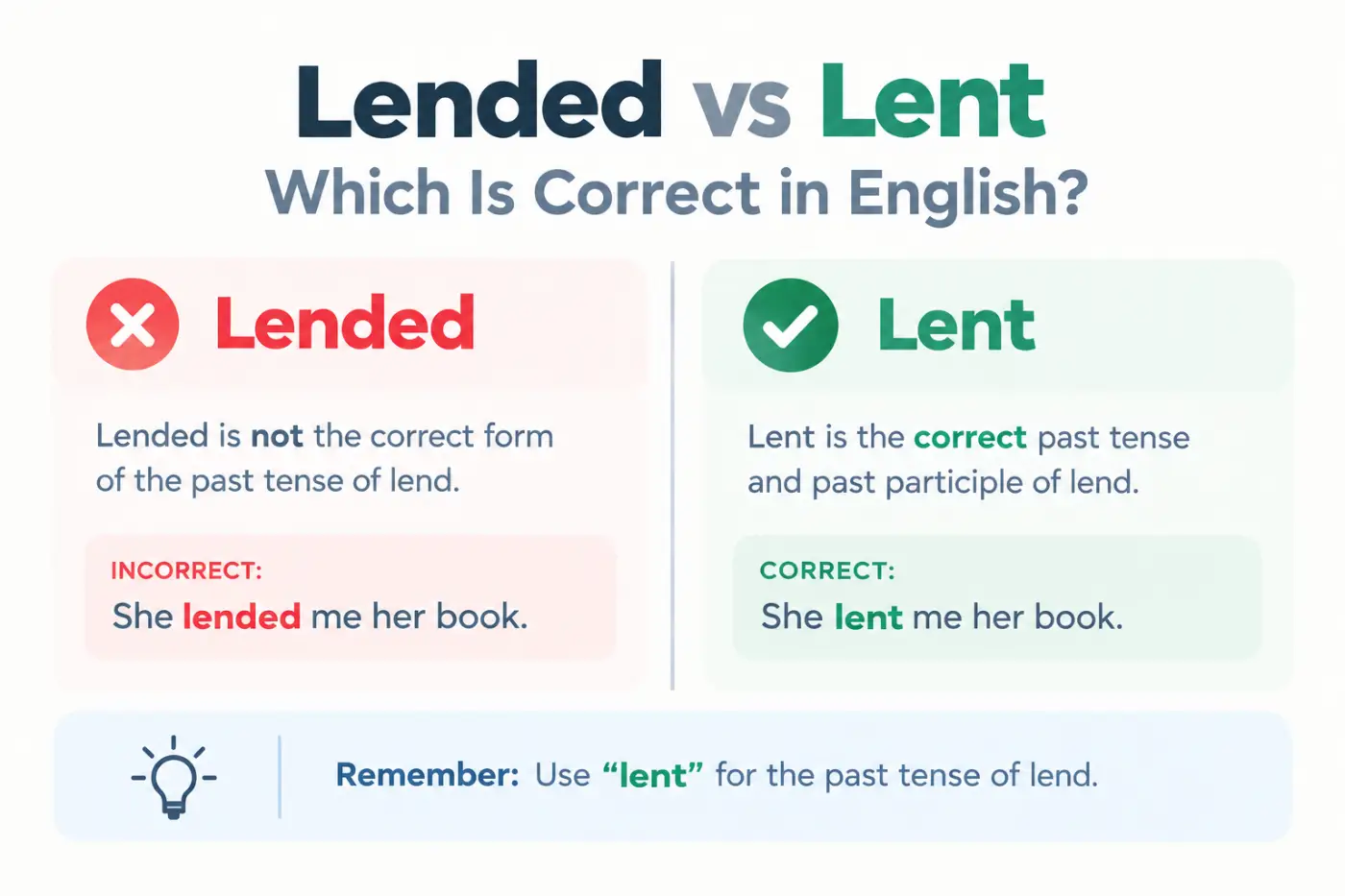
Have you ever written a sentence about giving someone money or an item temporarily and wondered if you should use lended vs lent? The correct standard past tense of lend is lent. Although lended occasionally appears in informal writing or nonstandard speech, it is not the accepted form in standard modern English.
The confusion makes sense. Many English verbs form their past tense by adding ed, as in helped, walked, and opened. However, lend is an irregular verb that changes form instead of following that pattern. Its three main forms are lend, lent, and lent. Use lend for the present tense, lent for the simple past, and lent as the past participle.
/Knowing this pattern helps you avoid a common grammar mistake. This guide explains the difference between lended vs lent, shows how to use the correct form in different tenses, and provides practical examples for conversations, schoolwork, emails, and professional writing. You will also learn how the word developed and discover an easy way to remember its correct past tense.
Still confused? Compare Device vs Devise Which Word Should You Use?.
Quick Answer
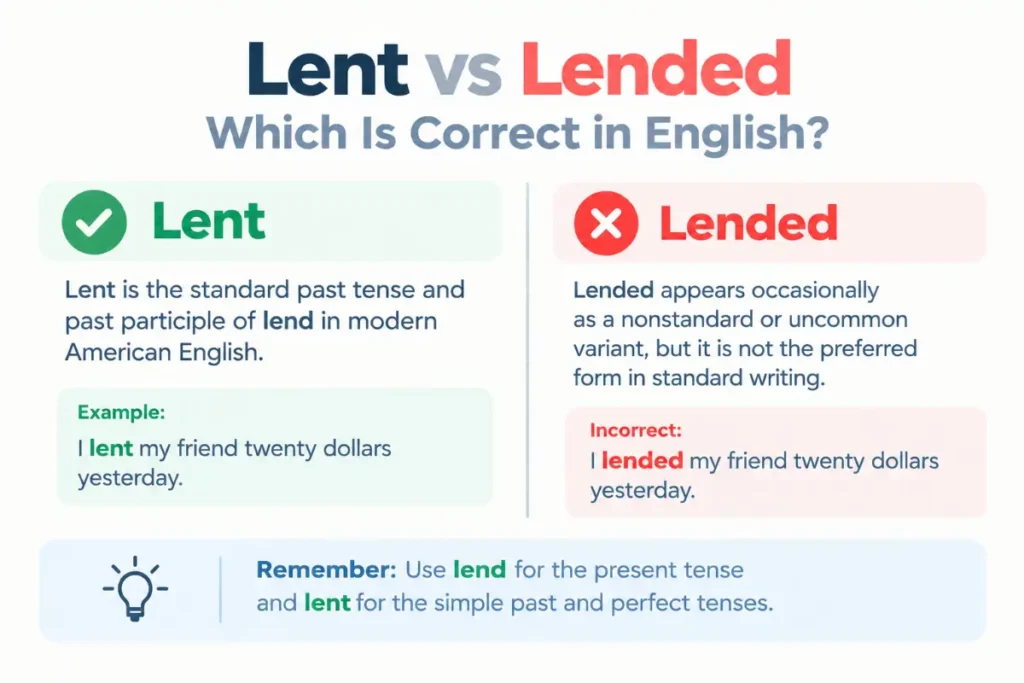
Lent is the correct standard past tense and past participle of lend. Lended is a nonstandard form that you should avoid in formal and standard English. Say, I lent my friend some money yesterday, not, I lended my friend some money yesterday.
Comparison Table
| Feature | Lend | Lent | Lended |
|---|---|---|---|
| Standard status | Correct | Correct | Nonstandard |
| Main function | Base form and present tense | Simple past and past participle | Attempted regular past form |
| Part of speech | Verb | Verb | Nonstandard verb form |
| Meaning | Give something temporarily | Gave something temporarily | Intended to mean gave temporarily |
| Pronunciation | /lɛnd/ | /lɛnt/ | /ˈlɛn.dɪd/ |
| Common usage | Present and future contexts | Past and perfect tenses | Not recommended in standard writing |
| Formality | Standard | Standard | Nonstandard |
| Example | I lend books to my friends. | I lent her my book. | I lended her my book. |
Meaning and Definition
What Does Lended Mean?
Lended is a nonstandard past tense form sometimes created by applying the regular ed ending to the verb lend. In standard English, lend does not form its past tense this way. Its accepted past form is lent.
The form may appear in casual speech, online comments, informal messages, or writing by people who are still learning English. It can also appear as a simple typing or grammar mistake. Readers will usually understand the intended meaning, but that does not make the form correct in standard usage.
For example:
- Nonstandard: I lended him my laptop for the weekend.
- Standard: I lent him my laptop for the weekend.
The second sentence follows the established irregular verb pattern. If you are writing an email, school assignment, article, report, or business message, use lent.
There is no need to treat lended as a separate verb with a different meaning. In ordinary modern English, it is usually an incorrect substitute for lent.
What Does Lent Mean?
Lent is the simple past tense and past participle of lend. The verb lend means to give something to another person temporarily, with the expectation that it will be returned or repaid.
You can lend physical items, such as books, tools, clothes, or equipment. You can also lend money, which means allowing someone to use a sum of money with an expectation of repayment. In a broader sense, lend can describe giving support, assistance, or attention.
Examples include:
- I lent my brother my bicycle.
- She lent me twenty dollars.
- The library lent us several books.
- They lent their support to the project.
- He has lent his experience to the new team.
The word changes form according to the tense and sentence structure. You use lend for the present or base form, lent for the simple past, and lent after helping verbs such as have, has, and had.
The Three Main Forms of Lend
English learners often find irregular verbs confusing because their past forms do not always follow one spelling rule. The verb lend is easier to remember once you learn its three main forms.
| Verb form | Word | Example |
|---|---|---|
| Base form | Lend | I lend my tools to trusted neighbors. |
| Simple past | Lent | I lent my tools to Sam yesterday. |
| Past participle | Lent | I have lent my tools to Sam before. |
Notice that the past tense and past participle are identical. This pattern is also found in other irregular verbs, such as send, sent, and spend, spent.
Key Differences Explained
1. Spelling
The standard spelling of the past tense is lent, not lended. The change from lend to lent involves replacing the final d sound with a t sound in the written form.
This is part of the verb’s irregular pattern. You cannot always form an English past tense by adding ed. Some verbs change a vowel, some change their final consonant, and others use a completely different form.
Compare these examples:
- Lend becomes lent.
- Send becomes sent.
- Spend becomes spent.
- Build becomes built.
- Keep becomes kept.
These examples show why memorizing common irregular verbs is useful. The spelling of lent is not a random exception. It belongs to a familiar group of English verb forms.
2. Meaning
Both forms are usually intended to express the same action: giving something temporarily. However, only lent is the standard form for the past tense and past participle.
For example, the sentence I lent her my notes means that you gave her your notes for temporary use. The form lended is generally understood in the same way, but it does not follow standard grammar.
The difference is not about the amount of time, the type of item, or the relationship between the people involved. It is about the correct form of an irregular verb.
3. Grammar
Lend is the base form. Lent is used for the simple past and as the past participle.
Use lend after modal verbs such as can, could, may, might, and will:
- I can lend you my charger.
- She will lend him the money.
- Could you lend me a pen?
Use lent for an action completed in the past:
- I lent him my car last week.
- They lent us some equipment.
Choose lent with have, has, or had:
- I have lent her my books before.
- He has lent money to several friends.
- We had lent the equipment to the school.
Do not add ed to the past form. The correct structure is have lent, not have lended.
4. Part of Speech
Lend is a verb, and lent is a verb form. The nonstandard form lended is also an attempted verb form, but it is not accepted as the standard past tense in edited English.
In a sentence such as She lent me her notebook, lent is the main verb. In She has lent me her notebook, it is the past participle used with the helping verb has.
The word lent can also appear in the name of the Christian season of Lent. In that context, it is a proper noun and refers to a period of religious observance. This meaning is unrelated to the past tense of lend, even though the spelling is the same.
5. Pronunciation
Lend and lent have one syllable each. The main difference is the final consonant sound.
- Lend: /lɛnd/.
- Lent: /lɛnt/.
The first word ends with a /d/ sound, while the second ends with a /t/ sound. Lended, when spoken, usually has two syllables: /ˈlɛn.dɪd/. That pronunciation follows the spelling of the nonstandard form, but it does not make it the correct past tense.
6. Formality
Lent is appropriate in every standard writing style. You can use it in casual texts, school assignments, business emails, academic writing, news reports, and formal documents.
Lended may appear in informal speech or online writing, but you should not use it in edited work. A reader may understand what you mean, yet the form can make your writing look unpolished.
7. Context
The correct form does not change according to the item being given. You use lent for money, books, clothes, tools, vehicles, and support.
Examples:
- She lent me her jacket.
- The bank lent the business money.
- He lent his voice to the campaign.
- My neighbor lent us a ladder.
The object may change, but the past tense remains lent.
8. Regional Usage
The standard form is lent in American, British, Canadian, and Australian English. There is no major regional difference that makes lended acceptable as the usual past tense.
Some speakers may use nonstandard forms in casual conversation, but formal and edited writing follows the same irregular verb pattern across these varieties.
Which Form Is Correct?
Lent is the correct standard past tense and past participle of lend. This is an irregular verb, so it does not take the regular ed ending in its past forms.
The standard verb pattern is:
- Present: I lend.
- Past: I lent.
- Past participle: I have lent.
This pattern is established in modern English grammar and standard dictionary usage. It is not a matter of personal preference or a difference between American and British spelling.
Consider these examples:
| Incorrect | Correct |
|---|---|
| I lended him my phone. | I lent him my phone. |
| She lended me some money. | She lent me some money. |
| They have lended us their car. | They have lent us their car. |
| He had lended his notes to Sam. | He had lent his notes to Sam. |
| We lended the school some books. | We lent the school some books. |
The correct form remains the same across simple past and perfect tenses. If you remember that lend changes to lent, you can avoid the most common mistake.
Sentence Examples
Here are ten natural sentences that show how to use the standard form in different situations.
- Everyday conversation: I lent my neighbor a ladder so he could fix his roof.
- Text message: I lent you my blue jacket last Friday.
- Workplace communication: The manager lent the new employee a company laptop for the training session.
- School: Sarah lent her classmate a calculator before the math test.
- Academic writing: The researchers lent their support to a project examining access to public education.
- Formal writing: The organization lent financial assistance to families affected by the storm.
- Social situations: My cousin lent me a dress for the wedding.
- Online communication: A reader asked if I had ever lent my camera to a friend.
- Banking and finance: The credit union lent the small business enough money to purchase new equipment.
- Family conversation: Dad lent us his truck when we moved into the new apartment.
Each sentence describes an action that happened in the past. The item or support was given temporarily, so lent is the natural choice.
Five Incorrect Examples and Their Corrections
These examples show how the nonstandard form may appear and how to correct it.
1. Incorrect: I lended my friend twenty dollars.
Correct: I lent my friend twenty dollars.
2. Incorrect: She lended me her favorite book.
Correct: She lent me her favorite book.
3. Incorrect: They lended their equipment to the school.
Correct: They lent their equipment to the school.
4. Incorrect: He has lended his car to his brother.
Correct: He has lent his car to his brother.
5. Incorrect: We had lended the money before the deadline.
Correct: We had lent the money before the deadline.
The corrections all follow the same rule. Do not add ed to lend when forming the simple past or past participle.
Common Mistakes and Misspellings
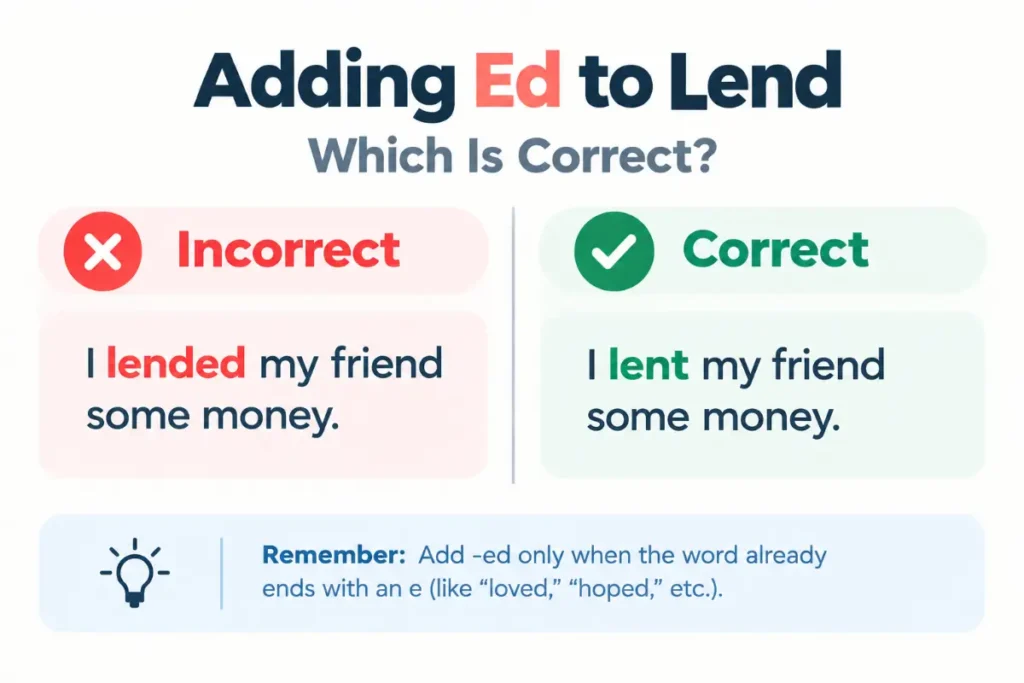
The most common error is adding ed to an irregular verb. Other mistakes involve confusing the base form, past tense, and past participle.
1. Adding Ed to the Past Tense
Incorrect: I lended her my laptop.
Correct: I lent her my laptop.
This mistake happens because many English verbs form the past tense with ed. However, lend is irregular and changes to lent. Remember the pattern rather than applying the regular rule to every verb.
2. Using Lend for a Completed Past Action
Incorrect: I lend him my car yesterday.
Correct: I lent him my car yesterday.
The word yesterday clearly places the action in the past. The simple past form is required, so use lent rather than the present form lend.
3. Using Lended After Have or Has
Incorrect: She has lended me her notes.
Correct: She has lent me her notes.
After have or has, you need the past participle. For lend, the past participle is lent. The correct form does not change just because the sentence uses a helping verb.
4. Confusing Lent With Loan
Incorrect: I lent him a loan.
Better: I lent him some money.
Lend is a verb, while loan is commonly used as a noun and can also function as a verb. The sentence I gave him a loan is another correct option. Choose the structure that matches the meaning you want.
5. Confusing Lend and Borrow
Incorrect: I borrowed him my book.
Correct: I lent him my book.
The verbs describe opposite sides of the same exchange. The person who gives something temporarily lends it. The person who receives it borrows it.
For example, if Maria gives her book to James, Maria lends the book and James borrows it. This distinction is useful because people sometimes mix up the two verbs even when they know the correct past tense.
A Quick Way to Avoid These Errors
Before submitting a sentence, check the time of the action and the helping verb.
- Present or base form: lend.
- Simple past: lent.
- Present perfect: have or has lent.
- Past perfect: had lent.
- Future: will lend.
This short pattern is easy to learn and works across everyday and formal writing.
Pronunciation Guide
How Do You Pronounce Lend?
Lend is pronounced /lɛnd/ in standard American English. It has one syllable and rhymes closely with words such as send, bend, and tend. Start with the /l/ sound, say the short e vowel heard in bed, and finish with the /nd/ sounds.
The final d is voiced, which means your vocal cords vibrate as you say it. Keep the word to one syllable rather than adding an extra vowel after the final consonant.
How Do You Pronounce Lent?
Lent is pronounced /lɛnt/. It also has one syllable and uses the same short e vowel as lend. The difference is the final sound: lent ends with /t/, while lend ends with /d/.
Say the words slowly to hear the difference:
- Lend: /lɛnd/.
- Lent: /lɛnt/.
The vowel remains the same. Only the final consonant changes.
How Is Lended Pronounced?
Lended is generally pronounced /ˈlɛn.dɪd/, with two syllables. This pronunciation follows the written ed ending, but it does not make the word the standard past tense of lend.
If you are speaking or reading aloud, use lent. It is shorter, follows standard English grammar, and is the form expected in edited writing.
Common Pronunciation Mistakes
Some learners add an extra syllable because they expect the past tense to end in ed. This produces lended instead of lent. Others may confuse the final /d/ in lend with the /t/ in lent.
A useful practice method is to say lend, lent, send, sent, spend, spent aloud. These pairs help you hear the pattern and remember the correct forms.
For another common grammar confusion, see Disloyal or Unloyal Which Word Is Correct.
Etymology and Word Origin
Where Does Lend Come From?
The verb lend has roots in Old English. It developed from the earlier form lænan, which meant to lend or grant something temporarily. Its history is connected with the idea of allowing someone to use something for a period of time.
The modern verb kept this central meaning. Today, it can refer to giving money, objects, assistance, or support for temporary use or benefit.
Why Does the Past Tense Become Lent?
Lend belongs to a group of English verbs with irregular past forms. These forms developed through older Germanic language patterns, where changes to sounds inside a word were common ways to mark tense.
The past form lent became established over time and remained part of standard English. Similar patterns appear in verbs such as send and spend, which become sent and spent.
Why Does English Have Irregular Verbs?
English has both regular and irregular verbs because its grammar developed over many centuries from several language influences. Regular verbs use a common ed ending, but many older verbs kept earlier patterns that do not follow that rule.
That is why you say walked, played, and opened, but went, sent, and lent. The difference reflects the history of English rather than a modern rule that every verb must follow the same pattern.
Regional Usage
American English
In American English, lent is the standard simple past and past participle of lend. It is used in conversation, schoolwork, newspapers, business writing, and formal documents.
The form lended may appear in casual speech or informal online messages, but it is not the accepted form in standard American English. Writers should use lent regardless of the setting.
British English
British English follows the same rule. Speakers use lend as the base form and lent for both the simple past and past participle. There is no standard British spelling difference that changes the verb to lended.
For example, a British writer would say, She lent me her umbrella, just as an American writer would.
Australian English
Australian English also uses lent as the standard past tense. The same irregular pattern applies in everyday speech, professional writing, and education. There is no established regional rule that makes lended the preferred form.
Canadian English
Canadian English follows the same pattern as American and British English. Lent is the accepted form in standard writing, and lended is generally treated as nonstandard.
Does the Meaning Change by Region?
No major difference in meaning exists across these English varieties. The verb describes giving something temporarily, and its standard past form remains lent.
If you are writing for an international audience, you can use the same spelling and grammar with confidence.
Grammar Rules and Part of Speech
Lend is an irregular transitive verb. It is usually transitive because it takes an object: you lend something to someone or lend someone something. It can also appear in broader expressions, such as lend support or lend a hand.
Using Lend in the Present Tense
Use lend for the base form, after modal verbs, and with plural subjects. Add s when the subject is a third person singular noun or pronoun.
Examples:
- I lend my books to friends.
- They lend money to local businesses.
- She lends her car to her sister.
- He can lend you a charger.
- We will lend the team some equipment.
The form does not change after can, could, may, might, must, or will. For example, say can lend rather than can lent.
Using Lent in the Simple Past
Use lent when the action happened and finished in the past. Time expressions such as yesterday, last week, two days ago, and in 2022 often help show that the simple past is needed.
Examples:
- I lent him my notes yesterday.
- She lent her car to a friend last weekend.
- The company lent equipment to the local school.
- We lent our neighbor a lawn mower last summer.
The verb remains lent regardless of the subject. You say I lent, she lent, and they lent.
Using Lent as a Past Participle
The past participle appears with helping verbs, especially have, has, and had. This structure helps express an action connected to another time or completed before another past event.
Examples:
- I have lent him money before.
- She has lent her books to several students.
- They had lent us the equipment before the event began.
- We have lent our support to the campaign.
Do not use lended in these structures. The correct forms are have lent, has lent, and had lent.
Using Lend in Questions and Negative Sentences
The auxiliary verb do changes the sentence structure, but the main verb stays in its base form.
Examples:
- Did you lend him your car?
- Did she lend you the money?
- I did not lend anyone my laptop.
- They did not lend us the equipment.
A common mistake is to use the past form after did. The correct sentence is Did you lend it to him? not Did you lent it to him? The helping verb did already marks the past tense, so the main verb returns to its base form.
Common Sentence Patterns
The verb works in several useful patterns.
| Pattern | Example |
|---|---|
| Lend something to someone | I lent my camera to Alex. |
| Lend someone something | I lent Alex my camera. |
| Lend money to someone | The bank lent money to the company. |
| Lend support to something | Many residents lent support to the plan. |
| Lend a hand | My neighbor lent a hand with the move. |
| Lend itself to something | The topic lends itself to further research. |
The phrase lend itself to means that something is suitable for a particular use or activity. For example, This topic lends itself to a detailed discussion means the topic is well suited to that discussion.
Is Lend Always About Giving Something Back?
Usually, lend describes giving something temporarily with the expectation that it will be returned. This is especially clear when talking about physical objects or money.
However, some expressions use the verb more broadly. To lend support, lend a hand, or lend credibility does not mean that the support, help, or credibility will literally be returned. These expressions use the idea of providing something useful or adding value.
Real Life Usage Examples
Daily Conversation
In daily speech, the verb often appears when people share items or help each other.
- I lent my sister my headphones because hers stopped working.
- My neighbor lent me a shovel after the snowstorm.
Both sentences describe a temporary exchange. The person receiving the item is expected to return it.
Email and Workplace Communication
In professional communication, the verb can describe sharing equipment, money, or support.
- The IT department lent me a laptop while my computer was being repaired.
- Our partner organization lent its support to the new training program.
The first example describes temporary use of equipment. The second uses a common expression that means offering help or backing.
Academic Writing
In academic work, the verb may describe resources or support provided to a project.
- The university lent laboratory equipment to the research team.
- The findings lent further support to the original theory.
The second example uses lend in a broader sense. It means the findings strengthened the theory rather than physically giving something to someone.
News and Journalism
News reports often use the verb when describing loans, community support, or shared resources.
- The local bank lent funds to businesses affected by the storm.
- Volunteers lent their time to help families rebuild damaged homes.
The past form is the same in both sentences, even though one describes money and the other describes personal effort.
Literature and Storytelling
In stories, the verb can describe an act of kindness or the support that helps a character.
- The old shopkeeper lent the traveler a warm coat for the night.
- Her calm voice lent courage to the frightened children.
The first example uses the literal meaning. The second uses a figurative meaning, showing how something can provide confidence or strength.
Related and Confused Terms
These eight words and expressions are closely connected to lending, borrowing, or giving temporary support.
1. Lend
Lend is the base form of lent. It means to give something to another person temporarily. For example, I can lend you my notes means you can use them and return them later.
2. Borrow
Borrow describes receiving something temporarily from another person. If you lend someone a book, that person borrows it from you. The two verbs describe opposite sides of the same exchange.
3. Loan
Loan is commonly a noun referring to money or something provided for temporary use. For example, She received a loan from the bank. Loan can also function as a verb, especially in American English, as in The bank loaned him the money.
4. Lent
Lent is the correct simple past and past participle of lend. It describes an action completed in the past or used with a helping verb. For example, I lent him my bicycle, or I have lent him my bicycle before.
5. Give
Give is a broader verb that means to transfer something to another person. Unlike lend, it does not always suggest that the item will be returned. If you give someone a gift, the item usually becomes theirs.
6. Repay
Repay means to return money that someone borrowed. For example, If you borrow fifty dollars, you should repay the person according to your agreement. It is commonly associated with loans and debts.
7. Lease
Lease means to allow someone to use property or equipment under an agreement, usually in exchange for payment. It is more formal and often involves legal terms. Renting an apartment or leasing a vehicle are common examples.
8. Advance
Advance can mean to provide money before it is normally due or before work is completed. An employer may advance part of an employee’s salary. It differs from lend because the arrangement and repayment terms can be different.
Expert Editor Insight
An experienced editor treats lent as the standard past tense and past participle of lend. The confusion happens because many English verbs add ed, so writers may apply that familiar pattern to an irregular verb. In edited writing, the main checks are tense, helping verbs, and the relationship between lend and borrow. Grammar tools often flag lended, but automated suggestions should still be checked in context. A useful editing habit is to remember the three forms together: lend, lent, lent. This prevents errors in simple past sentences and perfect tense constructions.
Key Takeaways
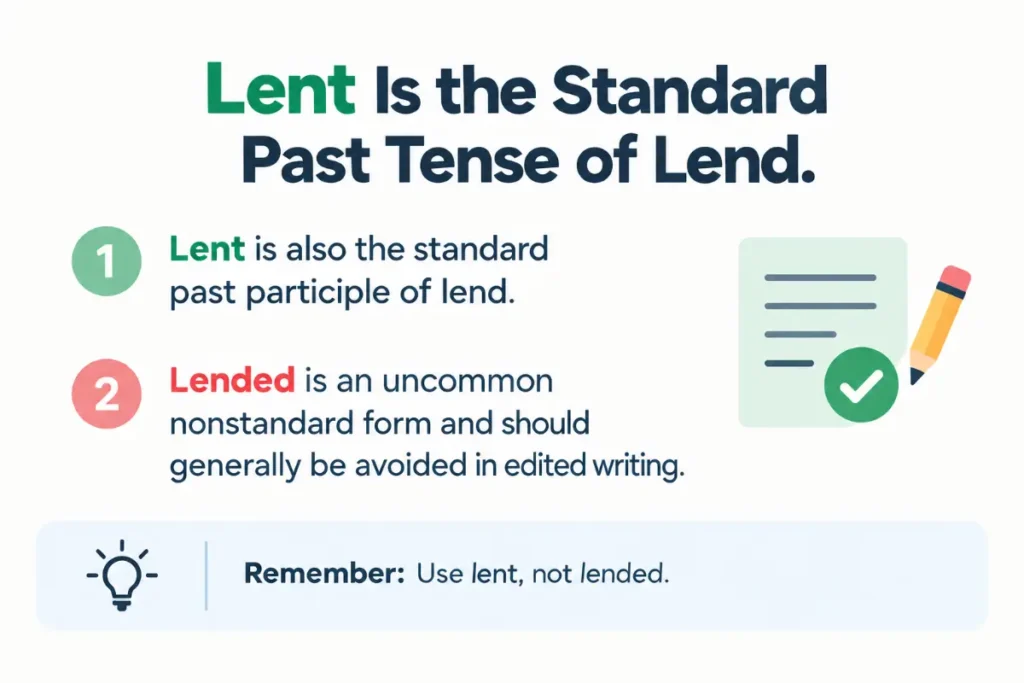
- Lent is the standard past tense of lend.
- Lent is also the standard past participle of lend.
- Lended is an uncommon nonstandard form and should generally be avoided in edited writing.
- Use lend after did, can, could, will, and other helping verbs that require the base form.
- Use lent after have, has, and had when forming perfect tenses.
- Lend describes giving something temporarily, while borrow describes receiving it temporarily.
- Loan is commonly a noun and can also function as a verb.
- Lent is the standard form in both American and British English.
- The easiest memory trick is to connect lend with send and lent with sent.
- When writing for school, work, or publication, choose lent rather than lended.
A related grammar guide is Soo vs So Which Spelling Is Correct.
Conclusion
The correct form in lended vs lent is lent. It serves as both the simple past tense and past participle of the irregular verb lend. Use lend for the base form and present tense, and use lent for completed past actions and perfect tense sentences. Avoid adding ed because this verb follows an established irregular pattern.
A simple way to remember it is to learn the three forms together: lend, lent, lent. Also remember the difference between lend and borrow: the person giving something lends it, while the person receiving it borrows it.
FAQs
Is Lended a Real Word?
Lended appears in some informal speech and writing, but it is not the standard past tense of lend in modern edited English. The accepted form is lent. If you are writing a school assignment, business email, article, or formal document, use lent to keep your grammar correct and natural.
Is Lent or Lended Correct?
Lent is correct in standard English. It is both the simple past tense and the past participle of lend. Lended is a nonstandard form created by adding ed to an irregular verb. For example, write I lent her my book yesterday, not I lended her my book yesterday.
What Is the Past Tense of Lend?
The past tense of lend is lent. Use it when describing an action that happened in the past, such as I lent my friend some money last week. The past participle is also lent, so you say I have lent him money before. The base form remains lend.
Is Lent the Past Participle of Lend?
Yes. Lent is both the simple past tense and the past participle of lend. You use it alone for a completed past action and with have, has, or had in perfect tense sentences. For example, She lent me a book yesterday and She has lent me several books are both correct.
Why Does Lend Become Lent Instead of Lended?
Lend is an irregular English verb, so it does not follow the regular rule of adding ed to form the past tense. Its past form developed from older English and Germanic language patterns. Similar verbs include send and spend, which become sent and spent. Learning these forms helps you remember the correct spelling.
Can I Say Have Lended?
No. In standard English, the correct phrase is have lent. The verb lend uses lent as its past participle, so the same form follows have, has, and had. For example, write They have lent us their equipment, not They have lended us their equipment.
What Is the Difference Between Lend and Borrow?
Lend means to give something temporarily to another person, while borrow means to receive something temporarily from someone else. If you give your friend a book, you lend it to your friend. Your friend borrows it from you. The verbs describe opposite sides of the same exchange.
Is Lent Correct in American and British English?
Yes. Lent is the standard past tense and past participle in American, British, Canadian, and Australian English. There is no major regional spelling difference for this verb. Lended may appear in casual speech, but it is not the accepted form in standard writing across these varieties.