
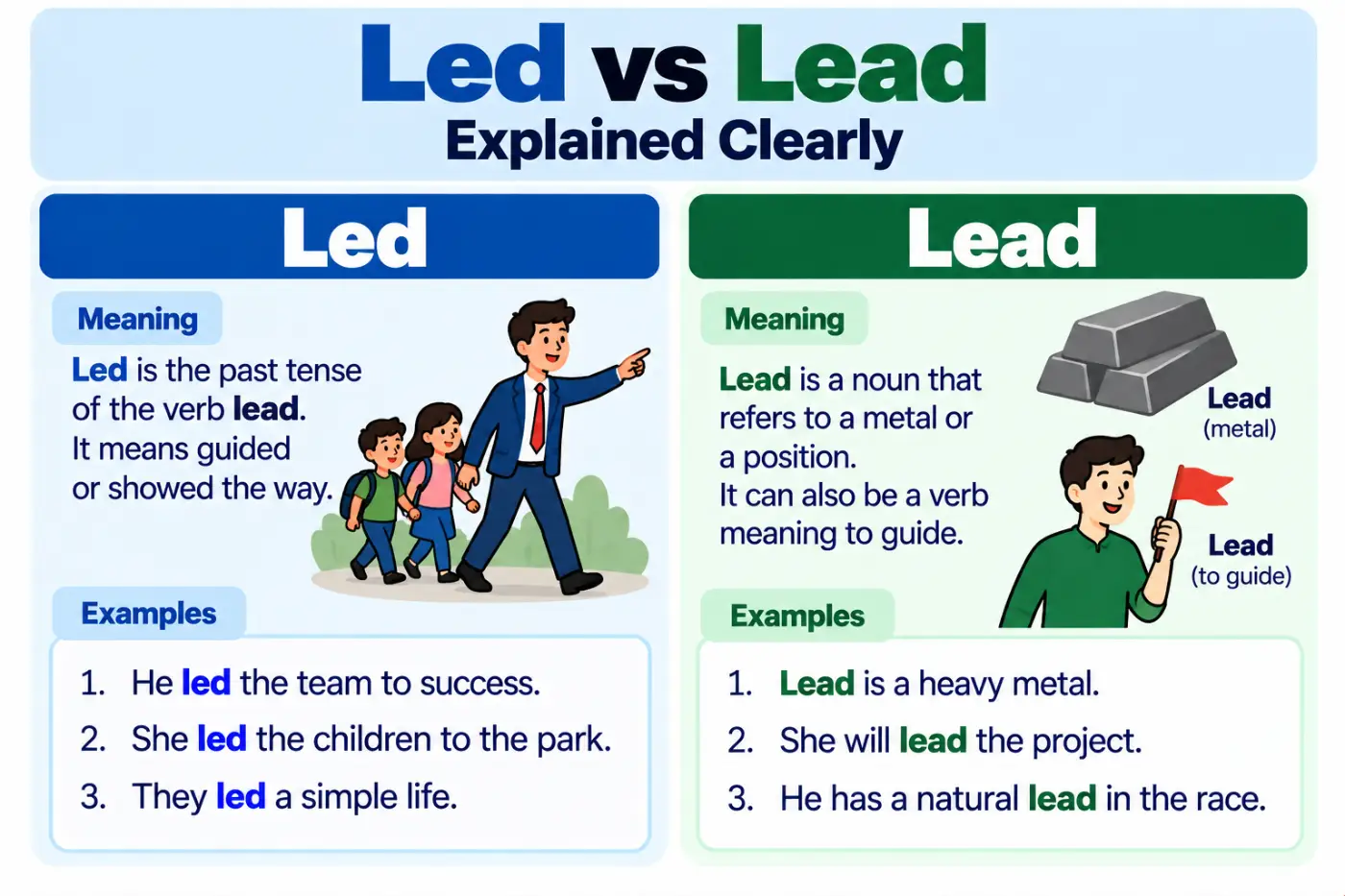
Confusing lead vs led is easy because the two words look and sound similar in some contexts, but they do not have the same meaning or pronunciation. The correct choice depends on the sentence. Lead is the present tense of the verb meaning to guide or direct, while led is its simple past tense and past participle. If you guided a team yesterday, you led the team.
The confusion often comes from the spelling of regular English past tense verbs. Many verbs form their past tense by adding ed, so writers may expect lead to become leaded. However, lead is an irregular verb, and its past form is led. The word lead also has another meaning: a type of metal, pronounced differently from the verb.
Understanding these forms will help you write about leadership, past events, instructions, and results accurately. This guide explains their meanings, pronunciation, grammar, common mistakes, and everyday usage so you can choose the right spelling with confidence.
Still confused? Compare Felt or Feel Which Word Is Correct.
Quick Answer
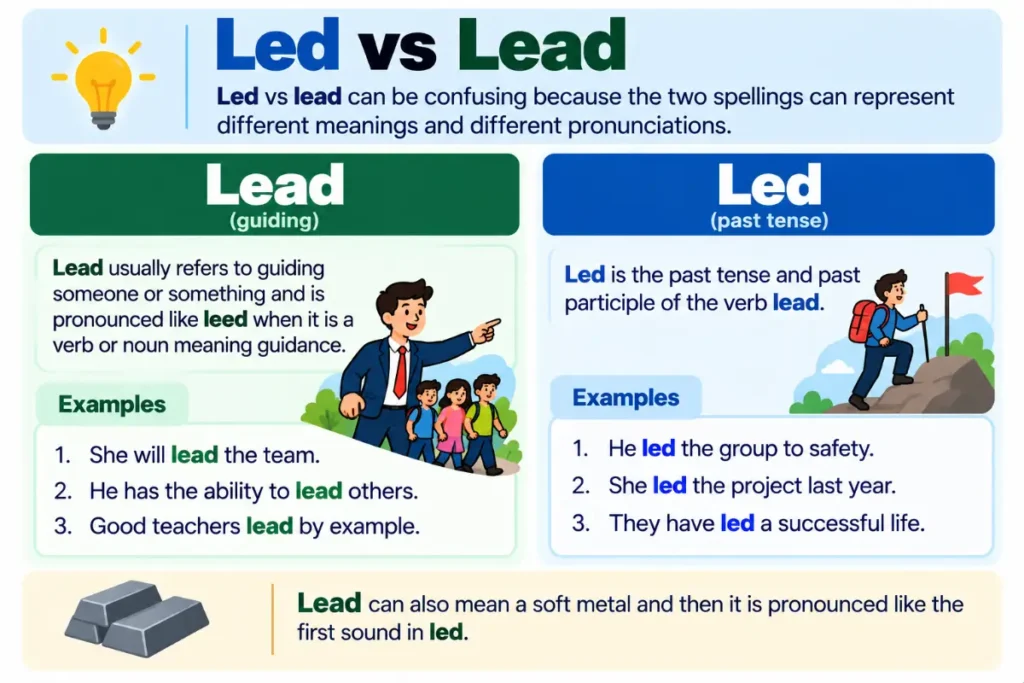
Lead is the present tense of the verb that means to guide, direct, or be in charge. Led is the past tense and past participle of that verb. Write lead when describing a current or future action, and use led when the action happened in the past or follows an auxiliary verb such as has or had.
Comparison Table
| Feature | Lead | Led |
|---|---|---|
| Main meaning | To guide, direct, or be in charge | Guided or directed in the past |
| Part of speech | Verb in present tense; also a noun and adjective in other uses | Past tense and past participle of the verb lead |
| Pronunciation as a verb | /liːd/ | /lɛd/ |
| Syllables | One | One |
| Verb form | Base form and present tense | Simple past and past participle |
| Formality | Standard English | Standard English |
| Common contexts | Leadership, guidance, direction, influence | Past leadership, completed actions, reported events |
| Example | She will lead the department. | She led the department last year. |
Meaning and Definition
What Does Lead Mean?
Lead is a verb that means to guide, direct, manage, or show others the way. A person who leads may be responsible for a group, make decisions, give instructions, or help others reach a goal. The word can describe leadership in a workplace, a school, a sports team, a community, or a family.
For example, a manager may lead a team through a difficult project. A teacher may lead a classroom discussion, and a guide may lead visitors through a museum. In each case, the person takes an active role in directing or guiding others.
The verb can also describe being first or having an advantage. A runner may lead a race, a company may lead its industry, and a team may lead the competition by several points.
Common meanings include:
- To guide people or show them a direction.
- To manage or direct a group.
- To be in first place.
- To cause or contribute to a result.
- To influence someone or something.
- To show the way toward a place or goal.
The word appears in many common expressions, including lead a team, lead a meeting, lead the way, lead by example, and lead a discussion.
What Does Led Mean?
Led is the simple past tense and past participle of the verb lead. It describes an action that has already happened. If someone guided a group yesterday, directed a project last month, or managed a team last year, you use led.
For example, She led the marketing team during the product launch. The action took place in the past, so led is the correct form.
The word also appears after helping verbs such as has, have, and had.
Examples include:
- She led the discussion yesterday.
- He has led the company for five years.
- They had led the project before the new manager arrived.
- Our coach led the team to victory.
- The guide led us through the old town.
Led does not change according to the subject. You write I led, she led, they led, and we led. The form stays the same for all subjects.
Is Lead Ever a Noun?
Yes. Lead is also a noun, and it has several meanings. It can refer to a position of advantage, a clue in an investigation, the main role in a performance, or a piece of information that may help someone find something.
For example, a detective may follow a lead in a case. A news story may contain a strong opening lead. A runner may have a five second lead over the next competitor.
There is also a noun spelled lead that names a soft, heavy metal. This meaning has a different pronunciation from the verb.
What Does the Metal Lead Mean?
The noun lead refers to a chemical element with the symbol Pb and atomic number 82. It is a heavy, soft metal that has been used in products such as batteries, pipes, and some industrial materials.
This noun is pronounced /lɛd/, which sounds exactly like the past tense verb led. That shared pronunciation can create confusion in writing, but context usually makes the meaning clear.
For example:
- The old paint contained lead.
- The teacher led the students into the classroom.
The first sentence refers to a metal. The second describes a past action. The spellings are different because the words have different meanings and grammatical histories.
Key Differences Explained
1. Verb Tense
The most important difference is tense. Lead describes an action in the present or a general habit. Led describes an action that happened in the past.
Compare:
- She leads the team today.
- She led the team last year.
The first sentence describes her current role. The second describes a completed period of leadership.
You can also use lead after will, can, may, and other modal verbs.
For example, He will lead the next meeting. The action has not happened yet, so the base form lead is correct.
2. Pronunciation
The verb lead is pronounced /liːd/, with a long ee sound like the one in see. Led is pronounced /lɛd/, with a short e sound like the one in bed.
The metal lead is pronounced /lɛd/, just like the past tense verb. This creates an unusual spelling and pronunciation pattern: the present tense verb and the metal noun look identical but sound different.
3. Meaning
As a verb, lead means to guide or direct. Led means that the act of guiding or directing took place in the past.
The metal noun lead has an unrelated meaning in modern usage. It names a chemical element rather than an action.
4. Grammar
Lead is the base form of the verb. It appears with I, you, we, and they in the simple present, and with he, she, and it in the form leads.
Led is used for the simple past with every subject. It also functions as the past participle in perfect tenses.
Examples:
- I lead the group.
- She leads the group.
- They led the group.
- He has led the group before.
5. Formality
Both forms are standard in formal and informal English. There is no difference in formality between them. The choice depends on the time of the action and the sentence structure.
You can write, The director led the company through a difficult period, in a formal report. You can also say, I will lead the discussion, in an everyday conversation.
6. Context
The context usually makes the correct form clear. Words such as yesterday, last year, previously, and earlier often signal a past action. Words such as today, now, and every day may point to the present.
However, do not rely only on time words. The verb structure matters too. In the sentence She has led several projects, the helping verb has requires the past participle led.
7. Regional Usage
American, British, Canadian, and Australian English use the same spelling distinction. There is no major regional variation in which form is used for the past tense of the verb.
The pronunciation of the words may vary slightly across accents, but the basic distinction remains. The present tense verb has the long ee sound, while the past tense has the short e sound.
Which Form Is Correct?
Both lead and led are correct words. The right spelling depends on the grammatical role and time of the action. Use lead for the base form and present tense of the verb meaning to guide or direct. Use led for the simple past and past participle.
The verb lead is irregular. Unlike regular verbs that form the past tense by adding ed, it changes its spelling and vowel sound.
Here are examples that show the difference:
- Correct: I lead the weekly team meeting.
- Correct: I led the weekly team meeting yesterday.
- Correct: She will lead the new project.
- Correct: She has led several successful projects.
- Incorrect: She lead the project last year.
- Correct: She led the project last year.
The sentence She lead the project last year is incorrect in standard English because the simple past form is led. The spelling lead is correct only when the sentence requires the base or present form.
A useful way to check your sentence is to replace the verb with guide. If the action happened yesterday, you would say guided, so led is the correct choice. If the sentence describes what someone does now or will do later, use lead.
Sentence Examples
The following examples show how to use both forms in natural situations.
Ten Examples Using Lead and Led
- Everyday conversation: I usually lead the morning walk with my neighbors.
- Text message: Can you lead the discussion while I finish setting up?
- Workplace: Maria will lead the training session next Monday.
- School: Our science teacher leads an experiment every Friday.
- Academic writing: The research team led a detailed investigation into the causes of the problem.
- Formal writing: The director led the organization through a major period of change.
- Social situations: He often leads conversations when the group gets together.
- Online communication: The article explains how poor planning can lead to costly mistakes.
- Sports: The home team led by ten points at halftime.
- Personal development: A good manager leads by example rather than relying only on instructions.
These examples show that lead and led can appear in many settings. The present form describes current, habitual, or future actions, while the past form describes completed actions.
Five Examples of Incorrect and Correct Usage
1. Incorrect: She lead the department last year.
Correct: She led the department last year.
2. Incorrect: He has lead three major projects.
Correct: He has led three major projects.
3. Incorrect: They lead the campaign in 2022.
Correct: They led the campaign in 2022.
4. Incorrect: The coach lead the players to victory yesterday.
Correct: The coach led the players to victory yesterday.
5. Incorrect: I have lead several meetings this month.
Correct: I have led several meetings this month.
Each correction uses led because the sentence requires the past tense or past participle. The word lead may still appear in the same sentence when the grammar calls for the base form.
Common Mistakes and Misspellings
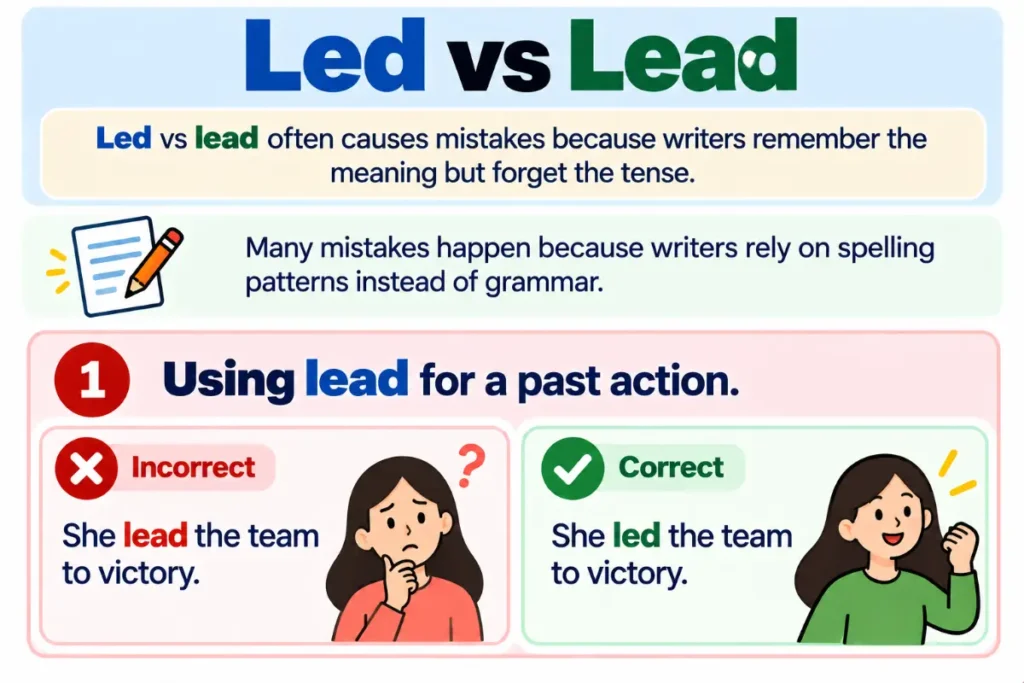
1. Writing Lead Instead of Led for a Past Action
Incorrect: The captain lead the team to victory last night.
Correct: The captain led the team to victory last night.
This mistake happens because writers remember the base form but forget that the verb is irregular. The time phrase last night signals a completed action, so led is required.
2. Writing Lead After Has or Have
Incorrect: She has lead several successful projects.
Correct: She has led several successful projects.
The helping verb has requires the past participle. The past participle of lead is led, not lead. This rule also applies after have and had.
3. Adding an Extra Ending
Incorrect: He leaded the team during the competition.
Correct: He led the team during the competition.
Many English verbs form their past tense by adding ed, so leaded may seem logical. However, lead is irregular, and its standard past tense is led.
4. Confusing the Verb With the Metal
Incorrect: The pipes were made from led.
Correct: The pipes were made from lead.
The metal is spelled lead and pronounced /lɛd/. The past tense verb is spelled led and has the same pronunciation. The surrounding sentence tells you which meaning is intended.
5. Using Leads Instead of Led
Incorrect: The manager leads the team through the merger last year.
Correct: The manager led the team through the merger last year.
Leads is the present tense form used with he, she, or it. The phrase last year signals a past event, so led is the correct form.
A Quick Way to Avoid These Mistakes
Before choosing the spelling, identify the tense and grammatical structure.
- If the action happens now or regularly, use lead or leads.
- If the action happened in the past, use led.
- If the sentence contains has, have, or had before the verb, use led.
- If you are naming the metal, use lead.
- If you are unsure, replace the verb with guide or guided and see which form makes sense.
This simple check prevents most errors.
Pronunciation Guide
How Do You Pronounce Lead?
When lead is used as a verb meaning to guide or direct, it is pronounced /liːd/. It has one syllable and rhymes with need, read in the present tense, and seed.
The easiest way to remember it is to think of the long ee sound in words such as see and tree. The final d is clearly pronounced.
Example: I will lead the meeting.
How Do You Pronounce Led?
Led is pronounced /lɛd/. It has one syllable and rhymes with bed, red, and said. The vowel is short, not long.
Example: She led the team through the difficult period.
How Do You Pronounce the Metal Lead?
The metal noun is pronounced /lɛd/, just like the past tense verb led. This is one reason the spelling can be confusing. The two words sound the same but have different meanings and spellings.
Example: Lead can be harmful if people are exposed to it.
Common Pronunciation Mistakes
Some readers pronounce the verb lead like the metal noun. This changes the meaning and can make the sentence unclear. Remember that the verb meaning guide rhymes with need, while the past tense led rhymes with bed.
The spelling alone does not always tell you the pronunciation. You must consider the meaning and grammatical role of the word.
Learn the difference in Bachelors or bachelor’s Which Spelling Is Correct.
Etymology and Word Origin
The Origin of Lead
The verb lead comes from Old English lædan, which meant to guide, conduct, or bring along. It developed from an older Germanic root and has been used in English for centuries to describe guiding people or directing movement.
Over time, its meaning expanded beyond physical guidance. Today, it can describe managing a team, directing an organization, influencing an outcome, or being first in a competition.
The Origin of Led
Led is the historical past form of the verb lead. It developed through the older forms of the verb and became the standard modern spelling for both the simple past and past participle.
The change from lead to led is part of the verb’s irregular pattern. English contains many irregular verbs that change their vowel or spelling instead of following the usual ed pattern.
Examples include:
- Speak becomes spoke.
- Write becomes wrote.
- Keep becomes kept.
- Lead becomes led.
The Origin of the Metal Lead
The noun lead has a separate history from the verb. Its name comes from Old English lēad and related Germanic forms. It refers to the heavy metal known by the chemical symbol Pb.
Although the metal and the verb have the same spelling in one form, they have different meanings and pronunciation patterns. Their shared spelling is a feature of English vocabulary, not evidence that they are the same word.
Regional Usage
American English
In American English, lead is the standard present form of the verb, and led is the standard past form. You might say, The manager leads the team, or The manager led the team last year.
The metal noun is also spelled lead but pronounced differently from the present tense verb. This distinction applies in everyday speech, education, journalism, and professional writing.
British English
British English follows the same spelling and tense rules. Writers use lead for the present form and led for the past form. The metal noun is also spelled lead and pronounced like led.
There is no meaningful regional difference in the basic grammar. Accent may affect the sound slightly, but the standard forms remain the same.
Australian English
Australian English uses the same verb forms. Lead describes a current or general action, while led describes a completed action. The metal is also spelled lead.
No special Australian spelling rule changes the distinction.
Canadian English
Canadian English follows the same standard pattern as American and British English. The verb changes from lead to led in the past tense, and the metal noun keeps the spelling lead.
For readers across these English varieties, the most reliable guide is the tense of the sentence.
Grammar Rules and Part of Speech
Understanding the grammatical forms makes it easier to choose the right spelling.
Lead as a Base Verb
Lead is the base form of the verb. It appears after modal verbs such as will, can, should, and may. It also follows to in an infinitive phrase.
Examples:
- She will lead the next meeting.
- You can lead the group if you are ready.
- They hope to lead the project.
- We should lead by example.
Do not change the verb to led after a modal. The modal already controls the verb structure, so the base form is required.
Lead in the Simple Present
In the simple present, use lead with I, you, we, and they. Add s to form leads with he, she, and it.
Examples:
- I lead the weekly meeting.
- They lead the school club.
- She leads the sales department.
- He leads by example.
The s in leads is a present tense ending. It does not make the word a past tense form.
Led in the Simple Past
Use led when the action happened and finished in the past. It does not change according to the subject.
Examples:
- I led the discussion yesterday.
- She led the team last season.
- They led the project in 2024.
- We led the campaign before the new director arrived.
Time expressions such as yesterday, last season, and in 2024 often make the past tense clear.
Led as a Past Participle
Led is also the past participle. It appears with has, have, and had in perfect tenses.
Examples:
- She has led three departments.
- They have led several successful campaigns.
- He had led the team before he became director.
The past participle is not the same as the base form. This is why has lead and have lead are incorrect in standard English when you mean that someone has guided or directed something.
Lead as a Noun
The noun lead can describe an advantage, clue, main role, or piece of useful information.
Examples:
- Our team has a five point lead.
- The detective followed a new lead.
- She played the lead in the school musical.
- The reporter wrote a strong lead for the article.
These meanings are separate from the verb’s tense forms. The noun is still spelled lead, even when it refers to something that happened in the past.
Punctuation and Sentence Position
Neither form requires special punctuation. The spelling depends on grammar, not on whether the word appears at the beginning, middle, or end of a sentence.
For example:
- Lead the group carefully.
- She led the group carefully.
- The person who will lead the group is waiting outside.
The first is a command, the second is a past statement, and the third uses the base form after will.
Real Life Usage Examples
Daily Conversation
In everyday speech, the present form describes what someone does now or is responsible for doing. The past form describes a completed action.
- My sister will lead the family trip this summer.
- Our neighbor led the cleanup effort after the storm.
The first sentence refers to a future role, while the second describes an earlier event.
Email and Workplace Communication
Both forms are common in business communication. Use the present form to describe current responsibilities and the past form to report completed work.
- I will lead the client presentation on Thursday.
- Jordan led the project team during the first phase.
These examples are clear and professional. The verb tense tells the reader when the work happens.
Academic Writing
Academic writing uses both forms to describe research leadership, studies, and historical actions.
- The research team leads the investigation into the effects of sleep loss.
- The researchers led a series of interviews with local residents.
The first describes an ongoing role. The second reports a completed research activity.
News and Journalism
News writing often uses the past form to report completed events and the present form for current roles or general statements.
- The mayor led the emergency response after the storm.
- The organization leads a campaign to improve public transportation.
The tense depends on the timeline of the event being reported.
Literature and Storytelling
In stories, the two forms help establish the timeline and describe a character’s role.
- The old guide will lead the travelers through the forest.
- The captain led the crew through the dangerous waters.
The first sentence describes a future action. The second looks back at an event that has already happened.
Related and Confused Terms
These eight words and expressions are useful when writing about direction, leadership, and past actions.
1. Leadership
Leadership is the ability or role of guiding and directing people. A person who leads a team demonstrates leadership by setting goals, making decisions, and supporting others. The noun describes the quality or activity, while lead is the verb.
2. Leader
A leader is a person who guides or directs others. For example, the team leader organizes tasks and helps the group work toward a shared goal. The noun names the person, while lead describes the action.
3. Guided
Guided means showed someone the way or helped direct an activity. It can sometimes replace led, but the best choice depends on the sentence. A tour guide guided visitors through a museum, while a manager led a team through a business change.
4. Directed
Directed means managed, controlled, or gave instructions. It is close in meaning to led, especially in work and project settings. However, directed can emphasize control or instructions, while led can suggest broader guidance and influence.
5. Managed
Managed means organized or controlled a task, group, or process. A manager may lead a team and manage its daily work. The two verbs overlap, but leading often emphasizes direction and influence, while managing often emphasizes planning and organization.
6. Lead the Way
Lead the way means to go first or show others where to go. It can also mean to set an example or introduce a new approach. For example, one company may lead the way in developing safer products.
7. Lead to
Lead to means to cause or contribute to a result. For example, poor communication can lead to mistakes. The expression does not necessarily describe leadership. It describes a connection between an action or condition and its outcome.
8. Take the Lead
Take the lead means to accept responsibility, move into first place, or become the person directing an activity. For example, Maya took the lead during the group project. The expression can describe leadership, competition, or initiative.
Expert Editor Insight
An experienced editor checks the timeline before correcting this word. If the sentence describes a current role, a habit, or a future action after a modal verb, lead may be right. If it describes a completed action or follows has, have, or had, use led. Spelling tools can miss the error because both forms are real words. A practical editing tip is to replace the verb with guide or guided. If guided fits the sentence, led is probably the form you need.
Key Takeaways
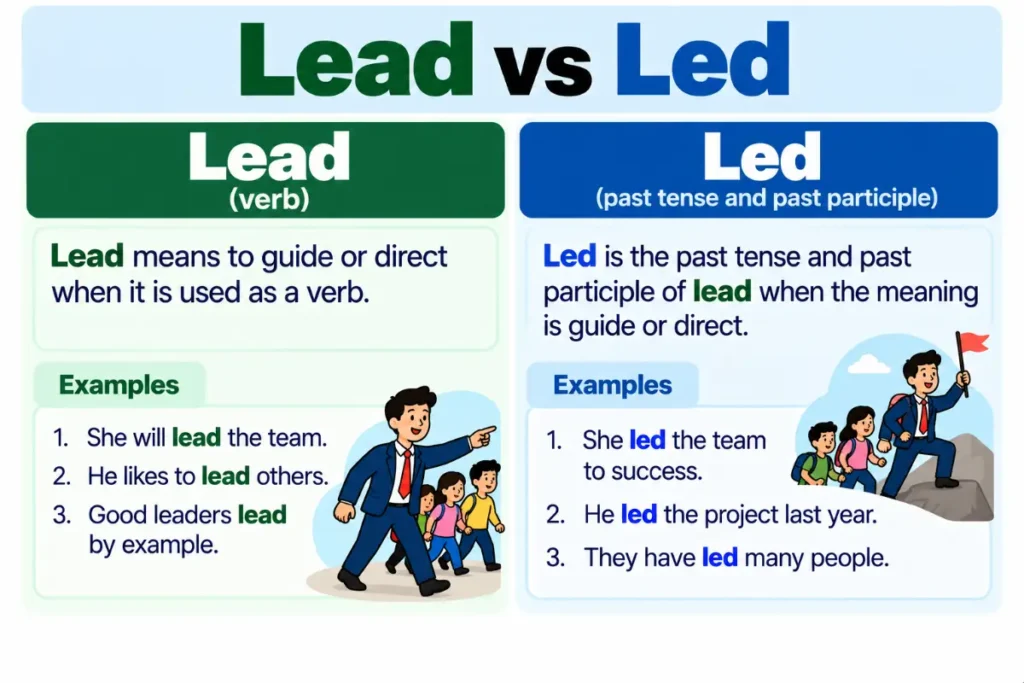
- Lead means to guide or direct when it is used as a verb.
- Led is the past tense and past participle of lead when the meaning is guide or direct.
- Lead can also be a noun meaning an advantage, clue, guidance, or main role.
- Lead can refer to the metal with the chemical symbol Pb.
- Lead meaning guide is pronounced /liːd/.
- Led is pronounced /lɛd/.
- Lead meaning the metal is also pronounced /lɛd/.
- Use lead after modal verbs such as can, will, should, and might.
- Use lead after to when forming an infinitive.
- Use led after have, has, and had when the verb means guide or direct.
- The surrounding meaning usually makes the correct form clear.
- Remember the simplest pattern. Lead now. Led before.
Still confused? Compare Stationary vs Stationery The Easy Way To Tell Them Apart.
Conclusion
The difference between lead vs led is mainly a matter of verb tense. Lead is the present form used for guiding, directing, or being in charge, while led describes an action that happened in the past and also works as the past participle. Both spellings are correct, but they cannot be exchanged freely.
To avoid mistakes, remember the verb pattern lead, led, led. When checking a sentence, replace the word with guide or guided. This simple test helps you choose the right form in emails, schoolwork, reports, and everyday writing.
FAQs
Is Lead or Led Correct?
Both spellings are correct, but they have different grammatical uses. Lead is the base and present tense form of the verb meaning to guide or direct. Led is the simple past and past participle. Use lead for current or future actions and led for completed actions or perfect tense constructions.
Is Led the Past Tense of Lead?
Yes. Led is the simple past tense of the verb lead. For example, She leads the team today becomes She led the team yesterday. Led is also the past participle, so you write She has led the team for three years. It is an irregular verb, so you do not add ed to form leaded.
Why Is Lead Sometimes Pronounced Like Led?
The spelling lead has two common meanings with different pronunciations. As a verb meaning guide, it sounds like need. As a noun naming the metal, it sounds like red. The past tense verb led also sounds like red. Context helps readers identify the intended meaning.
Should I Write Has Lead or Has Led?
Write has led when you mean that someone has guided, directed, or managed something. The helping verb has requires the past participle, and the past participle of lead is led. For example, He has led the team for five years is correct. Has lead is incorrect for this verb meaning.
Is Leaded Ever a Correct Word?
Leaded is a real word in certain contexts, but it is not the standard past tense of the verb meaning to guide. It can describe something containing lead, such as leaded glass, or appear in specialized terms. For the past action of guiding or directing, always use led.
How Do You Remember the Difference?
Think of the verb forms as lead, led, led. The present form rhymes with need, while the past form rhymes with bed. You can also replace the word with guide or guided. If guided makes sense, use led. If guide makes sense, use lead.
Is Lead a Noun as Well as a Verb?
Yes. Lead can be a verb meaning to guide, a noun meaning an advantage or clue, and a noun naming a heavy metal. These uses have different grammatical roles, and the metal noun has a different pronunciation from the verb. The surrounding sentence usually makes the intended meaning clear.
Do American and British English Use Different Forms?
No. American and British English use the same standard forms. Both varieties use lead for the present tense and led for the past tense and past participle. The metal is also spelled lead in both varieties. Accent may affect pronunciation, but it does not change the spelling rule.