
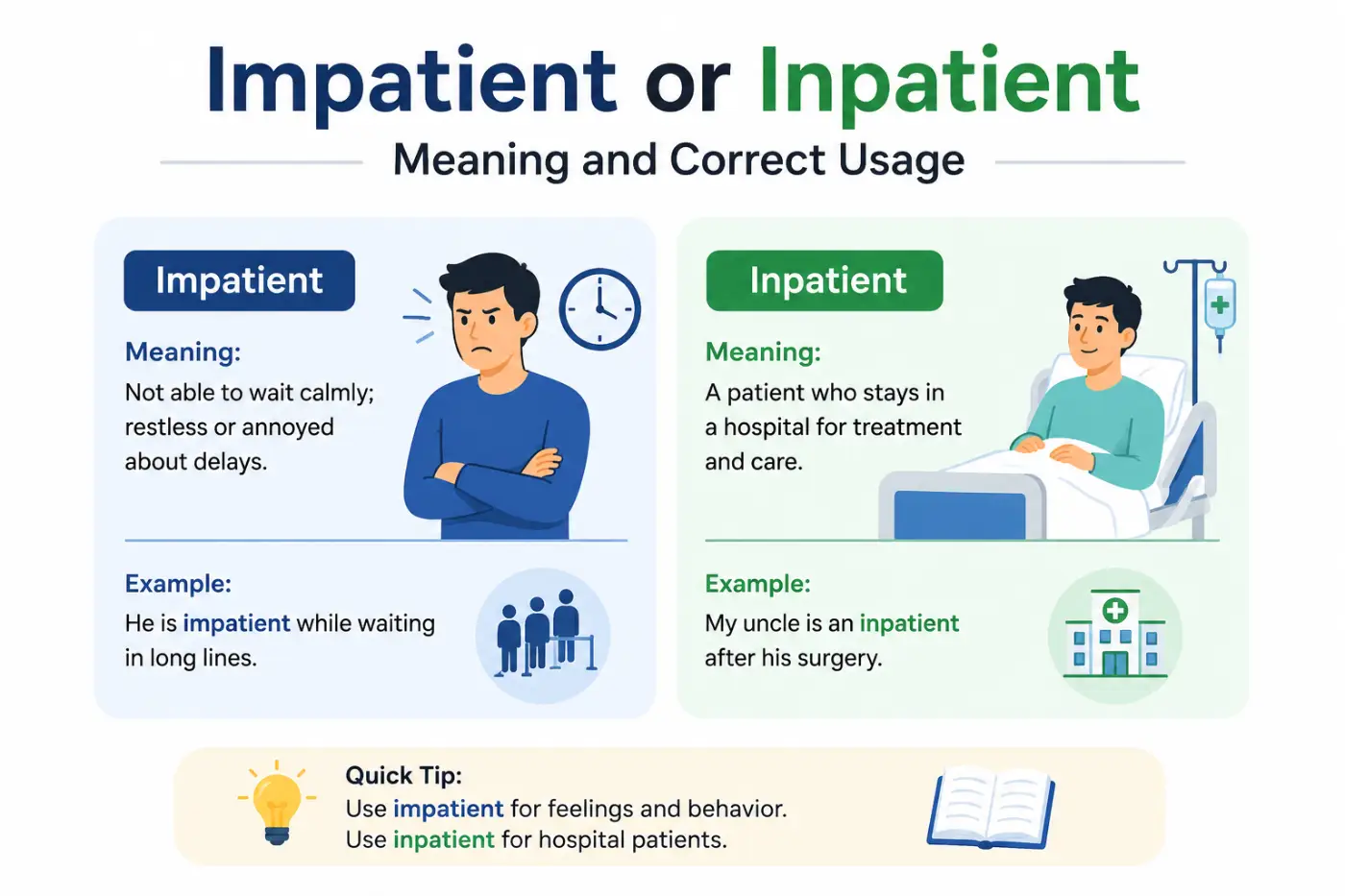
Have you ever confused Impatient or Inpatient while writing a sentence? These words look and sound similar, but they have very different meanings. One describes how someone feels when waiting, while the other refers to a person receiving medical care after being admitted to a hospital or healthcare facility.
Impatient is an adjective that describes someone who finds it difficult to wait calmly or becomes annoyed by delays. For example, a student may feel impatient while waiting for exam results. Inpatient is a healthcare term used for someone admitted to a hospital or another medical facility for treatment and care.
The difference becomes easier to remember when you connect each word with its purpose. Impatient relates to feelings, behavior, and waiting. Inpatient relates to hospital admission and medical treatment. Although the words share several letters and have similar pronunciations, they are not interchangeable.
This guide explains their meanings, pronunciation, grammar, origins, and common uses. You will also find practical examples and answers to frequently asked questions to help you choose the correct word in your writing.
Learn the difference in Mice vs Rat vs Mouse Meaning and Key Differences.
Quick Definition
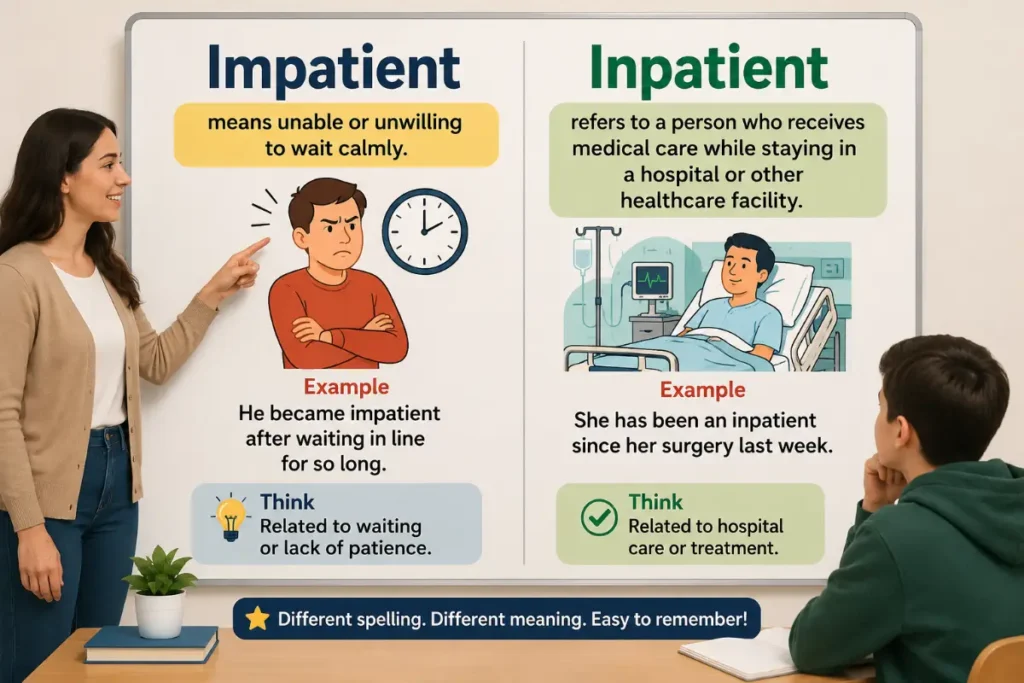
Impatient describes someone who is unable or unwilling to wait calmly, often because of frustration, excitement, or eagerness. Inpatient refers to a person admitted to a hospital or healthcare facility for medical care. Remember that impatient describes a feeling or attitude, while inpatient belongs mainly to the language of healthcare and hospital treatment.
The Main Difference Between Impatient and Inpatient
The main difference lies in meaning and context. Impatient describes a person’s attitude toward waiting or delays. Inpatient identifies a person receiving care as an admitted patient in a medical facility.
| Word | Part of speech | Meaning | Example |
|---|---|---|---|
| Impatient | Adjective | Unable or unwilling to wait calmly | She became impatient during the long wait. |
| Inpatient | Noun or adjective | A person admitted for medical care or something related to admitted patient care | The inpatient stayed in the hospital overnight. |
Both words are correct English words. The right choice depends on what you want to communicate.
If you are describing frustration, eagerness, or difficulty waiting, use impatient. If you are discussing hospital admission, patient care, or medical services for admitted patients, use inpatient.
What Does Impatient Mean
Impatient is an adjective that describes a person who struggles to remain calm while waiting or dealing with delays. It can also describe someone who wants something to happen quickly and becomes frustrated when it does not happen as expected.
For example, a customer waiting for a delayed delivery may become impatient. A child waiting for a birthday party may also feel impatient because of excitement rather than anger.
The word does not always suggest rude or unreasonable behavior. Sometimes, it simply expresses eagerness or a strong desire for progress.
How Impatient Is Used in Everyday English
People use impatient in many situations, including conversations, work, school, travel, and personal relationships.
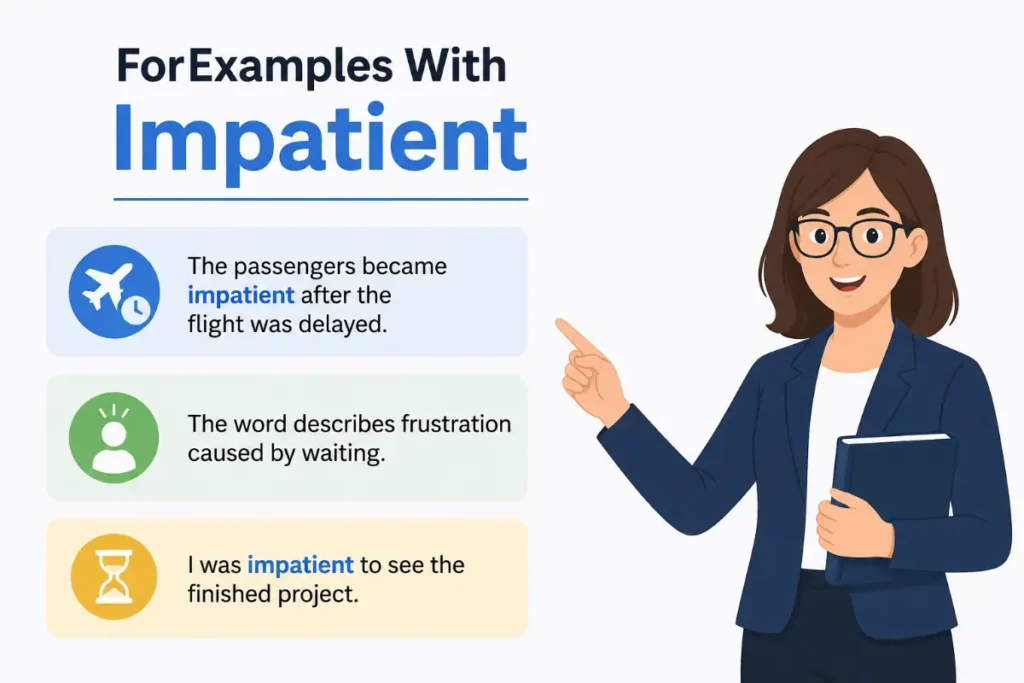
- She grew impatient while waiting for the bus.
- The children were impatient to open their presents.
- My manager became impatient when the meeting ran late.
- He sounded impatient because he had explained the problem several times.
- I am impatient to see the results of our hard work.
In each sentence, impatient describes an attitude, emotion, or reaction. It does not refer to a person’s medical status.
Common Expressions With Impatient
Several expressions help you use impatient naturally.
Impatient with someone or something describes frustration caused by a person, situation, or process. For example, a teacher may become impatient with students who repeatedly ignore instructions.
Impatient for something expresses a strong desire for an event or result. For example, she is impatient for her vacation to begin.
Impatient to do something describes eagerness to take action. For example, the team is impatient to start the new project.
These patterns make the word useful in both formal and informal writing.
What Does Inpatient Mean
Inpatient is a healthcare term that refers to someone admitted to a hospital or another medical facility for treatment, observation, or care. It can function as a noun or an adjective.
As a noun, inpatient means the person receiving care. For example, the hospital admitted three inpatients overnight.
As an adjective, inpatient describes services, treatment, units, or care intended for admitted patients. For example, an inpatient department manages people who have been admitted for medical attention.
Inpatient does not describe a person’s mood or patience. A patient may be calm, worried, cheerful, or impatient, but the term inpatient refers to their healthcare status.
How Inpatient Is Used in Healthcare
Inpatient commonly appears in hospital documents, medical reports, insurance information, and healthcare discussions.
- The hospital admitted the patient as an inpatient.
- The inpatient received treatment under medical supervision.
- The hospital expanded its inpatient services.
- Her doctor recommended inpatient care for further observation.
- The nurse checked the inpatient ward before the evening shift.
These examples show how the word connects to admission and organized medical care.
Inpatient and Outpatient
Inpatient is often contrasted with outpatient. An inpatient is admitted to a healthcare facility for care. An outpatient receives medical services without being admitted as an inpatient.
For example, someone who stays in the hospital after surgery may be an inpatient. Someone who visits a clinic for a routine checkup and returns home afterward is usually an outpatient.
However, the exact classification depends on the healthcare system and the patient’s formal admission status. Some procedures require hospital care without an overnight stay, so the length of the visit alone does not always determine the category.
Why These Words Are Often Confused
Impatient and inpatient are easy to confuse because they share many letters and have similar sounds. Both begin with the letter combination i and end with patient. The small difference near the beginning changes the meaning completely.
Impatient contains the prefix im, which expresses negation in this word. The meaning relates to a lack of patience. Inpatient combines in with patient in the medical sense, referring to someone admitted for care.
The best way to avoid confusion is to focus on the subject of your sentence. If you are describing an emotion or reaction to waiting, impatient is usually correct. If you are discussing hospital admission or services for admitted patients, inpatient is the appropriate choice.
Which Word Is Correct
Neither word is inherently incorrect. Both are standard English words, but they serve different purposes.
Use impatient when describing a person’s feelings or behavior. For example, the passengers became impatient after the train was delayed.
Use inpatient when referring to an admitted patient or a type of medical care provided to admitted patients. For example, the hospital opened a new inpatient unit.
Consider these two sentences.
- The impatient customer asked for an update.
- The inpatient received treatment throughout the night.
The first sentence describes frustration. The second describes a person receiving medical care after admission.
A useful editing habit is to identify the meaning before checking the spelling. Ask yourself if the sentence concerns patience or medical admission. That simple step can prevent most mistakes.
Ten Example Sentences
The following sentences show how both words work in natural English.
- I became impatient when the website took several minutes to load.
- The impatient driver honked because traffic was moving slowly.
- She was impatient to hear the final decision.
- The children grew impatient while waiting for their food.
- He tried not to sound impatient during the phone call.
- The hospital admitted the injured man as an inpatient.
- The inpatient unit provides care for people who require hospital admission.
- Doctors reviewed the inpatient’s condition early in the morning.
- The hospital introduced a new inpatient treatment program.
- The medical team explained the difference between inpatient and outpatient services.
Notice how the surrounding words provide clues. Words such as waiting, delay, and eager often point toward impatient. Words such as hospital, admission, treatment, and ward often point toward inpatient.
Common Mistakes to Avoid
Understanding the meanings is not enough if you overlook the context. These are some common errors to watch for.
Using Inpatient to Describe Frustration
Incorrect usage: He became inpatient while waiting for his appointment.
Correct usage: He became impatient while waiting for his appointment.
The sentence describes frustration caused by waiting, so impatient is the correct word.
Using Impatient for a Hospital Admission
Incorrect usage: The doctor admitted the patient as an impatient.
Correct usage: The doctor admitted the patient as an inpatient.
The sentence refers to medical admission, so inpatient is needed.
Assuming Inpatient Always Means an Overnight Stay
Inpatient care often involves an overnight stay, but the defining factor is formal admission under the relevant healthcare system. Some patients receive hospital treatment without staying overnight, and their classification depends on how the service is recorded.
Thinking Impatient Always Means Angry
Impatient can describe annoyance, but it can also express eagerness. A person who is impatient to begin a new job may feel excited rather than angry.
Choosing a Word Based Only on Sound
The words sound similar, so listening alone may not help. Focus on the meaning of the sentence and the context in which the word appears.
A related grammar guide is Lead vs Led Which Spelling Is Correct.
Pronunciation and Syllables
Both words contain three syllables, and their pronunciations are similar.
| Word | IPA pronunciation | Syllables |
|---|---|---|
| Impatient | /ɪmˈpeɪʃənt/ | im, pay, shunt |
| Inpatient | /ˈɪnˌpeɪʃənt/ | in, pay, shunt |
Pronunciation can vary slightly by accent and dictionary convention. The most noticeable difference is the opening sound. Impatient begins with im, while inpatient begins with in.
To practice, say each word slowly and then use it in a complete sentence. For impatient, think of someone waiting for a delayed bus. For inpatient, picture someone admitted to a hospital.
Connecting pronunciation with meaning helps you remember the words more easily.
Origins and Word Formation
Impatient comes through French and Latin roots. It is related to the Latin word patientem, associated with enduring or suffering, and the negative prefix in. The prefix changes form to im before certain sounds. The resulting word describes a lack of patience or an unwillingness to endure delays calmly.
Inpatient is formed from in and patient in the healthcare sense. It identifies a person receiving care as an admitted patient rather than someone receiving services without inpatient admission.
Although the words share the element patient, their modern meanings differ. Impatient developed as a description of a person’s attitude, while inpatient became established in medical language to describe hospital admission and related care.
Understanding these word parts can make the difference easier to remember. However, context remains the most reliable guide when choosing between them.
Regional Usage
Impatient is widely used in American, British, Canadian, and Australian English. Its basic meaning remains consistent across these varieties. People use it to describe frustration, eagerness, or an inability to wait calmly.
Inpatient is also used across these varieties of English, particularly in healthcare settings. Hospitals, insurance providers, and medical professionals use the term to describe admitted patients and services connected to their care.
Some healthcare systems have different rules for classifying hospital admissions, so the precise administrative meaning can vary by location. Still, the core distinction remains the same: impatient describes a person’s attitude, while inpatient refers to medical admission or care associated with it.
For American English writing, both spellings are standard. You do not need to change either word based on the country alone. Choose according to the meaning of your sentence.
Grammar and Sentence Structure
Impatient functions as an adjective. It usually appears before a noun or after a linking verb.
Examples include an impatient customer, an impatient audience, and the audience became impatient.
It can also be followed by prepositions such as with, for, and to. The choice depends on the intended meaning.
Inpatient can function as a noun or an adjective. As a noun, it identifies the person admitted for care. As an adjective, it describes medical services or facilities connected with admitted patients.
Examples include the inpatient, inpatient treatment, and inpatient services.
One practical way to check your sentence is to look at the word’s grammatical job. If it describes a person’s attitude, use the adjective impatient. If it names an admitted patient or describes a healthcare service, inpatient may be correct.
Real Life Examples in Different Settings
At Work
An employee who becomes frustrated because a meeting keeps getting delayed may be described as impatient. For example, the impatient employee checked the clock several times during the meeting.
Inpatient would be appropriate in a workplace conversation about healthcare benefits or hospital services. For example, the company insurance plan covers eligible inpatient treatment.
At School
A student waiting for exam results may feel impatient because the results have not been released. The word describes an emotional response to waiting.
Inpatient might appear in a lesson about healthcare careers or medical terminology. A nursing student may study how inpatient wards operate and how staff care for admitted patients.
At Home
A child who wants dinner immediately may become impatient while the meal is cooking. An adult may also feel impatient when waiting for a repair service.
Inpatient is more likely to appear in a conversation about a family member who has been admitted to a hospital. For example, the family visited their relative in the inpatient unit.
In Healthcare
Impatient can describe a patient who becomes frustrated by a long wait. It still refers to behavior, not admission status.
Inpatient describes the person’s formal care category. A person can be an inpatient and also feel impatient while waiting for test results. This example shows that the words can describe different aspects of the same person.
Eight Related Words That Can Cause Confusion
Impatience
Impatience is the noun form of impatient. It names the feeling or condition of finding it difficult to wait calmly. For example, his impatience grew as the line became longer.
Patient
Patient can be an adjective describing someone who can wait calmly. It can also be a noun referring to someone receiving medical care. Context tells you which meaning applies.
Patience
Patience is the ability to wait or deal with difficulties calmly. It is the opposite concept of impatience. For example, learning a new language takes patience.
Outpatient
Outpatient refers to someone receiving medical services without being admitted as an inpatient. It is a common healthcare term and often appears alongside inpatient in hospital documents.
Hospitalized
Hospitalized means admitted to or placed in a hospital for treatment or care. It describes an action or state rather than serving as a direct synonym for inpatient in every administrative context.
Admission
Admission is the process or act of accepting someone into a hospital or another facility for care. It is closely related to inpatient status.
Irritable
Irritable describes someone who becomes annoyed easily. An irritable person may also be impatient, but the words do not have exactly the same meaning.
Eager
Eager describes someone who strongly wants to do or experience something. An eager person may be impatient to begin, but eagerness can exist without frustration.
An Expert Editing Tip
When editing a sentence, do not rely on the first few letters alone. Identify the subject and the message you want to communicate.
If the sentence describes someone’s reaction to waiting, choose impatient. If the sentence concerns formal admission to a hospital or medical services for admitted patients, choose inpatient.
You can also replace the word temporarily to test the sentence. If frustrated or eager makes sense, impatient is likely the intended word. If admitted patient or hospital care makes sense, inpatient may be correct.
This method works well during proofreading because it checks meaning before spelling. It also helps you avoid changing a correct word simply because it looks unfamiliar.
Key Takeaways
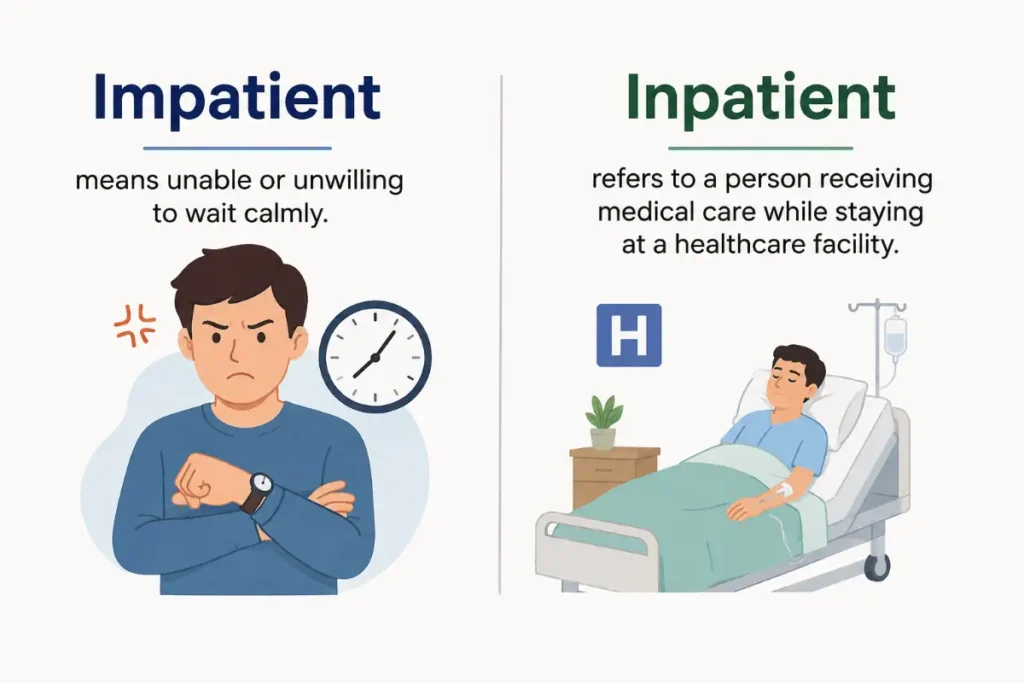
- Impatient means unable or unwilling to wait calmly.
- Inpatient refers to a person receiving medical care while staying at a healthcare facility.
- Impatient is an adjective.
- Inpatient can be a noun or an adjective.
- Patient is the shared word inside both terms.
- Impatient relates to patience and waiting.
- Inpatient relates to medical admission and treatment.
- Outpatient is the common healthcare contrast with inpatient.
- Context usually reveals which word belongs in a sentence.
- Professional and medical writing should use these terms carefully because the meanings are very different.
Many readers also check My vs Mine Which One Is Correct?.
Conclusion
Impatient or Inpatient can be confusing because the words look and sound alike, but their meanings are different. Impatient describes someone who struggles to wait calmly, feels frustrated by delays, or eagerly wants something to happen. Inpatient refers to a person admitted to a hospital or a type of medical care provided to admitted patients.
The easiest way to remember the distinction is to connect impatient with feelings and waiting, and inpatient with hospital admission and treatment. Both words are correct, and neither should replace the other without considering the sentence’s meaning. Before choosing one, think about what you want to describe. With this simple approach and a little practice, you can use both words accurately in everyday conversations, school assignments, professional writing, and healthcare discussions.
Frequently Asked Questions
What Is the Main Difference Between Impatient and Inpatient?
Impatient describes someone who finds waiting difficult or becomes frustrated by delays. Inpatient refers to a person admitted to a hospital or a healthcare facility for treatment. One word describes an attitude, while the other belongs to medical terminology. The surrounding words usually make the intended meaning clear.
Is Impatient a Correct English Word?
Yes. Impatient is a standard English adjective. It describes someone who struggles to wait calmly or wants something to happen quickly. For example, a person may become impatient during a long delay. The word can express frustration, eagerness, or annoyance, depending on the situation.
Is Inpatient Only Used in Hospitals?
Inpatient is used mainly in healthcare and institutional care settings. It commonly refers to a person formally admitted for treatment or observation, or it describes services for admitted patients. Its precise administrative use depends on the healthcare system, but its central meaning relates to receiving care as an admitted patient.
Can a Person Be Both Impatient and an Inpatient?
Yes. The words describe different things, so both can apply to the same person. For example, someone admitted to a hospital may become impatient while waiting for test results. Inpatient describes the person’s healthcare status, while impatient describes their emotional response to the delay.
What Is the Opposite of Impatient?
Patient is the most direct opposite of impatient. A patient person can wait calmly and handle delays without becoming easily frustrated. For example, a patient teacher gives students enough time to understand a lesson. However, patient can also refer to someone receiving medical care when used as a noun.
What Is the Opposite of Inpatient?
Outpatient is the common contrasting term in healthcare. An inpatient is admitted for care, while an outpatient receives medical services without being admitted as an inpatient. The exact classification depends on the healthcare system and the type of service. The distinction is based on care status, not a person’s attitude.
How Can I Remember the Difference?
Connect impatient with patience and feelings. If someone is frustrated or eager because of waiting, impatient is likely correct. Connect inpatient with hospital admission and medical treatment. Remembering these two ideas makes it easier to select the right word when writing emails, reports, assignments, or everyday messages.
Are Impatient and Inpatient Pronounced the Same Way?
No. They sound similar, but their opening sounds differ. Impatient begins with an im sound, while inpatient begins with an in sound. Both generally have three syllables. Since accents can affect pronunciation slightly, practicing each word in a complete sentence is a useful way to hear and remember the difference.