
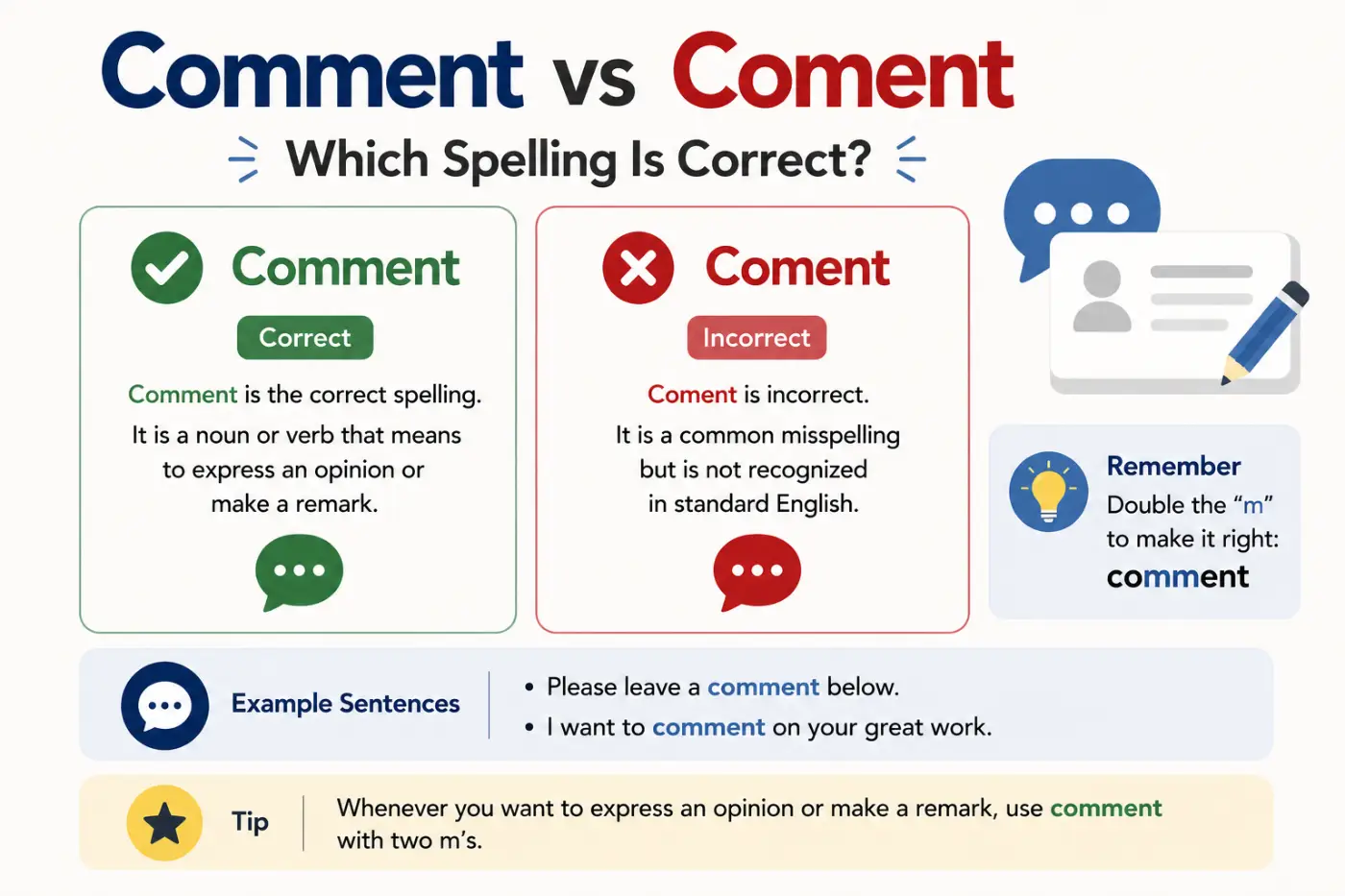
If you’ve ever paused while typing a message and wondered about comment vs coment, you’re not alone. The correct spelling in standard English is comment, with two letters m. The spelling coment is generally incorrect when you mean a remark, an opinion, or a response to something.
The confusion makes sense. English has many words with unusual spelling patterns, and a single missing letter can turn a correct word into a spelling mistake. Since both forms look almost identical, it’s easy to overlook the difference while typing quickly.
However, learning the correct form is straightforward once you understand its meaning and how to use it. A comment can be a quick reply on social media, a suggestion from a coworker, a note on a school assignment, or an observation during a conversation.
This guide explains the correct spelling, its meaning, pronunciation, grammar, and common uses. You’ll also find practical examples, related words, regional guidance, and editing tips to help you write with confidence.
You may also want to read Mather vs Mother Which Spelling Is Correct.
Quick Answer.
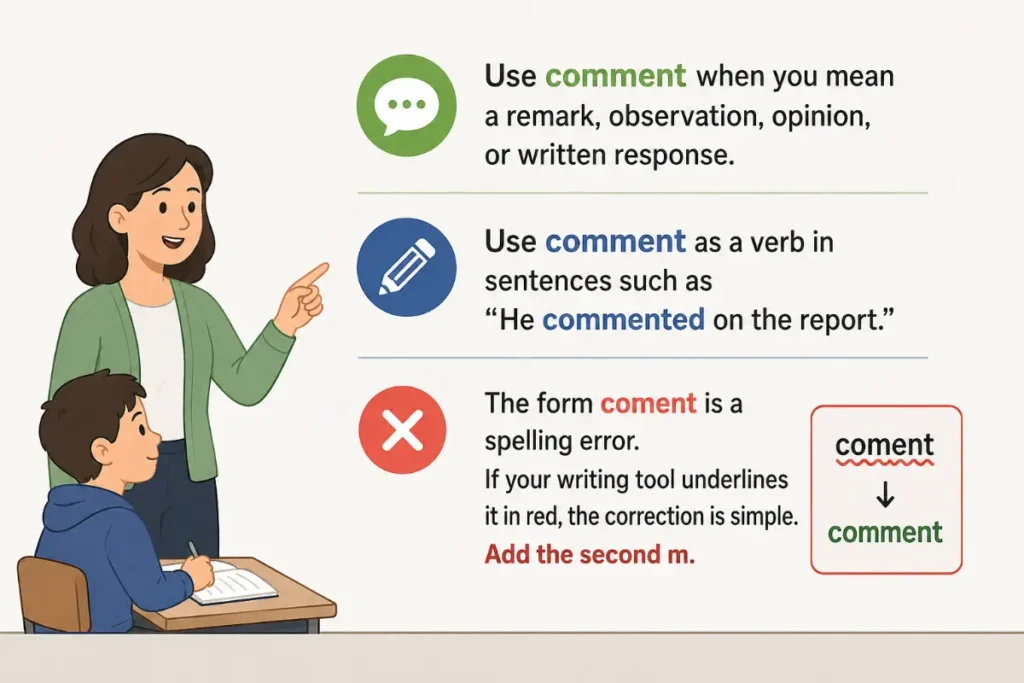
Comment is the correct spelling in standard English. It refers to a spoken or written remark, an observation, or feedback about something. Coment is generally a misspelling of comment and should not be used in ordinary English writing. Remember the double m to avoid this common typing mistake.
Meaning and Definition.
What Does Comment Mean.
Comment is a noun and a verb in English. As a noun, it means a remark, opinion, observation, or response about a person, event, idea, or piece of work. As a verb, it means to express an opinion or make a statement about something.
Here are two simple examples.
- As a noun, you might say, “Your comment helped me understand the assignment.”
- As a verb, you might say, “Please comment on the report before Friday.”
The word appears in everyday conversation and professional settings. You can leave a comment under a social media post, add comments to a document, or comment on a recent event during a discussion.
What Does Coment Mean.
In standard English, coment is not the accepted spelling of the ordinary word meaning a remark or opinion. Most readers will recognize it as a spelling error.
For example, writing “Thank you for your coment” in an email is incorrect. The standard version is “Thank you for your comment.”
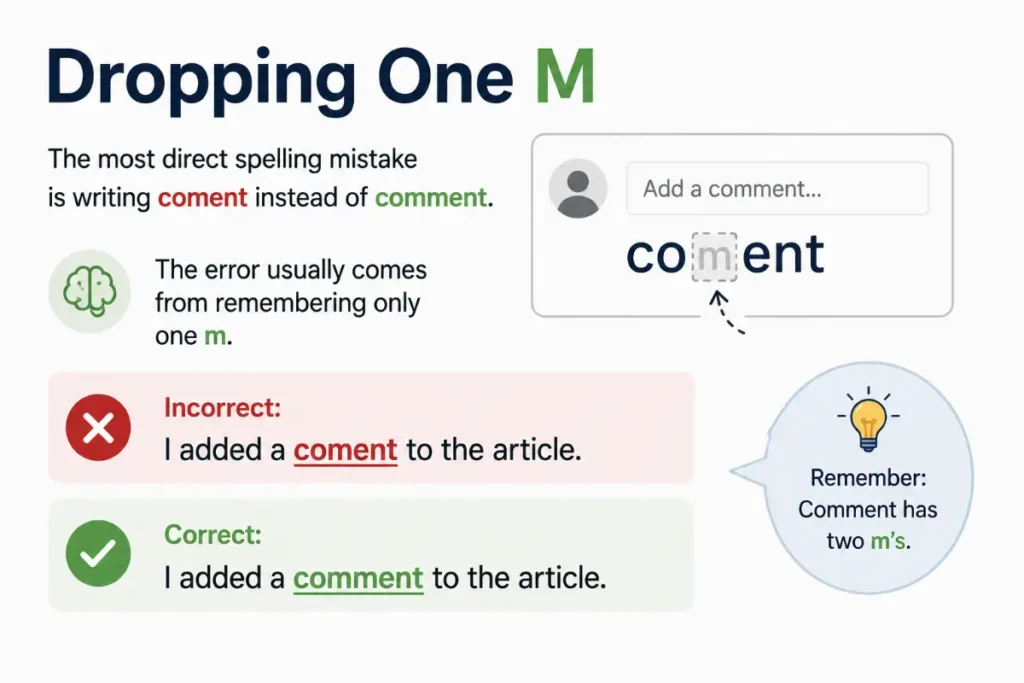
The misspelling usually occurs when someone accidentally leaves out one of the two m letters. It may also result from fast typing, unfamiliarity with the spelling, or a typing tool that fails to catch the error.
There is no need to treat the incorrect form as a separate English word simply because people sometimes type it. In ordinary writing, use comment.
Key Differences Explained.
The main difference is spelling. The standard word contains two m letters, while the incorrect form contains only one.
Spelling.
The correct spelling is comment. It contains seven letters, including two consecutive m letters.
The incorrect spelling contains six letters and leaves out one m. That small difference matters in school assignments, work emails, online discussions, and other written communication.
A useful memory trick is to picture the two m letters as a pair that always stays together in the word.
Meaning.
Comment has a clear meaning in standard English. It describes a remark or the act of expressing an opinion.
The misspelled form does not carry a separate standard meaning in ordinary English. If a reader encounters it in a sentence, they will usually understand that the writer intended to use the correct word.
Grammar.
The correct word functions as both a noun and a verb.
- Noun example. “Her comment was helpful.”
- Verb example. “He will comment on the results.”
The incorrect spelling does not become grammatically acceptable simply because it appears in a sentence. Correct spelling still matters when the word serves as a noun or a verb.
Pronunciation.
Both spellings may lead a reader to imagine the same pronunciation. However, the standard written form remains comment.
In American English, the word usually has two syllables, with the stress on the first syllable. The second m does not create another sound. It forms part of the spelling pattern.
Formality.
Comment is suitable for casual messages, business emails, academic work, news writing, and formal reports. Its meaning and tone depend on the surrounding sentence.
The misspelled form is unsuitable for standard professional or academic writing. Even if the reader understands the intended meaning, the error can make the text appear rushed or poorly edited.
Regional Usage.
American, British, Canadian, and Australian English all use comment as the standard spelling. There is no common regional spelling rule that changes it to coment.
Comparison Table.
| Feature | Comment | Coment |
|---|---|---|
| Standard spelling | Correct | Incorrect in ordinary English |
| Letter count | Seven | Six |
| Double m | Yes | No |
| Part of speech | Noun and verb | Not a standard form of this word |
| Meaning | A remark or to express an opinion | Usually intended to mean comment |
| Pronunciation | Commonly pronounced kuh ment | Usually intended to have the same pronunciation |
| Formality | Suitable for formal and informal writing | Avoid in standard writing |
| Regional usage | Standard across major English varieties | Not a recognized regional alternative |
| Common context | Messages reports feedback and online discussions | Usually a typing or spelling mistake |
| Example | Please comment on the proposal. | Please coment on the proposal. |
Which Form Is Correct.
Comment is the correct choice in standard English. The spelling follows the established form used in dictionaries and ordinary written communication.
English spelling does not always match pronunciation one letter at a time. Some words contain repeated consonants even though those letters do not represent separate sounds. Comment is one such word.
The best approach is to learn the accepted spelling rather than trying to spell the word from sound alone. When writing quickly, you might hear the word in your mind and type only one m. A quick proofreading check can catch the missing letter.
Use these rules as a guide.
- Write comment when you mean a remark, observation, or response.
- Write comments when you mean more than one remark.
- Write commented when describing a past action.
- Write commenting when describing an ongoing action.
- Keep the double m in every form of the word.
For example, comment, comments, commented, and commenting all retain the same double m pattern.
Sentence Examples.
The following sentences show how to use the correct spelling naturally in different situations.
- Everyday conversation. “Your comment made me think about the problem in a new way.”
- Text message. “I saw your comment and wanted to thank you for the advice.”
- Workplace communication. “Please add a comment to the report if you notice an error.”
- School assignment. “The teacher wrote a helpful comment at the end of my essay.”
- Academic writing. “The author includes a brief comment on the limits of the study.”
- Formal communication. “We appreciate your comment regarding the proposed changes.”
- Social situations. “His comment made everyone laugh during dinner.”
- Online communication. “You can leave a comment below the video.”
- News discussion. “The spokesperson declined to comment on the announcement.”
- Team collaboration. “I added a comment to explain why I changed that section.”
Each sentence uses the same standard spelling. The word can refer to a written response, a spoken remark, or the act of sharing an opinion.
Five Examples of the Spelling Error.
These examples show the mistake for learning purposes. The form with one m is incorrect in each sentence.
- Incorrect. “Thank you for your coment.” Correct. “Thank you for your comment.”
- Incorrect. “Please leave a coment below.” Correct. “Please leave a comment below.”
- Incorrect. “I have one coment about the proposal.” Correct. “I have one comment about the proposal.”
- Incorrect. “The teacher added a coment to my essay.” Correct. “The teacher added a comment to my essay.”
- Incorrect. “She refused to coment on the issue.” Correct. “She refused to comment on the issue.”
Notice how the meaning stays the same after you correct the spelling. The only change is the missing m.
Common Mistakes and Misspellings.
Small spelling errors often slip into writing because the writer focuses on meaning rather than the exact letters. Here are five mistakes to watch for when using this word.
1. Writing coment instead of comment. This is the main error. The writer leaves out one m, often while typing quickly. Correct it by checking the two consecutive m letters before sending the message.
2. Writing commment with three m letters. Adding an extra consonant is also incorrect. The standard spelling contains exactly two m letters in a row, not one or three.
3. Writing comments as coment’s. The apostrophe is unnecessary when you mean more than one remark. Use comments for the plural form. Use comment’s only when the word shows possession, as in “The comment’s meaning was unclear.”
4. Writing commentted instead of commented. The past tense does not need an extra t. The correct form is commented, with the original double m followed by e, d, and the remaining letters.
5. Using comment when another word fits better. A comment is a remark or opinion. If you mean a detailed evaluation, review may be more suitable. If you mean a proposed improvement, suggestion may express your point more clearly.
These mistakes are easy to fix once you learn the basic spelling pattern. A quick spelling check can prevent them from appearing in your final text.
Pronunciation Guide.
The word has two syllables and usually carries stress on the first syllable. Its pronunciation stays the same across the noun and verb forms.
Still confused? Compare hope you are doing well Meaning And Better Ways To Use It.
Comment
Noun and verb
IPA
/ˈkɑːmɛnt/ in a common American pronunciation, with some variation by accent.
Syllable breakdown
com ment.
Easy pronunciation guide
kuh ment, with the first syllable stressed.
How to Say the Word Naturally.
Start with the first syllable and then move smoothly into the second. In many American accents, the first vowel sounds similar to the vowel in calm, although the exact sound can vary by region.
The double m does not mean you pronounce the m sound twice. It is a spelling feature, not an instruction to repeat the sound.
A common mistake is to place equal stress on both syllables. In normal speech, the first syllable usually receives more emphasis. Try saying the word in a sentence, such as “Please comment on the report.” This helps you hear its natural rhythm.
The incorrect spelling may look shorter, but it does not represent a different standard pronunciation. The spelling still needs two m letters.
Etymology and Word Origin.
The English word comment has a long history connected to explanation, interpretation, and discussion. It entered English through French and ultimately traces back to Latin.
The Latin word commentum referred to an invention, idea, or contrivance. It is associated with the verb comminisci, meaning to devise or imagine. Over time, related forms developed meanings connected to interpretation and explanatory remarks.
English adopted the word and expanded its use. Today, a comment can be a short personal remark, a note explaining a passage, or feedback about a piece of work. As a verb, it describes the act of expressing an observation or opinion.
This history helps explain the word’s broad range of uses. A comment may be brief and casual, such as a reply to a friend’s post, or detailed and formal, such as an observation in an academic discussion.
The historical origin does not support treating coment as an alternative spelling. The accepted modern English form is comment.
Regional Usage.
The spelling remains consistent across the major varieties of English. Unlike words such as color and colour, this word does not have a standard American and British spelling difference.
American English.
Comment is the standard spelling in the United States. It appears in workplace emails, school assignments, news reports, social media posts, and everyday conversations.
American writers also use related forms such as comments, commented, and commenting. Each form retains the double m.
British English.
British English uses the same spelling. A British writer may comment on a proposal, add comments to a document, or ask someone to comment on a news story.
There is no general British spelling rule that removes one m.
Australian English.
Australian English follows the same standard spelling. Comment is appropriate in both casual and professional writing, and its grammatical forms remain unchanged.
Canadian English.
Canadian English also uses comment. The spelling does not change based on Canadian vocabulary preferences or the country’s mix of American and British conventions.
For readers in all four regions, the safest rule is simple. Use comment with two m letters.
Grammar Rules and Part of Speech.
The word is flexible because it works as both a noun and a verb. Understanding its grammatical role helps you use it correctly in different sentences.
Using Comment as a Noun.
A noun names a person, place, thing, or idea. In this case, comment refers to a remark or observation.
You can use it with an article, an adjective, or a possessive word.
- “I have a comment about the schedule.”
- “Her final comment was especially useful.”
- “The manager’s comment clarified the decision.”
The plural form is comments. For example, “The editor left three comments on the draft.”
Using Comment as a Verb.
As a verb, comment describes the act of expressing an opinion or observation. It often appears with the preposition on.
- “Please comment on the new policy.”
- “The professor commented on my research.”
- “She rarely comments on online arguments.”
The phrase comment on is common when someone responds to a topic, event, or idea. In formal writing, comment on a subject is often more natural than comment about a subject, although both can appear in everyday English.
Verb Forms.
The standard verb forms are comment, comments, commented, and commenting. The spelling pattern stays consistent throughout.
- Present tense. “I comment on the weekly report.”
- Third person singular. “She comments on every draft.”
- Past tense. “They commented on the results.”
- Present participle. “He is commenting on the proposal.”
Punctuation and Possession.
Use punctuation according to the sentence, not the spelling of the word itself.
A sentence may end with a period, a question mark, or an exclamation point, depending on its purpose. A direct question might read, “Do you have a comment?” A statement might read, “I have one comment.”
Remember that comments is a plural noun, while comment’s usually marks possession or represents the contraction comment is. For example, “The comment’s tone was friendly” shows possession. “The comment’s helpful” means “The comment is helpful,” though the expanded form is often clearer in formal writing.
Formal and Informal Usage.
Comment fits almost any level of formality. You can use it in a casual text, a business report, a class discussion, or an academic paper.
The surrounding language determines the tone. “Drop a comment below” sounds casual, while “Please provide a comment on the findings” sounds more formal. Both use the same correct spelling.
Real Life Usage Examples.
The word appears in many kinds of communication. The examples below show how its meaning and tone change with the setting.
Daily Conversation.
In casual speech, a comment is often a short remark or reaction. It can express humor, agreement, surprise, or concern.
- “That was a thoughtful comment about the movie.”
- “I didn’t mean my comment to sound rude.”
The first example describes an observation. The second explains the speaker’s intention. In both cases, the word refers to something someone said.
Email and Workplace Communication.
At work, comments often help people review documents, share feedback, and make decisions. Clear wording helps prevent confusion and keeps discussions productive.
- “Please add your comments to the shared report by Thursday.”
- “I have one comment about the proposed budget before we approve it.”
The plural form works well when several people are reviewing a document. The singular form is useful when a person wants to raise one specific point.
Academic Writing.
Students and researchers use comments to explain ideas, assess arguments, and respond to findings. The word can refer to informal classroom feedback or a more careful scholarly observation.
- “The professor’s comment helped me improve my thesis statement.”
- “The researcher added a brief comment about the study’s limitations.”
In academic writing, a comment may need supporting evidence or a clear explanation. The word itself does not automatically make an observation formal or authoritative.
News and Journalism.
News reports often use comment when describing official responses or statements. Journalists may ask a public official to comment on a decision or report that an organization declined to comment.
- “The mayor declined to comment on the proposal.”
- “The company issued a comment after the announcement.”
The verb phrase declined to comment means the person chose not to provide a statement. The noun phrase a comment refers to the statement itself.
Literature and Storytelling.
In literature, a comment can reveal a character’s attitude or add meaning to a scene. Writers may also use commentary to explain an idea or offer a broader interpretation.
- “Her quiet comment revealed how disappointed she felt.”
- “The narrator makes a sharp comment about the town’s social rules.”
These examples show how a short remark can carry more meaning than its length suggests. Context helps readers understand the speaker’s purpose.
Related and Confused Terms.
Several English words have meanings close to comment. Choosing the right one helps you express your idea more precisely.
1. Remark. A remark is something a person says or writes. It is close in meaning to comment, especially when referring to a short observation. For example, “His remark surprised the audience.”
2. Observation. An observation is something noticed or stated about a situation. It often sounds more analytical than a casual comment. For example, “Her observation about the results was useful.”
3. Feedback. Feedback gives information about performance, quality, or progress. It often helps someone improve their work. For example, “The editor gave me feedback on my article.”
4. Review. A review evaluates something in more detail, such as a book, product, film, or proposal. A comment may be only one part of a review. For example, “I wrote a review of the new laptop.”
5. Opinion. An opinion expresses what someone thinks or believes. A comment may contain an opinion, but it can also state a fact or observation. For example, “In my opinion, the plan needs more work.”
6. Suggestion. A suggestion offers an idea or possible course of action. A comment may point out a problem without offering a solution. For example, “My suggestion is to move the meeting to Friday.”
7. Response. A response is a reply to something someone says, asks, or does. A comment can be a response, but the word response covers a wider range of reactions. For example, “Her response answered my question.”
8. Commentary. Commentary usually refers to discussion or explanation about a subject. It can be more extended than a single comment. For example, “The documentary includes commentary from several experts.”
These words overlap, but they are not always interchangeable. Use comment for a general remark, feedback for guidance, review for evaluation, and suggestion for a possible improvement.
When To Avoid Confusing It With Online Comments
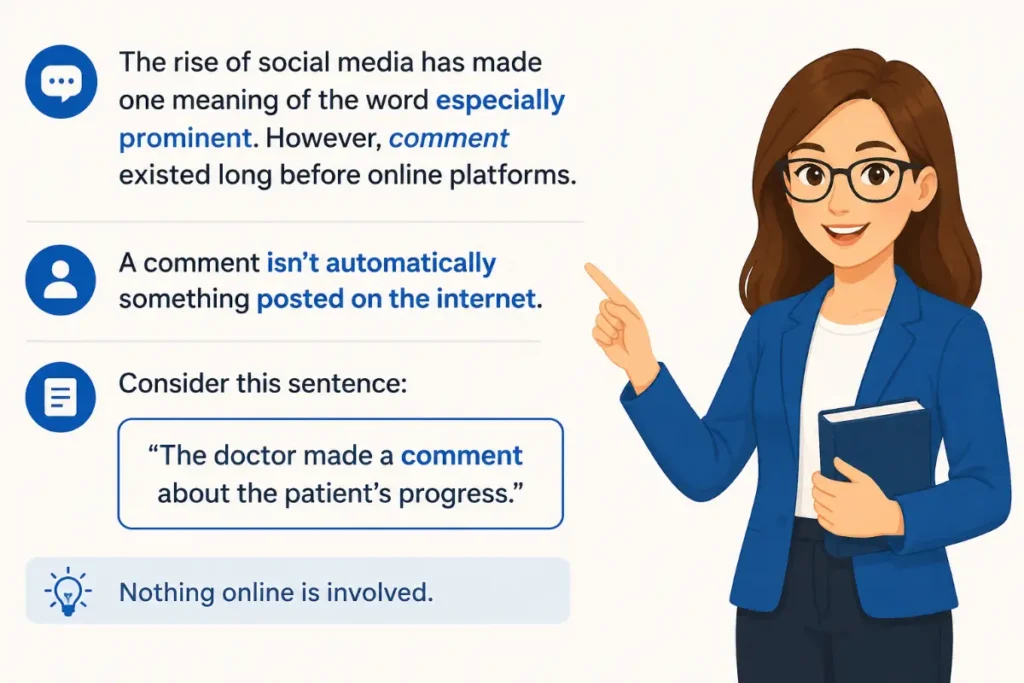
The rise of social media has made one meaning of the word especially prominent. However, comment existed long before online platforms. A comment isn’t automatically something posted on the internet.
Consider this sentence:
“The doctor made a comment about the patient’s progress.”
Expert Editor Insight
An experienced editor treats the spelling as a simple but worthwhile quality check. The missing m rarely prevents readers from understanding the intended meaning, yet it can distract them and reduce confidence in the writing. Spell checkers often catch the error because the one m form is not the standard spelling of the intended word, although software can miss mistakes in some contexts. My practical advice is to proofread short, familiar words as carefully as long ones. They’re easy to type without thinking, which makes them easy to overlook.
For another common grammar confusion, see incall vs outcall What Is the Difference.
Conclusion
When comparing comment vs coment, remember that comment is the correct spelling in standard English. It works as both a noun and a verb, so you can use it to describe a remark, share feedback, or express an opinion. The alternative spelling is generally a mistake caused by leaving out one m.
The same spelling rule applies in American, British, Canadian, and Australian English. You don’t need to learn separate regional versions or change the word for formal writing. Simply remember the double m, review your sentence, and use a spelling checker when needed. A small proofreading habit can make your emails, school assignments, reports, and online posts clearer and more professional.
FAQs.
Is Coment a Real English Word?
Coment is not the standard English spelling of the word that means a remark or opinion. In ordinary writing, readers will usually interpret it as a misspelling of comment. Unless you’re reproducing a name or a special term that deliberately uses this spelling, write comment with two m letters.
What Does Comment Mean?
Comment can mean a spoken or written remark, an observation, or an opinion about something. It also works as a verb that means to express an opinion or make an observation. For example, you can leave a comment on a post or comment on a report during a meeting.
Which Spelling Should I Use in American English?
Use comment in American English. The same spelling is standard in British, Canadian, and Australian English. There is no accepted regional rule that changes the word to coment. Keep the two m letters in the singular form and in related forms such as comments, commented, and commenting.
How Do You Pronounce Comment?
In American English, comment usually has two syllables, with stress on the first. Its pronunciation is commonly represented as /ˈkɑːmɛnt/, though vowel sounds vary across American accents. Say the first syllable with more emphasis, then move naturally into the second. The two m letters do not create two separate m sounds.
Can Comment Start a Sentence?
Yes. Comment can begin a sentence when the grammar supports it. For example, “Comment on the final paragraph before submitting your essay” uses the word as a verb in a command. You can also start with the noun, as in “Comments from the audience helped improve the presentation.”
What Is a Synonym for Comment?
Useful alternatives include remark, observation, response, and opinion. Feedback works when you’re discussing advice or an assessment, while suggestion fits a proposed action. The best choice depends on the intended meaning. A short remark may be a comment, but a detailed evaluation is often better described as a review.
Why Do People Misspell Comment?
People often misspell the word because they type quickly or rely on how the word sounds. Since the second m does not create a separate sound, it’s easy to leave it out by mistake. Learning the written pattern and checking the spelling before sending a message can help prevent this error.
Is Comment Appropriate for Formal Writing?
Yes. Comment is standard in professional, academic, and formal writing. You can use it in a report, research paper, business email, or official statement. The key is to choose a suitable tone and provide enough context. Avoid the misspelled form in edited writing because it is not the accepted spelling.