

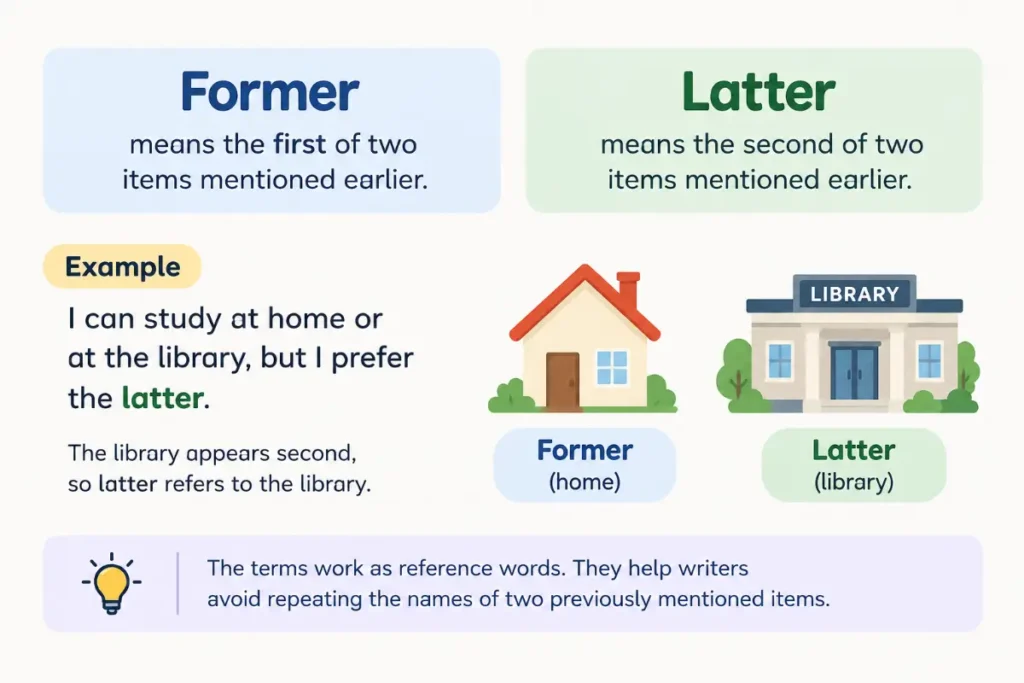
Have you ever read a sentence that mentions two choices and then refers to the former vs latter? The distinction can seem confusing at first. The good news is that both words are correct English, but they point to different things. In former vs latter, former refers to the first of two people or things already mentioned, while latter refers to the second.
For example, if someone says they enjoy reading and writing but prefer the former, they mean reading. If they prefer the latter, they mean writing. The words help writers avoid repeating names and phrases, especially in academic work, business documents, and formal discussions.
However, these terms can make a sentence harder to understand if the reader forgets the original order of the choices. You’ll learn what each word means, how the grammar works, how to pronounce them, and when to use simpler alternatives. With a few practical examples and an easy memory trick, you’ll be able to use both terms with confidence.
Many readers also check Stationary vs Stationery The Easy Way To Tell Them Apart.
Quick Answer
Former refers to the first of two people or things mentioned. Latter refers to the second. Both are standard English words, and neither is a misspelling. For example, in the sentence I enjoy tea and coffee, but I prefer the latter, the speaker prefers coffee because it was mentioned second.
Comparison Table
| Feature | Former | Latter |
|---|---|---|
| Main meaning | The first of two | The second of two |
| Part of speech | Adjective or noun | Adjective or noun |
| Refers to | An earlier item in a pair | A later item in a pair |
| Word order | First position | Second position |
| Pronunciation | FOR mer | LAT er |
| Formality | Common in formal and everyday English | Common in formal and everyday English |
| Common contexts | Essays, reports, conversations, comparisons | Essays, reports, conversations, comparisons |
| Example | I chose apples and oranges. The former were cheaper. | I chose apples and oranges. The latter were sweeter. |
The two terms work as a pair when a writer wants to refer back to two previously mentioned people, objects, ideas, or choices. Their meanings depend on the order of the items in the earlier sentence.
Meaning and Definition
What Does Former Mean
Former means the first of two people or things mentioned in a sentence or discussion. It can also describe someone or something that held a position or condition in the past.
Consider these examples.
- I considered a laptop and a tablet. The former was more suitable for my work.
- She is a former teacher who now runs a bookstore.
In the first example, former refers to the laptop because it appeared first. In the second example, former means that the person used to be a teacher but no longer holds that role.
These meanings are related to time and order, but context tells you which one applies. When former refers to a pair, it identifies the first item. When it describes a past role or status, it means previous or once held.
What Does Latter Mean
Latter refers to the second of two people or things mentioned. It can also describe the later part of a period or sequence.
For example, consider this sentence.
I can travel by train or bus, but I prefer the latter.
The speaker prefers the bus because it appears second in the sentence.
Here is another example.
The project began in January and finished in the latter part of the year.
In this case, latter means the later part of the year. It does not refer to the second of two named options because the sentence describes a period of time.
This distinction matters. The word latter often refers to the second item in a pair, but it can also mean the later portion of a period.
Are Both Words Correct
Yes. Both words are established parts of standard English. Neither is an incorrect spelling, and neither is a less formal version of the other.
The difference lies in meaning. Former points to the first item in a pair, while latter points to the second. Both can also describe time in different ways.
A simple way to remember the distinction is to think of the order in which the items appear. You do not need to memorize a complicated grammar rule. Just identify the two items and count their positions.
Key Differences Explained
Meaning and Order
The most important difference is the position of the item each word identifies.
- Former means first. If you mention history and science in that order, the former means history.
- Latter means second. In the same example, the latter means science.
Changing the order of the original items changes what each term refers to. If you mention science before history, the former means science and the latter means history.
This is why readers should pay attention to the complete sentence rather than trying to memorize a fixed meaning for a particular subject.
Grammar and Part of Speech
Both words can function as adjectives or nouns.
As adjectives, they describe a noun.
- The former manager trained the new team.
- We discussed the latter stages of the competition.
In the first sentence, former describes a manager who previously held the position. In the second, latter describes the later stages of an event.
As nouns, they can stand alone and refer to an item already mentioned.
- We compared two plans. The former cost less.
- We compared two plans. The latter offered more features.
Here, the words replace the names of the plans and prevent repetition.
Pronunciation
In standard American English, former is pronounced /ˈfɔːrmər/ and latter is pronounced /ˈlætər/. Both have two syllables, and the stress falls on the first syllable.
Former begins with the same sound as the word for. Latter begins with the short vowel sound heard in cat.
In many American accents, the middle consonant in latter sounds similar to the soft sound in water. This is a common feature of American pronunciation and does not change the word’s meaning.
Formality and Context
Both terms are standard, but they appear more often in careful writing than in casual conversation.
You may see them in academic essays, research papers, workplace reports, legal discussions, and formal comparisons. They can help shorten sentences when the writer has already named two things.
In everyday speech, people often repeat the name of the item instead. For example, someone might say, I like tea and coffee, but I prefer coffee, rather than using latter.
Neither choice is automatically better. The best wording depends on the audience, the sentence, and how easily the reader can follow the reference.
Standard and Nonstandard Usage
There is no general American or British spelling difference between these words. Both forms are standard in major varieties of English.
The main problem is not spelling. It is incorrect reference. A writer may use former when referring to the second item or latter when referring to the first. That is a meaning error rather than a spelling mistake.
Which Form Is Correct
Both forms are correct. Use former when you mean the first of two items already mentioned, and use latter when you mean the second.
For example, suppose a student must choose between studying alone and joining a study group. If the student prefers studying alone, the correct reference is former. If the student prefers joining a study group, the correct reference is latter.
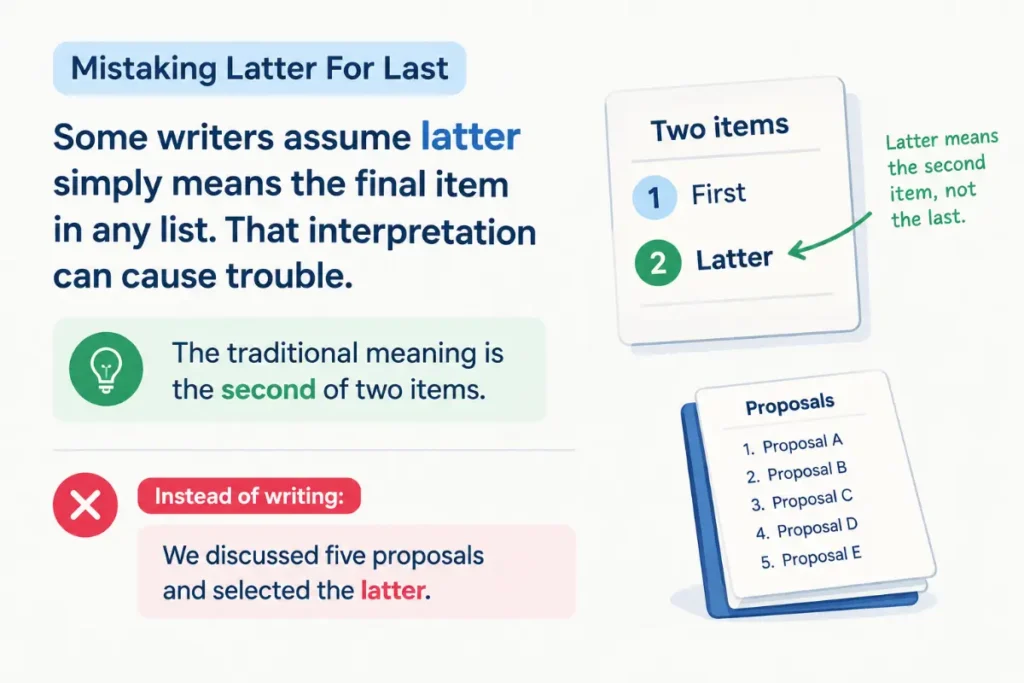
The words work only when the reader can identify the items being compared. If a sentence mentions three or more choices, these terms can create confusion because their basic contrast concerns the first and second items.
A useful rule is to name the two choices clearly before using either word. If the reference could confuse your reader, repeat the specific name instead.
Sentence Examples
The following examples show how these terms work in realistic situations.
- Everyday conversation: I can walk to work or take the bus, but I prefer the former because it gives me exercise.
- Text messages: We could order pizza or burgers. I’m in the mood for the latter.
- Workplace communication: The company considered two proposals, and the former required a smaller initial investment.
- School: Students can submit a written report or give a presentation. The latter helps them practice public speaking.
- Academic writing: The study compared online learning with classroom instruction, finding different benefits for the former and the latter.
- Formal writing: The agreement offers two payment methods. The former requires payment in full, while the latter allows monthly installments.
- Social situations: We could meet at the park or the café. I’d choose the latter because it might rain.
- Online communication: You can read the full article or watch the summary video. The former provides more detail.
- Personal preferences: My brother enjoys cooking and baking, but the latter is his favorite weekend activity.
- Business decisions: The team evaluated a short campaign and a yearlong strategy. The former was cheaper, but the latter offered more time to build customer trust.
Notice that each example establishes two items before using the reference word. This order makes the intended meaning easier to follow.
Common Mistakes and Confusing Usage
Mistake One Using Former for the Second Item
Incorrect: I compared tea and coffee, and I preferred the former because I like its taste, referring to coffee.
Correct: I compared tea and coffee, and I preferred the latter because I like its taste.
The first item is tea and the second is coffee. If the speaker prefers coffee, latter is the correct choice.
Mistake Two Using Latter for the First Item
Incorrect: We can travel by car or train. I prefer the latter, referring to the car.
Correct: We can travel by car or train. I prefer the former.
The reference must match the original order. Latter cannot mean the first option in a pair.
Mistake Three Using These Words for Three Choices
Incorrect: We can choose tea, coffee, or juice. The latter is my favorite, when the writer intends to refer to coffee.
Better: We can choose tea, coffee, or juice. Coffee is my favorite.
Although latter can describe something later in a sequence, using former and latter as a pair is clearest when two items are involved. If you introduce three choices, name the intended choice directly.
Mistake Four Forgetting the Original Order
Incorrect: I like reading more than watching television. The latter is my favorite, when the writer means reading.
Correct: I like reading more than watching television. The former is my favorite.
A reader may need to look back at the sentence to identify the two choices. Writers should check the order before using these terms.
Mistake Five Using Latter When a Name Would Be Clearer
Unclear: The department reviewed the marketing plan, the hiring plan, and the new budget. The latter needs more work.
Clearer: The department reviewed the marketing plan, the hiring plan, and the new budget. The new budget needs more work.
The second version removes the need for the reader to guess which item the writer means. In many cases, repeating a noun is better than using a formal reference word.
For another common grammar confusion, see ember vs gold for Color Meaning and Everyday Use.
Pronunciation Guide
Both words have two syllables. Their first syllables receive the main stress, so the opening sound should be clear.
| Word | IPA | Syllables | Easy guide |
|---|---|---|---|
| Former | /ˈfɔːrmər/ | for mer | FOR mer |
| Latter | /ˈlætər/ | lat ter | LAT er |
The IPA forms above represent common American English pronunciations. Exact vowel quality and the sound of the middle consonant can vary by accent.
How to Pronounce Former
Start with the sound in for, then finish with an unstressed syllable similar to mer. Keep the stress on the first syllable.
A common mistake is to give both syllables equal stress. In natural speech, the first syllable is stronger.
How to Pronounce Latter
Start with the short vowel sound in cat. Follow it with the unstressed ending.
In many American accents, the letter t between vowels can sound like a quick flap, similar to the middle sound in water. This is normal pronunciation rather than a different word.
Are Former and Latter Pronounced Alike
No. They have different opening vowel sounds and different consonants at the start. Former begins with an f sound, while latter begins with an l sound.
The words are easy to distinguish when spoken clearly. In writing, however, the more common challenge is remembering which word refers to which position.
Etymology and Word Origin
The histories of these words help explain their connection to time and order.
Origin of Former
Former developed from the idea of being earlier or first in a sequence. It is connected to form, which comes through French from Latin forma, meaning shape or form. The word’s historical development gave English a way to describe something that came before or previously held a position.
In modern English, former has two common uses. It can identify the first of two items, or it can describe a past role or condition. The meaning depends on the sentence.
For example, a former president once held the office. In a sentence comparing two presidents, the former refers to the one mentioned first.
Origin of Latter
Latter comes from the older English word lætra, which was related to the comparative form of late. Its historical meaning connects it with something later in time or order.
That connection remains visible in modern usage. The latter of two choices is the second one mentioned, while the latter part of a year means its later portion.
The two words developed different grammatical roles, but their meanings still reflect the basic ideas of earlier and later. Understanding this connection can help you remember their uses without relying only on memorization.
Regional Usage
American English
Both words are standard in American English. Writers use them in academic papers, workplace documents, news writing, and other situations that call for a concise reference to two items.
In casual American conversation, people often repeat the name of the item instead. For example, someone may say I prefer coffee instead of I prefer the latter. The shorter option is often easier to understand during a quick conversation.
Former also commonly describes a previous role, as in a former employee or former governor. Latter can describe a later stage or period, as in the latter half of the year.
British English
British English uses both words with the same main meanings. Former refers to the first of two items, and latter refers to the second.
There is no major spelling difference between American and British English for these terms. The main variation is stylistic. Some writers may prefer a more direct phrase in informal contexts, while others may use former and latter in formal prose.
Australian English
Australian English follows the same general distinction. Former identifies the first item in a pair, and latter identifies the second.
The terms are available in formal and professional writing, although everyday speakers may choose simpler alternatives for clarity. There is no special Australian spelling rule that changes their basic meanings.
Canadian English
Canadian English also uses both terms in the standard way. Writers can use them in school assignments, business communication, reports, and general prose.
As in the United States and Britain, the main concern is clarity rather than regional spelling. Readers need to know which two items the writer mentioned and in what order.
Grammar Rules and Part of Speech
Understanding how these words work in a sentence makes them easier to use accurately.
Using Former as an Adjective
Former can appear before a noun when it means that a person or thing previously held a role or had a particular status.
Examples include:
- The former director now works as a consultant.
- She visited her former school last week.
- The former owner sold the property two years ago.
In each sentence, former modifies a noun. It describes a past connection rather than identifying the first item in a pair.
Using Former as a Noun
When former identifies the first of two items, it can stand alone. The noun or idea it refers to should already appear in the sentence or nearby context.
Example: We discussed renting an apartment and buying a house. The former would cost less each month.
Here, former refers to renting an apartment. The sentence does not need to repeat the entire phrase.
Using Latter as an Adjective
Latter can appear before a noun to describe a later stage, part, or period.
Examples include:
- The latter half of the book is more exciting.
- Sales increased during the latter months of the year.
- The latter stages of the race tested the runners’ endurance.
In these examples, latter does not identify the second of two named choices. Instead, it describes a later part of something.
Using Latter as a Noun
Latter can stand alone to refer to the second of two items mentioned earlier.
Example: The store sells both fresh bread and frozen bread, but the latter lasts longer in the freezer.
The word latter refers to frozen bread because it appears second. This use is especially common in written comparisons.
Punctuation and Sentence Position
Neither word requires special punctuation simply because you use it. Normal sentence rules still apply.
For example, you could write: We considered two schedules. The former suited the staff, while the latter worked better for customers.
The comma before while separates the two related clauses. It is needed because of the sentence structure, not because former and latter require commas.
You can also use these words at the start of a sentence.
The former was affordable. The latter was more reliable.
This structure is grammatically correct because the reader can connect each word to the two options mentioned earlier.
Can You Use Former and Latter in the Same Sentence
Yes. Using both can make a comparison especially clear when you need to contrast two items.
For example: The former plan focused on saving money, while the latter aimed to improve customer service.
The first phrase identifies the first plan. The second identifies the other plan. This construction works well when both ideas matter to the discussion.
However, do not use these words simply to make your writing sound formal. If the sentence becomes difficult to follow, repeat the names of the two items instead.
Real Life Usage Examples
Daily Conversation
In conversation, these terms can help you discuss preferences or choices, but direct wording is often more natural.
- We could eat at home or go to a restaurant. I prefer the latter tonight.
- My cousins enjoy hiking and cycling. The former is my favorite way to spend a weekend.
Both examples establish the two activities before referring to one of them. In casual speech, you could also say I prefer going to a restaurant or I prefer hiking.
Email and Workplace Communication
These words are useful in workplace messages when you have already introduced two proposals, deadlines, or plans.
- We reviewed the morning shift and the evening shift. The former would provide better coverage during the busiest hours.
- Please review the standard contract and the revised contract. The latter includes the changes discussed in our meeting.
In professional writing, former and latter can save space. Still, repeating a document’s name may be safer if an email contains several contracts or proposals.
Academic Writing
Academic writing often compares theories, methods, arguments, or findings. These terms can reduce repetition when the comparison is clear.
- The paper compares qualitative interviews with quantitative surveys. The former explores personal experiences, while the latter measures patterns across a larger group.
- The researcher examined two explanations for the result. The former focused on social factors, and the latter emphasized individual choices.
The key is to make the two ideas easy to identify. If a paragraph contains several competing theories, use their names instead of asking readers to remember which one came first.
News and Journalism
News writing often compares policies, events, or public statements. These words can help a writer refer back to two clearly identified subjects.
- The city considered higher parking fees and expanded public transit. The latter received support from several neighborhood groups.
- Officials discussed a short term plan and a long term plan. The former would begin immediately, while the latter required additional funding.
Journalists need to keep references clear because readers may scan a story quickly. Repeating the subject is often the better choice if the passage contains more than two proposals.
Literature and Storytelling
Writers can use these terms when comparing characters, actions, or events. However, a story with many characters can make the reference difficult to follow.
- Mara could stay in the village or follow her brother into the mountains. The latter choice frightened her, but she knew it might be her only chance.
- He remembered the quiet summer and the stormy winter. The former brought him peace, while the latter changed his life.
In storytelling, clarity matters more than avoiding every repeated noun. If readers need to pause to work out the reference, name the character or event again.
Related and Confused Terms
Several English words and phrases express ideas about order, time, or previous status. Knowing how they differ can help you choose the right one.
1. Earlier
Earlier means before a particular time or event.
Example: We arrived earlier than expected.
Unlike former, earlier does not usually identify the first of two named items. It focuses on time.
2. Later
Later means after a particular time or event.
Example: I’ll call you later this afternoon.
Latter can mean the later part of a period, but later is more common in everyday conversation. Use latter when the formal reference fits the sentence.
3. Previous
Previous means occurring or existing before something else.
Example: The previous manager introduced the new schedule.
It is similar to former when describing a past role. However, previous does not automatically refer to the first of two items mentioned.
4. Subsequent
Subsequent means coming after something else in time or order.
Example: The subsequent review revealed two problems.
This word is common in reports and formal writing. It usually describes something that follows an earlier event rather than the second item in a pair.
5. First
First identifies the item that comes before the others in a sequence.
Example: The first proposal focuses on cost.
First is more direct than former. It is often the clearest choice when you want readers to identify an item without looking back through a sentence.
6. Second
Second identifies the item that follows the first in a sequence.
Example: The second proposal focuses on quality.
Second is a straightforward alternative to latter when you want to identify the second item explicitly. It is especially useful in instructions and explanations.
7. Previous Versus Current
Previous describes something that came before the present one. Current describes something that exists or applies now.
Example: My previous phone had a better camera than my current phone.
These words describe time and status. They do not work as direct substitutes for former and latter when referring to the first and second items in a pair.
8. The First and the Second
This phrase names the positions directly.
Example: We discussed two solutions. The first saves money, and the second saves time.
Although it may take a few more words, this construction is easy to understand. It works particularly well when the audience includes readers who are learning English.
Expert Editor Insight
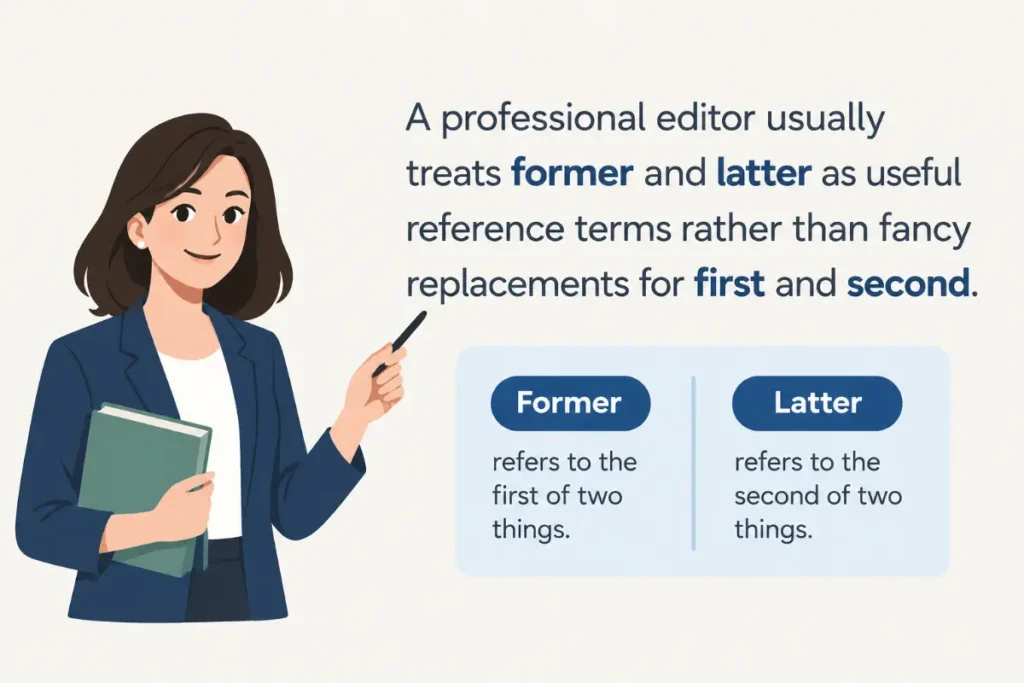
An experienced editor checks the order of the two items before approving either term. The most common problem is not spelling but an unclear reference. Editors also look for paragraphs that mention several people or ideas, since former and latter can force readers to search backward. Grammar tools may accept both words because both are valid English, so a spelling checker alone may not catch a meaning error. My practical advice is to replace the reference with the actual name if you have to reread the sentence to understand it.
Need another quick comparison? Read Lay vs Lie Explained With Grammar Rules and Examples.
Conclusion
Understanding former vs latter comes down to one simple rule. Former refers to the first of two items mentioned, while latter refers to the second. Both words are correct and useful in formal writing, academic work, and professional communication. Former can also describe a past role, and latter can refer to the later part of a period.
To use them correctly, identify the two items and check their original order. If your reader might lose track of the reference, repeat the name instead. Remember this simple trick: former means first, and latter means last of the two. Clear writing always matters more than sounding formal.
FAQs
What Is the Main Difference Between Former and Latter?
Former refers to the first of two items mentioned, while latter refers to the second. For example, if you mention tea and coffee in that order, tea is the former and coffee is the latter. Both words are correct English. Their meanings depend on the order of the items in the sentence.
Are Former and Latter Both Correct Words?
Yes. Both are standard English words with established meanings. Former can identify the first of two items or describe a past role. Latter can identify the second item or describe a later part of a period. Neither word is a misspelling, and the correct choice depends on what you want to express.
Can Former and Latter Refer to More Than Two Things?
These words are clearest when used to distinguish two items. Although latter can describe a later point in a sequence or period, using former and latter to refer to several choices can confuse readers. If you mention three or more options, name the specific choice or use first, second, and third to make the meaning clear.
How Do You Pronounce Former and Latter?
Former is pronounced /ˈfɔːrmər/, and latter is pronounced /ˈlætər/ in common American English. Both words have two syllables, with stress on the first. Former begins with an f sound, while latter begins with an l sound. Regional accents may change some vowel and consonant details without changing the meanings.
Can Former or Latter Start a Sentence?
Yes. Both words can start a sentence when the reader already knows which items they refer to. For example, after mentioning two plans, you could write, The former costs less. The latter offers more flexibility. If the reference is unclear or too far from the original comparison, repeat the name of the plan instead.
What Is a Synonym for Former and Latter?
Useful alternatives depend on the context. First and second work well when identifying two options. Previous can replace former when describing something that existed earlier. Later can replace latter when describing time. These words are not exact substitutes in every sentence, so choose one that preserves the intended meaning and makes the reference clear.
Why Do People Confuse Former and Latter?
People often confuse these words because both refer back to something already mentioned. Their meanings also connect to time and order, which can feel similar. The simplest solution is to identify the two items and check their positions. Former points to the first, and latter points to the second. Repeating the noun can prevent confusion.
Are Former and Latter Appropriate in Formal Writing?
Yes. Both words are suitable for formal writing, including essays, reports, and professional documents. They can reduce repetition and make comparisons more concise. However, formal language is not always clearer language. If readers must search through a long paragraph to identify the reference, repeating the name of the person, object, or idea is usually better.