

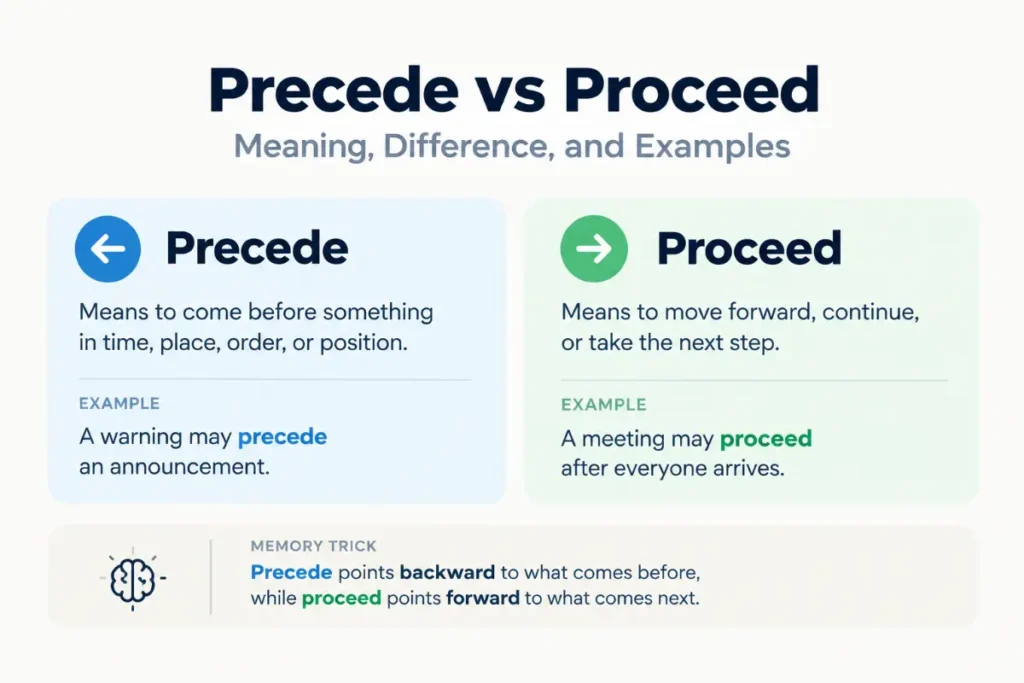
Confusing words can turn a clear sentence into a confusing one. The difference between precede vs proceed comes down to two simple ideas. One word means to come before something. The other means to move forward or continue.
Use precede when one event happens before another or one thing comes earlier in an order. Use proceed when someone moves ahead with an action, continues a process, or advances to the next step. Both words are correct, but they aren’t interchangeable.
For example, a short introduction may precede a speech, but the speaker proceeds with the speech after the introduction ends. The spelling looks similar, and both words can appear in formal writing, which makes the confusion easy to understand.
Once you connect each word with its main meaning, choosing the right one becomes much easier. The following guide explains their definitions, pronunciation, grammar, word origins, common mistakes, and real world examples so you can use them with confidence.
Many readers also check bosses or bosss Correct Spelling And Usage.
Quick Answer
Precede means to come before something in time, order, or position. Proceed means to move forward, continue an activity, or advance to the next step. For example, an introduction precedes a presentation, and the presenter proceeds with the main topic afterward.
Comparison Table
| Feature | Precede | Proceed |
|---|---|---|
| Main meaning | To come before | To move forward or continue |
| Part of speech | Verb | Verb |
| Pronunciation | priˈseed | prohˈseed |
| IPA | /prɪˈsiːd/ | /proʊˈsiːd/ in American English |
| Main idea | Earlier in time or order | Forward movement or continued action |
| Common contexts | Events, introductions, sequences, history | Instructions, meetings, travel, processes |
| Formality | Standard in formal and informal English | Standard in formal and informal English |
| Example | The opening remarks precede the lecture. | We can proceed with the lecture. |
Meaning and Definition
What Precede Means
Precede is a verb that means to come before something in time, order, position, or sequence. It helps show that one person, event, action, or item comes earlier than another.
For example, breakfast may precede a morning meeting. In a book, one chapter precedes the next. In a historical account, one event may precede another and help explain how it happened.
The word often answers the question, What came first?
Common patterns include:
- An event precedes another event.
- One person precedes another in a line or order.
- An introduction precedes a speech.
- A warning precedes a decision.
Here are two examples.
- The safety briefing will precede the flight.
- A short explanation should precede the instructions.
In both sentences, the first thing comes before the second. The word doesn’t mean that the first thing causes the second. It only establishes the order unless the surrounding context suggests a connection.
What Proceed Means
Proceed is a verb that means to move forward, continue, or begin the next stage of an activity. It often appears when someone takes action after reaching a decision, receiving permission, or completing an earlier step.
For example, a manager may approve a plan and tell the team to proceed. A traveler may proceed to the boarding gate. A student may proceed to the next question after finishing the current one.
The word often answers the question, What happens next?
Common patterns include:
- Proceed with a plan or activity.
- Proceed to the next step or location.
- Proceed as instructed.
- Proceed carefully or cautiously.
Here are two examples.
- The team decided to proceed with the project.
- Please proceed to the next page.
The key idea is movement or continuation. That movement can be physical, such as walking down a hallway, or abstract, such as advancing a project or continuing a discussion.
Key Differences Explained
The main difference is simple. One word establishes what comes first, while the other describes moving ahead.
Spelling and Meaning
Both words contain seven letters and end with the same letters. Their similar appearance can make them easy to mix up while typing or writing quickly. However, the first part of each word points toward a different meaning.
Precede begins with pre, a word element associated with something earlier or before. Proceed begins with pro, which in this word connects with advancing or going forward.
Think of these two examples.
- The announcement will precede the ceremony.
- The guests may proceed into the hall.
The announcement comes before the ceremony. The guests move forward into the hall. The context makes the distinction clear.
Grammar and Sentence Structure
Both words function as verbs, but they often appear in different sentence patterns.
Precede commonly takes a direct object. The object identifies the person, event, or thing that comes afterward.
For example, the opening scene precedes the main story. The phrase the main story is the direct object of the verb.
Proceed often appears with a preposition or an adverb. Common expressions include proceed with the work, proceed to the next stage, proceed carefully, and proceed as planned.
For example, the committee will proceed with the review. Here, the phrase with the review identifies the activity that will continue.
Pronunciation
The two words share a similar ending sound, which can make them seem even more alike when spoken. The first syllable differs, though, and that difference helps distinguish them.
Precede is pronounced prih SEED. Proceed is pronounced proh SEED. In both words, the stress falls on the second syllable.
The final sound is the same. The main difference lies in the vowel sound at the beginning.
Formality and Context
Both words are standard English and work in casual conversation, business writing, academic work, and formal documents.
Precede often appears in explanations of events, written instructions, historical accounts, and descriptions of order. Proceed is common in directions, meetings, legal language, workplace communication, and step by step instructions.
For example, a report might explain that a policy change preceded a rise in demand. A meeting leader might say that the group can now proceed to the next item.
Neither word is more correct than the other. The right choice depends on what you want to express.
Which Form Is Correct
Both forms are correct. The difference lies in meaning, not spelling.
Use precede when something comes earlier than another thing. Use proceed when someone or something moves forward, continues, or advances.
A useful way to check your choice is to replace the word with a simpler phrase.
- If you mean comes before, choose precede.
- If you mean moves forward or continues, choose proceed.
Consider this sentence: The introduction will precede the interview. You can replace precede with come before without changing the main meaning.
Now consider this sentence: We will proceed with the interview. You can replace proceed with continue with and preserve the intended meaning.
Established English dictionaries recognize both as separate verbs with different definitions. Their similar spelling doesn’t make one a variation or misspelling of the other.
Sentence Examples
These examples show how the two verbs work in natural English.
Examples Using Precede
- A brief introduction will precede the guest speaker’s presentation.
- The storm preceded a sudden drop in temperature.
- Please read the safety instructions that precede the test.
- In the schedule, the staff meeting precedes the lunch break.
- A short discussion usually precedes the final decision.
- The warning signs preceded the equipment failure.
- The first chapter precedes the section on advanced techniques.
- A formal greeting should precede the main request in this letter.
- Several important events preceded the launch of the new program.
- The opening ceremony will precede the awards presentation.
Examples Using Proceed
- We can proceed with the plan after everyone approves it.
- Please proceed to the checkout counter.
- The teacher asked the students to proceed to the next question.
- The meeting will proceed as scheduled.
- After checking the figures, the accountant proceeded with the report.
- You may proceed when the signal turns green.
- The team decided to proceed with the second design.
- Please proceed carefully through the construction area.
- After a short break, the speaker proceeded with the presentation.
- The application will proceed to the next stage after review.
Notice how the sentence meaning changes when you replace one word with the other. The first set describes something that comes earlier. The second set describes action or progress.
Common Mistakes and Misspellings
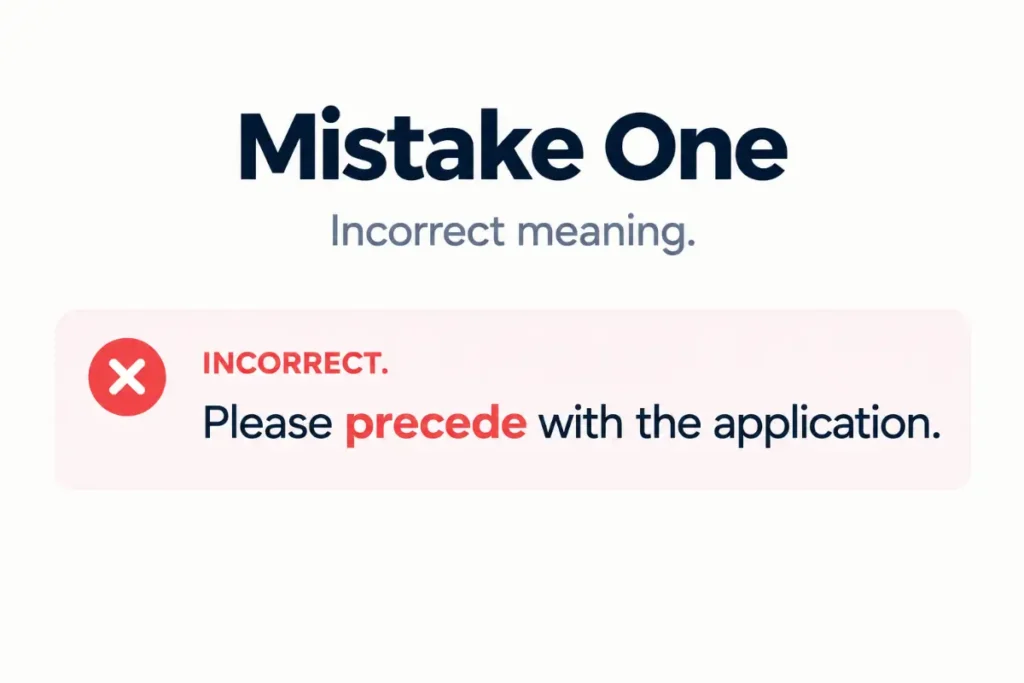
Most errors happen because the two verbs look alike. Other mistakes involve choosing the right word but using the wrong grammatical form.
Using Proceed When You Mean Come Before
Incorrect: The introduction will proceed the lecture.
Correct: The introduction will precede the lecture.
The sentence describes order, not forward movement. The introduction comes before the lecture, so precede is the right choice.
Using Precede When You Mean Continue
Incorrect: We will precede with the meeting.
Correct: We will proceed with the meeting.
The group intends to continue the meeting. It doesn’t intend to come before the meeting, so proceed fits the meaning.
Confusing Proceed With Precedent
A precedent is an earlier decision or action that can guide later decisions. Proceed is a verb that means to continue or move forward.
Incorrect: The court will precedent with the case.
Correct: The court will proceed with the case.
The words share some letters, but they serve different grammatical roles.
Confusing Precede With Previous
Previous is an adjective that describes something from an earlier time. Precede is a verb that describes the relationship between two things in a sequence.
For example, you can say, The previous meeting preceded the budget review. The word previous describes the meeting, while preceded explains its position in the sequence.
Using the Wrong Verb Form
The base form of precede changes to precedes, preceded, or preceding. The base form of proceed changes to proceeds, proceeded, or proceeding.
Incorrect: The announcement proceed the ceremony.
Correct: The announcement precedes the ceremony.
The subject is singular, so the present tense requires precedes. Choosing the correct word is only part of the task. You must also match the verb to the subject and tense.
Pronunciation Guide
Both words have two syllables, and both receive stress on the second syllable. Their final syllable sounds alike, so the opening vowel provides the clearest sound difference.
| Word | IPA | Easy pronunciation | Stress |
|---|---|---|---|
| Precede | /prɪˈsiːd/ | prih SEED | Second syllable |
| Proceed | /proʊˈsiːd/ | proh SEED | Second syllable |
How to Pronounce Precede
Say the first syllable with a short vowel sound, similar to the vowel in sit. Then say the second syllable with a long ee sound, as in seed.
Keep the stress on the second syllable. The word should sound like two connected syllables rather than two equally stressed parts.
How to Pronounce Proceed
Begin with the long vowel sound heard in the American English word go. Then finish with the same long ee sound used in the other verb.
Again, stress the second syllable. The first vowel sound is the main clue that separates the words in speech.
Common Pronunciation Problems
Some speakers pronounce the first syllable of both words in nearly the same way. That can make the distinction harder to hear, especially in fast conversation.
Practice each word in a short sentence. Say, The introduction will precede the talk. Then say, We will proceed with the talk. Hearing the words in context helps connect pronunciation with meaning.
Need another quick comparison? Read Forteen Vs Fourteen Which Spelling Is Correct.
Etymology and Word Origin
The histories of these words help explain why their meanings differ.
Origin of Precede
Precede entered English through French and Latin. It comes from Latin praecedere, which combines a form related to before with a verb meaning to go or to move.
The historical idea is going before something. Modern English keeps that central meaning in descriptions of time, order, and position.
The same idea appears in related words such as predecessor and preceding. A predecessor is someone or something that came before another in a role or sequence.
Origin of Proceed
Proceed also entered English through French and Latin. It comes from Latin procedere, formed from a prefix meaning forward and a verb meaning to go.
The original idea of moving forward remains in modern usage. Today, the word can describe physical movement, continued action, or progress through a process.
Related words include procedure, proceeding, and process. These words connect with steps, actions, and the way something moves from one stage to another.
What Their Origins Tell Us
The roots offer a useful memory aid. Precede connects with going before. Proceed connects with going forward.
Etymology can make the distinction easier to remember, but modern meaning should guide your choice. You don’t need to know Latin to use either word correctly.
Regional Usage
The meanings of these verbs remain consistent across major English varieties. American, British, Australian, and Canadian English all use them to describe order and forward movement.
American English
In the United States, both words are standard in everyday and professional communication. Precede often appears in reports, schedules, instructions, and descriptions of events. Proceed commonly appears in directions, business meetings, customer service messages, and official notices.
For example, a company may state that training will precede the new system launch. A customer service representative may tell a caller to proceed to the next step.
British English
British English uses the same distinction. Precede means to come before, while proceed means to continue or move forward.
Differences in accent may affect the exact sound of the opening syllable, but the basic meanings remain the same. There is no special British spelling that replaces either word.
Australian English
Australian English also follows the same spelling and usage rules. Both verbs are suitable for professional documents, everyday speech, and educational writing.
An Australian teacher might explain that one lesson precedes another. A workplace supervisor might ask an employee to proceed with a task.
Canadian English
Canadian English follows the same standard usage as American and British English. Neither word has a special Canadian meaning or spelling.
Across all four varieties, context determines the correct choice. Regional pronunciation may vary, but the difference in meaning does not.
Grammar Rules and Part of Speech
Both words are verbs, but their grammatical patterns differ in useful ways. Learning these patterns can help you avoid errors even when you’re writing quickly.
How to Use Precede in a Sentence
Precede is usually a transitive verb. That means it normally takes a direct object, which identifies what comes after the subject in the sequence.
For example, The opening remarks precede the main presentation. The subject is the opening remarks, the verb is precede, and the direct object is the main presentation.
You can use the verb in different tenses.
- Present tense: The introduction precedes the main discussion.
- Past tense: The introduction preceded the main discussion.
- Present participle: The introduction is preceding the main discussion in the program.
- Present perfect: The introduction has preceded the main discussion at several events.
The present participle form is grammatically possible, though it may sound less natural than a simple present or past form in many contexts.
How to Use Proceed in a Sentence
Proceed can stand on its own when the action is clear from the context. It can also take a prepositional phrase that explains the activity or destination.
For example, The meeting will proceed. The sentence is complete because the reader knows that the meeting will continue.
In the sentence, The team will proceed with the review, the phrase with the review explains what the team will continue.
Common grammatical patterns include the following.
- Proceed with something. Example: We will proceed with the plan.
- Proceed to a place or stage. Example: Proceed to the next room.
- Proceed by doing something. Example: Proceed by checking each entry.
- Proceed as planned. Example: The event will proceed as planned.
- Proceed from something. Example: The argument proceeds from a basic assumption.
The last pattern can appear in academic and formal writing when an argument or line of reasoning develops from a starting point.
Verb Agreement and Tense
Both verbs follow regular present and past tense patterns.
In the simple present, add s when the subject is third person singular.
- She precedes the other speakers in the schedule.
- He proceeds to the next stage.
- The announcement precedes the ceremony.
- The project proceeds according to plan.
For past tense, add ed.
- The announcement preceded the ceremony.
- The project proceeded according to plan.
Pay attention to the subject and intended meaning. A sentence can use the correct base word but still contain a grammar error if the tense or subject agreement is wrong.
Punctuation and Formal Writing
Neither verb requires special punctuation. Use commas, periods, and other marks according to the structure of the full sentence.
For example, you might write, Before we proceed, please review the instructions. The opening phrase needs a comma because it introduces the main clause.
In formal writing, proceed can sound polite and measured when used in directions. Precede works well when you need to describe the order of events precisely. Neither word is limited to formal settings, and both can appear naturally in ordinary conversation.
Real Life Usage Examples
The best way to learn the difference is to see how the words work in settings you encounter every day.
Daily Conversation
Precede: A quick phone call preceded our decision to visit the restaurant.
Proceed: We finished our coffee and proceeded to the movie theater.
The first example describes what happened earlier. The second describes what happened next.
Email and Workplace Communication
Precede: Please make sure the safety review precedes the equipment installation.
Proceed: Once the manager approves the budget, we can proceed with the purchase.
The first sentence establishes the order of two tasks. The second identifies a condition that allows work to continue.
Academic Writing
Precede: The introduction precedes the literature review in this report.
Proceed: After presenting the evidence, the researcher proceeds to discuss the results.
Academic writing often uses both words because it describes the order of sections, steps, arguments, and findings.
News and Journalism
Precede: Heavy rainfall preceded the flooding in several nearby communities.
Proceed: Officials said emergency crews would proceed with the planned inspections.
In news writing, precede can establish a timeline. Proceed can explain the next action taken by officials, investigators, or emergency teams.
Literature and Storytelling
Precede: A quiet scene preceded the sudden arrival of the stranger.
Proceed: The traveler proceeded through the forest until nightfall.
The first sentence establishes the order of scenes. The second describes a character’s movement through a setting.
These examples show that the distinction applies to both literal movement and abstract sequences. Once you identify the intended relationship, the correct verb becomes easier to choose.
Related and Confused Terms
Several other English words share parts of these meanings or appear in similar contexts. Understanding the differences can make your writing more precise.
1. Preceding. This form of precede describes something that came earlier. Example: The preceding chapter explains the basic rules.
2. Predecessor. A predecessor is a person, product, system, or thing that came before another in a role or sequence. Example: The new model improves on its predecessor.
3. Previous. This adjective describes something from an earlier time or position. Example: Please review the previous report.
4. Proceeding. This noun can refer to a formal process or series of actions. Example: The legal proceeding continued into the afternoon. It can also be the present participle of proceed.
5. Progress. Progress means movement toward a goal or improvement over time. Example: The team made progress on the project. Proceed describes continuing or moving forward, while progress often highlights the development achieved.
6. Continue. Continue means to keep doing something or to resume it after a pause. Example: We will continue the discussion tomorrow. This is one of the closest everyday alternatives to proceed in many contexts.
7. Advance. Advance means to move forward or make progress. Example: The team advanced to the final round. It can suggest movement toward a goal or a higher stage.
8. Precedent. A precedent is an earlier example or decision that can guide later actions. Example: The ruling established a precedent for future cases. It is a noun, not a substitute for either verb.
These related terms can help you vary your writing, but they aren’t always interchangeable. Choose the word that expresses the exact relationship or action you intend.
Expert Editor Insight
An experienced editor looks at the meaning of the sentence before checking the spelling. Similar looking words can pass a basic spell check because both forms are valid English. Grammar tools may catch some errors, but they can miss a word choice problem when the sentence remains grammatically correct. My practical advice is to replace the verb with come before or move forward. If the replacement preserves your meaning, you’ve likely found the right word. This quick check works in emails, school assignments, reports, and longer documents.
Key Takeaways
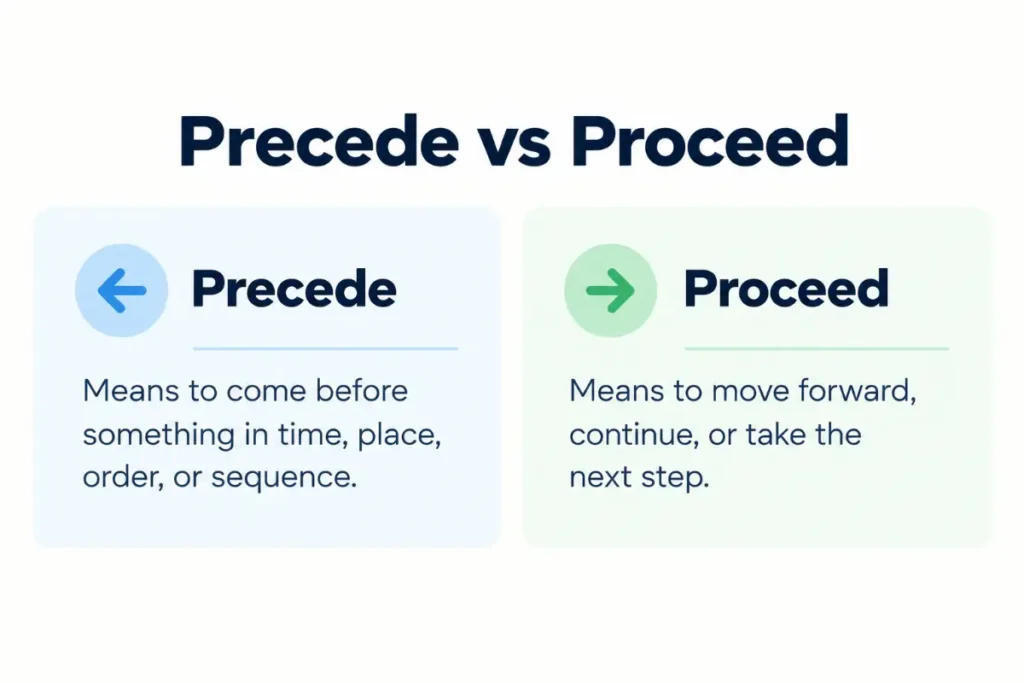
- Precede means to come before something in time, place, order, or sequence.
- Proceed means to move forward, continue, or take the next step.
- Use precede when the sentence focuses on what happened first.
- Use proceed when the sentence focuses on continued action or forward movement.
- Precede commonly takes an object. For example, the announcement preceded the meeting.
- Proceed commonly appears with with, to, or after. For example, the team proceeded with the project.
- Preceding means coming before.
- Proceeding can describe an ongoing action or a formal process.
- Proceeds is a noun that commonly means money received from a sale or activity.
- The simplest memory trick is before for precede and forward for proceed.
Many readers also check Noteable or Notable Which Spelling Is Correct 2026.
Conclusion
The difference between precede vs proceed becomes easy to remember once you focus on the action or relationship in the sentence. Precede means to come before something in time, order, or position. Proceed means to move forward, continue, or advance to the next step. Both are correct English words, and neither is a misspelling of the other.
Use one simple editing trick to choose correctly. Replace precede with come before and proceed with move forward. If the sentence keeps its intended meaning, you’ve made the right choice. With a little practice, you’ll use both words naturally in conversations, emails, schoolwork, and professional writing.
FAQs
Is Precede a Real Word?
Yes. Precede is a standard English verb meaning to come before something in time, order, or position. You can use it to describe events, people, sections of a document, or stages in a process. For example, the introduction precedes the main discussion. It is not a misspelling of proceed. The two words have different meanings.
What Does Proceed Mean?
Proceed means to move forward, continue an activity, or advance to the next stage. People often use it when giving instructions or describing the next action in a process. For example, a supervisor might say, Please proceed with the inspection. The word can describe physical movement, such as walking forward, or abstract progress, such as continuing a project.
Which Is Correct Precede or Proceed?
Both are correct, but they serve different purposes. Use precede when one thing comes before another. Use proceed when someone or something moves forward or continues. For example, the introduction precedes the speech, and the speaker proceeds with the speech. The right choice depends on the meaning you want to express, not on spelling preference or regional convention.
How Do You Pronounce Precede and Proceed?
Precede is pronounced /prɪˈsiːd/ and proceed is pronounced /proʊˈsiːd/ in American English. Both words have two syllables with stress on the second syllable. The main difference appears in the opening vowel sound. Precede begins with a short vowel similar to the sound in sit, while proceed begins with the vowel sound in go.
Can Precede or Proceed Start a Sentence?
Yes. Both verbs can start a sentence when the sentence structure supports them. For example, Preceding the ceremony, the organizers checked the equipment. Proceed to the next page when you’re ready. In the first example, preceding introduces an opening phrase. In the second, proceed gives a direct instruction. Capitalize the first word as usual.
What Is a Synonym for Precede?
Useful synonyms for precede include come before, lead up to, and go ahead of. The best choice depends on the sentence. Come before works well in everyday English, while precede often suits formal writing. Lead up to can suggest a series of events that prepares for a later event, so it may carry a slightly different meaning.
Why Do People Confuse These Two Words?
People often confuse the words because they have similar spellings, the same ending, and related ideas of movement and order. Both can appear in descriptions of events and processes, which makes the distinction less obvious at first. Remembering that precede means come before and proceed means move forward gives you a simple way to avoid the mistake.
Is Proceed Appropriate for Formal Writing?
Yes. Proceed is standard in formal documents, business emails, academic writing, legal communication, and official instructions. Phrases such as proceed with the review and proceed as directed are common in professional contexts. However, continue or move forward may sound more natural in some everyday sentences. Choose the verb that expresses your meaning clearly and matches the tone of your writing.