

Have you ever paused while writing an email because you couldn’t decide between council vs counsel? You’re not alone. These two words sound alike, but they have different meanings and grammatical roles. Choosing the wrong one can change the meaning of your sentence.
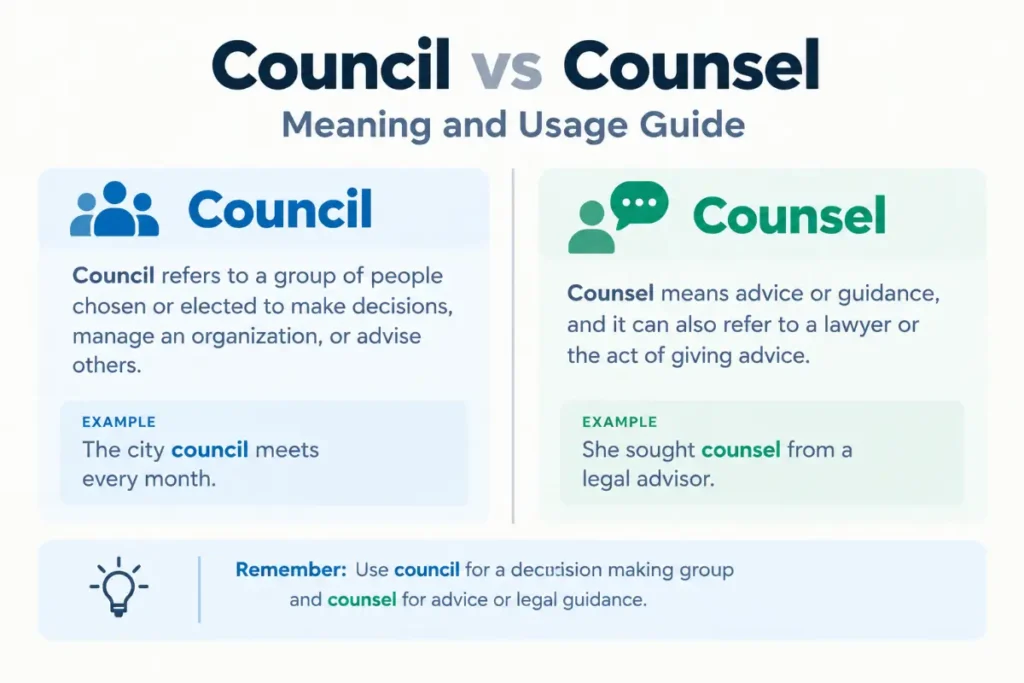
Council vs counsel comes down to a simple distinction. A council is a group of people who meet to make decisions, manage an organization, or advise a community. Counsel means advice or guidance. It can also refer to a lawyer or the act of giving advice.
For example, a city council approves local plans, while a lawyer may counsel a client about a legal problem. Both words are correct English, so neither is a misspelling. The key is understanding what you want to say.
Once you learn the difference, choosing the right word becomes much easier. You’ll also learn how to pronounce each word, recognize common mistakes, and use both forms confidently in school assignments, workplace emails, legal documents, and everyday conversations.
You may also want to read To Fast or Too Fast Which Phrase Is Correct.
Short Answer
A council is a group of people chosen or appointed to make decisions, manage affairs, or provide advice. Counsel means advice or guidance, and it can also refer to a lawyer or the act of advising someone. Both words are correct, but their meanings and grammatical uses differ.
Council and Counsel at a Glance
| Feature | Council | Counsel |
|---|---|---|
| Main meaning | A group that makes decisions or gives advice | Advice, guidance, or a lawyer |
| Part of speech | Noun | Noun or verb |
| Typical use | Government, schools, organizations, committees | Law, personal guidance, professional advice |
| Example | The city council approved the plan. | She sought counsel from her attorney. |
| Verb form | Not commonly used as a verb | To advise or guide someone |
| Pronunciation | KOWN suhl | KOWN suhl |
| Formality | Neutral to formal | Neutral to formal |
| Common context | Public meetings and governing bodies | Legal advice and personal guidance |
What Does Council Mean
A council is a group of people who meet to discuss issues, make decisions, set rules, or manage an organization. Members may be elected, appointed, or selected by the group they represent. Their responsibilities depend on the type of council and the authority it holds.
You may encounter councils in local government, education, business, and community organizations. For example, a city council may vote on a new park, while a student council may plan school events and represent students’ concerns.
Common Types of Councils
- City council. A group of elected officials who help govern a city or town. Its duties may include approving local budgets, setting policies, and overseeing public services.
- Student council. A group of students who represent their classmates and organize school activities. Members may suggest improvements, plan fundraisers, and help build school spirit.
- School council. A group that discusses school policies, student needs, or educational priorities. Its membership and authority vary by school system.
- Advisory council. A group that studies an issue and offers recommendations to leaders. Its advice may guide decisions without giving the group final authority.
- Executive council. A group of senior members who help direct an organization or institution. Its exact duties depend on the organization’s structure.
- Town council. A local governing body that handles municipal matters. Its powers depend on the laws and rules that govern the town.
How to Use Council in a Sentence
Use this word when you mean a group rather than an individual’s advice.
- The city council voted to improve the public library.
- Our student council organized a food drive.
- The advisory council recommended changes to the program.
- The town council discussed the cost of road repairs.
In each sentence, the word identifies a group with a role in decision making or discussion.
What Does Counsel Mean
Counsel has several related meanings. As a noun, it can mean advice or guidance, especially advice offered by someone with knowledge or experience. In legal settings, it can also mean a lawyer or legal representative.
As a verb, counsel means to advise, guide, or encourage someone. The word often appears in legal, professional, educational, and personal situations.
For example, a person may seek counsel from a trusted mentor before accepting a job. A lawyer may provide legal counsel to a client facing a contract dispute. A teacher may counsel a student who needs help choosing a course.
Counsel as a Noun
When used as a noun, the word often refers to advice or a person who provides legal representation.
Examples include:
- She asked her mentor for counsel before changing careers.
- The defendant spoke with legal counsel before the hearing.
- His counsel helped him understand the contract.
- The family sought professional counsel during a difficult period.
Notice that the meaning depends on the situation. In the first sentence, counsel means advice. In the second, it refers to a legal representative.
Counsel as a Verb
When used as a verb, counsel describes the act of advising or guiding someone. The person giving advice is the subject, and the person receiving it is often the object.
For example, a manager may counsel an employee about workplace performance. A school counselor may counsel students about academic choices.
Common patterns include:
- Counsel someone about a problem.
- Counsel someone on a decision.
- Counsel someone to take a particular action.
- Counsel against a risky choice.
Here are a few natural examples.
- The attorney counseled her client before the trial.
- The doctor counseled the patient about lifestyle changes.
- His parents counseled him to think carefully before signing the agreement.
The verb can sound formal in casual conversation. In everyday speech, people often say advise, guide, or talk with instead.
The Main Differences Explained
The two words share a pronunciation, but their meanings, grammatical functions, and common contexts set them apart.
Meaning and Purpose
The clearest distinction is what each word represents. A council is a group of people. Counsel is advice, guidance, or a legal representative.
Compare these sentences.
- The council reviewed the proposed budget.
- The mayor sought counsel from an experienced attorney.
The first sentence describes a group reviewing a plan. The second describes the advice or legal help the mayor received.
Grammar and Part of Speech
Council functions as a noun. It names a group or governing body. Counsel can function as both a noun and a verb.
For example, you can write, “The council met on Tuesday.” You can also write, “The lawyer will counsel the client.” In the second sentence, counsel describes an action rather than naming a group.
This grammatical difference offers a useful clue when you’re unsure which spelling belongs in a sentence.
Pronunciation
In standard American English, both words are pronounced the same way. They sound like KOWN suhl, with the stress on the first syllable.
Because pronunciation doesn’t help distinguish them, you need to rely on meaning and context. This makes the words homophones, which are words that sound alike but have different meanings and spellings.
Formality and Context
Both words appear in formal writing, but they tend to appear in different settings. Council is common in government documents, meeting notes, school communications, and organizational reports. Counsel often appears in legal documents, professional guidance, and discussions about advice.
Neither word is limited to formal writing. You can use council in a casual conversation about a school event or counsel when describing advice from a friend. The situation determines how natural each word sounds.
Regional Usage
The distinction remains the same in American, British, Canadian, and Australian English. These varieties use council for a governing or advisory group and counsel for advice, legal representation, or the act of advising.
Some local institutions use different names or structures, but that doesn’t change the basic spelling rule.
Which Spelling Is Correct
Both spellings are correct English words. The right choice depends on the meaning you intend to express.
Use council when referring to a group that meets, governs, represents people, or makes decisions. Use counsel when referring to advice, legal representation, or the act of advising someone.
Established English dictionaries recognize both words as separate entries with distinct meanings. Their similar pronunciation doesn’t make them interchangeable.
A reliable editing method is to replace the word mentally with a simpler expression. If group or committee fits, council is likely correct. If advice, lawyer, or advise fits, counsel is likely the right choice.
Consider these examples.
- Incorrect for the intended meaning: The city counsel approved the new parking rules.
- Correct: The city council approved the new parking rules.
- Incorrect for the intended meaning: She asked her attorney for council.
- Correct: She asked her attorney for counsel.
The incorrect examples contain real English spellings, but they don’t express the intended meanings. That distinction matters. A word can be spelled correctly and still be wrong for its sentence.
Ten Natural Sentence Examples
These examples show how the two words work in everyday life, education, business, and formal settings.
- The city council approved funding for a new playground.
- Our student council is planning a spring fundraiser.
- The council will meet next Thursday to discuss traffic safety.
- Residents asked the town council to repair the damaged sidewalk.
- She sought counsel from her supervisor before making the final decision.
- The company hired legal counsel to review the agreement.
- His attorney counseled him to read every page before signing.
- The school counselor counseled students about their college options.
- The committee received counsel from an outside expert.
- After reviewing the evidence, the council voted to change the policy.
Notice how the surrounding words reveal the intended meaning. Meetings, votes, residents, and policies often point toward a governing group. Advice, attorneys, guidance, and advising actions often point toward the other word.
Common Mistakes and How to Avoid Them
Most errors happen because the two spellings sound identical. People may type the first form that comes to mind without checking the sentence’s meaning.
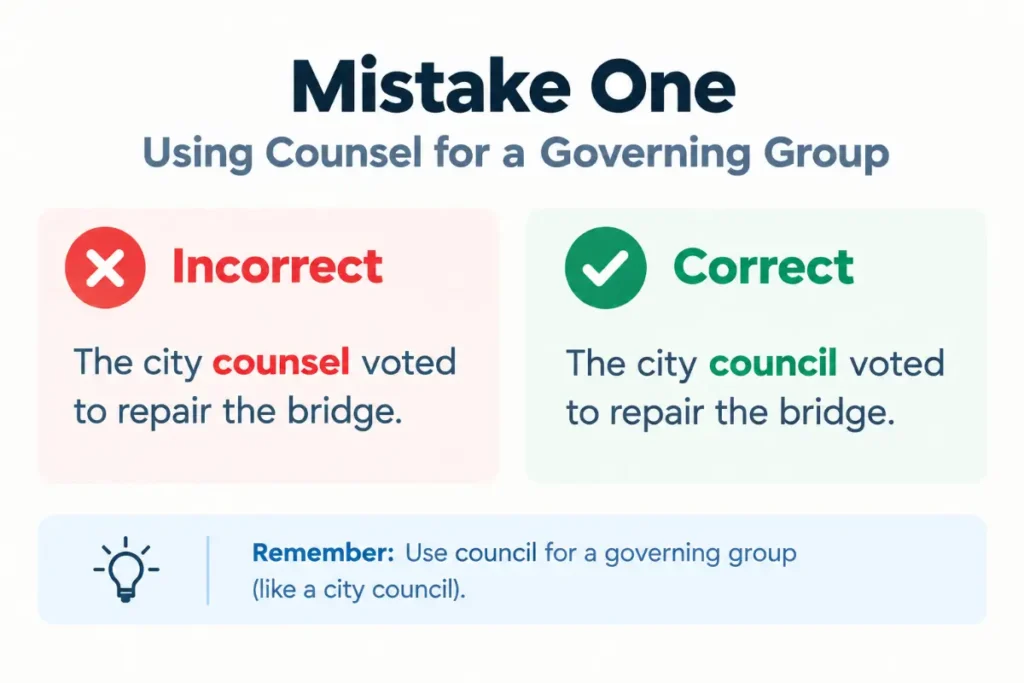
Using Counsel for a Governing Body
Incorrect: The city counsel voted to raise parking fees.
Correct: The city council voted to raise parking fees.
The sentence refers to a group of local officials, so council is the right choice.
Using Council for Legal Advice
Incorrect: I asked my lawyer for council.
Correct: I asked my lawyer for counsel.
The intended meaning is advice or legal guidance, not a governing group.
Confusing Counsel With Counselor
Incorrect: I spoke with the school counsel about my schedule.
Correct: I spoke with the school counselor about my schedule.
A counselor is a person who provides guidance. Counsel usually refers to the advice itself or to a lawyer in legal contexts. Some organizations may use specialized titles, so the exact job title can depend on the institution.
Confusing Counsel With Councilor
Incorrect: The council counsel spoke at the meeting.
Correct, if referring to an elected member: The councilor spoke at the meeting.
A councilor is a member of a council. Counsel can refer to advice or a lawyer. The words may appear together in legal or government reporting, but they do different jobs.
Treating the Words as Interchangeable
Incorrect: The school board asked its council to advise the principal.
This sentence is unclear if the writer means the board asked for advice. A clearer version is, “The school board sought counsel before advising the principal.”
If the board asked a separate committee for recommendations, council may be appropriate. Choose the word based on the actual people or action involved.
For another common grammar confusion, see principal vs principle Which Word Is Correct.
Pronunciation Guide
Both words have the same standard American English pronunciation.
IPA: /ˈkaʊn.səl/.
Easy pronunciation: KOWN suhl.
Syllable breakdown: coun sel.
Stress pattern: The first syllable receives the stress.
The first syllable rhymes with the word town. The second syllable has a relaxed sound, similar to the ending of several common English words.
There is no standard pronunciation difference that reliably separates these two spellings. If someone says either word aloud, listeners usually use the rest of the sentence to understand the meaning.
A common mistake is to assume that different spellings must produce different sounds. English has many homophones, including right and write, hear and here, and pair and pear. This pair follows the same pattern.
Etymology and Word Origin
The two words developed through different historical paths, even though they now sound alike.
The Origin of Council
Council entered English through Anglo French and Old French forms related to the Latin word concilium, which referred to an assembly or gathering. Its historical meaning fits its modern use for a group that meets to discuss issues or make decisions.
Over time, the word became associated with governing bodies, religious assemblies, public officials, and advisory groups. Today, it commonly refers to local government bodies and organized groups with decision making or advisory duties.
The Origin of Counsel
Counsel also came into English through French, with roots connected to the Latin verb consulere, meaning to consult, consider, or seek advice. Its historical development reflects its modern meanings of guidance, consultation, and legal advice.
The word later developed a verb use meaning to advise or guide someone. It also became established as a term for a lawyer or legal representative.
Although the words have different histories, their similar development in English pronunciation helps explain why writers confuse them today.
Regional Usage in English
The spelling distinction is stable across major English varieties. There is no general American or British rule that makes one spelling correct in one country and incorrect in another.
American English
In the United States, council is the standard spelling for local governing groups, such as a city council or town council. Counsel is standard for advice, legal representation, and the act of advising.
American readers expect these meanings in government reports, school documents, business communication, and legal writing.
British English
British English uses the same distinction. A local council may manage public services, while a solicitor or barrister may provide legal counsel, depending on the situation.
The exact legal titles and duties can differ from those in the United States, but the spelling distinction remains the same.
Australian English
Australian English also uses council for local government bodies and counsel for advice or legal representation. Local councils play an important role in municipal services, which makes the first word especially familiar in everyday Australian usage.
Canadian English
Canadian English follows the same rule. A municipal council may handle local matters, while legal counsel refers to a lawyer or legal advice. Regional differences in government structures do not change the words’ basic meanings.
Grammar Rules and Sentence Structure
Understanding the grammar of each word makes it easier to choose the right form without relying on memory alone.
How Council Works as a Noun
Council is a countable noun when it refers to a governing or advisory group. You can write about one council or several councils.
Examples include:
- The council meets every month.
- Three councils submitted recommendations.
- The council’s decision surprised local residents.
The apostrophe in the third example shows possession. The decision belongs to or comes from the council.
When referring to a specific official body, writers often use the definite article the, as in “the city council.” The name of a specific institution may also appear in a formal title.
How Counsel Works as a Noun
Counsel can refer to advice, which is often treated as an uncountable noun. You usually wouldn’t write “a counsel” to mean one piece of advice in ordinary modern English. Instead, write “some counsel,” “legal counsel,” or “a piece of advice.”
Examples include:
- She received valuable counsel from her mentor.
- The client consulted legal counsel.
- His counsel helped him avoid a costly mistake.
Counsel can also refer to a lawyer or legal representative. In that sense, it can take a countable use in appropriate contexts, such as referring to opposing counsel in a court case.
How Counsel Works as a Verb
As a verb, counsel means to advise or guide. It commonly appears with a person or group receiving the advice.
Examples include:
- The manager counseled the employee about missed deadlines.
- Her parents counseled her to consider the offer carefully.
- The lawyer counseled against signing the document immediately.
The verb changes form according to tense. Common forms include counsel, counsels, counseled, and counseling in American English.
Punctuation and Capitalization
Neither word needs special punctuation. Capitalize council or counsel at the start of a sentence, and capitalize the word when it forms part of a proper name that follows the institution’s official style.
Use apostrophes only when the sentence requires possession. For example, “the council’s report” refers to a report from the council. “The counsel’s advice” refers to advice given by a lawyer or adviser.
Real Life Usage Examples
The surrounding situation often makes the intended word clear. These examples show how the words appear in different kinds of writing.
Daily Conversation
- “The city council is closing the road for repairs,” Maya said.
- “I need some counsel before I accept the job,” Daniel told his mentor.
The first sentence concerns a public decision. The second concerns personal advice.
Workplace Emails
- “The council will review the proposal during its next meeting.”
- “Please consult legal counsel before approving the contract.”
The first example fits an organizational update. The second gives a practical instruction about legal review.
Academic Writing
- “The student council organized a campaign to reduce food waste.”
- “The study examines how professional counsel can support decision making.”
In academic work, use the first word for a group and the second for guidance or the professional service of advising.
News and Journalism
- “The council approved a revised transportation budget on Tuesday.”
- “The company sought legal counsel after the dispute arose.”
News writers need the distinction because a spelling error can misidentify a group or change the meaning of a report.
Literature and Storytelling
- “The village council gathered at dawn to discuss the threat.”
- “She sought counsel from the old teacher before leaving home.”
The first example creates a scene involving a group. The second describes a character seeking guidance.
Related Words You Should Know
Several words look or sound similar to these two forms. Learning their meanings can prevent additional spelling and grammar errors.
- Councilor. A person who serves on a council. For example, “The councilor answered questions from residents.”
- Counselor. A person who provides guidance or support. For example, “The school counselor helped the student plan a schedule.”
- Counseling. The act or process of giving guidance. For example, “The employee attended career counseling.”
- Advice. A suggestion about what someone should do. For example, “Her advice helped me prepare for the interview.”
- Advise. A verb meaning to give advice. For example, “I advise you to check the contract.”
- Committee. A group assigned to consider or handle a particular task. A committee may resemble a council, but the two terms are not always interchangeable.
- Board. A group responsible for oversight or decision making, such as a school board or board of directors. Its authority depends on the organization.
- Attorney. A legal professional who can represent or advise clients. Attorney is a useful alternative when counsel specifically means a lawyer, although legal roles and titles vary by jurisdiction.
These terms overlap in certain situations, but each has its own meaning. The best choice depends on the person’s role, the group’s authority, or the type of guidance involved.
Expert Editor Insight
An experienced editor checks the meaning of the sentence before correcting the spelling. Because the two words sound identical, a spell checker may accept both even when one doesn’t fit the context. Grammar tools can catch some usage errors, but they may miss the difference between a governing group and legal advice. The most reliable test is to replace the word with group, advice, lawyer, or advise and see which meaning fits. That simple habit catches many errors before publication.
Key Takeaways
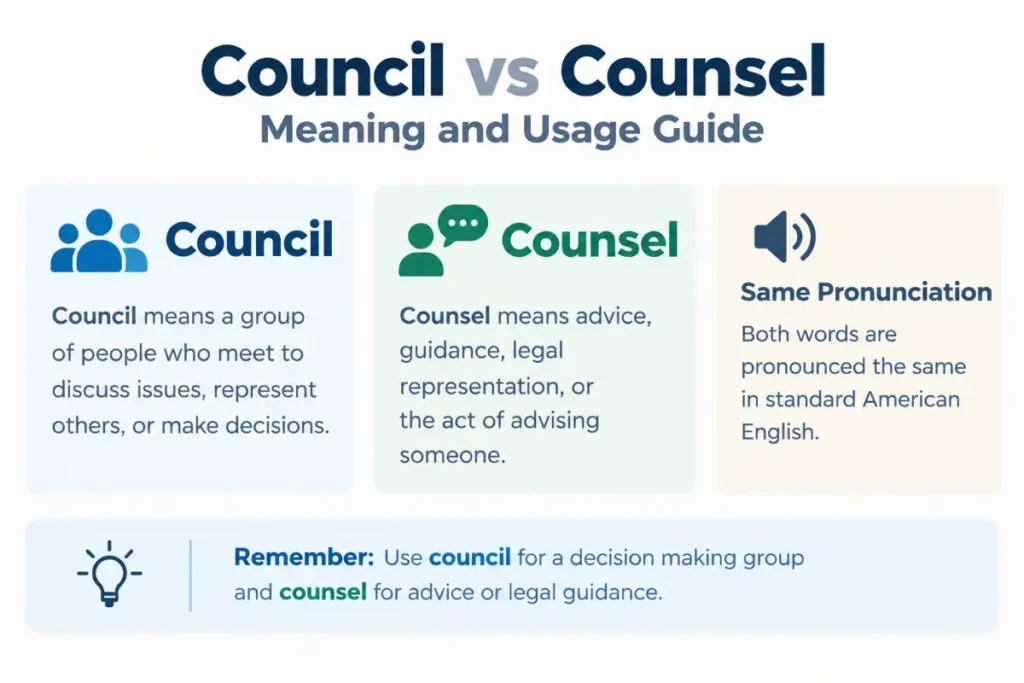
- Council means a group of people who meet to discuss issues, represent others, or make decisions.
- Counsel means advice, guidance, legal representation, or the act of advising someone.
- Both words are pronounced the same in standard American English.
- Council is a noun. Counsel can function as a noun or a verb.
- The plural of council is councils. Counsel is usually uncountable when it means advice.
- Councilor refers to a council member, while counselor refers to someone who provides guidance.
- American English uses counselor, counseled, and counseling. British English commonly uses counsellor, counselled, and counselling.
- A spell checker may accept both words, so always check the meaning of the sentence.
Many readers also check Emigrate vs Immigrate and How to Use Each Word.
Conclusion
Council vs counsel becomes easy to remember once you connect each word with its main meaning. Council refers to a group that meets, governs, or makes decisions. Counsel refers to advice, legal representation, or the act of advising someone. Both words are correct, and neither is a misspelling.
Use one simple editing trick whenever you hesitate. Replace council with group and counsel with advice or advise. If the sentence still makes sense, you’ve probably chosen the right word. Check the surrounding context before submitting an assignment, sending a work email, or publishing a report. A few seconds of careful reading can prevent a small spelling choice from changing your meaning.
FAQs
Is Council a Real Word?
Yes. Council is a standard English noun that refers to a group of people who meet to discuss issues, make decisions, or advise an organization. Common examples include city councils, student councils, and advisory councils. The word is appropriate in everyday conversation, school assignments, workplace communication, and formal documents.
Is Counsel a Real Word?
Yes. Counsel is a standard English word used as both a noun and a verb. As a noun, it can mean advice, guidance, or a lawyer. As a verb, it means to advise or guide someone. Its exact meaning depends on the sentence and the context in which it appears.
What Is the Main Difference Between Council and Counsel?
Council refers to a group of people who meet or make decisions. Counsel refers to advice, guidance, a legal representative, or the act of advising someone. Both words are spelled correctly, but they aren’t interchangeable. Think of a city council as a group and legal counsel as professional advice or representation.
How Do You Pronounce Council and Counsel?
Both words are pronounced KOWN suhl in standard American English. Their IPA transcription is /ˈkaʊn.səl/, with stress on the first syllable. Since they sound the same, pronunciation alone cannot tell you which word a speaker means. The surrounding sentence usually provides the information needed to understand the intended meaning.
Can Council or Counsel Start a Sentence?
Yes. Both words can begin a sentence when the grammar and meaning support them. For example, “Council members met early on Monday” refers to a group. “Counsel can help clients understand their legal options” refers to legal advice or representation. Capitalization doesn’t change the meaning of either word.
What Is a Synonym for Council?
Useful alternatives include committee, board, assembly, and governing body. However, these words aren’t always exact replacements. A city council may have legal powers that a temporary committee doesn’t have. Choose a synonym that matches the group’s role, authority, and purpose rather than swapping words automatically.
What Is a Synonym for Counsel?
When counsel means advice, useful alternatives include guidance, advice, and direction. When it refers to a lawyer, attorney or legal representative may fit and When used as a verb, advise or guide may express the same basic action. The best synonym depends on the meaning you want to communicate.
Is Counsel Appropriate in Formal Writing?
Yes. Counsel is common in legal documents, professional reports, and formal discussions about advice or guidance. Council is equally appropriate when referring to a governing or advisory group. Both forms work well in formal writing, provided you use the spelling that matches the intended meaning. In legal documents, use the exact title or term required by the context.