
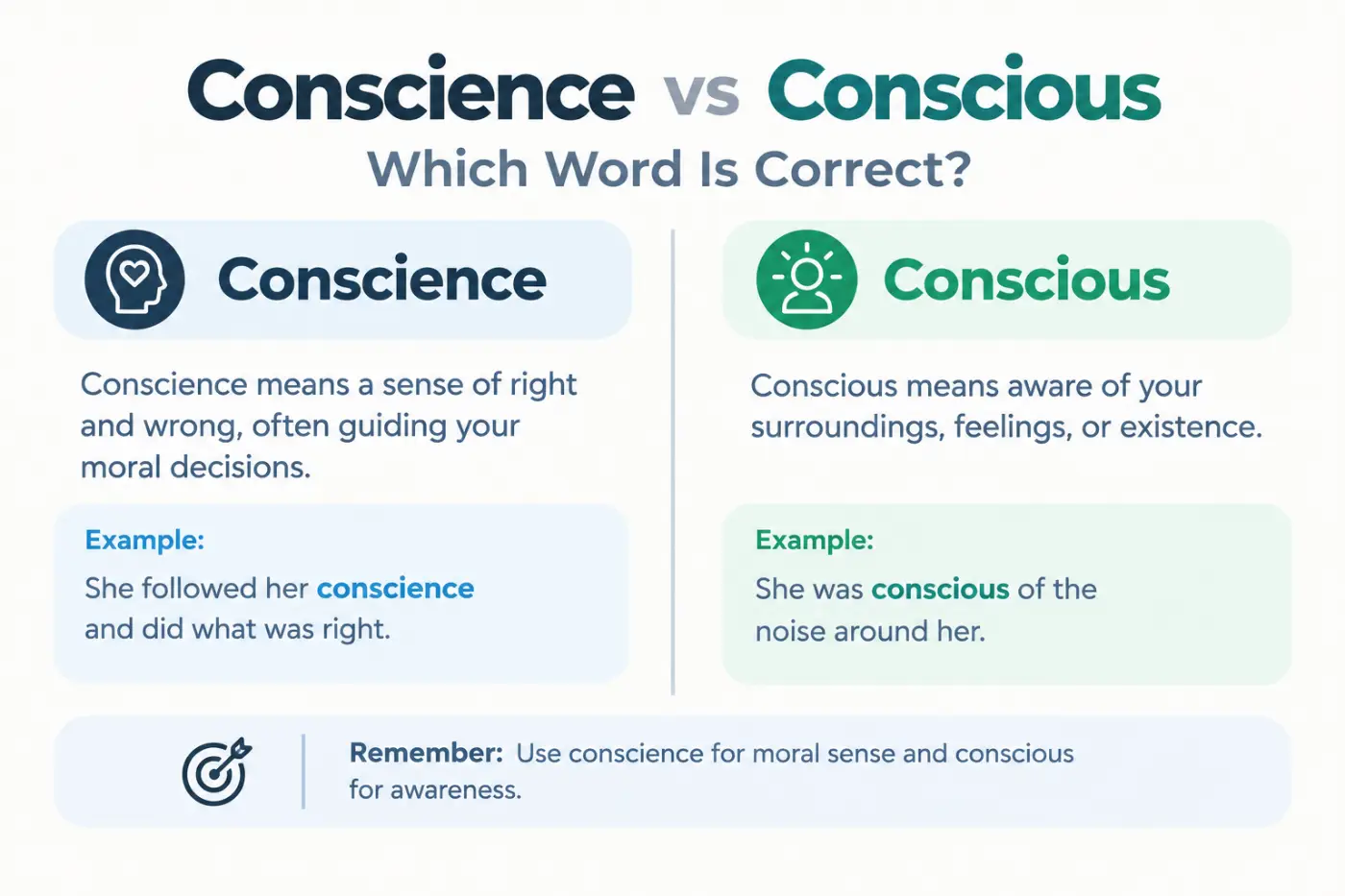
Conscience vs conscious is a common source of confusion because these two words look almost identical and share a similar sound. However, they have different meanings and serve different roles in a sentence. Conscience is your inner sense of right and wrong. Conscious means awake, aware, or able to notice something.
For example, if you feel guilty after telling a lie, your conscience may be bothering you. If you remain awake and aware of your surroundings after an accident, you’re conscious. Both words are correct, but you can’t swap one for the other without changing the meaning of your sentence.
The confusion often comes from their shared word history and similar spelling. Their endings offer a useful clue, but understanding their meanings is the best way to remember the difference. Once you learn how each word works, choosing the right one becomes much easier.
This guide explains their definitions, pronunciation, grammar, origins, and everyday uses. You’ll also find practical examples, common mistakes, and simple memory tips to help you write with confidence.
Still confused? Compare excelerate or accelerate Correct Spelling and Meaning.
Quick Answer
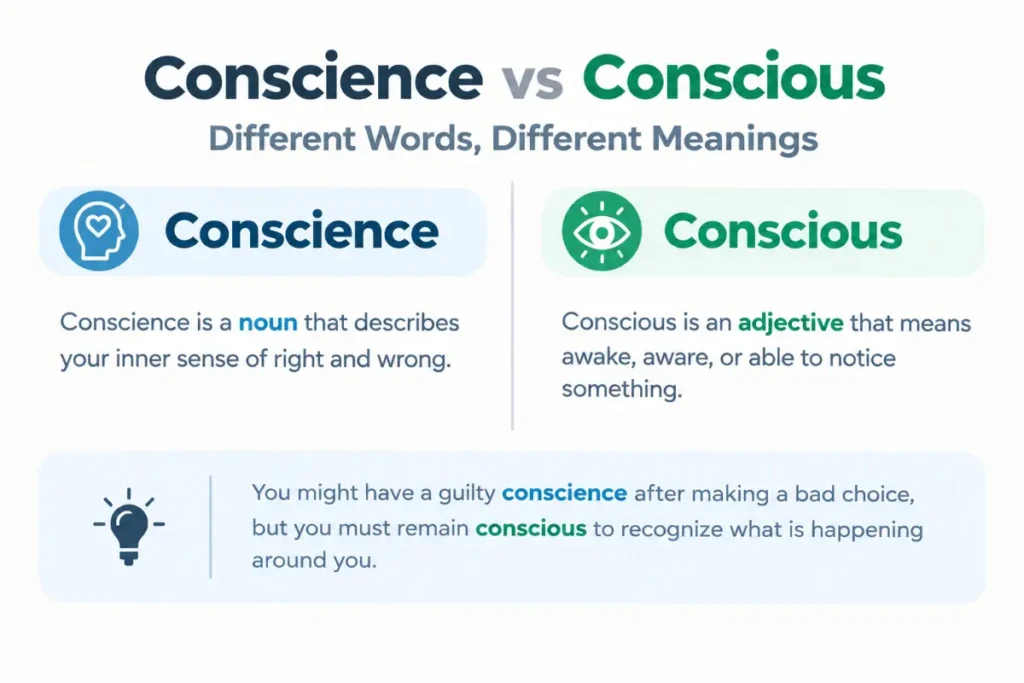
Conscience is a noun that describes your inner sense of right and wrong. Conscious is an adjective that means awake, aware, or able to notice something. You might have a guilty conscience after making a bad choice, but you must remain conscious to recognize what is happening around you.
Comparison Table
| Feature | Conscience | Conscious |
|---|---|---|
| Meaning | An inner sense of right and wrong. | Awake or aware of something. |
| Part of speech | Noun. | Adjective. |
| Pronunciation | KON shuhns. | KON shuhs. |
| Main use | Moral judgment and personal values. | Awareness and alertness. |
| Common phrases | Clear conscience and guilty conscience. | Conscious decision and conscious effort. |
| Formality | Standard in casual and formal writing. | Standard in casual and formal writing. |
| Example | My conscience told me to return the wallet. | I was conscious of the noise. |
| Spelling clue | Ends in science. | Ends in ous. |
What Conscience Means
Conscience is the inner sense that helps you judge your actions as right or wrong. It can make you feel proud when you act honestly or uncomfortable when you believe you’ve done something wrong. This feeling often comes from your values, beliefs, upbringing, and understanding of how your actions affect other people.
The word is a noun. It names a person’s moral awareness rather than describing the person’s physical state. You can listen to your conscience, ignore it, or feel troubled by it.
For example, imagine that a cashier accidentally gives you too much change. You notice the mistake and return the extra money. Your conscience may guide you to do the honest thing, even though you could have kept the money without being caught.
Common Expressions With This Word
Several everyday expressions use this word to describe moral feelings and decisions.
1. A clear conscience. You feel at peace because you believe you’ve acted honestly. For example, I can sleep with a clear conscience because I told the truth.
2. A guilty conscience. You feel troubled because you believe you’ve done something wrong. For example, his guilty conscience made it difficult for him to enjoy the celebration.
3. A matter of conscience. A decision depends on your personal moral beliefs. For example, donating to the cause was a matter of conscience for her.
4. Prick your conscience. Something makes you feel guilty or uncomfortable about your behavior. For example, seeing the damaged playground equipment pricked his conscience because he’d helped cause the damage.
5. Freedom of conscience. The right to hold personal moral or religious beliefs without unfair pressure. For example, freedom of conscience protects people’s ability to follow their convictions.
These expressions all relate to moral judgment. They don’t describe simply being awake or noticing your surroundings.
What Conscious Means
Conscious is an adjective that describes someone who is awake or aware. It can refer to physical awareness, attention, deliberate action, or recognition of a particular fact.
In everyday life, the word often describes a person’s state after an injury or medical emergency. A person who is conscious can respond to their surroundings, although the level of awareness may vary. In other contexts, it describes someone who notices a feeling, problem, or situation.
For example, you might be conscious of your posture during a job interview. You might also make a conscious effort to save money each month. In both cases, the word describes awareness rather than moral judgment.
Common Expressions With This Word
1. Conscious of. Aware of a person, fact, feeling, or situation. For example, I was conscious of everyone waiting for me.
2. A conscious decision. A choice made deliberately rather than by accident. For example, she made a conscious decision to spend less time on social media.
3. Conscious effort. A deliberate attempt to achieve something. For example, learning to listen without interrupting takes conscious effort.
4. Lose consciousness. Stop being aware of your surroundings, usually because of a medical event or injury. For example, the athlete lost consciousness after collapsing on the field.
5. Self conscious. Uncomfortable because you’re paying close attention to how others may see or judge you. For example, he felt self conscious about speaking in front of the class.
6. Conscious choice. An intentional selection made with awareness of the available options. For example, choosing public transportation was a conscious choice to reduce driving.
The central idea is awareness. That awareness may involve your body, your surroundings, your feelings, or your decisions.
Key Differences Explained
The easiest way to separate these words is to ask yourself one question. Are you talking about moral judgment or awareness?
Meaning and Grammar
Conscience names something. It refers to the inner moral guide that influences how you judge your actions. Since it’s a noun, it often appears after words such as my, your, his, or her.
For example, you might say, My conscience wouldn’t let me keep the money. The noun identifies the moral feeling that influences your choice.
Conscious describes something. As an adjective, it gives information about a person, action, or state of awareness.
For example, I was conscious of the mistake. The adjective describes your awareness of what happened.
Spelling Differences
The words differ by only a few letters at the end, which makes them easy to mix up when typing quickly.
1. Conscience ends in science. Think of the final letters as part of the complete word rather than trying to spell the word from its sound alone.
2. Conscious ends in ous. This ending appears in many English adjectives, such as curious, nervous, and obvious.
These spelling patterns can help you remember the difference, but meaning should guide your final choice.
Pronunciation Differences
Both words begin with a similar sound, and their final syllables sound alike in many American English accents. However, their endings are not spelled the same way.
Conscience is commonly pronounced KON shuhns, while conscious is pronounced KON shuhs. Both have two syllables and stress the first syllable.
Because the difference is subtle in speech, context often helps listeners understand the intended word. In writing, you need to choose the correct spelling yourself.
Formality and Context
Both words are standard English. Neither is more formal or more correct than the other.
Use conscience when discussing honesty, guilt, personal values, or moral responsibility. Use conscious when describing awareness, deliberate choices, or someone’s state of alertness.
For example, a student might write about following a conscience in an ethics essay. A medical report might describe a patient as conscious after an injury. Each word fits a different purpose.
Regional Usage
American, British, Canadian, and Australian English use these words with the same basic meanings and spellings. There isn’t a regional spelling difference that changes the choice.
You may hear small differences in accent and vowel quality, but those differences don’t change the grammar. Writers in all four varieties should select the word that matches the intended meaning.
Which Form Is Correct
Both forms are correct. The right choice depends on the sentence and the idea you want to express.
Use conscience when the subject is moral judgment. Use conscious when the subject is awareness or being awake. Treating one as a misspelling of the other would be inaccurate because both are established English words.
Established dictionaries distinguish the noun from the adjective through their definitions and grammatical labels. That distinction provides a reliable basis for choosing between them.
Consider these sentences.
1. I couldn’t ignore my conscience after seeing the unfair treatment. The noun refers to moral judgment.
2. I was conscious of the unfair treatment. The adjective describes awareness of the situation.
Both sentences are grammatically correct, but they communicate different ideas. In the first, the person feels a moral need to respond. In the second, the person notices what is happening.
When you’re unsure, replace the word with a simple explanation. If inner sense of right and wrong fits, choose conscience. If awake or aware fits, choose conscious.
Sentence Examples
The following examples show how these words work in everyday communication, school assignments, professional settings, and personal conversations.
Examples Using Conscience
1. I had a guilty conscience after taking credit for someone else’s work.
2. She returned the lost wallet because her conscience told her it was the right thing to do.
3. He couldn’t enjoy the meal with a clear conscience while his friend went hungry.
4. My conscience reminds me to treat people fairly, even when I’m upset.
5. The decision became a matter of conscience rather than personal gain.
6. After admitting the truth, she felt her conscience was finally clear.
7. The teacher encouraged students to think about their conscience when making difficult choices.
8. He knew he should apologize, and his conscience wouldn’t let him forget it.
9. The manager acted according to his conscience instead of choosing the easiest option.
10. I can live with the outcome because I followed my conscience and did my best.
Examples Using Conscious
1. I was conscious of the noise coming from the apartment upstairs.
2. She made a conscious effort to arrive at work on time.
3. The patient remained conscious and answered the doctor’s questions.
4. He became conscious of how often he checked his phone during dinner.
5. We need to make a conscious choice about how we use our time.
6. She was conscious that her words might hurt her friend’s feelings.
7. The company made a conscious decision to reduce unnecessary spending.
8. I wasn’t conscious of the mistake until my coworker pointed it out.
9. The speaker made a conscious effort to explain the topic in simple terms.
10. After the fall, the coach checked to see if the player was conscious.
Notice how the two groups differ. The first focuses on morality and personal responsibility. The second focuses on awareness, attention, and deliberate action.
Common Mistakes and Misspellings
Writers often confuse these words because they look similar and share related meanings. The following mistakes are worth watching for.
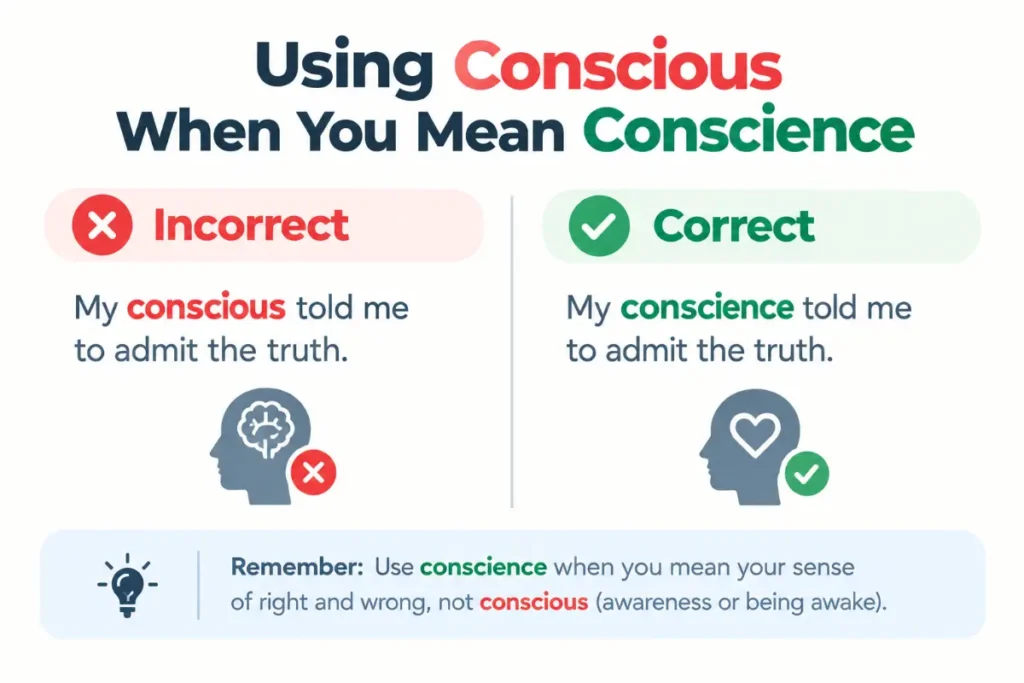
Using Conscious When You Mean Conscience
Incorrect: My conscious told me to admit the truth.
Correct: My conscience told me to admit the truth.
The sentence refers to a moral guide. The adjective conscious cannot fill that noun role.
Using Conscience When You Mean Conscious
Incorrect: She was conscience of the danger.
Correct: She was conscious of the danger.
The sentence describes awareness of a risk. The adjective conscious belongs after the linking verb was.
Confusing Conscience With Consciousness
Incorrect: He lost his conscience after fainting.
Correct: He lost consciousness after fainting.
Consciousness is the noun that describes the state of being conscious. Conscience refers to moral judgment. Losing consciousness means becoming unaware of your surroundings, not losing your sense of right and wrong.
Using Conscious for Moral Feelings
Incorrect: I have a clear conscious after telling the truth.
Correct: I have a clear conscience after telling the truth.
The familiar expression uses the noun that refers to moral judgment. The spelling conscious doesn’t fit this expression.
Using Conscience as an Adjective
Incorrect: It was a conscience decision to help the neighbor.
Correct: It was a conscious decision to help the neighbor.
The intended meaning is that the person chose deliberately. Conscious describes the decision, while conscience names a person’s moral sense.
A useful editing habit is to check the word’s job before checking its spelling. Many mistakes disappear once you identify the meaning and part of speech.
Learn the difference in Accross vs Across Which Spelling Is Correct.
Pronunciation Guide
Both words have two syllables in standard American English. Each word carries its main stress on the first syllable, so the opening sound is stronger than the ending.
Conscience
IPA: /ˈkɑːn.ʃəns/
Easy pronunciation: KON shuhns.
Syllables: con science.
The first syllable carries the stress. The ending sounds like shuhns, with a final n and s sound.
Conscious
IPA: /ˈkɑːn.ʃəs/
Easy pronunciation: KON shuhs.
Syllables: con scious.
Stress the first syllable. The ending sounds like shuhs, without the final n sound heard in the other word.
IPA symbols can vary slightly across dictionaries and American accents. The transcriptions above show common American pronunciations rather than every possible regional variation.
How to Avoid Pronunciation Errors
The main challenge is the similar sound at the beginning. Both words start with the same general consonant pattern, and the endings differ only slightly.
1. Say the word slowly and pay attention to the final sound.
2. Remember that the noun related to moral judgment ends with the n sound in its pronunciation.
3. Practice each word inside a short sentence. For example, My conscience is clear and I am conscious of the noise.
4. Don’t rely on pronunciation alone when writing. The sentence’s meaning and grammar provide stronger clues.
Etymology and Word Origin
These words have related histories, which helps explain their similar appearance. Both ultimately connect to Latin roots associated with knowing or awareness.
The Origin of Conscience
The English word conscience came through Old French from Latin conscientia. The Latin term was associated with knowledge, awareness, and, in particular, knowledge within oneself.
Over time, the word developed a strong connection to moral judgment. It came to describe the inner awareness that helps people assess their actions and recognize a sense of duty or guilt.
That development explains modern expressions such as guilty conscience and clear conscience. Both refer to how a person feels about their own behavior.
The Origin of Conscious
The English word conscious also traces back through French to Latin forms related to conscientia and conscius. These roots are associated with knowing or being aware.
In modern English, the adjective describes a state of awareness or deliberate attention. That meaning appears in phrases such as conscious effort, conscious choice, and conscious of danger.
The shared history helps explain why the words resemble each other. Their modern meanings and grammatical roles, however, have developed into distinct uses. A common origin doesn’t make two words interchangeable.
Regional Usage in English
The distinction remains the same across major English speaking countries. You don’t need to learn a separate spelling rule for each region.
American English
In the United States, both words are standard. Writers use conscience for moral judgment and conscious for awareness.
For example, an American might say, I couldn’t live with a guilty conscience. The same speaker might say, I was conscious of the time during the meeting.
British English
British English follows the same distinction. The spellings and basic grammatical functions match American usage.
A British writer can describe a person as having a clear conscience or being conscious of a problem. Neither expression requires a regional spelling change.
Australian English
Australian English also uses both words with the same meanings. Writers can use them in schoolwork, news reports, business communication, and everyday conversation.
Canadian English
Canadian English follows the same standard forms as American and British English. The choice depends on meaning, not location.
Across these varieties, the most reliable rule is simple. Use the noun for moral judgment and the adjective for awareness.
Grammar Rules and Parts of Speech
Understanding each word’s grammatical role makes it easier to use the correct form in longer sentences.
How to Use Conscience as a Noun
A noun names a person, place, thing, idea, or quality. In this case, the word names a person’s inner moral sense.
It commonly appears with possessive words, adjectives, and verbs that describe moral judgment.
Examples include the following.
1. My conscience troubled me after the argument.
2. She has a strong conscience.
3. He listened to his conscience and admitted the mistake.
4. Their consciences guided them through a difficult decision.
The plural form is consciences. Use it when referring to the moral sense of multiple people or discussing different people’s moral judgments.
How to Use Conscious as an Adjective
An adjective describes a noun or pronoun. This word commonly describes awareness, alertness, or an intentional action.
It often appears after linking verbs such as be, remain, and become. It can also appear before a noun.
Examples include the following.
1. The patient remained conscious.
2. I became conscious of my surroundings.
3. She made a conscious choice.
4. He took a conscious step toward changing his habits.
The adjective can also appear in phrases that describe personal awareness, such as self conscious and socially conscious. These expressions carry specific meanings, so consider the full phrase rather than interpreting each word in isolation.
Common Grammatical Patterns
The following patterns can help you choose the right form quickly.
| Pattern | Correct example | Why it works |
|---|---|---|
| Possessive word plus noun | My conscience is clear. | The noun names a moral sense. |
| Adjective plus noun | A conscious decision. | The adjective describes the decision. |
| Linking verb plus adjective | She is conscious. | The adjective describes her state. |
| Verb plus noun | He ignored his conscience. | The noun acts as the object. |
| Adjective plus preposition | I was conscious of the risk. | The phrase describes awareness. |
Punctuation doesn’t determine which word is correct. The grammatical role and intended meaning do. Both words can appear in simple sentences, compound sentences, and complex sentences.
Real Life Usage Examples
Different situations bring out the distinction in useful ways. These examples show how the words fit naturally into daily life and more formal communication.
Daily Conversation
1. I felt bad about leaving my friend behind, and my conscience kept bothering me.
2. Are you conscious of how loud the television is?
The first sentence describes moral discomfort. The second asks about awareness.
Email and Workplace Communication
1. I made a conscious effort to give every team member time to speak during the meeting.
2. My conscience wouldn’t allow me to take credit for a coworker’s idea.
The first describes a deliberate action. The second explains a decision based on personal ethics.
Academic Writing
1. The essay examines how conscience influences moral choices in difficult situations.
2. Researchers must remain conscious of the limits of their evidence when drawing conclusions.
The first uses a noun to discuss moral judgment. The second uses an adjective to describe awareness of limitations.
News and Journalism
1. The official said he had acted according to his conscience when making the decision.
2. Emergency workers found the injured passenger conscious at the scene.
These examples illustrate two distinct uses. One relates to moral responsibility, while the other describes a person’s state of awareness.
Literature and Storytelling
1. She returned to the old house because her conscience wouldn’t let her forget the promise she had made.
2. As the room grew quiet, he became conscious of footsteps moving behind him.
Writers can use the noun to reveal inner conflict and the adjective to show a character’s growing awareness. Both words help readers understand what a character feels or notices.
Related and Confused Terms
Several related words can make the distinction clearer. Each one serves a specific purpose in English.
Consciousness
Consciousness is a noun that describes the state of being conscious or aware. For example, the patient regained consciousness after the procedure. Unlike conscience, this noun doesn’t specifically refer to moral judgment.
Unconscious
Unconscious is an adjective that generally means not awake or not aware. It can also describe thoughts or actions outside a person’s immediate awareness. For example, the player was unconscious after the collision.
Conscientious
Conscientious means careful, responsible, and guided by a strong sense of duty. A conscientious employee checks their work and takes responsibilities seriously. The word is related in spelling and history, but it doesn’t mean simply awake or aware.
Self Conscious
Self conscious describes feeling awkward or overly aware of how others may see you. For example, she felt self conscious while giving her first presentation. It often relates to embarrassment or concern about other people’s opinions.
Awareness
Awareness means knowledge or understanding of a person, fact, feeling, or situation. For example, public awareness of road safety can help people make safer choices. It is a useful synonym for some meanings of conscious, but it doesn’t replace the moral meaning of conscience.
Morality
Morality refers to ideas about right and wrong behavior. Conscience can help a person apply those ideas to individual choices. For example, a person’s conscience may influence how they respond to an unfair situation.
Guilt
Guilt is a feeling of responsibility or remorse after doing something wrong. A guilty conscience may produce that feeling, but the two terms aren’t identical. Guilt names the feeling, while conscience refers to the inner moral sense associated with judging an action.
Deliberate
Deliberate means intentional or carefully considered. It overlaps with one meaning of conscious in phrases about purposeful action. For example, a deliberate choice is made intentionally, while a conscious effort involves awareness and intention.
These distinctions matter because related words often overlap without sharing exactly the same meaning. Choose the term that expresses the idea you intend.
Expert Editor Insight
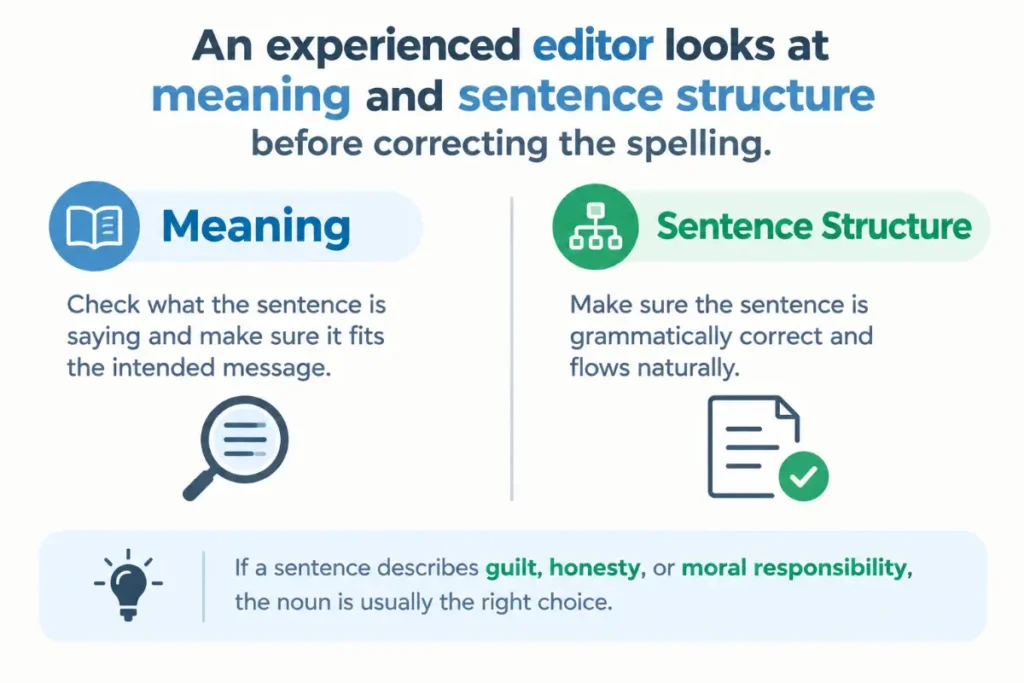
An experienced editor looks at meaning and sentence structure before correcting the spelling. If a sentence describes guilt, honesty, or moral responsibility, the noun is usually the right choice. If it describes awareness or an intentional action, the adjective is the better fit. Spelling tools may catch some mistakes, but they can miss a correctly spelled word used in the wrong context. A quick meaning check is often more useful than relying on automatic correction alone.
Learn the difference in Accept vs Except: Meaning and Usage Explained.
Conclusion
Conscience vs conscious becomes easy to understand once you focus on meaning instead of spelling. Conscience is the noun for your inner sense of right and wrong, while conscious is the adjective for being awake, aware, or intentional. Both words are correct in standard English, but they serve different grammatical roles.
Remember this simple rule: your conscience guides your moral choices, and you remain conscious of the things you notice. Before submitting an email, essay, or report, read the sentence and check what you want to express. That small habit will help you choose the right word and avoid a common writing mistake.
FAQs
Is Conscience a Real Word?
Yes. Conscience is a standard English noun that refers to a person’s inner sense of right and wrong. It often appears in expressions such as a clear conscience or a guilty conscience. You can use it in everyday conversation, school assignments, professional writing, and discussions about ethics. It isn’t an alternative spelling of the adjective conscious.
What Does Conscious Mean in Simple English?
Conscious means awake or aware of something. A conscious person can notice their surroundings, although their level of awareness can vary. The word can also describe an intentional action, such as making a conscious effort to improve your habits. It is an adjective, so it describes a person, condition, decision, or action rather than naming a moral sense.
Which Word Should I Use in Formal Writing?
Choose the word that matches your intended meaning. Use conscience to discuss moral judgment, honesty, or guilt. Use conscious to describe awareness or deliberate action. Both forms are suitable for formal writing, including reports, essays, workplace documents, and academic papers. Neither word is more professional than the other. Accuracy depends on using the right word in context.
How Do You Pronounce These Two Words?
In common American English, conscience sounds like KON shuhns, while conscious sounds like KON shuhs. Both words have two syllables and stress the first syllable. Their similar sounds can make them difficult to distinguish during conversation. When writing, rely on meaning and grammar rather than pronunciation alone to select the correct spelling.
Can Conscience Start a Sentence?
Yes. You can begin a sentence with conscience when it serves as the subject or introduces a topic. For example, Conscience can influence how people respond to difficult moral choices. The sentence is grammatically correct because the noun identifies the subject being discussed. Starting a sentence with the word doesn’t require special punctuation.
What Is a Synonym for Conscience?
Useful alternatives include moral sense, inner judgment, and sense of right and wrong. The best choice depends on the context. For example, moral sense works when discussing ethical decisions, while inner judgment can describe a person’s private assessment of their actions. These expressions convey similar ideas, but none replaces every use of the original noun perfectly.
Why Do People Confuse These Words?
People confuse them because they share a similar spelling, pronunciation, and historical background. Their meanings also relate to a person’s inner experience, which can make the distinction less obvious at first. However, their grammatical roles differ. One names a moral sense, while the other describes awareness. Learning those roles is more effective than memorizing spelling alone.
Is Conscious Appropriate for Academic Writing?
Yes. Conscious is a standard adjective used in academic, scientific, medical, and social discussions. Writers may describe a conscious decision, conscious awareness, or a patient who remains conscious. The word should match the intended meaning and the sentence structure. In academic writing, precise word choice matters because awareness, intention, and moral judgment refer to different ideas.