
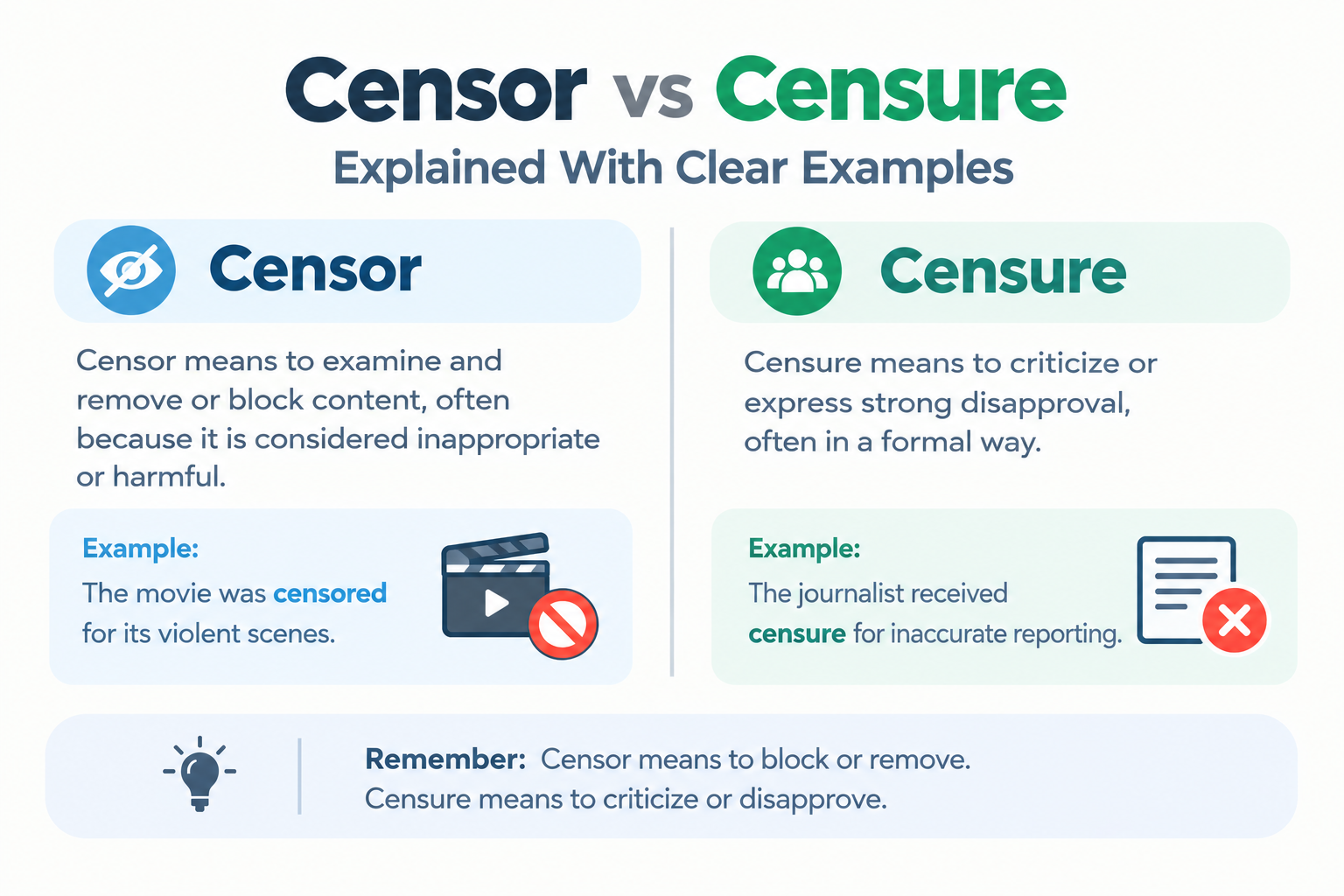
Have you ever mixed up censor vs censure while writing an email or explaining a news story? The two words look and sound almost identical, but they describe different actions. Censor means to examine and remove or restrict content. Censure means to express strong disapproval of someone or something.
The confusion makes sense. Both words can appear in discussions about government, public behavior, schools, workplaces, and the media. However, their meanings and grammatical uses differ. Choosing the wrong word can change the point of an entire sentence. For example, a school may censor inappropriate material, while its principal may censure a teacher for breaking school rules.
The easiest way to remember the difference is to connect censorship with controlling information and censure with criticism. Once you understand that distinction, you’ll find it much easier to use both words correctly. The examples and grammar tips below will help you recognize each word in everyday conversation and formal writing.
You may also want to read fair vs good Meaning and Usage Explained.
Quick Answer
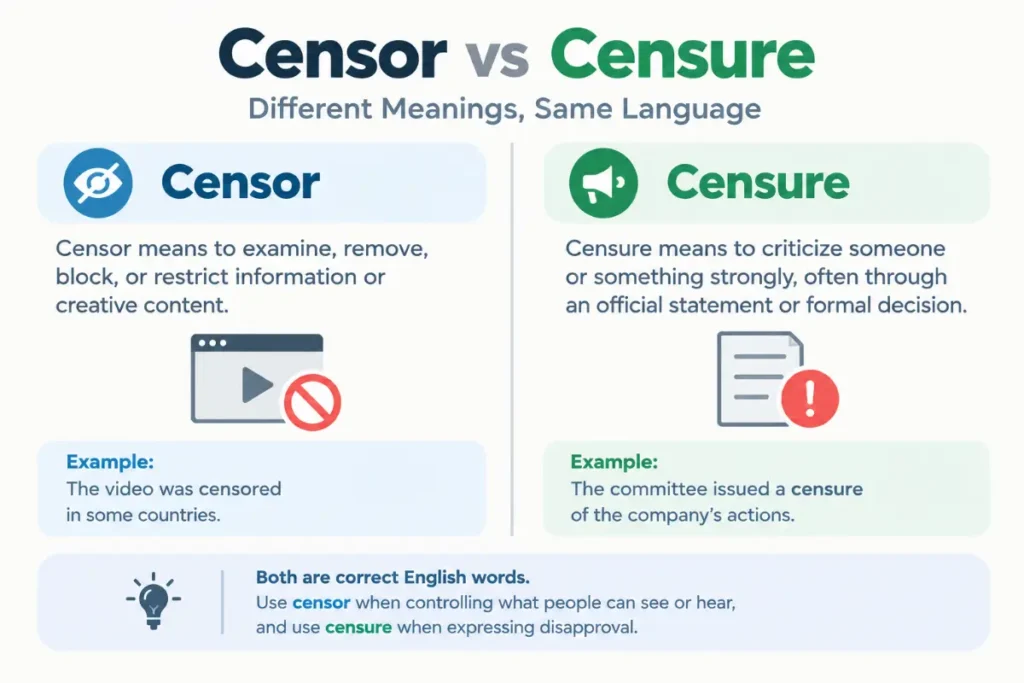
Censor means to examine, remove, block, or restrict information or creative content. Censure means to criticize someone or something strongly, often through an official statement or formal decision. Both are correct English words. Use censor when the issue involves controlling what people can see or hear, and use censure when the issue involves expressing disapproval.
The Main Difference Between the Two Words
The central difference comes down to the action each word describes. One deals with access to information. The other deals with criticism and blame.
Imagine a television station reviewing a movie before broadcasting it. If the station removes scenes containing graphic violence, it censors the movie. Now imagine a government committee issuing a formal statement condemning an official’s misconduct. The committee censures that official.
These actions can happen in the same situation, but they aren’t interchangeable. A person can criticize a decision without restricting its publication. Likewise, a publisher can remove sensitive material without formally condemning the person who created it.
Comparison Table
| Feature | Censor | Censure |
|---|---|---|
| Main meaning | Review or restrict content | Express strong disapproval |
| Part of speech | Noun and verb | Noun and verb |
| Typical object | Information, images, speech, or media | A person, action, decision, or behavior |
| Common context | Media rules, privacy, government, entertainment | Politics, workplaces, public conduct, official discipline |
| Formality | Used in everyday and formal English | Often formal, especially as an official action |
| Pronunciation | SEN ser | SEN shur |
| Related noun | Censorship | Censure |
| Example | The network censored the scene. | The board censured the director. |
Both words can appear in serious public debates. Their meanings depend on the action described, not simply on the topic or the speaker’s opinion.
What Censor Means
Censor is a noun and a verb. As a verb, it means to examine material and remove, change, block, or restrict parts considered inappropriate, harmful, sensitive, or unacceptable under a particular set of rules. As a noun, it can describe a person or authority responsible for reviewing content.
Censorship can affect many kinds of material. A television network may remove offensive language from a broadcast. A government agency may restrict the release of classified information. A company may hide personal details in a document before sharing it publicly.
The word doesn’t always imply wrongdoing. For example, a hospital may censor or redact confidential patient information before releasing a report. That action protects privacy. In other situations, censorship can raise concerns about free speech, public access to information, or political control.
Common Uses of Censor
In everyday life, the verb often describes editing or filtering content. A parent may censor a video before allowing a young child to watch it. A streaming service may censor a scene to meet local broadcasting standards.
In journalism, the word can describe restrictions on reporting. A government might censor news coverage about a military operation. In online communication, a platform might censor posts that violate its content rules.
The noun has a related meaning. A censor reviews material and decides which parts may be published or shown. Historically, the term also referred to a Roman public official with duties involving public conduct and civic affairs.
The Noun and Verb Forms
As a noun, censor identifies a person or authority that reviews material.
Example: The censor rejected several scenes from the film.
As a verb, it describes the act of restricting or editing material.
Example: The broadcaster chose to censor the offensive language.
The related noun censorship describes the practice or system of controlling access to information. The adjective censored describes material that has been restricted or edited.
What Censure Means
Censure means to express strong disapproval of a person, action, decision, or form of behavior. It often suggests that someone has violated a rule, failed to meet an expectation, or acted in a way that deserves criticism.
The word appears frequently in politics, government, professional organizations, and formal disciplinary settings. For example, a legislative body may censure a member for misconduct. A professional association may censure a practitioner for violating its ethical standards.
Censure doesn’t automatically mean that someone loses a job, faces a fine, or receives another legal penalty. It expresses condemnation, and the consequences depend on the rules and circumstances involved. In some organizations, it serves as a formal disciplinary measure. In others, it amounts to an official statement of disapproval.
Common Uses of Censure
In government, a censure motion can formally condemn a public official’s actions. The action communicates disapproval but doesn’t necessarily remove the official from office.
In the workplace, a manager might censure an employee for repeated misconduct. In academic settings, a university committee might censure a faculty member for violating professional standards.
The word can also appear in ordinary conversation. Someone might say that a community leader deserves censure after making an offensive public statement. In this case, the speaker means that the leader deserves strong criticism.
The Noun and Verb Forms
As a noun, censure refers to the act or expression of strong disapproval.
Example: The committee issued a formal censure after reviewing the complaint.
As a verb, it describes the act of condemning someone’s behavior or decision.
Example: The council voted to censure the official.
The word censured is the standard past tense and past participle. The phrase a vote of censure refers to a formal decision expressing disapproval.
Which Word Is Correct
Both forms are correct. The right choice depends on the meaning you intend to express.
Use censor when someone examines or restricts material. Use censure when someone strongly criticizes a person, action, or decision. Neither word is a misspelling of the other, and neither serves as a general replacement for its counterpart.
Consider these examples.
- The newspaper refused to censor the reporter’s account of the meeting. The sentence describes a decision not to restrict published information.
- The newspaper censured the editor for publishing an inaccurate report. The sentence describes criticism directed at the editor.
Notice how changing one word changes the entire meaning. In the first sentence, the focus is on publication and access to information. In the second, the focus is on responsibility and disapproval.
When you edit a sentence, identify the action first. If someone is hiding, removing, or restricting content, censor is likely the right choice. If someone is condemning conduct or expressing strong disapproval, choose censure.
Ten Natural Sentence Examples
The following examples show how these words work in everyday and professional situations.
- Everyday conversation. My parents used to censor some scenes in movies before letting us watch them.
- Text messages. The app censored my comment because it contained language that broke the rules.
- Workplace communication. The manager censured the employee after an investigation confirmed repeated violations of company policy.
- School. The teacher explained why the school shouldn’t censor a student’s opinion simply because it challenges a popular idea.
- Academic writing. Researchers examined how government censorship affected the public’s access to scientific information.
- Formal writing. The committee voted to censure the chairperson for failing to disclose a financial conflict.
- Social situations. Several community members censured the organizer for excluding local residents from the planning process.
- Online communication. The website may censor posts that reveal private information about other users.
- News reporting. Critics accused the administration of trying to censor independent journalists.
- Public policy. The council’s decision to censure the official sent a clear message about its expectations for ethical conduct.
Each sentence uses the word according to its meaning. The subject and object also help you recognize the intended action. Content is commonly censored, while people and their actions are commonly censured.
Common Mistakes and How to Avoid Them
These words create confusion because they share similar spelling and pronunciation. The following mistakes show how to correct that confusion.
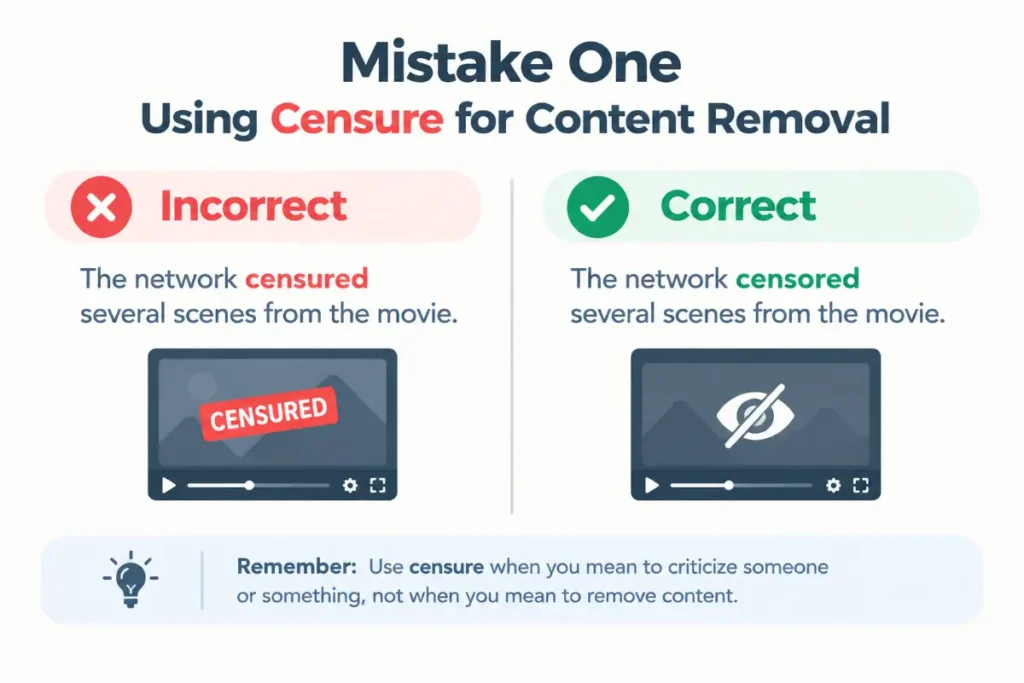
Mistake One Using Censure for Content Removal
Incorrect: The network censured several scenes from the movie.
Correct: The network censored several scenes from the movie.
The first sentence uses the wrong verb because the network removed or restricted material rather than formally condemning it. Use censor for editing or restricting content.
Mistake Two Using Censor for Formal Criticism
Incorrect: The board censored the director for misconduct.
Correct: The board censured the director for misconduct.
The board expressed disapproval of the director’s behavior. It didn’t restrict information. The verb censure communicates that action.
Mistake Three Treating Censorship and Censure as Synonyms
Incorrect: The official received censorship for breaking the rules.
Correct: The official received a censure for breaking the rules.
Censorship describes the practice of restricting information or expression. Censure names an expression or act of disapproval. The two nouns serve different purposes.
Mistake Four Assuming Censure Always Means Punishment
Incorrect: The official was censured, so the official automatically lost the job.
Correct: The official was censured, but the organization kept the official in the position.
Censure may carry professional or political consequences, but it doesn’t automatically result in removal. The relevant rules determine the outcome.
Mistake Five Choosing by Spelling Alone
Incorrect: The sentence must use censor because it concerns a government official.
Correct: The sentence must use the word that matches the action described.
Government officials can censor information or receive censure for misconduct. The topic alone doesn’t determine the correct word. Focus on the verb’s meaning and the action in the sentence.
For another common grammar confusion, see run vs ran Which Form Is Correct.
Pronunciation Guide
Both words have two syllables and begin with the same sound. Their endings differ, which can help you distinguish them when speaking.
- Censor. The International Phonetic Alphabet transcription is /ˈsɛn.sɚ/ in common American English pronunciation. A simple guide is SEN ser. Stress the first syllable.
- Censure. The American English transcription is /ˈsɛn.ʃɚ/. A simple guide is SEN shur. Stress the first syllable.
The main sound difference appears at the start of the second syllable. Censor uses an S sound. Censure uses the SH sound.
Because the words sound similar, listeners may rely on context to understand them. A discussion about editing a television program points toward censor. A discussion about an official reprimand points toward censure.
When writing, don’t rely on pronunciation alone. Remember the action each word describes and check the sentence for meaning.
Etymology and Word Origin
The histories of these words help explain their relationship. Both trace back to Latin, where the ideas of assessment, judgment, and official responsibility played a role in their development.
The Origin of Censor
Censor comes from the Latin word censor, which referred to a Roman official responsible for conducting a census and overseeing aspects of public conduct. The Latin verb censere carried meanings associated with assessing, judging, or forming an official opinion.
Over time, English developed the modern sense of a person who reviews material before it reaches an audience. The verb now commonly describes restricting or editing speech, writing, images, films, and other forms of expression.
The related word censorship names the practice or system of controlling content.
The Origin of Censure
Censure entered English through French and Latin forms connected with judgment, assessment, and criticism. Its modern meaning emphasizes strong disapproval or formal condemnation.
That history explains why the word appears so often in official settings. A censure communicates a judgment about conduct or a decision. It can express institutional disapproval without necessarily imposing a separate penalty.
Although the two words share historical roots, their modern meanings have developed in different directions. One focuses on restricting content. The other focuses on condemning behavior.
Regional Usage
The distinction remains consistent across major English varieties. American, British, Canadian, and Australian English use both words with essentially the same meanings and spelling.
American English
In the United States, censor is common in discussions about television ratings, online moderation, privacy, government restrictions, and media editing. Censure often appears in political reporting, legislative procedures, professional discipline, and formal criticism.
For example, an American news report might describe a platform censoring a post or a city council censuring a member. Both uses are standard.
British English
British English follows the same distinction. A broadcaster may censor a program, while a committee may censure a member for inappropriate conduct.
There is no major British spelling change that turns one word into the other. Writers should choose based on meaning rather than regional spelling rules.
Australian English
Australian English also uses both forms in their established senses. Discussions about media standards may use censor, while political or professional reporting may use censure.
The context determines the word. The distinction isn’t a special feature of Australian spelling.
Canadian English
Canadian English follows the same general pattern. Writers use censor for restrictions on content and censure for expressions of disapproval.
Across all four varieties, the safest approach is to learn the meaning and grammatical pattern of each word. Regional differences don’t remove the distinction.
Grammar Rules and Common Patterns
Both words can function as nouns and verbs, but they appear in different sentence patterns. Understanding those patterns makes editing easier.
How to Use Censor as a Verb
The verb usually takes the material being reviewed or restricted as its direct object.
Examples include the following.
- The broadcaster censored the scene.
- The agency censored the document.
- The platform censored the post.
You can also use the passive form when the person or organization responsible isn’t known or isn’t the focus.
Example: The report was censored before publication.
The verb’s main forms are censor, censors, censored, and censoring. Its related noun is censorship.
How to Use Censor as a Noun
As a noun, the word identifies a person or authority that reviews content.
Example: The censor approved the film after several edits.
The plural form is censors. The related adjective censored describes content that has been restricted or edited.
How to Use Censure as a Verb
The verb often takes the person or organization being criticized as its object. It may also take an action or decision as its object.
Examples include the following.
- The committee censured the member.
- The board censured the decision.
- Voters censured the official’s conduct.
The main forms are censure, censures, censured, and censuring. Use censured for the past tense and past participle.
How to Use Censure as a Noun
As a noun, the word can appear with articles and modifiers.
Examples include a formal censure, an official censure, and a vote of censure.
Example: The committee issued a formal censure after the investigation.
The noun can also appear after a preposition.
Example: The official faced censure for violating the code of conduct.
Punctuation and Sentence Structure
Neither word requires special punctuation. Use commas, periods, and other marks according to normal sentence rules.
For example, you can write: The board censured the director, but it didn’t remove the director from office.
The comma separates two independent clauses joined by but. It isn’t required because the sentence contains either of the target words.
In formal writing, make the object of the action clear. Readers should understand exactly what was restricted or who received criticism.
Real Life Usage in Different Settings
These words become easier to remember when you see them in situations that occur outside a grammar lesson.
Daily Conversation
A parent might say, I censored the movie because some scenes weren’t suitable for my child. Here, the parent restricted content.
A neighbor might say, The residents censured the landlord for ignoring repeated safety complaints. Here, the residents expressed strong disapproval.
Email and Workplace Communication
A human resources manager might write, The company censored confidential employee details before sharing the report. The focus is on protecting private information.
A department head might write, The committee voted to censure the supervisor for violating workplace policy. The focus is on professional conduct.
Academic Writing
A student might write, The study explores how censorship affected public debate during the period. The noun refers to restrictions on information or expression.
A researcher might write, The association issued a censure after reviewing the member’s professional conduct. The sentence describes a formal expression of disapproval.
News and Journalism
A journalist might report, Officials faced criticism after attempting to censor independent reporting. The sentence describes efforts to restrict news coverage.
Another report might state, The legislature voted to censure the representative after an ethics investigation. The sentence describes an official act of condemnation.
Literature and Storytelling
A novelist might write, The king ordered his advisers to censor the letters before they reached the public. The order controls what people can read.
Another writer might describe a character this way, The village elders censured the merchant for betraying a trusted friend. The sentence focuses on disapproval of the merchant’s behavior.
Related Words and Expressions
Several related terms can help you express the same ideas more precisely. Some describe restrictions on content, while others describe criticism or discipline.
- Censorship. The practice of reviewing and restricting information or expression. It is closely connected to the verb censor.
- Censored. The past tense or past participle of censor, also used as an adjective for material that has been restricted.
- Censoring. The act of reviewing and restricting content. Example: The agency is censoring parts of the document.
- Criticize. To express disapproval or point out faults. This is a broader and often less formal term than censure.
- Condemn. To express very strong disapproval. It often carries a more forceful tone than ordinary criticism.
- Reprimand. To formally tell someone that their behavior was wrong. A reprimand may be part of a disciplinary process.
- Rebuke. To criticize someone sharply. It can describe a direct verbal response rather than an official institutional decision.
- Redact. To remove or obscure sensitive information from a document before sharing it. Unlike censor, this term often refers specifically to editing text or records to protect confidential details.
These words overlap in some situations, but they aren’t exact substitutes. For example, an organization may reprimand an employee and separately issue a formal censure. A publisher may redact private details without condemning the person named in a report.
Expert Editor Insight
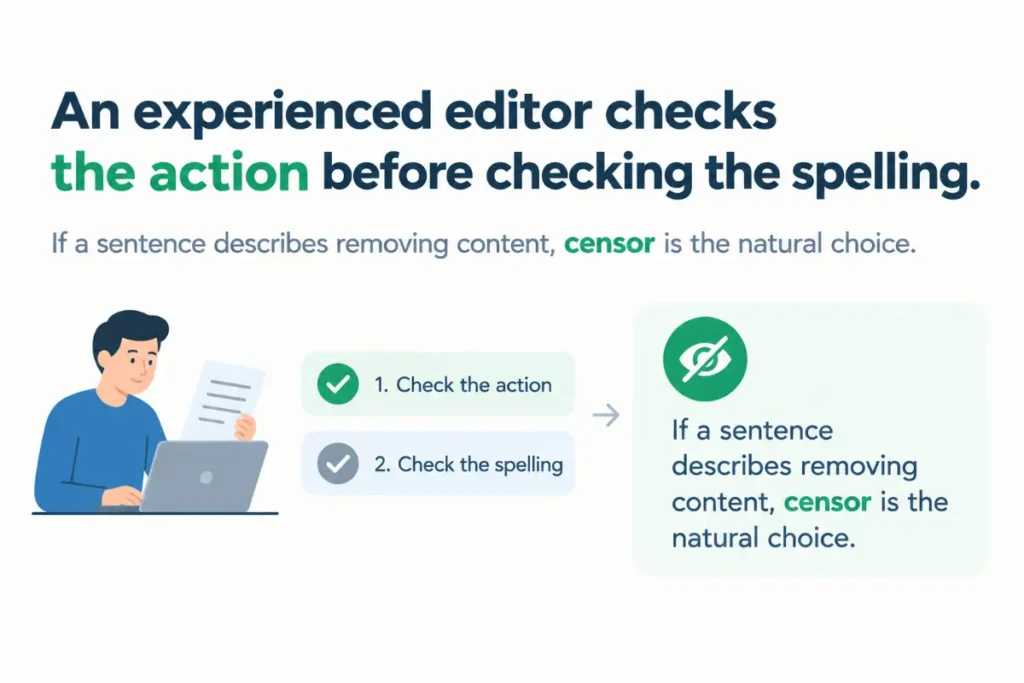
An experienced editor checks the action before checking the spelling. If a sentence describes removing content, censor is the natural choice. If it describes a formal expression of disapproval, censure fits. Spellcheckers may accept both words because both are legitimate English terms, so a standard spelling tool might not catch a meaning error. Read the entire sentence and ask what actually happened. That simple habit catches many word choice mistakes that automatic corrections miss.
A related grammar guide is Who’s vs Whose Meaning and Correct Usage.
Conclusion
The distinction between censor vs censure becomes clear when you focus on the action in the sentence. Censor means to review and restrict content, while censure means to express strong disapproval of a person, decision, or action. Both are correct English words, and neither is a misspelling of the other.
For a quick memory trick, connect censor with screens, media, and restricted information. Connect censure with criticism, condemnation, and official disapproval. Before you finish a sentence, ask yourself what happened. Did someone restrict information, or did someone criticize conduct? That one question will help you choose the right word with confidence.
FAQs
Is Censor a Real Word?
Yes. Censor is a standard English noun and verb. As a verb, it means to review and restrict content. As a noun, it can refer to a person or authority responsible for that review. The word appears in discussions about media, online platforms, privacy, government restrictions, and the release of sensitive information.
Is Censure a Real Word?
Yes. Censure is also a standard English noun and verb. It means to express strong disapproval of a person, decision, or action. A committee may censure a member for misconduct, or a professional organization may issue a formal statement condemning a violation of its standards. It doesn’t automatically mean the person will lose a job or face a legal penalty.
What Does Censor Mean?
Censor means to examine and remove, change, block, or restrict content under a set of rules or standards. A broadcaster might censor offensive language, and an organization might censor confidential details before releasing a document. The word can describe routine editing or more controversial restrictions on information and free expression. The context helps explain the reason for the restriction.
What Does Censure Mean?
Censure means to criticize or condemn someone or something strongly. It often appears in formal situations where a group expresses disapproval of conduct. For example, a council may censure a member who violates its rules. The word emphasizes judgment and criticism rather than the removal or restriction of information.
How Do You Pronounce These Words?
Both words have two syllables and carry stress on the first syllable. In American English, censor is commonly pronounced SEN ser, while censure is pronounced SEN shur. The main difference is the sound at the start of the second syllable. Listen for the S sound in the first word and the SH sound in the second.
Can Censure Start a Sentence?
Yes. You can start a sentence with censure when the word serves as a noun or a verb. For example, Censure followed the investigation into the official’s conduct. You could also write, The board may censure the member after reviewing the evidence. The important point is to use the word in a way that clearly expresses disapproval.
What Is a Synonym for Censure?
Useful alternatives include condemn, criticize, rebuke, and reprimand. Each has a slightly different meaning. Condemn often expresses very strong disapproval, while criticize can be broader and less formal. Reprimand usually involves a direct or formal warning. Choose the word that matches the strength and setting of the criticism.
Why Do People Confuse Censor and Censure?
People confuse these words because they look similar, share the same first syllable, and appear in overlapping contexts such as government, politics, and public debate. However, the actions differ. One concerns restricting information, while the other concerns expressing disapproval. Learning a short example for each word is often more effective than memorizing the spellings alone.