
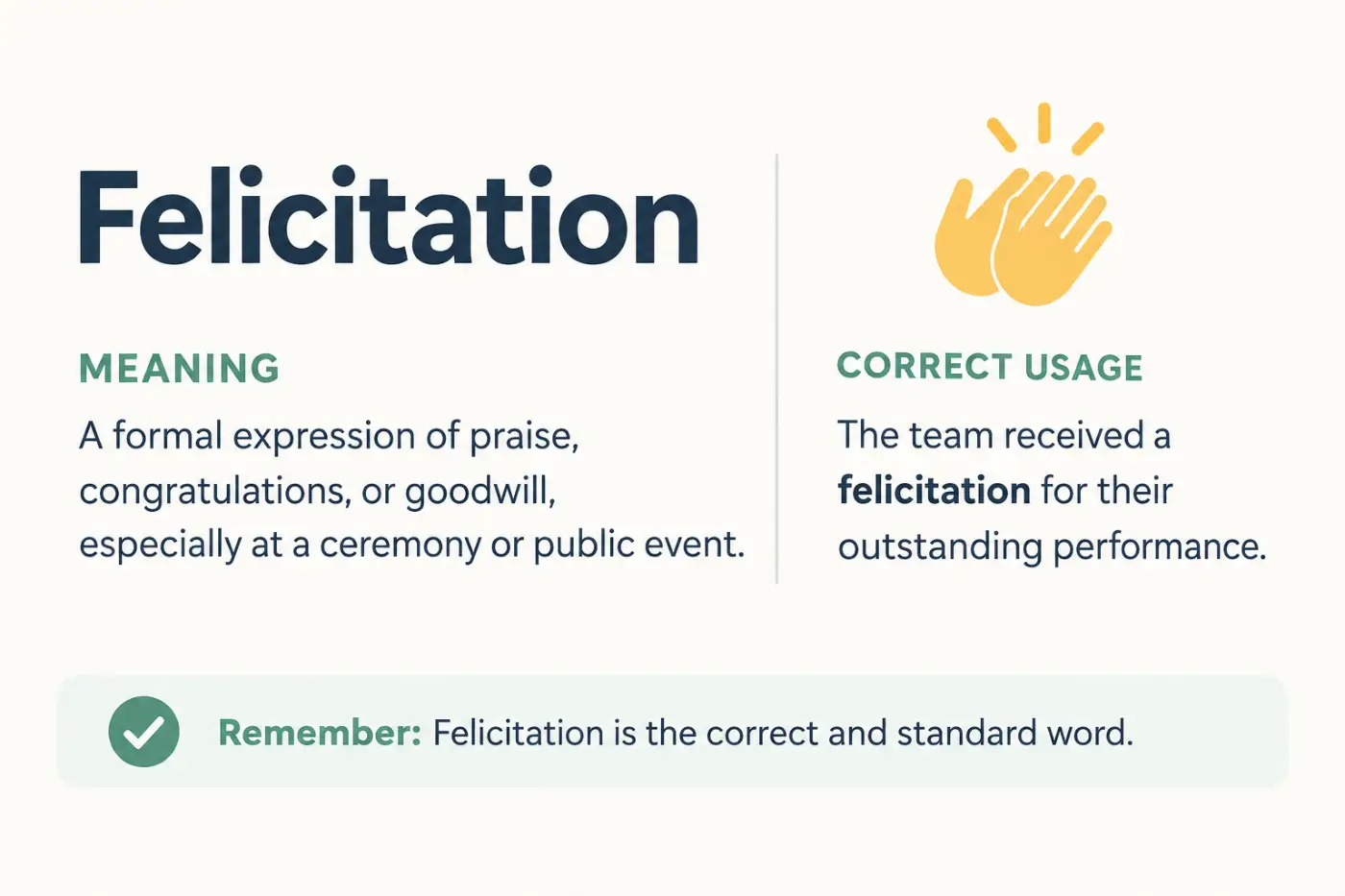
Felicitation meaning can be confusing because the word sounds familiar but does not appear often in everyday American conversation. At its core, it refers to congratulations, praise, or an act of honoring someone for an achievement, success, or important occasion. You may see it in formal speeches, award ceremonies, academic events, and official notices.
The word is closely connected with the verb felicitate, which means to congratulate someone. That connection makes the basic idea easier to understand. If someone is felicitated, that person is being congratulated or honored. A felicitation can therefore be an expression of congratulations or a formal event where someone receives recognition.
The word also has an interesting difference across English varieties. It is standard English in the United States and Britain, but Americans generally use congratulations more often in ordinary conversation. In South Asian English, especially in India and Pakistan, felicitation is widely used for formal ceremonies in which a person is honored with a speech, award, gift, certificate, or public recognition. This article explains the meaning, grammar, pronunciation, history, examples, and natural usage so you can choose the right expression for your context.
Learn the difference in alr meaning in Texting and Online Chat.
Quick Answer
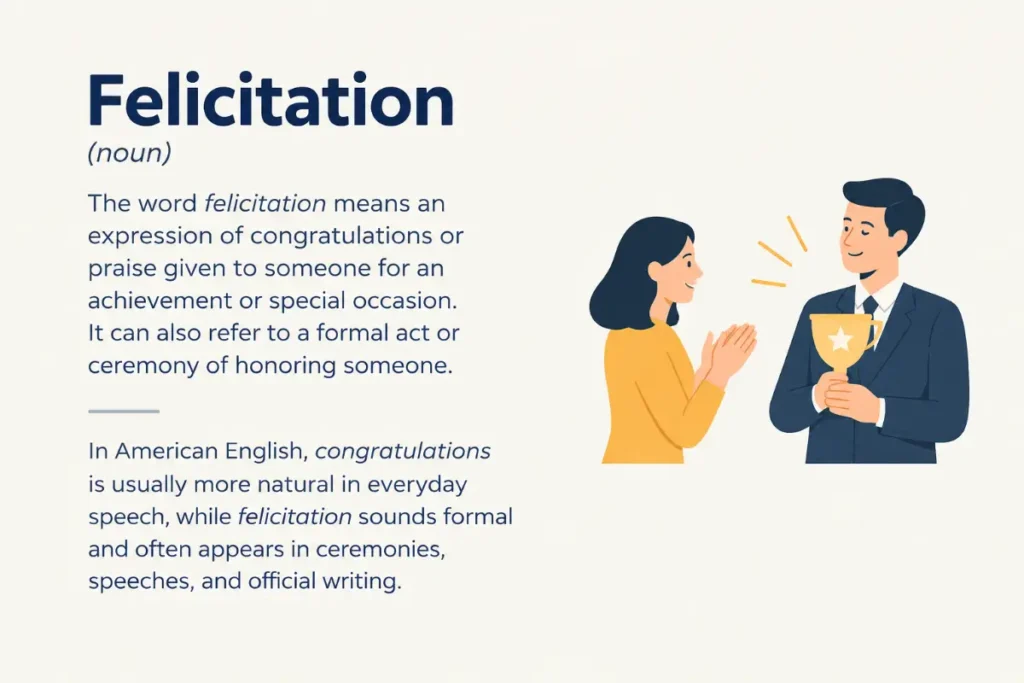
The word felicitation means an expression of congratulations or praise given to someone for an achievement or special occasion. It can also refer to a formal act or ceremony of honoring someone. In American English, congratulations is usually more natural in everyday speech, while felicitation sounds formal and often appears in ceremonies, speeches, and official writing.
Meaning Of Felicitation
Felicitation is a noun connected with congratulations, praise, or formal recognition. It can describe the act of congratulating someone or an organized event held to honor that person.
The basic idea is positive recognition. Someone has achieved something, reached an important milestone, received an honor, or taken part in an event worth celebrating. Another person or group then expresses congratulations or publicly recognizes the achievement.
For example:
- The school held a felicitation for the students who won the competition.
Here, felicitation refers to a formal event honoring the successful students.
- The organization sent its felicitations to the award winner.
Here, felicitations means congratulations.
- The mayor attended the felicitation ceremony.
In this sentence, the word refers to a formal event where someone is honored.
The meaning can therefore shift slightly according to context. Sometimes the focus is on the expression of congratulations. Sometimes the focus is on the ceremony or formal act of honoring someone.
What Does Felicitation Mean In Simple English
In simple English, felicitation means congratulations or formal praise for someone’s success.
You can think of it as a formal way to say that someone deserves recognition for something good they have achieved.
For example, imagine a student wins a national science competition. The school may organize a ceremony to honor the student. Teachers may give speeches, present a certificate, and congratulate the winner. That event can be described as a felicitation ceremony.
In everyday American English, however, most people would simply say congratulations or an award ceremony.
For example:
- The school held a ceremony to honor the winner.
- The principal congratulated the student on the achievement.
These sentences sound more natural in ordinary American English.
Felicitation is not wrong in these situations. It simply has a more formal tone.
Is Felicitation A Real English Word
Yes. Felicitation is a real and established English word.
It is related to felicitate, which means to congratulate someone. The noun form refers to the act of congratulating or honoring someone. The plural form felicitations is also used, especially in formal expressions meaning congratulations.
The word may seem unusual to some American readers because it is much less common in casual conversation than congratulations. A word can be completely standard English without being common in everyday speech.
That distinction matters. You should not assume that an unfamiliar word is incorrect simply because you rarely hear it.
Felicitation is best understood as a formal noun associated with congratulations and recognition.
Felicitation As A Noun
It is a noun. It names an action, expression, or event rather than describing a person or object.
Common patterns include:
- a felicitation ceremony.
- a felicitation event.
- a felicitation program.
- a felicitation function.
- a felicitation speech.
- a felicitation ceremony for the winners.
- a formal felicitation of the recipient.
The plural form felicitations can mean congratulations.
For example:
- Please accept my felicitations on your achievement.
This means:
Please accept my congratulations on your achievement.
The plural form sounds quite formal. In ordinary American conversation, Congratulations on your achievement would be much more natural.
Felicitation And Felicitate
Felicitation and felicitate come from the same word family.
Felicitate is a verb.
Felicitation is a noun.
The relationship becomes clear in these examples.
- The committee felicitated the winners.
- The committee organized a felicitation ceremony for the winners.
The first sentence describes the action of congratulating or honoring the winners.
The second sentence names the event connected with that recognition.
Another example makes the difference even clearer.
- The principal felicitated the students.
- The principal gave a felicitation speech.
In the first sentence, felicitated is the verb.
In the second sentence, felicitation is part of a noun phrase.
Felicitation Vs Congratulations
Felicitation and congratulations are closely related, but they are not equally natural in every situation.
Congratulations is the normal everyday word for expressing pleasure about someone’s success.
For example:
Congratulations on your promotion.
Congratulations on winning the award.
Felicitation has a more formal tone. It can refer to the act of offering congratulations, but it can also refer to a formal event or ceremony.
Compare these sentences:
- Congratulations on your promotion.
- Please accept my felicitations on your promotion.
The first sounds natural in everyday American English.
The second sounds formal and somewhat ceremonial.
Now compare:
- The company held a ceremony to honor the retiring director.
- The company held a felicitation ceremony for the retiring director.
Both can work. The second has a more formal and ceremonial flavor.
The choice depends on the situation and audience.
Comparison Table
| Form | Meaning | Part of Speech | Typical Context | Formality | Natural American Alternative |
|---|---|---|---|---|---|
| Felicitation | An act or expression of congratulations or formal recognition | Noun | Ceremonies and formal writing | Formal | Congratulations or recognition |
| Felicitations | Congratulations or expressions of good wishes | Plural noun | Formal messages and speeches | Very formal | Congratulations |
| Felicitate | To congratulate or honor someone | Verb | Formal writing and speeches | Formal | Congratulate |
| Congratulations | An expression of pleasure for someone’s success | Noun | Everyday and formal communication | Neutral | Congratulations |
| Recognition | Public or official acknowledgment of achievement | Noun | Awards and professional settings | Neutral | Recognition |
| Tribute | Words or actions showing respect or admiration | Noun | Ceremonies and memorial events | Neutral to formal | Tribute or honor |
How The Word Is Used
The word can describe several related situations.
An Expression Of Congratulations
In this use, felicitation means the act of congratulating someone.
For example:
The president sent his felicitations to the newly elected leader.
The focus is on the congratulations themselves.
A Formal Ceremony
In some contexts, especially South Asian English, felicitation commonly refers to a ceremony organized to honor someone.
For example:
The university organized a felicitation ceremony for its top graduates.
The event might include speeches, certificates, awards, flowers, gifts, or other forms of recognition.
An Act Of Honor
The word can also describe formal recognition given to someone.
For example:
The committee arranged a felicitation for the retiring professor.
The focus is on the formal act of honoring the professor.
These uses share one central idea. Someone is being recognized and congratulated for something worthy of praise.
How To Use The Word In A Sentence
Because felicitation is a noun, it often appears after words such as a, the, his, her, their, or formal descriptive adjectives.
For example:
- The school organized a felicitation ceremony.
- The award was presented during the felicitation.
- She received a special felicitation from the organization.
- The committee planned a formal felicitation for the professor.
- His achievements were recognized at the felicitation ceremony.
You can also use the plural felicitations when you mean congratulations.
For example:
- My felicitations to the entire team.
- Please accept our felicitations on your success.
- The governor offered his felicitations to the winners.
These sentences are grammatical, but felicitations is considerably more formal than congratulations.
Which Word Should You Use In American English
If you are writing for a general American audience, congratulations is usually the safest and most natural choice when you simply want to congratulate someone.
For example:
Congratulations on your new job.
That sentence sounds natural in a conversation, email, card, or social media post.
You could write:
My felicitations on your new job.
The sentence is understandable and grammatical, but it sounds formal and somewhat old fashioned to many American readers.
Use felicitation when the context itself is formal or ceremonial.
For example:
The university hosted a felicitation ceremony for the retiring professor.
That sentence works well because the event is formal and organized around public recognition.
If you are writing a casual message, choose congratulations.
If you are naming a formal recognition event and the term fits the local style, felicitation can work well.
Sentence Examples
Here are natural examples showing different uses.
- The university organized a felicitation ceremony to honor the retiring professor.
The noun refers to a formal event recognizing the professor’s career.
- The principal offered felicitations to the students who earned national awards.
Here felicitations means congratulations.
- The organization held a special felicitation for its longtime volunteers.
The word refers to a formal act or event honoring the volunteers.
- She received a certificate during the felicitation ceremony.
The context makes it clear that the ceremony was organized to recognize her achievement.
- The governor sent his felicitations to the athletes after their victory.
The plural noun means congratulations.
- The school invited parents to attend the felicitation of the scholarship winners.
The sentence describes a formal recognition event.
- The committee prepared a short speech for the felicitation ceremony.
The ceremony is the occasion for honoring someone.
- Please accept my felicitations on your well deserved success.
The sentence is a formal expression of congratulations.
- The company held a small event to recognize employees who had completed twenty years of service.
This sentence uses more everyday American wording for the same general idea.
- The award ceremony included a special tribute to the teacher.
Tribute is used here instead of felicitation because the focus is on admiration and respect.
Common Mistakes
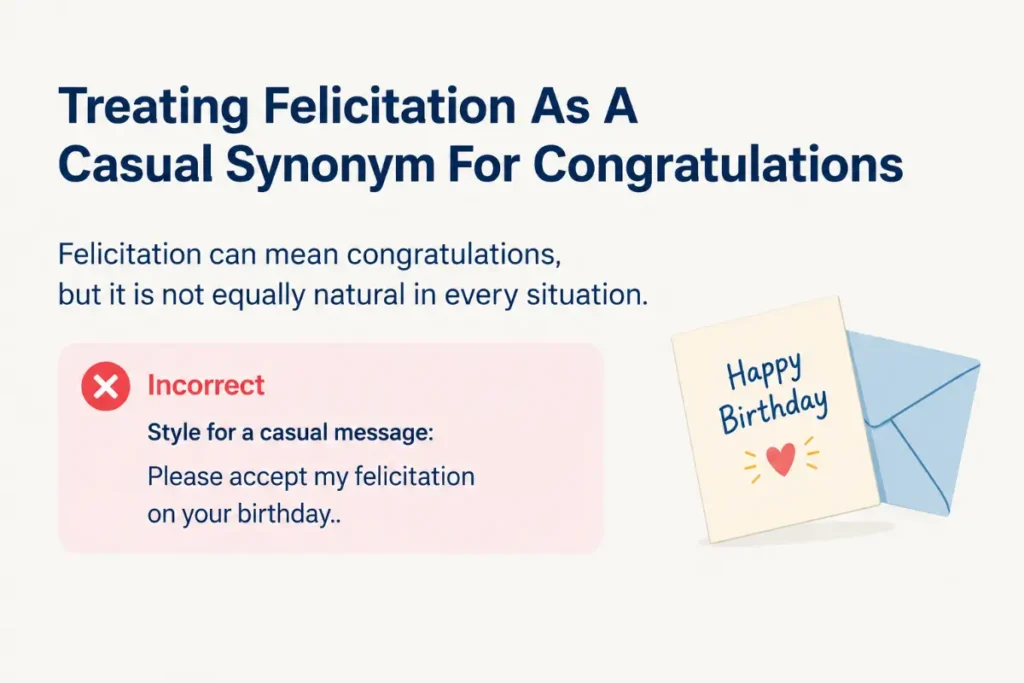
Treating Felicitation As A Casual Synonym For Congratulations
Felicitation can mean congratulations, but it is not equally natural in every situation.
Incorrect style for a casual message:
Please accept my felicitation on your birthday.
More natural:
Happy birthday.
Or:
Congratulations on your achievement.
The problem is not basic grammar. The issue is tone and context.
Assuming Felicitation Means Only A Ceremony
The word can refer to a ceremony, especially in some regional varieties of English, but its meaning is broader.
It can also refer to an expression or act of congratulations.
For example:
The letter contained felicitations from the committee.
There is no ceremony in that sentence.
Using Felicitate Like A Noun
Felicitate is a verb, not the noun for the ceremony.
Incorrect:
The school organized a felicitate for the winners.
Correct:
The school organized a felicitation for the winners.
Confusing Felicitation With Celebration
Celebration is broader. A celebration can mark a birthday, holiday, wedding, victory, anniversary, or any happy event.
Felicitation focuses more specifically on congratulations, honor, or recognition.
A retirement party may be a celebration.
A formal ceremony honoring a retiring employee may be described as a felicitation.
The two ideas can overlap, but they are not identical.
Using Felicitation When Recognition Is The Real Meaning
Sometimes recognition is a better word.
If an organization publicly acknowledges an employee’s years of service, recognition may sound more natural in American professional writing.
For example:
The company held an employee recognition ceremony.
This may be clearer to a general American audience than:
The company held an employee felicitation ceremony.
Both can communicate the idea of honoring someone, but the first is more familiar.
Pronunciation Guide
Felicitation has five syllables in common English pronunciation.
A standard American pronunciation can be represented approximately as:
fə LIS uh TAY shun.
The International Phonetic Alphabet can be represented as /fəˌlɪsəˈteɪʃən/.
The strongest stress falls on the syllable containing the long a sound.
The word comes from the same family as felicitate and felicity, so recognizing the shared beginning can help with pronunciation.
A common mistake is to pronounce every vowel strongly and evenly. Natural English reduces some unstressed vowels, especially in longer words.
If you are learning the word for formal speaking, focus on the main stress rather than trying to give every syllable equal weight.
Etymology And Word Origin
Felicitation belongs to a word family connected with happiness, good fortune, and congratulations.
The family traces back through French to Latin roots associated with happiness and good fortune. The Latin verb felicitare meant to make happy or to congratulate, while felicitas referred to happiness, good fortune, or prosperity.
English developed felicitate as a verb meaning to congratulate. Felicitation developed as the related noun.
This history helps explain the connection between the word and the idea of congratulations. The underlying sense is tied to wishing someone well or recognizing their good fortune.
The related English word felicity can mean happiness or a state of great pleasure. It can also refer to skillful or appropriate expression in some contexts.
These words share a historical family even though modern English gives them different meanings.
A related grammar guide is Choosing or Chosing Meaning, Usage and 20 Examples 2026.
Regional Usage
The word is standard English across major English varieties, but its frequency and preferred contexts differ.
American English
In American English, felicitation is understandable and legitimate but relatively formal. Most people are more likely to use congratulations in everyday conversation.
For example:
Congratulations on your promotion.
That is the natural everyday choice.
Felicitation is more likely to appear in formal ceremonies, institutional language, or writing that intentionally uses a ceremonial tone.
The phrase felicitation ceremony can also be understood by American readers, especially when the event is described clearly.
British English
British English also recognizes felicitation and felicitations. The words can appear in formal writing and ceremonial contexts.
Congratulations remains much more common in ordinary communication.
The difference is mainly one of frequency and register rather than correctness.
South Asian English
Felicitation has a particularly strong presence in South Asian English. In countries such as India and Pakistan, people commonly use felicitation to describe formal events where an individual is honored publicly.
A school, university, professional organization, or community group may organize a felicitation ceremony for a student, teacher, athlete, public figure, or retiring employee.
This usage is established in regional English and should not automatically be treated as an error simply because it sounds less common to an American reader.
Canadian And Australian English
The word is also available in Canadian and Australian English, although congratulations is generally more familiar for ordinary personal messages.
Regional differences mostly involve frequency and context. The basic meaning remains the same.
Grammar And Part Of Speech
Felicitation is a noun.
It can be singular when referring to one act, event, or instance of formal congratulations.
For example:
The felicitation was held on Friday.
It can also appear in a compound noun phrase.
For example:
The felicitation ceremony began at noon.
The plural felicitations can refer to several expressions of congratulations or formal good wishes.
For example:
The letter contained felicitations from several officials.
One important grammar point is the relationship between felicitate and felicitation.
Felicitate is a verb.
Felicitation is a noun.
Congratulate is also a verb.
Congratulations is a noun.
Compare these forms:
- The committee felicitated the winners.
- The committee organized a felicitation for the winners.
- The committee congratulated the winners.
- The committee sent its congratulations to the winners.
The first and third sentences use verbs.
The second and fourth use nouns.
Formal And Informal Usage
Felicitation is strongly associated with formal language.
That does not mean it is incorrect in casual writing. It simply means that another word will often sound more natural.
Consider a text message to a friend:
Congratulations on your new job.
That sounds completely normal.
Now consider:
My felicitations on your new appointment.
The second sentence sounds much more formal. It may even sound overly ceremonial for a casual message.
Now imagine a university event:
The university held a felicitation ceremony for the retiring dean.
Here the formal register fits the situation.
A good writer pays attention to the relationship between the word and the setting. The goal is not to use the most complicated word available. The goal is to use the word that fits the audience and purpose.
Real Life Usage Examples
Daily Conversation
In daily American conversation, people generally use congratulations instead of felicitation.
- Congratulations on passing your exam.
- Congratulations on your new apartment.
These expressions are simple, direct, and natural.
A speaker could use felicitations in a humorous or deliberately formal way, but that would create a different tone.
Workplace Communication
Professional writing gives you more room to use formal vocabulary.
- The company organized a ceremony to honor employees reaching twenty five years of service.
- The organization held a felicitation ceremony for its retiring director.
The first version is more direct for a general American audience. The second has a formal ceremonial tone.
Academic Writing
Academic institutions sometimes use formal recognition language.
- The university organized a felicitation ceremony for its distinguished graduates.
- The dean offered congratulations to the students who received academic honors.
Both are clear. The first emphasizes the formal event. The second uses more familiar language.
News Writing
News writing may use recognition, tribute, or ceremony depending on the event.
- The city held a ceremony honoring the Olympic medalist.
- Officials offered congratulations after the athlete’s victory.
A journalist writing for a broad American audience may prefer these expressions because they are immediately clear.
Literature And Storytelling
A writer may choose felicitation to create a formal or ceremonial tone.
For example:
The hall erupted in applause as the chairman delivered his felicitations to the retiring scientist.
The word works because the setting is formal and the speaker is addressing someone publicly.
Related And Confused Terms
Several words overlap with felicitation but have distinct meanings.
Congratulations
Congratulations is the closest everyday alternative. It expresses pleasure about someone’s success or good fortune.
Use it freely in everyday American English.
Congratulation
Congratulation is the singular noun related to congratulate, but congratulations is far more common as the standard expression directed at someone.
For example:
Congratulations on your promotion.
The plural form is the normal choice in this expression.
Recognition
Recognition means acknowledging someone’s achievement, contribution, status, or effort.
It does not always involve congratulations.
An employee can receive recognition for years of service even if no congratulatory message is given.
Honor
Honor means showing respect or giving special recognition.
A person may be honored for courage, service, achievement, leadership, or another quality.
Honor is broader than felicitation.
Tribute
A tribute is an expression of respect, admiration, or praise.
Tribute can be used for living people and for people who have died. Felicitation usually has a more positive congratulatory focus.
Celebration
A celebration marks a happy event or occasion.
It can include congratulations, but the word is broader.
A birthday party is a celebration. A formal ceremony honoring an award winner can also be a celebration.
Appreciation
Appreciation means recognition of the value, effort, or quality of something or someone.
An employer may express appreciation to an employee without celebrating a specific achievement.
Commendation
Commendation is formal praise for an action, achievement, or quality.
It is especially common in official, professional, military, and institutional settings.
Felicitation Ceremony Meaning
A felicitation ceremony is a formal event organized to honor or congratulate one or more people.
The event may recognize:
- Academic achievement.
- Professional success.
- Retirement.
- Long service.
- Sports achievements.
- Community service.
- Awards.
- Public contributions.
A typical ceremony might include an introduction, speeches, presentation of an award or certificate, words of appreciation, and congratulations.
The phrase is especially common in South Asian English. An American audience may understand it, but recognition ceremony, award ceremony, or ceremony honoring the recipient can sometimes sound more natural.
The best choice depends on the audience.
Felicitations Meaning
Felicitations is the plural form of felicitation.
In formal English, it can mean congratulations or expressions of good wishes.
For example:
Felicitations to the winners.
This means:
Congratulations to the winners.
The word has a distinctly formal tone.
You may encounter it in ceremonial speeches, formal letters, diplomatic language, academic events, and traditional expressions.
In ordinary American communication, congratulations is usually clearer and more natural.
Can You Use Felicitation For A Birthday
You can use the word in connection with a birthday if the context is formal and the intention is to offer congratulations or good wishes.
However, felicitation is not the normal everyday American word for a birthday greeting.
For a friend, family member, or coworker, simply write:
Happy birthday.
For a formal event, you might describe the occasion as a ceremony honoring the person.
A birthday felicitation is possible, but it has a formal or ceremonial flavor that may sound unusual in casual American English.
Can You Use Felicitation For An Award
Yes. An award ceremony can include a felicitation, especially when the event formally honors the recipient.
For example:
The university organized a felicitation ceremony for the award winning researcher.
The expression works because the event centers on recognition and congratulations.
Still, award ceremony or recognition ceremony may be more familiar to many American readers.
Can You Say Felicitation Speech
Yes. Felicitation speech is used in some formal English contexts to describe a speech that congratulates or honors someone.
For example:
The dean delivered a felicitation speech for the graduating class.
The phrase is especially familiar in South Asian institutional English.
For a general American audience, congratulatory speech or remarks honoring the graduates may communicate the idea more naturally.
The choice is mainly about audience and register.
How Native Speakers Usually Understand The Word
Native English speakers generally understand felicitation as a formal word connected with congratulations and honor. The meaning is not mysterious, but the word is less common than congratulations.
That difference explains why some readers may pause when they see it.
A professional editor usually asks two questions.
First, is the word grammatically correct.
Second, does it fit the intended audience and tone.
Felicitation can pass the first test while failing the second.
For a formal institutional event, it may be a good choice. For a casual American email, congratulations will usually be clearer.
This is a useful lesson in editing. Correct English is not only about grammar. Word choice also involves register, audience, clarity, and natural usage.
Expert Editor Insight
An experienced editor would not automatically replace felicitation with congratulations. The right choice depends on the context. If the sentence describes a formal ceremony, felicitation may be precise and appropriate. If the sentence is a casual message to an American reader, congratulations will usually sound more natural. Editors also watch for unnecessary formality because a technically correct word can still make simple writing feel stiff. When clarity matters most, choose the familiar expression unless the formal tone serves a clear purpose.
Memory Tip
A simple memory trick is to connect felicitation with felicitate.
Felicitate means to congratulate.
Felicitation is the noun connected with that action.
You can also remember the word through the phrase felicitation ceremony.
When you see the word in a formal event, think of a person being publicly congratulated or honored.
For everyday communication, keep congratulations in mind as the simpler alternative.
This gives you a practical two step rule.
- If you mean a formal act or ceremony of honoring someone, felicitation may fit.
- If you simply want to congratulate someone, congratulations is usually the natural choice.
Key Takeaways
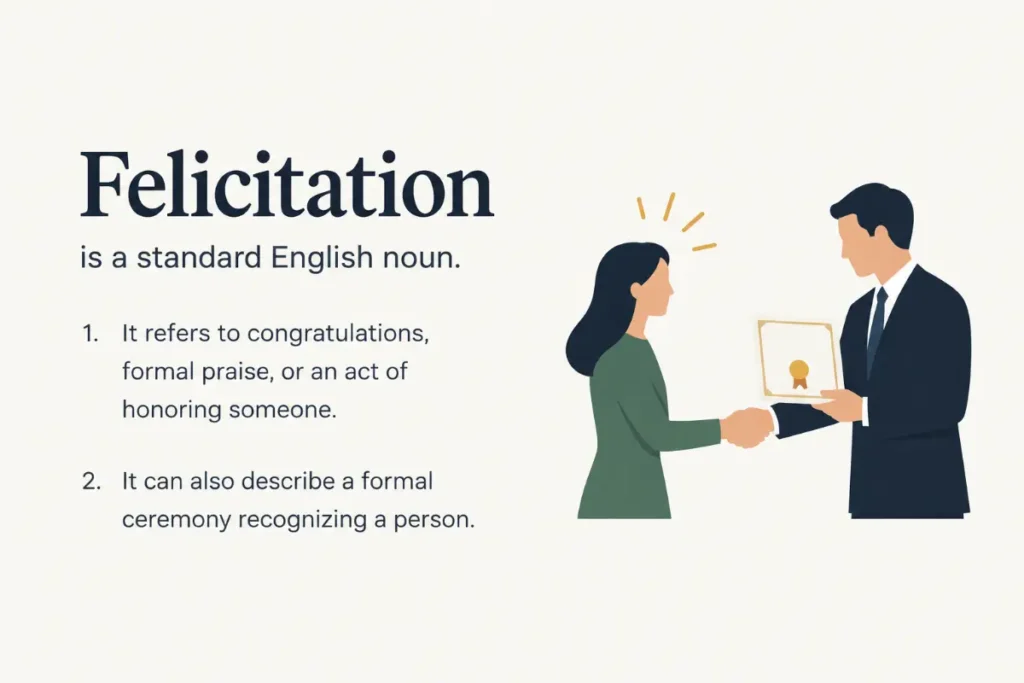
- Felicitation is a standard English noun.
- It refers to congratulations, formal praise, or an act of honoring someone.
- It can also describe a formal ceremony recognizing a person.
- Felicitate is the related verb.
- Felicitations is the plural form and can mean congratulations.
- The word is formal and less common in everyday American conversation.
- Congratulations is usually more natural for ordinary personal messages.
- Felicitation ceremony is especially common in South Asian English.
- The word is appropriate in formal institutional and ceremonial contexts.
- Recognition, honor, tribute, and celebration overlap with the idea but are not exact synonyms.
- The American pronunciation places the main stress near the end of the word.
- The best word depends on meaning, audience, and level of formality.
Still confused? Compare Unphased or Unfazed Meaning And Usage Guide 2026.
Conclusion
Felicitation is a correct English noun meaning an expression of congratulations, formal praise, or an act of honoring someone. It can also describe a ceremony held to recognize an achievement or important contribution. The word is especially useful in formal and institutional settings.
In everyday American English, congratulations is usually the more natural choice. Felicitation has a more ceremonial tone and is particularly common in formal events and South Asian English. Its related verb is felicitate, while felicitations can mean congratulations.
A simple editing tip is to match the word to the audience. Use felicitation when the formal setting calls for it. Use congratulations when you want a direct and natural everyday expression.
FAQs
What is the simplest definition of felicitation?
Felicitation means an expression of congratulations or formal recognition. It can also refer to a ceremony held to honor someone for an achievement, contribution, milestone, or success. In simple terms, it is a formal way of congratulating or honoring someone.
Is felicitation a correct English word?
Yes. Felicitation is a standard English noun. It is less common than congratulations in everyday American speech, but it is legitimate English. It appears in formal writing, speeches, ceremonies, institutional settings, and other contexts involving congratulations or recognition.
What is the difference between felicitation and congratulations?
Congratulations is the common everyday expression used to praise someone for an achievement or good fortune. Felicitation is more formal and can refer to the act of congratulating someone or a formal ceremony honoring them. For ordinary American communication, congratulations will usually sound more natural.
How do you pronounce felicitation?
Felicitation is commonly pronounced with five syllables and can be represented in American English as /fəˌlɪsəˈteɪʃən/. The strongest stress falls on the syllable containing the long a sound. The unstressed vowels are reduced in natural speech.
What is a felicitation ceremony?
A felicitation ceremony is a formal event held to honor and congratulate someone. Schools, universities, companies, professional groups, and community organizations may hold such ceremonies for academic achievements, awards, retirement, long service, sports success, or other important contributions.
Is felicitation common in American English?
Felicitation is standard in American English, but it is not especially common in everyday conversation. Americans usually say congratulations for personal achievements. The formal noun can still appear in ceremonies, institutional writing, and situations where a more ceremonial tone is appropriate.
What is another word for felicitation?
Depending on the context, alternatives include congratulations, recognition, honor, tribute, commendation, and celebration. These words are not exact replacements in every sentence. Congratulations is usually the closest everyday alternative, while recognition and honor may work better for formal events.
Is felicitation appropriate in formal writing?
Yes. Felicitation can be appropriate in formal writing, especially when discussing a ceremony or official act of recognition. It can sound overly formal in casual communication. For a general American audience, choose the more familiar word if the formal tone does not add useful meaning.