
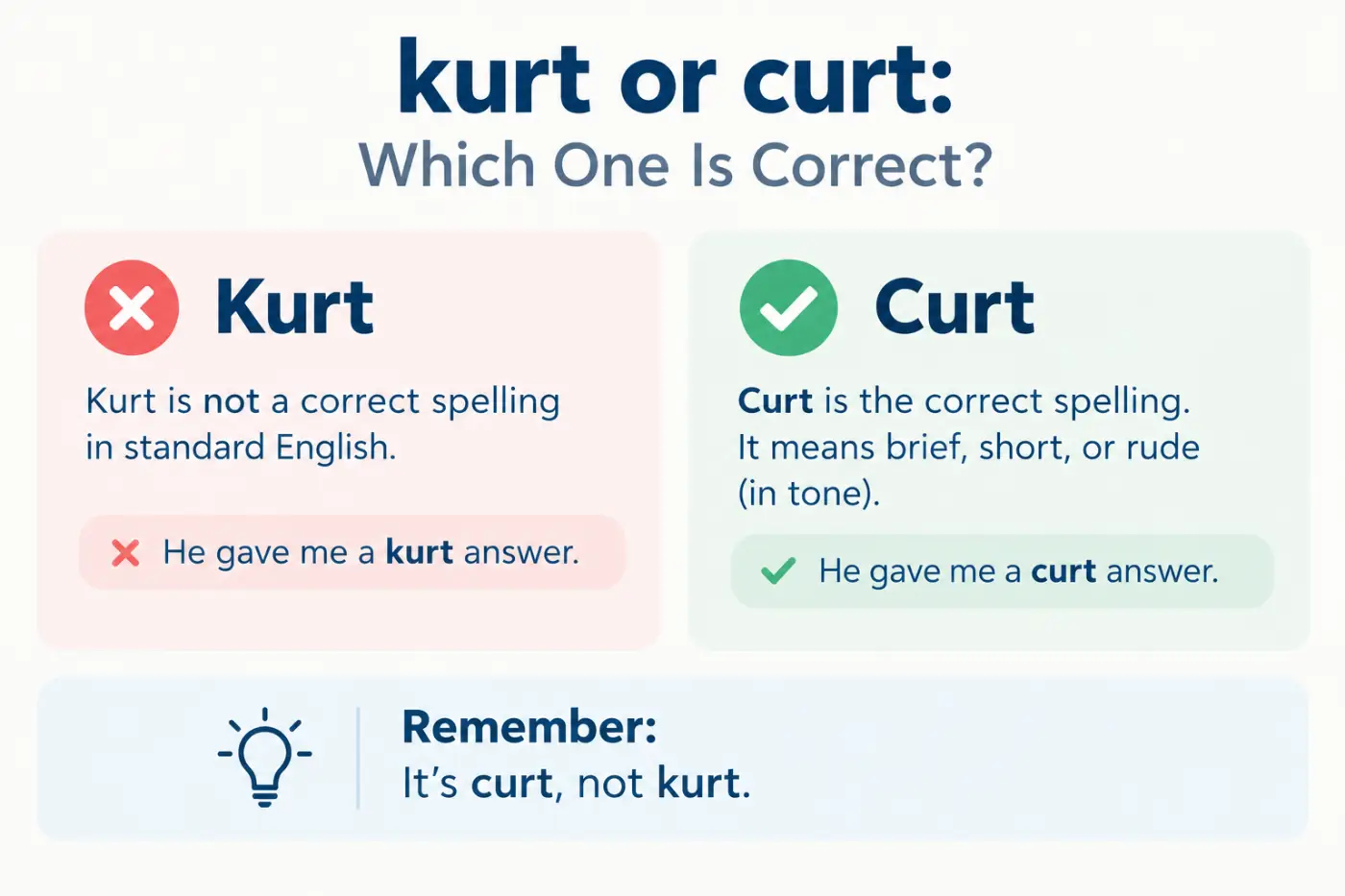
kurt or curt can cause confusion because the two forms sound almost exactly the same in American English. The correct spelling depends on what you mean. Curt is the standard English adjective used for speech, replies, behavior, or manners that are very brief and can sound rude or unfriendly. Kurt is normally a male given name.
The confusion is easy to understand. English has many pairs that sound alike but have different spellings and meanings. In this case, the pronunciation gives you little help because both forms are commonly pronounced with the same vowel sound and ending.
If you are describing someone’s reply, tone, manner, or behavior, use curt. If you are writing someone’s name, use Kurt only when that is the person’s actual spelling. This distinction matters in emails, school assignments, professional writing, names, and everyday communication.
A related grammar guide is Fliers vs Flyers Meaning and Difference With Easy Examples 2026.
Quick Answer
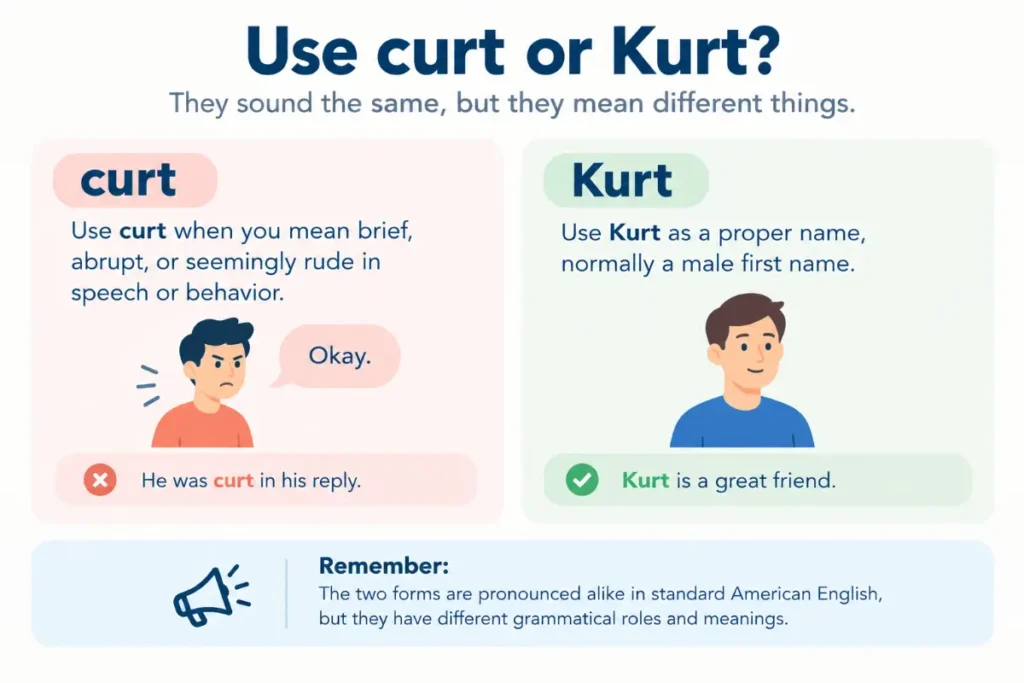
Use curt when you mean brief, abrupt, or seemingly rude in speech or behavior. Use Kurt as a proper name, normally a male first name. The two forms are pronounced alike in standard American English, but they have different grammatical roles and meanings.
Comparison Table
| Form | Meaning | Part of Speech | Origin | Usage | Formality | Common Contexts | Example |
|---|---|---|---|---|---|---|---|
| curt | Brief and often rude or abrupt in speech or behavior | Adjective | From Latin curtus, meaning shortened or cut short | Standard English word | Neutral to formal | Replies, comments, tone, manner, emails, conversations | Her reply sounded curt. |
| Kurt | A male given name | Proper noun | German form associated with Konrad | Standard personal name | Depends on the name bearer | Names, people, biographies, records | Kurt called me yesterday. |
| Curt | A male given name, also used as a form of Curtis | Proper noun | Used as a personal name and form of Curtis | Standard personal name | Depends on the name bearer | Names, people, biographies, records | Curt joined the meeting. |
The important point is that capitalization alone does not explain every use. Curt can also be a personal name, while lowercase curt is the ordinary adjective. Kurt is primarily a personal name in English. Collins lists Kurt as a masculine name and Curt as a male given name or form of Curtis.
What Curt Means
The adjective curt describes language or behavior that is very brief and can seem rude, unfriendly, impatient, or abrupt. A curt response gives the other person little explanation or warmth.
For example, imagine asking a coworker, Can you help me with this report? If the person simply says, No, I am busy, the answer might feel curt. The problem is not only that the response is short. The tone and lack of friendliness also matter.
Cambridge describes the word as applying to speech or manner that is rude because it is very quick or brief. Oxford similarly connects the word with a person’s manner or behavior when few words are used or something is done very quickly.
The word can describe several things.
- A curt reply can sound unfriendly.
- A curt answer can feel dismissive.
- A curt tone can suggest impatience.
- A curt email can seem colder than the writer intended.
- A curt nod can communicate acknowledgment without warmth.
- A curt order can sound abrupt or demanding.
The word does not always mean openly hostile. Someone can be curt because they are busy, distracted, tired, stressed, or simply trying to be brief. The listener may still interpret the short response as rude.
Meaning In Simple English
A simple way to remember the meaning is this.
Curt means short and possibly rude.
That makes it different from words such as concise or brief. Those words can be completely positive. A concise answer gives you the information you need without unnecessary detail. A curt answer may also be short, but it often carries an unfriendly feeling.
Compare these examples.
A concise reply: Thanks. I will send the file this afternoon.
A curt reply: Fine.
Both replies are short. The second one may feel colder because it gives little emotional or conversational context.
What Kurt Means
Kurt is normally a male given name. It is not the ordinary English adjective used to describe a brief or unfriendly response.
English dictionaries list Kurt as a masculine name and identify it as a variant or related form of Curt. The name has German usage and is associated with the German name Kurt, traditionally connected with Konrad.
This means the word can appear perfectly naturally in an English sentence, but its role is different.
Consider these examples.
Kurt is waiting outside.
I spoke with Kurt yesterday.
Kurt sent the report this morning.
In each sentence, Kurt identifies a person. It functions as a proper noun, so it begins with a capital letter.
You would not normally write Kurt when describing someone’s communication.
Incorrect: She gave a Kurt reply.
Correct: She gave a curt reply.
The capital letter does not make the adjective correct. The meaning determines the word.
Why The Two Forms Are Confused
The main reason for the confusion is pronunciation.
In American English, curt is pronounced /kɝːt/. Cambridge gives the US pronunciation as /kɝːt/. The name Kurt is also commonly pronounced with the same basic sound.
That makes these sentences sound almost identical when spoken.
Curt sent the email.
Kurt sent the email.
The listener needs context to know if the speaker means a person named Kurt or the adjective curt.
English contains many similar sound based spelling problems. A person may know a word perfectly well when reading it but still hesitate when trying to spell it after hearing it. That is especially common when two forms have established uses.
The important distinction here is semantic. Curt describes something. Kurt names someone.
Which Form Is Correct?
Both curt and Kurt are correct forms, but they are correct in different situations.
Use curt when you are describing a person’s speech, writing, tone, manner, response, or behavior.
Use Kurt when you are writing a person’s name and that person’s name is spelled Kurt.
Use Curt when a person’s actual name is Curt. This spelling also exists as a male given name and as a shortened form of Curtis.
The easiest rule is simple.
- If you mean a person’s name, check the person’s actual spelling.
- If you mean brief and possibly rude communication, use curt.
- If you are talking about a person named Kurt, capitalize it.
- If you are describing behavior, keep the adjective lowercase.
This distinction is based on grammar and meaning rather than personal preference.
Key Differences Explained
The difference becomes much easier to remember when you separate the words by function.
- Meaning. Curt describes brief or abrupt communication. Kurt identifies a person.
- Part of speech. Curt is an adjective. Kurt is normally a proper noun.
- Capitalization. The adjective is lowercase. The personal name is capitalized.
- Pronunciation. They are commonly pronounced alike in American English.
- Context. Curt appears with words such as reply, answer, tone, manner, response, and nod. Kurt appears before or after verbs as someone’s name.
- Grammar. Curt modifies a noun or follows a linking verb. Kurt functions as a name.
- Meaning in conversation. A curt response may suggest impatience or rudeness. Kurt has no such meaning when used as a name.
- Spelling choice. Context tells you which form to write because sound alone does not provide enough information.
Grammar And Part Of Speech
The adjective curt can appear before a noun or after a linking verb.
Before a noun:
She gave a curt answer.
He sent a curt email.
The manager offered a curt response.
After a linking verb:
Her answer was curt.
His tone became curt.
The conversation sounded curt and uncomfortable.
The word can also take comparative and superlative forms.
Her response was curter than his.
That was the curtest answer he could have given.
The adverb is curtly.
She replied curtly.
The noun is curtness.
His curtness surprised the customer.
These forms are useful because they show that curt behaves like an ordinary adjective in English. Dictionary sources list curtly and curtness as established derived forms.
Common Grammatical Patterns
Certain combinations sound especially natural to native English speakers.
- A curt reply.
- A curt answer.
- A curt response.
- A curt tone.
- A curt manner.
- A curt nod.
- A curt message.
- Be curt with someone.
- Sound curt.
- Respond curtly.
The pattern curt with someone is also common.
He was curt with his assistant.
She seemed curt with the customer.
This structure focuses on how someone treats another person during communication.
Pronunciation Guide
The standard American pronunciation is approximately /kɝːt/. It has one syllable and rhymes closely with words such as hurt, shirt, and dirt. Cambridge lists /kɝːt/ for American English and /kɜːt/ for British English.
An easy pronunciation guide is:
curt = kert
There is no extra syllable. The word is not pronounced cur it.
The name Kurt is normally pronounced the same way in American English. That shared pronunciation explains much of the spelling confusion.
Common Pronunciation Mistake
Some learners may try to pronounce curt with a short u sound because of the spelling. In standard American pronunciation, the vowel is the same general sound heard in words such as bird and hurt.
The safest approach is to learn the word as one syllable rather than trying to pronounce each letter separately.
Sentence Examples
Here are ten natural examples showing how the adjective works in everyday English.
- Her curt reply made me think she was upset.
- The manager gave a curt answer and returned to his work.
- His tone sounded curt during the phone call.
- I did not mean to sound curt in my email.
- The customer became frustrated after receiving a curt response.
- She gave him a curt nod and walked away.
- His message was so curt that I wondered if something was wrong.
- The teacher was direct but never curt with her students.
- He can sound curt when he is under pressure.
- The assistant apologized because her earlier response had sounded curt.
Notice that the word usually describes communication rather than a person’s permanent character. Saying someone gave a curt reply describes a particular moment. It does not necessarily mean the person is always rude.
Need another quick comparison? Read Cryer vs Crier Which Spelling Is Correct 2026.
Common Mistakes And Misspellings
Writing Kurt For The Adjective
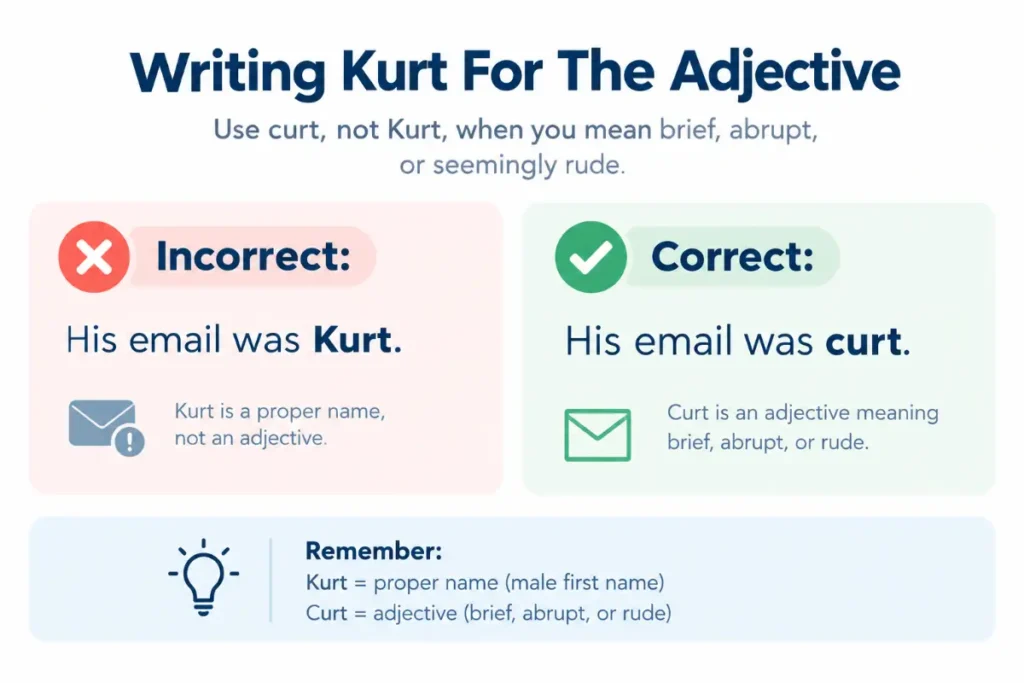
Incorrect: His email was Kurt.
Correct: His email was curt.
This mistake happens because the two forms sound alike. Remember that a personal name identifies a person, while the adjective describes communication or behavior.
Writing Curt When The Person Is Named Kurt
Incorrect: Kurt Cobain is spelled Curt Cobain.
Correct: Kurt Cobain is spelled Kurt Cobain.
Names belong to the individual. You should preserve the person’s chosen spelling.
Using Curt As A Synonym For Any Short Message
A short message is not automatically curt. The word usually carries some suggestion of abruptness or rudeness.
A short message such as Thanks for the update can be polite and efficient. Calling it curt may suggest that the writer sounded cold or impatient.
Assuming Curt Always Means Angry
Curt does not necessarily mean angry. Someone can be curt because they are busy, tired, distracted, or focused on another task.
The word describes how the communication comes across. It does not prove what the speaker feels internally.
Confusing Curt With Concise
Concise usually has a neutral or positive meaning. It suggests that someone communicates clearly without unnecessary words.
Curt often adds a negative social judgment. It suggests that the brevity feels abrupt or unfriendly.
That difference matters in professional writing.
Etymology And Word Origin
The adjective curt has a long history connected with the idea of being shortened. Oxford traces it to late Middle English and the Latin word curtus, meaning short or shortened. Etymonline also connects the word with Latin curtus and records the later development of the sense involving rude or abrupt speech.
The history explains why the modern meaning makes sense. Something curt is linguistically short. A curt reply gives you fewer words than you might expect in a normal social exchange.
The modern sense of abrupt or rude communication developed from this idea of shortness. The word eventually became associated not simply with brevity but with brevity that can feel sharp or unfriendly.
The personal name Kurt has a different history. It is a German given name and is commonly associated with Konrad. English sources treat it as a proper name rather than the ordinary adjective used to describe communication.
The shared sound creates the modern spelling trap, but the two forms have distinct histories and functions.
Regional Usage
American English
In American English, curt is the standard adjective for brief and potentially rude speech or behavior. It appears naturally in workplace communication, journalism, conversation, fiction, and formal writing. The pronunciation is commonly /kɝːt/.
Kurt is used as a personal name. Curt is also used as a personal name, especially as a form of Curtis.
There is no American spelling rule that replaces curt with Kurt when describing a response.
British English
British English also uses curt as the standard adjective. The British pronunciation is commonly represented as /kɜːt/. The meaning remains essentially the same: brief, abrupt, and often somewhat rude.
Kurt remains a personal name. The core distinction between the adjective and the name does not change.
Australian English
Australian English follows the same basic distinction in standard usage. Curt functions as an adjective describing brief or abrupt communication, while Kurt can function as a personal name.
There is no major Australian spelling difference that changes the answer for ordinary English writing.
Canadian English
Canadian English also follows the same general pattern. Use curt for the adjective and the person’s actual spelling for a personal name.
The pronunciation may vary slightly across Canadian speakers, but the spelling distinction remains straightforward.
Real Life Usage Examples
Daily Conversation
In conversation, curt often describes how someone responds.
She sounded curt when I asked about the delay.
He gave me a curt yes and went back to his phone.
These examples show why the word carries more meaning than simply short. The response has a social quality that makes it feel abrupt.
Workplace Communication
The word often appears when people describe emails, meetings, customer service, or management styles.
The client sent a curt email after the shipment was delayed.
Her manager was curt during the meeting but became more relaxed afterward.
In professional settings, calling an email curt can be a criticism because it suggests the message lacks warmth or courtesy.
Academic Writing
The adjective can appear in essays and analysis when describing a speaker’s behavior.
The author presents the character as curt and impatient.
The professor’s curt response ended the discussion.
Academic writing often uses the word to describe dialogue, tone, or characterization.
News And Journalism
News writing may use curt to characterize a public response or official statement.
The official gave a curt response to questions from reporters.
The company issued a curt statement after the criticism.
The word helps convey attitude without requiring a long description.
Literature And Storytelling
Writers often use curt to create a character’s voice quickly.
No, he said curtly, turning away.
She gave him a curt nod.
The word is useful in fiction because it tells the reader that the character’s brevity has emotional or social weight.
Curt Compared With Similar Words
Several words overlap with curt, but they are not identical.
Brief
Brief means short in length or duration. It is usually neutral.
We had a brief meeting.
A brief answer is not automatically rude.
Concise
Concise means expressing an idea clearly in few words. It is often positive.
Her explanation was concise and clear.
Calling an explanation concise usually praises its efficiency.
Terse
Terse means using very few words. It can suggest a cold or unfriendly tone, so it is close to curt.
His terse response ended the conversation.
Terse often focuses more strongly on the lack of words, while curt often highlights the social impression.
Abrupt
Abrupt can describe speech or behavior that feels sudden, unexpected, or unfriendly.
Her abrupt response surprised everyone.
Abrupt is broader than curt because it can also describe sudden changes or actions.
Brusque
Brusque describes speech or behavior that is quick, blunt, and sometimes rude.
The receptionist was brusque with the visitor.
Brusque is one of the closest practical synonyms for curt. Cambridge and Oxford both associate curt with words such as brusque and abrupt.
Blunt
Blunt means direct and unwilling to soften an opinion.
He was blunt about the problem.
A blunt person may give a detailed explanation. A curt person may simply give a very brief response.
Laconic
Laconic describes someone who uses very few words. It can sound more formal or literary than curt.
His laconic answer revealed little.
Laconic does not necessarily imply rudeness.
Polite
Polite is close to the opposite of curt in many social situations, although a polite reply can still be brief.
She gave a polite answer and thanked him for asking.
The key difference is the social tone. Brief communication can be polite, neutral, or curt depending on how it is delivered.
When A Short Reply Is Not Curt
This distinction is useful because people sometimes overuse the word.
Consider these replies.
Thanks.
Yes, I can do that.
No problem.
Sure, I will send it.
All four are short. None is automatically curt.
Now compare them with:
No.
Fine.
Not now.
I already told you.
These may sound curt because the wording gives little warmth or explanation. Tone, context, punctuation, and the relationship between the speakers can all influence the impression.
A one word answer is not automatically rude. The surrounding situation determines how the reader interprets it.
This matters especially in digital communication. Text messages and emails remove facial expressions, voice tone, and body language. A message that feels efficient to the sender may sound curt to the reader.
How To Avoid Sounding Curt In Writing
If you are concerned that an email or message may sound too abrupt, you do not need to make it long. A few small changes can add warmth.
Instead of:
Send the document.
Try:
Could you send the document when you have a chance?
Instead of:
No.
Try:
No, I do not think that will work for this project.
Instead of:
Fine.
Try:
Sounds good. Thanks.
The goal is not to add unnecessary words. The goal is to give the reader enough context and courtesy to understand your intent.
This is especially useful at work because written communication lacks the vocal cues people normally use to soften a short statement.
Expert Editor Insight
An experienced editor treats this as a context problem rather than simply a spelling problem. If the sentence describes a brief or unfriendly response, use curt. If it identifies a person, preserve the person’s actual name spelling. The strongest editing habit is to read the sentence for meaning before relying on a spell checker. A spelling tool can recognize both forms, but only context tells you which word belongs in the sentence.
A Simple Memory Trick
Use this memory rule.
Curt describes communication. Kurt describes a person.
Think of a curt reply as a reply that is cut short. The historical meaning of curt is connected with the idea of being shortened or cut short, so this memory link fits the word’s history.
For names, do not rely on memory alone. Check the person’s actual spelling.
If someone is named Kurt, write Kurt.
If someone is named Curt, write Curt.
If you are describing a reply, tone, answer, or manner, write curt.
That simple distinction handles almost every everyday spelling question involving these forms.
Many readers also check Excited or Exited Correct Spelling Meaning and Usage.
Conclusion
kurt or curt becomes easy to distinguish once you focus on meaning instead of sound. Curt is the standard adjective for communication that is very brief and can seem rude, abrupt, or unfriendly. Kurt is normally a male personal name, while Curt can also be a personal name or a form of Curtis.
The pronunciation creates the confusion because the forms commonly sound the same in American English. The best editing tip is simple: curt describes communication, while Kurt names a person. Check the context first, then choose the spelling. That rule will keep your writing clear in emails, schoolwork, professional documents, and everyday communication.
FAQs
Is Kurt a real English word?
Kurt is a legitimate personal name used in English and several other languages. English dictionaries list it as a masculine given name. It is not normally the adjective used to describe brief or unfriendly speech. When you are naming a person called Kurt, capitalize the first letter because names are proper nouns.
Is curt the correct spelling for a rude short reply?
Yes. Curt is the standard adjective for a reply, answer, tone, manner, or similar communication that is very brief and can sound rude or unfriendly. For example, She gave me a curt reply is standard English. The word describes the social effect of the short response, not simply its length.
Are Kurt and curt pronounced the same?
In standard American English, they are commonly pronounced the same way, approximately /kɝːt/. British English commonly uses /kɜːt/. Because the pronunciation is so similar, speakers cannot always identify the spelling from sound alone. Context tells you if the speaker means the adjective curt or the personal name Kurt.
Can Curt also be a person’s name?
Yes. Curt is used as a male given name and can serve as a shortened form of Curtis. This creates another possible spelling in names. If you are writing about a person, always use the spelling that person actually uses. The adjective curt remains lowercase when it describes speech or behavior.
What is the difference between curt and terse?
Both words describe communication that uses few words, but they emphasize different things. Terse focuses strongly on brevity and can imply a lack of detail. Curt usually adds the idea that the brevity feels abrupt, cold, or rude. A terse answer can be neutral, while a curt answer often carries a negative social impression.
Is curt appropriate in formal writing?
Yes. Curt is a standard English adjective and works well in formal writing when the meaning fits. It can describe a person’s response, tone, manner, or communication. For example, a report might say that an official gave a curt response. The word is not slang or limited to casual conversation.
Why do people confuse Kurt and curt?
The main reason is pronunciation. In common American English pronunciation, the two forms sound alike or extremely close. They also share the same basic consonants and vowel sound. Since spoken English does not reveal capitalization or spelling, listeners need context to decide if the speaker means a person’s name or an adjective describing communication.
What is a good synonym for curt?
Useful synonyms include brusque, terse, abrupt, blunt, and short. The best choice depends on the intended meaning. Brusque is especially close when someone behaves in a quick and unfriendly way. Terse focuses more on few words, while blunt focuses more on directness. Brief and concise can overlap with curt but usually lack its negative tone.