
Need another quick comparison? Read extent vs extant Meaning and Correct Usage.
Introduction
The debate around macaroon vs macaron confuses far more people than you might expect. Walk into a bakery, browse a dessert menu, or scroll through social media, and you’ll often see these two names used interchangeably. The problem is that a macaroon and a macaron are not the same dessert.
Many people assume one word is simply a misspelling of the other. Others believe they are regional variations of the same treat. In reality, they are two completely different cookies with distinct ingredients, textures, appearances, and histories.
If you’ve ever wondered why colorful French sandwich cookies are called macarons while coconut cookies are called macaroons, you’re not alone. Even experienced writers and food enthusiasts occasionally mix them up.
The good news is that the distinction is easy to understand once you know the basics.
This guide explains everything you need to know about macaroon vs macaron, including definitions, pronunciation, origins, spelling differences, usage examples, grammar rules, regional preferences, and expert insights. By the end, you’ll know exactly which word to use and why the confusion continues to persist.
Quick Definition
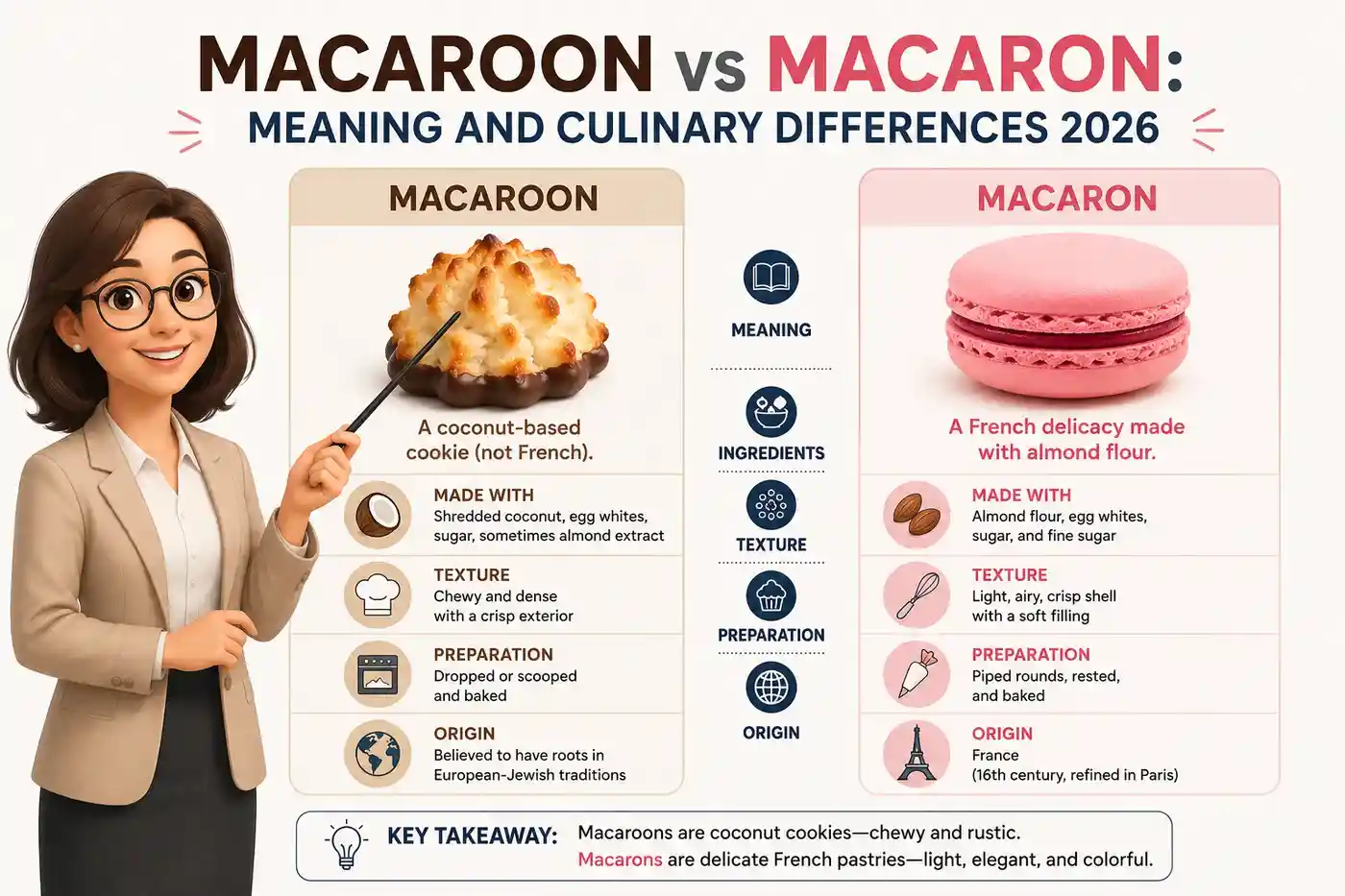
When comparing macaroon vs macaron, both words are correct, but they refer to different desserts. A macaron is a delicate French sandwich cookie made from almond flour, egg whites, and filling. A macaroon is a coconut based cookie that is typically dense, chewy, and often dipped in chocolate.
Macaroon Vs Macaron Quick Answer
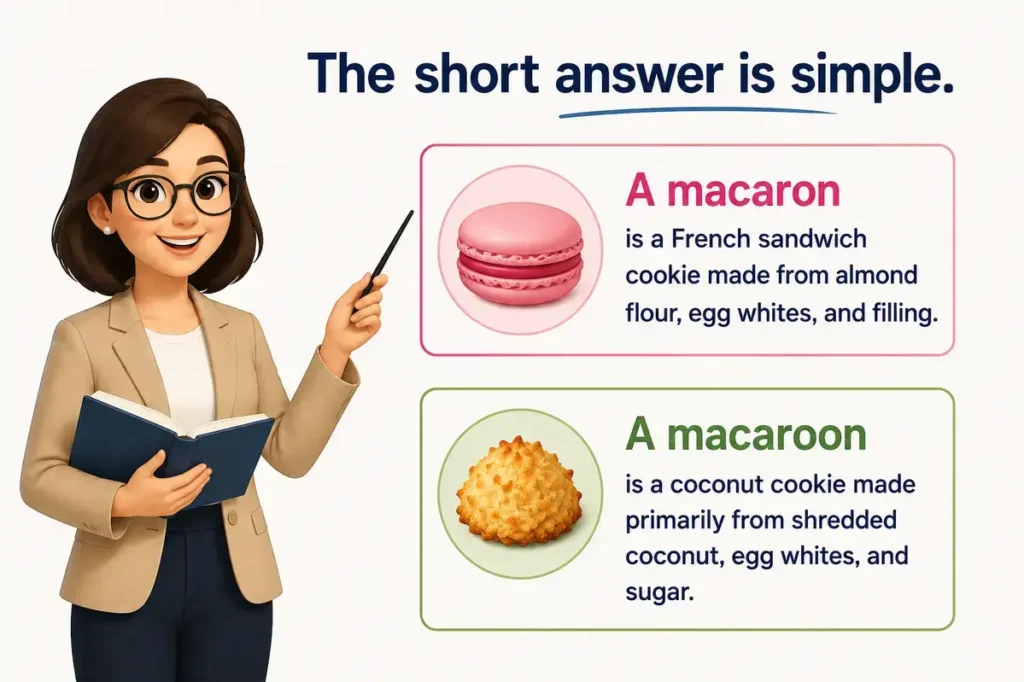
The short answer is simple.
- A macaron is a French sandwich cookie made from almond flour, egg whites, and filling.
- A macaroon is a coconut cookie made primarily from shredded coconut, egg whites, and sugar.
Neither word is more correct than the other.
The correct choice depends entirely on which dessert you’re describing.
Macaroon Vs Macaron Comparison Table
| Feature | Macaroon | Macaron |
|---|---|---|
| Correct Word | Yes | Yes |
| Type Of Food | Coconut cookie | French sandwich cookie |
| Main Ingredient | Coconut | Almond flour |
| Texture | Dense and chewy | Light and delicate |
| Origin | Italian roots with later adaptations | France |
| Appearance | Rough and rustic | Smooth and colorful |
| Filling | Usually none | Cream, ganache, or jam |
| Popular Context | Home baking and holidays | French pastry shops |
| Formality | Standard culinary term | Standard culinary term |
| Example | Chocolate dipped macaroon | Raspberry macaron |
Meaning Of Macaroon Vs Macaron
Meaning Of Macaroon
A macaroon is a sweet cookie traditionally made with shredded coconut, sugar, and egg whites.
The cookie is known for:
- A chewy texture.
- A rich coconut flavor.
- A rustic appearance.
- A golden exterior after baking.
Many bakeries also dip macaroons in chocolate.
Examples:
- She bought a box of coconut macaroons.
- The bakery sells chocolate covered macaroons.
Meaning Of Macaron
A macaron is a French pastry consisting of two almond based shells joined by a filling.
Common fillings include:
- Buttercream.
- Ganache.
- Fruit jam.
- Cream cheese filling.
Macarons are famous for:
- Their smooth shells.
- Their colorful appearance.
- Their delicate texture.
- Their elegant presentation.
Examples:
- The bakery displayed pistachio macarons.
- She ordered a dozen French macarons.
Macaroon Vs Macaron Meaning Differences
The difference between these desserts goes far beyond spelling.
Ingredient Differences
Macaroons rely primarily on coconut.
Macarons rely primarily on almond flour.
Texture Differences
Macaroons are:
- Dense.
- Moist.
- Chewy.
Macarons are:
- Crisp on the outside.
- Soft inside.
- Light and airy.
Appearance Differences
Macaroons look rustic and irregular.
Macarons have a smooth, polished appearance.
Baking Differences
Macaroons are relatively easy to make.
Macarons require precision and technical skill.
Serving Differences
Macaroons often appear as casual treats.
Macarons are frequently associated with luxury bakeries and elegant desserts.
Macaroon Vs Macaron Key Differences
Ingredient Differences
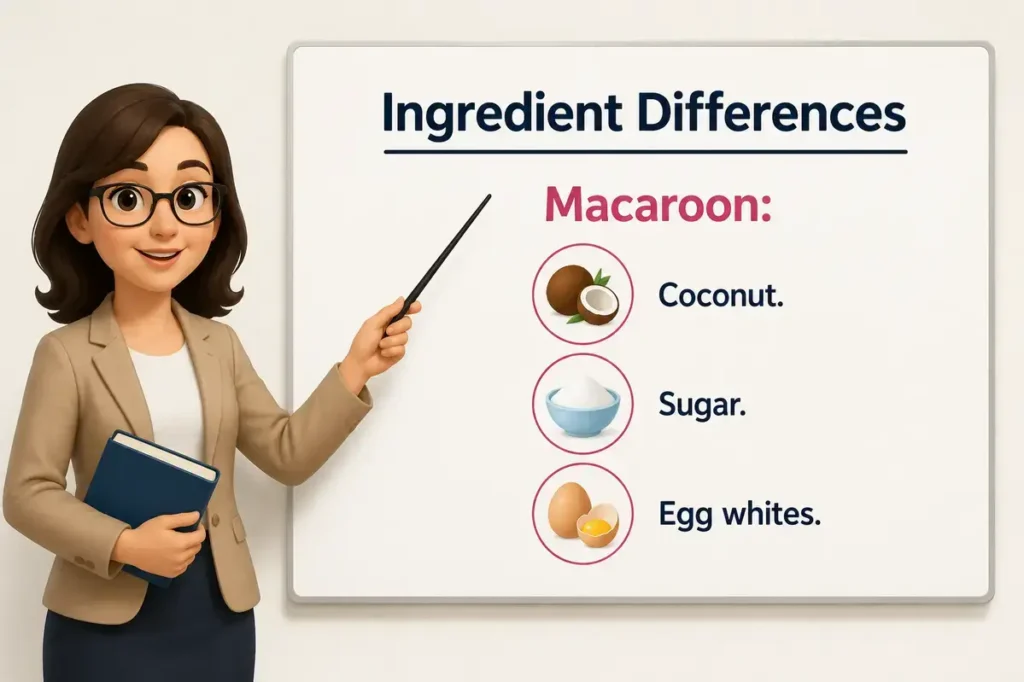
Macaroon:
- Coconut.
- Sugar.
- Egg whites.
Macaron:
- Almond flour.
- Sugar.
- Egg whites.
- Filling.
Flavor Differences
Macaroons typically taste strongly of coconut.
Macarons come in countless flavors.
Examples:
- Vanilla.
- Chocolate.
- Lemon.
- Pistachio.
- Raspberry.
- Coffee.
Cost Differences
Macarons usually cost more because they require more labor and precision.
Visual Differences
Macaroons appear rough and textured.
Macarons appear smooth and colorful.
Popularity Differences
Macarons have gained significant popularity through social media and luxury dessert culture.
Macaroons remain a classic favorite, especially during holidays.
Which One Is Correct
Both words are correct.
The real question is which dessert you’re describing.
Use macaroon when referring to a coconut cookie.
Examples:
- Coconut macaroon.
- Chocolate dipped macaroon.
Use macaron when referring to the French sandwich cookie.
Examples:
- Strawberry macaron.
- Pistachio macaron.
A common mistake occurs when people call a French macaron a macaroon.
Food professionals and pastry chefs generally maintain a clear distinction between the two terms.
Why People Confuse Macaroon Vs Macaron
Several factors contribute to the confusion.
Similar Spellings
The two words differ by only two letters.
Many readers assume they are alternate spellings of the same dessert.
Shared Historical Roots
Both names evolved from related European culinary traditions.
This shared ancestry contributes to the similarity.
Social Media Trends
Many online posts use the wrong term.
As a result, incorrect usage spreads quickly.
Pronunciation Similarities
Although the pronunciations differ, they still sound somewhat related to many English speakers.
Macaroon Vs Macaron In Modern Food Culture
The popularity of French pastries has dramatically increased interest in macarons.
Today, macarons appear in:
- Luxury bakeries.
- Wedding dessert tables.
- High end cafés.
- Food photography.
- Social media content.
Meanwhile, macaroons continue to enjoy popularity in:
- Home baking.
- Holiday celebrations.
- Traditional bakeries.
- Coconut dessert collections.
Both desserts remain beloved, but they occupy different spaces within modern food culture.
Learn the difference in Eg vs Ie Explained With Examples and Rules.
Macaroon Vs Macaron In Professional Writing
Food writers, cookbook authors, restaurant owners, and pastry chefs are careful about this distinction.
Correct terminology helps readers understand exactly which dessert is being discussed.
For example:
- A coconut macaroon recipe.
- A French macaron recipe.
Mixing the terms can confuse readers and create inaccuracies in menus, articles, and recipe books.
Macaroon Vs Macaron Examples In Sentences
Seeing the words in context makes the distinction much easier to remember.
Macaroon Examples In Sentences
- My grandmother baked coconut macaroons every holiday season.
- The bakery sells chocolate dipped macaroons near the front counter.
- She packed a few macaroons for the road trip.
- The homemade macaroons had a rich coconut flavor.
- He prefers macaroons because they are chewy and sweet.
- The dessert tray included several coconut macaroons.
- Freshly baked macaroons filled the kitchen with a pleasant aroma.
- The café serves gluten free macaroons made with coconut.
- She learned to make macaroons from her mother.
- The golden brown macaroons disappeared within minutes.
Macaron Examples In Sentences
- She ordered a box of colorful macarons for the party.
- The pistachio macaron was the most popular item in the bakery.
- He bought a raspberry macaron with a creamy filling.
- The pastry chef specializes in French macarons.
- Every macaron on display looked like a work of art.
- The bakery offers seasonal macaron flavors.
- She carefully arranged the macarons on a serving tray.
- The chocolate macaron had a smooth ganache center.
- Guests enjoyed sampling different macaron flavors.
- Learning to make macarons requires patience and precision.
Common Mistakes With Macaroon Vs Macaron
The confusion usually comes from spelling and appearance rather than meaning.
Mistake One Calling A Macaron A Macaroon
This is the most common error.
Incorrect:
- I bought six colorful French macaroons.
Correct:
- I bought six colorful French macarons.
French sandwich cookies are macarons.
Mistake Two Assuming One Is A Misspelling
Many people believe macaroon is simply a misspelling of macaron.
It is not.
Both are legitimate words with different meanings.
Mistake Three Using The Terms Interchangeably
A recipe for macarons cannot automatically be used to make macaroons.
The ingredients and techniques are completely different.
Mistake Four Ignoring The Ingredients
A simple rule helps avoid mistakes.
- Coconut equals macaroon.
- Almond flour sandwich cookie equals macaron.
Macaroon Vs Macaron Pronunciation Guide
Pronunciation often helps distinguish the two desserts.
Macaroon Pronunciation
IPA:
/ˌmækəˈruːn/
Syllable Breakdown:
Mac • a • roon
Sounds Like:
Mack uh roon
Macaron Pronunciation
IPA:
/ˌmækəˈrɒn/ or /ˌmækəˈroʊn/
Depending on accent and region.
Syllable Breakdown:
Mac • a • ron
Sounds Like:
Mack uh ron
Common Pronunciation Mistakes
Many English speakers pronounce both words the same way.
Food professionals usually maintain a clearer distinction between the two pronunciations.
Macaroon Vs Macaron Etymology And Word Origin
The history behind these desserts explains why their names are so similar.
Shared Italian Roots
Both words ultimately trace back to the Italian word maccarone. Historically, the term referred to a paste made from ground almonds. Over time, recipes evolved in different directions.
Development Of The Macaron
French pastry chefs refined almond based recipes into the elegant sandwich cookie known today.
The modern macaron became strongly associated with French baking traditions.
Development Of The Macaroon
Other versions evolved into coconut based cookies. These became known as macaroons in English speaking countries.
Why The Names Remain Similar
Because both desserts share historical ancestry, their names remained closely related even as the recipes became dramatically different.
Macaroon Vs Macaron Regional Usage
Different regions show varying levels of familiarity with each dessert.
Macaroon Vs Macaron American English
American English recognizes both terms. Macarons have become increasingly popular through specialty bakeries and social media. Macaroons remain common in grocery stores and home kitchens.
Macaroon Vs Macaron British English
British English uses both words as well. Food publications generally maintain a clear distinction between the two desserts.
Macaroon Vs Macaron Canadian English
Canadian bakeries frequently offer both macarons and macaroons. The terminology matches standard culinary usage.
Macaroon Vs Macaron Australian English
Australian cafés and bakeries commonly feature macarons. Macaroons also appear, particularly in traditional baking contexts.
Macaroon Vs Macaron International Food Culture
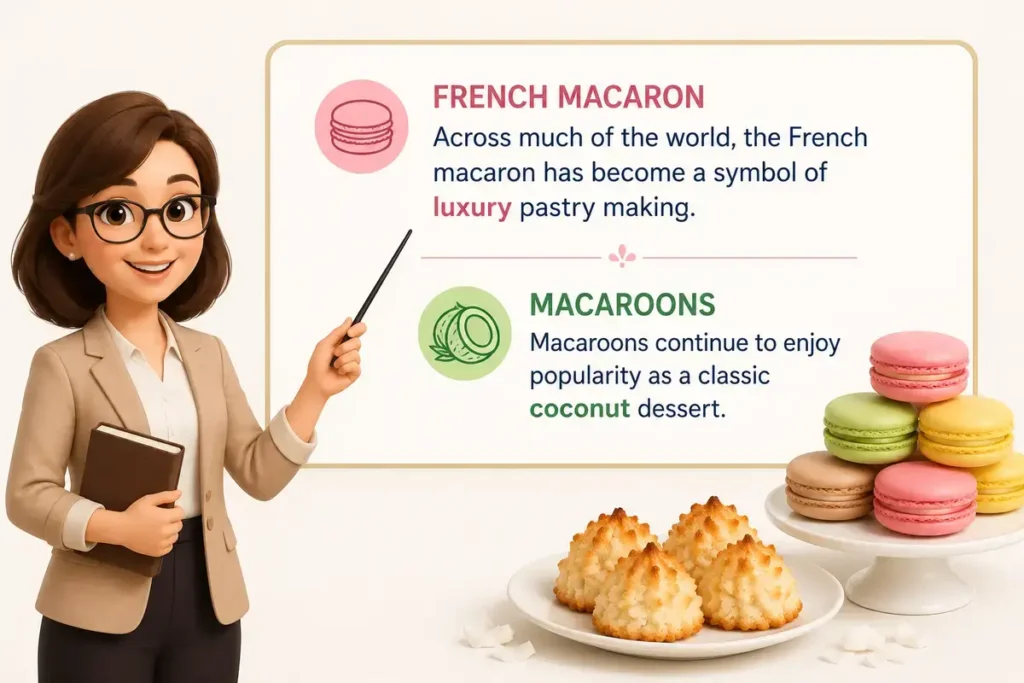
Across much of the world, the French macaron has become a symbol of luxury pastry making. Macaroons continue to enjoy popularity as a classic coconut dessert.
Macaroon Vs Macaron Grammar Rules
Understanding how these words function grammatically is straightforward.
Part Of Speech
Both words are nouns.
Examples:
- The macaroon tasted delicious.
- The macaron looked beautiful.
Singular Forms
Examples:
- One macaroon.
- One macaron.
Plural Forms
Examples:
- Macaroons.
- Macarons.
Sentences:
- She baked dozens of macaroons.
- The bakery displayed colorful macarons.
Common Sentence Structures
Examples:
- Article plus macaroon plus verb.
- Article plus macaron plus verb.
Sentences:
- The macaroon was chewy.
- The macaron was delicate.
Macaroon Vs Macaron In Real Life
Daily Conversation
Examples:
- I love coconut macaroons.
- Those macarons look amazing.
Professional Communication
Restaurant menus and bakery descriptions rely on precise terminology.
Example:
- Assorted French macarons available daily.
Culinary Education
Cooking schools teach the distinction carefully because each dessert requires different techniques.
Food Journalism
Food writers use the correct term to avoid misleading readers.
Example:
- The bakery specializes in handcrafted macarons.
Social Media
Many food influencers feature macarons because of their colorful appearance and visual appeal.
Related Words And Confused Terms
Several dessert terms are commonly associated with macarons and macaroons.
Related Dessert Terms
- Cookie.
- Pastry.
- Biscuit.
- Confection.
- Meringue.
- Ganache.
- Buttercream.
- Coconut cookie.
Related Baking Terms
- Almond flour.
- Egg whites.
- Piping.
- Filling.
- Baking sheet.
- Meringue mixture.
Commonly Confused Food Terms
- Macaroon and macaron.
- Biscuit and cookie.
- Custard and pudding.
- Gelato and ice cream.
- Torte and cake.
Expert Language Insight
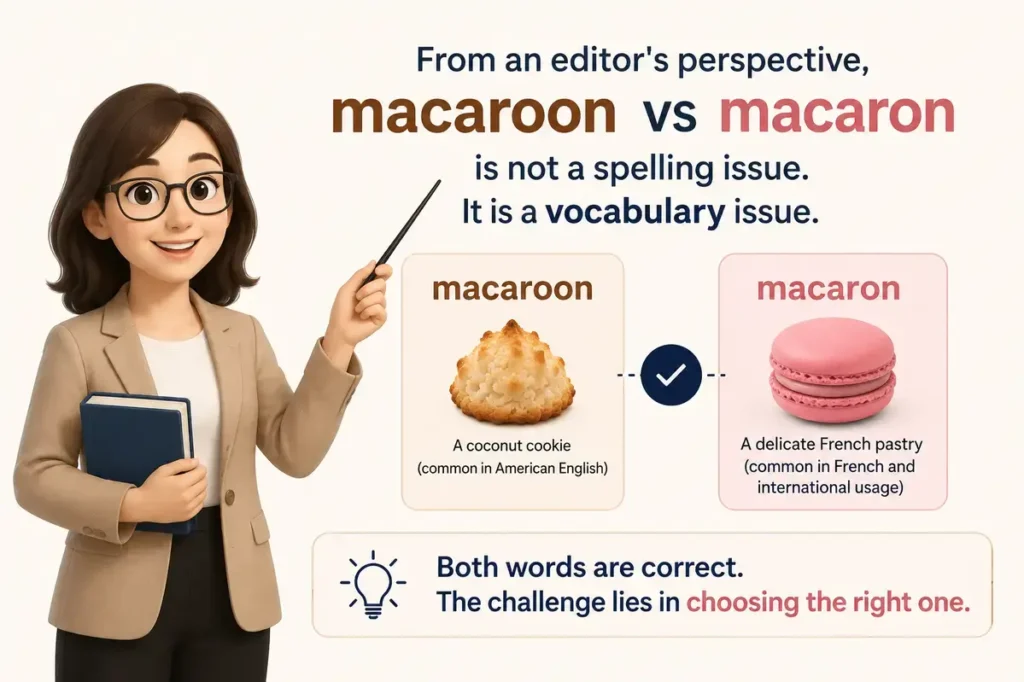
From an editor’s perspective, macaroon vs macaron is not a spelling issue. It is a vocabulary issue. Both words are correct. The challenge lies in choosing the right one. When writers refer to colorful French sandwich cookies as macaroons, readers familiar with baking immediately notice the mistake. Similarly, calling a coconut macaroon a macaron creates confusion. A practical memory trick can help.
Think of the extra letters in macaroon as representing the extra texture and coconut packed into the cookie. For macaron, think of the elegant French pastry displayed in bakery windows. Professional food writers, cookbook editors, and pastry chefs rarely confuse the two because the desserts are fundamentally different. The more you associate each word with its ingredients, the easier the distinction becomes.
Frequently Asked Questions
What Is The Difference Between A Macaroon And A Macaron?
A macaroon is a coconut based cookie that is chewy and dense. A macaron is a French sandwich cookie made with almond flour, egg whites, and a filling such as ganache or buttercream.
Is Macaroon Or Macaron The Correct Spelling?
Both spellings are correct. They refer to different desserts rather than alternative spellings of the same food.
Why Do People Confuse Macaroon And Macaron?
The words look very similar and share historical roots. Many people assume they are regional spellings of one dessert, but they actually describe two distinct baked goods.
Are Macarons Made With Coconut?
Traditional macarons are made with almond flour, not coconut. Coconut is the defining ingredient of a macaroon.
Which Dessert Is French?
The macaron is the French pastry. It is known for its colorful appearance, smooth shells, and creamy filling.
Which Dessert Is Easier To Make?
Macaroons are generally easier to prepare because they require fewer ingredients and less precision than macarons.
Are Macarons And Macaroons Gluten Free?
Many traditional recipes for both desserts are naturally gluten free. However, ingredients can vary, so checking individual recipes is important.
Which Is More Popular Today?
Macarons have gained significant popularity worldwide due to social media, luxury bakeries, and modern dessert trends. Macaroons remain popular as a traditional coconut cookie.
Still confused? Compare to bad or too bad which is correct.
Macaroon Vs Macaron Conclusion
The answer to macaroon vs macaron is simple once you understand the desserts behind the names. A macaroon is a coconut based cookie with a chewy texture and rustic appearance. A macaron is a delicate French sandwich cookie made from almond flour and filled with cream, ganache, or jam. Neither term is more correct than the other. The correct choice depends entirely on the dessert being discussed.
Remember this easy rule:
- Coconut cookie equals macaroon.
- French sandwich cookie equals macaron.
That distinction will help you write accurately, order confidently, and avoid one of the most common food related language mistakes.
1 thought on “Macaroon vs Macaron: Meaning and Culinary Differences 2026”