
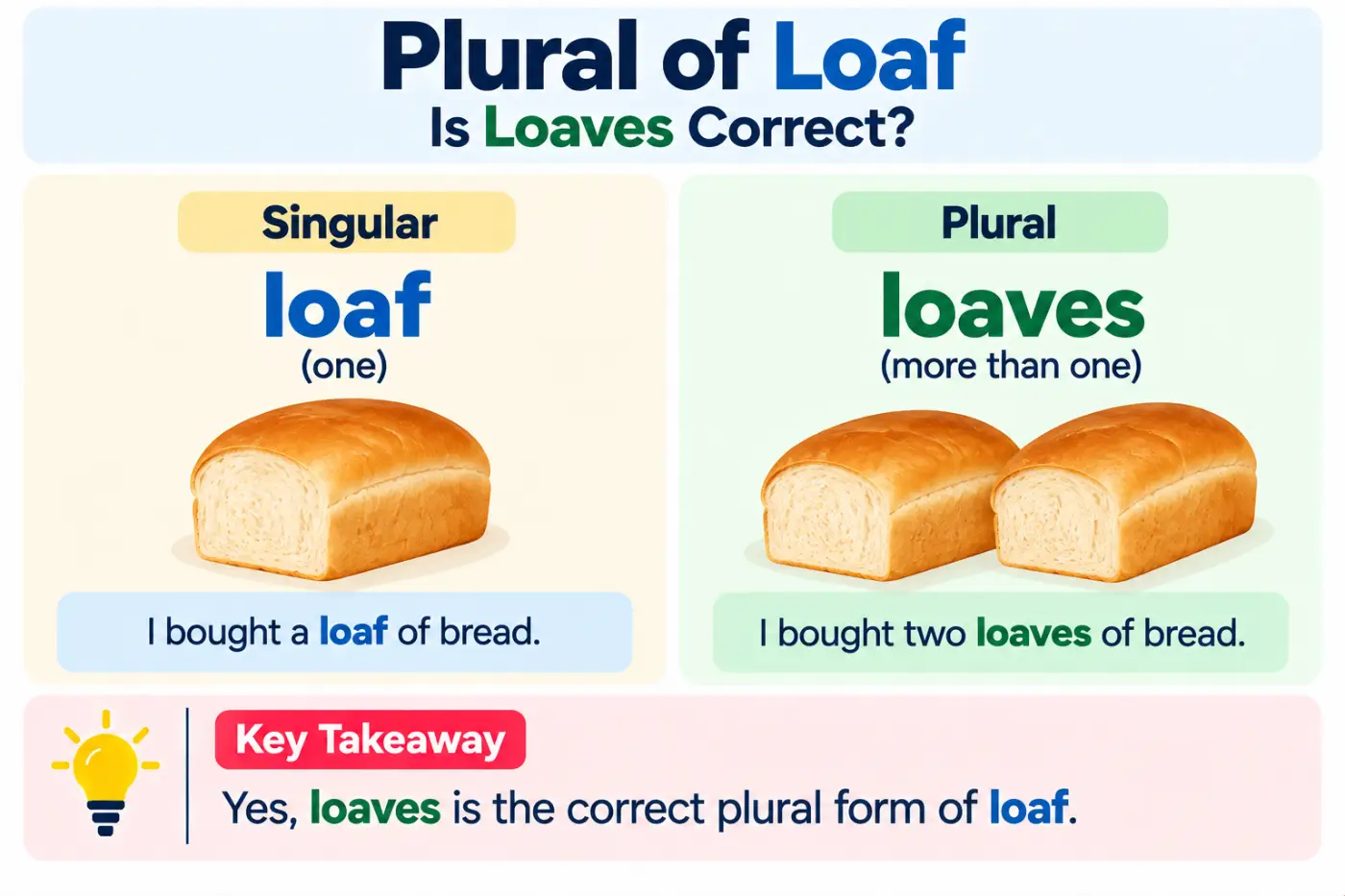
The plural of loaf is loaves. If you have one loaf of bread and buy another one, you have two loaves. The spelling changes from loaf to loaves because English uses a common plural pattern in which some nouns ending in f or fe change that ending to ves.
This can feel confusing because English has no single plural rule that works for every noun ending in f. For example, roof becomes roofs while loaf becomes loaves. That means you cannot always decide the plural simply by looking at the final letter. You need to learn the established form for each word.
The word loaf is most often used for a shaped quantity of bread, but it can also describe a single mass of other baked foods. In addition, loaf appears in the verb phrase loaf around, meaning to spend time doing very little. This guide explains the correct plural, the spelling change, grammar rules, pronunciation, word history, common mistakes, regional usage, and natural examples. You’ll also learn a quick memory trick for remembering the correct form.
Learn the difference in How to Spell Until Correctly and Use It 2026.
Quick Definition
The standard plural of loaf is loaves. Loaf refers to one shaped quantity of bread or another baked food, while loaves refers to two or more. The spelling changes from f to ves in the plural. For example, one loaf becomes two loaves, and one loaf of bread becomes several loaves of bread.
Quick Answer
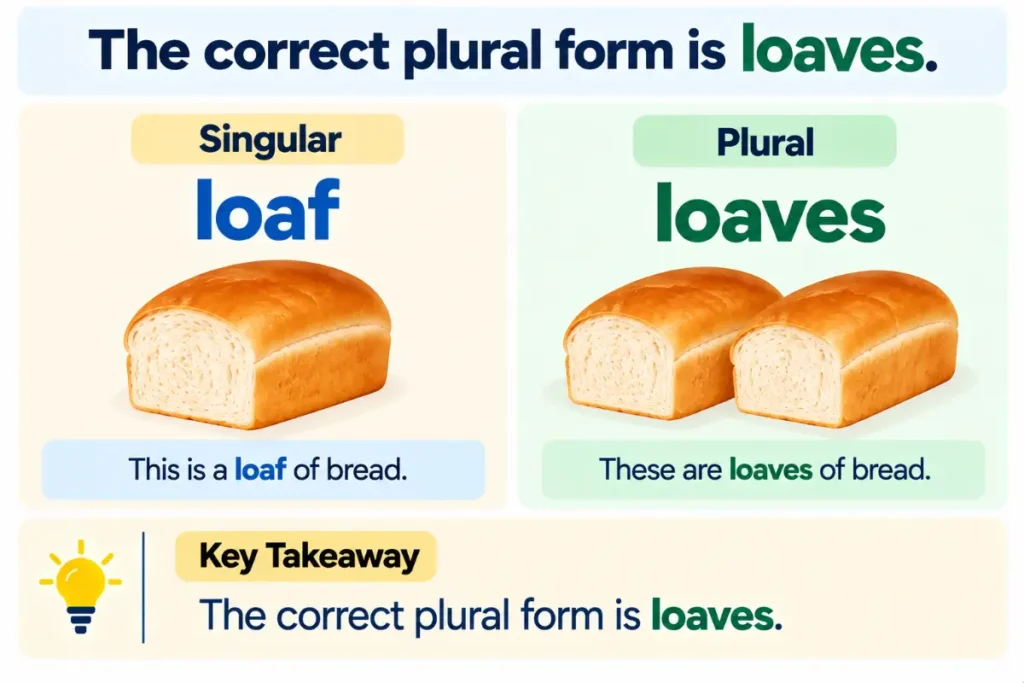
The correct plural form is loaves.
Use loaf for one item and loaves for more than one.
- One loaf of bread.
- Two loaves of bread.
The spelling changes because loaf belongs to a group of English nouns that form their plural by changing the final f to ves.
Comparison Table
| Form | Meaning | Part of Speech | Origin | Usage Frequency | Formality | Common Contexts | Example |
|---|---|---|---|---|---|---|---|
| Loaf | One shaped quantity of bread or another baked food | Noun | Old English hlāf | Very common | Neutral | Food, cooking, shopping, baking | I bought a loaf of bread. |
| Loaves | More than one loaf | Plural noun | Old English hlāf | Very common | Neutral | Food, cooking, shopping, baking | The bakery sells fresh loaves every morning. |
The important spelling point is the change from loaf to loaves. The pronunciation also changes slightly because the final consonant sound shifts in the plural.
Meaning And Definition
Meaning Of Loaf
Loaf is a countable noun when it refers to a whole shaped portion of bread.
For example:
I bought a loaf of bread.
The word loaf tells us that the bread is being treated as one complete unit. A loaf may be large or small and can have many different shapes depending on the type of bread.
You can have:
a loaf of white bread
a loaf of wheat bread
The exact meaning depends on the food being discussed.
Loaf can also refer to a shaped quantity of another baked or prepared food. For example, meatloaf is commonly treated as a loaf or shaped mass of food.
The word also has a verb use.
If someone says:
He spent the afternoon loafing around.
They mean he spent the time relaxing or doing very little useful work.
That verb meaning is related to the idea of idleness, but it does not change the plural form of the noun loaf.
Meaning Of Loaves
Loaves is simply the plural noun form of loaf. It means more than one loaf.
For example:
The bakery displayed six fresh loaves.
Here the word loaves refers to six separate units.
You can use loaves when talking about several kinds of bread or several individual pieces.
The baker prepared three loaves of sourdough.
The family bought two loaves for the week.
The restaurant serves warm loaves with dinner.
In each example, loaves means two or more whole units.
Why Loaf Becomes Loaves
The spelling change is one of the main reasons people search for this word.
Loaf ends in f, but its plural is not loofs. Instead, the f changes to v and the plural ending e s is added.
So:
loaf → loaves
This pattern appears in several common English nouns.
For example:
leaf → leaves
wolf → wolves
shelf → shelves
half → halves
calf → calves
knife → knives
wife → wives
life → lives
The pattern is useful, but you should not treat it as an absolute rule.
English contains exceptions.
For example:
roof → roofs
chief → chiefs
belief → beliefs
chef → chefs
These nouns normally keep the f sound and add s.
That means you should not assume every word ending in f automatically changes to ves.
Loaf is one of the established nouns that uses the ves plural.
The Spelling Rule In Simple Terms
English has several historical plural patterns. Some developed from older pronunciation and spelling systems that were part of earlier forms of the language.
For learners, the practical rule is easier.
When you see certain common nouns ending in f or fe, check if they have a ves plural.
Loaf is one of them.
The pattern is:
f → v + es
So:
loaf → loaves
The same pattern appears in leaf → leaves and wolf → wolves.
However, because English has exceptions, it is better to learn common plural forms individually rather than applying the pattern mechanically to every word.
For example, roof does not normally become rooves in standard modern English. It becomes roofs.
This is a good example of why English spelling often requires both rules and memory.
Sentence Examples
Here are natural examples using the correct plural form.
- The bakery sells fresh loaves every morning.
- We bought two loaves of whole wheat bread.
- The baker placed several warm loaves on the counter.
- The store had only three loaves left before closing.
- She baked four loaves for the community event.
- The restaurant serves fresh loaves with soup.
- We froze two loaves so they would last longer.
- The shelves were filled with different kinds of loaves.
- The baker makes small loaves for customers who live alone.
- They delivered twenty loaves of bread to the shelter.
These examples show that loaves works naturally in everyday speech, business writing, recipes, school assignments, and formal descriptions.
Common Mistakes
Loafs
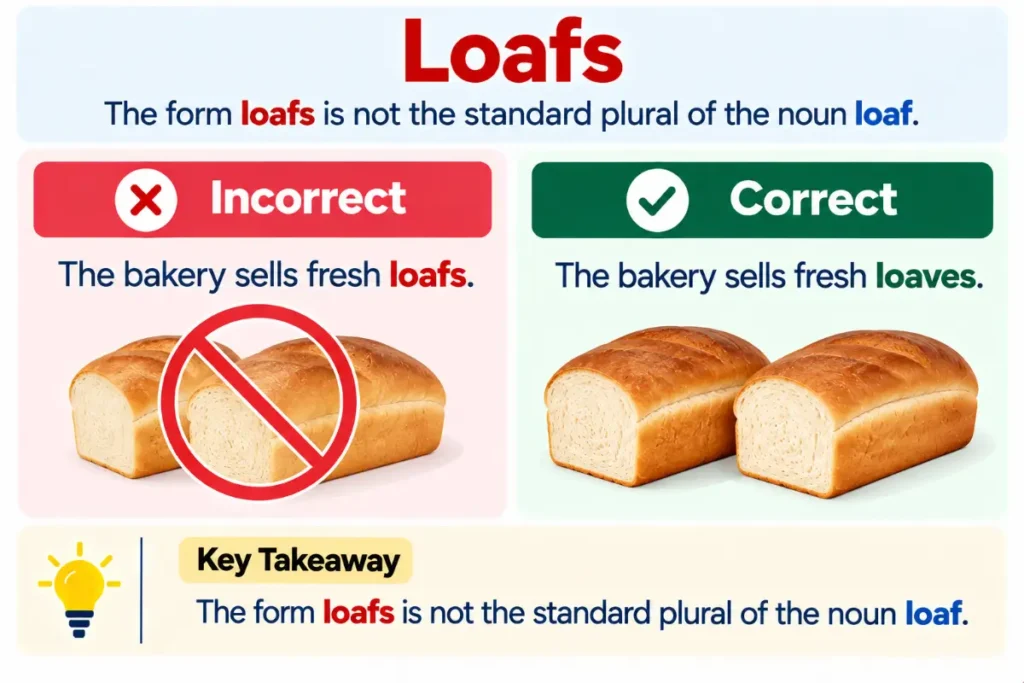
The form loafs is not the standard plural of the noun loaf.
Incorrect:
The bakery sells fresh loafs.
Correct:
The bakery sells fresh loaves.
The error happens when writers simply add s to the singular noun. That works for many English nouns, but loaf belongs to a group with a different plural pattern.
Loafs And Loaves As Different Forms
Loafs can appear as a third person singular form of the verb loaf.
For example:
He loafs around the house all day.
Here loafs is not a plural noun. It is a verb.
That distinction is useful because both forms can appear in English but perform completely different grammatical jobs.
Loafs Of Bread
The phrase loafs of bread is incorrect when you mean multiple bread units.
Use:
loaves of bread
For example:
The bakery delivered ten loaves of bread.
Loafs As A Spelling Shortcut
Some writers know that many nouns simply add s and apply that habit to loaf.
That is understandable, but the standard plural must be learned separately.
Confusing Loaves With Leaves
Loaves and leaves look similar because both use the f to ves spelling pattern.
Leaves is the plural of leaf.
Loaves is the plural of loaf.
The vowel pattern is different, so careful reading matters.
Pronunciation Guide
The singular loaf is commonly pronounced /loʊf/ in American English.
A simple pronunciation guide is:
LOHF.
The plural loaves is commonly pronounced /loʊvz/.
A simple pronunciation guide is:
LOHVZ.
The main difference appears at the end.
Loaf ends with an f sound.
Loaves ends with a v sound followed by a z sound.
So:
loaf → /loʊf/
loaves → /loʊvz/
The vowel sound remains similar, but the final consonant changes.
This is not only a spelling difference. It reflects an established sound pattern in the plural.
A common pronunciation mistake is to pronounce loaves as though it ended with an f sound. The correct plural has the voiced v sound.
Syllable Breakdown
Loaf has one syllable.
loaf
Loaves also has one syllable.
loaves
The words are therefore easy to say once the final consonant difference is clear.
The singular has a long o sound followed by f.
The plural has the same basic vowel followed by v and z.
You do not need to add an extra syllable when saying loaves.
Etymology And Word Origin
Loaf is an old English word with Germanic roots. The Old English form was hlāf, which referred to bread or a portion of bread. The word has a long history in English and is related to words for bread in other Germanic languages.
The modern English word developed from this older form through the natural sound and spelling changes that shaped English over centuries.
The historical connection between loaf and bread remains visible in related English words. For example, the word lord has an old connection to a person associated with providing or distributing bread, although its modern meaning is very different.
The plural form loaves also reflects historical changes in English. The f to v alternation is connected to older sound patterns in which related forms could have different consonant sounds.
Modern speakers do not need to know the historical details to use the word correctly. Still, the history helps explain why the plural is not formed simply by adding s.
Why The F Changes To V
The f to v change in words such as loaf and loaves has historical roots rather than being a random spelling trick.
In older stages of English, related word forms could show changes in consonant sounds depending on their position in the word. Over time, some of these patterns became fixed in spelling.
Modern English preserves several examples.
leaf → leaves
life → lives
knife → knives
wolf → wolves
loaf → loaves
The spelling records a change that became part of the established word pattern.
Not every noun followed the same path. That explains why modern English has both f to ves plurals and simple f plus s plurals.
For learners, the practical lesson is straightforward. Learn loaf and loaves as a pair.
Need another quick comparison? Read Analyzing or Analysing: Which Is Correct? 2026.
Grammar Rules And Part Of Speech
Loaf is a noun when it refers to a complete unit of bread or another food.
It is a countable noun in this sense.
That means you can say:
one loaf
two loaves
three loaves
several loaves
many loaves
You can also use numbers directly before it.
I bought two loaves.
The bakery made ten loaves.
When talking about bread as a substance rather than individual units, English often uses bread as an uncountable noun.
For example:
I bought some bread.
But when you identify complete units, loaf becomes useful.
I bought two loaves of bread.
This distinction is important for English learners.
You would not normally say:
I bought two breads.
Instead, you would say:
I bought two loaves of bread.
The phrase loaf of bread identifies the unit.
Loaf As A Verb
Loaf can also function as a verb.
To loaf means to spend time doing very little, especially when you should be working or being productive.
For example:
He spent the afternoon loafing around.
She was loafing instead of studying.
The verb has related forms.
loaf
loafs
loafed
loafing
Notice that loafs is possible as a verb.
For example:
He loafs around on weekends.
This is grammatically correct because loafs is the third person singular present form of the verb.
That explains an important spelling point.
Loaves is the plural noun.
Loafs can be a verb form.
The two should not be confused.
Countable And Uncountable Bread
Bread creates an interesting grammar distinction.
Bread is generally treated as an uncountable noun when referring to bread as food in general.
For example:
I need some bread.
We ran out of bread.
The bakery makes fresh bread.
When you want to count complete units, use loaf.
For example:
I need two loaves of bread.
We bought three loaves yesterday.
The bakery delivered ten loaves.
This pattern appears with many foods and materials in English. A substance may be uncountable while a particular unit of that substance is countable.
You can think of loaf as the counting unit for a whole piece of bread.
Regional Usage
American English
Loaf and loaves are standard in American English. The plural spelling is the same in ordinary US usage.
American speakers commonly use loaf when buying or discussing bread.
For example:
I bought a loaf of sourdough.
We need two loaves for the party.
The pronunciation follows the same basic distinction between the final f sound and the voiced v sound.
British English
British English also uses loaf and loaves as the standard singular and plural forms.
There is no major regional difference in the plural spelling.
British speakers may use loaf in the same food contexts as American speakers, although bread varieties and local vocabulary can differ.
Australian English
Australian English follows the same standard plural pattern.
One loaf becomes two loaves.
There is no special Australian plural spelling for this noun.
Canadian English
Canadian English also uses loaves as the standard plural.
The grammar and spelling are essentially the same as in American and British English for this word.
The main differences you may notice are related to local food vocabulary or style rather than the plural itself.
Formal And Informal Usage
Loaf and loaves are neutral English words. They work equally well in casual conversation and formal writing.
You can use them in a grocery list:
Buy two loaves of bread.
You can use them in a recipe:
Bake the loaves until the crust turns golden brown.
You can use them in a business context:
The bakery produces thousands of loaves each week.
You can also use them in academic or historical writing:
The study examined traditional methods for producing bread loaves.
The word does not carry a strongly formal or informal tone.
Real Life Usage Examples
Daily Conversation
We need two loaves of bread for dinner.
I bought a fresh loaf this morning and froze the other one.
These are natural everyday uses. The singular and plural forms depend simply on how many complete bread units you mean.
Email And Workplace Communication
The bakery delivered fifty loaves to the restaurant this morning.
Please confirm how many loaves are needed for Saturday’s event.
In workplace communication, the word works just like any other countable noun.
Academic Writing
The researchers examined the size and shape of traditional bread loaves.
Historical records describe the production and distribution of loaves in local communities.
The word can therefore appear naturally in serious writing without sounding casual.
News Writing
Local bakeries donated hundreds of loaves to community food programs.
The new bakery produces fresh loaves throughout the day.
Journalistic writing uses the plural normally when reporting quantities.
Literature And Storytelling
The baker placed three warm loaves beside the window.
By sunset, only a few loaves remained on the wooden table.
The word fits naturally into descriptive storytelling because it refers to a familiar physical object.
Related And Confused Terms
Bread
Bread is the general food substance. It is usually uncountable when referring to bread in general.
I bought some bread.
Loaf
Loaf refers to one complete shaped unit of bread.
I bought one loaf.
Loaves
Loaves refers to two or more complete units.
I bought three loaves.
Slice
A slice is a thin piece cut from a loaf.
I ate two slices.
Roll
A roll is usually a smaller individual bread product. It is different from a loaf.
Bun
A bun is a small round or shaped bread product. It is not normally counted as a loaf.
Loaf Pan
A loaf pan is a baking pan designed for foods shaped like a loaf.
Bread Loaf
Bread loaf is a phrase used to describe a complete loaf of bread. In ordinary English, loaf of bread is often the more natural construction.
Understanding these related words helps you choose the right counting unit.
How To Remember The Plural
The easiest memory trick is to connect loaf with leaf.
Think:
leaf → leaves
loaf → loaves
Both words change f to v before the plural ending.
You can also remember a short sentence:
One loaf. Two loaves.
Say it aloud a few times and the pattern becomes familiar.
Another useful trick is to notice that loaves contains the word sound pattern associated with other common plurals such as leaves and wolves.
Still, do not apply the pattern to every f ending noun. Roof is roofs, not rooves in standard modern English. Chief is chiefs, not chieves.
The best strategy is to memorize common irregular or changing plurals as individual word pairs.
Common Plural Patterns In English
English nouns use several plural patterns.
Many simply add s.
book → books
car → cars
table → tables
Others add es.
box → boxes
church → churches
Some change their spelling more dramatically.
child → children
man → men
mouse → mice
Loaf belongs to the group that changes f to ves.
loaf → loaves
This variety explains why English plural spelling can feel unpredictable.
There is a system, but the system contains historical layers and exceptions.
For learners, exposure matters. The more you read and use these forms, the more natural they become.
Why Loafs Is Usually Wrong As A Noun
If you write loafs when you mean multiple bread units, you are using the wrong plural form.
The reason is simple. Standard English has established loaves as the plural of loaf.
Incorrect:
The bakery delivered five loafs.
Correct:
The bakery delivered five loaves.
However, do not treat loafs as an impossible English form in every context. It can appear as the third person singular present form of the verb loaf.
For example:
He loafs around all weekend.
That sentence is correct.
This distinction is a useful reminder that spelling depends on grammar. The same base word can create different forms for different grammatical functions.
Expert Editor Insight
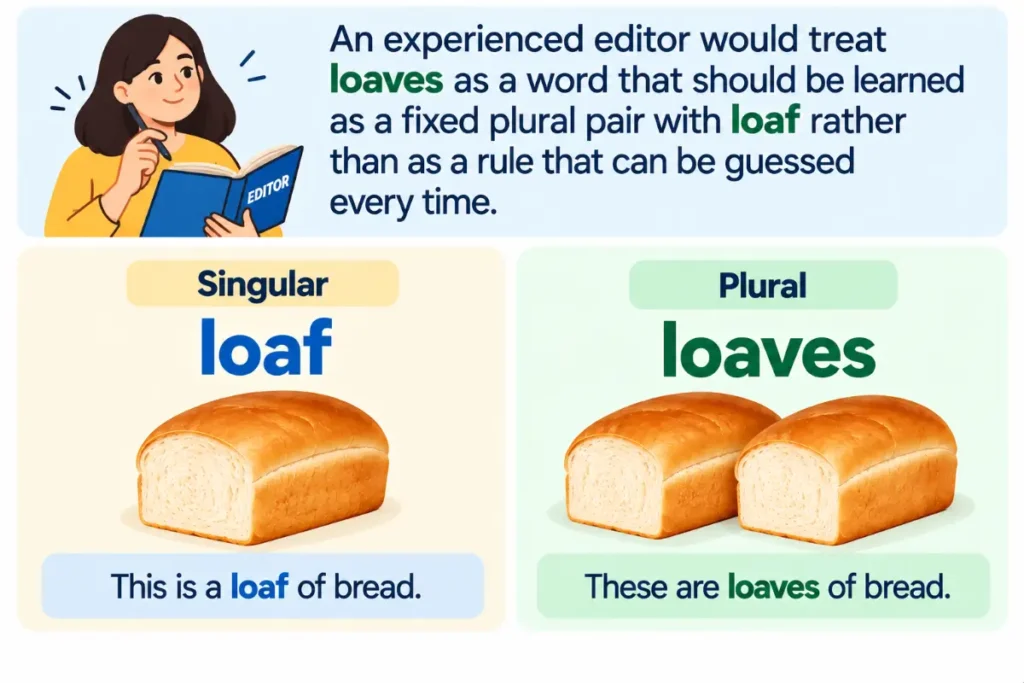
An experienced editor would treat loaves as a word that should be learned as a fixed plural pair with loaf rather than as a rule that can be guessed every time. The common error is adding s directly to the singular, producing loafs, because that pattern works with many English nouns. A quick editing check is to ask whether you mean several bread units or the verb form describing someone who loafs around. If you mean multiple bread units, loaves is the standard choice.
Many readers also check Reins and Reigns Definitions Examples and Grammar Guide 2026.
Conclusion
The plural of loaf is loaves. Use loaf when you mean one complete unit of bread and loaves when you mean two or more. The spelling changes from f to ves, giving you loaf for the singular and loaves for the plural.
The form loafs is not the standard plural noun, although it can be correct as a verb in a sentence such as He loafs around all day. That small grammar difference explains why both spellings may appear in English. The easiest memory trick is to connect loaf with leaf and remember loaf to loaves just as leaf becomes leaves. When you mean several bread units, choose loaves.
FAQs
What is the plural of loaf?
The standard plural is loaves. For example, one loaf becomes two loaves. The spelling changes from f to v before the plural ending. This is similar to other common English nouns such as leaf and wolf, which become leaves and wolves. The form loafs is not the standard plural noun form.
Is loafs a correct plural?
No, loafs is not the standard plural of the noun loaf. The correct plural is loaves. However, loafs can be grammatically correct as the third person singular present form of the verb loaf. For example, He loafs around all afternoon. The meaning and grammatical role determine which form belongs in the sentence.
Why does loaf become loaves?
Loaf becomes loaves because English preserves a historical plural pattern in which certain nouns ending in f or fe change the consonant to v before the plural ending. Similar examples include leaf to leaves and knife to knives. Not every f ending noun follows this pattern, so common words such as loaf are best learned individually.
How do you pronounce loaves?
Loaves is commonly pronounced /loʊvz/ in American English. It has one syllable and sounds roughly like LOHVZ. The singular loaf ends with an f sound, while the plural loaves ends with a v sound followed by a z sound. The vowel remains similar, so the main pronunciation difference is at the end.
Is loaves only used for bread?
No. Loaves most often refers to complete units of bread, but loaf can describe other foods that have been shaped into a loaf. Meatloaf is a familiar example. The exact meaning depends on context. Still, bread is by far the most common everyday context for loaf and loaves.
Is bread countable or uncountable?
Bread is generally uncountable when you mean the food as a substance. You can say I bought some bread. If you want to count complete units, use loaf as the counting noun. For example, I bought two loaves of bread. This distinction is standard English grammar and is useful for many food related expressions.
What is the difference between loaf and loaves?
Loaf is singular and refers to one unit. Loaves is plural and refers to two or more units. You might say I bought one loaf of bread or I bought three loaves of bread. The spelling changes from f to ves in the plural, so adding only s produces the wrong noun form.
Is loaf used as a verb?
Yes. Loaf can be a verb meaning to spend time doing very little or avoiding useful work. Its forms include loaf, loafs, loafed, and loafing. For example, He loafs around on weekends. This explains why loafs can appear in correct English even though it is not the plural noun form of loaf.