
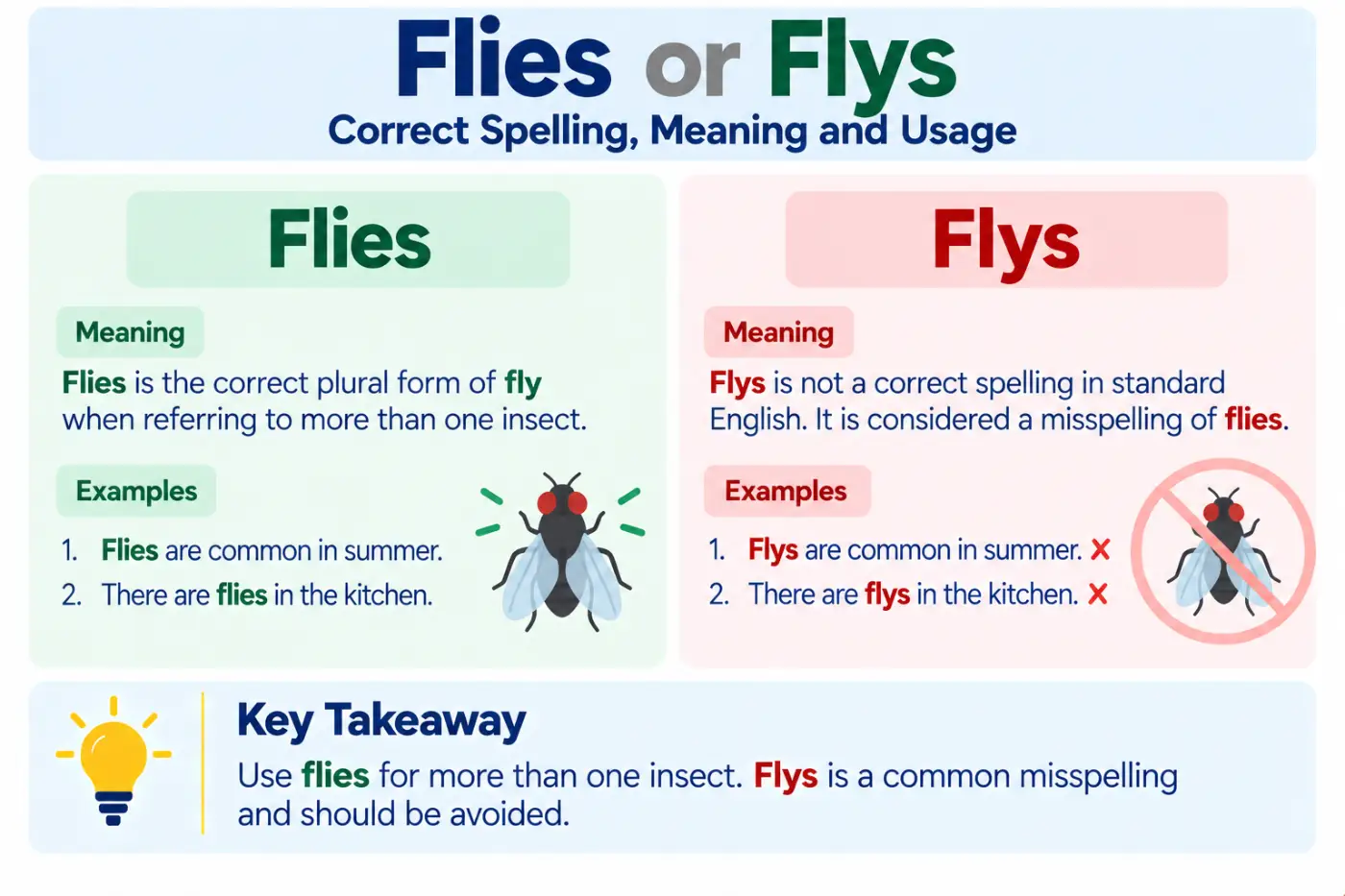
flies or flys is a common spelling question because both forms look like they could follow a normal English plural pattern. The correct standard spelling is flies when you mean more than one fly or the verb form related to fly. Flys is not the standard spelling for these meanings.
The confusion comes from a common English spelling rule. Many nouns form their plural by adding s, but words ending in a consonant plus y usually change the y to ies. So fly becomes flies. The same pattern appears in words such as baby and babies, city and cities, and party and parties. However, the word fly has another grammar use as a verb, which makes the full picture slightly more interesting.
This guide explains the difference in plain English. You’ll learn the spelling rule, meanings, grammar patterns, pronunciation, word history, common mistakes, regional usage, and natural examples. You’ll also see when flys might appear as a name or specialized form and why that does not make it the standard plural of fly.
A related grammar guide is Suing or Sueing: Correct Word, Pronunciation and Usage(2026).
Quick Definition
The standard spelling is flies. It can be the plural of the noun fly or a present tense verb form related to fly. For example, several flies are in the room and the bird flies over the trees are both correct. Flys is not the standard English spelling for these meanings.
Quick Answer
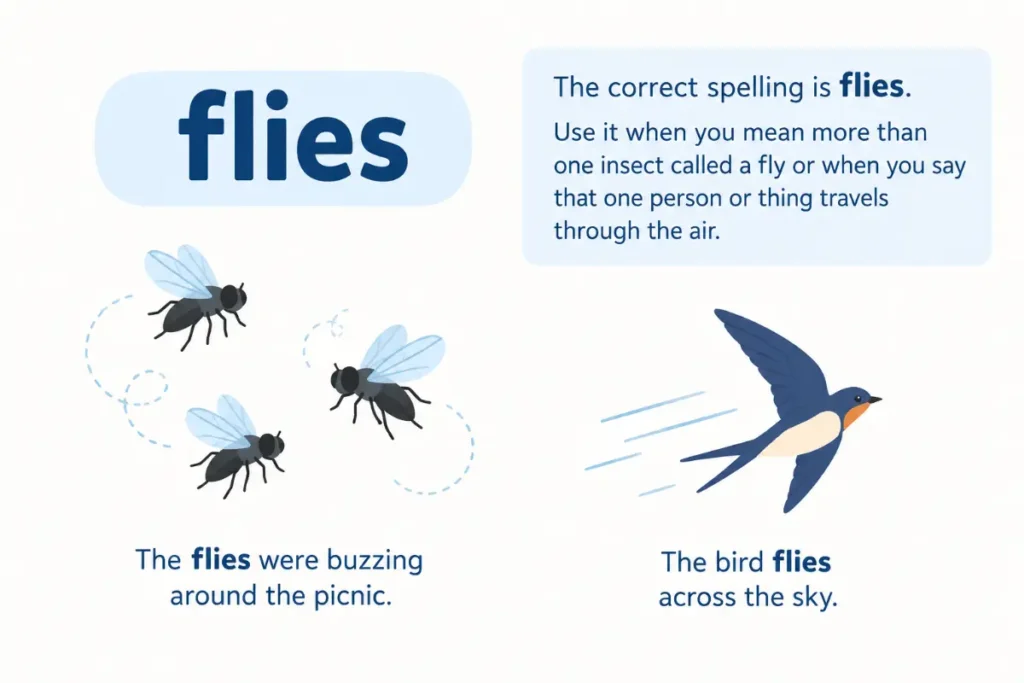
Use flies in standard English.
When fly is a noun, its plural is flies.
The fly is on the wall.
The flies are on the wall.
When fly is a verb, flies is used with a singular third person subject.
The bird flies over the lake.
The plane flies every morning.
The form flys is normally a spelling error in standard English. The reason is the spelling rule for words ending in a consonant followed by y. The y changes to i before the plural or verb ending is added.
Comparison Table Flies And Flys
| Form | Meaning | Part of Speech | Origin | Usage Frequency | Formality | Common Contexts | Example |
|---|---|---|---|---|---|---|---|
| Flies | More than one fly or a third person singular form of fly | Noun or verb | Old English and Germanic roots | Very common | Standard | Everyday speech, writing, science, travel, nature | The flies gathered near the food. |
| Flys | Not the standard spelling for the plural noun or verb | Usually a spelling error | Not a standard English inflection | Uncommon in standard writing | Nonstandard | Typing errors, informal mistakes, occasional names | Flys is normally corrected to flies. |
The key point is that flies has two important grammatical roles. It can name multiple insects or describe an action performed by one subject.
Meaning And Definition
Meaning Of Flys
Flys is generally not the standard English form of the plural noun fly or the third person singular verb form flies.
If you write:
There are three flys in the kitchen.
the standard form is:
There are three flies in the kitchen.
Likewise, if you write:
The bird flys across the field.
the standard form is:
The bird flies across the field.
There are occasional situations where Flys or flys can appear as a proper name, username, business name, title, product name, or other special label. A name can follow its own spelling conventions. That does not change the normal English grammar rule.
For ordinary writing, school assignments, professional communication, articles, reports, and formal documents, use flies.
Meaning Of Flies
Flies has two major grammatical uses.
First, flies is the plural form of the noun fly. A fly is a small flying insect belonging to the order Diptera. The word can refer to the common housefly or to other insects commonly called flies.
For example:
The flies are gathering around the fruit.
Second, flies is the third person singular present form of the verb fly.
For example:
The eagle flies over the valley.
Here flies describes an action. The subject is the eagle, which is singular.
This difference is easy to see when you compare these sentences.
The flies are outside.
The bird flies outside.
In the first sentence, flies is a plural noun. In the second, it is a verb.
The Main Spelling Rule
The spelling becomes much easier once you know one basic English rule.
When a noun ends in a consonant followed by y, the y usually changes to i before the plural ending is added.
For example:
Baby becomes babies.
City becomes cities.
Family becomes families.
Story becomes stories.
Country becomes countries.
Fly becomes flies.
The same spelling idea appears with certain verb forms. When a verb ends in a consonant plus y and takes the third person singular present ending, the y usually changes to i and es is added.
Try becomes tries.
Carry becomes carries.
Study becomes studies.
Fly becomes flies.
This is why the spelling flys does not follow the standard pattern.
There is an important exception to remember. If a word ends in a vowel followed by y, the y usually stays in place when forming the plural.
Boy becomes boys.
Toy becomes toys.
Key becomes keys.
Day becomes days.
The reason fly changes but boy does not come from the letter before y. Fly ends with a consonant sound and spelling pattern before y, while boy ends with a vowel before y.
Why The Spelling Changes
English spelling can look inconsistent until you notice the patterns behind it.
The ending in flies is not simply an extra s attached to fly. The word changes from y to ie before the final s.
Fly becomes flies.
This spelling makes the word easier to fit into a broader group of English words.
The same pattern can be seen in many common words.
Lady becomes ladies.
Puppy becomes puppies.
Library becomes libraries.
Company becomes companies.
The rule is especially useful for learners because it gives you a reliable starting point. Instead of memorizing every plural separately, look at the ending of the base word.
If the word ends in consonant plus y, changing y to ies is usually the right move.
Key Differences Explained
- Spelling. Flies is the standard form. Flys is normally incorrect in standard English.
- Noun meaning. Flies can mean more than one insect called a fly.
- Verb meaning. Flies can describe the action of one person, animal, or thing moving through the air.
- Grammar. As a noun, flies is plural. As a verb, flies is singular third person present tense.
- Pronunciation. The plural noun and verb form are generally pronounced the same way.
- Formality. Flies is standard in both formal and informal English.
- Regional usage. American, British, Australian, and Canadian English all use flies as the standard form.
- Special names. Flys may appear in a proper name or brand style, but such uses do not establish it as the normal English spelling.
The most useful rule is simple. If you mean more than one fly or you need the singular third person form of fly, choose flies.
Which Form Is Correct?
Flies is the correct standard form.
The spelling follows established English inflection patterns. When a word ends in a consonant followed by y, English commonly changes the y to i and adds es when forming a plural noun or a third person singular verb form.
This gives us:
Fly → flies.
Cry → cries.
Try → tries.
Reply → replies.
The spelling rule is also reflected in standard dictionary entries and ordinary edited English. Dictionaries list flies as the plural of fly and as a grammatical form of the verb fly.
Flys does not normally appear as the standard inflected form.
That distinction matters because English contains many words that look as though they should simply take s. The y ending creates a special spelling pattern that learners need to recognize.
Sentence Examples
Here are natural examples using the standard form.
- Several flies were buzzing around the kitchen.
- The bird flies across the garden every morning.
- We closed the window because flies kept coming inside.
- A butterfly flies from flower to flower.
- The scientist studies how the flies respond to changes in temperature.
- My dog watches the flies near the window.
- The plane flies over the mountains before landing.
- In warm weather, flies can become more noticeable around food.
- The eagle flies high above the valley.
- She quickly closed the door before more flies entered the house.
These examples show why context matters. In some sentences flies refers to insects. In others, it describes an action.
Here are examples showing the common incorrect form for comparison only.
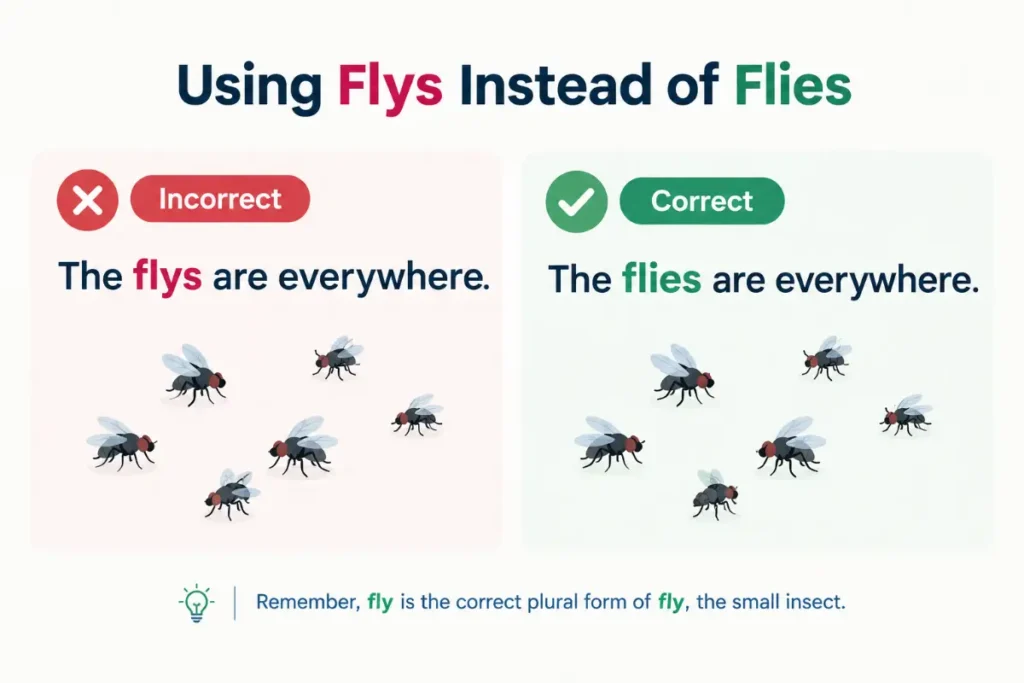
- Incorrect: There are several flys in the room. Correct: There are several flies in the room.
- Incorrect: The bird flys over the lake. Correct: The bird flies over the lake.
- Incorrect: She noticed two flys near the window. Correct: She noticed two flies near the window.
- Incorrect: The eagle flys above the mountains. Correct: The eagle flies above the mountains.
- Incorrect: Many flys gather around uncovered food. Correct: Many flies gather around uncovered food.
The repeated mistake comes from applying the simple s rule to a word that follows the consonant plus y spelling pattern.
Common Mistakes And Misspellings
Adding Only S
A common mistake is changing fly directly into flys.
The problem is that English does not normally form the plural this way for a word ending in consonant plus y.
Use flies instead.
Forgetting The Third Person Verb Rule
Some writers know the plural noun rule but forget that the same spelling pattern affects verbs.
He flys to New York every week is incorrect.
He flies to New York every week is correct.
The subject he is singular, so the verb needs its third person singular form.
Confusing Flys With Boys
Learners may notice that boy becomes boys and assume fly should become flys.
The difference is the letter before y.
Boy has a vowel before y.
Fly has a consonant before y.
That difference controls the spelling change.
Treating Every Y Ending The Same
Not every word ending in y changes to ies.
Boy becomes boys.
Key becomes keys.
Day becomes days.
But:
City becomes cities.
Family becomes families.
Fly becomes flies.
Look at the letter before y instead of relying on the final letter alone.
Relying Only On Sound
Flies and flys would seem close if you tried to spell the word only from pronunciation. English spelling often preserves patterns that cannot be heard clearly.
That is why it helps to learn spelling rules instead of depending entirely on sound.
From a language processing perspective, familiar word patterns also influence how people type. When a writer sees a common plural ending, the brain may predict a simple s ending before the spelling rule is consciously checked. A quick proofreading pass catches this kind of error.
For another common grammar confusion, see Blankie or Blanky (2026): Which Spelling Is Standard English?.
Pronunciation Guide
Flies is commonly pronounced /flaɪz/ in American English.
You can think of the sound as:
FLY Z.
It has one syllable.
The vowel sound is the long i sound heard in fly, my, and sky. The final s is pronounced like a z sound.
The noun flies and the verb flies are pronounced the same way.
For example:
The flies are outside.
The bird flies outside.
The spelling and grammar differ, but the pronunciation remains the same.
This creates one reason the form can be confusing. You cannot hear the difference between the correct spelling and the incorrect spelling flys. The distinction exists in writing.
Another useful point is that the final sound is voiced. It sounds closer to z than s.
That is similar to the pronunciation of the final sound in words such as dogs and bags.
Etymology And Word Origin
The word fly has a long history in English. The noun comes from Old English forms related to the word for the flying insect and belongs to a broader Germanic family.
The verb fly also has an Old English history. It developed from an ancient Germanic root associated with moving through the air.
The noun and verb are therefore both deeply established in English.
The spelling of flies reflects later English grammar and spelling conventions rather than a change in the basic meaning of the word.
English has used related forms for centuries, while the modern spelling system gradually became more standardized through written usage, dictionaries, education, and publishing.
The important point for modern writers is not the age of the word but the pattern it follows. The standard inflected form is flies.
Regional Usage
American English
American English uses flies as the standard spelling. You will see it in everyday conversation, school writing, newspapers, books, workplace communication, and scientific material.
The noun and verb meanings are both common.
For example:
The flies are outside.
The bird flies south in winter.
Flys is not a standard American English plural or verb form.
British English
British English also uses flies as the standard form.
The spelling rule does not change across the Atlantic. A British writer would use flies for both the plural noun and the third person singular verb.
The word can appear in both formal and informal writing.
Australian English
Australian English follows the same standard spelling.
Flies is used for multiple insects and as the third person singular form of fly. There is no established Australian spelling variant that replaces flies with flys.
Canadian English
Canadian English also uses flies as the standard form.
The grammar and spelling rule remains the same. Differences between Canadian and American English do not affect this particular word.
Across these major English varieties, flies is the standard form.
Grammar Rules And Part Of Speech
The most interesting feature of flies is that it can belong to two different grammatical categories.
Flies As A Noun
As a noun, flies is plural.
One fly is near the window.
Two flies are near the window.
The singular noun is fly. The plural is flies.
Because flies is plural, it normally takes plural verb agreement when it is the subject of a sentence.
The flies are annoying.
The flies were everywhere.
Notice the verbs are and were. They agree with the plural noun flies.
Flies As A Verb
As a verb, flies is the third person singular present form of fly.
I fly.
You fly.
We fly.
They fly.
He flies.
She flies.
The plane flies.
The spelling changes because the subject is singular and the verb follows the third person pattern.
This distinction is useful when proofreading.
If flies refers to insects, it is a noun.
If flies describes an action performed by a singular subject, it is a verb.
Sentence Position
As a noun, flies can appear as a subject or object.
The flies entered the house.
We removed the flies from the room.
As a verb, flies appears after a singular third person subject.
The bird flies south.
The plane flies over the city.
Punctuation
There is no special punctuation rule for the word itself. Standard sentence punctuation depends on the larger sentence.
For example:
The bird flies over the lake.
Several flies landed on the table.
A comma is not required simply because the word flies appears in a sentence.
Singular And Plural Forms
Understanding the singular form makes the plural easier.
Singular:
One fly.
Plural:
Two flies.
The spelling change follows the same general pattern found in many words ending in consonant plus y.
Singular | Plural
Fly | Flies.
City | Cities.
Baby | Babies.
Story | Stories.
Country | Countries.
This pattern is worth learning because it applies far beyond one word.
However, remember that not every y ending follows it.
Boy | Boys.
Toy | Toys.
Key | Keys.
Day | Days.
The vowel before y keeps the y in those words.
Real Life Usage Examples
Daily Conversation
There are flies in the kitchen, so close the door.
The bird flies away whenever we get too close.
These are simple everyday uses. The first treats flies as a noun. The second uses it as a verb.
Workplace Communication
Please keep the food covered so flies do not gather around it.
The delivery plane flies from Chicago to Denver each morning.
The word works naturally in professional communication without sounding overly formal.
Academic Writing
Houseflies can carry microorganisms from contaminated surfaces to food.
The insect flies toward the light under certain experimental conditions.
Scientific writing may use the noun in its biological sense and the verb to describe movement.
News Writing
The aircraft flies over the region several times each week.
Large numbers of flies were reported near the affected area.
Journalistic writing follows the same standard spelling.
Literature And Storytelling
A small group of flies circled the old table.
The bird flies above the trees as the sun begins to set.
In storytelling, the word can create a clear visual image with very little effort.
Related And Confused Terms
Fly
Fly is the singular noun and the base form of the verb.
One fly landed on the wall.
Birds fly across the sky.
Flies
Flies is the plural noun and the third person singular present verb form.
The flies are outside.
The bird flies south.
Flying
Flying is the present participle or gerund form of fly.
The bird is flying over the lake.
Flew
Flew is the simple past tense of fly.
The bird flew away.
Flown
Flown is the past participle.
The bird has flown away.
Flight
Flight is a related noun that refers to the act or process of flying or to a scheduled journey by air.
Our flight leaves at six.
Flyable
Flyable is an adjective meaning suitable or possible for flying under the relevant conditions.
The weather is flyable today.
Flyer
Flyer can refer to a person or thing that flies. It can also mean a printed advertisement.
She is an experienced flyer.
The store handed out a promotional flyer.
These words belong to the same broader word family but serve different grammatical roles.
Why Flys Looks Plausible
The incorrect form looks believable because many English plurals simply add s.
Book becomes books.
Car becomes cars.
House becomes houses.
Phone becomes phones.
That pattern is so common that writers may apply it automatically.
The problem is that English has many spelling rules layered over the basic plural rule. Words ending in consonant plus y are one of those groups.
Once you learn city becomes cities and baby becomes babies, fly becomes flies becomes much easier to remember.
There is also a visual reason for the confusion. The pronunciation does not clearly tell you that the spelling changes. If you hear flies, you cannot hear the difference between flies and the incorrectly written flys.
This is a classic example of why English spelling cannot always be predicted from pronunciation alone.
A Practical Editing Test
If you are unsure about the spelling, ask yourself what role the word has.
If you mean more than one insect, start with fly and apply the plural rule.
Fly → flies.
If you mean that one person, animal, or thing performs the action, check the subject.
The bird flies.
The plane flies.
The child flies the kite.
Notice the last example. The child flies the kite is correct because flies is the third person singular form of the verb. The object is the kite.
A quick grammar check can therefore help you choose the spelling even when pronunciation offers no clue.
Expert Editor Insight
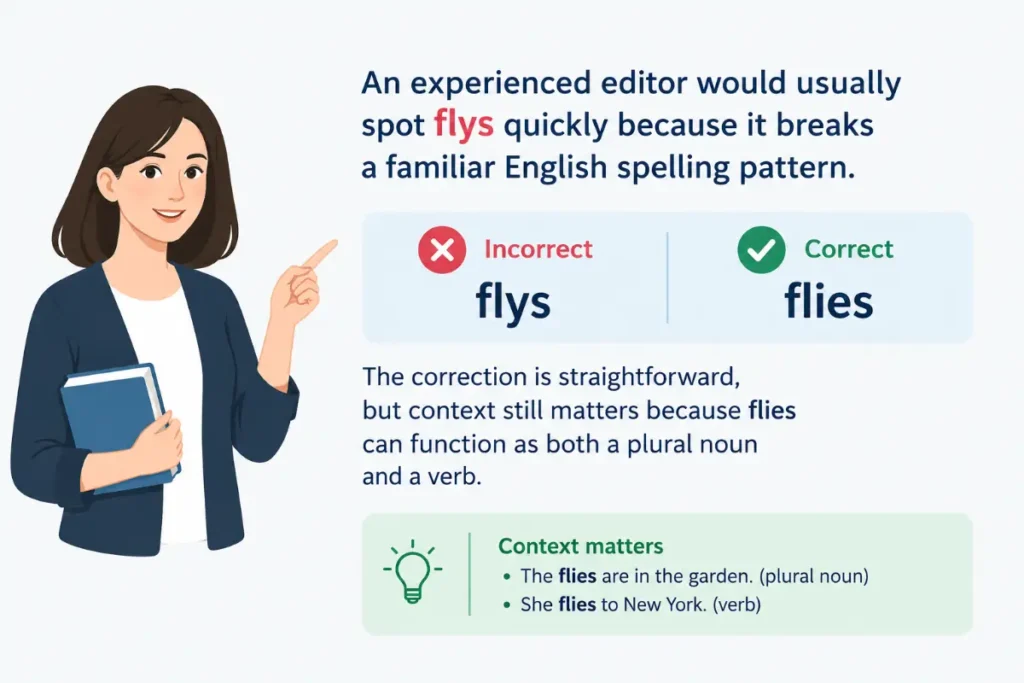
An experienced editor treats flys as a straightforward spelling error in ordinary English unless the context clearly shows that it is a special name or stylized label. The most useful editing check is to identify the grammatical role first. If the word names several insects, it is the plural noun. If it describes an action performed by a singular third person subject, it is the verb. In both standard cases, the spelling is flies. Spellcheckers usually catch the error, but understanding the y to ies pattern is more useful because it helps with many other words too.
Many readers also check Prooving vs Proving Which Spelling Is Correct 2026.
Conclusion
flies or flys has a clear answer in standard English. Flies is the correct form when you mean more than one fly or when you need the third person singular form of the verb fly. The form flys is normally a spelling error, although a special name or stylized label could use it intentionally.
The reason is the familiar consonant plus y spelling rule. Fly changes to flies instead of simply taking s. The same pattern appears in words such as city and cities or baby and babies.
A useful editing habit is to identify the grammar first and then check the spelling. If you mean several insects or an action performed by one singular subject, write flies. That quick check will keep your writing accurate.
FAQs
Is flys a real word?
Flys is not the standard English plural of fly and is not the standard third person singular form of the verb. In ordinary writing, it should be corrected to flies. A special name, username, brand, or stylized title could use Flys as a deliberate spelling, but that does not make it the normal grammatical form in English.
Which spelling is correct for more than one fly?
The standard plural spelling is flies. English changes the y to ie and adds s because fly ends in a consonant followed by y. For example, one fly becomes two flies. This follows the same pattern as baby becoming babies and city becoming cities. The form flys does not follow the standard plural spelling rule.
Why does fly become flies?
Fly becomes flies because English commonly changes a final consonant plus y to i before adding the plural ending. The spelling therefore changes from fly to flies rather than simply adding s. You can see the same pattern in words such as story and stories or family and families. The rule helps explain the spelling rather than requiring simple memorization.
Is flies a noun or a verb?
Flies can be either a noun or a verb. As a noun, it is the plural of fly and refers to more than one insect. As a verb, it is the third person singular present form of fly. For example, the flies are outside uses the noun, while the bird flies over the lake uses the verb.
How do you pronounce flies?
Flies is commonly pronounced /flaɪz/ in American English. It has one syllable and sounds roughly like fly followed by a z sound. The noun and verb forms have the same pronunciation. Because the sound does not reveal the spelling difference, learners may write flys by mistake. Remembering the spelling rule is more reliable than spelling the word from sound.
Is flies the same in American and British English?
Yes. American and British English use flies as the standard spelling for the plural noun and the third person singular verb form. Australian and Canadian English also follow the same pattern. There is no major regional spelling difference for this word. Differences between these varieties of English do not change the basic y to ies rule.
Can flies be used for something other than insects?
Yes. Flies can be the verb form of fly and can describe movement through the air. For example, the plane flies over the mountains uses flies as a verb. The word can also appear in other established expressions and contexts related to flying. Its exact meaning depends on the grammatical role and surrounding sentence.
Is flys acceptable in formal writing?
No. In standard formal English, use flies instead. The spelling flys should normally be treated as an error when you mean the plural of fly or the third person singular form of the verb. Before submitting an essay, report, email, or professional document, check words ending in consonant plus y because this spelling pattern causes many common mistakes.