
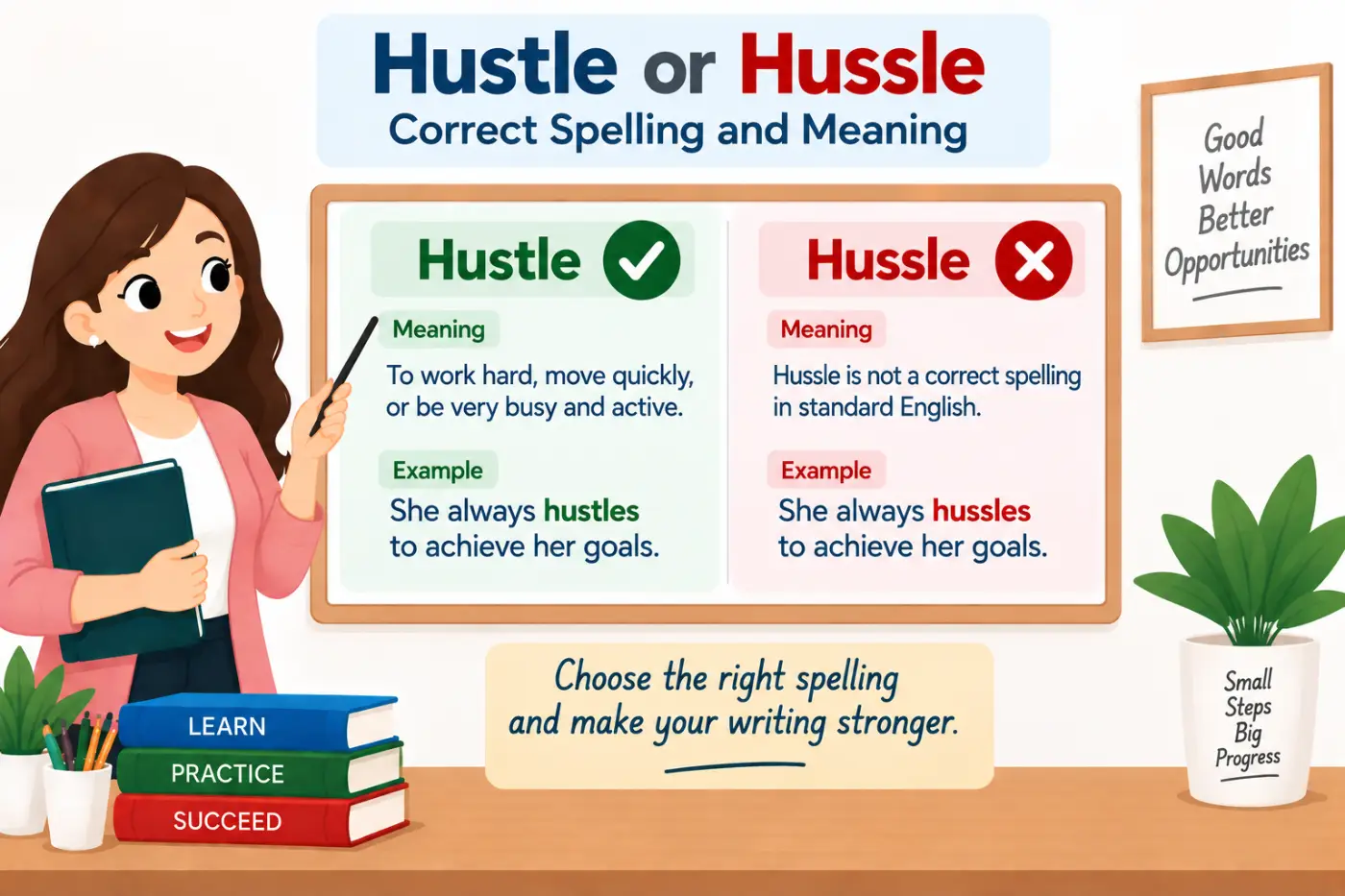
If you’re unsure about hustle or hussle you’re probably dealing with a very small spelling difference that can be surprisingly easy to miss. The correct standard English spelling is hustle. The form hussle is generally a misspelling and should not be used in polished English writing.
The confusion comes from the way the word sounds. When people say hustle quickly the middle sounds can make the spelling less obvious. English also has many words with double consonants so it’s easy to assume that this word follows the same pattern. It doesn’t. The standard spelling uses one s and keeps the familiar letter pattern h u s t l e.
Hustle has several meanings. It can describe moving quickly pushing someone to act working hard or making money through energetic effort. It can also refer to a dance and appears in familiar expressions such as hustle and bustle. You’ll learn the main meanings grammar pronunciation word history regional usage common mistakes and natural examples so you can recognize and use the word with confidence.
Still confused? Compare Centre vs Center: Meaning, Usage and Examples 2026.
Quick Definition
Hustle is the standard English spelling. It can mean to move quickly to push or persuade someone to act or to work energetically toward a goal. Hussle is generally a misspelling of hustle rather than an accepted alternative spelling in standard English.
Quick Answer
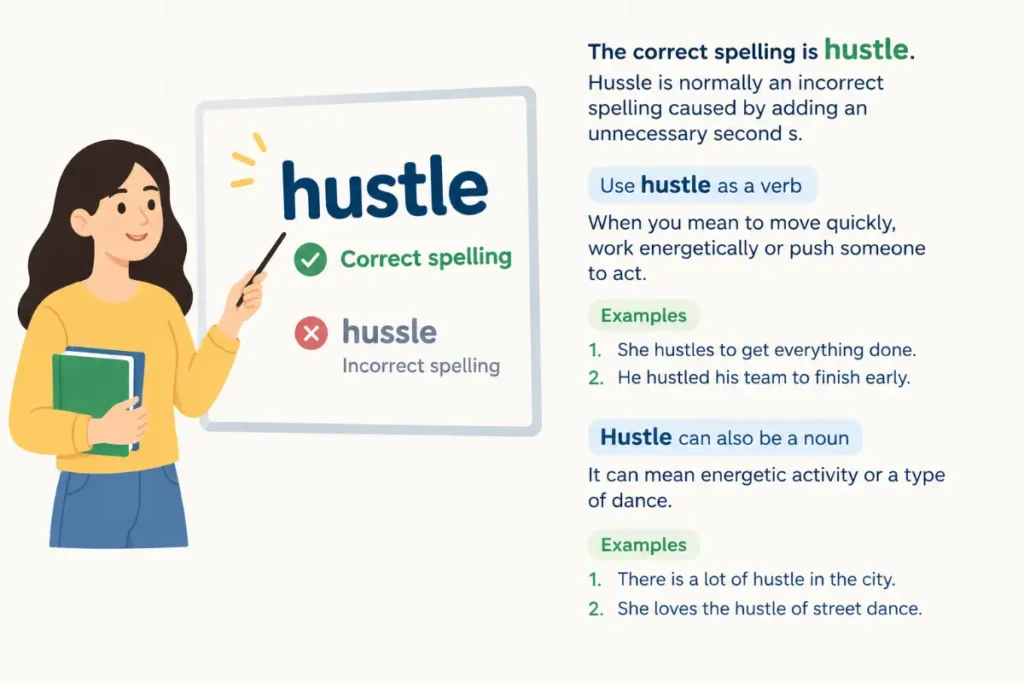
The correct spelling is hustle. Hussle is normally an incorrect spelling caused by adding an unnecessary second s. Use hustle as a verb when you mean to move quickly work energetically or push someone to act. It can also function as a noun for energetic activity or a type of dance.
Comparison Table hustle or hussle
| Correct Form | Meaning | Part of Speech | Origin | Usage Frequency | Formality | Common Contexts | Example |
|---|---|---|---|---|---|---|---|
| Hustle | To move quickly work energetically push or persuade | Verb and noun | English word with roots traced through Dutch and related Germanic forms | Very common | Neutral to informal depending on meaning | Work conversation sports business movement dance | We need to hustle if we want to catch the train. |
| Hussle | No standard meaning as the spelling of this word | Usually intended as a noun or verb | Common spelling error | Uncommon as a standard form | Not standard | Typing mistakes informal writing mistaken spellings | Hussle should normally be changed to hustle. |
Meaning and Definition
Meaning of the Incorrect Form
Hussle is generally not the standard spelling of the English word that means to move quickly work hard push someone or engage in energetic activity.
If you see hussle in a text message social media post comment school assignment or casual online discussion the writer most likely intended hustle. The extra s doesn’t create a different standard English word.
That distinction matters because repeated exposure can make an error look legitimate. If you see the same spelling often enough it can begin to feel familiar. Familiarity and correctness aren’t the same thing.
There may be isolated uses of Hussle as a name stage name username or other proper label. A proper name can follow its own spelling. That specialized use doesn’t establish hussle as the standard spelling of the ordinary English word.
For normal writing use hustle.
Meaning of the Correct Form
Hustle has a broad range of meanings. Its exact sense depends heavily on context.
As a verb it can mean to move quickly.
We need to hustle or we’ll miss the bus.
Here the word suggests urgency. The speaker wants someone to move faster.
It can also mean to work energetically or persistently.
She hustled all week to finish the project.
In this sense the word suggests effort and determination.
Another meaning involves pushing persuading or pressuring someone.
The salesperson tried to hustle me into buying the more expensive package.
This meaning can have a negative tone because it may suggest aggressive persuasion or dishonest dealing.
As a noun hustle can refer to energetic activity or hard work.
The daily hustle can be exhausting.
In modern informal American English the word can also refer to a side job or income producing activity.
His weekend hustle brings in extra money.
The word therefore has a wide semantic range. It can sound positive when it describes ambition and effort. It can sound negative when it describes manipulation or dishonest behavior. Context tells you which meaning the listener is likely to understand.
Key Differences Explained
- Spelling. Hustle has one s. Hussle usually adds an unnecessary second s.
- Meaning. Hustle has several established meanings involving movement effort persuasion activity and dance. Hussle normally has no separate standard meaning.
- Grammar. Hustle can function as both a verb and a noun.
- Pronunciation. The correct word is commonly pronounced with the first syllable receiving the main stress. The spelling does not require a doubled s.
- Formality. Hustle is standard English but some of its meanings are strongly informal. The word is perfectly acceptable when the context calls for it.
- Context. You may encounter hustle in conversations about work money sports movement dance business and everyday activity.
- Regional usage. The standard spelling remains the same across major English varieties.
- Standard usage. Hustle is the established spelling. Hussle is normally treated as an error when it is intended to represent the ordinary English word.
The key point is simple. The correct word does not need two s letters.
Which Form Is Correct?
Hustle is the correct standard spelling.
The spelling contains one s followed by t. That letter sequence is part of the established form of the word. Adding another s changes the appearance without creating a standard alternative.
Dictionary based usage supports hustle as the recognized English word. It appears as both a noun and a verb and has several established meanings. The spelling hussle does not normally represent a separate standard English entry for those meanings.
A good editor would correct hussle to hustle unless the writer clearly intends a proper name or specialized label.
There’s also a useful visual trick. Think of the middle of the word as ustl. That makes it easier to avoid inserting an extra s.
If you’re writing quickly and the spelling looks uncertain remember this simple pattern.
h u s t l e
One s is enough.
Sentence Examples
The following examples show how the standard word works in different situations.
- We need to hustle if we want to catch the train.
- She had to hustle to get everything ready before the meeting.
- He’s been hustling all week to finish the new project.
- The coach told the players to hustle back onto the field.
- I’ve got to hustle or I’ll be late for work.
- She started a small online hustle to earn extra money.
- The city was full of hustle and bustle during the festival.
- The dancer showed off her moves during the hustle.
- The salesman tried to hustle the customer into paying more.
- If you want to reach your goal you have to hustle sometimes.
Here are examples that show the common spelling mistake. These are incorrect when the intended word is the standard English term.
- We need to hussle if we’re going to catch the bus.
- She had to hussle to finish her work.
- The coach told the players to hussle back.
- He’s been hussling all weekend.
- I need to hussle if I want to get there on time.
In each example the intended standard spelling is hustle.
Common Mistakes and Misspellings
Writing Hussle Instead of Hustle
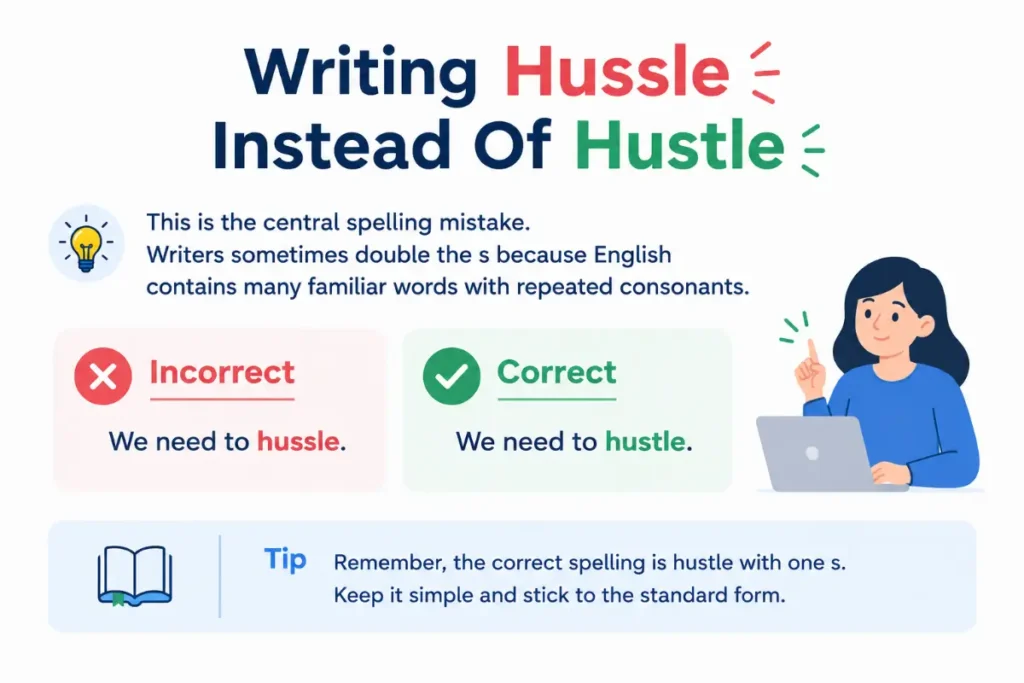
This is the central spelling mistake. Writers sometimes double the s because English contains many familiar words with repeated consonants.
Incorrect: We need to hussle.
Correct: We need to hustle.
The easiest fix is to remember that the word has one s followed directly by t.
Writing Hussling Instead of Hustling
When the word takes the ing ending the correct spelling becomes hustling.
Incorrect: He is hussling to finish the job.
Correct: He is hustling to finish the job.
The spelling remains connected to the base form. You don’t need to add another s.
Confusing Sound With Spelling
Speech can hide spelling patterns. In normal conversation the word moves quickly and the listener focuses on meaning rather than individual letters.
This is a common reason people spell words according to what they think they hear. Pronunciation is useful but it isn’t always a perfect guide to English spelling.
Assuming Double Letters Are Required
Some writers may associate the word with other common forms that contain double consonants. That visual pattern can influence typing even when the correct spelling has only one s.
This kind of spelling confusion is especially common when someone writes quickly without proofreading.
Treating Online Usage as Proof
Search engines and social platforms contain enormous amounts of informal writing. A misspelled word can appear thousands of times and still remain incorrect.
Language users often rely on frequency as an unconscious clue. In NLP terms this is a form of pattern familiarity. A word form that appears frequently can feel more acceptable even when standard dictionaries and edited writing favor another form.
Pronunciation Guide
Hustle is commonly pronounced /ˈhʌsəl/ in American English.
An easy pronunciation guide is:
HUSS uhl
The first syllable receives the main stress. The second syllable contains a relaxed vowel sound similar to the sound heard at the end of words such as little.
The word has two syllables.
hus tle
The t sound is part of the spelling even though natural speech can make the middle of the word sound smoother than the written form suggests.
A common mistake is to pronounce every letter with equal force. Native speakers usually say the word quickly and naturally rather than giving each letter a separate sound.
The pronunciation also explains part of the spelling confusion. You hear the main sounds but you don’t hear the word as a sequence of individual letters. That’s normal. English spelling and pronunciation don’t always line up perfectly.
If you’re learning the word remember both the sound and the visual pattern.
hustle
HUSS uhl
Connecting the two makes the spelling easier to retain.
You may also want to read Envolve vs involve: Correct Spelling and Usage.
Etymology and Word Origin
Hustle has an interesting history.
The word entered English from Dutch husselen meaning to shake or toss. Historical forms related to the word also carried ideas involving movement and pushing.
Over time English developed several related senses. The idea of energetic movement became connected with moving quickly and pushing or jostling. From there the word developed broader figurative uses involving energetic activity and persistent effort.
The modern word therefore has a history centered on movement and activity. That fits naturally with one of its most familiar meanings today.
The noun and verb forms developed into a wide range of everyday uses. In modern American English hustle can describe physical movement business activity determined work or a type of dance.
Its history also helps explain why the word has such a flexible personality. It can describe something as simple as hurrying across a room or something more abstract such as working hard to create an income.
The word has continued to develop through informal speech and popular culture while keeping the same basic spelling.
Regional Usage
American English
Hustle is standard in American English and is widely used in both speech and writing.
The word has several familiar American meanings. Someone can hustle to catch a bus. A person can hustle to finish work. Someone can talk about a side hustle when referring to an additional way of earning money.
The word can also describe dishonest or aggressive behavior depending on context.
Because some meanings are informal the tone matters. Hustle is common in conversation and popular culture but may need a more precise alternative in highly formal writing.
British English
British English also uses hustle as the standard spelling.
The basic meanings remain familiar. A person can hustle to move quickly or work hard. The word can also refer to energetic activity and other established meanings.
The spelling doesn’t change to hussle in British English.
Australian English
Australian English uses hustle as the standard spelling as well. The word can describe quick movement energetic effort and informal work or business activity.
There is no established Australian spelling that replaces the standard form with hussle.
Canadian English
Canadian English also follows the standard spelling hustle.
The meanings are broadly similar to those found in American and British English. Informal uses involving work and earning money may appear in everyday speech while the basic verb meaning remains easy to recognize.
Regional English doesn’t make hussle a standard alternative.
Grammar Rules and Part of Speech
Hustle can function as both a verb and a noun.
As a verb it can describe fast movement.
We need to hustle.
It can also describe working hard.
She hustled to complete the assignment.
Another verb pattern involves making someone move quickly.
The teacher hustled the students out of the room.
This construction can sound more forceful because the subject is causing another person to move.
The word can also appear with particles or prepositions depending on the intended meaning.
Hustle over here.
Hustle up.
These forms are informal and usually belong in conversational settings.
As a noun the word can describe energetic activity.
The morning hustle started before sunrise.
It can also refer to an income producing activity.
His side hustle has become a full time business.
Another established noun meaning refers to the dance called the hustle.
The grammar remains straightforward but context does much of the work. The same spelling can represent different meanings without changing its basic form.
Verb Forms
The common verb forms are:
- Hustle. I hustle to work every morning.
- Hustles. She hustles to finish on time.
- Hustled. He hustled to catch the train.
- Hustling. They are hustling to meet the deadline.
Notice that the spelling doesn’t require a doubled s in any of these forms.
Punctuation
Hustle doesn’t have any special punctuation requirement. Punctuation depends on the sentence around it.
If the word begins an ordinary sentence you simply capitalize it.
Hustle if you want to catch the bus.
In dialogue punctuation follows the normal rules for the sentence rather than the word itself.
Real Life Usage Examples
Daily Conversation
The word is especially natural when talking about time and movement.
We better hustle or we’ll be late.
Come on. Hustle up.
Both sentences sound casual and energetic. The word adds urgency without needing a long explanation.
Email and Workplace Communication
Hustle can appear in workplace communication but tone matters.
We’ll need to hustle to finish the project by Friday.
The team has been hustling to prepare for the launch.
These sentences are understandable but somewhat informal. In a very formal business document you might choose words such as work quickly work efficiently or accelerate the process instead.
Academic Writing
Academic writing usually favors precise neutral language. Hustle can still appear if the subject itself involves informal work culture popular language or social behavior.
The study examines how young workers describe their side hustle activities.
The phrase is appropriate here because it refers to a recognizable concept rather than using the word simply as a casual synonym for work hard.
News and Journalism
Journalists may use the word when reporting on business culture sports entertainment or public behavior.
The players hustled back to defend after losing possession.
Many workers now describe freelance projects as a side hustle.
The meaning becomes clear from the surrounding context.
Literature and Storytelling
Authors can use hustle to create movement and energy.
He hustled down the narrow street before the doors closed.
The market was filled with the noise and hustle of early morning.
The word works well in storytelling because it gives a scene a sense of motion. It can make a quiet description feel more active without adding many extra words.
Related and Confused Terms
Hurry
Hurry means to move or act quickly. It is often the closest simple replacement when hustle refers to speed.
Hurry up because the bus is leaving.
The difference is mostly in tone. Hustle can sound more energetic or forceful.
Rush
Rush suggests moving with great speed or urgency.
I had to rush to the airport.
Rush often emphasizes pressure while hustle can suggest energetic effort.
Work Hard
This phrase overlaps with one meaning of hustle.
She works hard every day.
Hustle can sound more informal and energetic than work hard.
Grind
Grind is an informal word for sustained hard work. It often appears in conversations about career goals money and personal ambition.
He’s been grinding all year.
The word can sound more intense and modern than the neutral phrase work hard.
Strive
Strive means to make a strong effort to achieve something.
She strives to improve every day.
This word is more formal than hustle and often fits academic or professional writing better.
Push
Push can mean to make a strong effort or encourage something to happen.
We need to push harder this week.
It can overlap with hustle but has a broader range of meanings.
Side Job
A side job is work done in addition to a main job. It can overlap with the informal expression side hustle.
She has a side job on weekends.
Side job is usually more neutral and direct.
Scam
Scam describes a dishonest scheme designed to deceive someone for money or another benefit.
The word hustle can sometimes refer to dishonest activity but it doesn’t always mean scam. Context matters greatly.
These related terms show why replacing hustle with any single synonym isn’t always a perfect solution. The intended meaning determines the best choice.
When Does Hustle Sound Positive?
Hustle often has a positive meaning when it describes effort determination and ambition.
Someone might say:
She’s hustling to build her business.
The sentence suggests energy and commitment. The speaker probably respects the person’s effort.
The word can also describe a person who refuses to sit around waiting for opportunities.
He has a real hustle mentality.
Here the word suggests drive and initiative.
Modern informal American speech often uses hustle in discussions about entrepreneurship freelance work creative careers and earning additional income. In these settings the word can have an upbeat tone.
Still context matters. The same word can sound negative when it describes pressure manipulation or dishonest behavior.
He tried to hustle me out of my money.
Now the speaker is accusing someone of taking advantage of them.
That range is one reason writers should consider the surrounding words rather than assuming hustle always has a positive meaning.
When Does Hustle Sound Negative?
The word can have a negative sense when it refers to dishonest dealing aggressive sales behavior or taking advantage of someone.
For example:
The street vendor was hustling tourists.
Depending on context this could mean actively selling goods or attempting to deceive people.
Another example is:
I think that guy is trying to hustle us.
Here the speaker suspects dishonesty.
This meaning has a long connection with the idea of pushing or manipulating someone. Modern usage can move between harmless persuasion and serious dishonesty.
If you want to describe hard work without any possible negative suggestion use clearer terms such as work hard make an effort or put in the effort.
That small change can make your writing more precise.
Hustle in Modern American Expressions
Hustle appears in several familiar expressions.
Hustle And Bustle
Hustle and bustle describes noisy energetic activity.
The city was full of hustle and bustle.
The phrase often creates an image of crowds movement noise and busy streets.
Side Hustle
A side hustle is an additional income producing activity alongside a main job or career.
Her photography business started as a side hustle.
This expression has become common in conversations about freelance work entrepreneurship and extra income.
Hustle Culture
Hustle culture refers to a social attitude that strongly emphasizes constant work productivity and ambition.
The article discusses the pressure created by hustle culture.
The phrase can be neutral or critical depending on the writer’s purpose.
Hustle Up
Hustle up means move faster or hurry.
Hustle up. We’re already late.
This expression is casual and is best suited to speech or informal writing.
These expressions show how productive a single word can be. It can describe movement physical effort economic activity and broader ideas about work.
Expert Editor Insight
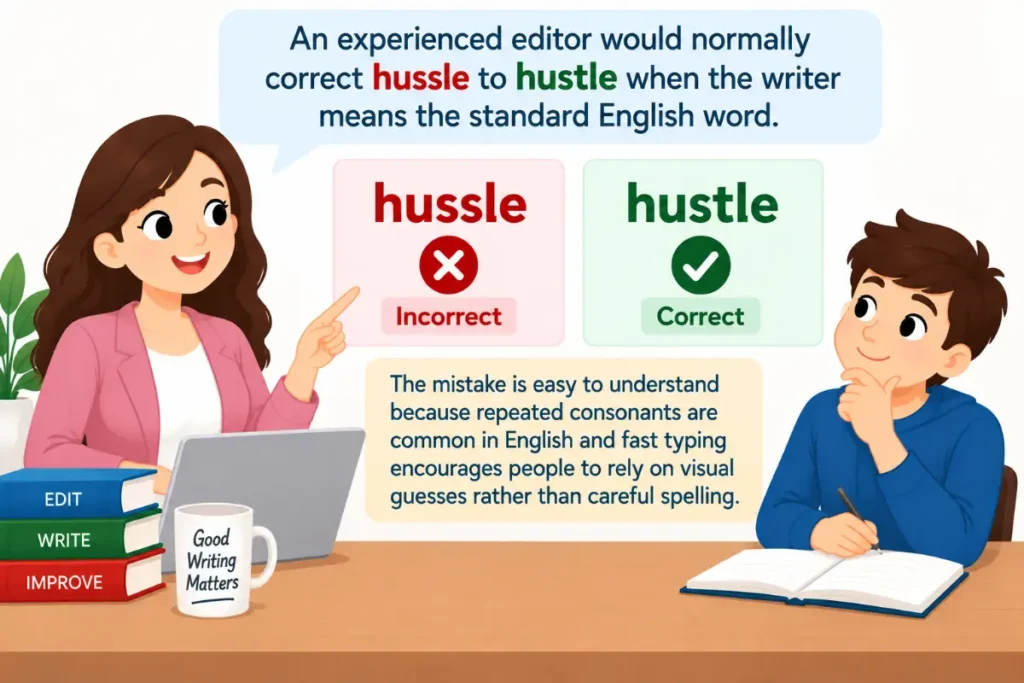
An experienced editor would normally correct hussle to hustle when the writer means the standard English word. The mistake is easy to understand because repeated consonants are common in English and fast typing encourages people to rely on visual guesses rather than careful spelling. Professional editing also considers meaning because hustle can be positive or negative depending on context. Spelling tools will generally recognize hustle as the standard form and may flag hussle as an error. A useful editing trick is to remember the middle sequence ustl. Seeing that pattern in your mind makes the correct spelling much easier to reproduce.
Need another quick comparison? Read reinforce vs reenforce Correct Spelling Meaning and Usage.
Conclusion
Hustle or hussle has a clear answer. Hustle is the correct standard spelling while hussle is normally a spelling mistake. The standard form uses one s followed by t and can function as both a verb and a noun.
The word has several meanings. It can describe moving quickly working hard pushing someone to act energetic activity or a dance. Modern American English also uses it in expressions such as side hustle and hustle culture. Context determines the tone because the word can suggest ambition in one sentence and dishonest behavior in another.
The easiest memory trick is to remember the middle of the word as ustl. Write h u s t l e and resist the urge to add another s. That small visual check is enough to prevent one of the most common spelling mistakes involving this useful everyday word.
FAQs
Is hussle a real word?
Hussle is generally not the standard spelling of the English word hustle. In ordinary writing it is usually a spelling mistake caused by adding an extra s. You may encounter Hussle as part of a personal name stage name username or other proper label. Those special cases don’t make the spelling standard for the ordinary English vocabulary item.
What does hustle mean?
Hustle has several meanings depending on context. It can mean to move quickly to work with energy or to push someone to act. As a noun it can describe energetic activity an income producing activity or a dance. The word can have a positive sense when discussing ambition and effort or a negative sense when referring to manipulation or dishonest behavior.
Which spelling is correct?
Hustle is the standard spelling. The form hussle normally contains an unnecessary second s and should be corrected in standard English writing. The correct sequence is h u s t l e. This spelling remains the same across American British Canadian and Australian English. If you’re referring to a proper name that intentionally uses a different spelling the name itself may follow its own convention.
How do you pronounce hustle?
Hustle is commonly pronounced /ˈhʌsəl/ in American English. An easy approximation is HUSS uhl. The first syllable receives the main stress and the second syllable has a relaxed vowel sound. The spelling contains one s followed by t. You don’t pronounce every written letter separately. Natural speech blends the sounds together which can make the spelling less obvious to learners.
Can hustle be used in formal writing?
Yes but context matters. Hustle is a standard English word and can appear in formal writing when its meaning is relevant. However some modern uses such as side hustle are informal. In highly formal documents you may prefer terms such as additional employment or independent work. The best choice depends on your audience and the specific meaning you need to communicate.
What is a synonym for hustle?
Possible synonyms include hurry rush work strive push and bustle. The best alternative depends on the meaning. Hurry and rush work well when the word refers to speed. Strive fits effort toward a goal. Work hard is clearer when discussing effort. Bustle describes busy activity. No single synonym covers every sense of the word.
Why do people spell hustle incorrectly?
People often add a second s because English contains many words with doubled consonants. Pronunciation also contributes because normal speech doesn’t make individual letters obvious. Fast typing can make the problem worse. Another factor is visual memory. Once someone has repeatedly seen an incorrect spelling online it may begin to look familiar. Proofreading against a trusted dictionary form helps prevent this kind of error.
Is hustle an American English word?
Hustle is used in American English and has several well established meanings. It also appears in British Canadian and Australian English so it isn’t limited to the United States. American usage has especially popularized informal expressions involving energetic work and additional income. The spelling remains hustle across these major English varieties rather than changing to hussle.