
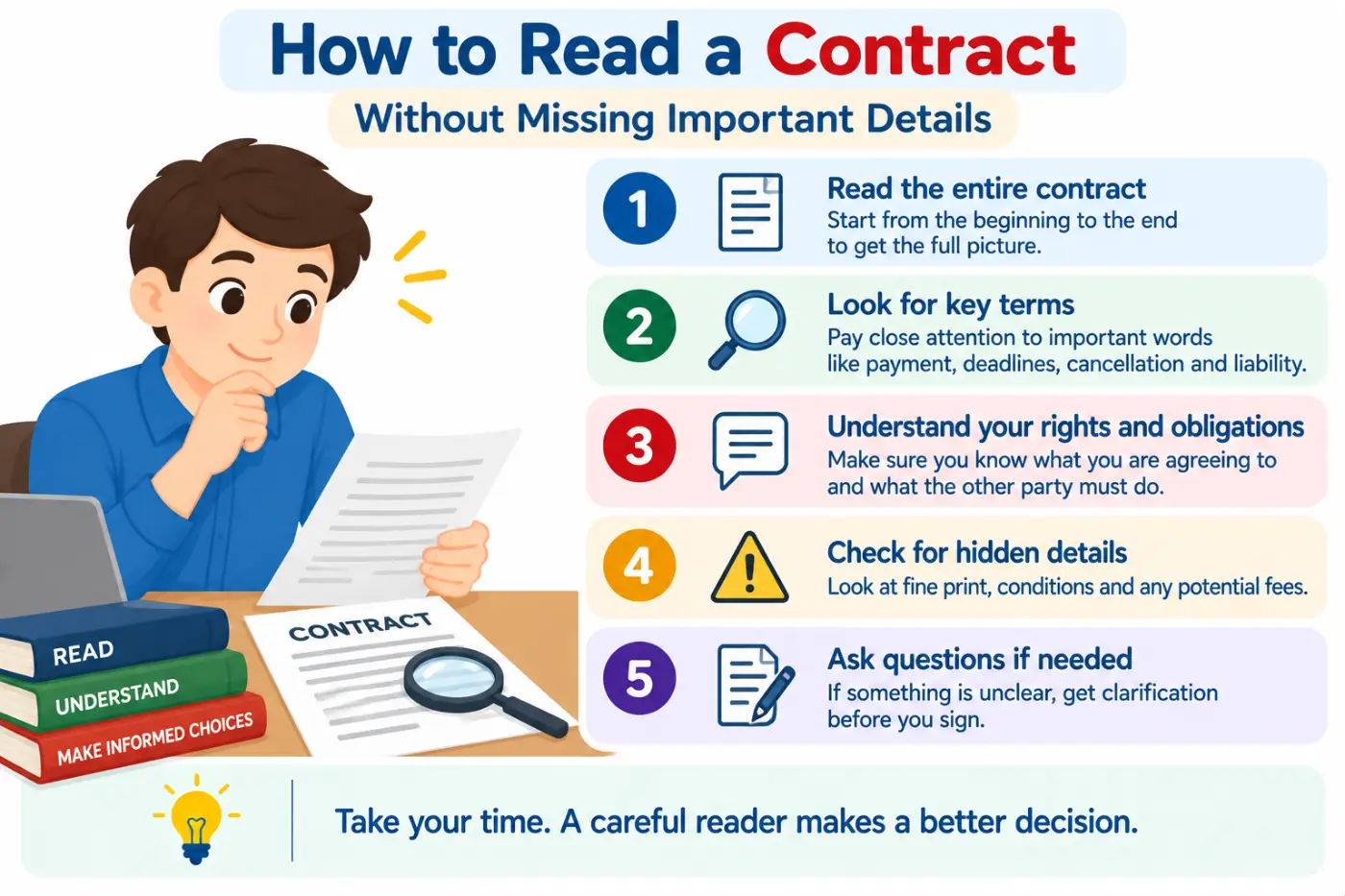
Learning how to read a contract can save you from agreeing to something you don’t fully understand. The safest approach is to read the entire document slowly before signing it and pay special attention to what you must do what the other party must do what happens if something goes wrong and how either side can end the agreement. Never assume that a familiar looking clause is harmless simply because it appears in a standard form.
Contracts can feel intimidating because they often combine ordinary business language with legal terms long sentences defined words and detailed conditions. A document may look simple at first and then contain an important obligation buried several pages later. That’s where careful reading matters.
A good review doesn’t require you to memorize legal vocabulary. You need a method. Start with the parties and purpose. Then examine money dates responsibilities deadlines renewal terms termination rights liability confidentiality dispute procedures and other provisions that could affect you. This guide walks through that process in plain English so you can approach your next agreement with more confidence and know when a lawyer should take a closer look.
Many readers also check Analyzing or Analysing: Which Is Correct? 2026.
Quick Definition
To read a contract properly means to examine the entire agreement and understand the rights duties costs deadlines restrictions and consequences it creates. Start with the basic deal and then review each important clause in context. Don’t sign until you understand your obligations and have addressed terms that could create serious financial or legal risk.
Quick Answer
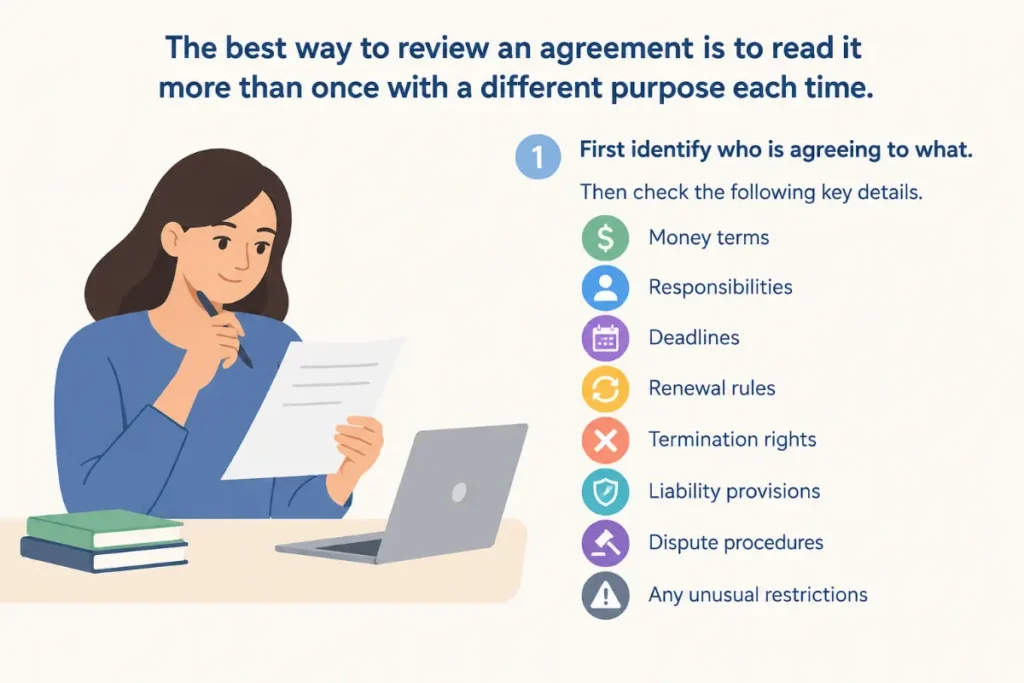
The best way to review an agreement is to read it more than once with a different purpose each time. First identify who is agreeing to what. Then check the money terms responsibilities deadlines renewal rules termination rights liability provisions dispute procedures and any unusual restrictions.
Pay particular attention to words such as must shall may only unless except and subject to. These small words can change the effect of an entire clause.
If a provision could create substantial financial exposure affect your legal rights transfer ownership or impose an obligation you don’t understand ask a qualified attorney for advice before signing.
Why Contracts Deserve More Than a Quick Read
A contract is more than a document that records a handshake. Once properly formed it can create enforceable obligations. The exact legal effect depends on the agreement and the law that applies to it but the basic practical lesson is simple. Don’t sign something merely because the other party says it is standard.
Many people make the same mistake. They read the first page carefully and then skim the rest. They look at the payment amount and signing date but skip the sections dealing with termination liability intellectual property confidentiality automatic renewal or dispute resolution.
That approach can create unpleasant surprises.
Imagine that you sign a service agreement because the monthly fee looks reasonable. Several pages later the agreement says the contract automatically renews for another year unless you give notice within a particular period. Another clause limits the provider’s responsibility for losses. Suddenly the deal looks different.
The contract didn’t change. Your understanding of it did.
A careful review gives you a chance to identify those issues before they become problems.
Start With the Big Picture
Before studying individual clauses take a few minutes to understand the overall deal.
Ask yourself four basic questions.
- Who are the parties?
- What is each party agreeing to provide?
- What does each party receive in return?
- What happens if one side doesn’t perform?
These questions create a mental map of the document.
Look for the names and legal identities of the parties. A business might operate under a brand name while the actual contracting party is a corporation limited liability company partnership or individual. Make sure the document identifies the correct entity.
Next identify the purpose of the agreement. Is it for employment services consulting software licensing real estate construction purchasing financing or something else?
Then find the main exchange. One party provides money goods services access rights or another benefit. The other party provides something in return.
Once you understand that basic exchange the detailed clauses become easier to interpret.
Identify Every Party and Their Responsibilities
A contract should make clear who has obligations.
Don’t assume that everyone mentioned in the document is necessarily a contracting party. Some people or organizations may appear only as references.
Look for language describing duties.
One party may need to deliver a product by a certain date. Another may need to pay within a particular period. A customer may need to provide information before work can begin. A contractor may need to meet specified standards.
Write down the major responsibilities in plain English.
For example a clause might say that a client shall provide access to certain records within five business days of a written request.
Your plain English note could be:
The client must provide the records within five business days after receiving a written request.
That exercise is surprisingly useful. If you can’t explain a major obligation in ordinary language you probably don’t understand it well enough yet.
Find the Definitions Section
Many contracts give special meanings to ordinary words.
A defined term might be capitalized. You may see something like Services Client Confidential Information Business Day or Effective Date used throughout the document.
The definition can be much narrower or broader than the everyday meaning.
For example a contract may define Business Day as a day other than Saturday Sunday or a specified holiday. That definition could affect a deadline.
A contract might define Confidential Information broadly enough to cover business records customer information pricing information technical materials and communications.
Never skip the definitions.
A clause that seems harmless can take on a very different meaning once you apply the contract’s special definitions.
Create a short list of important defined terms. Then check them whenever they appear later in the agreement.
Check the Effective Date and Contract Term
The dates in an agreement deserve close attention.
Find the effective date first. This may be the date the agreement becomes operative. It may be different from the date the parties sign it.
Then look for the contract term.
A contract could last for six months one year five years or another specified period. Some agreements continue until terminated.
Pay attention to renewal provisions too.
An agreement might automatically renew for another period unless one party gives notice within a specified window. Missing that window could extend the relationship.
For example an agreement might require thirty days notice before the end of the current term.
That creates a practical deadline. Put it on your calendar.
Dates are easy to overlook because they often appear in several sections. Check the main term clause termination provisions renewal language and any schedules or exhibits that contain separate deadlines.
Understand the Money Terms
Money deserves careful attention because the headline price rarely tells the whole story.
Start with the basic amount.
Then ask how and when payment occurs.
Look for these details.
- Payment amount.
- Payment schedule.
- Deposits.
- Taxes.
- Late charges.
- Interest.
- Reimbursement of expenses.
- Additional fees.
- Price increases.
- Refund rules.
- Credits.
- Payment disputes.
A contract may state a low base fee while allowing additional charges under certain circumstances.
Suppose a service agreement says the monthly fee is one thousand dollars but allows additional charges for work outside the defined scope. You need to understand exactly what counts as outside that scope.
Also look for payment triggers. Does payment become due after an invoice? After delivery? At the beginning of each month? After acceptance of the work?
A single phrase can affect cash flow significantly.
If the agreement involves a large purchase or long term financial commitment consider the total expected cost rather than focusing only on the first payment.
Examine What You Must Do
One of the most useful ways to review an agreement is to create an obligation checklist.
For every major responsibility ask three questions.
What must I do?
When must I do it?
What happens if I don’t?
The third question is often forgotten.
A contract may require you to provide notice within a specific period. It may require you to maintain insurance. It may restrict how you use certain materials. It may require you to meet performance standards.
Missing an obligation could trigger fees termination rights or other consequences.
Pay close attention to absolute language.
Words such as must and shall can signal mandatory obligations depending on the wording and governing law. Words such as may can indicate permission or discretion.
The surrounding clause matters. Never decide the legal effect of one word without reading the complete provision.
Examine What the Other Party Must Do
Contract review isn’t only about your obligations.
You also need to know what the other party promises.
Write those promises in plain language.
For example:
The supplier must deliver the equipment by June 30.
The customer must pay within fifteen days.
The contractor must correct qualifying defects.
The landlord must provide the agreed premises.
The employer must pay the stated compensation.
Then ask what happens if the other party fails to perform.
Some agreements provide a cure period. This gives the party in breach a specified amount of time to fix the problem.
Others may allow immediate termination or another remedy.
A balanced review compares the consequences on both sides. If your failure triggers strict consequences while the other party’s failure creates little or no remedy for you that difference deserves attention.
Pay Close Attention to Termination
Termination clauses can be among the most important parts of a contract.
Find out how the agreement can end.
There may be several routes.
- Expiration of the contract term.
- Termination for convenience.
- Termination for breach.
- Termination after failure to cure a breach.
- Termination after insolvency or another specified event.
- Mutual termination by agreement.
Then look at notice requirements.
A contract might allow termination only by written notice. It may require thirty sixty or ninety days notice.
Check what happens after termination.
Some obligations may continue. Confidentiality may survive. Payment obligations may remain. Intellectual property provisions may continue. Dispute provisions may remain effective.
The phrase survival of obligations can be particularly important.
Ending the business relationship doesn’t necessarily mean every clause disappears immediately.
Look for Automatic Renewal
Automatic renewal deserves its own check even if it appears inside another section.
An agreement may renew unless one party gives notice before a particular deadline.
This can catch people off guard.
Suppose a one year agreement renews for another year unless notice is given at least sixty days before expiration. If you remember only the one year term you might assume the relationship ends automatically.
It may not.
Find the renewal period. Find the notice period. Find the method for giving notice.
Then record the relevant date somewhere you’ll actually see it.
If the agreement allows price changes at renewal also check how and when those increases can occur.
Review Liability and Indemnification
Liability provisions can have major financial consequences.
They determine how responsibility for certain losses may be allocated between the parties.
Look for phrases involving liability limitations damages exclusions indemnification defense obligations and related concepts.
Indemnification can be especially important. In simple terms an indemnification clause may require one party to cover certain losses claims costs or liabilities involving the other party.
The actual scope depends heavily on the wording.
Ask:
- What types of claims are covered?
- Who is protected?
- What losses are covered?
- Are legal fees included?
- Are there exceptions?
- Is there a financial cap?
- Are certain types of damages excluded?
- Does the obligation apply to third party claims?
- Who controls the defense?
- Does the obligation continue after termination?
This is an area where professional legal advice can be especially valuable. A few lines can create exposure that isn’t obvious from the rest of the agreement.
Understand Liability Caps
Some contracts limit the amount one party can recover from the other.
A liability cap might be tied to fees paid under the agreement or another amount.
For example a clause could limit certain claims to the amount paid during a specified period.
But don’t stop at the cap.
Check the exceptions.
Some agreements exclude certain claims from the limitation. The exceptions may involve confidentiality intellectual property fraud intentional misconduct or other matters.
The interaction between the liability cap and indemnification provisions also matters.
Read these clauses together rather than in isolation.
Check for Confidentiality Duties
Confidentiality clauses are common in employment agreements business contracts consulting arrangements and technology deals.
The basic idea is that certain information must be protected.
But the details matter.
Look for the definition of confidential information. Then check what the receiving party can do with that information.
You may be required to use it only for a specified purpose. You may need to restrict access. You may need to return or destroy materials when the relationship ends.
Also check the exceptions.
Some agreements exclude information that is already public was independently developed was already known or becomes public without a breach.
Pay attention to the duration.
A confidentiality obligation might last for a defined period or continue after the contract ends.
Review Intellectual Property Rights
Intellectual property clauses can determine who owns work products inventions designs software documents data or other materials.
This matters greatly in consulting employment creative services software development and research agreements.
Ask what existed before the agreement.
This is often called preexisting or background intellectual property.
Then ask what is created during the relationship.
The contract may assign ownership to one party or grant a license instead.
Those are not the same thing.
Ownership generally involves rights to the work itself. A license grants specified permission to use something while ownership remains elsewhere.
Read carefully for rights involving copying modifying distributing displaying selling sublicensing or commercial use.
If you create valuable work as part of a contract don’t assume ownership based only on who paid for it. Read the actual intellectual property language.
Examine Restrictions and Limitations
Some contracts limit what you can do during or after the relationship.
These restrictions may involve competition solicitation use of information hiring employees contacting customers assignment or other activities.
The enforceability of these provisions can vary greatly depending on the wording and applicable law.
That’s why you shouldn’t rely on a general internet explanation to decide that a restriction is valid or invalid.
Instead identify the restriction and understand exactly what it says.
Ask:
What conduct is restricted?
How long does the restriction last?
Where does it apply?
Who does it cover?
What exceptions exist?
What happens if it is violated?
If a restriction could significantly affect your work business or future opportunities consider having an attorney review it.
Many readers also check In house KPIs Explained With Examples and Best Practices.
Check Assignment Rights
Assignment provisions address the transfer of contractual rights or obligations to another party.
A contract might prohibit assignment without consent. It might allow assignment to an affiliated company. It might permit transfer after a merger or sale.
This can matter more than it first appears.
Imagine that you enter into an agreement with a company because you trust that company. Later the business is sold.
If the contract contains an assignment provision you may need to understand what happens to your relationship after the transaction.
Look at both sides of the clause. A provision that restricts your ability to transfer the agreement may not impose the same restriction on the other party.
Review Dispute Resolution
If something goes wrong the dispute clause tells you how the parties are expected to handle it.
Look for requirements involving negotiation mediation arbitration or court proceedings.
Check where disputes must be handled.
A contract may specify a particular state or country. It may name a particular court or arbitration location.
These provisions can affect the cost and practical difficulty of resolving a disagreement.
Also look for attorney fee provisions.
Some contracts state that the winning party may recover certain legal fees. Others impose different rules.
Don’t assume that a dispute clause is boilerplate and therefore unimportant. It can shape what happens after a serious disagreement.
Identify the Governing Law
Contracts often contain a governing law provision.
This clause identifies the law that will generally be used to interpret the agreement.
For example an agreement might specify that the laws of a particular state govern the contract.
That doesn’t mean every legal issue is automatically settled by that clause. Other rules can apply depending on the circumstances and the type of dispute.
Still it’s an important provision because contract interpretation can depend heavily on applicable law.
If you are signing an agreement involving different states or countries pay particular attention to this section.
Read The Entire Agreement Clause
Many contracts include an entire agreement or integration provision.
In plain terms this type of clause often says that the written agreement represents the parties’ complete agreement concerning the subject matter and may replace earlier discussions or understandings.
This matters because people often rely on conversations before signing.
Someone might tell you that a service will include a particular feature or that a fee won’t apply. If the final contract says something different you may face a dispute about what actually controls.
That’s why important promises should be reflected accurately in the written agreement.
Don’t assume a verbal assurance will automatically override clear written language.
Look for Attachments and Exhibits
The main agreement may not contain the entire deal.
Contracts often refer to schedules exhibits statements of work policies order forms specifications or other attachments.
Those documents may contain important terms.
A statement of work could define the actual services.
A pricing schedule could establish fees.
A technical specification could establish performance requirements.
An order form could identify the product quantity or delivery terms.
Read every document incorporated into the agreement.
If the contract says an attachment is part of the agreement treat it as part of your review.
Watch for Conflicting Terms
Sometimes different sections appear to point in different directions.
One clause might set a deadline while another provides an exception.
A schedule might contain different pricing from the main agreement.
An order form might contain terms that conflict with standard terms.
Don’t simply choose the interpretation that seems most favorable.
Look for language explaining which provision controls.
Contracts may contain an order of precedence clause stating which document wins if there is a conflict.
If you find an unresolved contradiction ask the other party for clarification and consider legal advice before signing.
Understand Exceptions and Conditions
Small words can carry significant weight.
Pay attention to terms such as unless except subject to provided that only if and except as otherwise stated.
These phrases often introduce conditions or exceptions.
Consider this basic difference.
The supplier must deliver the product within ten days.
The supplier must deliver the product within ten days unless delayed by a specified event.
The second sentence creates an exception.
Never read only the first part of a clause. Continue through the conditions and exceptions attached to it.
This is one reason contract reading requires patience.
Create a Plain English Summary
After reading the agreement create your own short summary.
You don’t need to rewrite every clause.
Capture the practical points.
- Parties.
- Purpose.
- Price.
- Payment dates.
- Main responsibilities.
- Contract term.
- Renewal.
- Termination.
- Liability.
- Confidentiality.
- Intellectual property.
- Dispute process.
- Governing law.
- Important deadlines.
- Unusual restrictions.
If your summary differs from what you thought you were agreeing to you’ve found a reason to pause.
This technique also exposes gaps in your understanding. If you can’t summarize a clause clearly it deserves another reading.
A Simple Three Pass Review Method
A practical review can happen in three passes.
First Pass For The Deal
Read the document from beginning to end without trying to analyze every word.
Focus on the basic arrangement.
Who are the parties?
What is being exchanged?
How long does the relationship last?
What does each side expect?
Mark anything that immediately seems unclear.
Second Pass For Risk
Read it again specifically looking for obligations consequences and restrictions.
Focus on payment termination liability indemnification intellectual property confidentiality renewal dispute resolution and unusual conditions.
This is where the serious issues often become visible.
Third Pass For Details
Now check definitions dates cross references attachments and wording.
Make sure the names are correct. Check amounts. Check deadlines. Check notice methods.
Look for blanks and inconsistent information.
This three pass method is usually more effective than trying to understand every sentence perfectly on your first reading.
Common Contract Reading Mistakes
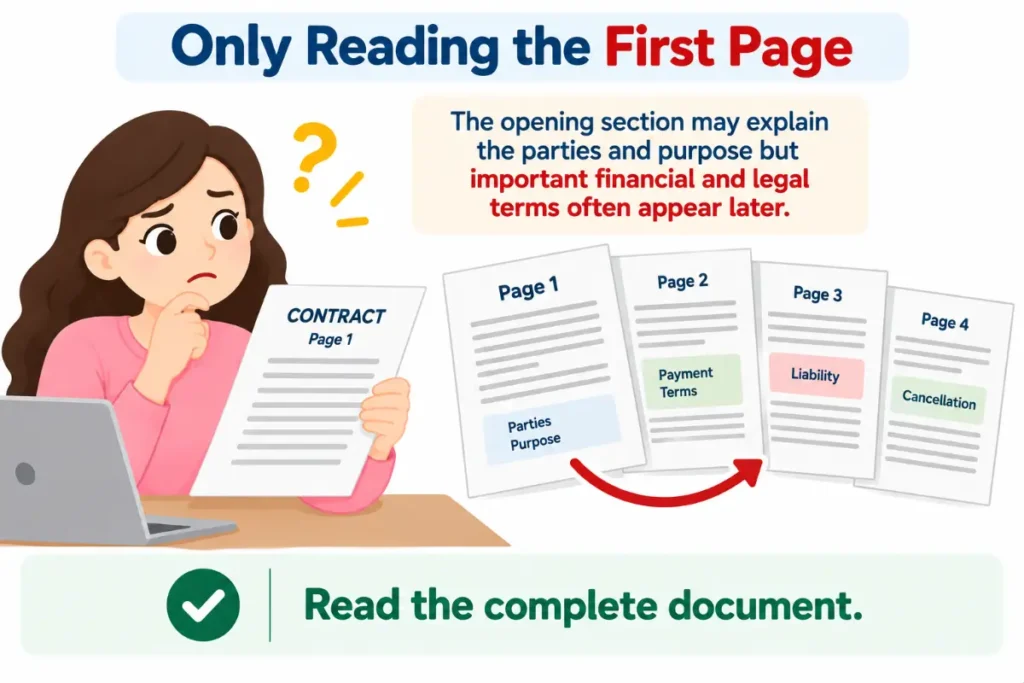
Only Reading the First Page
The opening section may explain the parties and purpose but important financial and legal terms often appear later.
Read the complete document.
Assuming Standard Means Safe
A clause can be common and still be unfavorable for your situation.
Standard doesn’t automatically mean fair or appropriate.
Ignoring Defined Terms
A familiar word may have a special contractual meaning.
Always check definitions.
Skipping Attachments
A schedule or exhibit can contain essential terms.
Read anything incorporated into the agreement.
Focusing Only on Price
The cheapest contract isn’t necessarily the least expensive arrangement.
Fees termination costs renewal obligations liability exposure and restrictions can change the overall value.
How to Handle Legal Language
You don’t need to understand every legal phrase immediately.
Start by translating the clause into ordinary English.
Ask who must do something.
Ask what they must do.
Ask when they must do it.
Ask what conditions apply.
Ask what happens if they don’t.
Then look at related provisions.
Contract clauses often work together. A payment obligation may connect to an invoice definition. A termination right may connect to a cure period. A liability limitation may connect to an indemnification clause.
That means isolated reading can produce the wrong impression.
If a sentence is unusually complex don’t guess.
Mark it and investigate the meaning or ask a qualified attorney.
When You Should Ask a Lawyer
Not every routine agreement requires a lawyer. Some contracts are relatively straightforward and low risk.
Professional legal advice becomes especially valuable when the agreement involves significant money complicated business arrangements valuable intellectual property substantial liability restrictive obligations real estate employment issues or disputes.
Consider legal review before signing if:
- You don’t understand a major obligation.
- The contract could expose you to substantial financial loss.
- You are giving up an important legal right.
- The agreement contains unusual restrictions.
- You are agreeing to indemnify another party.
- You are transferring intellectual property.
- The contract involves multiple countries or complex jurisdiction issues.
- The other party refuses to explain a provision that concerns you.
- The agreement is connected to an existing dispute.
- The consequences of getting it wrong would be difficult to reverse.
A lawyer can assess legal meaning and enforceability in a way a general explanation cannot.
Questions to Ask Before Signing
Before you sign put the document aside for a moment and ask yourself these questions.
- Do I know exactly who the parties are?
- Do I understand what I am receiving?
- Do I understand everything I must provide?
- Do I know how much I will pay or receive?
- Do I understand every important deadline?
- Does the contract renew automatically?
- How can I end it?
- What happens if the other party breaches it?
- What happens if I breach it?
- Am I accepting liability for someone else’s conduct?
- Who owns the work or intellectual property?
- Are there confidentiality obligations?
- Are there restrictions on what I can do?
- Where will disputes be handled?
- What law governs the agreement?
- Are there attachments I haven’t read?
- Does the written document match what I was promised?
- Is anything important missing?
If you can answer these questions clearly you’ll have a much stronger understanding of the agreement.
Real Life Contract Review Examples
Employment Agreement
Suppose you receive an employment agreement.
You might focus first on salary.
But the document could also contain terms about bonuses benefits confidentiality intellectual property termination notice dispute procedures and post employment restrictions.
Your review should cover the entire relationship rather than compensation alone.
Freelance Agreement
A freelancer should examine the scope of work payment schedule revisions deadlines ownership of work confidentiality expenses termination and client responsibilities.
A vague scope can create endless revision requests.
A strong review identifies exactly what the freelancer is expected to deliver.
Service Agreement
A service customer should examine what the provider promises and how performance is measured.
Look for service standards response times fees renewal terms cancellation rights liability limits and remedies.
The goal is to understand what you actually receive for the price.
Lease Agreement
A lease can contain rent terms deposits maintenance duties utilities renewal rules notice requirements insurance and restrictions on use.
Read the provisions that determine your financial and practical responsibilities.
Business Partnership Agreement
A partnership agreement can affect ownership decision making contributions distributions management responsibilities and exit rights.
These agreements can become particularly important when partners disagree.
For a significant business arrangement professional legal review can be well worth the cost.
Related Terms You Should Understand
Contract
A contract is an agreement that may create legally enforceable obligations when the applicable legal requirements are met.
Clause
A clause is a specific provision within a contract.
Obligation
An obligation is something a party is required to do under the agreement.
Breach
A breach generally occurs when a party fails to perform a contractual obligation as required.
Termination
Termination refers to ending the contractual relationship under the terms of the agreement or applicable law.
Indemnification
Indemnification generally concerns an obligation to cover certain losses claims or liabilities. The exact scope depends on the contract and applicable law.
Liability
Liability concerns legal responsibility for certain acts losses claims or obligations.
Amendment
An amendment changes the terms of an existing agreement.
Understanding these terms makes contract language easier to follow because they appear frequently across different types of agreements.
Expert Editor Insight
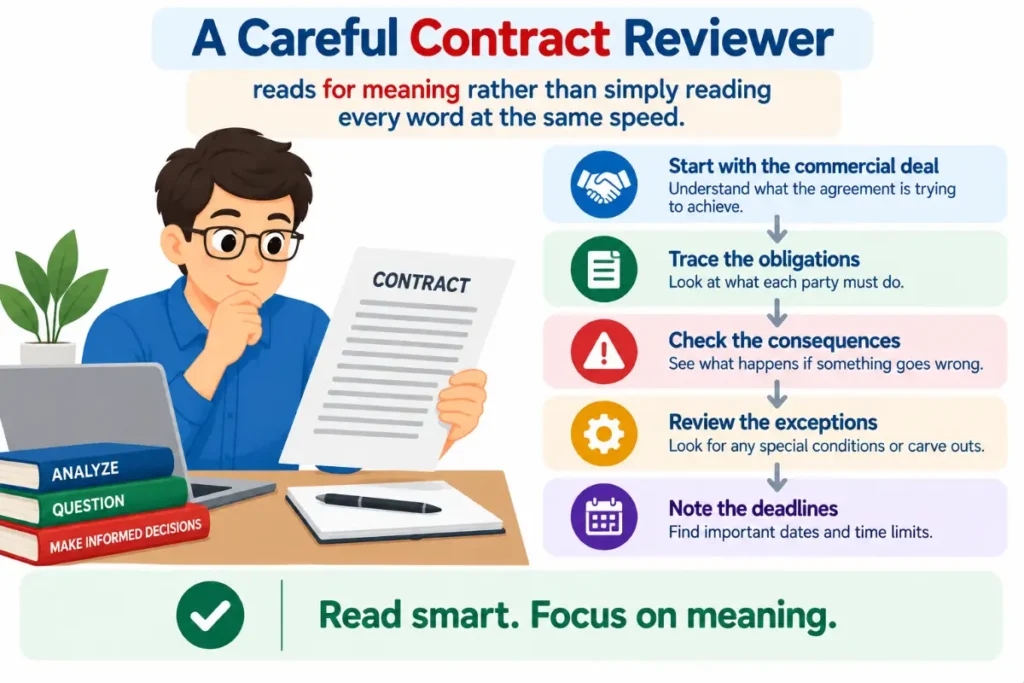
A careful contract reviewer reads for meaning rather than simply reading every word at the same speed. Start with the commercial deal then trace the obligations consequences exceptions and deadlines through the document. Professional editors and careful reviewers also watch for undefined terms inconsistent dates conflicting provisions missing attachments and language that changes an obligation through a small exception. My strongest practical tip is to write a plain English sentence beside every major obligation. If you can’t explain what the clause requires and what happens if it isn’t followed you haven’t finished reviewing it.
Still confused? Compare Thank You For Your Concern Meaning And Usage.
Conclusion
Learning how to read a contract starts with one simple habit. Don’t treat the document as something to skim before signing. Read it from beginning to end and identify the parties the purpose the money terms the responsibilities deadlines renewal rules termination rights and major risk provisions. Then translate the important clauses into plain English so you can see exactly what you’re agreeing to.
The details often matter more than the headline deal. A reasonable price can be paired with an automatic renewal. A simple service arrangement can contain broad liability language. A short agreement can transfer valuable intellectual property. Check definitions attachments exceptions and cross references because they can change the meaning of provisions elsewhere in the document.
Your best practical rule is to slow down when a clause could create serious consequences. Mark unclear language and ask questions before signing. If the agreement involves substantial money significant rights or complex legal issues have a qualified attorney review it. A few careful minutes now can prevent a much bigger problem later.
FAQs
What should I look for first in a contract?
Start with the parties purpose price main responsibilities term and termination rules. These sections tell you the basic shape of the agreement. After that examine liability confidentiality intellectual property renewal dispute resolution and other provisions that could materially affect you. Also check definitions attachments and schedules because they may contain terms that change how the main clauses operate.
How long should it take to review a contract?
There is no single correct amount of time. A short straightforward agreement may take only a few minutes to understand while a complex business contract may require several careful readings. The risk and complexity of the agreement matter more than its page count. Never rush simply because the other party wants a quick signature.
What words should I pay attention to?
Pay close attention to words such as must shall may only unless except subject to and provided that. These words can establish duties permissions conditions or exceptions. Also watch defined terms that appear throughout the agreement. Never interpret an important word in isolation because the surrounding language can change its practical meaning.
What is the most important part of a contract?
There usually isn’t one universally most important section. The answer depends on the type of agreement and your circumstances. Payment obligations termination liability indemnification intellectual property confidentiality renewal and dispute provisions can all be significant. The best approach is to understand how the clauses work together rather than choosing one section and ignoring the rest.
Should I read the entire contract before signing?
Yes. Reading the entire agreement is the safest approach. Important terms often appear outside the sections that initially seem relevant. Attachments schedules definitions and later clauses can affect your rights and responsibilities. If you don’t understand a provision that could materially affect you pause before signing and consider asking a qualified attorney for advice.
What does termination mean in a contract?
Termination means bringing the contractual relationship to an end under the agreement or applicable law. A contract may permit termination after a breach after notice at the end of a term or under another specified condition. Always check the notice procedure and what obligations survive after termination because ending the agreement may not end every duty immediately.
What should I do if a contract has confusing language?
First read the confusing provision together with its definitions and related clauses. Then rewrite it in plain English to identify what you think it means. If the wording remains unclear or the provision could create significant financial or legal consequences don’t guess. Ask the other party for clarification and consider obtaining advice from a qualified attorney.
Can I change a contract before signing?
In many situations the parties can negotiate changes before signing. A proposed change should be clearly reflected in the written agreement and handled according to the document’s requirements. Don’t rely on informal promises to change an important term. If the change affects major rights obligations payment liability ownership or another significant issue professional legal advice can help you understand the consequences.