
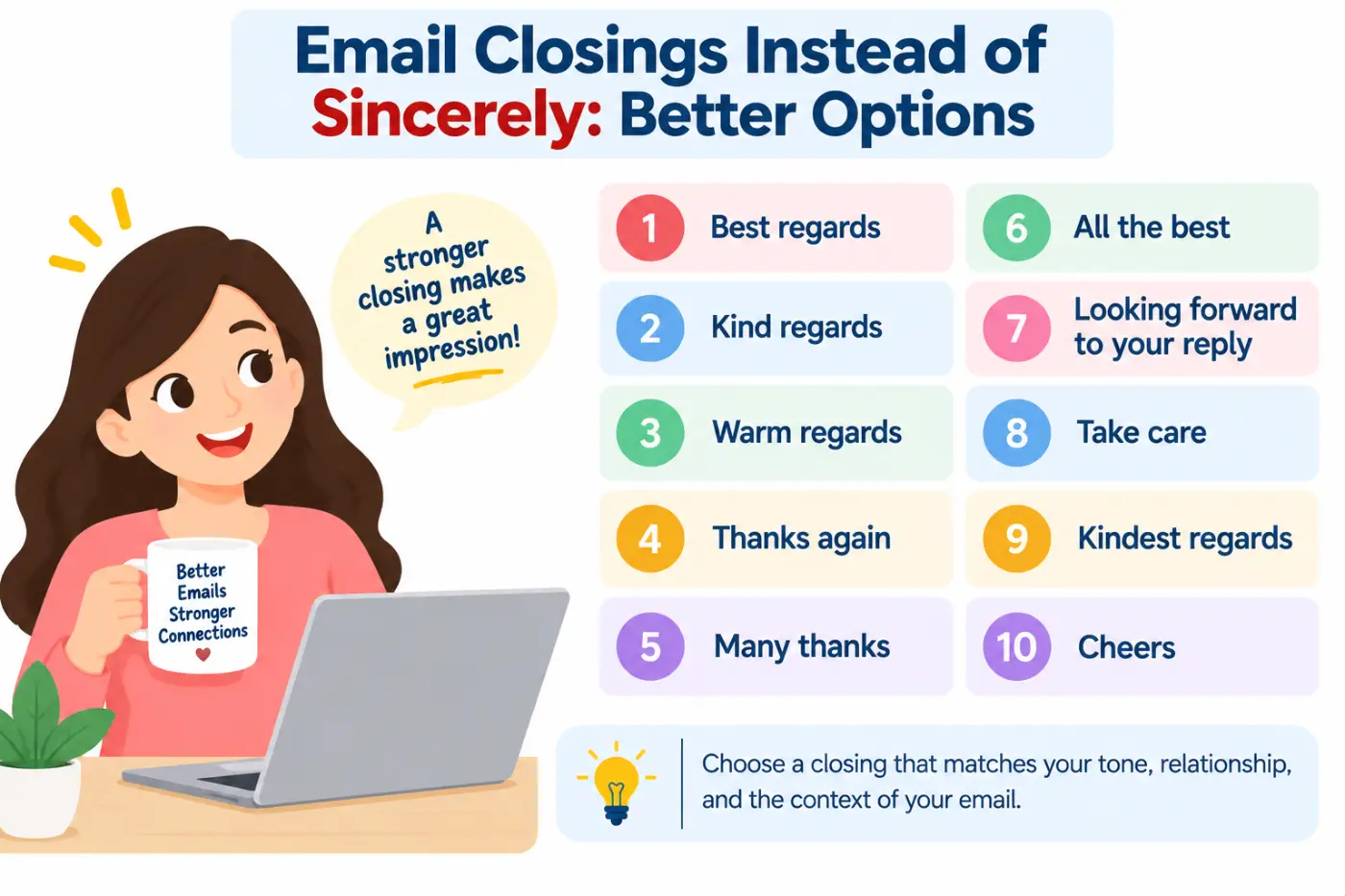
Choosing the right email closing can feel surprisingly difficult. You may have written a clear message and reached the last line only to wonder if sincerely sounds too formal too cold or simply outdated for the situation. If you’re looking for email closings instead of sincerely you have plenty of strong choices. The best option depends on your relationship with the reader and the tone of your message.
Sincerely is still correct and professional. However it isn’t the only polished way to end an email. A thoughtful closing can make your message feel warmer more confident more respectful or more relaxed without changing the main point of what you wrote. The final few words can shape how the reader remembers the entire message.
This guide explains the strongest alternatives and shows exactly when to use them. You’ll find examples for work emails job applications customer messages academic communication networking and everyday professional conversations. You’ll also learn which closings can sound too casual and which ones are safest when you’re unsure about the relationship.
Learn the difference in Are You Free Alternatives for Natural English used in 2026.
Quick Definition
Good alternatives to sincerely include best regards kind regards regards thank you many thanks best and respectfully. Each creates a slightly different tone. Best regards is a dependable professional choice while thank you works well when you’re asking for help or responding to assistance. The right closing should match your relationship with the reader and the purpose of the email.
Quick Answer
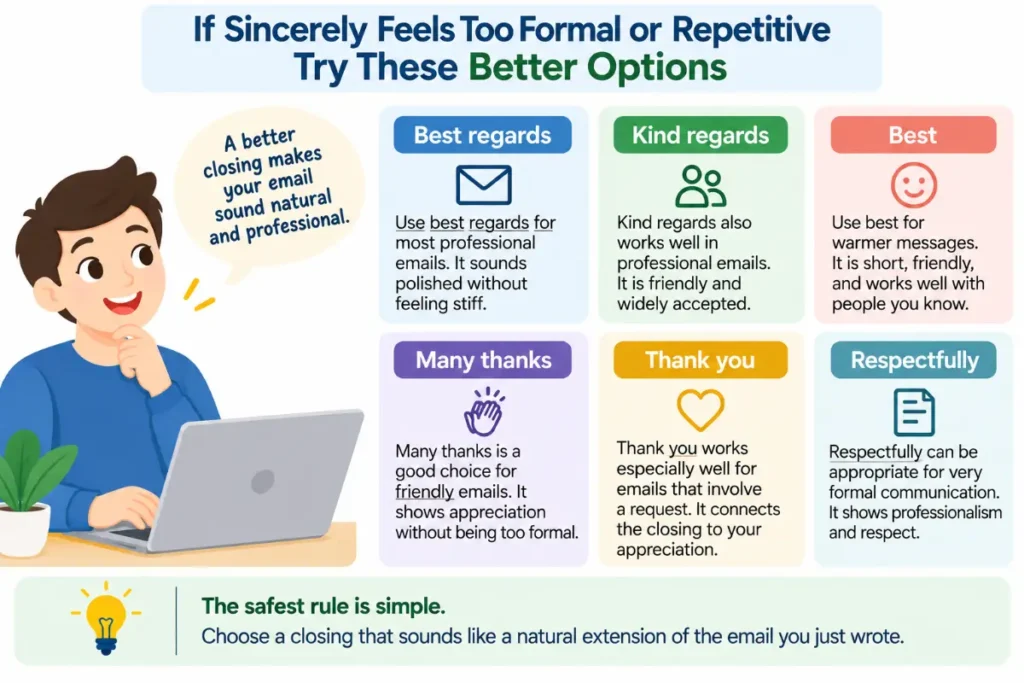
If sincerely feels too formal or repetitive use best regards or kind regards for most professional emails. They sound polished without feeling stiff. For warmer messages use best or many thanks. For emails that involve a request thank you can work especially well because it connects the closing to your appreciation. For very formal communication respectfully can be appropriate. The safest rule is simple. Choose a closing that sounds like a natural extension of the email you just wrote.
Comparison Table for Professional Email Closings
| Closing | Tone | Best Use | Formality | Warmth | Common Context | Example |
|---|---|---|---|---|---|---|
| Best regards | Professional and friendly | General business email | Medium | Medium | Workplace and networking | Best regards, Maya |
| Kind regards | Polite and warm | Professional relationships | Medium | High | Clients and coworkers | Kind regards, Daniel |
| Regards | Neutral and direct | Routine communication | Medium | Low | Internal and external email | Regards, Alex |
| Thank you | Appreciative | Requests and assistance | Medium | High | Work and customer communication | Thank you, Jordan |
| Many thanks | Warm and appreciative | Friendly professional email | Medium | High | Requests and follow ups | Many thanks, Chris |
| Best | Brief and friendly | Familiar professional contacts | Low | High | Coworkers and ongoing contacts | Best, Taylor |
| Respectfully | Formal and respectful | Official or sensitive matters | High | Low | Formal correspondence | Respectfully, Morgan |
| All the best | Warm and personable | Friendly professional relationships | Low | High | Networking and coworkers | All the best, Sam |
| Take care | Personal and warm | Familiar contacts | Low | High | Friendly professional communication | Take care, Jamie |
Why Sincerely Can Feel Too Formal
Sincerely has a long history in formal correspondence. It remains grammatically correct and professional. The issue isn’t correctness. The issue is tone.
A closing can be perfectly acceptable and still feel slightly out of place. Imagine sending a quick message to a coworker you communicate with every day. If the email says Please send me the updated schedule and ends with Sincerely the contrast may feel unusually formal.
That doesn’t mean you should stop using it. Sincerely still makes sense when the message calls for a traditional professional tone. Job applications formal requests and unfamiliar professional relationships can all support its use.
The better approach is to think about tone before choosing the final words.
Ask yourself three simple questions.
- How well do I know this person.
- How serious or formal is the subject.
- What feeling should the reader get from the final line.
Your answer will usually point you toward the right closing.
The Best Professional Alternatives
Best regards
Best regards is one of the safest choices for professional email. It feels polished without sounding excessively formal.
It works particularly well when you communicate with clients managers coworkers vendors recruiters and professional contacts. It also fits many situations where you haven’t developed a close relationship with the recipient.
For example:
Thank you for reviewing the proposal. Please let me know if you have any questions.
Best regards
Emily
This closing is dependable because it rarely creates a strong emotional signal. It simply ends the message politely.
Kind regards
Kind regards feels slightly warmer than best regards. It’s a strong choice when you want to sound professional while still showing some personal warmth.
You might use it with a client you know well or with a colleague after several positive conversations.
For example:
I appreciate your help with the project. I’ll send the revised document tomorrow.
Kind regards
Marcus
Kind regards can also work nicely when your email contains a request. It softens the overall tone without becoming overly friendly.
Regards
Regards is short direct and professional. It works well for routine communication.
Some people find it slightly cooler than best regards. That can actually be useful when you want a clean business tone without adding unnecessary warmth.
For example:
The updated figures are attached for your review.
Regards
Nicole
Use it most naturally when the email itself already has a neutral professional tone.
Thank you
Thank you is especially effective when your email involves a request.
Instead of ending a request with a generic sign off you can use the closing to reinforce appreciation.
For example:
Could you please review the attached document before Friday.
Thank you
James
This works because the closing matches the purpose of the message. You’re asking for something and expressing appreciation at the same time.
However don’t use thank you as a habit when you aren’t actually expressing thanks. A closing should sound sincere rather than automatic.
Many thanks
Many thanks is warmer than thank you. It works well with people you already know or in professional situations where a friendly tone is welcome.
For example:
Thanks for sending the figures so quickly. I’ve added them to the report.
Many thanks
Laura
It’s particularly natural in follow up messages and collaborative work.
Best
Best is short modern and widely used in professional communication. It works especially well when you already have an established relationship with the recipient.
For example:
I’ll review the draft tonight and send my comments tomorrow.
Best
Chris
Its simplicity is part of its appeal. Still it can feel too casual in highly formal correspondence. Use it when the rest of the message has a conversational professional tone.
All the best
All the best is friendly without becoming overly personal. It can be a good choice for colleagues former coworkers clients and professional contacts you know reasonably well.
For example:
It was great speaking with you today. I hope we can work together again soon.
All the best
Rachel
It adds more warmth than regards while remaining suitable for many workplace situations.
Respectfully
Respectfully is more formal than most everyday email closings. It can suit official communication serious requests or messages where respect needs to be emphasized.
For example:
Thank you for considering my request. I appreciate your time and attention.
Respectfully
David
It can sound too formal in an ordinary workplace conversation. Save it for situations where the formality serves a purpose.
How to Choose the Right Closing
The easiest way to choose an email sign off is to match it to the relationship.
- For a new professional contact use best regards or kind regards. These options create a safe balance between respect and friendliness.
- For a familiar coworker use best or all the best. These closings feel natural when you already communicate regularly.
- For a request use thank you or many thanks. The closing reinforces appreciation and gives the message a warmer finish.
- For a formal application use sincerely or best regards. Both can work depending on the overall tone.
- For official communication use respectfully when appropriate. It creates a distinctly formal tone.
- For a short routine message use regards or best. A simple email doesn’t always need an elaborate sign off.
- For a warm professional relationship use kind regards or all the best. These choices show personality without crossing into casual language.
The important point is consistency. If your email sounds friendly and conversational from beginning to end then a very stiff closing may feel disconnected.
Formality Levels Matter
Not every professional email needs the same level of formality.
A message to a government office may need a different closing from a quick note to your teammate. Treating every situation exactly the same can make your writing feel unnatural.
Very Formal
Respectfully is appropriate for some official situations.
Sincerely can also work in formal correspondence especially when you’re following traditional letter conventions.
Professional and Neutral
Best regards is one of the strongest choices in this group.
Regards is another useful neutral option.
Professional and Warm
Kind regards works well here.
Many thanks can also fit when the message involves appreciation.
Friendly Professional
Best and all the best are natural choices for familiar professional relationships.
Casual
Take care and talk soon can work with people you know well. These are less suitable for formal business communication.
Think of formality as a sliding scale rather than a simple right or wrong choice.
Email Closings Instead of Sincerely for Job Applications
Job applications deserve special attention because the closing can influence the overall impression of your message.
If you’re applying for a position and contacting a recruiter or hiring manager you don’t know personally then a professional closing is usually the safest choice.
Best regards is a strong option.
Sincerely is also appropriate.
Kind regards can work when the message feels slightly warmer.
For example:
Thank you for taking the time to review my application. I’d welcome the opportunity to discuss how my experience could support your team.
Best regards
Jordan Lee
The closing should never try too hard to sound impressive. A clear message followed by a simple professional sign off usually works better than an elaborate phrase.
Email Closings Instead of Sincerely for Business Communication
Business emails often benefit from a closing that reflects the relationship.
If you’re contacting a new client use best regards or kind regards. If you’re writing to a colleague you work with every day then best may sound more natural.
For example:
I’ve attached the revised agreement for your review. Please let me know if you’d like to discuss any changes.
Kind regards
Sofia
For routine internal communication:
The numbers look good from my side. I’ll add the final notes to the report this afternoon.
Best
Ethan
Both messages are professional. They simply have different levels of warmth.
Email Closings Instead of Sincerely for Requests
Requests need a little care because the closing can influence how demanding the message feels.
Thank you is often a natural choice when you’re asking someone to take action.
For example:
Could you please send the updated invoice by Thursday so we can complete the payment process.
Thank you
Olivia
Many thanks also works when you have an established relationship.
For example:
Could you take a quick look at the attached draft and share your thoughts when you have time.
Many thanks
Ben
Avoid using thank you in a way that assumes someone has already agreed to something. If the request is sensitive or significant you may prefer a softer sentence before the closing.
Learn the difference in As Well As Alternatives for Clearer English.
Email Closings Instead of Sincerely for Follow Up Messages
Follow up emails usually don’t need a heavy formal tone.
Best regards remains reliable. Best can feel more natural when the relationship is established.
For example:
I wanted to follow up on my message from Monday. Please let me know if you’ve had a chance to review the proposal.
Best
Natalie
If you’re following up after someone helped you then many thanks can add a useful touch.
For example:
Thanks again for sending those documents. They answered my questions and helped me finish the report.
Many thanks
Ryan
The key is to avoid making a simple follow up sound like a formal legal letter.
Email Closings Instead of Sincerely for Academic Emails
Academic communication can range from highly formal to quite conversational.
When contacting a professor you don’t know well best regards or kind regards are safe choices.
For example:
Thank you for clarifying the assignment requirements. I’ll submit the revised paper by Friday.
Kind regards
Avery
For an ongoing conversation with an instructor or research colleague best may feel perfectly natural.
For formal academic correspondence such as a scholarship request or official application sincerely can still be appropriate.
The subject of the email matters too. A serious request deserves a more restrained closing than a quick scheduling message.
Email Closings Instead of Sincerely for Customer Service
Customer communication requires warmth and professionalism.
Thank you can work particularly well after solving a customer issue or requesting information.
For example:
Thank you for your patience while we reviewed the issue. We’ve now updated your account and confirmed the correction.
Best regards
Customer Support Team
Kind regards can also work when you want the message to feel personal.
Avoid overly casual closings such as catch you later or take care unless your brand and relationship clearly support that tone.
Email Closings Instead of Sincerely for Networking
Networking emails benefit from warmth because the goal is often to build a relationship.
Best regards is dependable.
All the best is warmer.
Many thanks works well after an introduction or favor.
For example:
It was great meeting you at the conference. I enjoyed our conversation about the future of the industry and hope we can stay in touch.
All the best
Marcus
A networking email should feel like a human message rather than a form letter. Your closing is one small opportunity to show that personality.
Common Mistakes With Email Sign Offs
Using a Formal Closing in Every Email
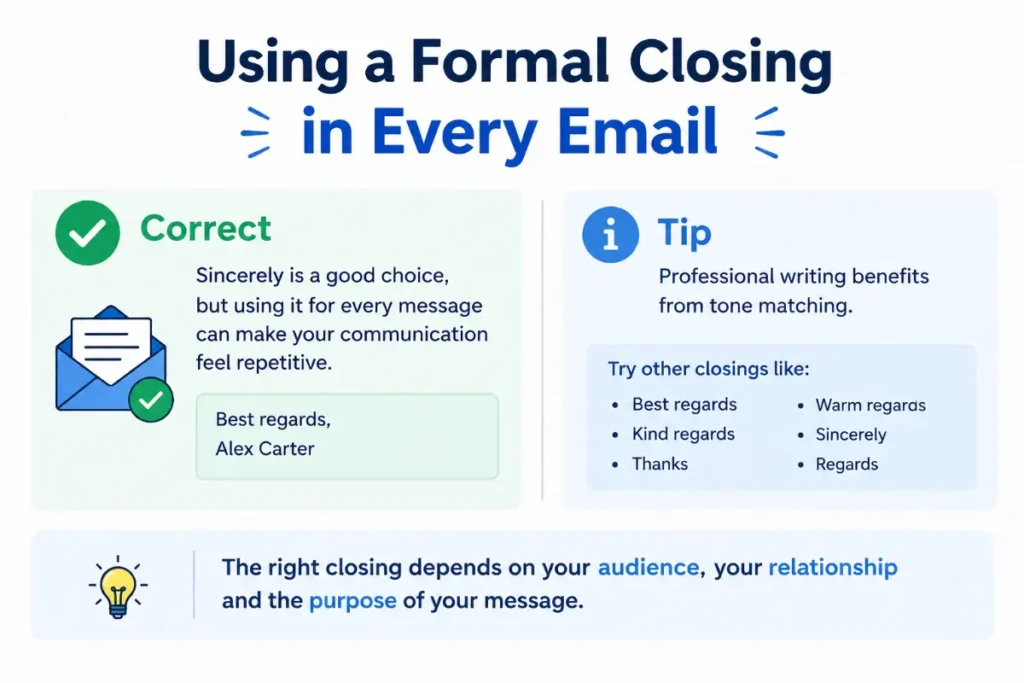
Sincerely is correct but using it for every message can make your communication feel repetitive. Professional writing benefits from tone matching.
Choosing a Casual Closing for a Formal Reader
A closing such as take care may sound friendly to one person and too informal to another. If you’re writing to someone in a senior role or an unfamiliar organization then a safer professional option is usually better.
Using Thank You Without a Real Reason
Thank you works best when the message includes appreciation or a request. Adding it mechanically to every email can make it lose its meaning.
Mixing Tones
Imagine an email that begins with a highly formal sentence such as I am writing to formally request your consideration and ends with cheers.
The closing doesn’t match the message.
Tone should feel consistent from the greeting through the body and into the sign off.
Adding Too Many Words
A professional email usually doesn’t need a long closing paragraph.
Thank you for your time and consideration and I sincerely appreciate your continued attention to this matter and hope you have a wonderful day can feel excessive for a simple request.
A clean closing is often stronger.
Punctuation and Formatting Rules
Email sign offs have a few common formatting conventions.
In American business writing the closing is often followed by a comma.
Best regards,
Taylor Morgan
However email formatting is flexible. Many modern professional emails use the closing without a comma.
Best regards
Taylor Morgan
Both styles appear in real professional communication. The more important issue is consistency.
Avoid adding a period after the sender’s name.
Best regards,
Taylor Morgan
is cleaner than:
Best regards.
Taylor Morgan.
The sign off should normally sit on its own line followed by your name.
For a professional email signature you may then add your job title phone number and other contact information.
Are Some Closings Too Casual?
Yes. Some expressions work best only with people you know well.
Cheers
Cheers can sound friendly and natural in some English speaking communities. In American professional communication it can feel less conventional depending on the workplace.
Talk Soon
Talk soon is friendly and works best when you genuinely expect another conversation.
Take Care
Take care can sound warm and personal. It’s generally better for familiar contacts than formal business relationships.
See You
See you is highly conversational. It works for colleagues you know well but not for a formal client message.
Thanks Again
Thanks again is perfectly natural when someone actually helped you. It can feel odd if no previous favor or assistance exists.
The issue isn’t that these phrases are bad English. They simply carry stronger social signals than neutral business closings.
Related Terms and Useful Alternatives
Understanding related expressions helps you choose the right tone.
- Best regards. A balanced professional sign off with moderate warmth.
- Kind regards. A polite option with a warmer feel.
- Regards. A neutral and direct professional closing.
- Thank you. A useful choice for requests and appreciation.
- Many thanks. A warmer expression of gratitude.
- Best. A brief friendly closing for established relationships.
- All the best. A personable sign off that works well in friendly professional communication.
- Respectfully. A formal option for official or serious correspondence.
These expressions overlap but they aren’t identical. Choosing the right one is less about memorizing a ranking and more about understanding the social tone each phrase carries.
How Native Speakers Think About Email Closings
Native speakers rarely analyze a closing as a strict grammar problem. They usually judge it by tone.
If the message is formal they expect a formal ending.
If the conversation is friendly they often choose something warmer.
If the email contains a request they may use thank you.
If they communicate with the same person every day they may use a short sign off such as best.
That natural instinct comes from context. You can develop the same skill by reading your email from the recipient’s point of view.
Ask how the final phrase feels after the sentence before it. Does it sound connected or does it suddenly become much more formal or casual?
That quick check catches many awkward choices.
Expert Editor Insight
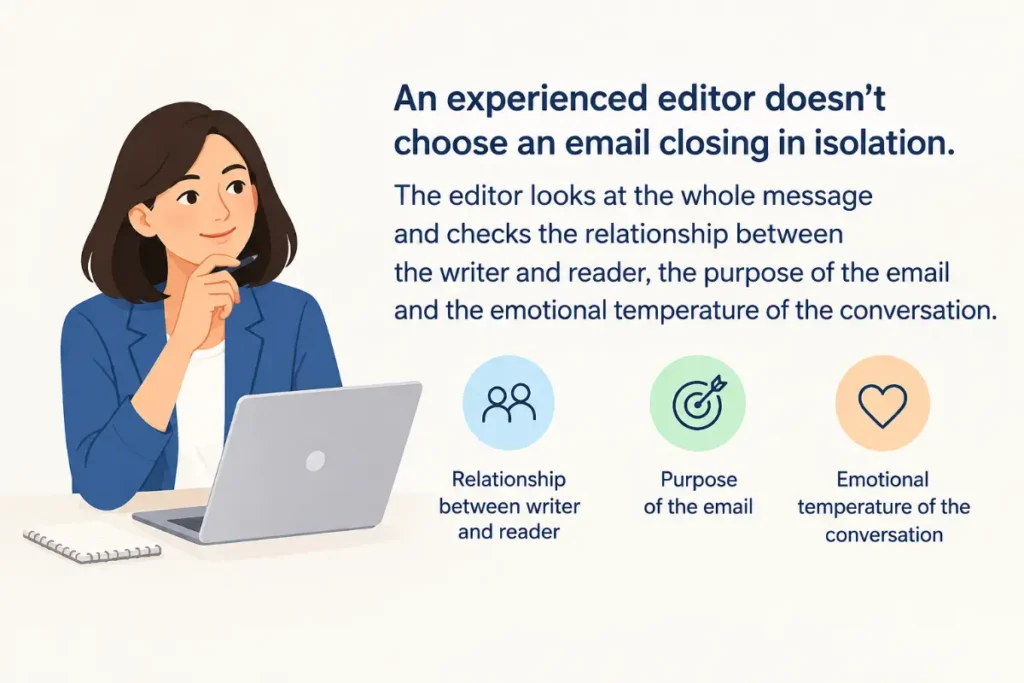
An experienced editor doesn’t choose an email closing in isolation. The editor looks at the whole message and checks the relationship between the writer and reader the purpose of the email and the emotional temperature of the conversation. A useful editing trick is to read only the first sentence the main request and the final two lines. If those parts sound like they belong in the same conversation then the closing is probably a good fit. Grammar tools can catch punctuation issues but they can’t reliably judge every social nuance of a sign off.
Still confused? Compare First Come First Serve Alternatives For Clear Writing.
Conclusion
If you’re searching for email closings instead of sincerely you have several strong choices. Best regards is the safest all purpose professional option while kind regards adds a little warmth. Thank you works naturally with requests and appreciation while best and all the best suit familiar professional relationships.
The key isn’t finding one closing that replaces sincerely in every situation. Good email writing depends on matching the sign off to the reader the relationship and the purpose of the message. A job application may call for a formal ending while a quick note to a coworker can use something much simpler.
As a practical editing tip read your final two sentences and your sign off together. If they sound like they belong to the same conversation you’ve probably chosen well.
FAQs
What is the best professional alternative to sincerely?
Best regards is one of the safest professional alternatives. It works for clients coworkers managers recruiters and other professional contacts. Kind regards is another strong choice if you want a slightly warmer tone. The best option depends on the relationship and purpose of the email. For a request thank you may fit better because it directly expresses appreciation.
Is sincerely too formal for an email?
Sincerely isn’t too formal for all emails. It remains appropriate for job applications formal requests official correspondence and messages to people you don’t know well. It can feel unnecessarily stiff in a short message to a familiar coworker. In those situations best regards kind regards or best may sound more natural while staying professional.
What should I use instead of sincerely in a work email?
Best regards is a dependable choice for most work emails. Kind regards works when you want a little more warmth. Regards can suit short routine messages while best works well with coworkers you know well. If the email asks someone for help then thank you can be especially effective because it connects the closing to the purpose of your message.
Is best regards more casual than sincerely?
Best regards is generally a little less formal than sincerely while still being clearly professional. That makes it useful for everyday business communication. Sincerely has a traditional formal tone that can work well for applications and official correspondence. Best regards fits a broader range of workplace situations because it balances professionalism with a natural conversational feel.
Can I use best in a professional email?
Yes. Best is widely used in professional email and can sound polished and natural. It works especially well with coworkers clients and professional contacts you already know. It may feel too casual for a highly formal application or official letter. If you’re unsure about the relationship then best regards is usually a safer choice.
Is kind regards appropriate for American English?
Yes. Kind regards is completely understandable and professional in American English. It creates a polite and slightly warmer tone than regards. You can use it with coworkers clients recruiters and other professional contacts. It’s especially useful when you want to sound friendly without becoming casual. It works well in both routine messages and more thoughtful professional communication.
Should I use thank you as an email closing?
Thank you is a strong closing when the email includes a request or expresses appreciation. For example you might ask someone to review a document and finish with thank you. It reinforces the courteous purpose of the message. If you haven’t asked for help or expressed gratitude then another closing such as best regards may sound more natural.
What is the most polite email closing?
There isn’t one universally most polite closing because politeness depends on context. Best regards and kind regards are excellent general professional choices. Respectfully can be more appropriate for highly formal or official communication. Thank you works well when you’re requesting assistance. The most polite closing is usually the one that matches the relationship and tone without sounding forced.