
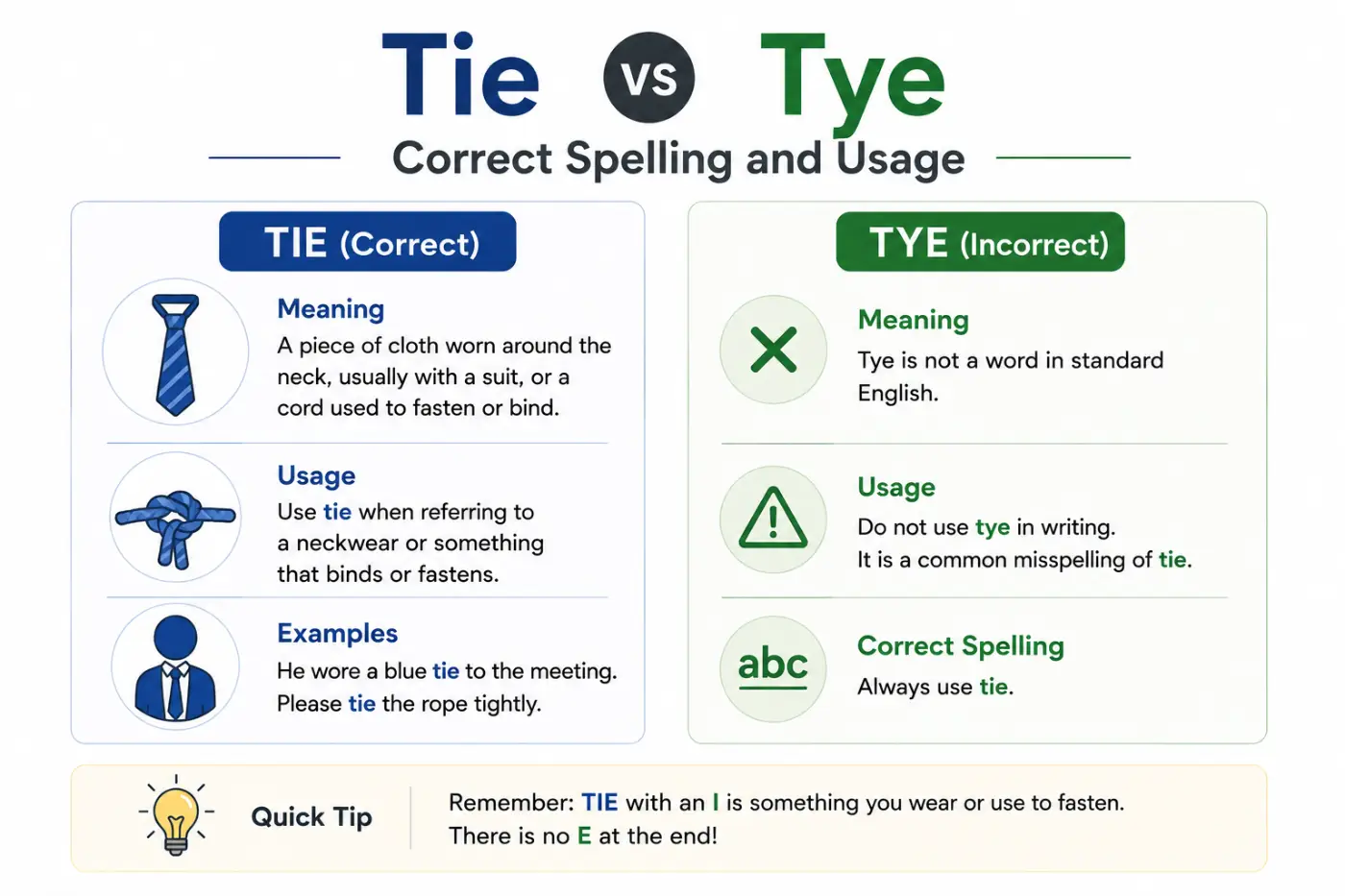
If you’re confused about tie vs tye you’re looking for a simple spelling answer. For normal modern English the correct form is tie. Use it when you mean to fasten something with a knot or cord. Use it for the piece of clothing worn around the neck. You also use it when two people or teams finish with the same score.
The confusion is understandable because tye isn’t just a random spelling mistake. It exists as a rare English word with historical dialectal and specialized meanings. Those meanings are uncommon in everyday American English though. For most modern writing tye will look like a misspelling of tie.
This guide explains the difference clearly. You’ll learn what both forms mean how they’re pronounced how they work in a sentence and when tye can actually be correct.
Many readers also check Uninclined vs Disinclined Which Word Should You Use? 2026.
Quick Answer
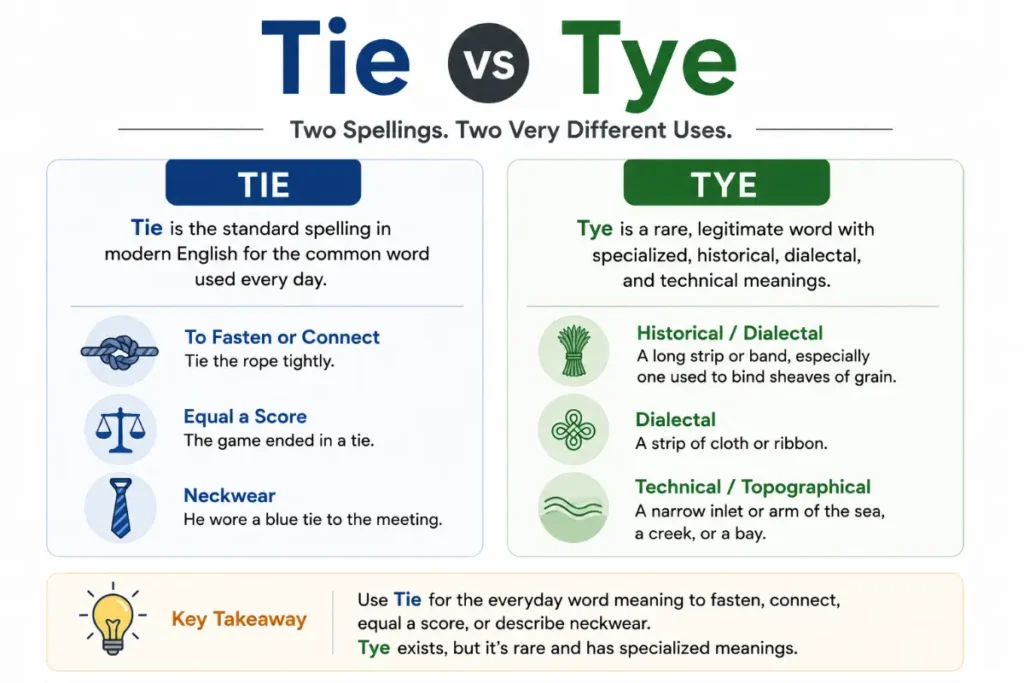
Tie is the standard spelling in modern English for the common word meaning to fasten connect equal a score or describe neckwear. Tye is a rare legitimate word with specialized historical dialectal and technical meanings. It isn’t the normal spelling of the everyday word tie.
The Correct Spelling
For everyday English use tie.
You tie your shoes. You tie a package. A game can end in a tie. You can also have strong ties with family friends or a community.
The same spelling covers several common meanings. Tie works as both a noun and a verb and appears frequently in spoken and written English.
The spelling tye shouldn’t replace tie in ordinary sentences. Writing it that way can make a sentence look incorrect to most readers.
There is one useful exception. Tye does exist as a dictionary word. It has several rare meanings connected with historical English dialects mining nautical language and other specialized contexts.
So it would be inaccurate to say that tye is never a word. The better rule is this.
Use tie for the ordinary modern word. Use tye only when a specific specialized meaning requires it.
Comparison Table
| Form | Meaning | Part of Speech | Origin | Usage Frequency | Formality | Common Contexts | Example |
|---|---|---|---|---|---|---|---|
| tie | Fasten connect equal a score or describe neckwear | Verb and noun | Old English and Middle English development | Very common | Standard | Daily speech work school clothing sports relationships | Please tie your shoes. |
| tye | Rare historical dialectal mining or nautical meanings | Noun and verb | Historical English forms | Very rare | Specialized | Historical writing mining dialect and nautical contexts | The historical text used tye for a specialized term. |
The difference becomes much clearer when you focus on context. If you’re talking about shoes clothing sports relationships or ordinary fastening then tie is almost certainly the word you need.
What Tie Means
Tie has several common meanings. The sentence usually makes the intended meaning obvious.
As a verb tie can mean to fasten something with string rope cloth or another material.
You might tie your shoes before leaving home. You could tie a ribbon around a gift.
Tie can also mean to connect things.
Two ideas can be tied together. A person can feel tied to a particular place. A business can be closely tied to a certain industry.
Another common meaning appears in sports and competitions. If two teams have the same score the result can be a tie. One player can also tie another player’s record by reaching the same result.
As a noun tie can describe neckwear.
He wore a blue tie to work.
Tie can also describe a relationship or connection.
The two families have strong ties to the area.
The word has several additional meanings in areas such as music construction transportation and other fields. That broad range makes tie one of the most useful everyday words in English.
What Tye Means
Tye is a real word but it isn’t the ordinary spelling of tie.
The word has several rare meanings. Some are historical or dialectal. Others belong to specialized areas of language.
One historical meaning refers to a small box or container. Another British usage relates to mining and the washing or separation of ore. Tye can also refer to enclosed land or pasture in some dialectal uses.
There is also a nautical meaning connected with rope or chain equipment used to raise or lower a yard on a sailing vessel.
These meanings are unusual today. Most people who see tye in an ordinary sentence will assume the writer meant tie.
That distinction matters. A word can be legitimate without being a normal choice for everyday communication.
English contains many old and specialized words that remain recorded even though most speakers rarely encounter them.
Why People Write Tye
The spelling confusion is easy to understand.
English spelling doesn’t always match pronunciation in a predictable way. Someone who hears the sound /taɪ/ may know how the word sounds but hesitate over the letters.
The letter y can also appear in many familiar English words. Words such as type style and typical may make a spelling like tye seem possible.
There is another interesting reason for the confusion. Historical English forms of tie included spellings that resemble tye. English spelling changed over time and became more standardized.
That means tye has a genuine historical connection to the word tie. Still the modern standard form for everyday English is tie.
Key Differences Explained
The biggest difference is modern standard usage compared with rare specialized usage.
- Spelling. Tie is the standard modern spelling for the common word. Tye is a rare form with separate historical and specialized meanings.
- Meaning. Tie commonly means to fasten connect equal a score or describe neckwear. Tye has unusual historical dialectal mining and nautical meanings.
- Grammar. Tie commonly functions as both a noun and a verb. Tye can also function as a noun or verb in specialized uses.
- Pronunciation. Both forms can represent the sound /taɪ/ in their recorded uses.
- Formality. Tie works naturally in casual professional academic and formal writing. Tye is restricted to specific contexts.
- Regional usage. Tie is standard across major English varieties. Some meanings of tye are associated with British dialects or specialized language.
- Frequency. Tie is extremely common. Tye is rare and may appear to be a spelling error outside its specialized contexts.
The practical lesson is simple. A word can appear in a dictionary without being an everyday alternative to another word.
Which Form Is Correct
For normal modern English tie is the correct form.
Use tie when you mean to fasten something.
Please tie the rope securely.
Use tie when you mean neckwear.
He bought a new tie for the wedding.
Use tie when you mean an equal result.
The game ended in a tie.
Use tie when you mean a connection.
The two ideas are closely tied together.
Tye should only appear when you’re using one of its specific historical dialectal or technical meanings.
This distinction is particularly useful when proofreading. Don’t automatically assume that every occurrence of tye is wrong. First check the context.
If a modern email says Please tye your shoes then the writer almost certainly needs tie.
If an old historical document uses tye in a specialized sense the spelling may be intentional.
Context comes first. Correction comes second.
Sentence Examples
Here are ten natural examples using the standard form.
- Please tie your shoes before you go outside.
- She used a ribbon to tie the package.
- I need to tie my hair back before I start cooking.
- He wore a dark blue tie to the interview.
- The game ended in a tie after both teams scored twice.
- Their families have strong ties to the local community.
- These two issues are closely tied together.
- The company wants to tie the new program to its larger goals.
- She tied the loose end of the rope around the post.
- The runner tied the school record during the final event.
These examples show how one spelling works across many everyday meanings.
You can use tie for physical fastening emotional connections sports results clothing and abstract relationships.
Examples With The Common Misspelling
The following examples are shown only to demonstrate the mistake.
- Incorrect: Please tye your shoes before you leave.Correct: Please tie your shoes before you leave.
- Incorrect: He decided to tye the package with string.Correct: He decided to tie the package with string.
- Incorrect: I need to tye my hair back.Correct: I need to tie my hair back.
- Incorrect: She wore a red tye to the ceremony.Correct: She wore a red tie to the ceremony.
- Incorrect: The teams finished in a tye.Correct: The teams finished in a tie.
Outside rare specialized contexts these uses of tye should be corrected.
Common Mistakes and Misspellings
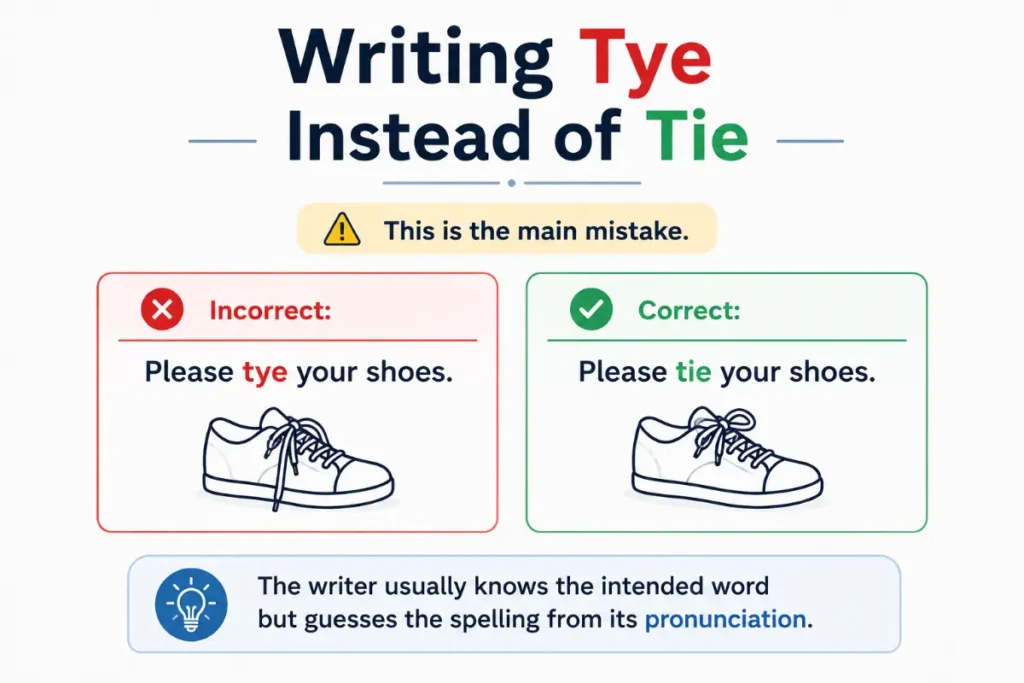
Writing Tye Instead of Tie
This is the main mistake.
Incorrect: Please tye your shoes.
Correct: Please tie your shoes.
The writer usually knows the intended word but guesses the spelling from its pronunciation.
Writing Tiee Instead of Tie
Some writers may add an unnecessary extra vowel.
Incorrect: Tiee the ribbon carefully.
Correct: Tie the ribbon carefully.
The correct base form is short and simple.
Confusing Tie With Tied
Tie is the base form of the verb.
I tie my shoes every morning.
Tied is the past tense and past participle.
I tied my shoes before leaving.
Knowing the verb forms helps prevent spelling errors.
Confusing Tie With Tying
The present participle is tying.
Correct: She is tying her shoes.
The form tieing is not the standard spelling.
When the verb ends in a silent e the e is removed before the ing ending in this case.
Confusing Tie With Tied In Sports
Tie and tied can describe the same basic situation but they serve different grammatical roles.
The game ended in a tie.
The teams were tied at halftime.
Tie is a noun in the first sentence. Tied functions as a past participle describing the teams in the second.
Pronunciation Guide
Tie is pronounced /taɪ/.
It has one syllable.
An easy pronunciation guide is tie as in the sound in words such as high my and sky.
The vowel is the long i sound.
Tye can also be pronounced /taɪ/ in its recorded uses. That shared pronunciation can make the spelling difference harder to notice when people hear the word instead of seeing it written.
This is a common feature of English. Sound alone doesn’t always tell you which letters belong on the page.
When you mean the common modern word the spelling to remember is tie.
Etymology and Word Origin
The history of tie reaches back many centuries.
The word developed through earlier forms of English and has roots connected with older Germanic vocabulary involving fastening and pulling.
Historical English records contain forms that resemble tye. Over time English spelling became more standardized and tie became the familiar modern form.
This history explains something important. The existence of an older spelling doesn’t mean modern writers should use it freely.
English changes. Spellings shift. Some older forms disappear from everyday language while others survive in specialized fields or regional speech.
Tye is an interesting example of that process. It has survived in limited uses while tie became the dominant modern form.
Need another quick comparison? Read in line or inline Meaning Difference And Correct Usage.
Regional Usage
American English
Tie is the standard spelling in American English.
It appears in everyday speech professional writing school assignments journalism and general publishing.
Tye isn’t normally used in the United States as an alternative spelling for tie.
If you write I need to tye my shoes most American readers will probably consider it a spelling mistake.
British English
Tie is also the standard spelling in British English.
Tye survives in some specialized and dialectal uses. British English has preserved certain regional words that aren’t common in everyday American English.
Those specialized meanings don’t turn tye into a general alternative spelling for tie.
Australian English
Tie is the normal spelling in Australian English for common meanings involving fastening neckwear sports and connections.
There is no general Australian spelling rule that changes tie to tye.
Canadian English
Canadian English also uses tie as the standard spelling for ordinary meanings.
The same practical rule applies. Use tie for the common modern word and use tye only when a specific specialized meaning requires it.
Grammar Rules and Part of Speech
Tie works as both a noun and a verb.
As a verb it describes an action.
You can tie your shoes.
You can also use tie to describe a relationship or connection.
The two subjects are tied together.
The new policy is tied to the company’s goals.
As a noun tie has several common meanings.
A tie can be an item of clothing.
He bought a new tie.
A tie can be a connection.
They have strong family ties.
A tie can describe an equal result.
The game finished in a tie.
Tie also appears in music. A musical tie connects notes of the same pitch so they continue as one sustained sound.
Verb Forms
The basic forms of the verb are useful to learn together.
Base form: tie.
Present tense: tie or ties.
Past tense: tied.
Past participle: tied.
Present participle: tying.
For example:
I tie my shoes.
She ties her shoes.
He tied his shoes.
They have tied the ropes together.
She is tying the ribbon.
Learning the complete word family makes it easier to avoid common spelling errors.
Tie In Daily Conversation
Tie appears naturally in everyday speech.
Someone may ask you to tie a bag shut. A parent may remind a child to tie their shoes. You might tell a friend that your hair is too long and you need to tie it back.
The word also appears in common expressions.
You can tie something up.
You can also describe emotional or social connections.
I feel tied to my hometown.
She has strong ties to her family.
These expressions show how easily tie moves between literal and figurative meanings.
Tie In Workplace Writing
Tie works perfectly well in professional writing.
For example:
The report ties the sales decline to lower customer demand.
The manager tied the new policy to the company’s broader goals.
The presentation explains how the two projects are tied together.
These sentences sound professional without using complicated vocabulary.
That’s an important writing principle. A formal sentence doesn’t need an unnecessarily fancy word.
Tie can communicate a relationship clearly and directly.
It also appears often when writers discuss business relationships.
The company has strong ties with local suppliers.
The two organizations have maintained close ties for several years.
Tie In Academic Writing
Academic writers use tie when discussing relationships between ideas events or evidence.
A researcher may explain how two factors are tied together. A historical essay may examine ties between political events. A paper may tie a conclusion to evidence presented earlier.
For example:
The study ties increased demand to changes in consumer behavior.
The author ties the two events together through economic evidence.
The word remains useful in academic writing because it is clear and familiar.
However academic writing sometimes needs greater precision. If you mean prove a direct cause then tie may be too broad. Words such as connect associate relate or link may express the intended relationship more precisely.
Good academic writing chooses the clearest word for the exact relationship.
Tie In News Writing
Tie appears often in journalism.
Sports writers use it to describe equal results.
The teams finished in a tie after a tense final quarter.
News writers also use tie to describe relationships between people organizations and countries.
The report examined business ties between the two companies.
The article discussed strong cultural ties between the communities.
The word works well in journalism because it is short familiar and easy to understand.
Tie In Literature And Storytelling
Writers can use tie in both literal and figurative ways.
A character may tie a rope around a tree.
Another character may feel tied to an old family home.
The figurative use can create a stronger emotional connection without adding complicated language.
For example:
She felt tied to the town where she had grown up.
The word can suggest loyalty responsibility attachment or emotional connection depending on the surrounding sentence.
That flexibility has helped tie remain useful across many types of writing.
Related And Confused Terms
Bind
Bind means to fasten or hold something together. It can also describe an obligation.
You can bind papers together. You can also feel bound by an agreement.
Fasten
Fasten means to secure something.
You can fasten a button or fasten a belt. Tie is one way of fastening something but the words aren’t interchangeable in every situation.
Knot
A knot is a structure made by tying material such as rope string or cord.
You tie a knot.
The knot is the result.
Attach
Attach means to connect one thing to another.
You can attach a document to an email or attach a label to a package.
Attachment doesn’t necessarily involve tying.
Connect
Connect has a broad meaning involving physical or abstract relationships.
Two wires can connect.
Two ideas can connect.
People can connect emotionally.
Link
Link describes a connection between things.
You can link two ideas in an essay. You can also describe a physical link between objects.
Tied
Tied is a form of the verb tie.
It can describe something that has been fastened.
She tied the rope to the post.
It can also describe two people or teams with the same score.
The teams were tied at halftime.
Necktie
Necktie specifically describes the item of clothing worn around the neck.
In American English tie is much more common in everyday conversation.
Is Tye Ever Correct
Yes.
That point deserves attention because simply calling tye a misspelling would be too broad.
Tye has documented historical dialectal and specialized meanings. It has appeared in older English and survives in limited technical or regional contexts.
For example a historical text may use tye for a specialized term connected with mining. A nautical text may use tye for equipment associated with raising or lowering a yard.
In those contexts the word can be intentional.
The important question is not simply whether tye exists. The important question is what the writer means.
If you’re writing a normal sentence about tying shoes then tye is wrong.
If you’re discussing a historical technical term then tye may be exactly the word you need.
That’s why context matters so much in professional editing.
How Spelling Tools Treat The Word
Spelling tools generally focus on common standard vocabulary.
As a result an unusual word such as tye may be flagged in ordinary writing even though it has legitimate specialized meanings.
A spell checker doesn’t always understand historical language regional dialects or highly specialized vocabulary.
That’s why you shouldn’t blindly accept every automated correction.
Imagine you’re editing a historical document and the writer uses tye as an established technical term. Changing it automatically to tie could alter the meaning.
Now imagine you’re editing a modern email that says Please tye your shoes.
In that context the correction is obvious.
Good proofreading combines language knowledge with context. Automated tools can help spot possible errors but the final decision still depends on what the sentence means.
Expert Editor Insight
An experienced editor would normally treat tie as the default form in modern English. Tye deserves a closer look only when the surrounding text points toward a historical dialectal mining or nautical meaning. The confusion happens because tye has genuine historical uses even though it isn’t the standard spelling for the everyday word. The best editing habit is simple. Understand the meaning first then decide if the spelling fits that meaning.
A Simple Memory Trick
Remember this phrase.
Tie it tight.
The word tie contains the letters you need for the everyday form.
Tie your shoes.
Tie the ideas together.
If you see tye in an ordinary sentence ask yourself if you’re actually using a rare historical or specialized meaning.
If you aren’t then choose tie.
This small check can save you from an easy spelling mistake.
Need another quick comparison? Read cleverer vs more clever Which Form Should You Use.
Conclusion
The answer to tie vs tye is simple for everyday English. Use tie when you mean to fasten something when you’re talking about neckwear when two sides have an equal score or when you’re describing a connection between people ideas or things.
Tye isn’t completely invalid. It has rare historical dialectal mining and nautical meanings that can appear in specialized writing. Those uses are very different from the everyday word tie.
The easiest editing tip is to remember tie it tight. If you’re using the familiar modern word then tie is the spelling you want. Save tye for a specific context that clearly calls for its specialized meaning.
FAQs
Is Tye A Real Word?
Yes. Tye is a real English word with several rare meanings. Some relate to historical English. Others occur in British dialectal mining language or nautical terminology. However tye isn’t the ordinary spelling for the common word meaning to fasten connect equal a score or describe neckwear. In normal modern writing use tie.
Which Is Correct Tie Or Tye?
For everyday modern English tie is correct. Use it for fastening something for neckwear for an equal result and for many kinds of relationships or connections. Tye is reserved for specific historical dialectal or technical meanings. If you’re writing an ordinary email essay message or report then tie is the appropriate form.
What Does Tie Mean?
Tie can mean to fasten something using string rope or another material. It can also mean to connect things to equal a score or to describe clothing worn around the neck. As a noun tie can also refer to a relationship or connection. The exact meaning depends on the context of the sentence.
How Do You Pronounce Tie?
Tie is pronounced /taɪ/. It has one syllable and uses the long i sound. It rhymes with words such as my high and sky. Tye can also have the /taɪ/ pronunciation in its recorded uses. The similar sound explains part of the spelling confusion but doesn’t make the two forms interchangeable.
Can Tie Start A Sentence?
Yes. Tie can start a sentence when it functions as a verb or noun. For example you can write Tie the rope securely before moving the box. You can also use it as a noun at the beginning of a sentence. Its position in a sentence doesn’t change the spelling.
What Is A Synonym For Tie?
The best synonym depends on the meaning. Fasten and bind can work when you mean secure something. Connect and link can work when you mean establish a relationship. Draw can sometimes replace tie when describing an equal sports result. No single synonym works for every meaning of tie.
Why Do People Confuse Tie And Tye?
People can confuse the two spellings because they share a similar pronunciation and because English spelling doesn’t always follow simple sound patterns. The letter y can also seem plausible based on other English words. The existence of rare historical meanings for tye adds another layer of confusion.
Is Tie Appropriate In Formal Writing?
Yes. Tie is completely appropriate in formal writing when it expresses the intended meaning clearly. Academic writers can use it to describe relationships between ideas. Professional writers can use it to describe connections between events organizations or concepts. You don’t need to replace tie with a more complicated word simply to make your writing sound formal.