
If you’re confused about currier vs courier you’re not alone. The correct word for someone who delivers a package or carries an important document is courier. Currier is also a real English word but it has a completely different meaning. It traditionally refers to someone who prepares and finishes leather and can also describe a person who grooms a horse.
The confusion is easy to understand because these two words look almost identical and sound quite similar when spoken. They share several letters and differ mainly in the middle of the word. If you’re typing quickly or spelling the word from memory that small difference can easily trip you up.
Once you connect each word with its meaning the distinction becomes much easier. In this guide you’ll learn how to spell and pronounce both words correctly along with their meanings grammar rules origins common mistakes and natural examples that show exactly when to use each one.
You may also want to read complaint vs complain Meaning Difference And Correct Usage.
Quick Answer
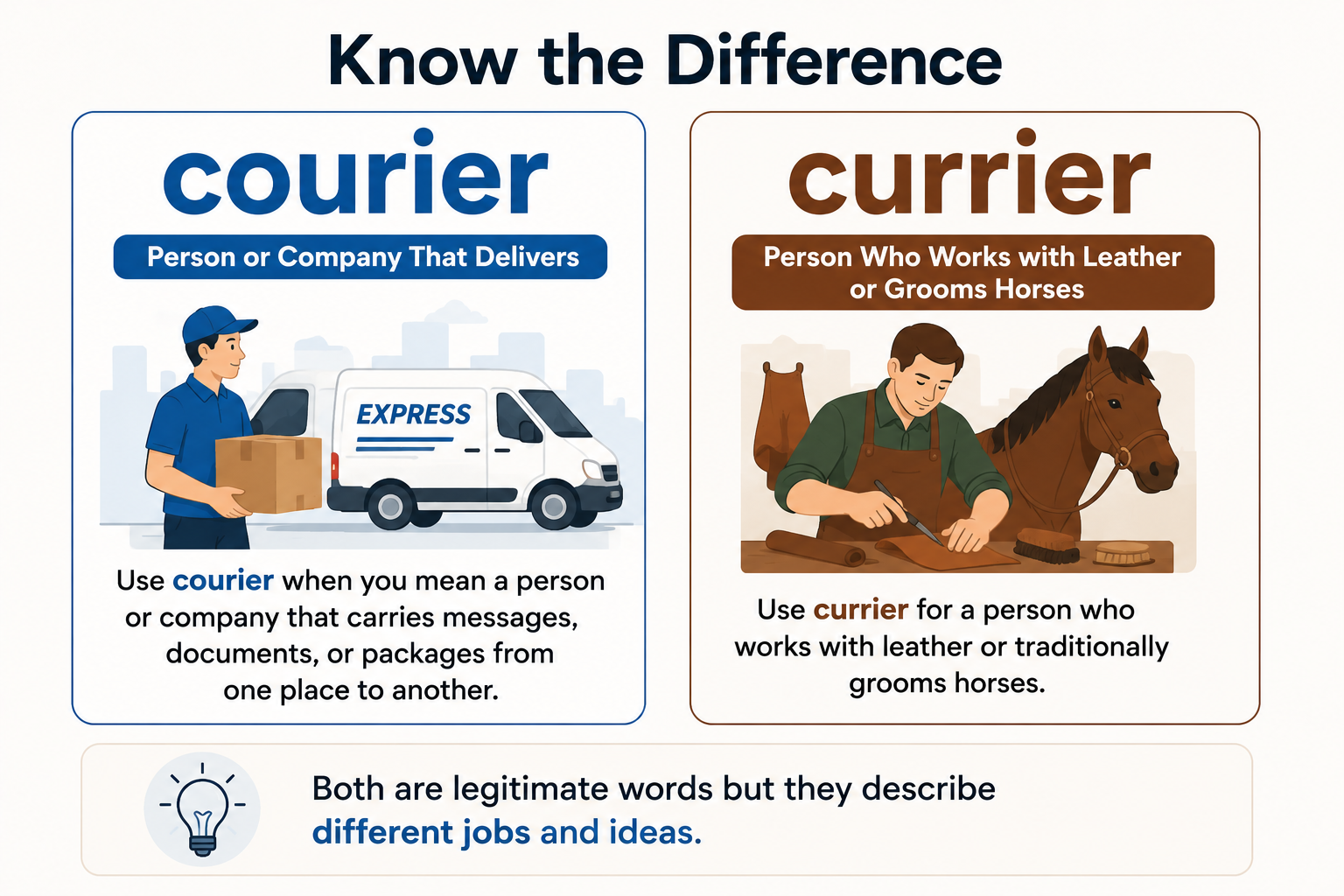
Use courier when you mean a person or company that carries messages documents or packages from one place to another. Use currier for a person who works with leather or traditionally grooms horses. Both are legitimate words but they describe different jobs and ideas.
Quick Answer For Everyday Writing
If you’re writing about package delivery choose courier.
For example:
The courier delivered my package this morning.
If you’re talking about leather work choose currier.
For example:
The currier prepared the leather for the saddlemaker.
So the spelling depends entirely on the meaning. A delivery worker is a courier. A traditional leather worker is a currier.
Comparison Table
| Form | Meaning | Part of Speech | Origin | Standard Status | Common Contexts | Example |
|---|---|---|---|---|---|---|
| Courier | A person or company that carries messages documents or packages | Noun and verb | French and Italian roots connected with running | Standard English | Delivery business documents packages travel | The courier delivered the documents. |
| Currier | A worker who prepares and finishes leather or traditionally grooms horses | Noun | Middle English and French roots connected with leather work and grooming | Standard but specialized English | Leather work horse grooming historical writing | The currier treated the leather carefully. |
The table shows why treating one spelling as a simple typo for the other can cause trouble. They aren’t two spellings of one word. They are separate words with separate histories and meanings.
Meaning Of Courier
A courier is a person or company that transports something from one location to another. In modern American English the word commonly appears in discussions about packages documents and delivery services.
For example:
The courier picked up the package at noon.
We sent the contract by courier.
The company uses a local courier for urgent deliveries.
The word can describe an individual delivery worker. It can also describe a business that provides delivery services.
English also uses courier as a verb. If you courier something you send it using a courier service.
For example:
I’ll courier the signed documents to your office.
That verb use is especially common in business communication. Cambridge lists courier as both a noun and a verb and gives delivery of documents and packages as central uses.
Historically the word had a broader messenger sense. A courier could carry important messages across distances before modern communication technology made instant contact possible.
That older idea still appears in historical writing. A military courier might carry orders from one commander to another. A diplomatic courier might transport official documents.
Today the everyday meaning is much more likely to involve delivery.
Meaning Of Currier
A currier is a legitimate but much less common word. It traditionally refers to a worker who prepares tanned hides or skins so they can be used as finished leather. Merriam Webster records the word as dating back to the fourteenth century.
The work involves treating and finishing leather after tanning. Historically this was an important skilled trade because leather was essential for clothing tools saddles shoes bags and many other goods.
The word can also connect to horse grooming. A person who curries a horse uses a currycomb to clean and groom the animal. A currier can therefore refer to someone who performs this work.
This meaning is uncommon in everyday American conversation. Most people today are far more likely to encounter the word in historical material specialized leather discussions or a surname.
That lower frequency explains part of the confusion. If you type the word while thinking about package delivery you may accidentally choose the less familiar spelling.
Why The Two Words Get Confused
The spelling difference is tiny.
Courier contains an o after the c.
Currier contains an r after the c.
That one letter changes the word completely. The pronunciation can also contribute to confusion because both words contain a similar r sound and end with a similar sound. When people hear an unfamiliar word instead of seeing it written they may rely on a familiar spelling pattern.
There is another reason for the confusion. Courier is common in modern life. Currier is much less common. A person may recognize the sound of the word but have little experience writing it.
This creates a classic spelling problem. Your brain knows what the word means but has to reconstruct the spelling from sound. English has plenty of words that create this kind of uncertainty. Words with similar sounds can look very different on the page. In this case the problem is especially easy to solve because the meanings are so different.
Think of the meanings as two separate paths.
Courier belongs to delivery and messages.
Currier belongs to leather work and traditional grooming.
Once you connect the spelling to the meaning the distinction becomes much easier to remember.
Key Differences Explained
Spelling
Courier is spelled C O U R I E R.
Currier is spelled C U R R I E R.
The second word has two r letters after the u.
That difference matters because the words are not interchangeable.
Meaning
Courier means a person or company that delivers messages documents or packages.
Currier means a person who works with leather or traditionally grooms horses.
Part Of Speech
Courier can function as a noun and a verb.
As a noun:
The courier arrived early.
As a verb:
We will courier the documents today.
Currier is normally a noun.
For example:
The currier prepared the hide.
Context
Courier belongs naturally in modern delivery and business contexts.
Currier belongs mainly in specialized historical leather and horse grooming contexts.
Formality
Courier works comfortably in casual professional and formal writing.
Currier is not informal. It is simply specialized and less common.
Regional Usage
The basic distinction remains the same across major English varieties. American English and British English use courier for delivery. Currier retains its specialized meanings.
There is no standard regional spelling rule that changes one into the other.
Which Form Is Correct?
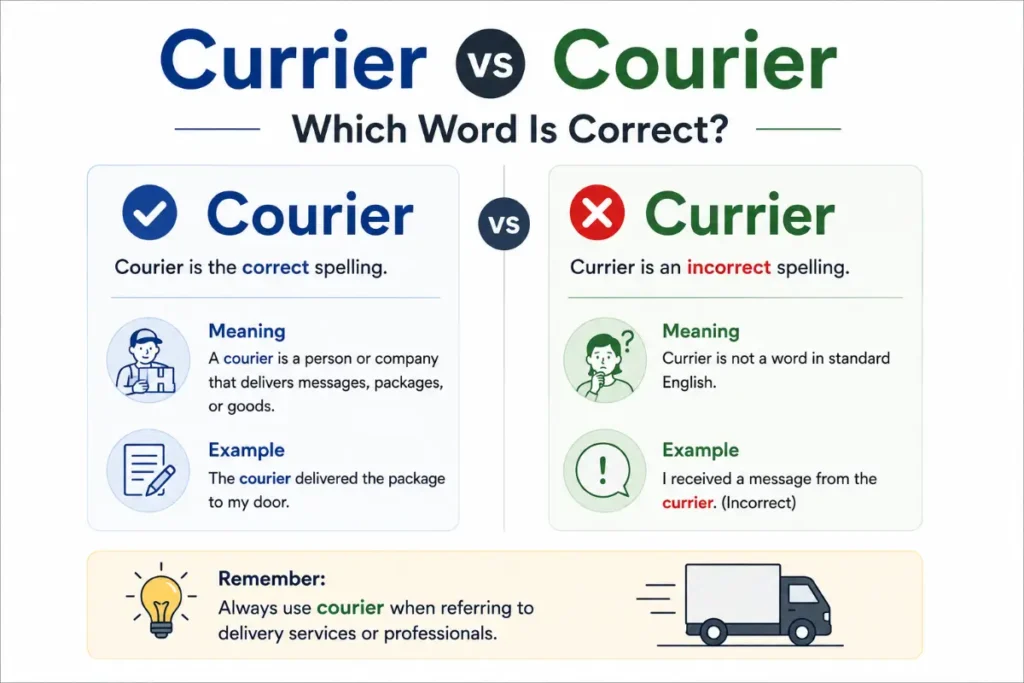
Both forms are correct English words. The important question is which meaning you need. Use courier for delivery.
Use currier for leather work or the traditional grooming sense. If you write that a currier delivered your package you’re probably using the wrong word. The reader may understand your intention from context but the sentence still contains a vocabulary error.
If you write that a courier prepared leather after tanning you have the same problem in the opposite direction. Professional editing focuses on meaning as well as spelling. A spell checker may recognize both words because both exist in English. That means software alone may not catch the mistake.
This is a useful reminder that spelling tools don’t replace context. A word can be spelled perfectly and still be the wrong word for the sentence.
Sentence Examples
Here are natural examples that show how courier works in everyday and professional writing.
- The courier delivered my package before lunch.
- We hired a courier to take the signed contract across town.
- The company sent the replacement part by courier.
- I received a message saying the courier would arrive within an hour.
- Please give the documents to the courier at the front desk.
- The law firm uses a courier for urgent paperwork.
- The store couriered the order directly to the customer.
- A motorcycle courier brought the package to our office.
- The museum sent the fragile item through a specialist courier.
- The courier called before arriving at the delivery address.
These examples cover casual conversation business writing and practical everyday situations. In each case the word refers to delivery or transport.
Here are examples showing the specialized word.
- The currier prepared the leather for the saddle maker.
- The old workshop employed a skilled currier.
- The currier treated the hide before it was sent to the manufacturer.
- Historical records describe the currier as an important member of the leather trade.
- The currier used traditional methods to finish the leather.
These examples make the contrast clear. The two words describe different kinds of work.
Common Mistakes And Misspellings
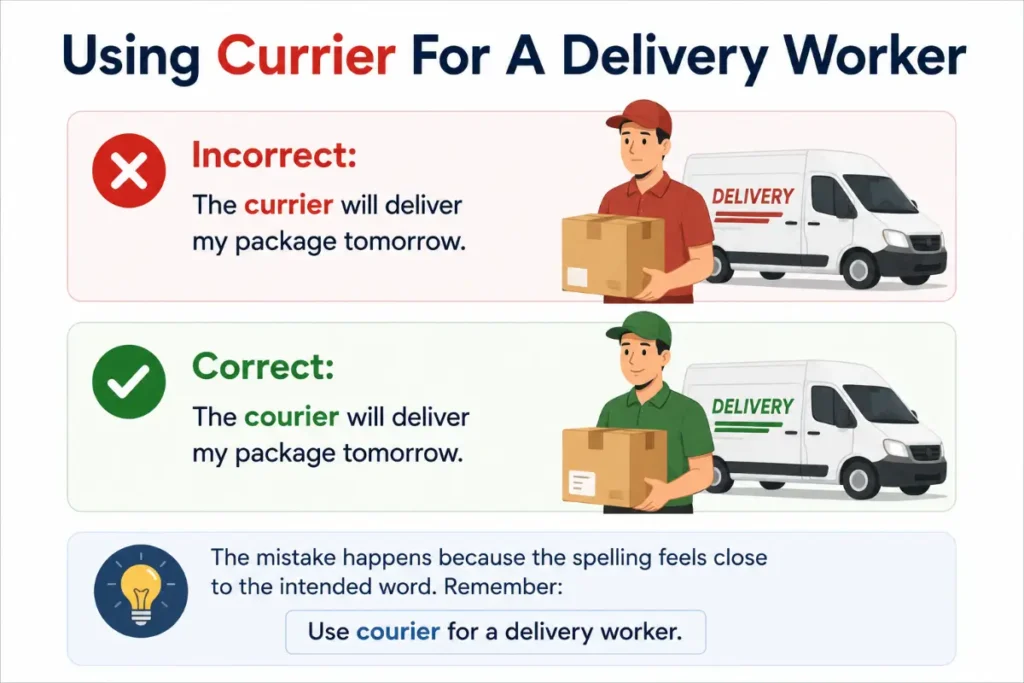
Using Currier For A Delivery Worker
Incorrect:
The currier will deliver my package tomorrow.
Correct:
The courier will deliver my package tomorrow.
The mistake happens because the spelling feels close to the intended word. Remember that package delivery belongs with courier.
Using Courier For A Leather Worker
Incorrect:
The courier prepared the leather.
Correct:
The currier prepared the leather.
The second sentence uses the specialized word for the leather trade.
Treating The Words As Alternate Spellings
Neither word is simply an alternate spelling of the other.
Courier and currier have different meanings and different historical development.
Relying Only On Pronunciation
Sound can help you recognize a word but it may not give you enough information to spell it correctly.
If you hear someone mention a delivery worker you need to connect the sound with the meaning before choosing the spelling.
Trusting Spell Check Without Checking Meaning
A spell checker may accept both words because both are legitimate dictionary entries.
That doesn’t mean both words fit your sentence.
Always check the meaning when two similar words are competing for the same place.
Pronunciation Guide
The American pronunciation of currier is represented by Cambridge as /ˈkɝː.i.ɚ/. The main stress falls on the first syllable. It can sound roughly like KUR ee er.
Courier has the American pronunciation /ˈkʊr.i.ɚ/ in Cambridge. It can sound roughly like KUR ee er with a slightly different vowel at the beginning. Cambridge also records pronunciation variation in its American dictionary entry.
For an easy breakdown:
Currier.
KUR ee er.
Courier.
KUR ee er.
The distinction can be subtle in fast speech. That is one reason the spelling confusion is understandable.
The safest approach is to focus on meaning when writing. If you mean delivery think courier. If you mean leather work think currier.
Etymology And Word Origin
The histories of the two words help explain why they look related even though their modern meanings are different.
Currier has a long history connected with the preparation and treatment of leather. Merriam Webster traces the related verb curry through Middle English forms such as curreyen and correyen and connects those forms with Anglo French words associated with preparing dressing and cleaning.
The noun currier developed as the name for a person who performed this type of work. Merriam Webster records its first known use in the fourteenth century.
Courier has a different history. It entered English through French and Italian forms connected with the idea of running. That historical sense makes sense because a courier was originally someone who traveled quickly to carry a message or information.
The modern meaning expanded naturally from the messenger role to the transport of documents and packages.
This is a useful lesson in word history. Two words can look similar in modern English while having different paths into the language.
Etymology can explain a word but it should not be used as a substitute for its modern meaning. Dictionaries treat word history and present day definition as separate kinds of information.
For another common grammar confusion, see Fliers vs Flyers Meaning and Difference With Easy Examples 2026.
Regional Usage
American English
In American English courier is the normal word for a person or business that delivers packages documents or messages.
You might hear phrases such as courier service courier company or motorcycle courier.
Currier exists in American English but it is uncommon outside specialized contexts. It may appear in discussions of leather work historical trades horse grooming or surnames.
British English
British English also uses courier for delivery services and people who transport documents or packages.
The word has another established British use connected with travel. A courier can be a person who looks after a group of travelers and helps them with arrangements or advice. Cambridge records this travel related meaning in British English.
Currier retains its traditional specialized meaning.
Australian English
Australian English follows the same basic distinction. Courier is the normal term for delivery work. Currier remains a specialized word connected with its established meanings.
There is no major Australian spelling difference that turns one word into the other.
Canadian English
Canadian English also uses courier for delivery and messenger services. Currier remains a separate specialized noun.
For everyday writing in Canada the same memory rule works well.
Delivery means courier.
Leather work means currier.
Grammar Rules And Part Of Speech
Courier is especially flexible because it can act as both a noun and a verb.
As a noun it identifies a person or company.
The courier arrived at nine.
The noun can also appear before another noun.
Courier service is available in our area.
Courier company is another common phrase.
As a verb courier means to send something through a courier.
For example:
We courier important documents to our clients.
The company couriered the replacement part yesterday.
The verb is useful in business writing but send by courier may sound more natural in many everyday situations.
Currier is normally used as a noun because it names a person involved in a traditional occupation.
For example:
The currier prepared the leather.
The sentence follows a simple subject verb object pattern.
You generally won’t need complicated grammar rules for these words. The biggest issue is lexical choice. In other words you need to choose the word that carries the meaning you intend.
This is why context matters so much.
Real Life Usage Examples
Daily Conversation
Courier is common when people talk about deliveries.
My courier just arrived.
The courier left the package at the door.
These sentences sound natural because delivery is a familiar part of everyday life.
Currier is far less likely to appear in casual conversation unless someone is discussing leather work history or horse grooming.
Workplace Communication
Courier is useful in professional messages.
Please send the signed documents by courier.
The courier will collect the package this afternoon.
These sentences are clear and direct. They work well in workplace communication.
Currier may appear in a business connected with traditional leather production.
The currier will finish the leather before production begins.
Academic Writing
Academic writing may use courier when discussing historical communication transportation or delivery systems.
For example:
The ruler sent a courier with instructions for the regional governor.
Currier may appear in historical research about trades and crafts.
For example:
The currier played an important role in the preparation of leather during the period.
News And Journalism
News writing may use courier in stories about delivery services business operations travel or historical events.
For example:
The courier delivered the documents shortly before the meeting.
Historical reporting might use currier when describing an old trade.
For example:
The town once had several workshops employing skilled curriers.
Literature And Storytelling
Courier has a strong historical feel in stories involving kingdoms armies or long journeys.
A courier arrived before dawn with urgent news.
Currier can help establish the setting of a historical story.
The young apprentice watched the currier work the leather.
In both cases the word contributes specific meaning to the scene.
Related And Confused Terms
Several words sit close to courier in meaning or context. Understanding them can make your vocabulary more precise.
Messenger
A messenger carries information from one person to another. The word often focuses on communication rather than commercial delivery.
Delivery Driver
A delivery driver transports goods to customers. The term usually describes the person doing the driving rather than the broader service.
Carrier
Carrier is a broad word for a person or organization that transports something. It can apply to mail packages passengers goods and other things.
Mail Carrier
A mail carrier delivers letters and other mail. In the United States this is a common term for postal delivery workers.
Dispatch Rider
A dispatch rider traditionally carried messages or documents by motorcycle or bicycle. The expression is more historical and specialized today.
Runner
Runner can describe someone who carries messages or performs quick errands. The meaning depends heavily on context.
Leatherworker
A leatherworker makes or repairs products from leather. This is a broader modern term than currier.
Tanner
A tanner treats raw animal hides to turn them into leather. Tanning and currying are related stages of traditional leather production but they are not identical jobs.
The distinction between tanner and currier is useful because both belong to the leather trade. A tanner works on the process that turns hides into leather. A currier traditionally performs further work that prepares and finishes the leather.
Courier And Delivery Language
Modern English uses courier in many practical expressions.
Courier service refers to a service that transports items.
Courier company refers to a business that provides that service.
Courier delivery refers to delivery carried out by a courier.
A courier package is a package being transported through such a service.
The word also appears as a verb in phrases such as courier the documents or courier the package.
In everyday American English you may also hear send by courier. That expression is straightforward and easy to understand.
The important point is that the word has a strong connection with movement and delivery.
If an item needs to move from one place to another and a person or company is responsible for that movement courier is often the natural choice.
Currier And The Leather Trade
Currier belongs to a much older vocabulary connected with skilled manual trades.
Traditional leather production required several stages and specialized workers. A currier worked with prepared leather and helped give it the qualities needed for later use.
The occupation was once far more visible than it is today. Modern readers are therefore more likely to encounter the word in historical documents books museum descriptions or discussions of traditional crafts.
The word can also appear as a surname. Currier is well known as a family name in the United States and elsewhere. A proper name obviously should not be changed simply because it looks similar to courier.
That distinction matters in editing. Context tells you what the writer intends.
Expert Editor Insight
An experienced editor would treat these as two separate vocabulary entries rather than two spelling options. The fastest editing test is to replace the word with a simple phrase. If you mean delivery person or delivery company use courier. If you mean traditional leather worker use currier. Spell check can identify misspelled words but it may not identify a correctly spelled word that has the wrong meaning. Context remains the final test.
A Simple Memory Trick
You don’t need a complicated rule to remember these words.
Think about the job.
A courier carries something.
A currier works with leather.
The word courier contains the familiar idea of moving something from one place to another. That connection makes it easier to remember the spelling when you’re writing about deliveries.
For currier think of curry and leather or horse grooming. The spelling with the double r belongs to this specialized word.
Another useful trick is to picture two different scenes.
Picture a courier standing at your front door with a package.
Now picture a currier working inside an old leather workshop.
The images are completely different. That difference is exactly what you need to remember.
Why Context Matters More Than Spell Check
Many people assume that a spelling tool will always identify the right word. That isn’t true.
Both courier and currier are valid English words. A spell checker can therefore accept either one even when the surrounding sentence requires the other.
Imagine writing:
The currier delivered my new laptop.
The spelling is technically valid. The problem is the meaning.
The sentence suggests that a leather worker delivered the laptop.
If you intended a delivery worker then courier is the correct choice.
This is an important editing principle. Grammar and spelling tools are useful assistants but they don’t fully understand intention. Good writing requires you to check the meaning of the word as well as its spelling.
When To Use Courier
Use courier when you mean someone who delivers or transports messages documents or packages.
It works in casual writing.
The courier dropped off my package.
It works in business writing.
We sent the contract by courier.
It works in formal writing.
The organization appointed a courier to transport the documents.
It also works as a verb.
We will courier the documents tomorrow.
If the central idea is delivery courier is almost certainly the word you need.
When To Use Currier
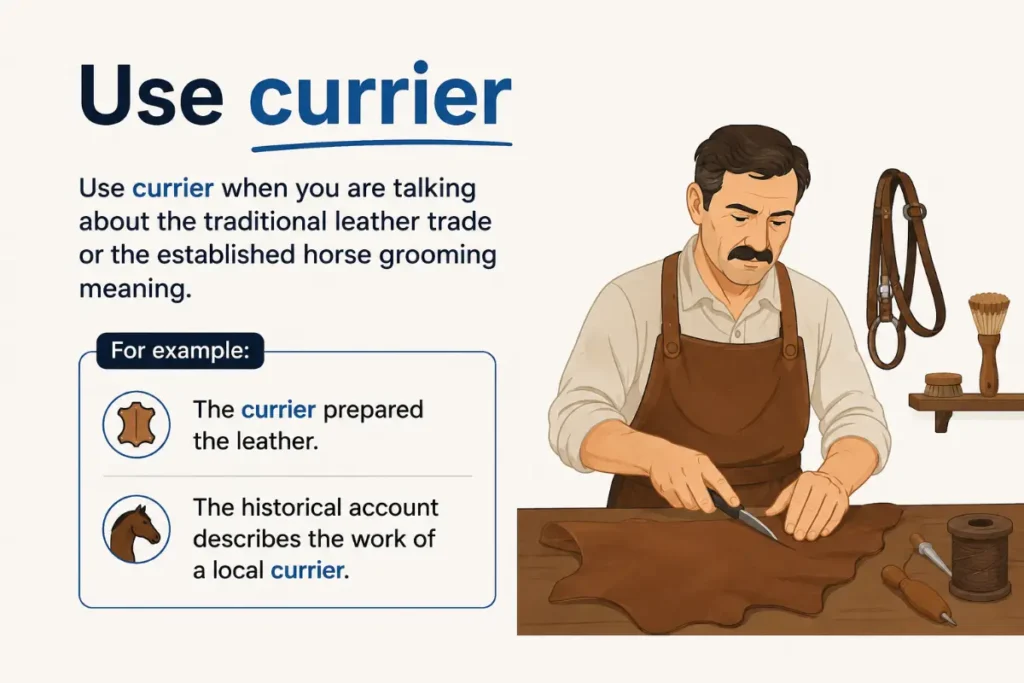
Use currier when you are talking about the traditional leather trade or the established horse grooming meaning.
For example:
The currier prepared the leather.
The historical account describes the work of a local currier.
The word is uncommon in everyday American English but it remains legitimate.
You may also encounter Currier as a surname or part of a proper name. In that situation it functions as a name rather than the ordinary occupational noun.
The key is context
Many readers also check Nosey or Nosy Which Word Should You Use in 2026?.
Conclusion
The answer to currier vs courier depends on what you mean. Use courier for a person or company that delivers packages documents or messages. Use currier for a traditional leather worker or someone who grooms a horse.
The two words look similar enough to cause confusion but they aren’t interchangeable. Courier is the word you’ll need in modern delivery and business writing. Currier is a legitimate but specialized word that appears mainly in discussions of leather work history horse grooming and names.
A simple memory trick can save you every time. Think delivery when you see courier. Think leather or grooming when you see currier. When you’re unsure always check the meaning rather than relying only on spell check. That small habit will help you choose the right word with confidence.
FAQs
Is currier a real word?
Yes. Currier is a legitimate English noun. It traditionally refers to a person who prepares and finishes leather. It can also refer to someone who grooms a horse using a currycomb. The word has a long history in English and is recorded in major dictionaries. It is simply much less common in everyday American English than courier.
What does courier mean?
Courier means a person or company that carries messages documents or packages from one place to another. The word is common in modern business and delivery language. Courier can also function as a verb meaning to send something through a courier service.
Which spelling should I use for package delivery?
Use courier for package delivery. A courier can deliver packages documents letters and other items. Currier does not mean a delivery worker. It refers mainly to a traditional leather worker or someone connected with horse grooming. If your sentence involves shipping or delivery courier is the correct choice.
How do you pronounce currier?
In American English currier is commonly represented as /ˈkɝː.i.ɚ/. A simple pronunciation guide is KUR ee er. The stress falls on the first syllable. The word can sound similar to courier in fast conversation so the meaning and spelling need careful attention.
How do you pronounce courier?
In American English Cambridge gives courier as /ˈkʊr.i.ɚ/. An easy guide is KUR ee er. The first vowel differs from the American pronunciation listed for currier. Because the words can sound close in natural speech it helps to connect the word with its meaning.
Is courier appropriate in formal writing?
Yes. Courier is completely appropriate in formal writing. It appears naturally in business communication legal documents shipping information historical writing and other professional contexts. You can use phrases such as courier service or send the documents by courier. The word is standard English and does not sound overly casual.
Why do people confuse these two words?
People confuse them because they look almost identical and have similar sounds. Courier is also far more familiar to most modern readers while currier is specialized. When someone remembers the sound but not the spelling it is easy to choose the wrong form. The best solution is to connect each spelling with its meaning.
Is currier an alternative spelling of courier?
No. They are separate words rather than alternate spellings. Courier refers to delivery and message carrying. Currier refers mainly to traditional leather work and horse grooming. The spelling difference reflects a difference in word history and meaning. Using one as a replacement for the other can change the meaning of a sentence.