
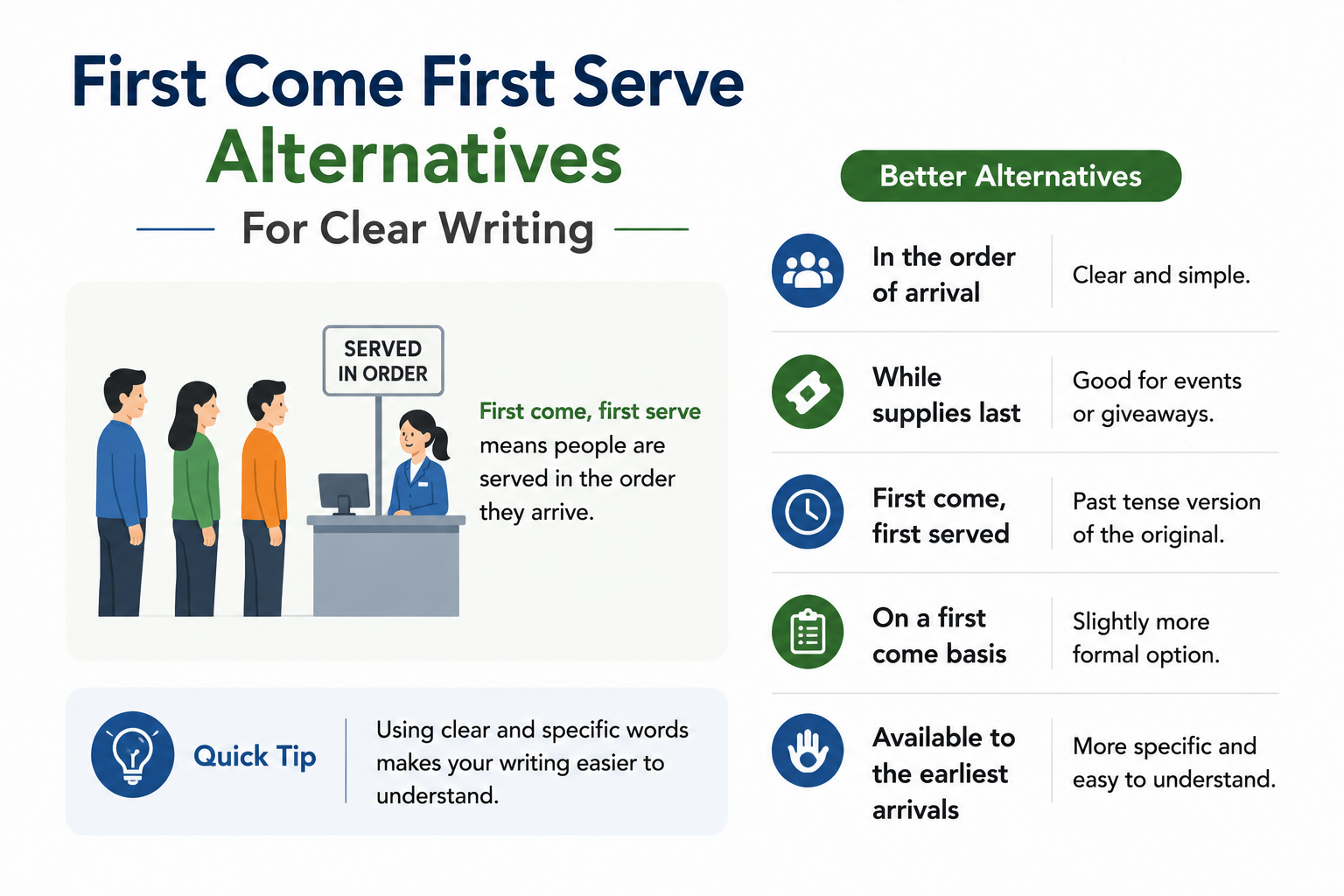
If you need first come first serve alternatives you probably want wording that sounds natural and professional without changing the basic meaning. The standard expression is first come first served. It means that people receive something based on the order in which they arrive or make a request. The shorter form first come first serve is common in everyday writing but many editors consider it nonstandard.
The confusion comes from the structure of the phrase. Serve is a base verb while served works as the past participle in this expression. The idea is that people who come first get served first. That makes first come first served the conventional form.
Still there are plenty of situations where you can choose a cleaner alternative. Depending on your message you might write first in line gets priority or service is provided in order of arrival. In this guide you’ll learn the best alternatives how each one sounds and when to use them in professional casual academic and public communication.
Learn the difference in it means a lot alternatives for Natural English.
Quick Definition
The best alternative to first come first serve depends on your context. For most situations use first come first served when you want the traditional expression. Other clear choices include service is provided in order of arrival and priority is given to those who arrive first. These options can sound more direct in formal writing.
Quick Answer
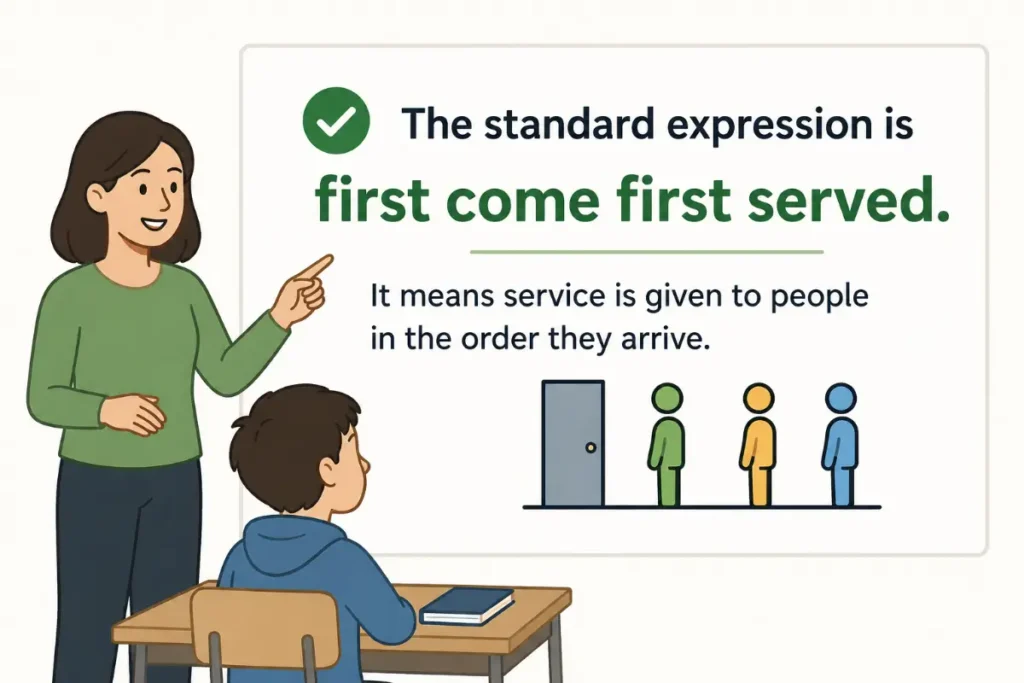
The standard expression is first come first served. If you want an alternative you can say first in line gets priority or people are served in order of arrival. In formal notices you can also write priority is given based on arrival order. These versions remove ambiguity and make the rule immediately clear.
Comparison Of Useful Alternatives
| Alternative | Meaning | Part of Speech | Origin | Usage Frequency | Formality | Common Contexts | Example |
|---|---|---|---|---|---|---|---|
| First come first served | People who arrive first receive service first | Idiomatic phrase | Traditional English expression | Very high | Neutral | Events bookings services | Seats are available on a first come first served basis. |
| First in line gets priority | The person who reaches the line first gets served first | Sentence phrase | Modern English | High | Neutral | Queues offices stores | First in line gets priority. |
| Served in order of arrival | Service follows the order in which people arrive | Passive verb phrase | Modern English | Moderate | Formal | Policies offices appointments | Requests are served in order of arrival. |
| Service is provided in arrival order | People receive service according to arrival time | Passive construction | Modern administrative English | Moderate | Formal | Notices policies customer service | Service is provided in arrival order. |
| Priority goes to early arrivals | People who arrive early receive priority | Sentence phrase | Modern English | Moderate | Neutral | Events tickets registration | Priority goes to early arrivals. |
| Those who arrive first are served first | The first arrivals receive service before later arrivals | Full sentence | Plain English | High | Neutral | General communication | Those who arrive first are served first. |
| Requests are handled in order received | Requests are processed based on when they arrive | Passive verb phrase | Administrative English | High | Formal | Email support applications | Requests are handled in order received. |
| Arrival order determines priority | The order of arrival decides who gets served first | Declarative phrase | Modern English | Moderate | Formal | Rules policies applications | Arrival order determines priority. |
What First Come First Served Means
First come first served describes a system based on order of arrival or order of participation. The person who arrives first gets the opportunity first. Someone who arrives later waits behind those who came earlier.
Imagine a bakery with ten free samples and a line of twenty customers. The first ten people in line can receive a sample. Once the samples run out the remaining customers get nothing. That is a first come first served system.
The expression can apply to more than physical lines. It can describe appointments registrations seats tickets offers applications reservations and limited resources.
For example a community center might announce that workshop spaces are available on a first come first served basis. The center means that people who register first get the available spaces.
The phrase also appears frequently in business communication. A company might tell customers that promotional items are available to the first customers who place an order.
Why First Come First Serve Causes Confusion
First come first serve appears frequently in speech and informal writing. People understand it immediately because the intended meaning is familiar.
The grammar becomes less clear when you examine the final word.
In the standard expression the people who come first are served first. The word served describes what happens to those people. The construction therefore uses the past participle served rather than the base verb serve.
You can think of the full idea as this.
Those who come first are served first.
The shorter phrase first come first serve leaves out the grammatical structure that makes served appropriate. It has become common through everyday use but many style guides and editors still recommend first come first served.
That distinction matters most in polished writing. A casual social media post may use the shorter version without causing confusion. A company policy university notice public announcement or professional email should normally use the established form.
Best Alternatives For Different Situations
No single replacement works perfectly in every sentence. The strongest wording depends on your audience and purpose.
First In Line Gets Priority
This is one of the clearest alternatives when people physically stand in a line.
First in line gets priority.
The wording is short and easy to understand. It also feels conversational rather than overly formal.
A clinic could say that walk in patients are seen in the order they arrive. A store could explain that customers waiting outside will be helped from the front of the line backward.
Served In Order Of Arrival
This option works especially well in formal communication.
Requests will be handled in order of arrival.
The sentence focuses on the process rather than the people. That makes it useful for policies instructions and customer service messages.
It also removes the idiomatic quality of the traditional phrase. Readers don’t have to interpret an expression because the rule appears directly on the page.
Those Who Arrive First Are Served First
This is probably the most transparent alternative.
Those who arrive first are served first.
There is almost no room for confusion. The sentence explains the entire rule in ordinary language.
Use it when clarity matters more than brevity.
Priority Goes To Early Arrivals
This version works well for events and limited offers.
Priority goes to early arrivals.
It sounds friendly while still communicating the rule. You can use it in event announcements registration information and promotional messages.
Requests Are Handled In Order Received
This alternative is particularly useful for email and administrative communication.
Requests are handled in order received.
It shifts attention from physical arrival to the time a request reaches an organization. That makes it better than first come first served when people aren’t actually arriving in person.
For example a support team can explain that customer messages are handled in the order received.
Arrival Order Determines Priority
This wording sounds more formal and policy focused.
Arrival order determines priority.
It works well when you are explaining a system rather than speaking directly to customers.
The phrase is concise and precise. It also avoids the informal feel that some readers associate with first come first served.
When To Use First Come First Served
The traditional expression remains perfectly useful. You don’t need to replace it simply because alternatives exist.
Use first come first served when the audience already understands the concept and you want a familiar phrase.
For example an event organizer might write that free tickets are available on a first come first served basis.
A restaurant might explain that outdoor tables are first come first served.
A university might announce that limited workshop seats are available on a first come first served basis.
The expression works especially well when space is limited and access depends on arrival or registration order.
When An Alternative Is Better
An alternative can be stronger when you need to remove ambiguity.
Suppose you write that applications are accepted first come first served. A reader may understand the intended meaning immediately. However the phrase doesn’t explain exactly what counts as arriving first.
If applications arrive by email then requests are handled in order received is more precise.
If people register online then registrations are processed in the order received may be the best option.
Good editing isn’t about replacing familiar phrases simply to sound sophisticated. It’s about choosing words that fit the situation.
Common Grammar Mistakes
First Come First Serve
This is the most common variation. Many people use it because serve sounds natural after first come first. However standard edited English generally favors first come first served.
First Comes First Served
This version changes the structure and can sound awkward when used as a replacement for the established expression.
First Come First Serving
This form doesn’t work as the standard idiom. Serving has a different grammatical function and changes the structure of the phrase.
First Arrive First Serve
This version removes the grammatical pattern and doesn’t sound natural in standard English.
First Come First Get
People sometimes create shortened versions such as first come first get. The meaning may be understandable but the expression isn’t idiomatic English.
How Native Speakers Understand The Expression
Native speakers usually process first come first served as one familiar unit. They don’t stop to analyze every word.
That’s why the phrase can feel grammatically unusual while still sounding natural to experienced speakers.
The same thing happens with many idioms. Once a phrase becomes established people recognize the entire pattern rather than constructing it word by word.
Still standard writing favors the conventional form. If you’re writing for customers colleagues students or a broad public audience first come first served is the safer choice.
First Come First Served In Formal Writing
The expression works in formal writing as long as the context supports it.
You might see it in policies notices registration instructions and service information.
For example a community program could state that applications will be accepted on a first come first served basis.
However formal writing often benefits from greater precision. If an organization processes applications electronically then applications are reviewed in the order received may communicate the actual process more accurately.
This is a useful editing principle. Familiar wording isn’t always the most precise wording.
First Come First Served In Casual Writing
Casual writing gives you more freedom.
A friend might text that concert tickets are first come first served. A social media post might tell followers that free samples are available to the first people who arrive.
In these situations the expression feels natural and friendly.
You can also make the message more conversational.
Come early because spots are limited.
The first people here will get a spot.
Get here early to secure your place.
These alternatives often sound more energetic than the traditional idiom.
Examples In Everyday Communication
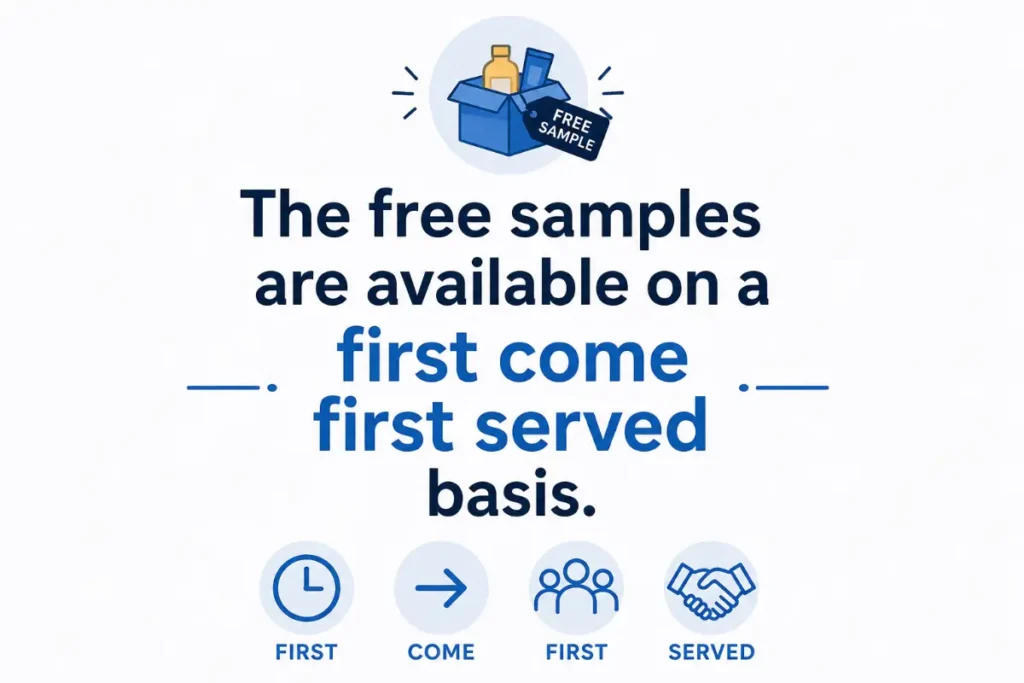
- The free samples are available on a first come first served basis.
- The first people in line will receive a gift.
- Guests will be seated in order of arrival.
- Early arrivals will receive priority.
- Requests are handled in the order they are received.
- The first twenty customers can claim the offer.
- Seats will be given to people who arrive first.
- Registration will be processed according to arrival time.
- Once all spaces are filled no additional registrations will be accepted.
- Please arrive early because available seats are limited.
Examples For Business Emails
- We have a limited number of spaces and registrations will be processed in the order received.
- Because availability is limited priority will go to customers who submit their requests first.
- We’ll review all requests in the order they arrive.
- The first customers to complete registration will receive confirmation.
- Please register early to secure your place.
These versions often work better in professional email because they state the process directly.
Examples For Academic Writing
Academic and institutional writing usually benefits from precision.
- Applications will be reviewed in the order received.
- Workshop places will be assigned according to registration time.
- Students who register first will receive priority.
- Available spaces will be allocated in order of application.
- Registration will close once all available places have been filled.
Notice how these sentences avoid an idiom entirely. That can make institutional writing easier to interpret.
Examples For Public Notices
Public notices need to communicate quickly.
- First come first served.
- The first fifty visitors will receive a free guide.
- Service is provided in order of arrival.
- Early arrivals receive priority.
- Spaces are limited and will be assigned in arrival order.
For a sign or poster the shortest version may be best. For a formal policy the longer explanation may be preferable.
Learn the difference in Professional Apology Alternatives For Better Communication.
First Come First Served Compared With First In Line Gets Priority
These expressions share the same basic idea but they aren’t identical in every context.
First come first served is broader. It can describe physical arrival registration booking applications or access to limited resources.
First in line gets priority usually suggests a physical queue.
Consider a concert where people register online. First come first served works naturally. First in line gets priority could sound strange because there isn’t a physical line.
Now imagine a bakery with customers waiting outside. First in line gets priority is direct and easy to understand.
Choose the phrase that matches the actual process.
First Come First Served Compared With Eventually
Eventually doesn’t mean the same thing.
Eventually describes something that happens after some time. It doesn’t automatically say that people are served in arrival order.
For example a customer might eventually receive a response. That doesn’t tell us which customer receives attention first.
First come first served describes priority.
Eventually describes timing.
Keeping these meanings separate will help you choose the right word.
First Come First Served Compared With At Last
At last usually expresses relief or satisfaction because something finally happened.
For example you might say that the package arrived at last.
That doesn’t communicate a queue or priority system.
First come first served tells readers how access is decided.
At last tells readers that an anticipated event has finally occurred.
They belong to different semantic fields even though both can involve the passage of time.
First Come First Served Compared With In The End
In the end refers to the final result of a situation.
For example a team might struggle throughout a project but succeed in the end.
It doesn’t mean that the first person to arrive gets priority.
This distinction matters because phrases connected with time can look similar while serving very different purposes.
Related Expressions And Semantic Terms
Several expressions connect to the idea of sequence priority timing or final results.
- At last refers to something happening after a long wait.
- Eventually refers to something happening after some time.
- Ultimately refers to the final result or outcome.
- At the end refers to the final point of something.
- Conclusively refers to something established with a definite result.
- In the end refers to the eventual result of a situation.
- Lastly introduces the final item in a sequence.
- In order of arrival directly describes a process based on arrival time.
These expressions aren’t interchangeable. Context determines the right choice.
Pronunciation Guide
First come first served is pronounced naturally as a connected phrase rather than as four completely separate words.
The pronunciation of first is /fɝːst/ in American English.
Come is /kʌm/.
First is again /fɝːst/.
Served is /sɝːvd/.
A natural spoken rhythm sounds close to first kum first survd.
In fast conversation some sounds become less distinct. That doesn’t change the spelling.
A common pronunciation mistake is to give served too much emphasis or pronounce it as two syllables. In standard American English served has one syllable.
The alternative first in line gets priority has a different rhythm and may be easier to say in conversational situations.
Etymology And Word History
The expression first come first served developed from the straightforward idea that people who arrive earlier receive attention before people who arrive later.
Its structure reflects an older English pattern in which a past participle describes what happens to someone.
The phrase became established as a common way to describe queues and limited opportunities. Over time it expanded into business communication event policies registration systems and public notices.
The individual words have much older histories. First traces back through Old English forms connected with the idea of being foremost. Come also has Old English roots. Serve entered English through Anglo French and ultimately traces to Latin servire meaning to serve.
The full expression is therefore a blend of very old English vocabulary and a long established idiomatic structure.
Regional Usage In The United States
In the United States first come first served is extremely common. You’ll see it in event announcements customer service information registrations and public notices.
First come first serve also appears frequently in informal American writing. It is understandable but many professional editors prefer the conventional served form.
American writers often replace the phrase with direct wording when they want a warmer or clearer tone.
Regional Usage In The United Kingdom
British English also commonly uses first come first served.
The same grammatical preference applies. Edited British writing generally favors served rather than serve.
You may encounter first come first serve in casual communication but it isn’t normally the preferred polished form.
Regional Usage In Australia
Australian English uses first come first served in much the same way as American and British English.
The phrase appears in notices event information and everyday communication.
Writers can also choose direct alternatives such as places will be allocated in order of arrival when a formal tone is needed.
Regional Usage In Canada
Canadian English follows the same general pattern.
First come first served is the standard expression used in many forms of public and professional communication.
First come first serve may appear in informal writing but served remains the safer choice for edited content.
Grammar And Sentence Structure
First come first served is an idiomatic construction.
The word first functions as an adverb describing the order in which people come.
Come functions as a verb.
First appears again to establish the priority sequence.
Served functions as a past participle that describes what happens to the people who arrive first.
You can expand the expression into a complete sentence.
Those who come first are served first.
That expanded version makes the grammatical logic easier to see.
The expression can also follow the verb be.
Tickets are available on a first come first served basis.
You don’t need to capitalize every word when the phrase appears inside a sentence. Capitalize it only when normal sentence rules require capitalization.
Punctuation And Style
The expression is often written without commas.
First come first served is the cleanest standard form.
Some writers insert commas because they hear two separate ideas. In most ordinary uses those commas aren’t necessary.
You may also see first come first served hyphenated before a noun in some editorial styles. However since your writing preference avoids hyphens the safest practical approach is to rewrite the sentence when the construction creates awkwardness.
For example instead of forcing the phrase into a complicated noun modifier you can write that spaces are given to people in order of arrival.
Clear writing usually beats complicated punctuation.
Expert Editor Insight
As an editor I’d treat first come first served as the standard choice when you want the familiar idiom. If your audience needs exact information then I’d often replace it with a direct sentence such as requests are handled in the order received. Grammar tools may flag first come first serve because the base verb doesn’t fit the established construction. Spell checkers can also overlook the issue because both serve and served are valid English words. That is why context and sentence structure matter more than a simple spell check.
Expert Tip
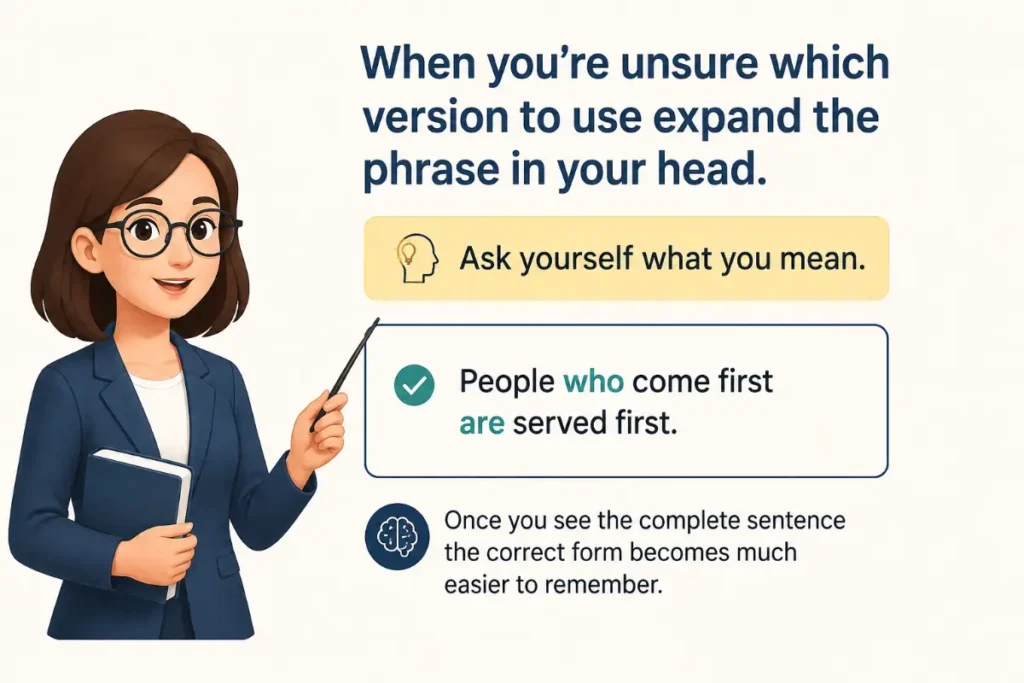
When you’re unsure which version to use expand the phrase in your head. Ask yourself what you mean. People who come first are served first. Once you see the complete sentence the correct form becomes much easier to remember. If you need maximum clarity don’t rely on the idiom at all. Write the rule directly. For example say requests are handled in the order received. That sentence tells readers exactly how the system works.
Learn the difference in As Well As Alternatives for Clearer English.
Final Takeaway
The best first come first serve alternatives depend on what you’re trying to communicate. For a familiar expression use first come first served. For applications or online requests use requests are handled in the order received.
The main grammar point is simple. Served is the conventional form because the phrase means that people who come first are served first. First come first serve is common but it isn’t the preferred form in careful edited English.
As a practical tip remember the complete sentence instead of memorizing four separate words. People who come first are served first. That small mental check makes the correct expression much easier to use and helps you choose a clearer alternative when the situation calls for one.
FAQs
Is first come first serve a real word?
First come first serve is not usually treated as the standard form of the established expression. People use it frequently and most readers understand it. However edited English generally prefers first come first served. The shorter version is best avoided in formal writing when you want to follow conventional grammar and editorial practice.
What does first come first served mean?
First come first served means that people who arrive or make a request first receive priority over people who arrive later. It commonly applies to limited seats tickets appointments registrations services and resources. The expression describes a system based on sequence. The first person gets attention before the next person.
First come first serve or first come first served which is correct?
First come first served is the standard form. The word served works as a past participle in the established expression. You can understand the grammar by expanding it to people who come first are served first. First come first serve is common in informal use but served is the safer choice for professional and edited writing.
How do you pronounce first come first served?
In American English first is pronounced /fɝːst/ and come is /kʌm/. First is pronounced /fɝːst/ again and served is /sɝːvd/. The final word has one syllable. In natural conversation the phrase often flows together quickly. Focus on the main sounds rather than giving each word heavy emphasis.
Can first come first served start a sentence?
Yes. The expression can begin a sentence when it introduces a rule or condition. For example you can write First come first served applies to all available seats. You can also write First come first served means that earlier arrivals receive priority. Capitalize First because it begins the sentence.
What is a synonym for first come first served?
Useful alternatives include first in line gets priority, served in order of arrival, priority goes to early arrivals, and requests are handled in order received. The best choice depends on the situation. If people are physically waiting in line then first in line gets priority works well. For digital requests use order received instead.
Why do people misspell first come first served?
People often write first come first serve because serve fits naturally with the repeated structure first come first. Everyday speech can also blur the final sound. Since both serve and served are real English words spell checkers may not always catch the problem. Familiarity with the complete sentence people who come first are served first helps prevent the mistake.
Is first come first served suitable for formal writing?
Yes. First come first served is acceptable in formal writing and appears frequently in policies notices and institutional communication. However a direct alternative can sometimes sound more precise. For example applications are reviewed in the order received clearly describes an administrative process. Choose the wording that gives your readers the clearest picture of how priority actually works.