
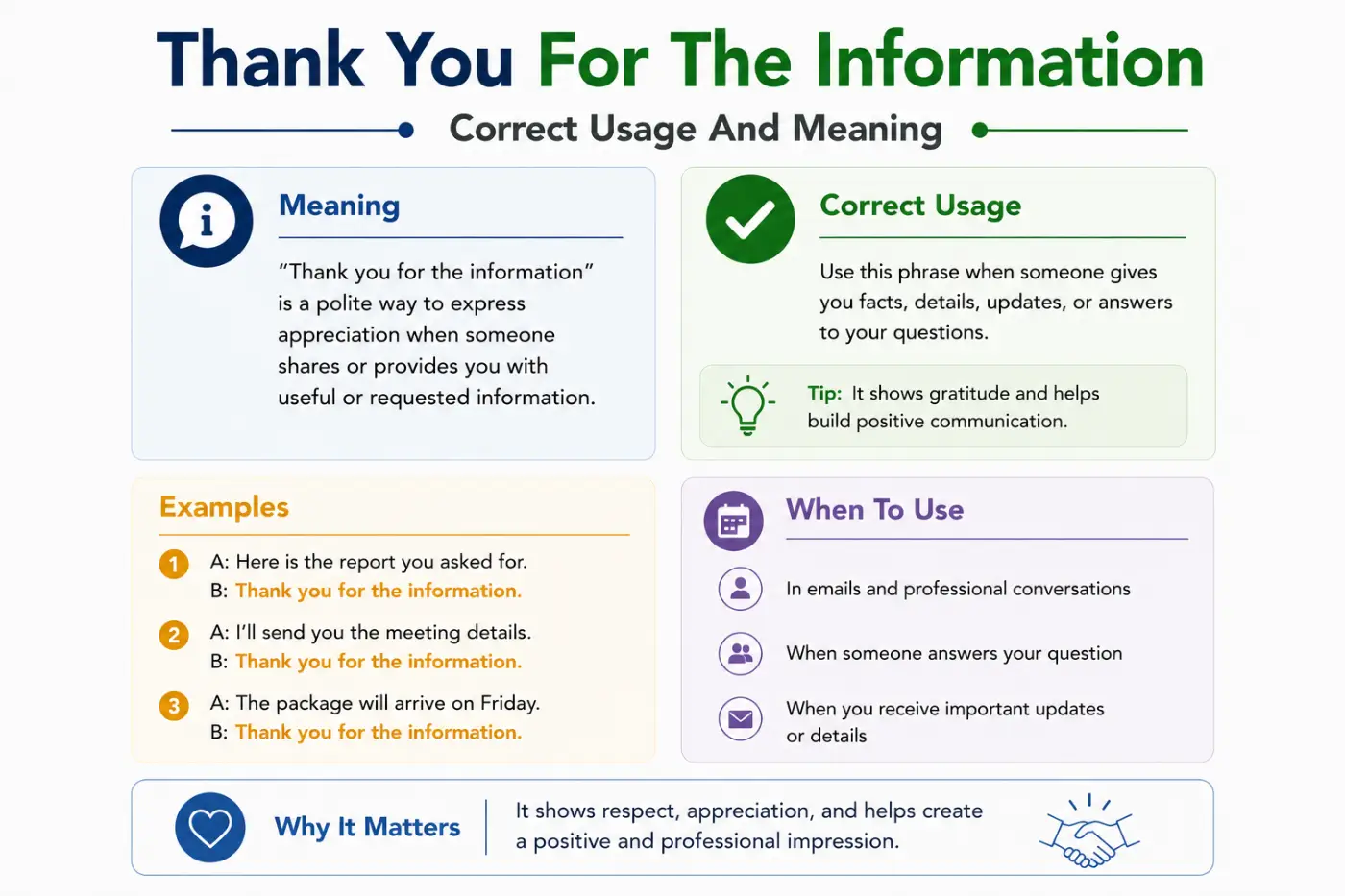
Thank you for the information is a common English phrase used when someone gives you useful facts details or an update. It tells the other person that you received the information and appreciate them sharing it with you. The phrase is grammatically correct and works well in both everyday and professional communication.
People often wonder if the phrase sounds natural or if a different expression would be better. The answer depends mainly on the situation. In a short workplace email the phrase can sound polite and professional. In casual conversation you might choose a warmer or simpler expression such as thanks for letting me know and In formal communication you may want a slightly more polished version.
This guide explains the meaning grammar pronunciation tone punctuation and practical use of the phrase. You’ll also see natural examples for emails conversations school writing and professional situations. By the end you’ll know when to use it and which alternatives fit different situations.
Still confused? Compare Reins and Reigns Definitions Examples and Grammar Guide 2026.
Quick Answer
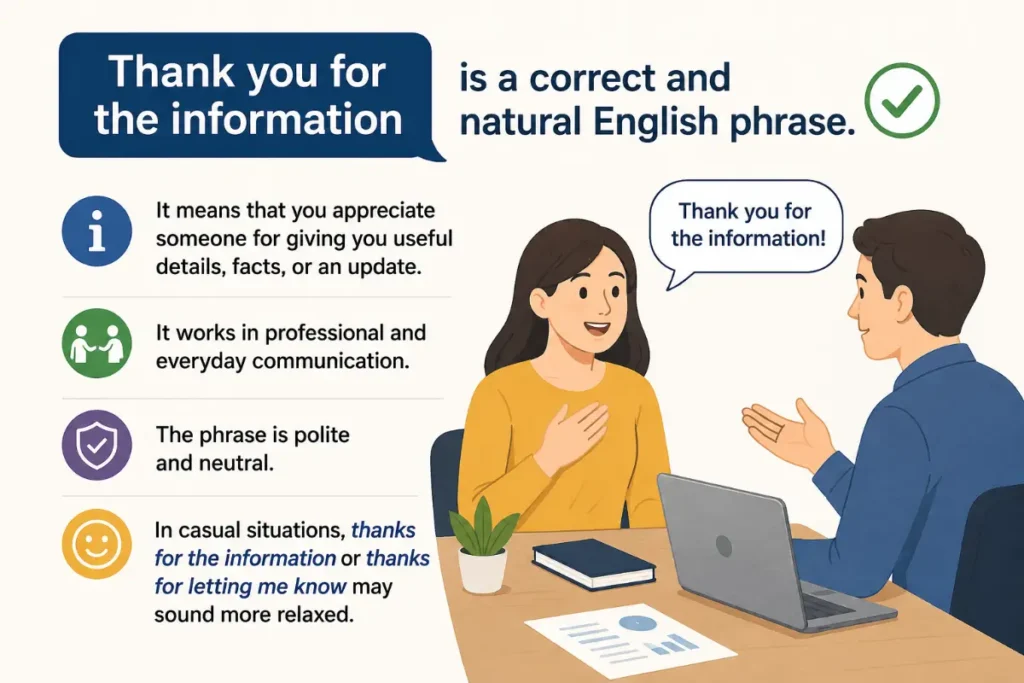
Thank you for the information is a correct and natural English phrase. It means that you appreciate someone for giving you useful details facts or an update. It works in professional and everyday communication. The phrase is polite and neutral. In casual situations thanks for the information or thanks for letting me know may sound more relaxed.
Quick Answer For Everyday Use
You can use this phrase after someone gives you information that you needed or found useful. It can stand alone as a complete response or appear inside a longer sentence.
For example:
Thank you for the information. I’ll review the documents today.
The phrase does not tell the reader exactly how important the information is. It simply shows appreciation for receiving it. That makes it flexible.
In a workplace setting it can sound calm and professional. In a personal conversation it can sound polite but slightly formal. Your relationship with the other person and the situation usually determine the best alternative.
Meaning And Definition
The phrase expresses gratitude for information that another person has provided.
In simple English it means that you appreciate someone for telling you something or giving you useful details.
The word thank is a verb. It means to express gratitude to someone. The word you identifies the person receiving the thanks. The preposition for connects the gratitude to the reason for it. The noun information refers to facts details knowledge or an update that someone has shared.
The phrase can refer to a single piece of information or a larger amount of information.
For example:
Thank you for the information about the meeting.
Thank you for the information. It helped me make a decision.
English treats information as an uncountable noun. This point matters because learners sometimes try to use a plural form that does not fit standard English.
Is The Phrase Correct
Yes. The phrase is grammatically correct.
It follows a very common English pattern.
Thank you + for + noun.
The same pattern appears in many everyday expressions.
Thank you for your help.
Thank you for the information.
The phrase can also use a clause after for.
Thank you for letting me know.
Thank you for sending the details.
This pattern makes the expression easy to adapt to different situations.
Grammar Explained
The grammar is straightforward.
Thank is the main verb. You is the object of the verb. For introduces the reason for the gratitude. The information is the noun phrase that identifies what the speaker appreciates.
The structure is:
Thank + someone + for + something.
When the person is you the result is:
Thank you for the information.
You can replace the noun phrase with many other things.
Thank you for your message.
Thank you for the update.
You can also use a gerund phrase after for.
Thank you for helping me.
Thank you for checking the schedule.
This grammar pattern is one reason the phrase feels natural to native English speakers.
Why Information Is Usually Uncountable
Information is normally an uncountable noun in standard English.
That means we generally do not say informations when we mean facts or details.
We also do not normally say an information.
Instead use a piece of information or some information when you need to express quantity.
For example:
Thank you for the information.
Thank you for sharing this information.
If you want to refer to separate items you can use details facts points or pieces of information.
For example:
Thank you for the details.
Thank you for the two pieces of information.
This distinction is especially useful for English learners because many other languages treat the equivalent of information as a countable noun.
Comparison Table
| Form | Meaning | Part of Speech | Formality | Common Contexts | Example |
|---|---|---|---|---|---|
| Thank you for the information | Shows appreciation for information received | Verb phrase | Neutral and polite | Work school daily communication | Thank you for the information. |
| Thanks for the information | Shows appreciation in a more relaxed way | Verb phrase | Informal to neutral | Conversation messages casual email | Thanks for the information. |
| Thank you for letting me know | Shows appreciation for an update or notification | Verb phrase | Neutral and polite | Work conversation email | Thank you for letting me know about the change. |
| I appreciate the information | Shows clear appreciation | Clause | Professional | Work formal communication | I appreciate the information you provided. |
| Thanks for the update | Shows appreciation for new information | Phrase | Informal to neutral | Work messages conversations | Thanks for the update. |
| Thank you for sharing this | Shows appreciation for information or material someone shared | Verb phrase | Neutral | Work school online communication | Thank you for sharing this with me. |
When To Use The Phrase
Use the phrase when someone has given you information that you want to acknowledge.
A person might tell you about a schedule change. You could respond with the phrase.
A colleague might send you instructions. You could use it in an email.
A customer service representative might explain a problem. You could use it to acknowledge the explanation.
A teacher might provide additional details about an assignment. You could respond politely.
The phrase works particularly well when you want to acknowledge information without adding strong emotion.
It can also be useful when you want to keep a conversation brief.
For example:
Thank you for the information. I’ll take a look.
That response acknowledges the message and tells the other person what you plan to do next.
When The Phrase Can Sound Too Formal
The phrase is not overly formal. Still it can sound more formal than some alternatives.
Imagine a close friend telling you that a restaurant has changed its opening time. Saying the phrase is grammatically fine. It might simply sound a little businesslike.
In that situation you could say:
Thanks for letting me know.
Thanks for telling me.
Good to know.
Those options feel more conversational.
Tone matters because English speakers often choose expressions based on the relationship as much as the grammar.
Formal And Professional Usage
The phrase fits professional communication very well.
You can use it after receiving a report an update an explanation a schedule or other useful details.
For example:
Thank you for the information. I’ll review the proposal before our meeting.
Thank you for the information. I’ll share the update with the team.
Thank you for the information. I’ll follow up after I speak with the manager.
The expression is useful because it is polite without sounding overly emotional.
It also gives you room to continue the message.
For example:
Thank you for the information. I’ll review the documents and get back to you tomorrow.
This sounds professional and direct.
Use In Email
The phrase works especially well in email because email often requires a balance between politeness and efficiency.
You can use it near the beginning of a message.
Thank you for the information. I’ll review the schedule and confirm the final details.
You can also use it after someone answers a question.
Thank you for the information. That answers my question.
You can use it before moving to the next issue.
Thank you for the information. I have one more question about the deadline.
The expression does not need a long explanation after it. A short follow up sentence often makes the email more useful.
Use In Workplace Communication
In the workplace people exchange information constantly. A short acknowledgment can prevent confusion and keep communication moving.
Suppose a colleague sends you a revised schedule.
You might write:
Thank you for the information. I’ll update my calendar.
Suppose a manager explains a change in procedure.
You could write:
Thank you for the information. I understand the new process.
Suppose a customer gives you details about an order.
You might say:
Thank you for the information. I’ll check the order status.
In each example the phrase does more than express gratitude. It confirms that you received the message.
Use In Casual Conversation
The phrase is perfectly understandable in casual conversation. However native speakers often shorten it.
You might hear:
Thanks for the information.
Thanks for telling me.
Good to know.
I appreciate that.
The best choice depends on how warm or formal you want to sound.
A friend may prefer thanks for letting me know. A coworker may receive either thanks for the information or thank you for the information without any problem.
Sentence Examples
- Thank you for the information. I’ll read the report tonight.
- Thank you for the information about the new schedule.
- Thank you for the information. It helped me understand the problem.
- Thank you for the information you provided during the meeting.
- Thank you for the information. I’ll contact the office tomorrow.
- Thank you for the information about the application process.
- Thank you for the information. I’ll make the necessary changes.
- Thank you for the information you sent earlier today.
- Thank you for the information. I appreciate your help.
- Thank you for the information about the assignment.
These examples show how flexible the expression can be. It can stand alone or connect naturally to another sentence.
Punctuation And Sentence Structure
The most common punctuation is a period when the phrase stands alone.
Thank you for the information.
You can also use a comma after the phrase when the sentence continues in a way that requires one.
For example:
Thank you for the information, which was very helpful.
You can avoid complicated punctuation by making the thought two sentences.
Thank you for the information. It was very helpful.
That second option often sounds clearer and more natural.
The phrase can also appear at the beginning of a longer sentence.
Thank you for the information about the new policy. I’ll make sure everyone on the team receives it.
In professional writing short clear sentences often work better than one long sentence packed with several ideas.
Pronunciation Guide
The phrase is usually pronounced naturally as part of a sentence rather than as four separate heavily stressed words.
A simple pronunciation guide is:
Thank yoo fer thee in fer MAY shun.
The exact pronunciation varies slightly by speaker. In connected speech the words can flow together.
The main stress usually falls on information when the speaker wants to emphasize the thing being received.
For example:
Thank you for the inforMATION.
In a normal conversation you do not need to stress every word. English rhythm generally gives more emphasis to important content words while smaller function words receive less stress.
Common Pronunciation Mistakes
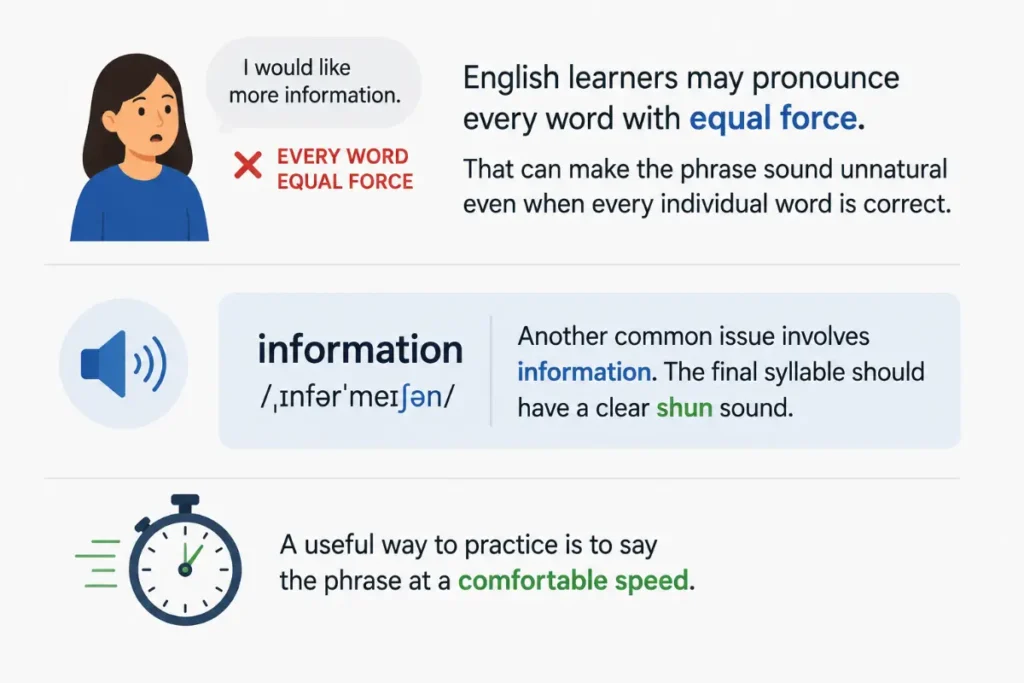
English learners may pronounce every word with equal force. That can make the phrase sound unnatural even when every individual word is correct.
Another common issue involves information. The final syllable should have a clear shun sound.
A useful way to practice is to say the phrase at a comfortable speed.
Thank you for the information.
Then connect it to a natural follow up.
Thank you for the information. I’ll check it today.
Practicing the complete sentence helps develop natural rhythm instead of focusing on isolated words.
Common Mistakes And Better Forms
Several mistakes appear around this phrase.
Using Informations
Incorrect:
Thank you for the informations.
Correct:
Thank you for the information.
Information is normally uncountable in standard English.
Using An Information
Incorrect:
Thank you for an information.
Correct:
Thank you for the information.
If you need to identify one specific item you can say a piece of information.
Thank you for that piece of information.
Forgetting The Preposition
Incorrect:
Thank you the information.
Correct:
Thank you for the information.
The standard structure requires for before the thing that explains the reason for the thanks.
Using Too Much Formal Language
The phrase itself is fine. Problems can arise when you surround it with unnecessarily complicated language.
Simple writing is usually stronger.
Thank you for the information. I’ll review it today.
That is clearer than using several formal expressions to communicate the same idea.
Repeating The Phrase
Using the same expression several times in one email can make the writing feel mechanical.
If you have already thanked someone once you can use another natural expression later.
I appreciate your help.
Thanks for the update.
That answers my question.
Variety makes communication sound more natural.
You may also want to read Space Words That Start With I.
Related Expressions
English offers many alternatives. Each one carries a slightly different tone.
Thanks For The Information
This is the shorter and more casual version.
It works well in conversation messages and many workplace situations.
Thank You For Letting Me Know
This is especially useful when someone has given you an update or told you about a change.
For example:
Thank you for letting me know about the schedule change.
Thanks For The Update
Use this when someone gives you new information about an ongoing situation.
For example:
Thanks for the update. I’ll wait for the final report.
I Appreciate The Information
This sounds more professional and deliberate.
It can be useful when the information required effort to provide.
For example:
I appreciate the information you provided during the meeting.
Thanks For Sharing
This is friendly and natural when someone shares information an idea article or personal experience.
Good To Know
This is very casual.
It shows that the information is useful but does not express gratitude as directly.
I Appreciate Your Help
Use this when the person did more than simply provide information.
It focuses on the assistance rather than the information itself.
Thanks For The Details
This works well when someone provides specific facts or explanations.
It can sound warmer and more conversational than the longer expression.
Real Life Usage Examples
Daily Conversation
Imagine a friend tells you that a store has moved to another location.
You could say:
Thanks for letting me know. I didn’t realize it had moved.
If the conversation is slightly more formal you could say:
Thank you for the information. I’ll check the new location.
The first sounds warmer. The second sounds more neutral.
Workplace Communication
A coworker sends you an updated project schedule.
You could write:
Thank you for the information. I’ll adjust my tasks to match the new timeline.
This response is useful because it acknowledges the message and shows that you understand what to do next.
Academic Writing
A student might receive additional information from a teacher about an assignment.
The student could say:
Thank you for the information. I now understand the requirements.
The phrase works because the student is acknowledging useful guidance in a respectful way.
Customer Service
A customer might receive an explanation about an order.
They could respond:
Thank you for the information. I’ll wait for the next update.
This keeps the tone calm and professional.
Social Communication
Someone might explain why they could not attend an event.
You could respond:
Thanks for letting me know. I hope everything works out.
That sounds more personal than the formal phrase.
American English Usage
The expression is standard in American English.
American speakers use it in workplaces schools emails customer service conversations and everyday communication.
There is no unusual American spelling issue involved. The words follow standard English spelling.
The main difference between situations is tone rather than grammar.
In a business email you might prefer the full form.
Thank you for the information.
In a text message you might naturally shorten it.
Thanks for the information.
In a close personal conversation you might use:
Thanks for letting me know.
These choices are based on context and relationship.
British English Usage
British English also uses the expression naturally.
There is no major British American difference in the phrase itself.
The same grammar applies. The same general punctuation rules apply.
Regional differences in English often involve vocabulary spelling or pronunciation. This particular expression does not create a meaningful difference between American and British usage.
Canadian And Australian English
Canadian and Australian speakers also use the phrase naturally.
As with American and British English the main variation is usually stylistic rather than grammatical.
A professional email may use the full form while a casual conversation may use a shorter expression.
That consistency across major English varieties makes the phrase a safe choice for international communication.
Formality And Tone
Tone is one of the most useful things to understand.
The full phrase has a polite neutral tone.
Thanks for the information has a more relaxed tone.
I appreciate the information sounds more deliberate and professional.
Thanks for letting me know sounds friendly and natural.
Good to know sounds casual and brief.
You can think of these expressions as points along a tone scale.
More formal:
I appreciate the information you provided.
Neutral:
Thank you for the information.
More casual:
Thanks for the information.
Very casual:
Good to know.
None of these expressions is automatically better. The situation determines the strongest choice.
How Native Speakers Choose The Right Expression
Native speakers often make this choice almost automatically.
They consider the relationship between the speakers. They consider the seriousness of the situation and They also consider how much warmth or formality the message needs.
If a manager gives you a policy update the full phrase works well.
If someone spends time researching something for you I appreciate the information may sound more appropriate because it recognizes the effort.
The key is not to search for one perfect phrase for every situation. Good communication gives you several options.
Expert Editor Insight
An experienced editor looks beyond grammar and asks if the wording matches the situation. The phrase is correct but tone can make a bigger difference than correctness alone. In professional writing it is a safe neutral choice. In a friendly conversation a shorter expression may sound more natural. Editors also watch for repetition. If the same phrase appears several times in one message they may replace later uses with expressions such as I appreciate your help or thanks for the update.
Etymology And Word Origin
The phrase itself does not have a single historical origin because it combines several ordinary English words.
Thank comes from the older English word thanc which was connected with thought gratitude and goodwill. Over time the word developed into the modern verb thank.
You comes from the English pronoun used to address another person or people.
Information ultimately traces back through French to Latin roots connected with informing and giving knowledge or understanding.
The modern phrase combines these familiar words into a standard expression of gratitude.
Its long history also helps explain why the structure feels natural. English frequently forms expressions of thanks by using thank followed by a person and for followed by the reason.
Grammar Patterns You Can Reuse
Once you understand the pattern you can build many correct sentences.
Thank you for your help.
Thank you for your patience.
The pattern is productive. You can change the noun or gerund phrase according to the situation.
This makes it one of the most useful structures for polite English communication.
How To Make The Phrase More Specific
The basic phrase is useful but adding a specific detail can make your response sound more sincere.
Compare these two sentences:
Thank you for the information.
Thank you for the information about the application deadline.
The second sentence tells the reader exactly what you appreciated.
You can also explain why the information helped.
Thank you for the information. It clarified the next step.
Or you can state what you will do.
Thank you for the information. I’ll contact the office tomorrow.
Specific details make short messages feel more purposeful.
When To Say Thanks Instead
Thanks is a shortened form of thank you and sounds more casual.
Use thanks when the relationship and situation are relaxed.
For example:
Thanks for the information.
Thanks for your help.
In many workplaces thanks is completely acceptable. Still some situations call for the fuller thank you.
If you are writing to someone you do not know well or communicating in a formal setting the full form is often the safer choice.
Common Confusion With Advice
Information and advice are related but they are not identical.
Information gives you facts or details.
Advice gives you a recommendation about what you should do.
For example:
Thank you for the information about the train schedule.
Thank you for your advice about the interview.
The first sentence thanks someone for facts. The second thanks someone for guidance.
Using the correct noun makes your message more precise.
Common Confusion With Update
An update is a type of information about a situation that has changed or developed.
For example:
Thank you for the update.
This works well when someone tells you about the current status of a project.
The broader phrase can work too:
Thank you for the information about the project.
The choice depends on what you want to emphasize.
If the message contains new developments an update may sound more specific.
Common Confusion With Details
Details are specific pieces of information.
For example:
Thank you for the details about the event.
This sounds natural when someone has given you practical information such as dates times locations instructions or requirements.
Information is broader.
Details are more specific.
That small distinction can help you choose a phrase that sounds precise.
Memory Tip
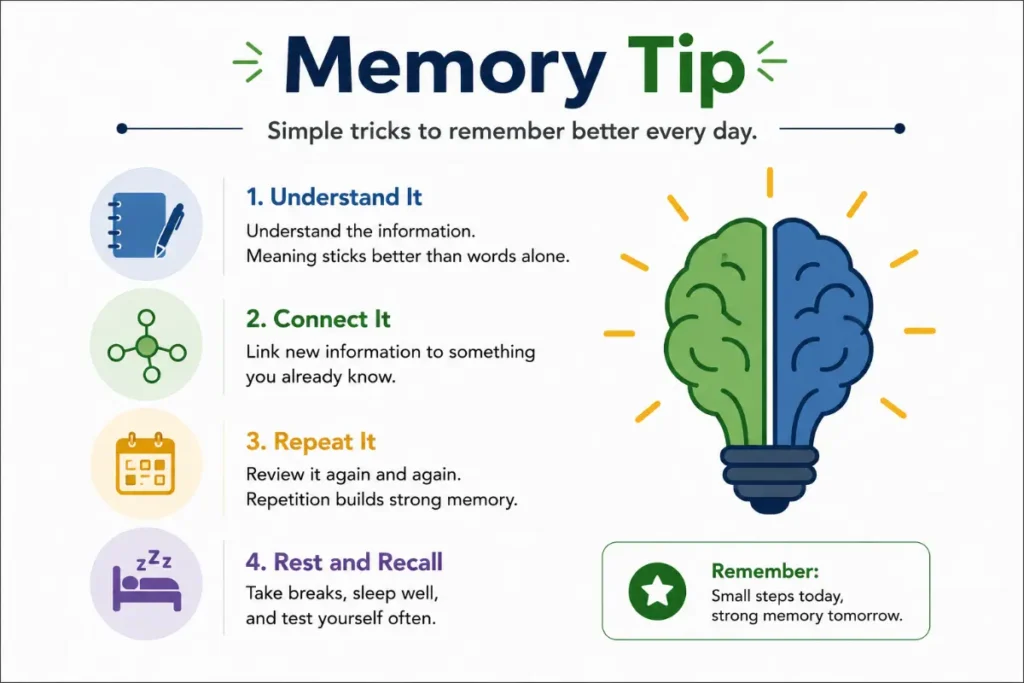
A simple way to remember the grammar is to think of the pattern as thank someone for something. Thank you for the information. Thank you for the reminder. The word for connects the thanks to the reason. If you remember that pattern you can create many correct sentences without memorizing each expression separately.
Final Thoughts
Thank you for the information is a correct and useful English phrase. It expresses appreciation after someone gives you facts details an explanation or an update. Its tone is polite and neutral which makes it suitable for professional emails workplace conversations school communication and many everyday situations.
The main choice is usually about tone rather than grammar. Use the full phrase when you want a clear professional response. Choose thanks for the information or thanks for letting me know when you want something more relaxed. Also remember that information is normally uncountable so avoid forms such as informations or an information. A simple editor’s tip is to match your expression to the relationship and situation. Clear wording almost always sounds more natural than overly formal language.
For another common grammar confusion, see is timeframe one word Correct Spelling And Usage.
FAQs
Is the phrase grammatically correct?
Yes. The phrase follows a standard English grammar pattern. Thank is the verb. You is the person receiving the thanks. For introduces the reason for the gratitude. The information identifies what the speaker appreciates. It is standard English and works in professional communication as well as ordinary conversation.
Is it formal or informal?
It has a neutral and polite tone. It works in formal situations but does not sound excessively formal. In casual conversations many speakers prefer thanks for the information or thanks for letting me know. Your relationship with the other person and the setting should guide your choice.
Can I use it in a professional email?
Yes. It is a good choice for professional emails. You can use it after receiving an update a report instructions or useful details. For example you could write the phrase and then add a sentence explaining what you plan to do next. That keeps the message polite and useful.
Is information countable in English?
Information is normally an uncountable noun. You generally should not write informations or an information in standard English. If you need to count individual items use expressions such as a piece of information or two pieces of information. You can also use words such as details facts or points.
What is a more casual alternative?
Thanks for letting me know is one of the most natural casual alternatives. Thanks for the information also works well. In very casual situations you might simply say good to know. The best option depends on the relationship and the kind of information being shared.
Can I say thanks instead of thank you?
Yes. Thanks is a common shorter form of thank you. It sounds more casual but remains polite in many situations. It is especially common in conversation text messages workplace chats and informal emails. The full form can create a slightly more formal or respectful tone.
What is the difference between information and advice?
Information gives you facts details or knowledge. Advice gives you a recommendation about what action you should take. You can thank someone for information after they provide facts. You can thank someone for advice after they recommend a course of action.
Is it appropriate in formal writing?
Yes. The phrase is appropriate in professional and formal communication. It is clear polite and grammatically correct. If you want a more formal tone you can use I appreciate the information you provided. If you want a warmer tone you can use thank you for letting me know.