
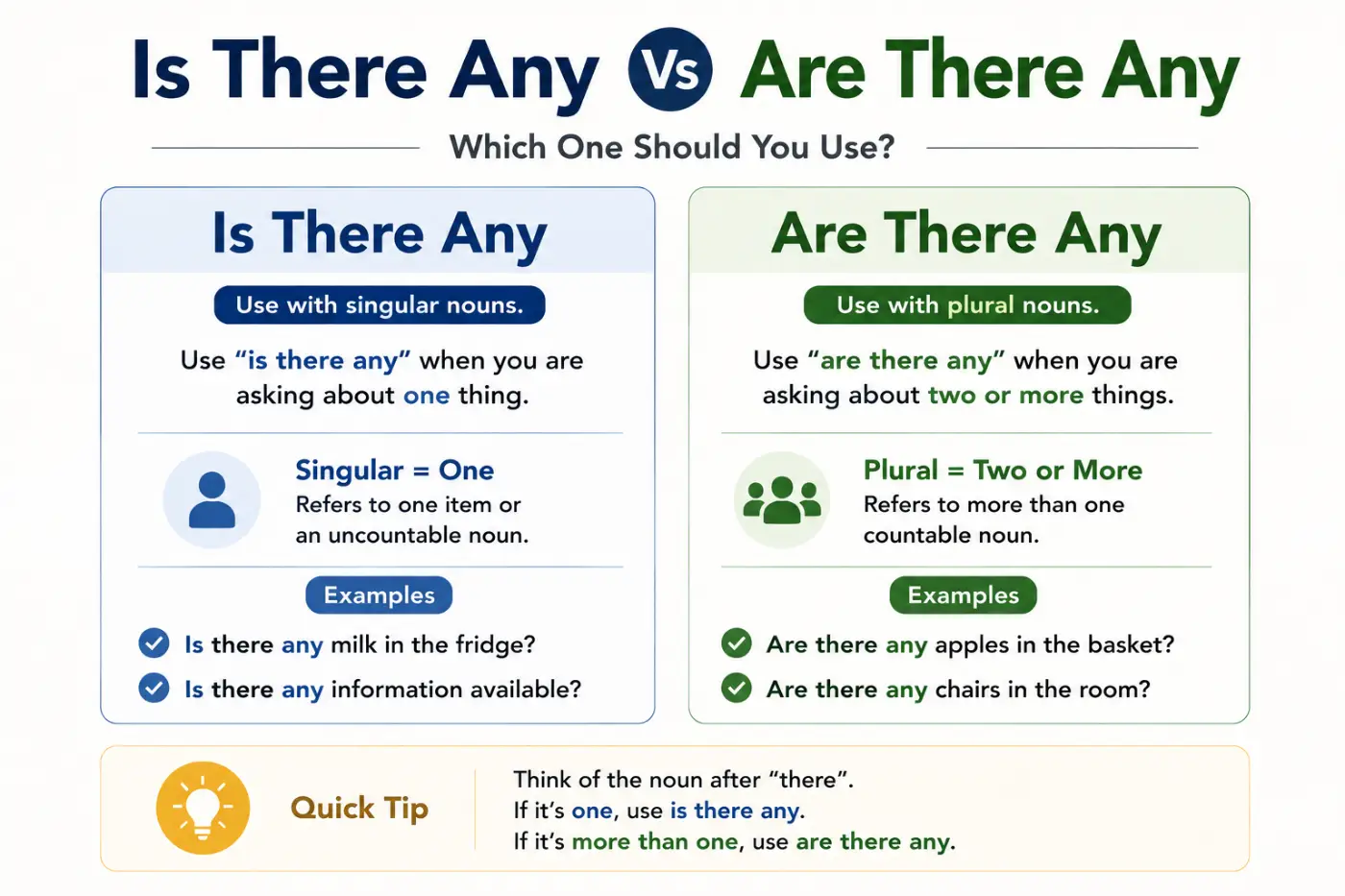
Is there any vs are there any can be confusing because both forms appear in everyday English questions. The correct choice depends on the noun that follows any. Use is there any with an uncountable noun or a singular countable noun. Use are there any with a plural countable noun.
The word any works with different types of nouns, so it doesn’t determine the verb by itself. The noun does. For example, we say Is there any milk? because milk is uncountable, but Are there any tickets? because tickets is a plural countable noun.
Once you identify the noun, the choice becomes much easier. This guide explains the grammar with clear examples from everyday conversation, work, school, and formal writing.
Learn the difference in extent vs extant Meaning and Correct Usage.
Quick Answer
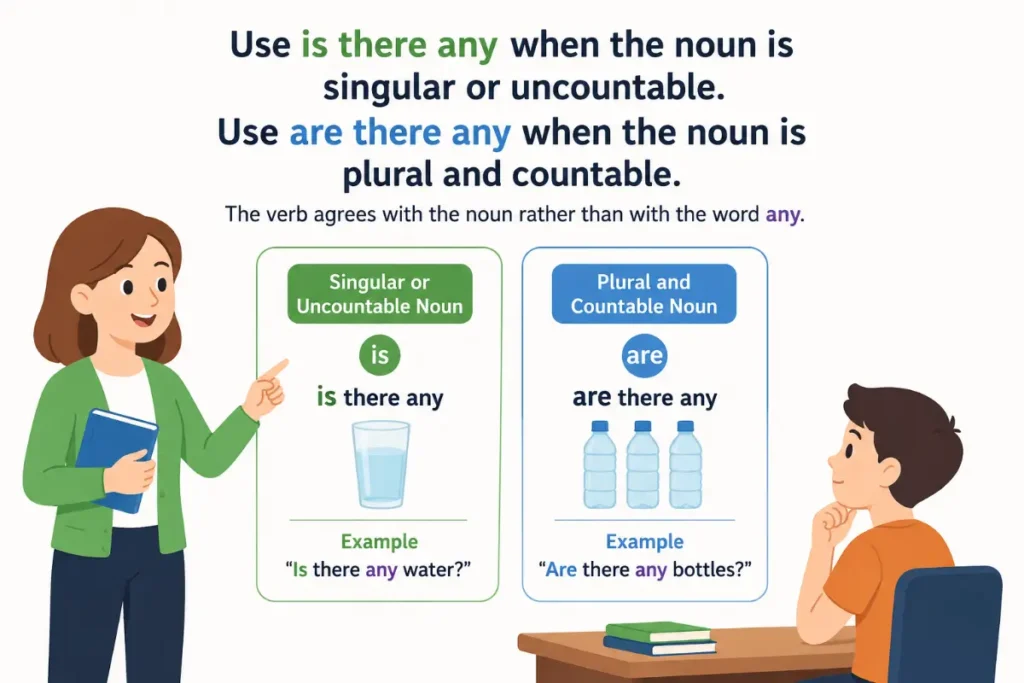
Use is there any when the noun is singular or uncountable. Use are there any when the noun is plural and countable. For example, say “Is there any water?” but say “Are there any bottles?” The verb agrees with the noun rather than with the word any.
Is There Any Vs Are There Any
| Correct Form | Meaning | Part of Speech | Origin | Usage Frequency | Formality | Common Contexts | Example |
|---|---|---|---|---|---|---|---|
| Is there any | Asks about an uncountable noun or a singular countable noun | Question phrase | Modern English grammar | Very common | Neutral | Conversation work school writing | Is there any coffee left? |
| Are there any | Asks about plural countable nouns | Question phrase | Modern English grammar | Very common | Neutral | Conversation work school writing | Are there any seats available? |
The two forms are both correct. Neither one is a misspelling or an incorrect version of the other.
The difference is grammatical rather than lexical.
Why The Verb Changes
English uses subject verb agreement. In simple terms, the verb needs to match the subject.
Consider this sentence.
There is a problem.
The subject is problem. It is singular. Therefore the verb is is.
Now change the noun.
There are problems.
The subject is problems. It is plural. Therefore the verb becomes are.
Questions with there follow the same basic pattern.
Is there a problem?
Are there problems?
Adding any does not change that rule.
Is there any problem?
Are there any problems?
The word any works as a determiner here. It helps describe the noun but does not control the form of the verb.
That distinction is useful because many learners mistakenly focus on any instead of the noun that follows it.
When To Use Is There Any
Use is there any with an uncountable noun.
Uncountable nouns refer to things that English normally treats as a mass rather than as separate individual items. Common examples include water, money, information, advice, furniture, traffic, sugar, milk, time, and work.
You can ask:
Is there any water?
Is there any furniture in the room?
In each example the noun is treated as uncountable. That is why is works.
You can also use this pattern with a singular countable noun.
Is there any reason for the delay?
Is there any student who needs help?
The meaning changes slightly depending on the noun and context. The grammar remains the same.
When To Use Are There Any
Use are there any with plural countable nouns.
A plural countable noun refers to multiple individual things that you can normally count.
Examples include books, cars, students, questions, tickets, restaurants, documents, chairs, and mistakes.
You can ask:
Are there any books on the desk?
Are there any restaurants nearby?
In every example the noun is plural and countable. That is why are is correct.
A useful test is to remove any.
Are there books on the desk?
Are there students in the classroom?
If the plural noun remains natural then are there any will usually be the right choice.
The Role Of Any
The word any can make this grammar rule feel harder than it really is.
Any commonly appears in questions and negative sentences. It can work with both countable and uncountable nouns.
For example:
Is there any coffee?
Are there any cups?
There isn’t any coffee.
There aren’t any cups.
Notice how any stays the same while the verb changes.
That is the clue.
The verb responds to the noun rather than to any.
Think of any as a flexible word that can work with different noun types. The noun still determines the grammatical structure.
Countable And Uncountable Nouns
Understanding countable and uncountable nouns makes this topic much easier.
Countable nouns can normally have singular and plural forms.
One book.
Two books.
One chair.
Three chairs.
One student.
Ten students.
Uncountable nouns are normally treated as substances ideas or masses rather than separate countable units.
Water.
Milk.
Money.
Information.
Advice.
Furniture.
You would normally say:
Is there any information?
You would not normally say:
Are there any informations?
Likewise you would say:
Is there any advice?
Not:
Are there any advices?
The problem here isn’t the question form. The problem is treating an uncountable noun as plural.
Singular Countable Nouns
A singular countable noun can also follow any in certain questions.
Consider:
Is there any reason?
Is there any way to fix this?
The nouns reason, chance, solution, and way are singular countable nouns.
The singular verb is therefore fits the structure.
This pattern is especially common when the speaker is asking if at least one possible thing exists.
For example:
Is there any solution to this problem?
The speaker isn’t necessarily asking about one specific solution. The question asks if even one solution exists.
That is why the singular structure works naturally.
Plural Countable Nouns
Plural nouns require are in this question structure.
Compare:
Is there any solution?
Are there any solutions?
The first question asks if one solution exists.
The second asks if multiple solutions exist.
Both are grammatical. The noun changes from singular to plural and the verb changes with it.
More examples show the pattern clearly.
Is there any reason?
Are there any reasons?
Is there any mistake?
Are there any mistakes?
Is there any option?
Are there any options?
Is there any message?
Are there any messages?
The change is small but meaningful.
Is There Any With Uncountable Nouns
Uncountable nouns are one of the most common reasons people use the singular form.
Here are several everyday examples.
Is there any food left?
Is there any water in the bottle?
These questions sound natural because English treats the nouns as uncountable in these meanings.
Sometimes a noun can be countable in one context and uncountable in another. That can change the question form.
For example consider coffee.
Is there any coffee?
Here coffee means the drink or substance in general.
Now consider a café.
Are there any coffees on the menu?
Here coffees refers to different servings or types of coffee. The noun has become countable in that particular context.
This is why context matters.
When Both Forms Can Be Correct
The choice isn’t always about a fixed word. Context can affect how a noun functions.
Take the word chicken.
Is there any chicken left?
Here chicken refers to food. It is uncountable.
Are there any chickens in the yard?
Here chickens refers to individual birds. It is plural and countable.
The same basic word appears in both questions but the meaning changes.
Another example is experience.
Is there any experience required for this job?
Here experience means knowledge or skill gained over time. It is uncountable.
Are there any experiences you remember from college?
Here experiences refers to separate events. It is plural and countable.
This is an important point for advanced learners. You shouldn’t memorize a verb with every noun as a fixed pair. Learn how the noun functions in the sentence.
Which Form Is Correct
Both forms are correct.
The correct choice depends on the noun.
Use is there any with an uncountable noun or a singular countable noun.
Use are there any with a plural countable noun.
The mistake happens when speakers choose the verb based on any rather than on the noun.
For example:
Is there any books?
This is incorrect in standard English because books is plural.
The correct version is:
Are there any books?
Likewise:
Are there any water?
This is incorrect because water is uncountable in this context.
The correct version is:
Is there any water?
The rule is simple once you focus on the noun.
Ten Natural Sentence Examples
Here are ten examples that show how these forms work in real situations.
- Is there any milk in the refrigerator?
- Is there any information about the new schedule?
- Is there any reason for the change?
- Is there any homework due tomorrow?
- Is there any chance we can meet later?
- Are there any seats available near the front?
- Are there any messages for me?
- Are there any students waiting outside?
- Are there any documents I need to sign?
- Are there any good restaurants near the hotel?
These examples cover everyday speech as well as workplace and school situations.
Notice how naturally the form changes when the noun changes.
You may also want to read focussed or focused Correct Spelling and Usage.
Common Mistakes
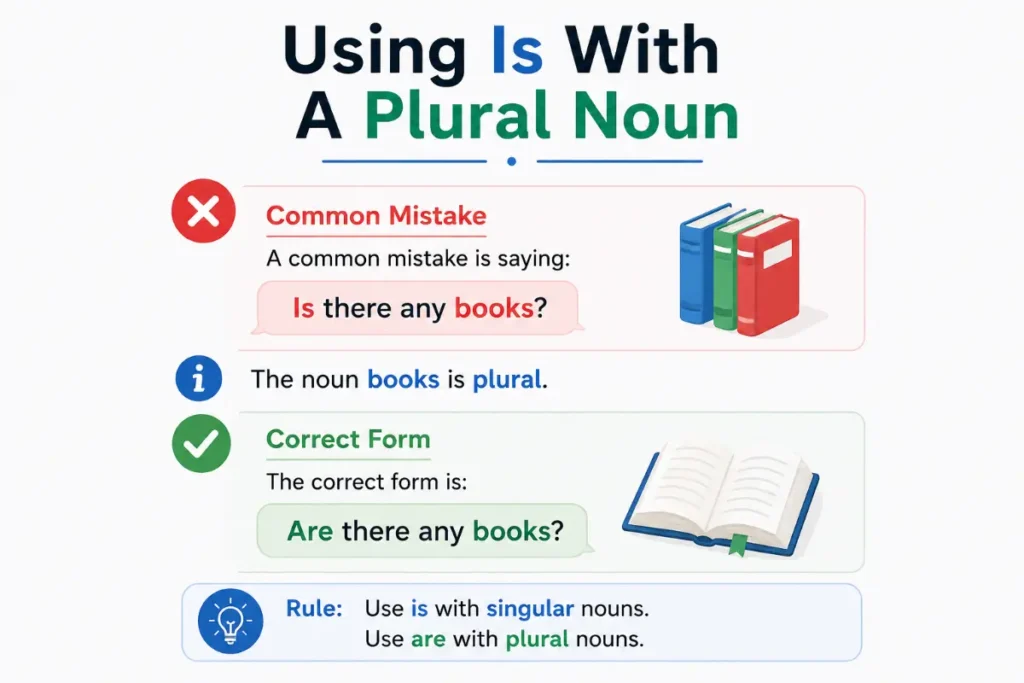
Using Is With A Plural Noun
A common mistake is saying:
Is there any books?
The noun books is plural. The correct form is:
Are there any books?
The easiest fix is to check the noun immediately after any.
Using Are With An Uncountable Noun
Another mistake is:
Are there any information?
Standard English uses information as an uncountable noun in this meaning.
The correct sentence is:
Is there any information?
The same pattern applies to advice and furniture.
Treating Any As The Subject
Some learners think any determines the verb.
It doesn’t.
In these structures the noun after any is the key element for agreement.
Instead of asking yourself which verb sounds right with any ask yourself what kind of noun follows it.
Confusing Singular And Plural Meaning
Compare:
Is there any problem?
Are there any problems?
The first uses a singular noun.
The second uses a plural noun.
Both are grammatical but they don’t have exactly the same structure or meaning.
Translating Directly From Another Language
Learners sometimes build these questions using the grammar of their first language. That can lead to forms that sound logical but aren’t standard English.
English relies heavily on subject verb agreement in this structure.
Learning the pattern through real examples is often more effective than translating word by word.
Pronunciation Guide
The phrase is there any is commonly pronounced in natural speech as a connected group of words.
A simple pronunciation guide is:
iz thair en ee
The exact sound can vary with accent and speaking speed.
The phrase are there any can be approximated as:
ar thair en ee
In careful speech each word remains clear. In casual American English the sounds often connect.
The word there usually carries the main sound in both phrases when the speaker is asking about existence.
Don’t worry about sounding perfectly formal. The grammar matters more than forcing each word into a separate sound.
Etymology And Word Origin
The words in these expressions have long histories in English.
Is comes from an old form of the verb be. The verb be is one of the oldest and most irregular verbs in English and has roots that reach back through Germanic languages.
Are is another present tense form of be. Its history is also connected to older Germanic forms.
There developed from an old demonstrative and locational form. Over time English began using there in existential structures such as there is and there are.
Any has Germanic roots and has long been used to express an indefinite amount or number.
The modern expressions developed through the normal evolution of English grammar. Their forms may look simple today but they reflect centuries of grammatical change.
Regional Usage
American English
Both forms are standard in American English.
Americans regularly use is there any with uncountable and singular nouns.
Is there any gas in the car?
Is there any reason to wait?
They also commonly use are there any with plural nouns.
Are there any stores open?
Are there any questions?
There is no major American English rule that changes the basic distinction.
British English
British English follows the same core rule.
You will hear:
Is there any milk left?
You will also hear:
Are there any buses after midnight?
The same subject verb agreement applies.
Australian English
Australian English also follows the same general grammatical pattern. The choice depends on the noun rather than on a special regional rule.
Canadian English
Canadian English follows the same standard distinction as American and British English in this area.
Regional accents may affect pronunciation but not the basic grammar.
Grammar Rules And Sentence Structure
The basic structure is:
Is there any + singular or uncountable noun?
For example:
Is there any problem?
Is there any sugar?
The plural structure is:
Are there any + plural countable noun?
For example:
Are there any problems?
Are there any questions?
The word there introduces the existence structure. The noun comes later in the sentence.
This can make the grammar feel unusual because the subject isn’t always obvious at first glance.
Compare:
There is a book.
There are books.
Turn those statements into questions and you get:
Is there a book?
Are there books?
Add any and the pattern remains:
Is there any book?
Are there any books?
The grammar hasn’t changed. Only the question has become more open or indefinite.
Punctuation In These Questions
Both forms normally appear as direct questions when the speaker is asking for information.
Use a question mark at the end.
Is there any water?
Are there any tickets left?
In a reported question the punctuation can change because the sentence is no longer a direct question.
For example:
She asked if there was any water.
He wanted to know if there were any tickets left.
The direct question uses is there or are there. Reported speech can shift the tense depending on the context.
Formal And Informal Usage
Both forms work in formal and informal English.
You can use them in conversation.
Is there any coffee left?
You can use them at work.
Are there any documents that require approval?
You can use them in academic settings.
Is there any evidence supporting this claim?
You can also use them in formal writing.
Are there any factors that could affect the result?
The structure itself isn’t informal. The vocabulary around it determines much of the tone.
For formal writing you might choose a more precise noun or a more polished sentence structure. The grammar remains the same.
Real Life Usage Examples
Daily Conversation
Is there any food left for dinner?
Are there any clean glasses?
Is there any milk in the fridge?
Are there any towels in the bathroom?
These are ordinary questions that people use without thinking about the grammar.
Workplace Communication
Is there any information I should review before the meeting?
Are there any documents that need my signature?
Is there any update from the client?
Are there any tasks left for this afternoon?
These examples work naturally in spoken and written workplace communication.
Academic Writing
Is there any evidence that supports the proposed explanation?
Are there any studies that challenge this conclusion?
Is there any reason to reject the hypothesis?
Are there any limitations that should be considered?
Academic English often uses these structures when discussing evidence questions and possible explanations.
News And Journalism
Is there any indication that the policy will change?
Are there any new details about the investigation?
Is there any confirmation from officials?
Are there any developments expected today?
These forms are useful when asking about information that may or may not exist.
Storytelling
Is there any sound coming from the house?
Are there any footprints near the door?
Is there any way out?
Are there any people still inside?
The structures can also create tension in stories because they naturally express uncertainty and possibility.
Related And Confused Terms
Is There
This structure asks if something exists or is present.
Is there a problem?
It normally pairs with a singular or uncountable noun.
Are There
This structure asks about plural things.
Are there any problems?
It pairs with plural countable nouns.
There Is
This is the statement form for singular and uncountable nouns.
There is some water in the glass.
There Are
This is the statement form for plural countable nouns.
There are several messages for you.
There are three students outside.
Some
Some often appears in affirmative sentences.
There is some coffee left.
There are some cookies in the kitchen.
Any
Any commonly appears in questions and negative sentences.
Is there any coffee left?
Are there any cookies left?
None
None means not one or not any.
There are none left.
There is none available.
The exact construction depends on the noun and context.
A Lot Of
A lot of can work with both countable and uncountable nouns.
There is a lot of traffic.
There are a lot of cars.
Again the noun determines the verb.
Enough
Enough can also work with different noun types.
Is there enough time?
Are there enough chairs?
The same agreement principle appears again.
A Simple Memory Trick
Use the noun as your guide.
If you can point to one thing or an uncountable amount use is.
If you are talking about several countable things use are.
Think of these pairs.
Is there any water?
Are there any bottles?
Is there any information?
Are there any documents?
Is there any reason?
Are there any reasons?
The noun changes and the verb follows it.
That is the entire pattern in a nutshell.
Why The Confusion Is So Common
The confusion exists partly because any works with different types of nouns.
A learner may see any and try to memorize one fixed phrase. English doesn’t work that way here.
The phrase changes according to the noun.
Another source of confusion is the unusual position of there. In a sentence such as Are there any questions? the noun appears after the verb. That can make the agreement rule less obvious.
English learners also encounter many examples of there is in everyday speech. That frequent exposure can make is feel natural even when the following noun is plural.
The best solution is simple. Look past there and any. Find the noun.
How Editors Catch This Error
Professional editors often read these questions by identifying the noun that controls agreement.
If the sentence says:
Is there any changes needed?
An editor will notice that changes is plural.
The sentence should be:
Are there any changes needed?
The same check works in longer sentences.
Are there any new information available?
Here the issue isn’t simply the verb. Information is uncountable. A better sentence would be:
Is there any new information available?
This shows why editing requires more than swapping is for are. You need to understand the noun and the intended meaning.
Expert Editor Insight
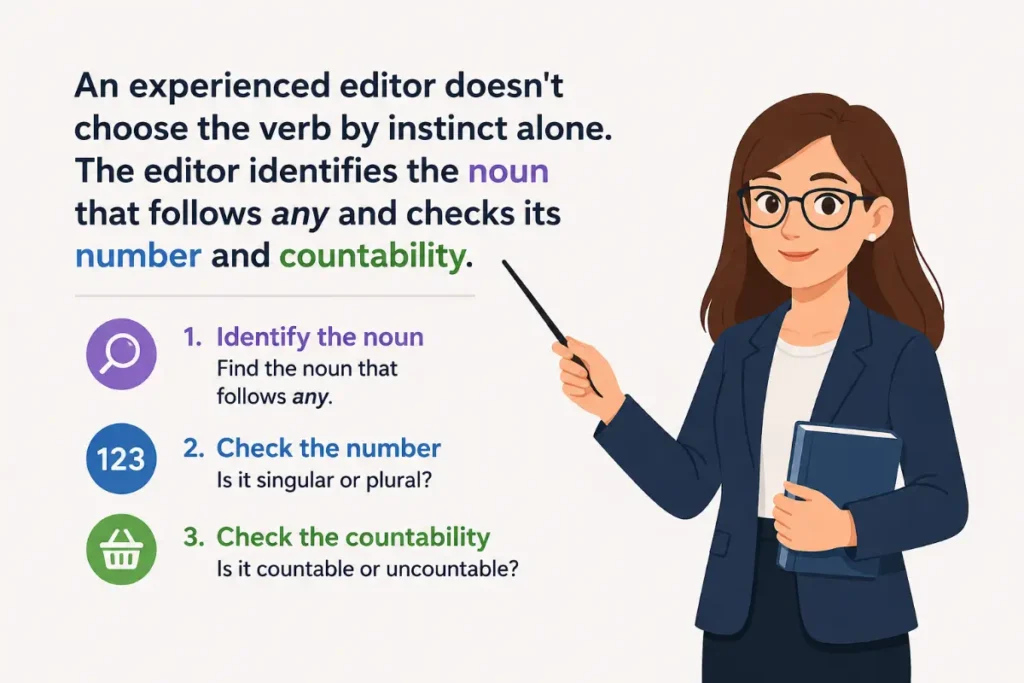
An experienced editor doesn’t choose the verb by instinct alone. The editor identifies the noun that follows any and checks its number and countability. This catches errors such as is there any books and are there any information quickly. Grammar tools can flag some of these mistakes but context still matters. A human reader can recognize when a noun changes from an uncountable idea into a countable meaning.
A related grammar guide is Fact Or Fiction Meaning Difference And Correct Usage 2026.
Final Takeaway
The choice between is there any vs are there any depends on the noun that follows any. Use is with a singular countable noun or an uncountable noun. Use are with a plural countable noun. The easiest way to remember the rule is to ignore any for a moment and look at the noun. Ask yourself if you mean one thing or an uncountable amount. Use is. If you mean several countable things use are.
With practice the pattern becomes automatic. When editing your own writing check the noun first and let it guide the verb. That small habit can prevent a surprisingly common grammar mistake.
FAQs
Is There Any Always Singular?
No. Is there any works with uncountable nouns and singular countable nouns. Examples include Is there any water? and Is there any reason? The word any itself isn’t singular. The verb is chosen based on the noun that follows it.
Are There Any Always Plural?
In this question structure are there any normally introduces a plural countable noun. Examples include Are there any books? and Are there any questions? The plural noun requires the plural form of the verb.
Which Is Correct Is There Any Or Are There Any?
Both are correct. Use is there any with a singular countable noun or an uncountable noun. Use are there any with a plural countable noun. The noun after any tells you which verb to choose.
Is There Any Water Correct?
Yes. Water is normally uncountable when you mean the substance. Therefore Is there any water? is standard English. If you are talking about separate bottles or containers you would use a plural noun instead and say Are there any bottles of water?
Are There Any Information Correct?
No. In standard English information is normally uncountable. The natural form is Is there any information? You can make the noun countable by changing the structure. For example you can say Are there any pieces of information?
Can Is There Any Start A Sentence?
Yes. It can naturally start a direct question. Examples include Is there any problem? and Is there any reason to wait? Starting a sentence with this structure is completely standard and common in everyday English.
Why Do People Confuse These Forms?
The confusion often comes from the position of the noun. The subject appears after there and after the verb. Learners may focus on any instead of checking the noun. Looking at the noun first makes the choice much easier.
Is This Grammar Important In Formal Writing?
Yes. The distinction matters in formal writing because subject verb agreement is part of standard English grammar. A sentence such as Is there any errors can distract readers and make otherwise polished writing look careless. Checking the noun after any is a quick way to avoid the problem.