
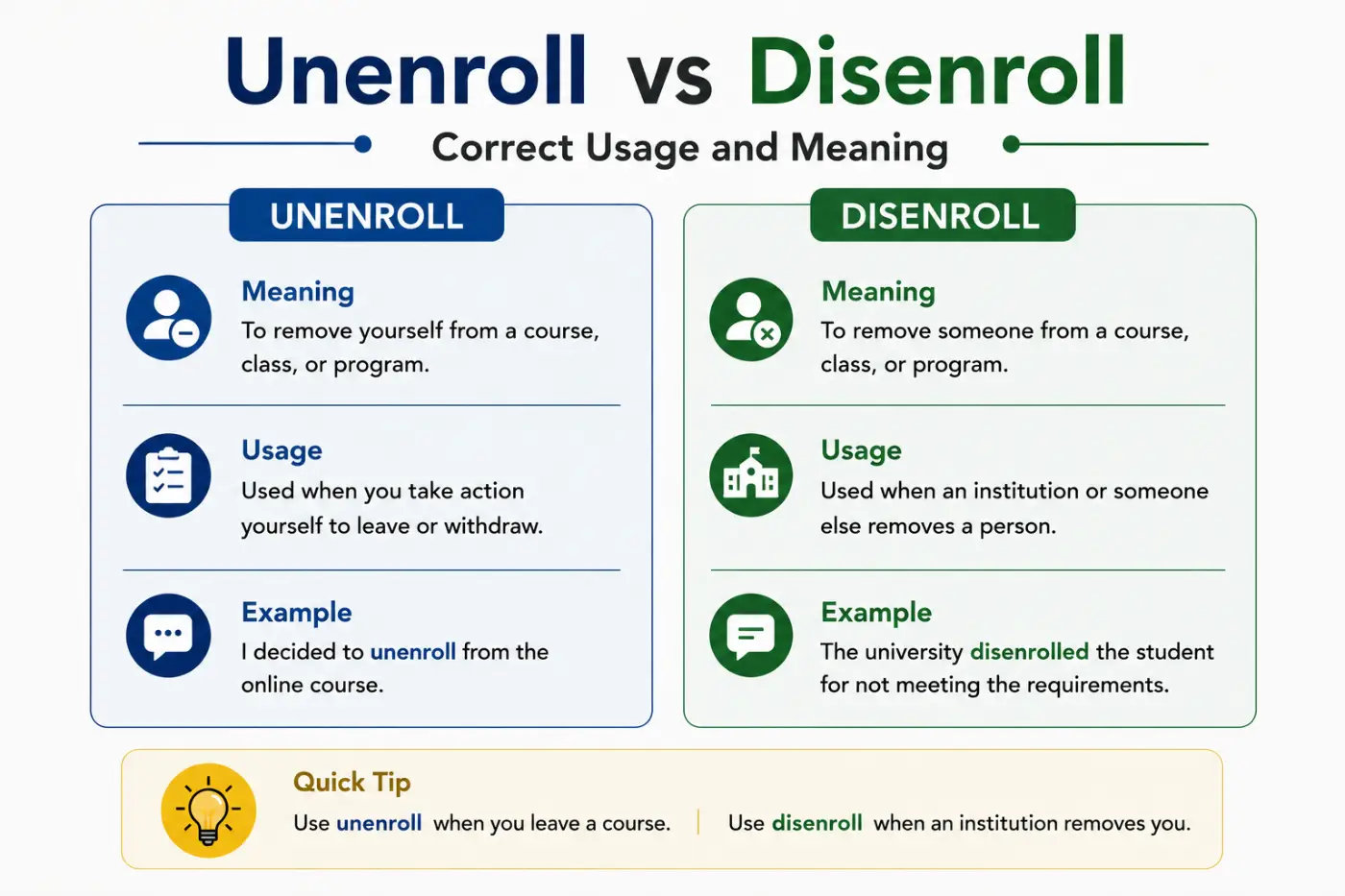
If you’re comparing unenroll vs disenroll because you need to remove someone from a course program membership or official list you’re dealing with two real English forms. Both can appear in published English but unenroll is the more familiar choice for American readers and is especially common in education and online services.
The confusion comes from the prefixes un and dis. Both can create words that describe reversing an action or ending a previous state. That doesn’t mean they work in exactly the same way with every verb. English has many pairs like this where two forms seem logical but one feels much more natural to native speakers.
For most everyday American English writing you’ll usually want unenroll when you mean to remove yourself or another person from a course program class or service. Disenroll is also a legitimate form and has established usage. It often appears in institutional administrative and formal contexts. Understanding that small difference can help you choose the word that sounds natural instead of simply choosing the form that looks grammatically possible.
Many readers also check Mather vs Mother Which Spelling Is Correct.
Quick Answer
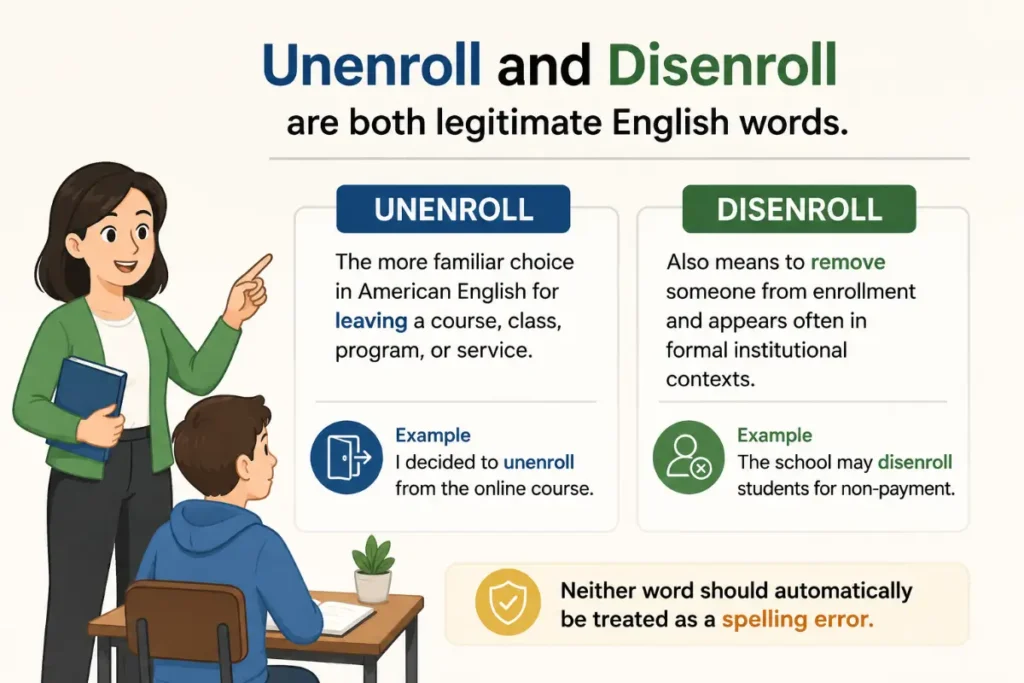
Unenroll and disenroll are both legitimate English words. Unenroll is the more familiar choice in American English for leaving a course class program or service. Disenroll also means to remove someone from enrollment and appears often in formal institutional contexts. Neither word should automatically be treated as a spelling error.
Quick Answer In Plain English
Use unenroll when you want the most natural everyday American English choice.
Use disenroll when the context is formal or administrative and the organization itself uses that term.
For example:
- I decided to unenroll from the course.
- The school may disenroll students who fail to meet the requirements.
The difference is mainly one of usage and tone rather than a completely different meaning.
Comparison Table
| Form | Meaning | Part of Speech | Origin | Usage Frequency | Formality | Common Contexts | Example |
|---|---|---|---|---|---|---|---|
| Unenroll | To remove someone or yourself from enrollment | Verb | English prefix un plus enroll | Common | Neutral | Courses classes programs memberships services | I need to unenroll from the class. |
| Disenroll | To remove someone or yourself from enrollment | Verb | English prefix dis plus enroll | Less common in everyday speech | Formal or institutional | Schools programs plans organizations and administrative systems | The program can disenroll participants who no longer qualify. |
The table shows the most useful practical distinction. The meanings overlap heavily. The choice often depends on the setting and the preferred vocabulary of the organization involved.
What Unenroll Means
Unenroll means to stop being enrolled in something or to remove someone from an enrollment list.
The word normally describes a reversal of enrollment. Someone first becomes enrolled in a course program class service or other organized activity. Later that enrollment ends. The person can then be described as unenrolled.
For example:
I decided to unenroll from the summer course.
The speaker was enrolled in the course and then chose to leave it.
The verb can also describe an action performed by another person.
The administrator unenrolled the student from the class.
Here the administrator performed the action.
In American English this form feels straightforward and familiar. People commonly encounter it on school websites learning platforms registration systems and membership services.
You may also see the related noun unenrollment.
The system processed her unenrollment from the program.
The noun is less common in casual conversation but works naturally in administrative writing.
What Disenroll Means
Disenroll has essentially the same core meaning. It means to remove someone from enrollment or to end a person’s enrollment in a program or organization.
For example:
The university may disenroll students who do not complete the required paperwork.
The word is especially useful when the organization is describing an official administrative action.
It can also be used for voluntary departure.
She chose to disenroll from the program before the semester began.
Still the word often has a more institutional sound than unenroll.
That doesn’t make it incorrect. It simply means that many American readers will encounter disenroll more often in policies notices regulations and administrative documents than in casual conversation.
Think of the two words as close neighbors. They live in the same semantic neighborhood but they aren’t always equally common on every street.
The Main Difference Between The Two Forms
The biggest difference isn’t basic meaning. Both words describe ending enrollment.
The more useful distinction involves natural usage and context.
Unenroll tends to sound more direct and familiar in everyday American English.
Disenroll tends to sound more formal and administrative.
Consider these sentences.
I want to unenroll from the course.
This sounds natural in a conversation with a teacher or support representative.
Now consider:
The institution reserves the right to disenroll a participant who violates the program rules.
That sentence has an official policy tone. Disenroll fits comfortably in that setting.
You could replace disenroll with unenroll and the basic meaning would remain clear. The reverse is also possible. Yet the sentence may sound more formal after you choose disenroll.
This distinction matters for editors because good word choice isn’t always about finding a word that is technically possible. It is also about choosing the word that fits the audience and situation.
Which Form Should You Use
For most American readers unenroll is the safest everyday choice.
Choose it when you are writing a casual message or explaining that you want to leave a course class or program.
For example:
I need to unenroll from my online class.
Choose disenroll when an institutional or administrative voice makes the stronger choice.
For example:
The department may disenroll students who fail to meet the attendance requirement.
There is no need to treat disenroll as a misspelling. It is an established word.
Likewise you shouldn’t assume that unenroll is informal slang simply because it sounds more familiar. It is a standard verb and works well in ordinary professional communication.
The best choice depends on the sentence and audience.
Why Both Forms Exist
English often creates new verbs by adding prefixes to existing words.
The base verb here is enroll.
To enroll means to enter a course program organization or other structured activity as a participant or member.
English can then add prefixes that signal a change in that state.
The prefix un often suggests reversal or removal.
Examples include:
- Untie means to reverse tying.
- Unlock means to reverse locking.
- Unpack means to remove something from a package.
- Unplug means to disconnect something that was plugged in.
In unenroll the prefix suggests reversing enrollment.
The prefix dis can also express separation removal or reversal in English.
Examples include:
- Disconnect means to separate something that was connected.
- Discontinue means to stop something.
- Disassemble means to take something apart.
- Disengage means to release or separate.
That makes disenroll semantically understandable. English speakers can recognize the intended meaning even before they have seen the word many times.
The existence of two logical formations doesn’t mean both will have identical usage patterns. English develops through repeated use. Speakers and institutions settle into preferred forms over time.
Grammar And Part Of Speech
Both unenroll and disenroll function primarily as verbs.
They can be transitive or intransitive depending on the sentence.
An intransitive use does not take a direct object.
I decided to unenroll from the course.
The subject performs the action and leaves the course.
A transitive use takes an object.
The school unenrolled the student from the program.
The school performs the action on the student.
The same basic pattern works with disenroll.
I decided to disenroll from the program.
And:
The organization disenrolled the participant.
The preposition from commonly follows the verb when the sentence identifies the course program or organization that someone leaves.
You can also use these verbs in different grammatical forms.
Present tense:
I unenroll from the class.
Past tense:
I unenrolled from the class.
Present participle:
I am unenrolling from the class.
Past participle:
I have unenrolled from the class.
The same pattern applies to disenroll.
I disenrolled from the class.
I am disenrolling from the class.
I have disenrolled from the class.
The forms are regular verbs. Their grammar isn’t particularly difficult. The main challenge is choosing the form that suits your context.
Spelling Rules To Remember
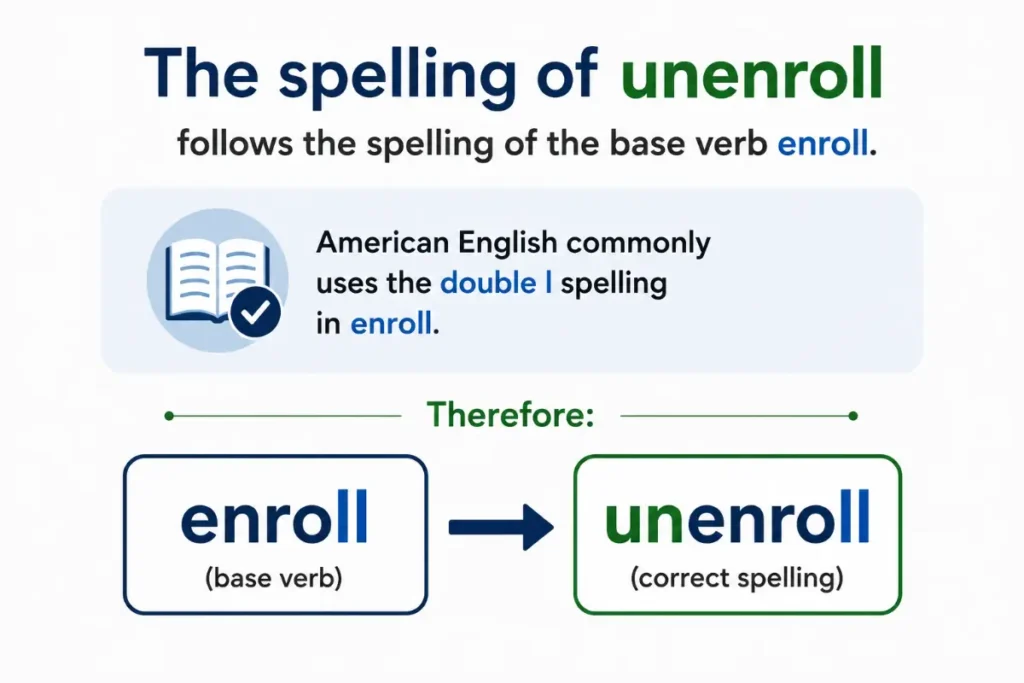
The spelling of unenroll follows the spelling of the base verb enroll.
American English commonly uses the double l spelling in enroll.
Therefore:
enroll
becomes:
unenroll
The same applies to disenroll.
enroll
becomes:
disenroll
The ending changes when you add certain grammatical forms.
For example:
enrolled
enrolling
unenrolled
unenrolling
disenrolled
disenrolling
The exact spelling of these forms can cause confusion because English spelling rules vary across dialects and word families.
American English commonly uses enroll while British English often uses enrol.
That regional difference carries into related forms.
American English Usage
American English strongly favors enroll as the base spelling.
You will see it in schools universities government programs healthcare systems online education platforms and many other settings.
That makes unenroll a natural extension of the American spelling pattern.
For example:
You can unenroll from the course through your student account.
American readers will understand the sentence immediately.
Disenroll also appears in American English. It can be found in formal policies and administrative communication.
The important point is that American English does not require you to avoid disenroll. The word is legitimate. It simply carries a more formal institutional feel in many contexts.
If you’re writing for a general audience and you want the most familiar wording then unenroll will often be the better choice.
British English Usage
British English commonly spells the base verb as enrol rather than enroll.
That creates related forms such as:
unenrol
and:
disenrol
The spelling difference is important for writers targeting British readers.
American readers generally expect enroll with two l’s. British readers commonly expect enrol with one l.
This is a spelling difference rather than a fundamental difference in meaning.
The underlying idea remains the same. Someone joins a course or program and later leaves it.
For a US focused article or website unenroll and disenroll are the forms that fit American spelling conventions.
Canadian English Usage
Canadian English can show influence from both American and British spelling traditions.
In practical writing you may encounter enroll as well as enrol depending on the institution and editorial standard.
That means Canadian usage deserves some flexibility.
If you’re writing for a Canadian organization then follow its established style guide. Consistency matters more than forcing one spelling into every context.
For an American audience however enroll remains the expected base spelling.
Australian English Usage
Australian English generally follows British spelling patterns in many areas. The form enrol is therefore common.
Related forms may use unenrol and disenrol.
The underlying meaning does not change.
This is a useful reminder that spelling questions often involve dialect rather than right versus wrong English. A form that looks unusual to an American reader may be completely normal under another English spelling system.
Pronunciation Guide
The pronunciation of these words is relatively easy once you recognize the base word enroll.
A common American pronunciation of enroll is represented in the International Phonetic Alphabet as /ɪnˈroʊl/.
The stress falls on the second syllable.
You can think of it as:
en ROLL
For unenroll the pronunciation can be represented approximately as:
/ˌʌnɪnˈroʊl/
A simple pronunciation guide is:
un en ROLL
For disenroll a useful approximation is:
/ˌdɪsɪnˈroʊl/
You can think of it as:
dis en ROLL
The strongest stress remains on roll.
One common mistake is to place too much stress on the first part of the word. Native speakers normally keep the final syllable prominent because it comes from the base verb enroll.
Etymology And Word Origin
The history of these words becomes clearer when you start with enroll.
Enroll ultimately traces back to Old French and Medieval Latin forms associated with entering a name into a roll or official list.
The image behind the word is quite literal. A person’s name could be entered into a written register or roll. Over time the meaning expanded from writing a name on a list to formally entering someone into a group course institution or organization.
The prefix un has Germanic roots and has long been used in English to express reversal removal or negation.
The prefix dis entered English through French and Latin and has developed several related meanings including separation reversal and removal.
Both prefixes therefore provide a reasonable way to describe the ending of enrollment.
The important linguistic point is that modern usage determines which formation feels natural in a particular setting. Word formation gives English speakers possibilities. Repeated use establishes conventions.
Formality And Tone
Word choice can quietly change the tone of a sentence.
Compare these examples.
I want to unenroll from the training course.
I wish to disenroll from the training program.
The first sounds straightforward and conversational.
The second sounds more formal.
Neither sentence is grammatically wrong.
This distinction matters in workplace writing. A customer service message usually benefits from plain language.
Please unenroll me from the course.
An institutional notice may use a more formal construction.
Participants may be disenrolled if they fail to satisfy the program requirements.
Both sentences communicate the same general action.
The difference is similar to choosing between everyday language and policy language. One speaks to the person. The other sounds like it belongs in a handbook.
Still confused? Compare Developed vs Developped Which Spelling Is Correct?(2026).
Ten Natural Sentence Examples
Here are practical examples that show how the preferred everyday form works.
- I need to unenroll from the online course before the next billing cycle.
- She decided to unenroll from the class after finding a better schedule.
- You can unenroll from the program through your student portal.
- He asked the advisor how to unenroll from the summer session.
- The website lets students unenroll from a course without contacting support.
- I accidentally enrolled in the wrong class and had to unenroll.
- Parents can unenroll their children from the activity before the new term begins.
- She plans to unenroll from the training program at the end of the month.
- The student contacted the office because she could not unenroll from the course online.
- You should check the school’s policy before you unenroll from a paid class.
These examples show why unenroll works well in everyday communication. It is clear and direct. The reader doesn’t have to stop and interpret an unusually formal expression.
When Disenroll Fits Better
There are situations where disenroll sounds completely natural.
Administrative policies are one example.
The provider may disenroll members who no longer meet the eligibility requirements.
Institutional notices are another.
The university may disenroll students who fail to submit the required documents.
Formal program rules can also use the term.
The organization reserves the right to disenroll participants who violate the code of conduct.
In each case the word describes an official decision or administrative process.
That context gives the word a natural home.
You shouldn’t change every occurrence of disenroll to unenroll simply because the latter is more familiar. Professional editing requires attention to context. If an institution consistently uses disenroll in its policies then changing it may create unnecessary inconsistency.
Common Mistakes And Misspellings
Several mistakes can appear around these words.
- Unroll
This is a real word but it does not mean to leave an enrollment program. Unroll means to open something that has been rolled up.
Please unroll the poster.
It has nothing to do with leaving a course.
- Enrole
This spelling can appear as a mistake when writers are trying to spell enroll or enrol.
For American English use enroll.
For British English use enrol.
- Unenroled
This form can appear when someone follows the British spelling pattern but uses it inconsistently with American English.
American English uses:
unenrolled
British English may use:
unenrolled
The doubled l remains relevant in the American form of the base word.
- Disenrolled from of
Some writers add an unnecessary preposition combination.
Write:
She was disenrolled from the program.
Not:
She was disenrolled from of the program.
- Unenrolled the course
The verb normally describes the person being removed from enrollment.
Write:
I unenrolled from the course.
Or:
The school unenrolled me from the course.
Saying I unenrolled the course changes the grammatical structure and usually produces an unintended meaning.

Related Words And Expressions
Several terms belong to the same semantic field.
- Enroll
This means to enter a course program organization or service as an enrolled participant.
- Register
This often means to officially record your name or information for an event course or service.
- Withdraw
This can mean leaving a course or program. In education it may describe a formal departure after enrollment.
- Drop
This is common informal language for leaving a class.
I decided to drop the course.
- Cancel
This means to stop something from continuing. It does not always imply enrollment.
- Remove
This is a broad word meaning to take someone or something away from a place list group or system.
- Dismiss
This can mean to remove someone from a position program or responsibility. Its meaning is stronger and more specific than simply ending enrollment.
- Discontinue
This means to stop something from continuing. It normally describes a service activity product or process rather than a person’s enrollment.
These words overlap in some situations but they aren’t interchangeable in every sentence.
Enroll And Unenroll
The relationship between enroll and unenroll is especially easy to understand.
Enroll describes joining.
Unenroll describes leaving.
For example:
I enrolled in the course last week.
Later:
I unenrolled from the course today.
This pair creates a simple before and after relationship.
The person first enters the program. Then the person reverses that decision.
That makes the word easy to remember.
Think of enroll as entering a door and unenroll as walking back out. The prefix signals the reversal.
Enroll And Disenroll
The relationship between enroll and disenroll works in much the same way.
The school enrolled the student in the program.
Later:
The school disenrolled the student from the program.
The second sentence often sounds more official because the institution performs the action.
This makes disenroll particularly useful in formal administrative contexts.
For personal communication however many writers will naturally choose unenroll.
Withdraw And Unenroll
These words can overlap in educational contexts but they aren’t identical.
Withdraw often describes a student’s formal departure from a course or academic program.
She withdrew from the course after the first week.
Unenroll focuses more directly on the enrollment status.
She unenrolled from the course after the first week.
The difference can be subtle.
A school may use withdrawal as a specific administrative process with deadlines and financial consequences. Unenroll can simply describe the action in plain language.
When an institution has a formal policy use the institution’s own terminology.
Drop And Unenroll
Drop is common in American college and school conversation.
I’m going to drop my history class.
This sounds natural among students.
Unenroll is broader and can work for many kinds of programs.
I’m going to unenroll from the training program.
The word drop can sound casual. Unenroll is more neutral.
If you’re writing a formal email to an academic office then unenroll or the institution’s official term may be safer.
Real Life Usage In Daily Conversation
People often prefer the simplest expression in everyday speech.
I need to unenroll from this class.
How do I unenroll?
Can I unenroll before the semester starts?
These sentences are short and clear.
You may also hear drop in casual educational conversation.
I think I’m going to drop the class.
The choice depends on the situation. Casual speech allows shorter expressions. Formal communication benefits from precise wording.
Workplace And Email Usage
Workplace communication often sits between casual and formal language.
A clear email might say:
Hello. I would like to unenroll from the training session scheduled for next month. Please let me know if I need to complete a form.
That wording is professional without sounding stiff.
An official company policy might instead say:
The company may disenroll employees from training programs when eligibility requirements are no longer met.
The second sentence has an institutional voice.
Both forms work. The difference lies in audience and purpose.
Academic Writing
Academic writing values precision and consistency.
If you’re describing your own decision in an essay or report then unenroll can be perfectly clear.
The student chose to unenroll from the course because the schedule conflicted with her research work.
If you’re discussing an institutional policy then disenroll may fit.
The institution may disenroll students who fail to satisfy the required academic conditions.
The best choice depends on the terminology used by the institution.
Don’t replace an official term simply to make the prose sound more conversational. In academic and administrative writing consistency matters.
News And Journalism
Journalists generally prefer words that ordinary readers understand quickly.
A news story about education might say:
Several students chose to unenroll from the program after the schedule changed.
An article about an institutional decision might say:
The organization said it could disenroll participants who failed to meet eligibility rules.
Both constructions are understandable.
The journalist’s goal is usually clarity first. That makes familiar language valuable.
Expert Editor Insight
An experienced editor would not mark disenroll as automatically wrong simply because unenroll sounds more familiar. The better editorial question is context. For a general American audience unenroll is usually the clearer everyday choice. For a policy document or institutional notice disenroll may fit the established voice. Editors also check the organization’s own terminology because consistency can matter more than swapping one legitimate word for another.
How Grammar And Spell Checkers May Treat Them
Digital writing tools can sometimes create confusion around less frequent words.
A spell checker may recognize unenroll more readily because it appears often in common educational and software contexts. Another tool may accept disenroll without hesitation.
A warning from a writing tool doesn’t automatically prove that a word is incorrect.
This is a useful editing lesson. Automated tools work from language data and programmed dictionaries. They can flag uncommon words even when those words are legitimate.
When a tool marks disenroll or unenroll you should look at the sentence and intended audience before changing the word. Human judgment still matters.
A Simple Memory Trick
You can remember the distinction through the tone of the words.
Think:
Unenroll sounds everyday.
And:
Disenroll sounds administrative.
This isn’t an absolute grammar rule. It’s a practical writing shortcut.
If you’re telling a friend that you want to leave a class then unenroll will usually sound natural.
If you’re writing a formal policy about an organization’s authority to remove participants then disenroll may feel more appropriate.
The meaning remains closely connected in both cases.
Is One Form More Correct
There is no good reason to label disenroll as simply wrong.
The form is established English and carries a clear meaning.
At the same time unenroll is an excellent choice for general American English. This is an important distinction for writers. English isn’t always divided into one correct form and one incorrect form. Sometimes two legitimate words compete in the same semantic space while developing different patterns of frequency tone and context. That is what happens here. If your goal is plain American English then choose unenroll in most ordinary situations. If your goal is formal institutional language then disenroll can be a suitable choice.
How To Choose The Right Word
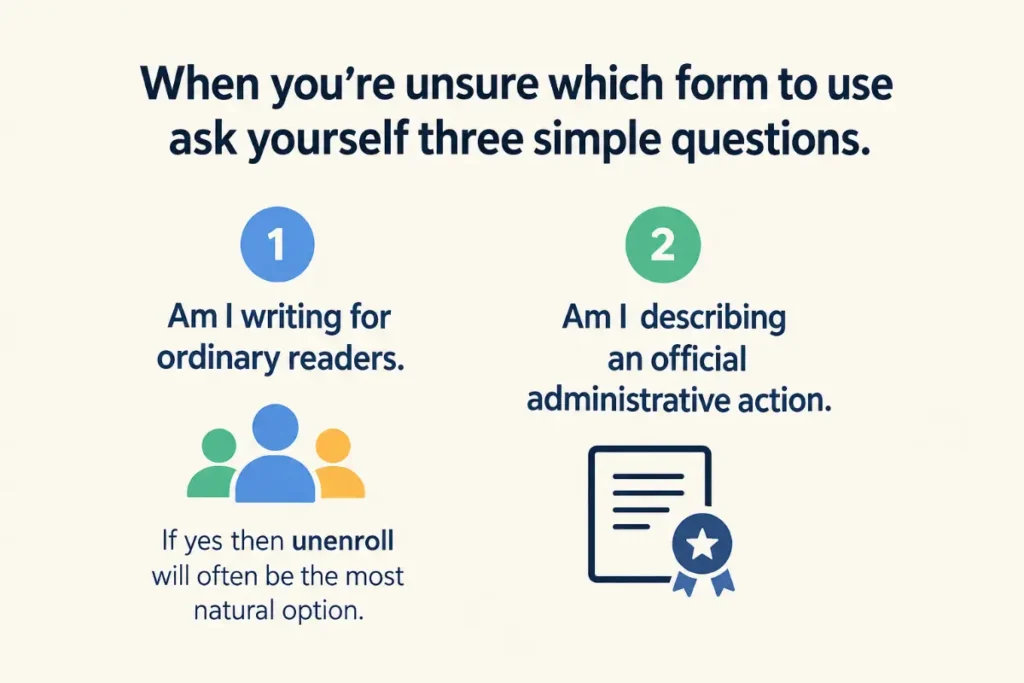
When you’re unsure which form to use ask yourself three simple questions.
- Am I writing for ordinary readers.
If yes then unenroll will often be the most natural option.
- Am I describing an official administrative action.
If yes then disenroll may fit the tone.
This approach is more reliable than trying to memorize a rigid rule.
Language works through context. A good writer pays attention to the whole sentence rather than judging a word in isolation.
A related grammar guide is in line or inline Meaning Difference And Correct Usage.
Final Takeaway
The best everyday choice for most American readers is unenroll. It clearly describes leaving a course class program or other activity in which someone was enrolled. Disenroll is also a legitimate word and often fits formal institutional or administrative writing. The two forms share the same basic meaning but their tone and usage can differ. Think of unenroll as the plain everyday option and disenroll as a word that can sound more official.
When editing your own writing focus on the audience first. If you’re writing a simple message choose the familiar form. If you’re describing an organization’s formal enrollment process then disenroll may be a better fit. That small context check is more useful than treating one form as right and the other as wrong.
Frequently Asked Questions
Is Disenroll A Real Word?
Yes. Disenroll is a legitimate English verb. It means to remove someone from enrollment or to end someone’s enrollment in a course program or organization. It can appear in formal policies administrative documents and institutional communication and It isn’t simply a misspelling of unenroll.
What Does Unenroll Mean?
Unenroll means to leave something in which you were enrolled or to remove someone from an enrollment list. It commonly appears in education online learning programs and membership systems. In American English it is a clear and familiar choice for everyday communication.
Which Form Is Better For American English?
Unenroll is generally the more natural everyday choice for American readers. Disenroll is also correct but can sound more formal or administrative. If you’re writing a simple message to a student customer or colleague then unenroll will usually feel more direct and familiar.
How Do You Pronounce Unenroll?
A common American pronunciation is approximately un en ROLL. The IPA representation can be given as /ˌʌnɪnˈroʊl/. The main stress falls on the final syllable. The pronunciation keeps the sound of the base word enroll at the end.
Can Unenroll Start A Sentence?
Yes. Unenroll can start a sentence when it functions as a verb.
Unenroll from the course before the registration deadline.
This is an imperative sentence. The subject you is understood. The word can also appear in other sentence positions depending on its grammatical function.
What Is A Synonym For Unenroll?
Useful alternatives include withdraw and drop in educational contexts. Remove from enrollment is another clear expression. The best synonym depends on the situation. Withdraw may describe a formal academic process while drop sounds more casual.
Why Do People Confuse Unenroll And Disenroll?
The words share the same base concept and both use prefixes that can suggest reversal or removal. That makes both formations seem equally natural. English often permits several possible word formations but repeated usage gives each form its own patterns of frequency tone and context.
Is Disenroll Suitable For Formal Writing?
Yes. Disenroll can work well in formal writing especially in policies regulations and institutional notices. It clearly communicates an official removal from enrollment. Still you should follow the terminology used by the organization you’re writing about because consistent terminology can improve clarity.