
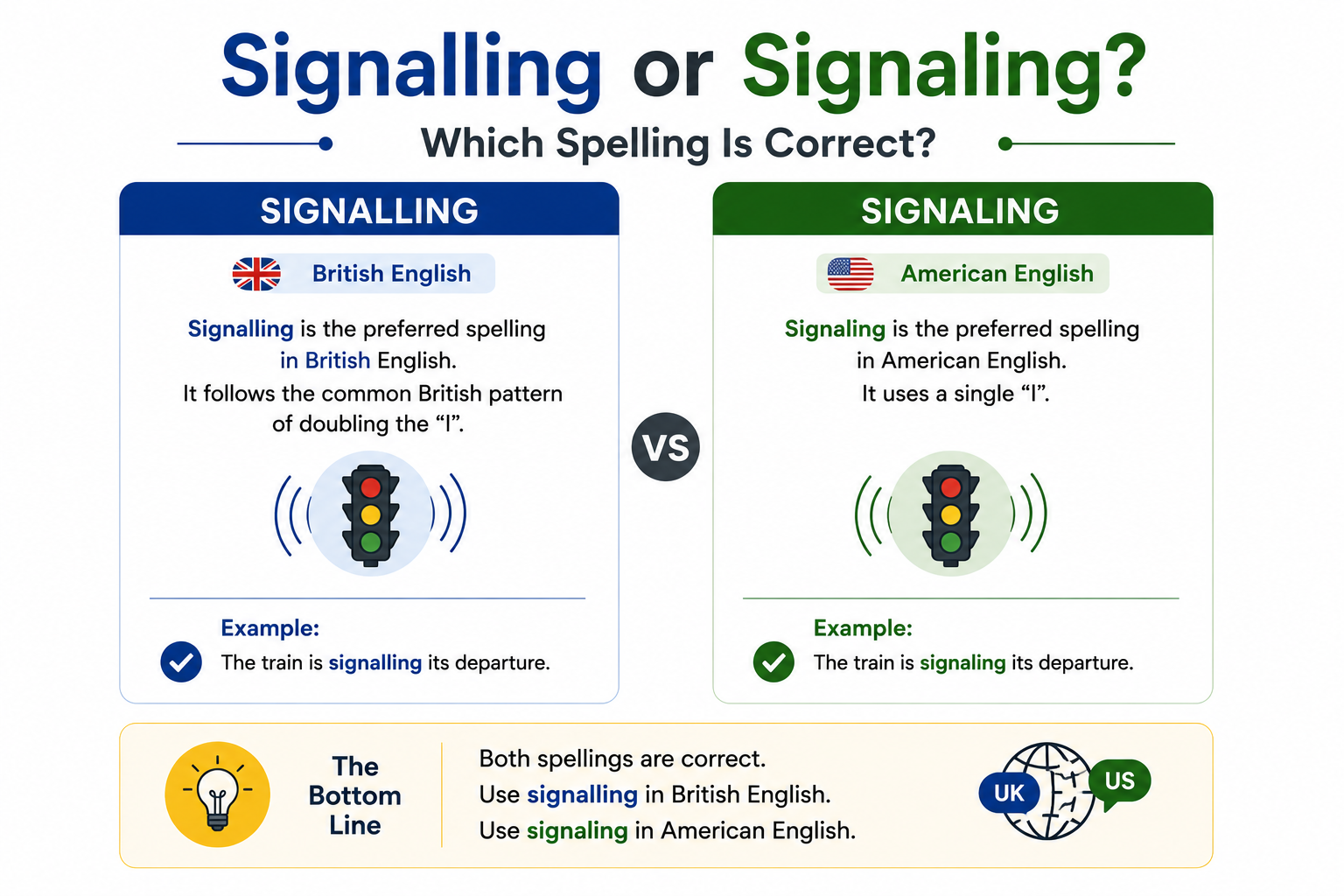
If you’re unsure about signalling or signaling you’re dealing with a genuine difference between English varieties rather than a simple spelling mistake. Both forms are used by fluent English speakers. The main difference comes from regional spelling conventions. American English generally favors the shorter form with one l while British English commonly keeps the doubled l.
The confusion often comes from the base word signal. When you add the ending ing the spelling changes differently across major English varieties. American spelling often drops the second l in words such as signaling while British spelling commonly keeps it. The same pattern appears in related forms such as canceled and cancelled or labeled and labelled.
This distinction matters most when you’re writing for a specific audience. If you write for readers in the United States then signaling is the natural choice. If your audience follows British English then signalling is usually the better choice. This guide explains the spelling rule the pronunciation the grammar the regional differences and the most common mistakes so you can choose the form with confidence.
You may also want to read Eccentric vs Eclectic Meaning and Usage (2026).
Quick Answer
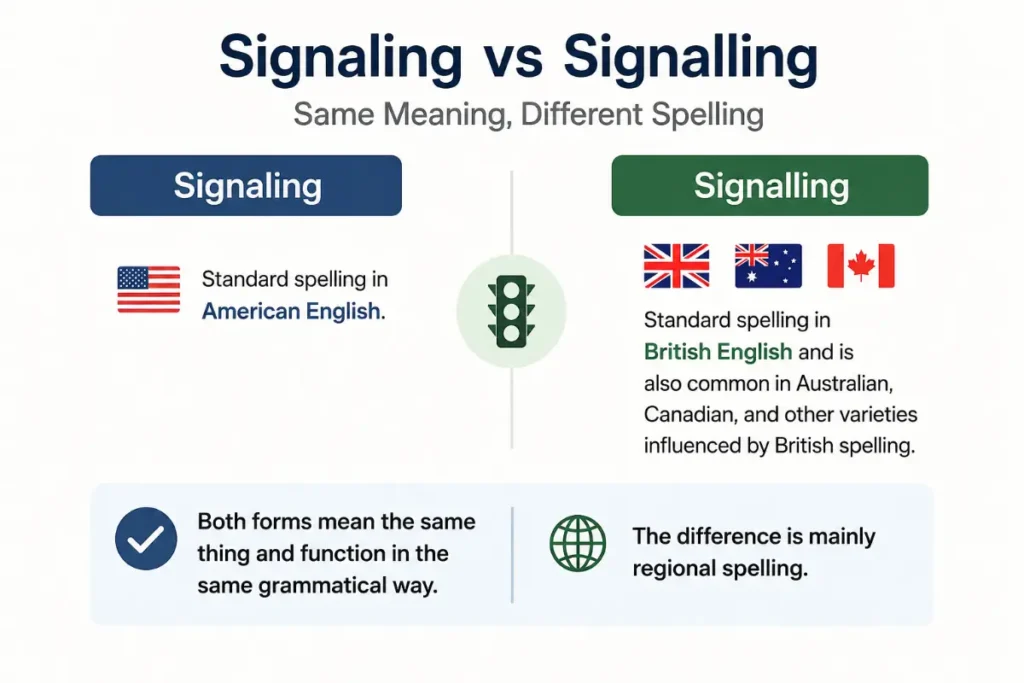
Signaling is the standard spelling in American English. Signalling is the standard spelling in British English and is also common in Australian Canadian and other varieties influenced by British spelling. Both forms mean the same thing and function in the same grammatical way. The difference is mainly regional spelling.
Comparison Table
| Form | Meaning | Part of Speech | Origin | Usage Frequency | Formality | Common Contexts | Example |
|---|---|---|---|---|---|---|---|
| Signaling | Giving or communicating a sign or indication | Verb form | From signal | Common in American English | Standard | US writing business technology news | The device is signaling a problem. |
| Signalling | Giving or communicating a sign or indication | Verb form | From signal | Common in British English and many Commonwealth varieties | Standard | UK writing education news technical writing | The device is signalling a problem. |
The two forms have the same meaning. Neither spelling changes the grammatical function of the word. The difference is tied to regional spelling practice.
Meaning and Definition
The word signal has several related meanings. It can describe an action that communicates information. It can also refer to a sign that gives someone a warning or instruction. In technology it can describe an electrical radio or digital transmission that carries information. The form ending in ing is the present participle of the verb signal. It can also function as a gerund when the activity itself acts as a noun. Consider this sentence. The driver is signaling a turn. Here the word describes an action happening at the moment of speaking.
The American Form
American English generally writes the form with one l before ing. The standard form is signaling. You’ll see it in newspapers business documents school assignments technical manuals websites and everyday communication in the United States. The same American spelling pattern appears in related words such as labeled traveled and canceled. This doesn’t mean every word ending in l follows the same rule. English spelling has plenty of exceptions. Still the pattern provides a useful guide for many words where a final l is followed by a suffix.
The British Form
British English commonly writes the form with two ls. The standard form is signalling. You’ll find this spelling in British newspapers academic writing government documents books and everyday communication. The doubled l reflects a broader British spelling pattern. Related forms often include labelled travelled and cancelled. The two spellings are not different words. They don’t carry different meanings and they don’t require different grammar.
Key Differences Explained
The most useful distinction is regional rather than grammatical.
- Spelling differs. American English normally uses one l while British English commonly uses two ls.
- Meaning stays the same. Both forms describe the act of giving a sign indication message or warning.
- Pronunciation stays the same. Native speakers generally pronounce both forms alike.
- Part of speech stays the same. Both forms can serve as a present participle or gerund.
- Formality stays the same. Neither spelling is more formal than the other.
- Context determines the preferred form. Your intended English variety should guide your choice.
- Grammar does not determine the spelling choice. Regional convention does.
- Consistency matters. Once you choose an English variety keep related spellings consistent throughout the same piece of writing.
This last point is especially useful for professional writing. A document written for a US audience usually looks cleaner when it follows American spelling throughout. A British audience expects British conventions.
Which Form Is Correct?
Both forms are correct in standard English. The right choice depends on the variety of English you’re using. For American English choose signaling. For Australian English the doubled l form is common. Canadian English also often follows British style in words of this type although Canadian usage can show variation depending on the publication or house style. There is no need to treat one form as a misspelling of the other. Calling signalling wrong in every context would ignore standard British usage. Calling signaling wrong would create the same problem for American English. The safest professional rule is simple. Match the spelling to your audience and stay consistent. f you’re writing a US college paper then use the American form. If you’re preparing a document for a British organization then use the British form.
Why The Spelling Changes
The difference becomes easier to understand when you look at the spelling patterns used in American and British English. American English often uses a single final l before a suffix in words such as signaling. British English frequently doubles the l in comparable forms.
That gives us pairs such as:
- Signaling and signalling.
- Labeled and labelled.
- Traveled and travelled.
- Canceled and cancelled.
- Modeled and modelled.
The pattern is not completely mechanical. English spelling contains many historical exceptions and regional preferences. That’s why it’s better to learn the pattern as a useful guide rather than an absolute law. The important point is that the difference has developed through established spelling traditions. It isn’t caused by a difference in pronunciation or meaning.
Sentence Examples
The following examples show how the word works naturally in different settings.
- The warning light is signaling that the battery is low.
- The teacher was signaling for the students to return to their seats.
- The driver kept signaling before changing lanes.
- The system is signaling an error on the main display.
- Early signaling can help prevent misunderstandings at work.
- The researchers observed birds signaling danger to the rest of the group.
- The referee was signaling that play should stop.
- The company is signaling a change in its approach to customer service.
- The student used hand gestures for signaling during the activity.
- The traffic officer was signaling drivers to move forward.
In British English the same sentences can use the doubled l spelling without changing their meaning. The traffic officer was signalling drivers to move forward. The company is signalling a change in its approach. The pronunciation and grammatical role remain the same.
Common Mistakes and Misspellings
Several mistakes appear because writers mix regional spelling systems or apply a spelling rule too broadly.
Using The British Form In American Writing
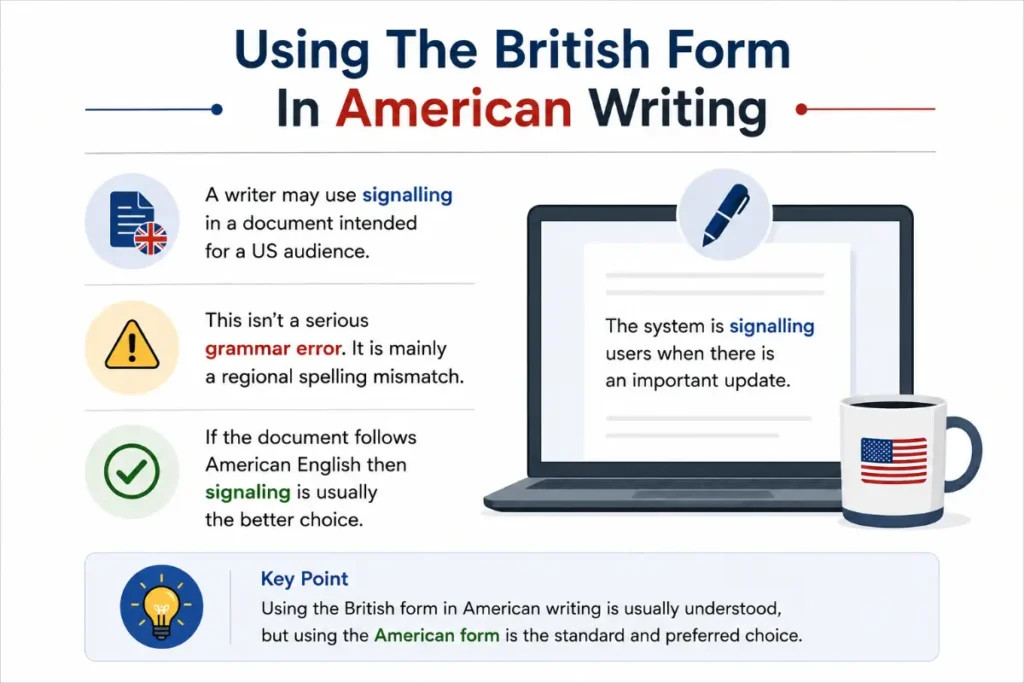
A writer may use signalling in a document intended for a US audience. This isn’t a serious grammar error. It is mainly a regional spelling mismatch. If the document follows American English then signaling is usually the better choice.
Using The American Form In British Writing
The reverse can happen when a writer uses signaling in a British document. Again the meaning remains clear. The issue is consistency with the chosen English variety.
Confusing The Base Word With Another Form
Some writers may incorrectly remove part of the base word when adding ing. The correct base is signal. The resulting form describes an ongoing action or an activity.
Adding An Unnecessary Extra Letter
Another common mistake comes from treating every regional spelling pattern as universal. A writer may add additional letters beyond the established spelling. That produces forms that standard English does not normally use.
Mixing Regional Styles
A document might use signaling in one paragraph and labelled or travelled elsewhere. This creates an inconsistent style. Professional editors usually choose one spelling system and apply it throughout the document unless a particular quotation or proper name requires something different.
Pronunciation Guide
Both major spellings are normally pronounced the same way. The pronunciation can be represented in the International Phonetic Alphabet as approximately /ˈsɪɡ.nəl.ɪŋ/. A simple pronunciation guide is: SIG nuhl ing The primary stress falls on the first syllable. The word has three main syllable parts:
- Sig.
- Nuhl.
- Ing.
The doubled l in the British spelling does not create an extra syllable. It also does not normally change the pronunciation. That makes this an important distinction between spelling and sound. Two written forms can look different while sounding the same. You should also avoid pronouncing the word as though the spelling contained an extra syllable. The doubled consonant belongs to the spelling pattern rather than representing an additional sound.
Etymology and Word Origin
Signal ultimately traces back to the idea of a sign or mark that communicates information.
The English word developed through languages including French and Latin. The Latin word signum referred to a mark sign token or indication. Related forms moved through European languages before becoming established in English. The noun signal entered English centuries ago and later developed into a verb. English speakers began using the verb for the act of giving a sign or communicating information through a visible audible or other indication. The modern word now appears in many fields. Traffic signals communication systems animal behavior medicine technology and everyday conversation all use the concept. Its history helps explain why the word has such a broad meaning today. A signal can be a hand movement a flashing light a sound a radio transmission or an abstract indication of a developing situation.
For another common grammar confusion, see Gait vs gate and the correct usage.
Regional Usage
Regional spelling is the main reason readers encounter two forms.
American English
American English normally uses signaling. You’ll see this spelling in US newspapers schools universities business documents technical material and everyday writing. American style also commonly uses one l in related forms such as labeled traveled and canceled. If your audience is primarily American then the single l form is the natural editorial choice.
British English
British English commonly uses signalling. The doubled l form fits a broader British spelling convention found in words such as labelled travelled and cancelled. British publishers schools government bodies and professional organizations commonly use this spelling. If you’re writing for a British audience then signalling will usually look more natural and familiar.
Australian English
Australian English generally follows British spelling traditions in this area. The doubled l form is therefore common. A writer preparing material for an Australian audience should normally follow the style guide used by the publication institution or organization. House style can always take priority over a general regional preference.
Canadian English
Canadian English combines influences from British and American English. Many Canadian writers use British style for words of this kind and therefore prefer the doubled l form. However Canadian spelling can vary by publisher and context. A professional document should follow its stated style guide rather than switching between systems.
Grammar Rules and Part of Speech
The word functions as a present participle of the verb signal.
For example:
The driver is signaling a left turn.
The structure is:
Subject + be + present participle.
The form can also work as a gerund.
For example:
Signaling clearly helps other drivers understand your intentions.
Here the action of signaling is treated as the subject of the sentence. The word can also appear after certain verbs.
For example:
She continued signaling to the team.
It can appear after prepositions too.
For example:
He apologized for signaling too late.
The grammar remains unchanged across American and British English. The only visible difference is the spelling.
Spelling And Grammar Are Different Issues
This distinction helps solve many English questions. Grammar tells you how a word functions in a sentence. Spelling tells you how that word is written. The two forms discussed here have the same grammatical function. Their regional spelling conventions differ. That means a grammar checker might accept both forms while a style checker could recommend one based on the selected English variety. This distinction is useful when working with writing software. If your document is set to American English then a British spelling may receive a style warning even though it is not an incorrect word.
Real Life Usage Examples
The word appears in many areas of everyday life.
Daily Conversation
People use the word when describing signs gestures warnings or changes.
For example:
He was signaling that we should wait.
She kept signaling toward the door.
These sentences sound natural in ordinary conversation.
Workplace Communication
The word often describes signs of a business decision or a change in direction.
For example:
The manager is signaling that the project needs more time.
The new policy is signaling a shift in the company’s priorities.
In professional writing the regional spelling should match the organization’s preferred style.
Academic Writing
Researchers use the term when discussing communication behavior systems data or patterns.
For example:
The study examines how animals use movement for signaling.
The findings suggest that early signaling can improve cooperation.
Academic writers should follow the spelling system required by their institution or publication.
News Writing
Journalists often use the word to describe an action that suggests a larger development.
For example:
The announcement is signaling a change in government policy.
The decision is signaling stronger support for the proposal.
The exact spelling depends on the publication’s regional style.
Literature And Storytelling
Writers can use the word to describe gestures sounds or other signs within a scene.
For example:
She stood at the window signaling for him to come inside.
The distant light was signaling that someone was still awake.
The word works naturally because it connects a visible action with a meaning understood by another person.
Related And Confused Terms
Several words sit close to this concept. Understanding their differences can help you choose a more precise expression.
Sign
A sign is something that communicates information or points to a meaning. The dark clouds were a sign of rain.
Signal
A signal is an action object or message that communicates information. The flashing light was a signal to stop.
Indicate
Indicate means to show or point out something. The results indicate a possible problem.
Suggest
Suggest means to give an idea or impression without stating it directly. His expression suggested that he was worried.
Gesture
A gesture is a physical movement used to communicate. She made a gesture toward the empty chair.
Alert
Alert can describe a warning that tells someone about danger or a problem. The system sent an alert to the operator.
Notify
Notify means to give someone information or formal notice. The office notified students about the schedule change.
Communicate
Communicate means to share information thoughts feelings or messages. Good managers communicate clearly with their teams. These words overlap in meaning but they aren’t interchangeable in every sentence. Signal usually emphasizes the message or indication being transmitted.
A Useful Memory Rule
A simple way to remember the regional spelling is to connect the form with the spelling system you’re using. For American English think of one l. For British English think of two ls. You can apply the same memory trick to several related words. American English often prefers labeled traveled and canceled while British English commonly uses labelled travelled and cancelled. The rule becomes easier after you see the pattern several times. Still don’t treat it as a universal spelling formula. English has exceptions. Use a trusted dictionary or the required publication style when a word doesn’t follow the pattern you expect.
How Editors Handle The Difference
An experienced editor usually starts with audience and style rather than trying to decide which spelling looks more correct. If the document is intended for American readers the editor will normally choose the American spelling and check related words for consistency. If the document follows British English the editor will normally retain the British convention. Editors also pay attention to the settings in spelling and grammar software. A document written in American English can flag a British spelling even though the British form is completely standard in its own variety. The practical lesson is simple. Don’t change a regional spelling just because a tool highlights it. First check the language variety selected for the document and then apply the appropriate style consistently.
Why Consistency Matters In Professional Writing
Regional spelling becomes especially noticeable in long documents. Imagine a company report that uses American spelling in one section and British spelling in another. Readers may understand every word but the document can still feel poorly edited. Consistency creates a smoother reading experience. If you choose American English then keep that system throughout the document. If you choose British English then stay with that system. This applies beyond this particular word. The same principle affects spelling choices such as color and colour or organize and organise. A professional document doesn’t need to pretend that one English variety is superior. It simply needs to use one variety deliberately and consistently.
Does The Double L Change The Meaning
No.
The spelling difference does not create a different meaning. A British reader understands the American spelling. An American reader understands the British spelling. The surrounding language usually makes the meaning completely clear. The difference matters mainly for style consistency and audience expectations. his is why you shouldn’t spend time trying to assign different meanings to the two spellings. They represent the same word and the same action.
Is One Form More Formal
No.
Neither spelling is inherently more formal. The choice depends on regional English and editorial style. You can use the American form in formal academic writing professional reports legal documents technical writing and business communication when the document follows American English. You can use the British form in equally formal contexts when the document follows British English. Formality comes from the context vocabulary grammar structure and tone of the writing. The number of ls does not determine it.
How To Choose The Right Form
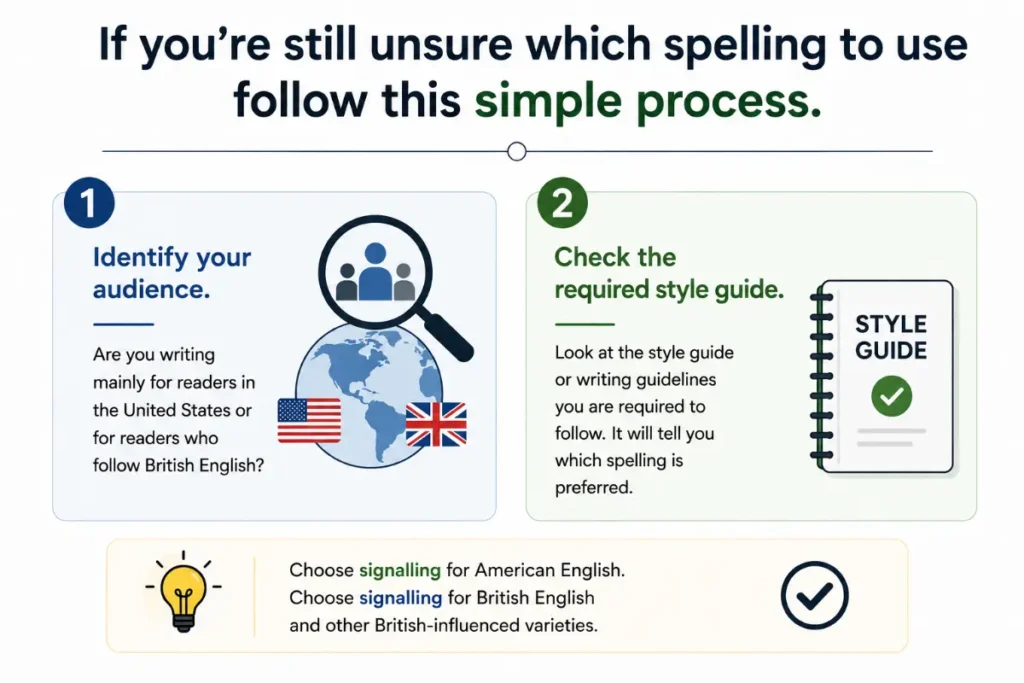
If you’re still unsure which spelling to use follow this simple process.
- Identify your audience.
Are you writing mainly for readers in the United States or for readers who follow British English?
- Check the required style guide.
A school university employer publisher or organization may specify a particular English variety.
- Look at nearby spelling choices.
If the document already uses words such as labeled and canceled then the American convention is probably being used. If it uses labelled and cancelled then the British convention may be in place.
- Stay consistent.
Once you select a spelling system don’t switch randomly between regional forms.
- Check unusual cases.
If a particular word doesn’t fit the pattern you expect consult a reliable dictionary or the relevant house style. This process takes only a few seconds and prevents many unnecessary spelling changes.
Still confused? Compare check in vs check-in Correct Spelling Meaning and Usage.
Conclusion
The choice between signalling or signaling comes down to English variety rather than meaning. American English normally uses signaling with one l while British English and many Commonwealth varieties commonly use signalling with two ls. Both forms are standard in their appropriate regional contexts and both perform the same grammatical function.
If you’re writing for a US audience choose the single l form. If you’re following British English choose the doubled l form. Australian and Canadian writing often follows the British pattern although a specific house style should always take priority.
The easiest editing tip is to check the spelling of nearby words such as labeled or labelled and canceled or cancelled. Once you identify the regional style of the document keep it consistent from beginning to end. That simple habit will prevent most spelling confusion.
FAQs
Which form is correct in American English?
American English normally uses signaling with one l. This is the preferred standard spelling for US writing. Use it in school work business communication technical documents news writing and other material aimed at an American audience unless a specific style guide requires another convention.
Is the British spelling wrong in the United States?
No. The British form is not a meaningless or invented spelling. It is a standard regional form used in British English and other varieties influenced by British spelling. In US writing it may look unusual or may be flagged by a style checker. For an American audience the single l form is normally the better choice.
Why does British English use two ls?
British spelling traditions commonly double the final l before certain suffixes. This pattern appears in several words including labelled travelled cancelled and signalling. American English often uses a single l in these forms. The difference developed through separate spelling conventions rather than a difference in meaning or pronunciation.
How do you pronounce the word?
Both spellings are normally pronounced the same way. A useful pronunciation guide is SIG nuhl ing. The IPA representation is approximately /ˈsɪɡ.nəl.ɪŋ/. The doubled l in the British spelling does not add another syllable.
Is the word a verb or a noun?
The form ending in ing is a present participle of the verb signal. It can also function as a gerund when the activity itself acts as a noun. For example the sentence Signaling clearly helps drivers uses the form as a gerund.
Can the word start a sentence?
Yes. The word can begin a sentence when its grammatical role allows it. For example Signaling early can prevent confusion is grammatically correct. Starting a sentence with an ing form is not an error. The important point is that the sentence must use the form correctly.
What is a synonym for signal?
Useful alternatives include indicate suggest communicate gesture alert notify and sign. The best choice depends on context. Signal often emphasizes a message or indication that another person or system can recognize. Some alternatives may sound more formal or may describe a slightly different kind of communication.
Is the word suitable for formal writing?
Yes. Both regional spellings are suitable for formal writing when they match the selected English variety. American formal writing normally uses signaling while British formal writing commonly uses signalling. The spelling itself does not make the word informal. Context and sentence structure determine the overall level of formality.