
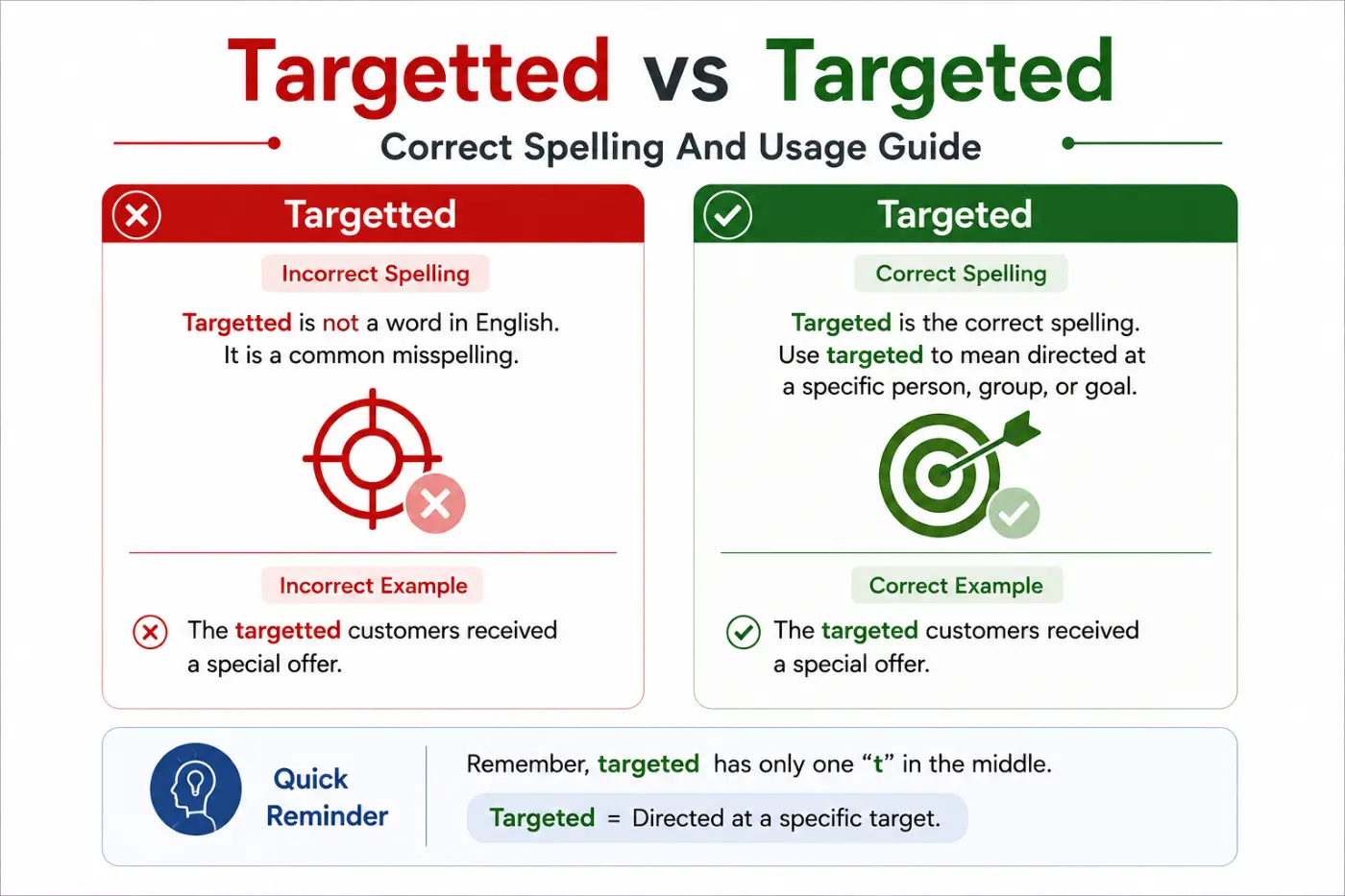
If you’ve ever written targetted vs targeted and stopped to wonder which spelling looks right you’re not alone. The two forms look almost identical and the extra letter can seem logical because English often doubles a final consonant before adding an ending. However the standard spelling is targeted with one t after the e. Targetted is a common misspelling rather than the standard past tense or past participle of target.
The confusion comes from a real spelling pattern in English. Some short words double their final consonant before an ending is added. Words such as planned and stopped can make a writer expect the same pattern in every similar word. Target follows a different spelling pattern because of its final stressed syllable and established verb forms. Standard dictionaries list the past form as targeted and the present participle as targeting.
Once you see the pattern it becomes much easier to remember. This guide explains the correct spelling and why it works. You’ll also see how the word functions as a verb and adjective how Americans and British speakers use it and how to avoid the most common spelling mistake. The goal is simple: you should be able to choose the right form without second guessing yourself.
Need another quick comparison? Read Encorporate vs Incorporate Meaning and Usage 2026.
Quick Answer
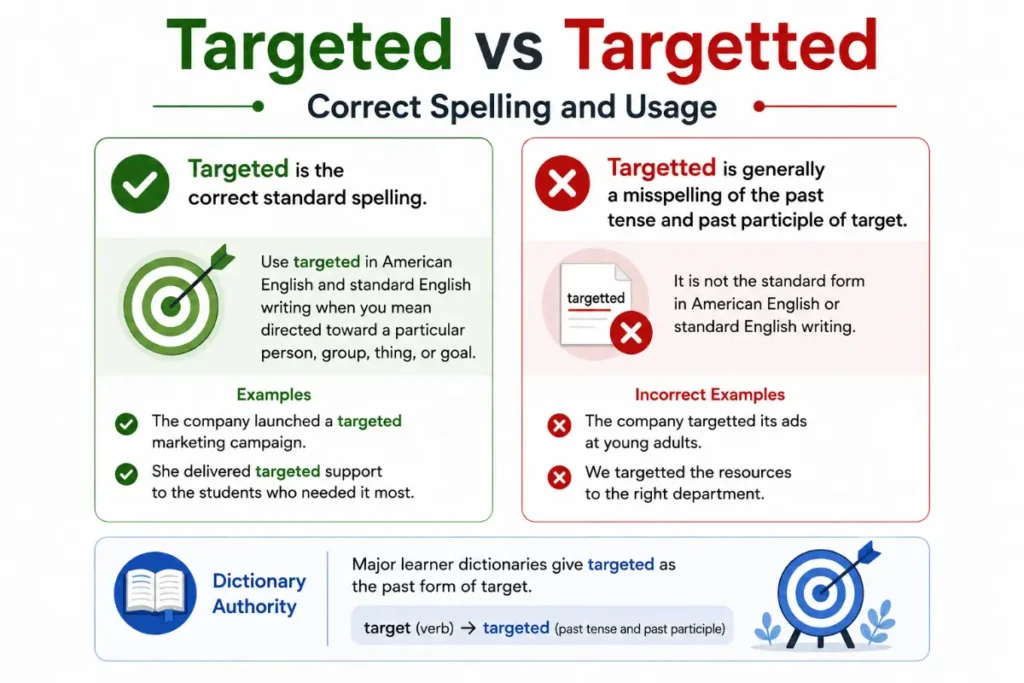
Targeted is the correct standard spelling. Targetted is generally a misspelling of the past tense and past participle of target. Use targeted in American English and standard English writing when you mean directed toward a particular person group thing or goal. Major learner dictionaries give targeted as the past form of target.
Comparison Table
| Form | Meaning | Part of Speech | Spelling Status | Formality | Common Contexts | Example |
|---|---|---|---|---|---|---|
| Targeted | Directed at a particular person group thing or goal | Verb form or adjective | Standard | Formal and informal | Business marketing education policy medicine everyday writing | The campaign targeted younger customers. |
| Targetted | Intended as the past form of target | Usually intended as a verb form | Nonstandard spelling | Not recommended | Informal typing mistakes and spelling errors | The writer should change targetted to targeted. |
The important distinction is spelling rather than meaning. A reader who writes targetted usually intends exactly the same meaning as targeted. The problem is that standard English does not spell the word with two t letters before the ed ending.
What Targeted Means
Targeted comes from the verb target. As a verb target means to direct an action criticism product service message or attack toward a particular person group or thing. It can also describe choosing something for a particular purpose. Oxford lists targeted as both the past simple and past participle form of target.
The word can also work as an adjective. In that role it describes something designed or directed toward a particular person group purpose or result. Cambridge defines targeted as directed at a particular person or thing and gives examples involving advertising content sanctions and other focused actions.
The meaning stays closely connected to the idea of choosing a specific destination or focus. A targeted advertisement is aimed at a particular audience. A targeted lesson is designed for a particular group of learners and A targeted treatment focuses on a particular condition or part of the body.
The word therefore carries a sense of direction and purpose. It tells the reader that something was not aimed randomly. Someone selected a particular person group object problem or goal.
Meaning Of Targetted
Targetted is not normally treated as a separate English word with its own established meaning. In most writing it appears as a misspelling of targeted.
That distinction matters. Some unusual spellings can belong to names brands dialects or specialized terms. This is not normally the case here. If you are writing standard American English and you mean the past form of target the accepted spelling is targeted. Oxford and Cambridge both present targeted as the relevant verb form.
A spelling checker may flag targetted because the standard dictionary form is targeted. A careful editor would also change it in professional writing.
The mistake is understandable because English spelling does contain many examples of consonant doubling. The visual shape of words such as committed and permitted can make targetted look plausible. Still a plausible spelling is not automatically a standard spelling.
Why The Extra T Looks Tempting
The main reason people write targetted is probably the way English handles some verbs when endings are added.
Consider a word such as stop. Its final consonant doubles before the ed ending:
- stop becomes stopped.
Plan follows the same pattern:
- plan becomes planned.
Prefer also produces preferred. These examples can create a mental rule that says a short word ending in a consonant should double that consonant before ed.
English spelling is not that simple.
Target does not become targetted. It becomes targeted. The standard dictionaries agree on this form. Oxford specifically lists targeted as the past simple and past participle of target.
The safest approach is not to rely on appearance alone. Learn the established form of the verb and recognize that English spelling rules have exceptions and conditions.
Which Form Is Correct
Targeted is the correct form for standard English.
Use targeted when you need the past tense or past participle of target.
For example:
- The company targeted small businesses.
- The campaign targeted college students.
- The article targeted readers who were new to the subject.
- The program was targeted at local families.
In each sentence the spelling remains targeted with one t before ed.
Targetted should not be used in standard professional writing. If you see it in a draft email report article or school assignment you should normally correct it to targeted.
This is not a difference between American and British spelling. Both major dictionary sources recognize targeted as the standard form. Oxford gives the same past form for its American and broader English dictionary entries.
Grammar And Part Of Speech
Target can function as both a noun and a verb.
As a noun it can mean a result you want to achieve. It can also mean a person group place or thing that receives attention or action. Cambridge gives examples involving sales targets target audiences and people who are the focus of criticism or attack.
As a verb it means to direct something toward a particular person group thing or purpose.
The verb forms are straightforward:
- Base form: target.
- Third person singular: targets.
- Past tense: targeted.
- Past participle: targeted.
- Present participle: targeting.
Oxford lists these forms directly in its American English entry.
The word can also appear in passive constructions.
For example:
The advertisement was targeted at young adults.
The campaign was targeted toward first time buyers.
The criticism was targeted at the company.
In these sentences targeted functions as a past participle in a passive construction.
It can also work adjectivally.
The company developed a targeted marketing campaign.
Here targeted describes the marketing campaign rather than functioning as the main verb.
Spelling Rules Behind The Form
The spelling of targeted becomes easier to understand when you look at the base verb and its pronunciation.
Target has two syllables in standard pronunciation. The final syllable is pronounced with a short i sound rather than carrying the main stress. The word is commonly represented in American English as /ˈtɑrɡɪt/. Cambridge gives the American pronunciation as /ˈtɑːr.ɡɪt/ in its dictionary notation.
When the past ending is added the standard form is targeted. The spelling does not require a second t.
This is a useful reminder that English spelling rules depend on more than word length. Stress pronunciation syllable structure and historical spelling patterns can all affect how a word behaves.
You should therefore avoid creating a broad rule such as all short verbs double the final consonant before ed. That rule would lead you into many errors.
Instead learn common verb families and pay attention to established forms. A good dictionary confirms the spelling quickly when you are unsure.
Pronunciation Guide
Target is pronounced roughly like TAR git in American English.
The IPA form commonly given for American English is /ˈtɑrɡɪt/. Cambridge also gives a related American pronunciation representation as /ˈtɑːr.ɡɪt/.
Targeted adds the ending pronounced like id.
A simple guide is:
TARGET ed.
The word has three spoken syllables in the past form:
- TAR.
- GIT.
- ID.
The stress stays on the first syllable.
A common mistake is to let the spelling influence pronunciation too strongly. Writing targetted does not create a different standard pronunciation. It is simply an incorrect spelling of the intended word.
Ten Natural Sentence Examples
The correct form appears naturally across many areas of English. These examples show how flexible the word can be.
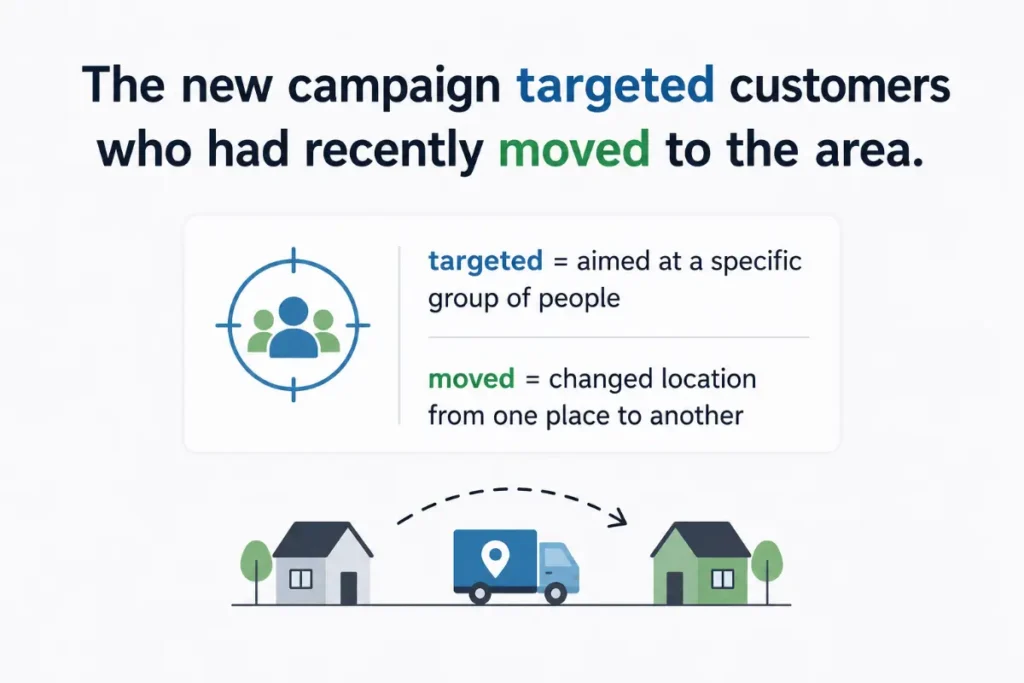
- The new campaign targeted customers who had recently moved to the area.
- The teacher targeted the lesson at students who needed extra practice.
- The company targeted small businesses with a lower cost service plan.
- The email was targeted at people who had already joined the mailing list.
- The researchers targeted a specific group for the study.
- The school introduced targeted support for students who were struggling with reading.
- The advertisement targeted younger consumers without excluding older customers.
- The manager targeted the main source of the problem instead of treating the symptoms.
- The charity targeted families that needed immediate assistance.
- The article was targeted at readers who wanted a simple explanation of the topic.
Notice that the spelling stays the same in every example. The context changes but the verb form does not.
Common Mistakes
The most common problem is adding an unnecessary second t.
- Incorrect: The campaign targetted young adults.
Correct: The campaign targeted young adults.
The mistake comes from treating target like verbs that double their final consonant before an ending.
- Incorrect: The company has targetted a new market.
Correct: The company has targeted a new market.
Here targeted is a past participle after has.
- Incorrect: The program was targetted at new employees.
Correct: The program was targeted at new employees.
The passive construction does not change the spelling.
- Incorrect: The teacher targetted the weakest areas.
Correct: The teacher targeted the weakest areas.
The past tense needs the standard form targeted.
- Incorrect: We need a more targetted approach.
Correct: We need a more targeted approach.
Here targeted works as an adjective describing the approach.
The useful trick is to notice the base verb. If the word comes from target and you are adding ed for the past form or past participle use targeted.
Why Writers Often Make This Mistake
Spelling mistakes rarely happen for no reason. The brain tends to build patterns from familiar words.
A writer may know stopped planned and admitted. Those words reinforce the idea that doubling a final consonant can happen before an ending. When the writer sees target they may unconsciously apply the same pattern.
Another factor is visual balance. Targetted can look convincing at first glance because the repeated t resembles other familiar English forms.
Typing habits can make the problem worse. If you have seen the incorrect form many times online your brain may recognize it as familiar even though familiarity does not make a spelling standard.
Pronunciation can also contribute to uncertainty. The ending in targeted is easy to hear while the spelling requires you to remember that the base word keeps its single final t.
The solution is simple. Do not judge a spelling only by how familiar it looks. Check the established form when you are unsure.
Targeted In American English
Targeted is standard in American English.
American dictionaries and learner dictionaries use targeted for the past tense and past participle of target. Oxford gives the American pronunciation and lists targeted as the past form.
The word is common in everyday American writing.
You might see it in business writing:
The campaign targeted local customers.
You might see it in education:
The program targeted students who needed extra help.
You might see it in journalism:
The investigation targeted several companies.
You might see it in healthcare:
The treatment targets specific cells.
The spelling does not change across these contexts.
Targeted In British English
British English also uses targeted as the standard form.
There is no meaningful British spelling distinction that changes targeted into targetted. Oxford’s broader English entry lists targeted as the past simple and past participle.
This makes the spelling issue easier than some other English spelling questions. You do not need to choose between an American form and a British form here.
For example:
American English: The campaign targeted young people.
British English: The campaign targeted young people.
The spelling is the same.
Differences between American and British English appear in many other words but this is not one of those cases.
Still confused? Compare Passtime or Pastime Which Is Correct? 2026.
Australian And Canadian English
Australian and Canadian English also use targeted in standard writing.
The important point is that the extra t does not become correct simply because English varies by region. Regional vocabulary and pronunciation can differ but the standard spelling of this verb remains targeted.
If you are writing for an international audience you can safely use targeted.
That makes it a useful word to remember because there is no regional spelling choice to complicate the decision.
Targeted As An Adjective
Targeted does more than describe a past action. It can also function as an adjective.
When used this way it usually means carefully directed toward a particular person group problem or purpose.
Consider these examples:
The company created a targeted advertisement.
The school offered targeted support.
The government introduced targeted assistance.
The doctor recommended a targeted treatment.
The team used a targeted approach.
Cambridge specifically defines targeted as directed at a particular person or thing and includes common uses such as targeted advertising and targeted content.
This adjective use has become especially common in professional communication. Marketing education policy healthcare and technology all use the word frequently.
The core idea remains the same. Something targeted has a clear focus.
Common Grammar Patterns
Target often appears with several useful grammatical patterns.
One common pattern is target something.
For example:
The company targeted new customers.
Another is target something at someone or something.
For example:
The campaign targeted the message at younger voters.
The passive form is also common:
The campaign was targeted at younger voters.
Oxford gives examples using target somebody or something and targeted at particular groups.
You can also use target for a particular purpose.
For example:
The hospital targeted the program for additional funding.
The exact preposition can depend on the intended meaning. At is especially common when you describe the person or group that receives the focus.
This matters because correct spelling is only part of correct usage. A sentence can spell targeted correctly and still use an awkward grammatical pattern.
Real Life Usage
Everyday Conversation
In casual conversation people often use targeted when talking about ads plans criticism or support.
For example:
That ad feels targeted at people my age.
The teacher targeted the hardest part of the lesson.
The joke seemed targeted at him.
The word sounds natural because it expresses a simple idea. Something has been directed toward a specific person or purpose.
Workplace Communication
Targeted is especially useful in professional writing.
For example:
We need a more targeted sales strategy.
The team created targeted training for new employees.
The report recommends targeted support for smaller offices.
In workplace writing the adjective form often appears before a noun.
Academic Writing
Academic writers use targeted when describing research methods interventions or analysis.
For example:
The researchers targeted a specific population.
The intervention was targeted at students with reading difficulties.
The study examined targeted treatment strategies.
The word can help make academic writing precise because it tells readers that the action or method focused on a defined group or issue.
News Writing
Journalists also use targeted to describe criticism sanctions attacks campaigns and other focused actions.
For example:
The new measures targeted illegal activity.
The investigation targeted several major firms.
The criticism was targeted at the policy rather than the people who created it.
The word works well in news writing because it communicates direction clearly.
Storytelling
In fiction and narrative writing targeted can describe a person who becomes the focus of an action.
For example:
She realized that she had been targeted by the group.
The thief targeted the busiest shops.
The detective discovered that the message had targeted one specific person.
The meaning remains clear even though the setting changes.
Related And Confused Terms
Several words connect closely with targeted. Understanding the differences can make your writing more precise.
Aimed
Aimed means directed toward a particular person place thing or result. It is often broader than targeted.
The campaign was aimed at new customers.
Directed
Directed means guided or sent toward something. It can describe actions messages criticism or attention.
The funds were directed toward community projects.
Focused
Focused means concentrated on a particular subject or goal.
The meeting focused on customer complaints.
Intended
Intended describes something planned or designed for a particular purpose.
The course was intended for beginners.
Specific
Specific means clearly identified or limited to one particular thing.
The instructions give specific examples.
Selective
Selective describes choosing some people or things rather than others.
The company used a selective approach to hiring.
Goal
A goal is something a person or organization wants to achieve.
The team reached its main goal.
Objective
An objective is a planned result or purpose. It often sounds more formal than goal.
The main objective was to reduce costs.
Target and objective can overlap but they are not always interchangeable. Oxford notes that a target is often an officially recorded result that someone aims to achieve.
Target And Targeted Are Not The Same Thing
Target is the base word. Targeted is one of its past forms and can also function as an adjective.
Compare these sentences:
The company targets small businesses.
The company has targeted small businesses.
The first uses the present form.
The second uses the past form.
The third uses the past participle after has.
Now compare:
The company created a targeted campaign.
Here targeted describes the campaign.
This distinction helps you understand the word instead of memorizing the spelling in isolation.
A Simple Memory Trick
Think of the word as target plus ed.
Target + ed = targeted.
Do not insert another t.
A useful mental image is a target on a board. The word already ends with the t you need. When the ed ending arrives you simply attach it.
Target.
Targeted.
That small visual habit can prevent the most common mistake.
Another useful trick is to compare target with visit.
Visit becomes visited rather than visitted. Target follows the same general visual pattern.
You do not need to memorize a complicated spelling rule every time you use the word. Remember the standard form and let repeated correct use make it automatic.
Expert Editor Insight
An experienced editor would not spend much time debating the spelling once the base word is identified. The professional check is simple: if the intended word is the past tense or past participle of target the standard form is targeted. Editors also look at the surrounding sentence because targeted can function as a verb or adjective. Spelling tools usually catch targetted but a careful human review still matters because context determines grammar and word choice. The best editing habit is to recognize the base word first and then confirm the established inflected form.
Etymology And Word Origin
The history of target explains why the word does not behave exactly like every modern short verb.
Oxford traces the noun to Middle English and connects it with targe which referred to a small round shield. The noun later developed broader meanings involving round objects and things aimed at. The verb appeared in English in the early seventeenth century.
The modern sense grew naturally from the idea of a target as something at which a person aims.
Today the word can refer to a physical object an intended result a person group audience market or problem.
That historical development also helps explain why target has become such a flexible word. Its core meaning is still tied to direction and aim but English has expanded the word into many areas of modern life.
Formal And Informal Usage
Targeted works comfortably in both formal and informal English.
You can use it in a text message:
That ad was clearly targeted at me.
You can use it in a workplace report:
The company introduced targeted training for new staff.
You can use it in academic writing:
The intervention targeted students with specific learning needs.
You can use it in journalism:
The campaign targeted several key regions.
The spelling remains the same in every setting.
What changes is usually the surrounding vocabulary and sentence structure rather than the word itself.
When To Use A Different Word
Targeted is useful but it should not become a substitute for every word that means focused.
Sometimes aimed is more natural.
The course is aimed at beginners.
Sometimes designed is better.
The program was designed for new employees.
Sometimes focused gives a cleaner sentence.
The discussion focused on customer service.
Sometimes intended is the right choice.
The book was intended for younger readers.
Good writing depends on precision. A thesaurus can offer many alternatives but the best word is the one that expresses the exact relationship you mean.
Targeted usually suggests deliberate direction toward a defined person group thing or goal. That idea should be present before you choose it.
Is The Spelling A Pronunciation Problem
Not really.
The main problem is visual rather than phonetic. People can pronounce the word correctly while still spelling it incorrectly.
This happens often with English because pronunciation does not always give enough information about spelling.
For targeted the ending sounds clear enough but the writer may still wonder if the final consonant should double.
That is why learning the written form matters.
Say the base word target.
Then add ed.
Targeted.
The pronunciation does not require you to pronounce a second t simply because you might have written one.
Why Spellcheck Matters But Should Not Be Your Only Guide
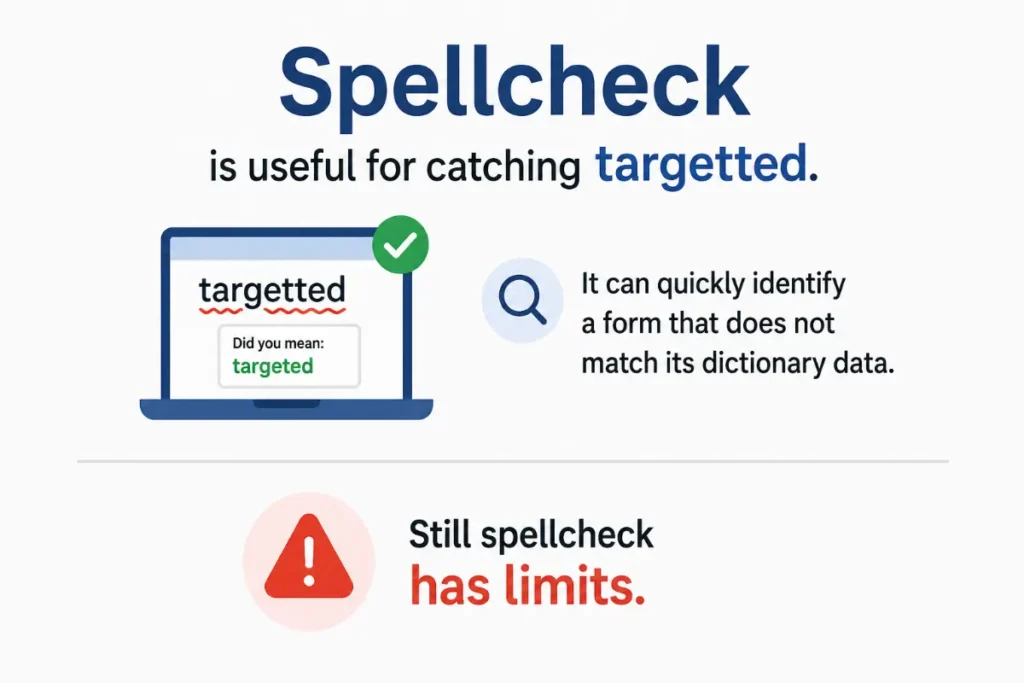
Spellcheck is useful for catching targetted. It can quickly identify a form that does not match its dictionary data. Still spellcheck has limits. spelling tool can tell you that a word looks unusual. It may not explain why the word is wrong or how the sentence should be rewritten. For example a sentence can contain targeted with correct spelling but poor word choice. The campaign targeted at customers. A careful editor might revise that sentence depending on the intended structure. The campaign targeted customers.
Learn the difference in Specialty Or Speciality Which Spelling Is Correct 2026.
Final Verdict
The correct standard spelling is targeted. The form targetted is generally a misspelling and should be corrected in standard American English and other major varieties of English. Oxford lists targeted as the past tense and past participle of target while Cambridge uses targeted for the adjective and verb form.
The easiest way to remember the difference is to start with target and add ed. You do not need another t. The word can function as a verb or adjective and it commonly describes something directed toward a particular person group thing or goal. Keep that meaning in mind and the spelling becomes much easier to recall.
For editing purposes think of the form as target plus ed. If your draft contains targetted change it to targeted. That small correction keeps your writing standard clear and professional.
FAQs
Is targetted a real English word?
Targetted is generally not the standard spelling of the past tense or past participle of target. In standard English writing use targeted. Major learner dictionaries list targeted as the past form of target. If you see targetted in ordinary prose it is usually a spelling error rather than a separate established word.
Which spelling should I use?
Use targeted. It is the standard form in American English and British English. The spelling does not change based on the English variety. If you are writing an email report article assignment or professional document targeted is the safe standard form. You do not need to add another t before the ed ending.
Why do people spell targeted with two t letters?
People often make this mistake because English has many verbs that double a final consonant before an ending. Words such as stopped and planned can create a strong spelling pattern in the mind. Target does not follow that pattern. Its established past form is targeted with one t before ed.
How do you pronounce targeted?
In American English targeted can be pronounced roughly like TAR git id. The base word target is commonly represented as /ˈtɑrɡɪt/. The past form adds an ending that produces three spoken syllables. The main stress remains on the first syllable.
Can targeted be an adjective?
Yes. Targeted often works as an adjective meaning directed toward a particular person group thing or purpose. Examples include targeted advertising targeted support and targeted treatment. Cambridge specifically lists targeted as an adjective with the meaning of being directed at a particular person or thing.
Is targeted appropriate in formal writing?
Yes. Targeted is completely appropriate in formal writing when it expresses the intended meaning. It appears naturally in academic business government healthcare and journalistic contexts. The key is to use the word accurately and choose the right grammatical structure around it.
What is a synonym for targeted?
Useful alternatives include aimed directed focused intended specific and selective. The best choice depends on the sentence. Targeted usually emphasizes deliberate direction toward a particular person group thing or goal. Aimed is often broader while intended emphasizes purpose and focused emphasizes concentration.
How can I remember the correct spelling?
Remember target plus ed. Write the base word first and then add the ending without adding another t. Target becomes targeted. If you are unsure while editing check the verb forms listed in a reliable dictionary. Repeated exposure to the correct form will eventually make the spelling feel natural.