
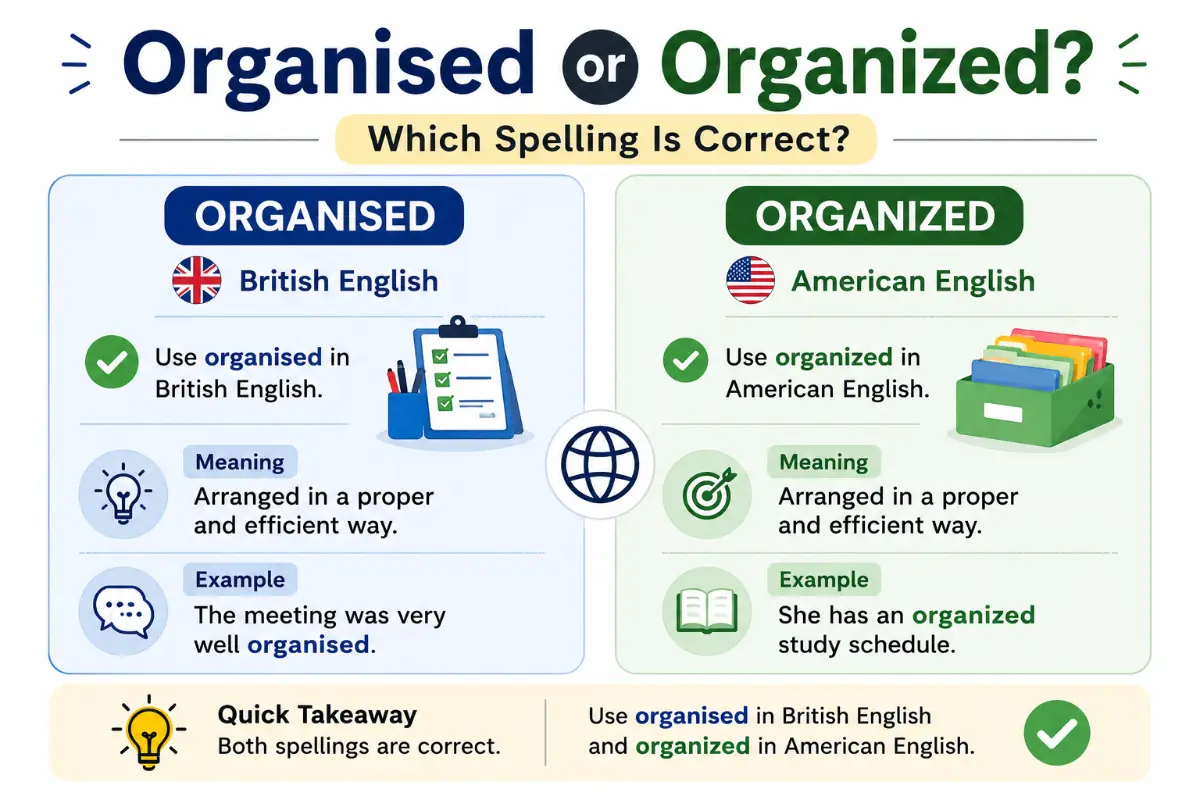
If you’ve ever stopped while writing and wondered if organised or organized is correct you’re not alone. Both spellings are valid English. The main difference comes from regional spelling conventions rather than meaning.
For American English the preferred form is organized. British English commonly uses organised. Cambridge lists organized as the main form and notes that organised is usually used in the UK. Oxford also recognizes organise as a British English form while using organize as the main headword.
The two forms have the same meaning and pronunciation. They can describe something arranged in a clear way or a person who plans things carefully. The verb also means to arrange an event or put information into a useful order. This guide explains the spelling difference in plain English. You’ll learn which form fits American writing which one appears more often in British writing how to pronounce the word and how to use it naturally in sentences.
Need another quick comparison? Read Elfs or Elves Correct Spelling Meaning and Usage Guide.
Quick Answer
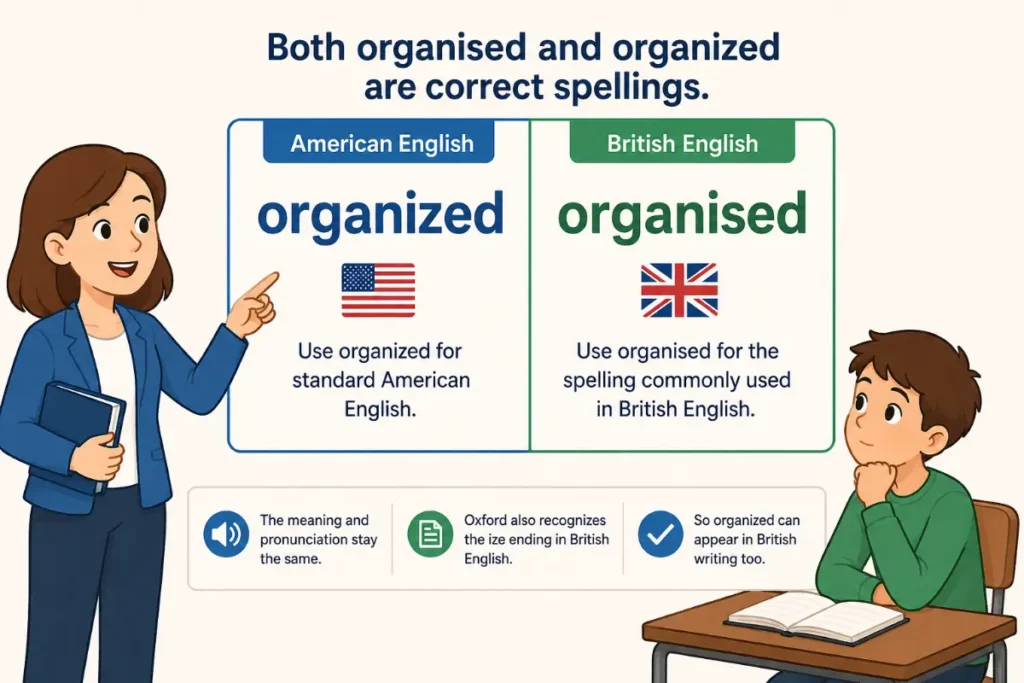
Both organised and organized are correct spellings. Use organized for standard American English and organised for the spelling commonly used in British English. The meaning and pronunciation stay the same. Oxford also recognizes the ize ending in British English so organized can appear in British writing too.
The Main Difference
The difference is simply the spelling of the ending.
American English normally uses organized with ize. British English commonly uses organised with ise. Cambridge specifically marks organized as the US form and says the UK usually uses organised.
Neither spelling changes the basic meaning.
For example:
- She organized the meeting carefully.
- She organised the meeting carefully.
Both sentences mean that she arranged the meeting.
The choice depends on the English variety and the style you’re following. If you’re writing for an American audience then organized is the natural choice. If you’re following a British style guide then organised will usually fit better.
The key point is consistency. A document that uses American spelling should generally keep American spelling throughout. Mixing organized with other British spellings can make the writing look inconsistent even though the individual words may still be understood easily.
Comparison Table
| Correct Form | Meaning | Part of Speech | Origin | Usage Frequency | Formality | Common Contexts | Example |
|---|---|---|---|---|---|---|---|
| organized | Arranged or planned in an orderly way | Adjective or past form of a verb | From organize | Very common in American English | Standard | Work school planning events writing | She organized the files. |
| organised | Arranged or planned in an orderly way | Adjective or past form of a verb | From organise | Very common in British English | Standard | Work school planning events writing | She organised the files. |
The table shows why calling one spelling wrong would be misleading. The difference is mainly regional spelling.
What Organized Means
Organized can work as an adjective or as the past tense and past participle of the verb organize.
As an adjective it can describe someone who plans well and keeps things in order.
For example:
She is very organized at work.
Here organized describes the person.
It can also describe something arranged according to a system.
For example:
The documents are organized by date.
The word can describe planned activities too.
For example:
They joined an organized tour of the city.
Cambridge gives several related meanings. It describes an organized person as someone who can plan carefully and keep things tidy. It also uses the word for activities that have been planned and arranged.
The word can also describe groups or movements.
For example:
The report discusses organized labor.
The police investigated organized crime.
In these cases organized means that people are working together as part of a structured group.
What Organised Means
Organised has the same basic meanings as organized. The only major difference is the spelling.
British English commonly uses the ise ending.
For example:
She is well organised.
The files were organised by subject.
They organised a charity event.
Cambridge lists organized as the main dictionary form but identifies organised as the usual UK spelling.
That detail matters because some people learn that every British English word ending in ise must use that spelling. English spelling is a little less tidy than that.
Oxford explains that the ize suffix is also used in British English. Its dictionary gives examples such as criticize and organize and notes that British English also uses the ise spelling.
So organized is not automatically a spelling mistake in British English.
Is Organized Correct In American English
Yes. Organized is the standard spelling for American English.
If you’re writing a school assignment for an American audience then organized is the natural choice. The same applies to business writing academic work websites emails and most other forms of US English.
Examples include:
- The team organized a meeting for Friday.
- She keeps her desk organized.
- We organized the files by category.
- The students organized a fundraiser.
- He is highly organized and rarely misses a deadline.
American English also uses related forms with the same spelling pattern.
Organize becomes organized.
Organizing keeps the z.
Organization uses the z form.
For example:
The company organized the event.
The company is organizing another event.
The organization has grown quickly.
This pattern gives American readers a consistent spelling system.
Oxford’s American English dictionary lists organize with forms such as organized and organizing.
Is Organised Correct In British English
Yes. Organised is a standard and very common British English spelling.
You’ll see it in British newspapers books websites workplace documents school materials and everyday writing.
Examples include:
- The meeting was well organised.
- She organised the files before leaving.
- They organised a school event.
- The office is better organised now.
- The students organised a charity drive.
Cambridge specifically labels organized as the US spelling and notes that the UK usually uses organised.
There is one useful wrinkle. British English also permits the ize spelling in many words. Oxford uses organize as its main form and lists organise as the British alternative.
That means you shouldn’t treat organised as the only acceptable spelling for every British writer.
Why The Two Spellings Exist
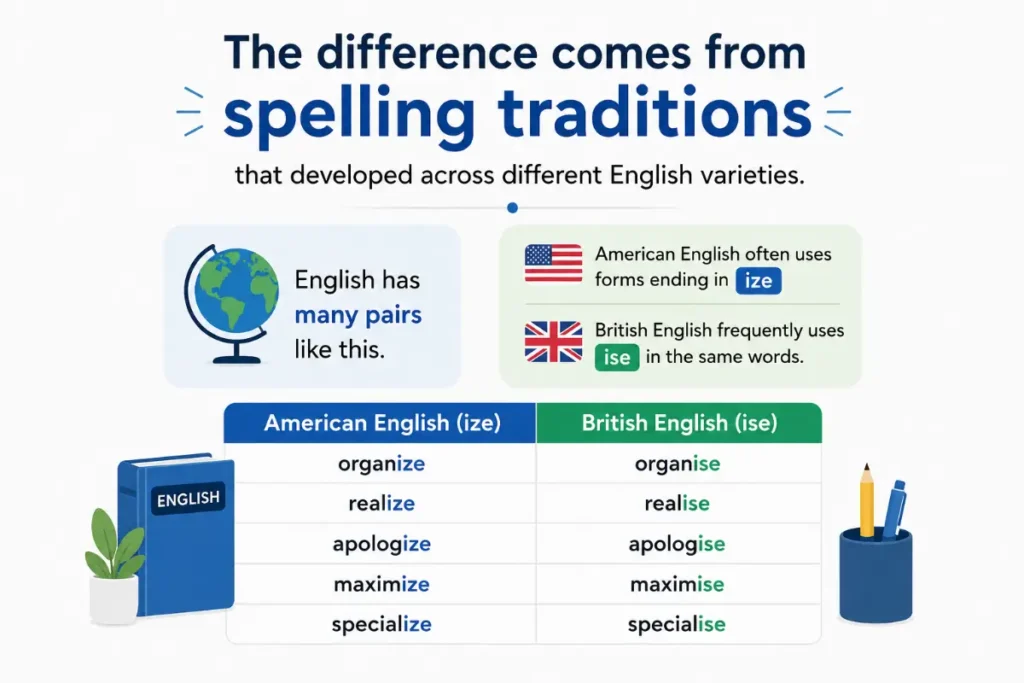
The difference comes from spelling traditions that developed across different English varieties.
English has many pairs like this.
American English often uses forms ending in ize while British English frequently uses ise in the same words.
You can see the pattern in words related to organization.
American English commonly uses:
- organize
- organized
- organizing
- organization
British English commonly uses:
- organise
- organised
- organising
- organisation
The underlying word and meaning remain the same.
This is similar to other regional spelling differences such as color and colour or center and centre. English developed in different places and spelling conventions naturally took different paths.
There’s no hidden difference in meaning between the two endings in this case.
Pronunciation Guide
Both forms are pronounced the same way.
The common pronunciation is:
/ˈɔrɡənaɪzd/ in American English.
A simple pronunciation guide is:
OR guh nized
The first syllable receives the main stress.
The final d sound is pronounced as part of the ending.
British pronunciation can sound slightly different because accents vary. Cambridge gives the British pronunciation as approximately /ˈɔːɡənaɪzd/ and the American pronunciation as approximately /ˈɔːrɡənaɪzd/.
The spelling difference does not create two different pronunciations.
That’s why hearing the word alone usually won’t tell you which spelling the writer should use.
If you’re unsure while typing, think about the English style you’re using rather than trying to hear the spelling in your head.
Grammar And Part Of Speech
The word can have more than one grammatical role.
First, organized can be the past tense of the verb organize.
For example:
We organized the meeting yesterday.
Here organized tells us that the action happened in the past.
It can also be the past participle.
For example:
The files have been organized.
The passive structure uses organized with a form of be.
It can also function as an adjective.
For example:
She is organized.
In this sentence organized describes her.
The same grammatical functions apply to organised.
For example:
They organised the event yesterday.
The files have been organised.
She is organised.
The spelling changes but the grammar does not.
Common Sentence Patterns
Several patterns appear frequently in everyday English.
Organized With A Person
When you describe someone’s habits or personality you can use the word after a form of be.
She is organized.
He’s extremely organized.
They’re well organized.
The word describes someone’s ability to plan and maintain order.
Organized With Objects
You can describe documents files information or other things that have been arranged.
The records are organized by year.
The books are organized by subject.
The data is organized into categories.
Organized With Events
The verb can describe arranging an activity or event.
We organized a conference.
She organized a birthday party.
They organized a fundraiser.
Oxford defines organize as arranging for something to happen or be provided. It also includes arranging things into a particular order or structure.
Ten Natural Sentence Examples
Here are examples that show how the word works in real situations.
- I organized my notes before starting the report.
- She keeps her calendar organized so she doesn’t miss appointments.
- The manager organized a meeting with the new employees.
- We organized the files by date and project.
- His organized approach helped the team finish early.
- The students organized a fundraiser for their school.
- I finally got my workspace organized.
- The information is organized into three main sections.
- She’s organized enough to handle several projects at once.
- The volunteers organized everything before the guests arrived.
For British English the same sentences can use organised instead.
The meaning stays exactly the same.
Need another quick comparison? Read acceptions vs exceptions Meaning and Usage.
Common Spelling Mistakes
The main mistake is usually not confusion about meaning. It’s confusion about which spelling system the writer is following.
Using Organised In American Writing
This spelling can look unusual to an American reader because US English normally uses organized.
For example:
She is organised.
For American writing use:
She is organized.
Using Organized In A British Style
This one is more complicated because organized is not necessarily wrong in British English. Oxford recognizes the ize ending in British English.
Still if your publication or institution follows the common British ise convention then organised is the better choice.
Mixing The Two Styles
A writer may use organized in one paragraph and organised later.
That creates an inconsistent style.
Choose one convention and keep it throughout the document.
Changing The Ending Incorrectly
Some writers may create forms such as organizised or organiszed.
Those are simply spelling errors.
The standard forms are organized and organised.
Changing Related Words Inconsistently
The problem can spread to related words.
For American English use:
organize
organized
organizing
organization
For a British style that follows the common ise convention use:
organise
organised
organising
organisation
A consistent word family makes polished writing much easier to read.
Regional Usage
Regional spelling matters most when you’re writing for a specific audience.
American English
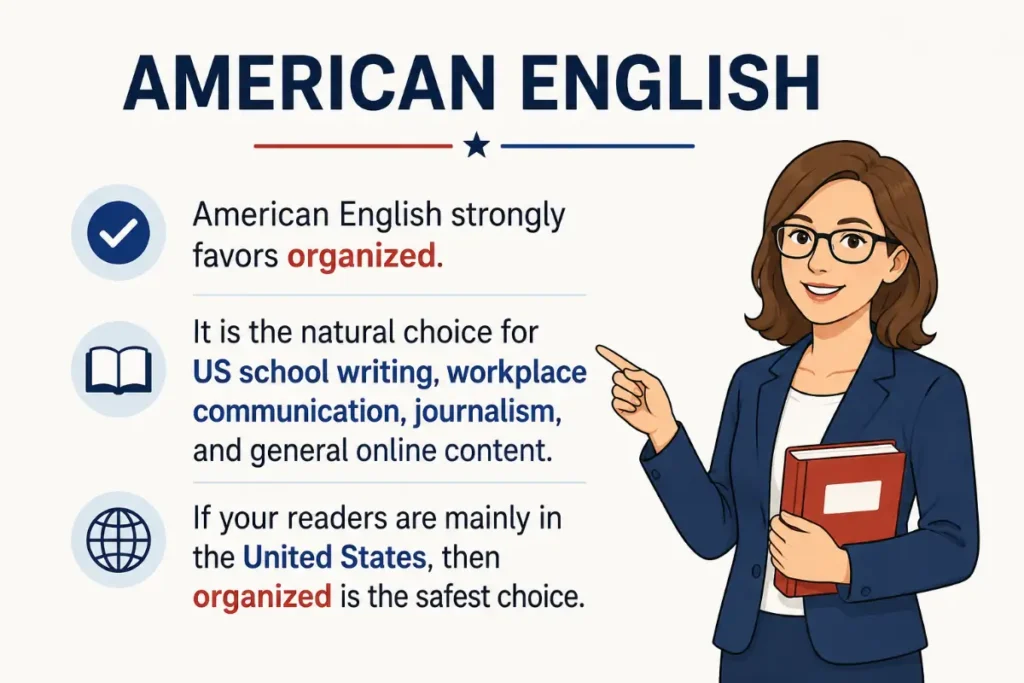
American English strongly favors organized.
It is the natural choice for US school writing workplace communication journalism and general online content.
If your readers are mainly in the United States then organized is the safest choice.
British English
British English commonly uses organised.
Cambridge identifies organized as the US form and organised as the usual UK form.
Oxford adds an important point by recognizing organize and organise as British English options.
So a British writer may encounter both forms.
Australian English
Australian English has its own established spelling conventions. The Australian Government Style Manual advises writers to use Australian English consistently and recommends checking an Australian dictionary such as the Australian Concise Oxford Dictionary or Macquarie Dictionary.
For Australian writing the best editorial practice is simple. Follow the dictionary or style guide required by your publication institution or employer and stay consistent.
Canadian English
Canadian English can show a mixture of British and American spelling traditions. The safest approach is to follow the style guide used by your school employer publication or organization.
For an audience that expects US English use organized.
Etymology And Word Origin
The history of the word goes much deeper than the spelling difference suggests.
Oxford traces organize to Late Middle English. The word developed through Medieval Latin and ultimately connects to Latin organum meaning instrument or tool. That Latin term came from Greek organon with meanings connected to a tool instrument or bodily organ.
The original idea is interesting because the modern meaning still carries a sense of arranging parts into a useful system.
Think about a toolbox.
A pile of tools may contain everything you need. Yet finding the right wrench becomes frustrating if everything is scattered across the floor.
Arrange the tools by purpose and the same collection suddenly becomes useful.
That basic idea of putting things into a workable order sits at the heart of organize.
Over time the word developed broader meanings. Today it can describe arranging objects planning events managing information or bringing people together for a shared purpose.
Formal And Informal Usage
Both spellings are suitable for formal writing when they match the regional style you’re using.
You can use organized in:
- Academic papers.
- Business reports.
- Professional emails.
- Resumes.
- School assignments.
- News writing.
- Government documents.
You can use organised in the equivalent British style contexts.
There’s nothing informal about either spelling.
The important question is not formality. It’s regional convention and consistency.
For example an American business report might say:
The department organized the records by year.
A British report might say:
The department organised the records by year.
Both sentences are professional.
Real Life Usage Examples
Daily Conversation
People often use the adjective when talking about habits and routines.
I’m trying to stay organized this month.
She’s very organized.
He keeps everything organized.
In British English the spelling may appear as organised.
I’m trying to stay organised this month.
The meaning doesn’t change.
Workplace Communication
The word is common in professional writing.
The team organized a training session for new employees.
The files have been organized by department.
We need to get the schedule organized before Friday.
These examples show that the word can describe both an action and a resulting state.
Academic Writing
Students may use the word to describe information or research.
The data was organized into several categories.
The essay is organized around three main ideas.
The research notes were organized by topic.
Clear organization helps readers follow complex information.
News And Journalism
The word can describe planned events or groups.
Local residents organized a public meeting.
The group organized a campaign to raise awareness.
Police investigated an organized criminal network.
Storytelling
The word can describe a character’s habits or the structure of events.
Maya was organized enough to pack everything the night before.
The story is organized around a series of letters.
The group organized a rescue effort before sunset.
These examples show how flexible the word is outside textbook grammar.
Related And Confused Terms
Several words connect closely with organized.
Organize
Organize is the base verb.
Example:
I need to organize my desk.
Organization
Organization is the noun form.
Example:
The organization helps local families.
It can also refer to the act or system of arranging things.
Organizer
An organizer is a person or tool that helps arrange things.
Example:
She was the main organizer of the event.
Organizing
Organizing is the present participle or gerund form.
Example:
I’m organizing the files now.
Disorganized
Disorganized describes something lacking order or structure.
Example:
His notes are disorganized.
Orderly
Orderly means arranged in a neat or systematic way.
Example:
The records were kept in an orderly system.
Systematic
Systematic describes an approach that follows a clear method.
Example:
She took a systematic approach to the problem.
Structured
Structured means arranged according to a clear framework.
Example:
The course has a structured learning plan.
These terms overlap but they aren’t perfect substitutes in every sentence.
Organized And Disorganized
Organized and disorganized are opposites in many contexts.
An organized desk has a clear system.
A disorganized desk may have papers scattered everywhere.
An organized person tends to plan tasks and manage time carefully.
A disorganized person may struggle to keep track of tasks or information.
Cambridge lists disorganized as the opposite of organized in its dictionary entry.
This contrast makes the meaning easy to remember.
Organized means things have a system.
Disorganized means the system is missing or not working well.
Organized And Arranged
These words are close but not identical.
Arranged usually focuses on putting things into a particular order or position.
Organized often suggests a broader system.
For example:
I arranged the chairs in a circle.
I organized the entire event.
You can arrange chairs without organizing the whole event.
That small difference helps you choose the stronger word.
Organized And Structured
Structured usually refers to a planned framework.
For example:
The course has a structured format.
Organized can refer to the actual arrangement or management of the material.
For example:
The course materials are organized by topic.
The two words can work together but they highlight different ideas.
Expert Editor Insight
An experienced editor usually doesn’t treat organized and organised as a simple right versus wrong spelling problem. The first question is the target variety of English. For US readers use organized unless a quoted name or required house style says otherwise. For British readers check the publication style because both ise and ize conventions exist. Oxford explicitly recognizes the ize pattern in British English while Cambridge identifies organised as the usual UK spelling.
A useful editing trick is to check the entire word family instead of correcting one word in isolation. If your document uses organization and organizing then organized usually fits naturally in American English. If your British style uses organisation and organising then organised creates a consistent pattern.
A Simple Memory Trick
Think of the audience first.
If you’re writing for the United States then think z.
Organize.
Organized.
Organizing.
Organization.
If you’re following the common British ise convention then think s.
Organise.
Organised.
Organising.
Organisation.
The memory trick works because you’re not trying to memorize one isolated word. You’re remembering the spelling pattern across the whole word family.
Which Form Should You Use
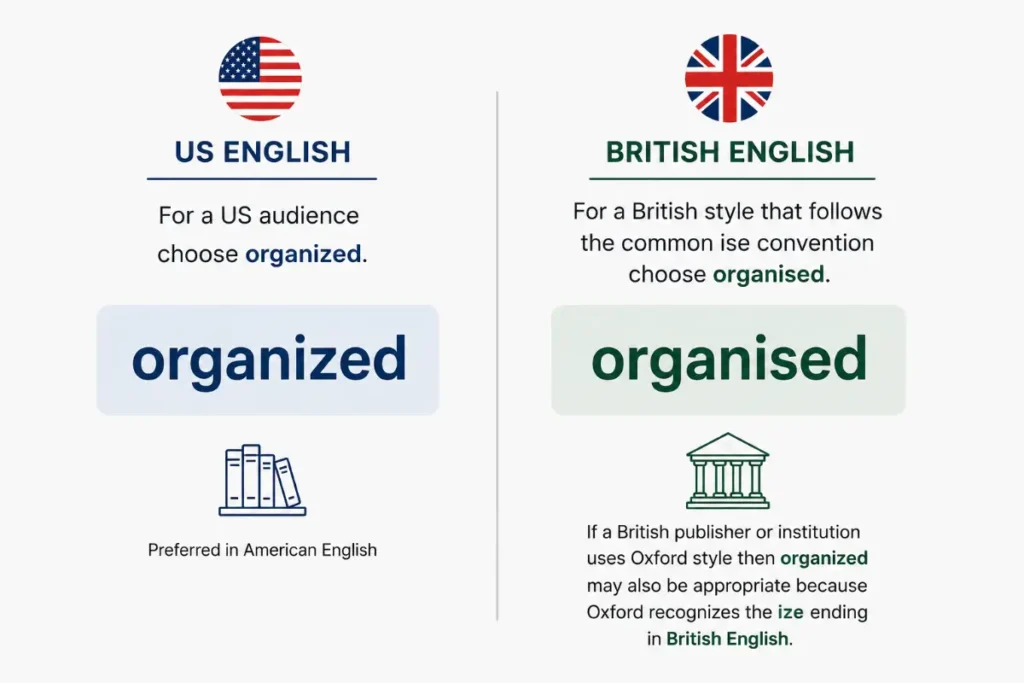
For a US audience choose organized. For a British style that follows the common ise convention choose organised. If a British publisher or institution uses Oxford style then organized may also be appropriate because Oxford recognizes the ize ending in British English. If you’re unsure about your audience then check the style guide before making a final choice. For general American writing there’s no real reason to switch to organised. Organized is the familiar US spelling. For British writing don’t automatically label organized as wrong. Check the style standard being followed. That distinction is useful because English spelling rules often have more flexibility than simple school exercises suggest.
A related grammar guide is Offered Vs Offerred Meaning Usage And Correct Form.
Final Answer
Organized and organised are both correct English spellings. For American English use organized. For the common British English convention use organised. Oxford also accepts the ize pattern in British English so the difference isn’t as absolute as many spelling guides suggest.
The meaning and pronunciation stay the same. The real issue is consistency. If you’re writing for US readers stick with the z spelling throughout your word family. If you’re following a British style guide use its preferred convention. When editing your own work remember to check related words such as organize organization and organizing too. One consistent spelling pattern will keep your writing clean and professional.
FAQs
Is organized the American spelling?
Yes. Organized is the standard spelling used in American English. It appears in US dictionaries and is the natural choice for American school writing business communication academic work and general publishing. Cambridge identifies organized as the US form and notes that the UK usually uses organised.
Is organised the British spelling?
Yes. Organised is a very common standard spelling in British English. Cambridge identifies it as the usual UK form. British English also allows the ize pattern in many words so organized can appear in British writing too depending on the style being followed.
Which is correct organized or organised?
Both are correct. The choice depends mainly on regional spelling style. American English generally uses organized while British English commonly uses organised. If you’re writing for a specific publication then follow its style guide and keep the spelling consistent throughout the document.
How do you pronounce organized?
Organized is commonly pronounced approximately /ˈɔrɡənaɪzd/ in American English. A simple guide is OR guh nized. The British pronunciation can differ slightly by accent but the spelling difference does not create a separate basic pronunciation. Cambridge provides British and American pronunciation information for the word.
Does organized have the same meaning as organised?
Yes. The two forms have the same basic meaning. Both can describe a person who plans carefully or something arranged according to a system. Both can also describe activities that have been planned. The difference is mainly spelling convention rather than meaning.
Is organized acceptable in British English?
Yes. Organized can be acceptable in British English. Oxford lists organize as a British English form and notes that British English also uses organise. This means the ize spelling should not automatically be treated as an error in British writing. A publisher or institution may still prefer the ise convention.
Why do people spell organized with an s?
People often write organised because that spelling is common in British English and several other English varieties influenced by British spelling traditions. The spelling does not change the meaning. Writers may also choose the s form because their school employer publisher or local style guide uses British conventions.
Which spelling should I use in American English?
Use organized. It matches standard American spelling and will look natural to US readers. The same pattern continues through related forms such as organize organizing and organization. Keeping the entire word family consistent is a simple way to avoid regional spelling problems.