
If you’ve ever typed alot and wondered if it should actually be a lot you’re not alone. This mistake is common because the two words sound like one unit when people speak naturally. The spelling can feel just as natural when you write it that way.
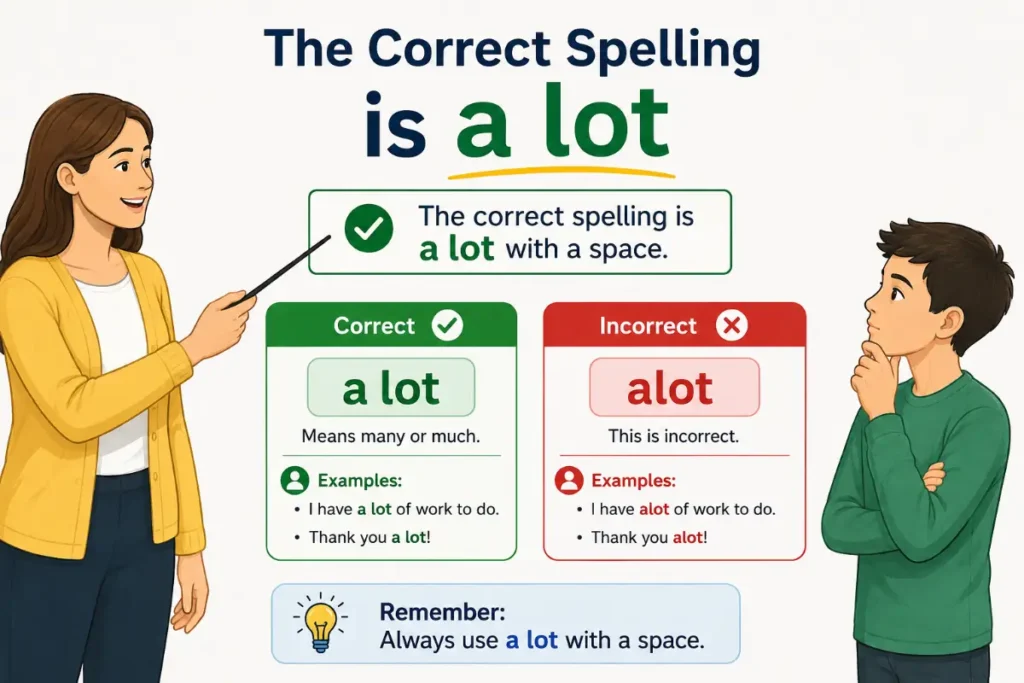
The correct form is a lot. Alot isn’t accepted as a standard English word. You should write a lot when you mean a large amount or a large number. For example: “She has a lot of experience.”
The confusion comes from English pronunciation. When people say the phrase quickly the words blend together. That can make the incorrect spelling look reasonable. You’ll also see the mistake often in casual online writing where people type quickly and don’t proofread.
Still confused? Compare Holistic or Wholistic Which Spelling Is Correct? 2026.
Quick Definition
A lot is the correct standard English form. It means a large amount or a large number. Alot is generally a spelling error rather than an accepted standard English word. Use a lot in casual writing formal writing academic work emails and professional communication.
Quick Answer
A lot is correct. Alot is a common misspelling and shouldn’t be used in standard English.
Use a lot when you want to say that something exists in a large amount or happens frequently. For example: “I learned a lot from that experience.”
Comparison Table
| Correct Form | Meaning | Part of Speech | Origin | Usage Frequency | Formality | Common Contexts | Example |
|---|---|---|---|---|---|---|---|
| A lot | A large amount or number | Adverbial phrase or noun phrase | English phrase formed from the noun lot | Very common | Neutral | Conversation writing emails general prose | She travels a lot. |
| Alot | No standard meaning in modern standard English | Not a standard part of speech | Common spelling error caused by combining the words | Common as a mistake | Nonstandard | Informal online writing and typing errors | Alot is incorrect in standard English. |
Meaning and Definition
Meaning of Alot
Alot isn’t recognized as the standard spelling of the phrase a lot. In ordinary English editing it’s treated as a misspelling.
You may occasionally encounter the form in usernames brand names creative writing jokes or intentionally informal text. Those special uses don’t change the standard spelling rule.
If you’re writing an email school assignment article report application or business message you should use a lot.
The reason this error feels so natural is simple. English speakers often pronounce the phrase smoothly as one sound group. In fast speech the small word a can become less noticeable. Your brain then stores the phrase as a single sound and may reproduce it as one written word.
That process happens with many spelling errors. People don’t always spell from individual letters. They often remember the overall shape and sound of a familiar phrase.
Meaning of A Lot
A lot usually means a large amount or a large number.
When it describes an uncountable noun it means a large amount.
For example:
“She has a lot of patience.”
“We need a lot of information.”
“There’s a lot of water in the tank.”
When it relates to a countable noun it means a large number.
For example:
“He owns a lot of books.”
“We met a lot of people.”
“They received a lot of questions.”
A lot can also function as an adverbial phrase meaning frequently or to a great degree.
For example:
“I exercise a lot.”
“She talks a lot.”
“They travel a lot.”
“He worries a lot.”
The phrase is extremely common because it works naturally in everyday English. Native speakers use it in casual conversation and ordinary writing all the time.
Key Differences Explained
- Spelling
The standard spelling is a lot with two separate words. The form alot combines them incorrectly.
- Grammar role
A lot can function as an adverbial phrase or as a noun phrase depending on the sentence. Alot doesn’t have a standard grammatical role in ordinary English.
- Meaning
The standard phrase expresses a large amount a large number or frequent action. The incorrect form doesn’t have an established standard meaning.
- Tone
A lot works in casual and professional writing. Alot immediately looks like a spelling mistake to most experienced editors.
- Context
You can safely use a lot in emails essays articles conversations reports and everyday messages. Avoid alot in standard English unless you’re deliberately reproducing a nonstandard spelling for a specific reason.
Which Spelling Is Correct?
A lot is the correct spelling in standard English.
The linguistic reason is straightforward. A lot is a phrase rather than one standard word. The word lot has its own history and meanings while the article a modifies it. English dictionaries list a lot as a phrase meaning a large amount a large number or frequently.
Major English dictionaries such as Merriam Webster Cambridge Dictionary and Oxford English Dictionary recognize a lot as standard usage. They don’t treat alot as the standard spelling for this meaning.
That dictionary treatment gives you a useful editorial rule. If you’re deciding between the two forms in normal English writing choose a lot.
Think of it like this. You wouldn’t normally merge a little into alittle. You also wouldn’t combine a few into afew. The same basic idea applies here.
Sentence Examples
Here are natural examples showing how standard English uses a lot.
- I learned a lot during my first year at college.
- She spends a lot of time reading.
- We have a lot of work to finish today.
- He knows a lot about American history.
- They received a lot of support from their community.
- I’ve been thinking about that a lot lately.
- There are a lot of reasons to keep trying.
- My brother travels a lot for work.
- This book has a lot of useful information.
- You can learn a lot by listening carefully.
Now compare those sentences with the common misspelling.
- Incorrect: I learned alot during my first year at college.
- Incorrect: She spends alot of time reading.
- Incorrect: We have alot of work to finish today.
- Incorrect: He knows alot about American history.
- Incorrect: They received alot of support from their community.
These examples show the main problem clearly. The meaning doesn’t change. The spelling does.
Common Mistakes and Misspellings
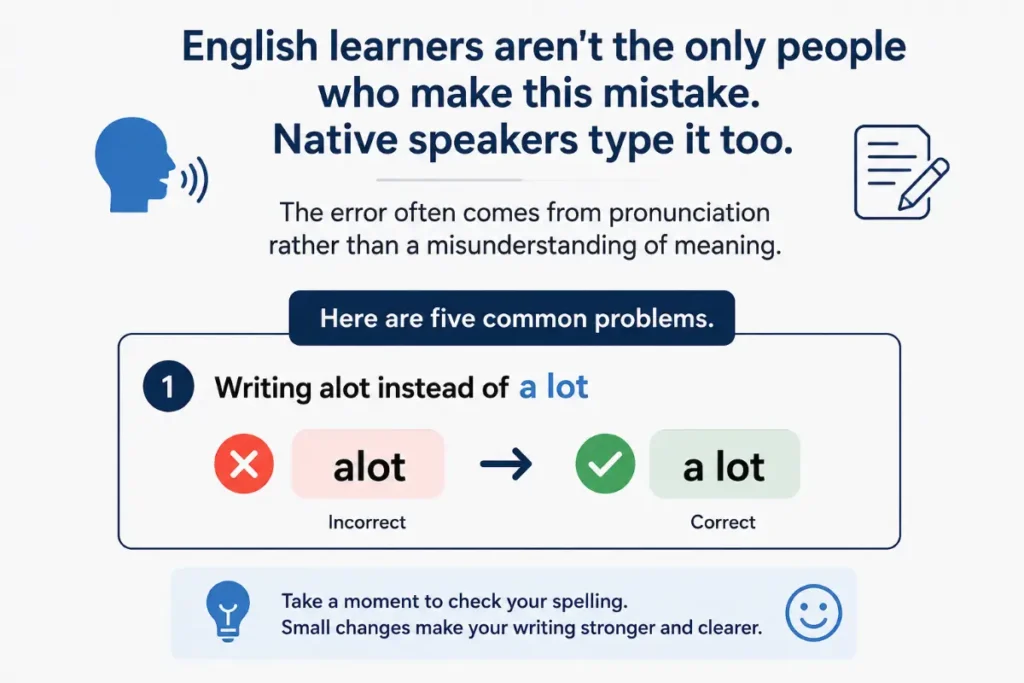
People make this error for several predictable reasons.
- Writing from sound
When spoken quickly a lot can sound almost like one word. Writers sometimes transfer that spoken rhythm directly into spelling.
- Visual familiarity
People see incorrectly written forms repeatedly online. Repeated exposure can make an incorrect spelling look familiar and therefore seem correct.
- Fast typing
When someone types quickly they may group words according to sound instead of standard spelling. This happens especially in informal messages.
- Pattern confusion
English contains many single words that developed from older phrases. Writers may assume a lot has gone through the same process and should now be one word.
- NLP and language processing
From an NLP perspective the phrase is interesting because speech recognition and language prediction systems often process frequent word sequences as connected units. Human readers do something similar. We recognize familiar phrases as chunks rather than analyzing every word separately.
That doesn’t make alot correct. It simply helps explain why the mistake is so easy to make.
Other common errors include writing alot of, alot more, alot better, alot less, and alot of people. The correction is the same in every case. Separate the two words.
Pronunciation Guide
The phrase a lot is usually pronounced with the two words connected smoothly in speech.
A common American English pronunciation is approximately:
uh LOT
The IPA can be represented as /ə ˈlɑt/ in many American English contexts.
The first word a usually has a weak vowel sound similar to the sound in about. The main stress falls on lot.
The syllable pattern is simple:
a | lot
There are two spoken syllables in the phrase.
In relaxed conversation you may hear the phrase pronounced so quickly that the boundary between the words becomes difficult to notice. That’s one reason writers sometimes produce the spelling alot.
The pronunciation itself doesn’t tell you how to spell the phrase. English has many examples where connected speech hides word boundaries. Writing requires you to follow the established standard form.
A useful editing trick is to say the phrase slowly and deliberately. Hear the two parts:
a lot
Then write them separately.
You may also want to read Clutz or Klutz Meaning, Usage and Correct Form 2026.
Etymology and Word Origin
The word lot has a long history in English. It comes through Old English and related Germanic forms and has historically carried meanings connected with a portion an assigned share or something received by chance.
Older uses of lot included the idea of an allotted portion. A person could receive a particular lot or share. From that basic idea the word developed several related meanings.
The modern phrase a lot grew from the concept of a large portion or quantity. Over time English speakers began using it as a common expression for a large amount or large number.
The phrase later developed an important adverbial use.
For example:
“She talks a lot.”
In that sentence a lot doesn’t refer to a physical portion. It tells us about the frequency or degree of the action.
This history helps explain why the phrase remains two words. Its structure comes from an ordinary English phrase involving the article a and the noun lot.
English does sometimes turn phrases into single words. That process is called lexicalization. But spelling changes don’t happen simply because speakers pronounce a phrase quickly. Standard usage develops through long term patterns of writing and recognition.
In modern standard English the established form remains a lot.
Regional Usage in the US
American English uses a lot very frequently in conversation and writing.
You’ll hear it in everyday statements such as “I like it a lot” and “We have a lot of time.” It also appears regularly in American journalism general nonfiction and professional communication.
The spelling alot isn’t considered standard American English. American style guides and dictionaries treat a lot as the correct form.
Regional Usage in the UK
British English also uses a lot as the standard form.
The meaning and grammar are essentially the same. British speakers commonly use the phrase to describe quantity frequency or degree.
You might see regional vocabulary differences between American and British English but this isn’t one of them. The standard spelling remains a lot in both varieties.
Regional Usage in Australia
Australian English follows the same standard spelling.
Australians use a lot in everyday conversation and formal writing. Alot remains a common spelling mistake rather than an accepted regional variant.
The phrase can appear in casual writing across social media and messaging but informal contexts don’t create a different standard spelling.
Regional Usage in Canada
Canadian English also uses a lot.
Canadian English shares many features with both American and British English but this particular spelling follows the same standard pattern across major English varieties.
So if you’re writing for readers in the United States Canada the United Kingdom or Australia the safe standard form is a lot.
Grammar Rules and Part of Speech
Understanding the grammar makes the spelling easier to remember.
A lot can work in more than one way.
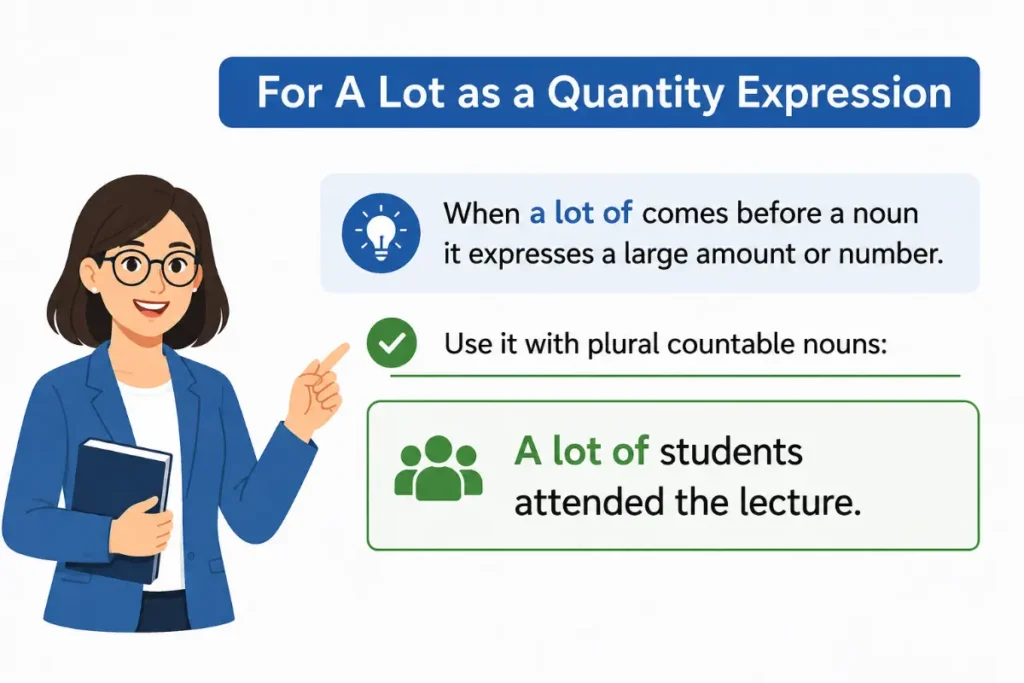
When it refers to quantity it functions as a noun phrase.
For example:
“A lot of people attended the event.”
Here a lot identifies a large number of people.
The structure is:
a lot of + noun
You can use this pattern with both countable and uncountable nouns.
Countable example:
“A lot of students joined the club.”
Uncountable example:
“A lot of water was wasted.”
When a lot modifies a verb it functions as an adverbial phrase.
For example:
“She studies a lot.”
“He laughs a lot.”
“They travel a lot.”
It can also modify adjectives and adverbs in certain constructions.
For example:
“This one is a lot better.”
“That sounds a lot more interesting.”
The phrase commonly appears after the verb.
“I exercise a lot.”
However its position can change depending on the sentence.
For example:
“A lot has changed since then.”
Here a lot comes before the verb because it functions as the subject.
You should also distinguish a lot from allot.
Allot is a completely different word. It means to distribute or assign something.
For example:
“The committee will allot each department a budget.”
So remember the three forms.
A lot means a large amount or number.
Allot means to distribute or assign.
Alot is normally a spelling error.
That distinction is especially useful because allot is a legitimate single word while alot isn’t the standard form of the quantity phrase.
Real Life Usage Examples
Daily Talk
- “I like this restaurant a lot.”
- “We’ve got a lot to talk about.”
These examples sound completely natural in everyday American conversation. The phrase is especially common because it expresses quantity or degree without sounding overly formal.
- “Thanks a lot for your help with the project.”
- “We’ve received a lot of useful feedback from the team.”
Both sentences work naturally in ordinary professional emails. The phrase doesn’t automatically make writing informal.
Academic Writing
- “A lot of research has examined the effects of sleep on memory.”
- “Students can learn a lot from carefully designed experiments.”
There’s one useful editorial point here. A lot is grammatically correct in academic writing but writers sometimes prefer more precise terms such as many much or a large amount when a formal academic tone calls for greater precision.
For example:
“Many studies have examined this issue.”
That can sound more precise than:
“A lot of studies have examined this issue.”
The original phrase isn’t grammatically wrong. The choice depends on style and context.
News
- “A lot of residents attended the public meeting.”
- “The storm caused a lot of damage across the region.”
News writing often favors concise language. A lot can appear naturally but journalists may choose more specific quantities when reliable figures are available.
For example:
“The storm damaged hundreds of homes.”
That tells the reader more than a lot of homes.
Literature
- “He had a lot to remember.”
- “She had changed a lot since they last met.”
Literary writing gives authors more freedom with rhythm and voice. A lot can sound natural and intimate because it belongs to everyday English.
Expert Editor Insight
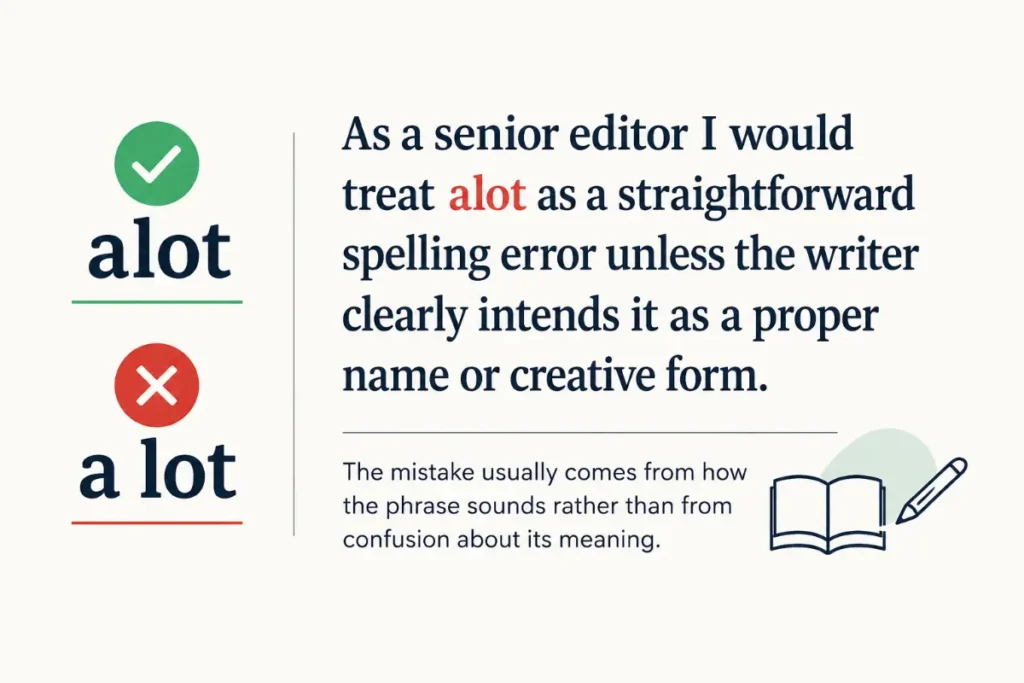
As a senior editor I’d treat alot as an automatic correction in standard prose. It’s one of those errors that can slip through when someone writes quickly because the phrase sounds like a single unit. Spellcheck tools may catch it but you shouldn’t depend on software alone. A good editor recognizes the grammatical structure immediately. When you see alot ask yourself if the sentence means a large amount a large number or frequent action. If it does write a lot as two words. That small habit eliminates the mistake almost every time.
Learn the difference in simpler or more simple Which Form Is Correct.
Conclusion
Alot or a lot has a simple answer. A lot is the correct standard English form. It can describe a large amount a large number or frequent action. Alot is normally a spelling mistake even though it looks and sounds natural when people speak quickly.
The confusion comes mainly from connected speech. When native speakers say a lot quickly the phrase can sound like one unit. That makes the incorrect spelling easy to produce. Dictionaries and standard English usage consistently support the two word form.
The easiest tip is to remember the structure. Think of a lot as two words just like a few or a little. If you’re talking about quantity frequency or degree write a lot. That simple habit will keep your spelling clean in casual messages professional emails academic work and everything in between.
FAQs
Is alot accepted in standard English?
No. Alot isn’t the standard spelling of the phrase a lot. In ordinary English editing it’s treated as a misspelling. You may encounter it in usernames creative writing jokes or informal online posts but those special uses don’t make it standard English. For school work professional writing emails articles and formal documents use a lot.
Does finally mean a large amount?
No. Finally and a lot have completely different meanings. Finally usually refers to the last stage of a process or something that happens after a long wait. For example “She finally arrived.” A lot refers to a large amount a large number or frequent action. For example “She travels a lot.” Don’t confuse these unrelated expressions.
Should I write alot or a lot?
Write a lot. The two words remain separate in standard English. Use the phrase for a large amount a large number or frequent action. For example “He reads a lot.” The form alot is a common spelling error. This rule applies across major English varieties including American British Canadian and Australian English.
How should I pronounce the phrase a lot?
The phrase a lot is commonly pronounced approximately like uh LOT in American English. The IPA is often represented as /ə ˈlɑt/. The first word usually has a weak vowel sound while lot receives the main stress. In fast speech the two words can blend together. That connected pronunciation partly explains the common spelling mistake.
Is it grammatically correct to begin with a lot?
Yes. A lot can start a sentence when it functions as the subject or part of a larger noun phrase. For example “A lot has changed since last year.” You can also begin a sentence with a lot of followed by a noun. For example “A lot of people attended the meeting.” The position depends on the sentence structure.
What words can replace a lot?
The best synonym depends on the sentence. For quantity you might use many much numerous plenty or a large amount. For degree you might use greatly or considerably. These alternatives don’t always work in exactly the same grammatical position so choose one that fits the sentence.
Why do people write alot instead of a lot?
People commonly write alot because the phrase sounds connected in natural speech. Fast pronunciation can hide the boundary between the two words. Frequent exposure to incorrect online spelling can also make the form look familiar. Typing speed adds another factor. Writers often reproduce the sound pattern they hear instead of recalling the established written form.
Can I use a lot in formal English?
Yes. A lot is grammatically correct and appears in standard formal English. Still you may choose a more precise expression in academic technical or highly polished writing. For example many studies can be more precise than a lot of studies. The phrase itself isn’t incorrect or unprofessional. Context determines the best word choice.