
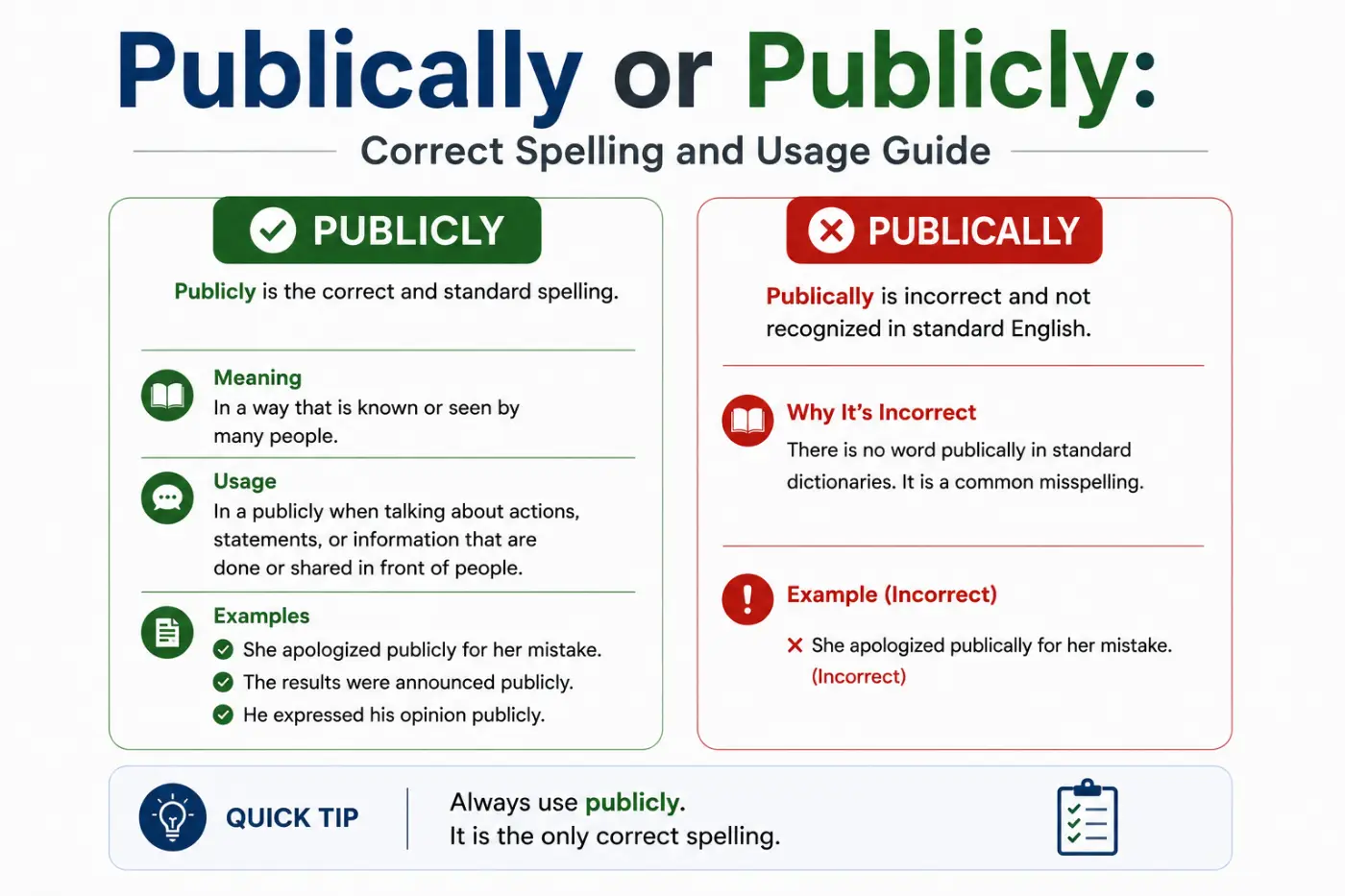
Publically or publicly is a common spelling question that can trip up even careful writers. The correct standard spelling is publicly. Publically is generally considered a misspelling rather than an accepted alternative. The confusion happens because many English adverbs are formed by adding ly directly to an adjective. However public follows a different spelling pattern when it becomes an adverb.
If you’re writing an email article report essay or professional document use publicly. It means openly or in a way that is known or available to the public. You’ll often see it in phrases such as publicly announced publicly available and publicly supported.
This guide explains the spelling difference between publically and publicly along with their meaning grammar pronunciation word origin regional usage and common mistakes. You’ll also find natural examples that show how publicly works in everyday conversation and formal writing.
Many readers also check Dysregulated vs Disregulated Which Spelling Is Correct 2026.
Quick Definition
Publicly is the correct standard spelling. It is an adverb that means openly or in a way that is known or available to the public. Publically is a common spelling mistake caused by adding ly directly to public without removing the final c before the ending. Standard dictionaries list publicly as the accepted form.
Quick Answer
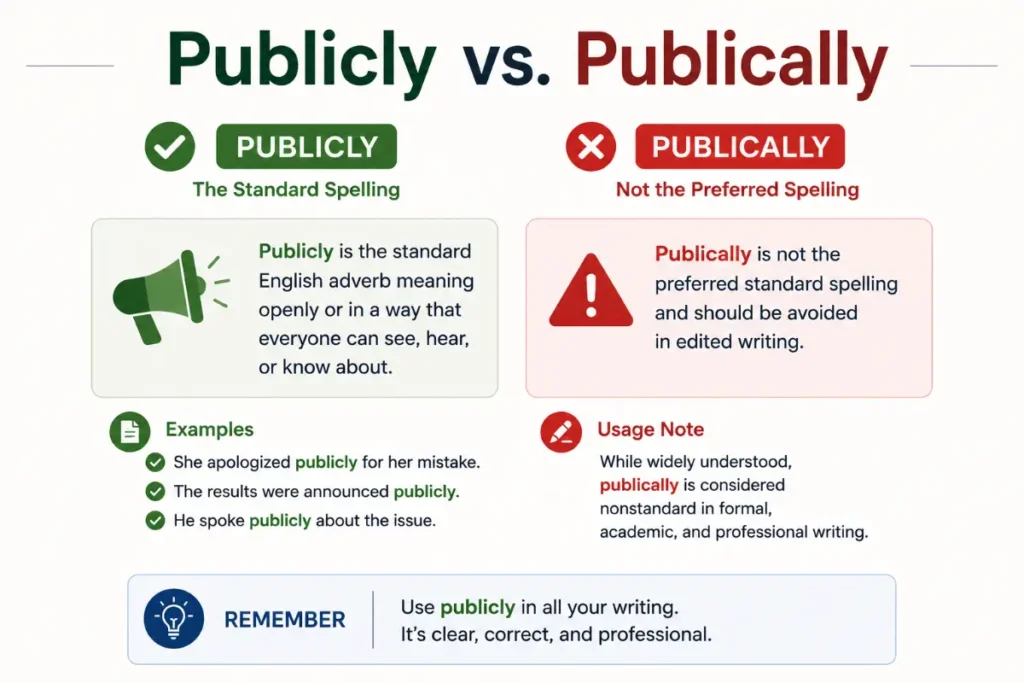
The correct form is publicly. Publicly is the standard English adverb meaning openly or in a way that everyone can see hear or know about. Publically is not the preferred standard spelling and should be avoided in edited writing.
A useful memory trick is simple. Think of public plus ly as publicly rather than publically. Once you learn the spelling pattern the mistake becomes much easier to avoid.
Comparison Table publically or publicly
| Correct Form | Meaning | Part of Speech | Origin | Usage Frequency | Formality | Common Contexts | Example |
|---|---|---|---|---|---|---|---|
| publicly | Openly or in a way known to people | Adverb | From public with the adverb ending ly | Very common | Standard | News writing business speech academic writing government media | The company publicly announced the change. |
| publically | Intended spelling of the same idea but generally treated as a misspelling | Intended adverb form | Created by applying a regular spelling pattern incorrectly | Uncommon in edited English | Nonstandard | Informal typing errors drafts and spelling mistakes | The writer accidentally used publically instead of publicly. |
Meaning and Definition
Meaning of publically
Publically is usually not a separate word with a special meaning. In most standard English contexts it is simply an incorrect spelling of publicly. The mistake is easy to understand. English learners and even fluent writers often expect the word public to behave like many other adjectives when forming an adverb. For example gentle becomes gently and careful becomes carefully. That pattern can make publically look perfectly reasonable at first glance.
The problem is that English spelling does not always work through a simple add ly rule. The standard form is publicly. Dictionaries such as Cambridge identify publicly as the adverb derived from public. Cambridge defines it in senses that include doing something so everyone can know about it and describes uses connected with government and public activity.
So if a spelling checker marks publically as an error you should normally accept the correction. There is no useful difference in meaning between publically and publicly. The issue is standard spelling rather than a difference in definition.
Meaning of publicly
Publicly is an adverb. It describes an action that happens openly or in a way that allows other people to know about it.
For example:
The actor publicly apologized for the mistake.
The company publicly announced its new policy.
She publicly supported the proposal.
In each sentence publicly tells us how the action happened. The apology was made openly. The announcement was made for people to know. The support was expressed openly rather than kept private.
Cambridge gives publicly several related meanings. It can describe something done openly so people can see or hear it. It can also refer to government involvement or something provided or funded by the government. In other contexts it describes activities that involve ordinary people or the public.
That range makes publicly a particularly useful word in news reports business writing government documents academic work and ordinary conversation.
Key Differences Explained
The difference between publically and publicly is mainly about standard spelling. The two forms are not normally used to express different ideas.
- Spelling.
Publicly is the accepted standard form. Publically is generally considered a misspelling.
- Grammar role.
Publicly functions as an adverb. It modifies verbs and sometimes entire clauses by explaining that an action happened openly or in a way known to the public.
- Meaning.
Publicly means openly or in a way that people can know about. Publically is usually intended to express exactly the same meaning but uses the wrong spelling.
- Tone.
Publicly works in casual conversation and formal writing. It appears naturally in journalism academic prose business communication government documents and everyday speech.
- Context.
Use publicly when discussing announcements statements criticism apologies support funding ownership access or actions that are visible to people outside a private setting.
The easiest choice is also the safest one. If you are writing for school work a website a business document a newspaper style article or a professional email use publicly.
Which Spelling Is Correct?
Publicly is the correct standard spelling.
The linguistic reason is connected to English word formation and spelling conventions. The base adjective is public. When the adverb ending ly is added the standard spelling becomes publicly rather than publically.
Dictionary evidence supports this form. Cambridge lists publicly as an adverb and gives several established meanings and examples. Its American Dictionary entry also gives the pronunciation and uses of publicly.
This is a useful editorial principle. When two spellings appear online the more familiar form is not automatically the standard form. A professional editor checks authoritative dictionaries and established usage before accepting a disputed spelling.
For this word the evidence is straightforward. Use publicly.
If you are proofreading a sentence such as The organization publically released its findings you should change publically to publicly.
The corrected sentence is:
The organization publicly released its findings.
That small correction makes the sentence conform to standard modern English.
Sentence Examples
The best way to remember a spelling is to see it doing real work inside sentences. These examples show several common uses of publicly.
- The mayor publicly thanked the volunteers for their hard work.
- The company publicly announced its plans on Monday.
- She publicly apologized after realizing that her statement was inaccurate.
- The professor publicly praised the students for their research.
- The organization publicly released the results of its investigation.
- He had never publicly discussed the decision before that interview.
- The singer publicly supported the charity during the event.
- The government publicly confirmed the new policy.
- The author publicly defended the accuracy of the book.
- The board publicly rejected the proposal after a long discussion.
These examples show an important point about meaning. Publicly does not always mean literally standing in front of a crowd. It can describe an action that becomes known to the wider public through a statement interview announcement publication or official communication.
For example publicly confirmed can describe a statement released through the media. Publicly available can describe information that people can access. Publicly traded describes a company whose shares are available to investors through a public market.
Now look at examples containing the common misspelling.
- The writer used publically in the first draft.
- The spelling checker changed publically to publicly.
- She accidentally typed publically in the report.
- The student corrected publically during proofreading.
- The editor removed publically from the final version.
These examples use publically only to discuss the spelling mistake itself. In standard writing you should use publicly when you mean openly or in a way known to the public.
Common Mistakes and Misspellings
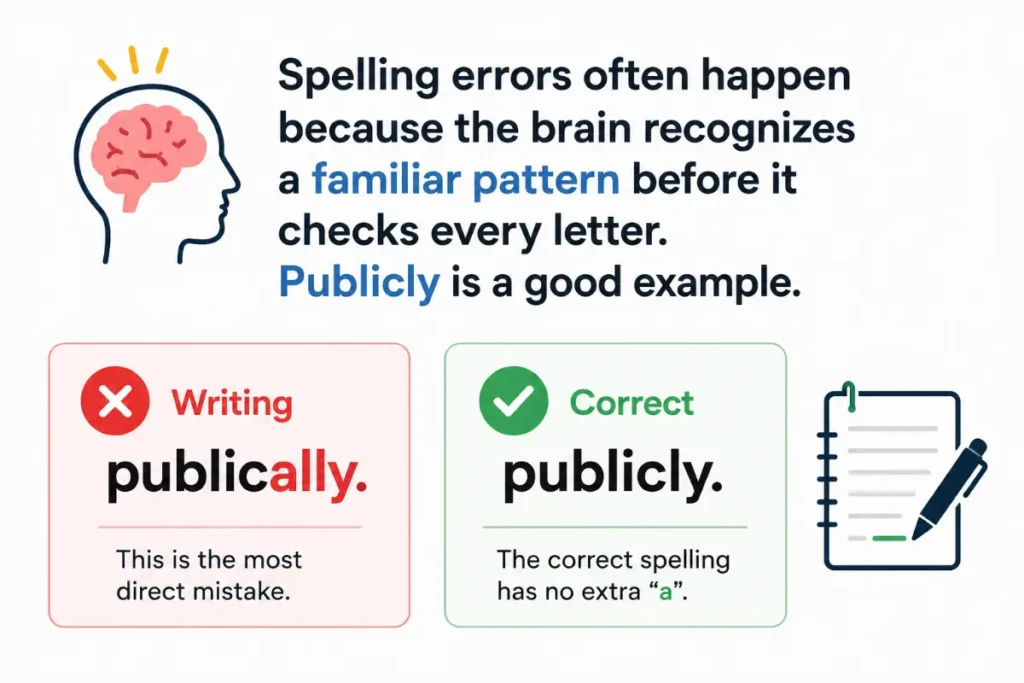
Spelling errors often happen because the brain recognizes a familiar pattern before it checks every letter. Publicly is a good example.
- Writing publically.
This is the most direct mistake. The writer adds ly to public without following the standard spelling pattern. The result looks logical but does not match the accepted form.
- Writing publicaly.
Some writers drop one letter or misplace the final part of the word. This often happens during fast typing.
- Writing publically available.
This phrase is especially common because publicly available appears frequently in websites reports articles and official documents. The correct phrase is publicly available.
- Writing publically known.
The standard phrase is publicly known. The spelling mistake can survive unnoticed because the sentence still makes perfect sense.
- Writing publically announced.
The standard form is publicly announced. This phrase appears often in news business and government contexts.
Why does the brain produce publically so easily?
Part of the answer comes from pattern recognition. English has many adjectives that form adverbs by adding ly directly. A writer may unconsciously apply that familiar pattern to public.
Another factor is visual similarity. Public and publicly share almost all their letters. When you type quickly your brain can recognize the intended word before your eyes notice the spelling.
Search behavior also plays a role. People who see publically online may encounter the misspelling repeatedly. Familiarity can make an incorrect form feel acceptable.
This is a useful NLP point. Search engines and language models can recognize misspellings because users frequently produce them. Recognition does not make a spelling standard. A search engine may understand what you mean even when your spelling is wrong.
That distinction matters for professional writing.
For another common grammar confusion, see Until or Untill Which Spelling Is Correct in 2026.
Pronunciation Guide
Publicly is pronounced with three main syllable beats.
IPA: /ˈpʌb.lɪk.li/
A simple pronunciation guide is pub lick lee.
The first syllable receives the main stress. Say PUB more strongly than the following syllables.
You can think of the word as three spoken parts:
PUB
lick
lee
The final ly sounds like lee. The middle part keeps the sound associated with public.
A common pronunciation mistake is to rush the middle of the word so much that the final syllable disappears. Another is to pronounce the word as if it had four distinct syllables.
The standard pronunciation is relatively short and smooth.
Cambridge gives publicly as /ˈpʌb.lɪk.li/ in both its British and American dictionary entries.
Try this sentence aloud:
She publicly supported the decision.
Then say:
The company publicly announced the results.
Hearing the word in complete sentences makes the pronunciation easier to remember than memorizing the sound in isolation.
Etymology and Word Origin
The history of publicly begins with public.
Public comes into English through French from Latin publicus. The Latin word was connected with the people and the community. Over time the English word public developed several related meanings involving ordinary people government shared access and open activity.
English then formed the adverb publicly from public and the adverb ending ly.
The meaning developed naturally from the adjective. If something is public it is connected with people generally or available openly. If something is done publicly it is done in a way that makes it known or visible to people.
This explains why publicly has such a broad range of modern uses.
Consider these expressions:
Publicly stated.
Publicly announced.
Each phrase connects an action or condition with public knowledge access involvement or visibility.
The spelling publically may look historically intuitive because writers often form adverbs by attaching ly directly to adjectives. Yet standard English settled on publicly as the accepted form.
Language is full of these small spelling patterns. You cannot always predict the modern spelling simply by adding a suffix to the base word. That is one reason careful writers rely on established dictionaries and style references when a form looks uncertain.
Regional Usage US UK AU CA
US English
American English uses publicly as the standard spelling. It appears frequently in journalism business writing academic work government communication and everyday speech. Cambridge lists publicly in its American Dictionary with meanings related to openness government activity and public involvement.
UK English
British English also uses publicly as the standard form. The pronunciation shown by Cambridge is closely aligned with the American form. British writers use publicly in news reports formal documents academic writing and ordinary conversation.
Australian English
Australian English follows the same standard spelling. Publicly is the appropriate form in edited Australian writing. Publically may appear as an individual spelling error but it does not become a standard regional alternative simply because it occurs online.
Canadian English
Canadian English also uses publicly in standard writing. they generally follow the same established spelling used across major varieties of English. The meaning remains the same.
So there is no meaningful US UK AU or CA spelling split here. Publicly is the safe standard form across these major varieties.
Grammar Rules and Part of Speech
Publicly is an adverb.
An adverb can modify a verb by explaining how an action happens. In this case publicly tells us that an action happens openly or becomes known to the public.
Consider:
The company apologized publicly.
Here publicly modifies apologized. It explains how the company apologized.
You can also place publicly before the main verb.
The company publicly apologized.
Both sentences are grammatical. The second version often sounds slightly more direct because the adverb appears before the main verb.
Publicly can also appear after a helping verb.
The company has publicly apologized.
The organization was publicly criticized.
The board had publicly rejected the proposal.
It can also modify a participle or adjective in established expressions.
The information is publicly available.
The shares are publicly traded.
The statement is publicly known.
Position depends partly on the verb and the rhythm of the sentence. English allows some flexibility with adverbs. The goal is clarity rather than forcing the word into one fixed position.
Punctuation with publicly
Publicly does not require special punctuation. If it appears at the beginning of a sentence it may be followed by a comma when the sentence structure calls for one.
For example:
Publicly the company denied the accusation.
A more natural version might be:
The company publicly denied the accusation.
In many cases placing publicly closer to the verb makes the sentence cleaner.
The word itself does not need quotation marks or italics in normal writing.
Real Life Usage Examples
Daily Talk
Publicly often appears in everyday discussion when people talk about apologies opinions relationships or statements.
He never publicly talked about the disagreement.
She publicly thanked everyone who helped.
These sentences sound natural because publicly describes something that moves from private space into public view.
Business emails often use publicly when discussing announcements information or statements.
The company has publicly confirmed the change.
The report is now publicly available.
These sentences work well in professional communication because publicly is precise without sounding overly formal.
Academic Writing
Academic writers use publicly when describing information access research statements and institutional activity.
The dataset is publicly available for researchers.
The authors publicly presented their findings at the conference.
In academic writing publicly can help distinguish information that anyone can access from information limited to a research group.
News Writing
Journalists use publicly very often because news stories frequently describe statements announcements criticism and official responses.
The minister publicly defended the decision.
The organization publicly released its findings.
The word works especially well in news writing because it signals that the action or statement was not private.
Literature
Writers can also use publicly to contrast outward behavior with private thoughts.
He publicly praised the decision but privately questioned its wisdom.
She publicly accepted the result while continuing to struggle with it in private.
This contrast is one of the most useful features of the word. Publicly can create a clear line between what people show and what they keep to themselves.
Related and Confused Terms
Several words and phrases overlap with publicly in meaning or appear in related contexts. They are not always interchangeable.
- Openly.
Openly means without secrecy. It can often replace publicly when the main idea is lack of concealment.
- In public.
This phrase usually refers to something happening where other people can see or hear it.
- Publicly known.
This means information is known by people generally.
- Publicly available.
This means information or material can be accessed by the public.
- At large.
This can refer to people generally or a broad group rather than a restricted organization.
- In the open.
This phrase suggests that something is no longer hidden.
- Officially.
Officially means in an authorized or formal capacity. It is related to publicly in some contexts but does not mean exactly the same thing.
- Privately.
Privately is an important contrast. It means something happens in secret or with only a small number of people present. Cambridge defines privately in terms of secrecy limited participation and private activity.
These distinctions help you choose the right word instead of treating every related expression as an exact synonym.
Expert Editor Insight
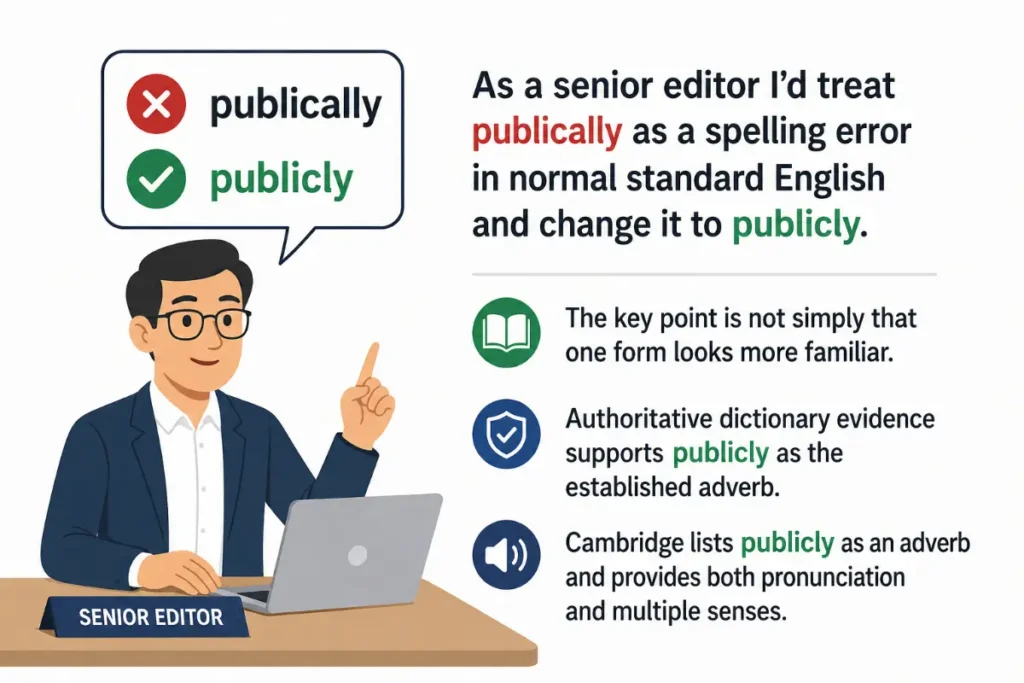
As a senior editor I’d treat publically as a spelling error in normal standard English and change it to publicly. The key point is not simply that one form looks more familiar. Authoritative dictionary evidence supports publicly as the established adverb. Cambridge lists publicly as an adverb and provides both pronunciation and multiple senses.
A useful editing habit is to pay extra attention to words that look almost right. Spelling mistakes such as publically are dangerous precisely because the reader can understand them instantly. A typo that creates nonsense usually gets caught. A typo that creates a believable word can slip through an entire draft.
Modern spelling tools can help flag the error. Word processors grammar tools and browser spell checkers may suggest publicly when you type publically. Still you should not rely on software alone. Good editing combines automated checking with human judgment.
My expert tip is simple. When you see publically available in a draft pause and check the spelling. The standard phrase is publicly available. That one phrase is a useful visual reminder of the correct pattern.
Many readers also check enrol or enroll: The Truth About These Two Spellings (2026).
Conclusion
Publicly is the correct standard spelling. Publically is generally a misspelling and does not have a separate meaning that you need to learn. The word publicly functions as an adverb and usually means openly or in a way that becomes known to people. You’ll see it in everyday conversation as well as business writing academic work news reports and government communication.
The spelling can feel tricky because English often forms adverbs by adding ly directly to adjectives. Public does not follow that simple visual pattern. Remember publicly as the standard form and watch for common phrases such as publicly available and publicly announced. If you’re proofreading your own writing take one extra second to check this word. That small habit can prevent an easy spelling mistake from reaching the final draft.
FAQs
Is publically a real word?
Publically appears in real world writing because people use it as a spelling variant or mistake. However it is generally not treated as the standard modern spelling in edited English. If you mean openly or in a way known to the public use publicly. Major dictionary evidence supports publicly as the standard adverb.
What does publicly mean?
Publicly is an adverb meaning openly or in a way that people generally can see hear or know about. It can describe public statements apologies announcements criticism support and disclosures. It can also appear in contexts involving government activity and public access. For example publicly available means available for people to access rather than restricted to a private group.
publically or publicly which is correct?
Publicly is correct in standard English. Publically is generally considered a misspelling rather than a separate word with a different meaning. If you are writing an essay report email article application or professional document choose publicly. The spelling is supported by major dictionaries including Cambridge which lists publicly as an adverb.
How do you pronounce publicly?
Publicly is pronounced /ˈpʌb.lɪk.li/. A simple way to remember the sound is pub lick lee. The main stress falls on the first syllable. The word has three main syllable beats. Cambridge provides this pronunciation for both its British and American dictionary entries.
Can publicly start a sentence?
Yes. Publicly can begin a sentence when you want to emphasize that something happened openly or became known to people. For example you could write Publicly the organization supported the proposal. Still many sentences sound smoother when the adverb appears closer to the verb. The organization publicly supported the proposal is often the more natural choice.
What is a synonym for publicly?
Common alternatives include openly and in public. The best choice depends on context. Openly emphasizes a lack of secrecy. In public emphasizes a setting where other people can see or hear something. Publicly can also describe information or actions that become known to a wider audience. In formal writing choose the word that expresses your exact meaning.
Why do people misspell publicly?
People often misspell publicly because English has a familiar pattern in which adjectives form adverbs by adding ly directly. That pattern can make publically look logical. Fast typing and visual familiarity can reinforce the mistake. Once a person has seen the misspelling several times it may start to feel correct even though standard dictionaries support publicly.
Is publicly suitable for formal writing?
Yes. Publicly is completely suitable for formal writing. You can use it in academic papers business reports government documents professional emails journalism and official statements. It is also common in everyday conversation. Expressions such as publicly announced publicly available publicly funded and publicly traded are well established. Cambridge documents these uses across its dictionary entries and examples.