
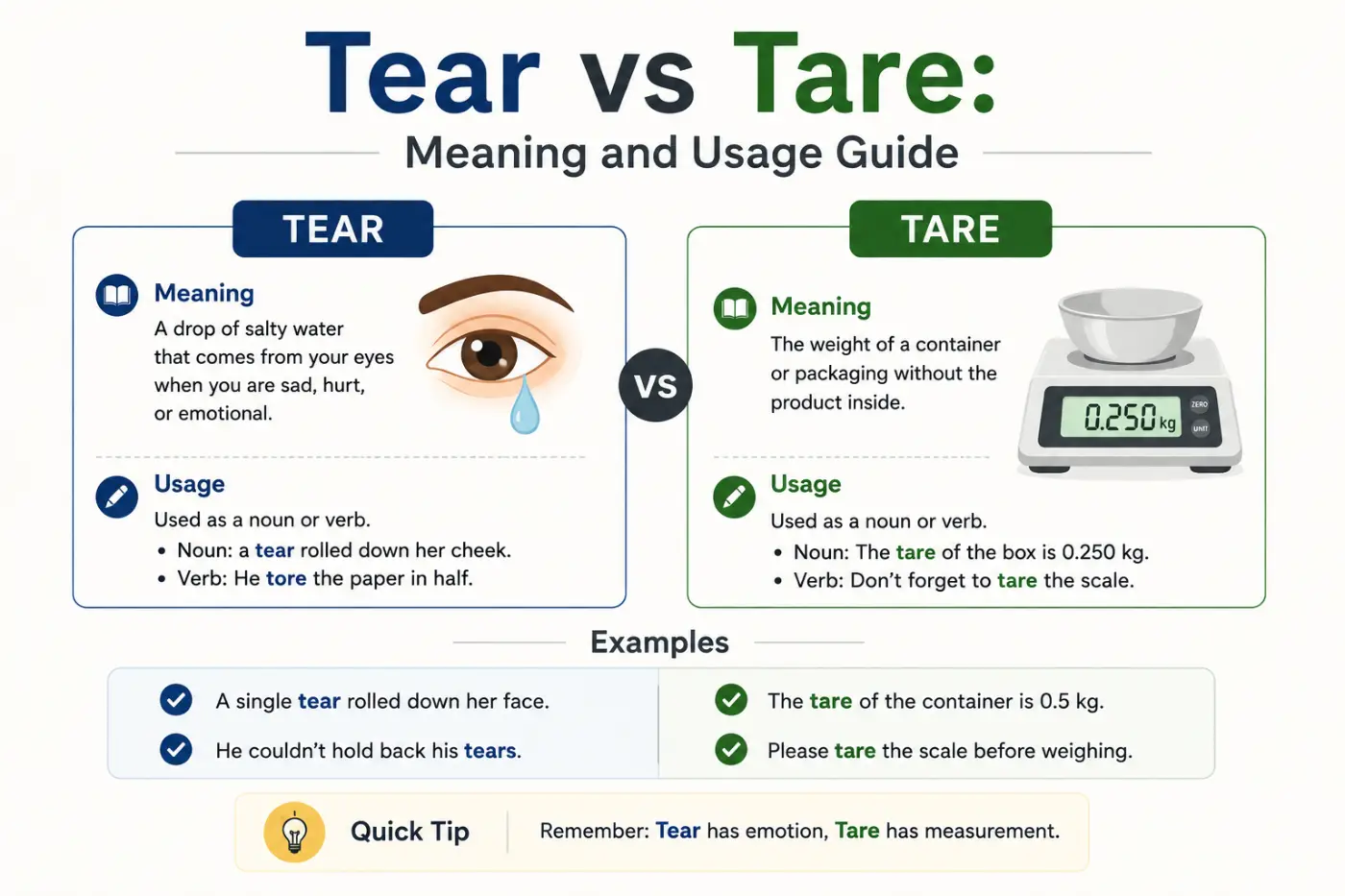
English has plenty of word pairs that can trip you up even when you know the language well. Tear vs tare are a good example. They look almost identical and can sound alike in some forms of English. Yet they belong to very different parts of everyday vocabulary.
The correct word depends entirely on what you mean. Tear can describe ripping paper or cloth. It can also mean a drop of liquid from your eye. Tare usually refers to the empty weight of a container or vehicle when calculating net weight. It can also refer to a type of plant.
The confusion gets even more interesting because tare once appeared as a historical form related to the verb tear. Modern English no longer uses it as the standard past tense. Today you write tore. This guide explains the difference between tear and tare in plain English. You’ll learn their meanings their grammar their pronunciation their origins and the situations where native speakers use each word. You’ll also see practical examples that make the distinction easy to remember.
Learn the difference in Baloney vs Bologna Which Word Should You Use 2026.
Quick Definition
Tear is commonly a verb meaning to pull something apart and a noun meaning either a rip or a drop from the eye. Tare is mainly a noun used for the empty weight of a container or vehicle. It can also name a plant. The words have different meanings and uses.
Quick Answer
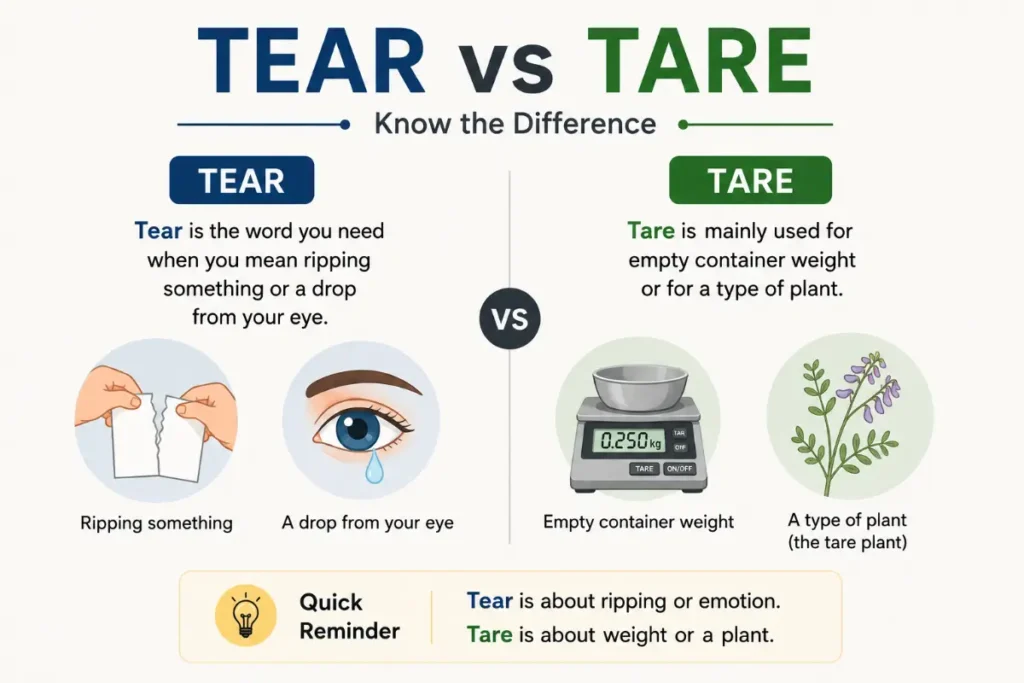
Tear is the word you need when you mean ripping something or a drop from your eye. Tare is mainly used for empty container weight or for a type of plant.
For example, you can say I tore the paper or There’s a tear in my shirt. In shipping and weighing you might see tare weight. The past tense of tear is tore rather than tare.
Comparison Table
| Correct Form | Meaning | Part of Speech | Origin | Usage Frequency | Formality | Common Contexts | Example |
|---|---|---|---|---|---|---|---|
| Tear | To rip or pull apart | Verb | Old English and Germanic roots | Very common | Neutral | Clothing paper books materials | I accidentally tore the page. |
| Tear | A drop from the eye | Noun | Old English and Germanic roots | Very common | Neutral | Emotion crying sadness | A tear rolled down her cheek. |
| Tear | A rip or opening | Noun | Derived from the verb tear | Common | Neutral | Clothing paper fabric | There’s a tear in my jacket. |
| Tare | Empty weight of a container or vehicle | Noun | Anglo French Italian Medieval Latin and Arabic | Specialized | Formal or technical | Shipping trade weighing | The tare weight is 2,000 pounds. |
| Tare | A type of plant | Noun | Middle English with uncertain origin | Uncommon | Literary or specialist | Botany agriculture older texts | Tare can grow among grain. |
Meaning and Definition
Meaning of Tear
The word tear has several meanings. Context tells you which meaning the reader should understand.
As a verb it means to pull something apart or cause something to split. You might tear a sheet of paper. You might tear a hole in your jeans. A sharp object can tear fabric. A person can also tear something deliberately.
The past tense is tore and the past participle is torn. This is one of the reasons the word can be confusing for learners. English uses an irregular verb pattern rather than simply adding an ending.
As a noun tear can mean a damaged place in something. If your shirt catches on a nail and the fabric splits you have a tear in your shirt.
The word has another completely different pronunciation and meaning when it refers to liquid from the eye. A tear can appear when you cry because of sadness happiness pain irritation or another strong emotional response. Cambridge lists both the ripping sense and the crying sense as separate meanings.
So one spelling can represent several meanings. That’s normal in English. Context does most of the work.
Meaning of Tare
Tare is a real English word. It isn’t simply a misspelling of tear.
One important meaning appears in measurement and transportation. Tare weight is the weight of an empty container vehicle or other vessel. When you subtract the tare weight from the gross weight you can determine the net weight of the goods inside. Cambridge gives this as a standard measurement and transportation meaning.
For example imagine a truck carrying a load of grain. The total weight of the truck and grain is the gross weight. The empty truck has its own weight. That empty weight is relevant when calculating the weight of the actual cargo.
Tare also has a botanical meaning. It can refer to a plant that grows among crops and is sometimes treated as a weed. Oxford marks this meaning as literary or specialist.
This gives the word a much narrower modern role than tear.
There’s also an interesting historical connection. Older forms of English used tare as a past form of the verb related to modern tear. That historical form eventually disappeared from standard English and tore became the modern past tense.
So if you write I tare the paper yesterday you’re using an outdated historical form rather than standard modern English.
Key Differences Explained
Spelling
The spelling differs by one letter.
Tear uses e after the initial t.
Tare uses a after the initial t.
That tiny spelling difference changes the word completely in modern English.
Grammar Role
Tear can function as a verb or noun.
As a verb it describes an action.
She tore the envelope.
As a noun it can describe a rip.
There’s a tear in the envelope.
It can also describe liquid from the eye.
A tear appeared in his eye.
Tare is mainly a noun in the meanings discussed here. It commonly appears in technical phrases such as tare weight. It can also function as a noun when referring to the plant.
Meaning
The meanings are not interchangeable.
Tear connects with ripping damage or crying.
Tare connects mainly with weighing containers vehicles or goods. It can also refer to a plant.
Tone
Tear is an everyday word. You’ll hear it in casual conversations professional writing news stories books and classroom discussions.
Tare has a more specialized feel when it refers to weight. You’re more likely to encounter it in shipping manufacturing retail transportation agriculture or technical documentation.
Context
Context makes the choice much easier.
If you’re talking about a ripped shirt use tear.
If you’re talking about a particular plant use tare.
A simple mental picture can help. Think of tear as something being pulled apart or something falling from an eye. Think of tare as the empty weight that gets taken away from a total.
Which Spelling Is Correct?
Both tear and tare are correct English words. The important point is that they aren’t interchangeable.
Use tear for ripping damage or a drop from the eye. Use tare for the empty weight of a container or vehicle and in the botanical sense for a particular plant.
Modern dictionaries support these separate meanings. Cambridge defines tear as a verb for pulling something apart and as a noun for a hole or an eye drop. It defines tare as the weight of an empty vehicle or container.
The historical record adds another layer. Tare once appeared as a past tense associated with the older form of tear. That form did not survive as the standard modern past tense. Modern English uses tore.
From an editing perspective the safest rule is simple. Choose the word based on meaning rather than sound.
For example:
I tore the paper.
The paper has a tear.
The container has a tare weight of 10 pounds.
Those three sentences cover three different uses.
Sentence Examples
Examples Using Tear
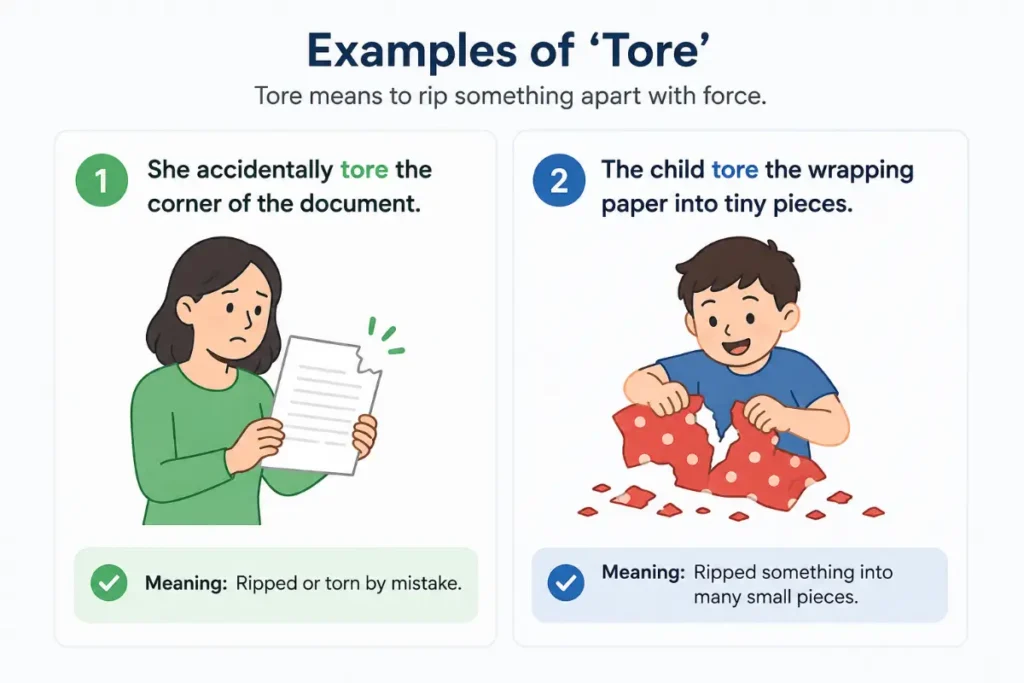
- She accidentally tore the corner of the document.
- The child tore the wrapping paper into tiny pieces.
- There’s a small tear in the sleeve of my jacket.
- He tried not to cry but a tear rolled down his cheek.
- A single tear appeared in her eye when she heard the news.
- Be careful with that old book because the pages can tear easily.
- The sharp edge tore a hole in the bag.
- I tore the letter in half after reading it.
- The fabric developed a tear near the seam.
- The movie brought a tear to my eye.
These examples show why tear is so common. The word covers several everyday ideas while the surrounding sentence makes the intended meaning clear.
Examples Showing Final Misspelling Patterns
When people are trying to write the past tense of tear they sometimes produce tare by mistake.
- Incorrect: I tare the paper yesterday.
Correct: I tore the paper yesterday. - Incorrect: She tare her shirt on the fence.
Correct: She tore her shirt on the fence. - Incorrect: He tare the envelope open.
Correct: He tore the envelope open. - Incorrect: The dog tare the toy apart.
Correct: The dog tore the toy apart. - Incorrect: I tare the page by accident.
Correct: I tore the page by accident.
Notice the pattern. Tare is a real word but it does not serve as the normal modern past tense of tear.
Common Mistakes and Misspellings
Mistaking Tare for the Past Tense
This is probably the most interesting mistake because it has a historical reason behind it.
Modern English uses tore.
I tore my shirt.
The form tare existed in older English as a past form related to the verb tear. Historical English forms can still appear in old texts or Bible translations. Modern writers should use tore in ordinary English.
Confusing Tare Weight With Tear Weight
People sometimes type tear weight when they mean tare weight.
The correct technical term is tare weight.
It refers to the weight of the empty container vehicle or packaging that must be accounted for when calculating net weight.
Treating Tare as a General Synonym for Tear
The words are not synonyms.
You cannot replace tear with tare in a sentence about ripping fabric.
You cannot replace tare with tear in a technical statement about empty container weight.
Relying Only on Sound
Sound can create trouble because pronunciation varies by meaning and region.
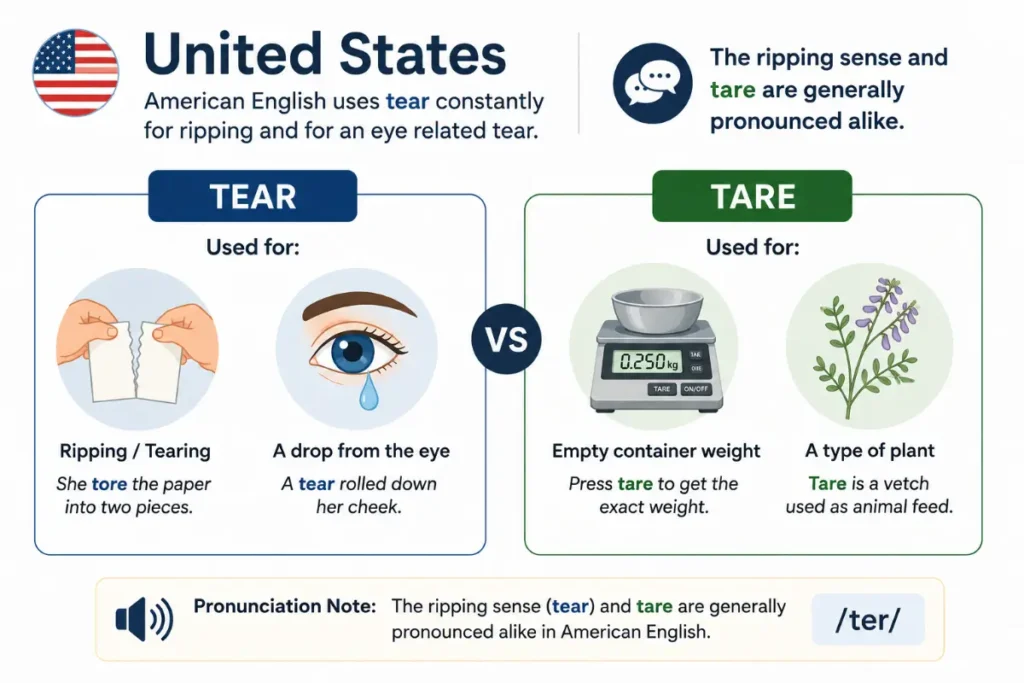
The ripping verb tear is pronounced like tare in many forms of English. The eye related noun has a different vowel sound. Cambridge gives the US pronunciation of the ripping form as /ter/ while the eye related noun is /tɪr/.
That means spelling based only on pronunciation can lead you down the wrong path.
Confusing Similar Looking Words
This is a common NLP style confusion. The brain notices shared letters and similar sound patterns and then predicts a familiar form.
The same type of confusion appears with pairs such as there and their or principal and principle. The words may look or sound related even when their meanings are completely different. The best solution is to connect each spelling with a meaning.
A related grammar guide is Propose vs Purpose Which One Should You Use 2026.
Pronunciation Guide
Pronunciation makes this pair particularly interesting.
Tear Meaning To Rip
In American English the verb tear meaning to rip is commonly pronounced /ter/. It sounds like tare. Cambridge gives /ter/ for this US form.
You can think of it as:
tear
Sounds like:
tair
Example:
Tear the paper carefully.
Tear Meaning A Drop From The Eye
The noun tear meaning a drop from the eye has a different pronunciation. In American English it is commonly represented as /tɪr/.
It sounds close to teer.
Example:
A tear fell from her eye.
This is a classic example of one spelling having two pronunciations and two meanings.
Tare
Tare is commonly pronounced /ter/ in American English. That makes it a homophone of the ripping sense of tear in many accents. Oxford gives the American pronunciation as /tɛr/.
So you may hear:
tear meaning rip
tare meaning empty weight
and hear almost exactly the same sound.
That’s why spelling matters.
Etymology and Word Origin
The history of these words explains some of their unusual behavior. The ripping sense of tear goes back to Old English teran. It belonged to an old Germanic verb family associated with pulling apart or destroying. The historical development eventually produced the modern forms tear, tore, and torn.
The history of the eye related noun tear is separate. It traces through Old English forms such as tear and teor and ultimately connects with an ancient Indo European root associated with tears. Related forms appear across several older languages. The noun meaning a rip developed from the verb meaning to tear. Oxford dates the noun sense of a damaged area to the early seventeenth century.
The history of tare is even more interesting because modern English has more than one historical source for the word. The measurement sense comes through Anglo French tare and Italian tara and ultimately from Medieval Latin and Arabic. The underlying idea involves something deducted or rejected. That meaning fits the modern measurement concept because tare weight is deducted from gross weight to determine net weight.
The botanical word tare has a different history. Oxford describes its origin as Middle English and uncertain. Etymological sources suggest possible connections with older Germanic and European plant terms. There’s also the historical connection between tare and the verb tear. Old English used a past form that survived in some older texts as tare. By the seventeenth century standard English had moved toward tore.
That historical detail explains why the two spellings may feel strangely connected. They actually were connected in one older grammatical use. Modern English has separated their functions much more clearly.
Regional Usage
United States
American English uses tear constantly for ripping and for an eye related tear. The ripping sense and tare are generally pronounced alike. Tare weight is common in technical fields involving shipping measurement packaging transportation and manufacturing. Cambridge gives the US pronunciation of the ripping form as /ter/ and the eye related noun as /tɪr/.
United Kingdom
British English also uses tear for ripping and for a drop from the eye. The pronunciation of the ripping form can differ from the common American pronunciation. Cambridge gives /teə r/ for the UK ripping sense. Tare remains a separate word with specialized meanings.
Australia
Australian English follows the same broad distinction. Tear is used for ripping and crying while tare remains a specialized term connected with measurement and other established meanings. The spelling distinction remains the same.
Canada
Canadian English also maintains the standard distinction between the two words. Writers use tear for ripping or eye related meanings and tare for technical weight terminology and the plant meaning. The exact pronunciation can vary among Canadian speakers.
No major English speaking region uses tare as the normal modern past tense of tear. If you mean that something was ripped in the past you should write tore.
Grammar Rules and Part of Speech
Tear As A Verb
As a verb tear can describe an action.
I tear the paper carefully.
In the past tense it becomes tore.
I tore the paper yesterday.
The past participle is torn.
The paper has been torn.
This irregular pattern needs to be memorized. English has many older strong verbs that developed irregular past forms.
Tear As A Noun
The noun tear can describe a rip.
There is a tear in my coat.
It can also describe a drop from the eye.
A tear ran down his cheek.
The sentence usually makes the meaning obvious.
Tare As A Noun
The measurement meaning of tare is normally a noun.
The tare is listed on the shipping document.
The common phrase tare weight is especially useful.
The tare weight is 15 kilograms.
The botanical meaning is also a noun.
The field contained tare among the grain.
Word Placement
The verb tear can appear in many normal verb positions.
She tears the paper.
She is tearing the paper.
The noun follows normal noun grammar.
A tear appeared.
The tear was small.
The tear in the fabric was repaired.
The word tare also behaves normally as a noun.
The tare was recorded.
The tare weight was deducted.
Real Life Usage Examples
Daily Talk
I tore my favorite shirt this morning.
This is the kind of sentence you might hear in an ordinary conversation. The word describes accidental damage.
I had a tear in my eye during the final scene.
Here the meaning relates to emotion rather than damage.
I noticed a tear in the document after printing it.
This works well in a workplace message because it clearly describes physical damage.
Please confirm the tare weight listed on the shipping record.
This is appropriate for logistics or inventory communication where precise weight information matters.
Academic Writing
The researchers observed that the material could tear under high pressure.
The verb describes a physical property of a material.
The experiment recorded the tare weight before adding the sample.
The technical noun fits measurement language.
News Writing
The storm tore through the region and damaged hundreds of homes.
Here tear has a figurative sense that suggests moving through something with force.
Officials confirmed the tare weight of the shipment before transport.
This kind of usage can appear in reports involving freight transportation or regulated measurement.
Literature
A tear slipped quietly down her cheek.
The noun creates an emotional image.
The wind tore the old banner from the wall.
The verb gives the sentence movement and force.
These examples show why context is more reliable than sound. A sentence about emotion clothing or physical damage points toward tear. A sentence about empty load weight points toward tare.
Torn
Torn is the past participle of tear.
The page was torn.
It can also have a figurative meaning.
She felt torn between the two choices.
Oxford identifies torn as the past participle of tear.
Expert Editor Insight
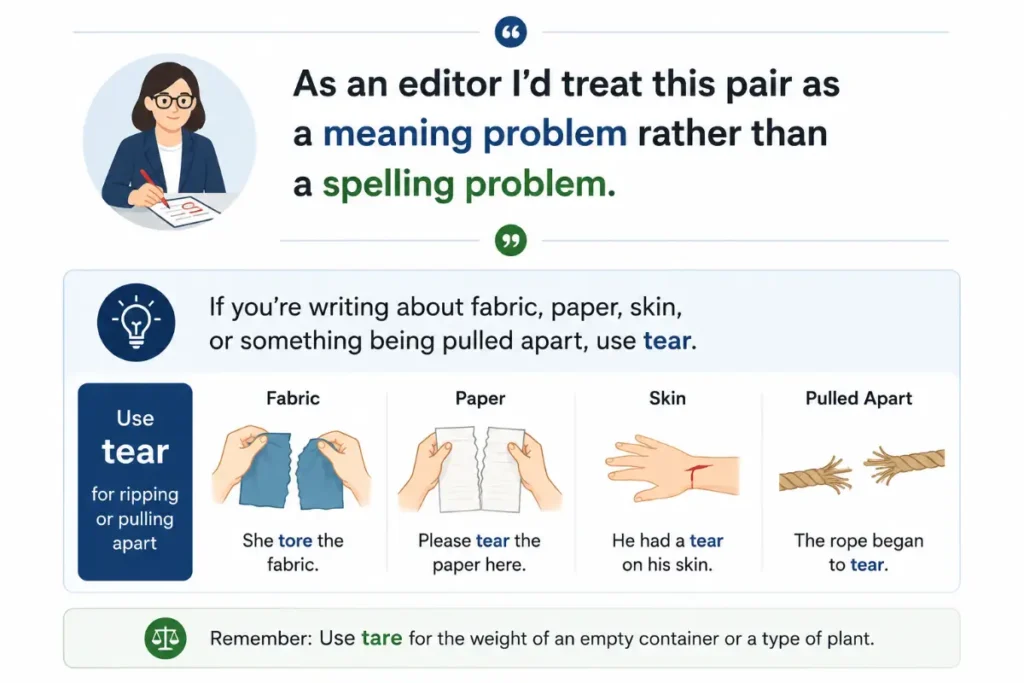
As an editor I’d treat this pair as a meaning problem rather than a spelling problem. If you’re writing about fabric paper skin or something being pulled apart use tear. If you’re describing a past action use tore. That three word distinction solves most errors immediately. Dictionary evidence supports the modern forms while historical sources explain why tare can sometimes look familiar as an old past form.
A useful editing trick is to replace the questionable word with a plain synonym. If you mean rip you probably need tear. If you mean empty container weight you need tare and If you mean ripped in the past you need tore. That quick substitution test catches errors without forcing you to memorize a complicated rule.
Conclusion
The key distinction is simple. Tear and tare are both legitimate English words but they have different jobs. Tear refers to ripping something or to a drop from the eye. It can also mean a rip or damaged opening. Tare usually refers to the empty weight of a container or vehicle and can also name a plant.
The past tense of tear is tore not tare. The best practical tip is to focus on meaning before spelling. If something is ripped use tear. If you’re talking about empty weight use tare. and If the ripping happened in the past use tore. That simple three word rule will prevent most mistakes.
For another common grammar confusion, see genious or genius Correct Spelling Meaning And Usage.
FAQs
What Is The Difference Between Tear And Tare?
Tear can mean to rip something or a drop of liquid from the eye. Tare mainly refers to the weight of an empty container or a type of plant. They have different meanings even though some pronunciations are the same.
Is Tear The Correct Word For Ripping?
Yes. Tear is the correct word when you mean to rip or pull something apart. For example, “Be careful not to tear the paper.”
What Does Tare Mean?
Tare commonly refers to the weight of an empty container. It can also refer to a type of vetch plant. For example, “The scale automatically subtracts the tare weight.”
Are Tear And Tare Pronounced The Same?
The ripping sense of tear and tare are generally pronounced alike in American English, usually like “tair.” However, tear has another pronunciation when it means a drop from the eye.
Is Tear Used For Tears From Your Eyes?
Yes. Tear can mean a drop of liquid produced by the eyes. For example, “A tear rolled down her cheek.” In this meaning, it has a different pronunciation from the ripping sense.
How Do You Remember Tear And Tare?
Think of tear as being connected with ripping or emotion. Tare is connected with weighing and containers. This simple association can help you choose the right spelling.
Can Tear Be A Noun And A Verb?
Yes. Tear works as both a noun and a verb. As a noun, it can mean a drop from the eye. As a verb, it can mean to rip something. For example, “She shed a tear” and “He tore the paper.”
Which Is Correct In American English Tear Or Tare?
Both tear and tare are correct words, but they have different meanings. Use tear for ripping or an eye related drop. Use tare mainly for empty container weight or the plant.