
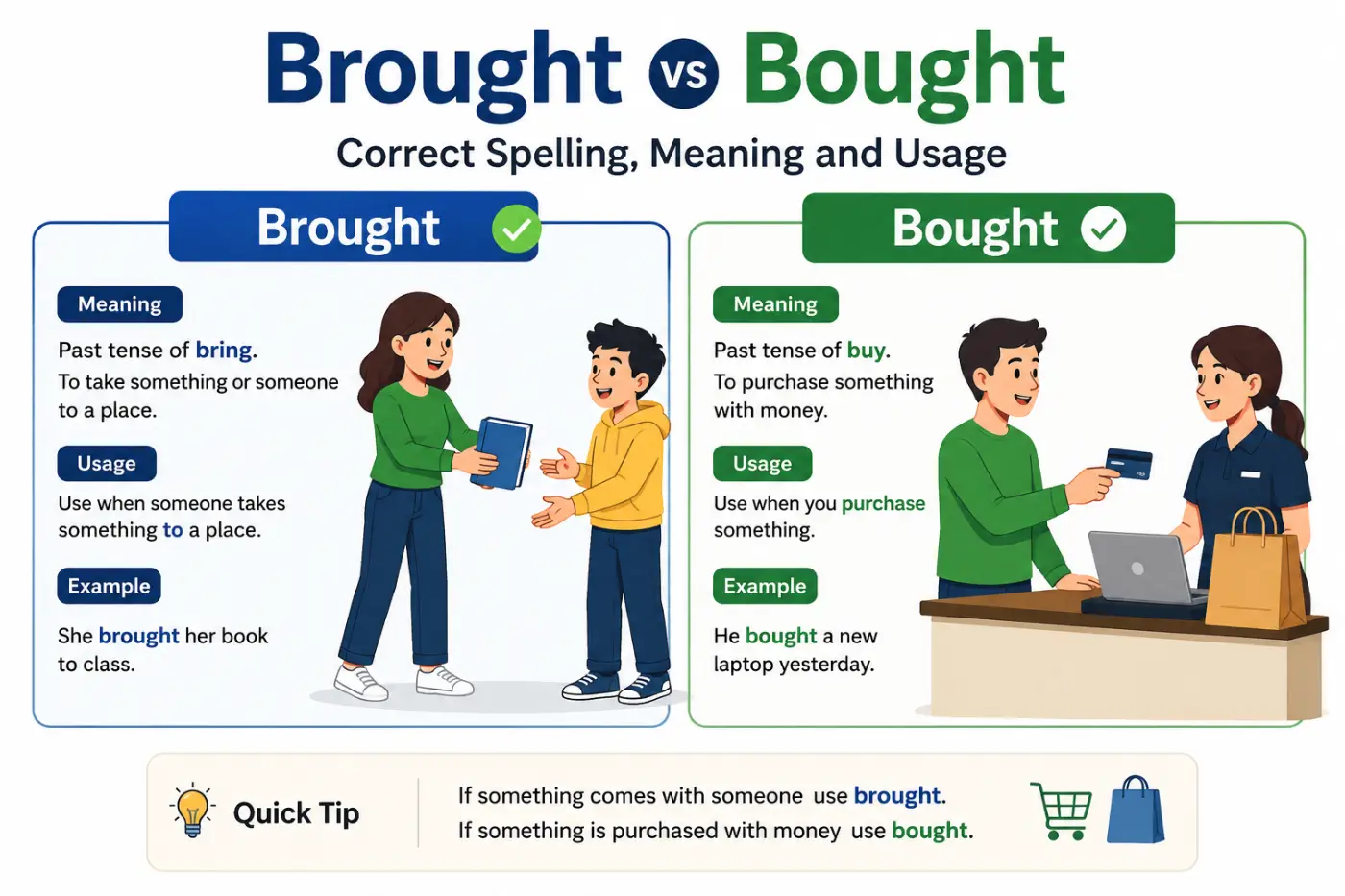
Mixing up brought vs bought is one of those English mistakes that can slip into a sentence before you notice it. The words look and sound surprisingly similar so even confident writers can pause over them. The good news is that the difference is simple once you connect each word to its original verb. Brought is the past tense and past participle of bring. Bought is the past tense and past participle of buy. They aren’t alternate spellings of the same word.
The confusion comes mainly from pronunciation. In many varieties of English both words have a similar vowel sound. Their meanings are completely different though. One involves moving or delivering something. The other involves getting something by paying for it.
This guide explains brought vs bought with clear definitions grammar rules pronunciation guidance natural examples and practical memory tricks. You’ll also learn how native speakers use both words in everyday conversation formal writing emails academic work news reports and other common situations.
A related grammar guide is Peace vs Piece: Meaning and Correct Usage.
Quick Definition
Brought is the past tense and past participle of bring. It means carried moved delivered caused or accompanied something or someone to a particular place or situation. Bought is the past tense and past participle of buy. It means obtained something by paying money for it.
Quick Answer
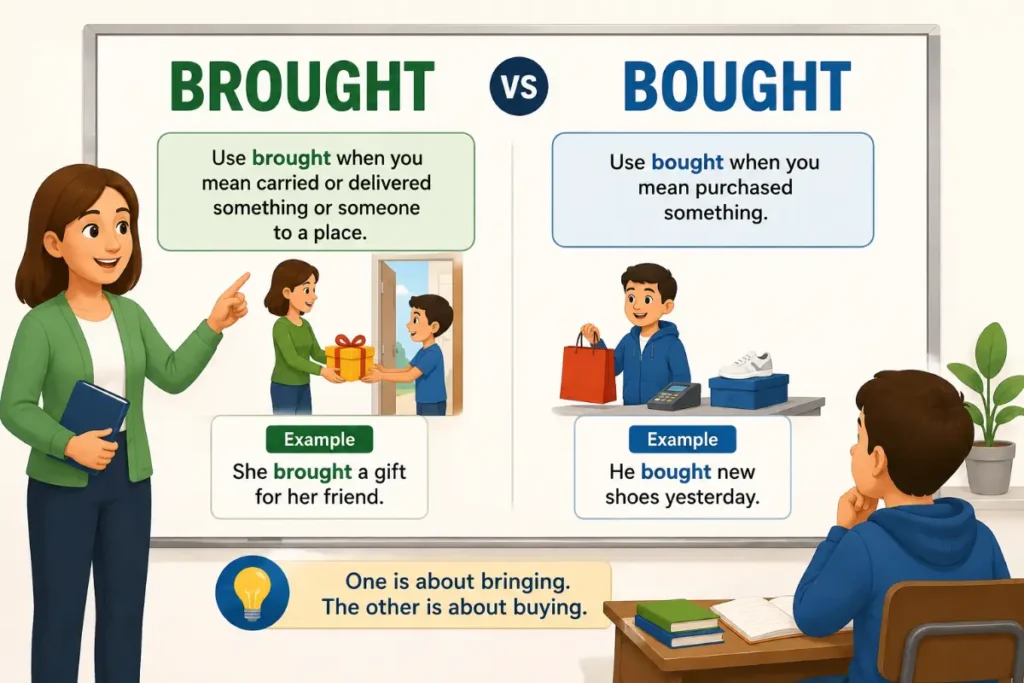
Use brought when you mean carried or delivered something or someone to a place. Use bought when you mean purchased something.
For example you brought your lunch to work because you carried it with you. You bought your lunch because you paid for it. The spelling changes because the underlying verbs are different.
Comparison Table
The table shows the central distinction. Brought belongs to bring while bought belongs to buy. Merriam Webster identifies brought as the past tense and past participle of bring and bought as the past tense and past participle of buy.
Meaning and Definition
Meaning of Brought
Brought is a real and standard English word. It is the past tense and past participle of bring.
The core meaning of bring involves moving something toward a person place or specific point. For example you can say you brought your notes to a meeting after carrying them there. The same verb works for delivery such as when you bring a package to someone. It can also describe causing an event or result such as when a decision brings positive changes.
Consider these examples.
She brought her notebook to school.
He brought some snacks for everyone.
The news brought tears to her eyes.
They brought the matter to the manager.
In each sentence the word describes an action connected to bringing something somewhere or causing something to happen.
Merriam Webster defines bring with meanings that include conveying carrying causing something to come along delivering and causing something to exist or occur. Its historical information traces the verb to Old English bringan.
Meaning of Bought
Bought is also a standard English word. It is the past tense and past participle of buy.
The central meaning involves purchasing something by giving money or another form of payment.
She bought a new phone.
We bought groceries after work.
He bought tickets for the concert.
They bought a house last year.
Cambridge defines buy as getting something by paying money for it. Merriam Webster likewise identifies bought as the past tense and past participle of buy.
The easiest way to separate the two is to think about the action involved. Brought focuses on carrying moving delivering or causing. Bought focuses on purchasing.
Key Differences Explained
- Spelling
The words have only one major spelling difference in the middle. Brought contains r after the initial b. Bought does not.
That small difference matters because it points to two separate verbs. Brought comes from bring. Bought comes from buy.
- Grammar role
Both words can function as a past tense form or past participle. The difference comes from their base verbs.
Bring becomes brought.
Buy becomes bought.
This means you cannot swap them simply because they sound alike.
- Meaning
Brought relates to movement delivery or cause.
Bought relates to purchase.
If you carried something to the office you brought it. If you paid money for that item you bought it.
- Tone
Neither word has a special formal tone. Both are ordinary words used in casual conversation professional writing academic prose journalism and everyday communication.
- Context
The surrounding words usually make the correct choice obvious.
Brought often appears with words such as home school office party class food message gift and documents.
Bought often appears with words such as store money price ticket clothes food car house gift and product.
Which Spelling Is Correct?
Both brought and bought are correct spellings. The correct choice depends on the verb you need.
Use brought as the past form of bring.
I brought my passport.
Use bought as the past form of buy.
I bought a new passport holder.
This distinction follows standard dictionary grammar. Merriam Webster lists brought as the past tense and past participle of bring. It lists bought as the past tense and past participle of buy.
Cambridge gives the same grammatical treatment. Its entry for brought identifies it as the past simple and past participle of bring. Its entry for buy gives bought as the past form.
A useful editor’s test is to replace the word with its base verb.
If the sentence makes sense with bring then use brought for a past action.
If it makes sense with buy then use bought.
For example.
I ___ some flowers for my mother.
Ask yourself what happened. Did I carry flowers to my mother or did I purchase flowers? If the meaning is carrying them to her then the answer is brought. If the meaning is paying for them then the answer is bought.
This simple test works far better than trying to remember the spelling by sight alone.
Sentence Examples
Examples With Brought
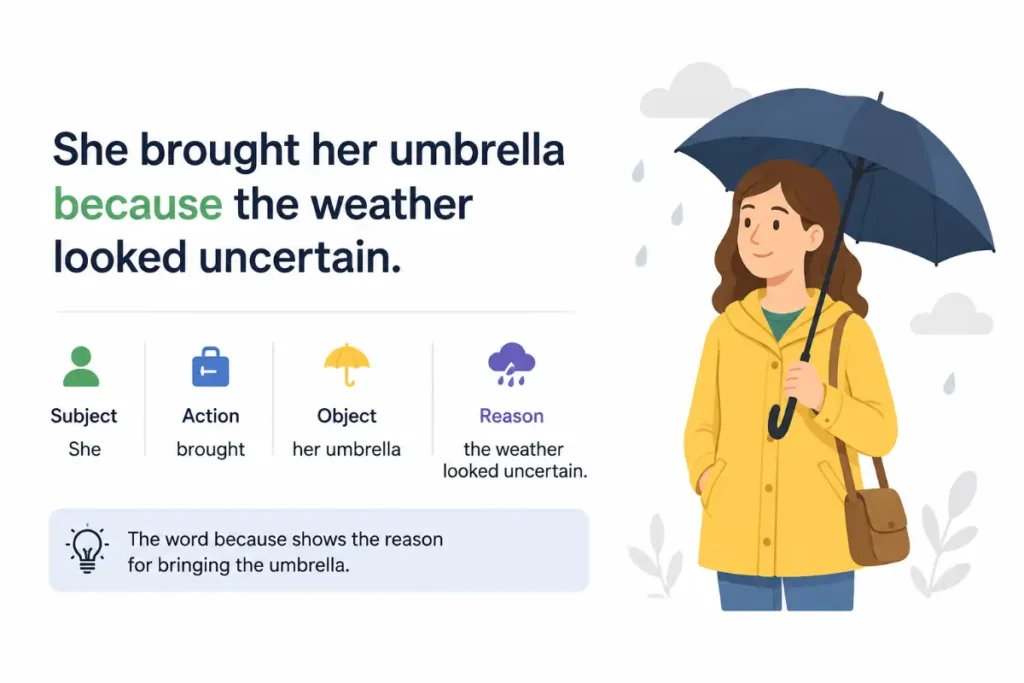
- She brought her umbrella because the weather looked uncertain.
- I brought some coffee for everyone at the office.
- He brought his daughter to the school meeting.
- They brought fresh fruit from their garden.
- The teacher brought several books for the students.
- My brother brought his camera to the wedding.
- The delivery driver brought the package to our door.
- Her speech brought hope to the community.
- We brought extra chairs for our guests.
- The discussion brought an important issue to light.
Notice that none of these examples means purchased. The action involves carrying delivering accompanying or causing something.
Examples With Bought
- She bought a new pair of shoes yesterday.
- I bought groceries on my way home.
- They bought tickets for the game.
- He bought his mother a birthday gift.
- We bought a table for the dining room.
- The company bought new computers for its employees.
- She bought the book after reading a review.
- I bought some flowers at the market.
- They bought a used car last summer.
- He bought lunch for the entire team.
Here the action involves payment or purchase. That is the key signal.
Examples Showing the Common Misspelling
The form brougt is a common spelling error involving brought.
- Incorrect: She brougt her lunch to school.
- Correct: She brought her lunch to school.
- Incorrect: He brougt the documents to the meeting.
- Correct: He brought the documents to the meeting.
- Incorrect: They brougt extra chairs for the guests.
- Correct: They brought extra chairs for the guests.
The mistake happens because the spelling of brought does not follow a simple regular past tense pattern. English has many irregular verbs and their forms often need to be learned as complete word families.
Common Mistakes and Misspellings
- Using bought when you mean carried
A sentence such as I bought my laptop to work is incorrect if the intended meaning is that you carried the laptop to work. The correct sentence is I brought my laptop to work.
- Using brought when you mean purchased
A sentence such as I brought a new phone yesterday is incorrect if you mean that you purchased the phone.
The correct sentence is I bought a new phone yesterday.
- Confusing sound with meaning
This is one of the biggest reasons people make the mistake. The pronunciation of brought and bought is close enough in many accents to create uncertainty. When you hear the word without seeing it you may not immediately know which spelling belongs in the sentence.
- Treating irregular verbs like regular verbs
Learners sometimes expect English verbs to follow a predictable pattern. Bring does not become bringed. Buy does not become buyed. Their standard past forms are brought and bought.
- Remembering the letters instead of the verb
Trying to memorize two isolated spellings can make the problem harder. Connect each form to its base verb instead.
Bring becomes brought.
Buy becomes bought.
That connection gives you a reliable mental shortcut.
From an NLP perspective this confusion is understandable because the words share several phonetic features and appear in similar sentence positions. The brain can recognize a familiar sound pattern before it fully processes the semantic distinction. Similar sound patterns are often responsible for confusion among words such as accept and except or affect and effect.
Pronunciation Guide
Brought is commonly pronounced /brɔːt/ in British English and /brɔːt/ or /brɑːt/ in American English depending on the speaker and accent. Cambridge lists the American pronunciation as /brɔt/.
A simple pronunciation guide is:
Brought sounds roughly like braught.
It has one syllable.
Bought is commonly pronounced /bɔːt/ in British English and /bɔːt/ or /bɑːt/ in American English.
A simple pronunciation guide is:
Bought sounds roughly like bawt.
It also has one syllable.
The initial br sound in brought provides an important clue. Bought begins with a simple b sound.
This difference may be easy to miss in fast speech. Native speakers often reduce sounds in casual conversation so the words can seem even closer than they appear on the page. Cambridge lists brought as the past form of bring and gives its pronunciation information for both British and American English.
Etymology and Word Origin
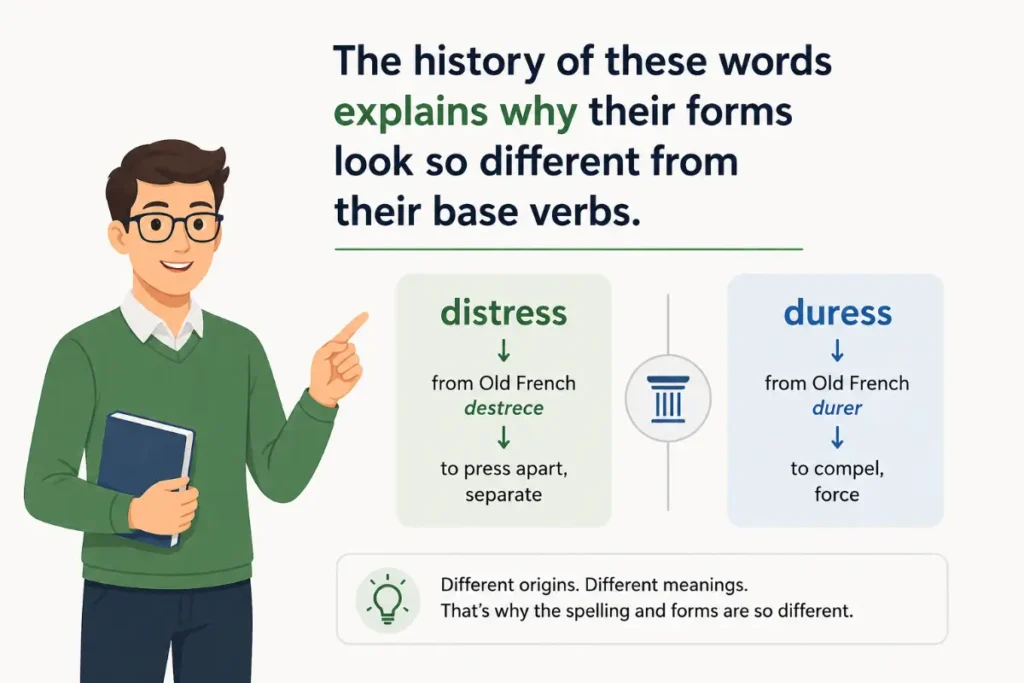
The history of these words explains why their forms look so different from their base verbs.
Brought comes from bring. Merriam Webster traces bring to Middle English and Old English bringan. The word is related to forms found in other Germanic languages.
Bring belongs to an old group of English verbs whose past forms developed through historical sound changes rather than by simply adding a regular ending.
Bought comes from buy. Buy has an old Germanic history as well. Its past form developed into bought through changes that occurred over centuries of English development.
This is why English learners shouldn’t expect irregular verbs to behave like regular verbs.
A regular verb such as walk becomes walked.
An irregular verb can change much more dramatically.
Bring becomes brought.
Buy becomes bought.
The spelling reflects historical development rather than a modern spelling rule that you can apply to every verb.
Regional Usage in US English
American English uses both brought and bought as standard forms. There is no standard American variant that replaces either word in ordinary writing. You will hear brought in sentences such as I brought dinner home and bought in sentences such as I bought dinner after work.
American pronunciation can make the two forms sound particularly close for some speakers. The difference becomes clearer when you focus on the initial br in brought.
Need another quick comparison? Read Shinning or Shining Which Is Correct in 2026?.
Regional Usage in UK English
British English also uses brought and bought as standard past forms. The meanings remain the same. A person who carried something somewhere brought it. A person who paid for something bought it.
Pronunciation can vary by region and individual accent. Cambridge provides separate British and American pronunciation information for brought.
Regional Usage in Australian English
Australian English follows the same standard distinction. Brought is the past form of bring. Bought is the past form of buy.
Regional pronunciation may affect how clearly the words sound different in conversation but it does not change their standard spelling or grammatical function.
Regional Usage in Canadian English
Canadian English also follows the standard distinction between the two forms.
You would write She brought the documents to the office when she carried them there.
You would write She bought new documents when she purchased them.
The difference is semantic rather than regional.
Grammar Rules and Part of Speech
Both words are forms of irregular verbs.
Brought is the past tense and past participle of bring.
Bought is the past tense and past participle of buy.
As past tense forms they can describe completed actions.
I brought my coat yesterday.
She bought a new coat yesterday.
As past participles they can appear with helping verbs.
I have brought enough food.
She has bought enough food.
They had brought the equipment before the event started.
They had bought the equipment before the event started.
The words can also appear in passive constructions.
The documents were brought to the office.
The tickets were bought online.
The important point is that the grammar does not change the basic distinction between the verbs.
Sentence Placement
Brought and bought usually appear after the subject in simple past sentences.
I brought the files.
She bought the dress.
They can also appear after auxiliary verbs.
I have brought the files.
She has bought the dress.
In questions the auxiliary verb carries the tense while the main verb returns to its base form.
Did you bring the files?
Did you buy the dress?
This rule is especially useful because learners sometimes write Did you brought or Did you bought.
Both are incorrect.
After did use the base verb.
Did you bring it?
Did you buy it?
Never use the past form after did in standard English.
Punctuation
Neither brought nor bought requires special punctuation. Use normal sentence punctuation based on the sentence structure.
She brought her passport.
He bought a ticket.
When the words appear inside longer sentences the usual punctuation rules apply.
After work I bought groceries and brought them home.
Real Life Usage Examples
Daily Talk
- I brought some snacks for the kids.
- She bought coffee on her way here.
These sentences show how naturally the words appear in everyday conversation. One describes bringing something along. The other describes paying for something.
- I brought the requested documents to the meeting.
- We bought the equipment from an approved supplier.
Professional emails use both forms frequently because workplace communication often involves deliveries documents purchases and supplies.
Academic Writing
- The study brought attention to an overlooked issue.
- The university bought new equipment for the laboratory.
In academic writing brought can describe an effect or result. Bought usually refers to an actual purchase.
News Writing
- The storm brought heavy rain to several communities.
- The company bought a smaller technology firm.
News writing often uses brought in a broader sense. It can describe something causing an event or condition rather than physically carrying an object.
Literature
- The traveler brought stories from distant places.
- The merchant bought rare goods from local sellers.
Literary writing can use both words in concrete and figurative ways. Brought is especially flexible because bring can describe physical movement as well as emotional or abstract effects.
Related and Confused Terms
Several expressions overlap with the ideas behind brought and bought. Understanding them helps you choose the right word more quickly.
- At last
At last means finally after a long wait or delay.
At last the package arrived.
- Eventually
Eventually describes something that happens after some time.
She eventually found the book.
- Ultimately
Ultimately refers to the final result or conclusion.
The decision ultimately brought the two sides together.
- At the end
At the end refers to the final point of a period event or sequence.
At the end of the meeting we discussed the budget.
- In the end
In the end means finally or after considering the final outcome.
In the end they bought the house.
- Lastly
Lastly introduces the final item in a sequence.
Lastly the speaker thanked the audience.
- Delivered
Delivered is closely related to brought when something is taken to a person or place.
The courier delivered the package.
- Purchased
Purchased is a more formal synonym for bought.
The company purchased new equipment.
These related terms help show why context matters. Bought is about acquiring something through purchase. Brought is about movement delivery or cause.
Expert Editor Insight
As a senior editor I would never correct this pair by looking only at spelling. I would first identify the base verb and the intended meaning. That approach catches the mistake at its source. If the writer means bring then brought is the correct past form. If the writer means buy then bought is correct. Dictionary entries support this distinction clearly. Merriam Webster identifies brought as the past tense and past participle of bring and bought as the past tense and past participle of buy. Grammar checkers can flag obvious misuse but context still matters. A human reader can understand the intended meaning from the surrounding sentence while an automated tool may need more context. The strongest editing habit is therefore simple. Identify the action first and check the verb second.
A Simple Memory Trick
Think of brought as connected to bring.
Bring something.
Brought something.
Think of bought as connected to buy.
Buy something.
Bought something.
You can also use the movement versus money test.
If something moves with you then think brought.
If something costs you money then think bought.
Imagine leaving a store with a new jacket. You bought the jacket at the store. When you carry that jacket home you brought it home.
One object can appear with both words in different sentences.
I bought the book at the bookstore.
I brought the book home.
That example captures the entire difference.
How Native Speakers Choose the Right Word
Native speakers usually don’t consciously analyze the grammar when they use these words. The meaning is tied closely to the verbs they learned as children.
If someone says I brought dinner they understand that dinner was carried or delivered to the relevant place. If someone says I bought dinner they understand that money was exchanged for the meal. The surrounding noun can also provide a useful clue.
You can bring a message.
You can bring a gift.
That is why context is often more powerful than spelling memory.
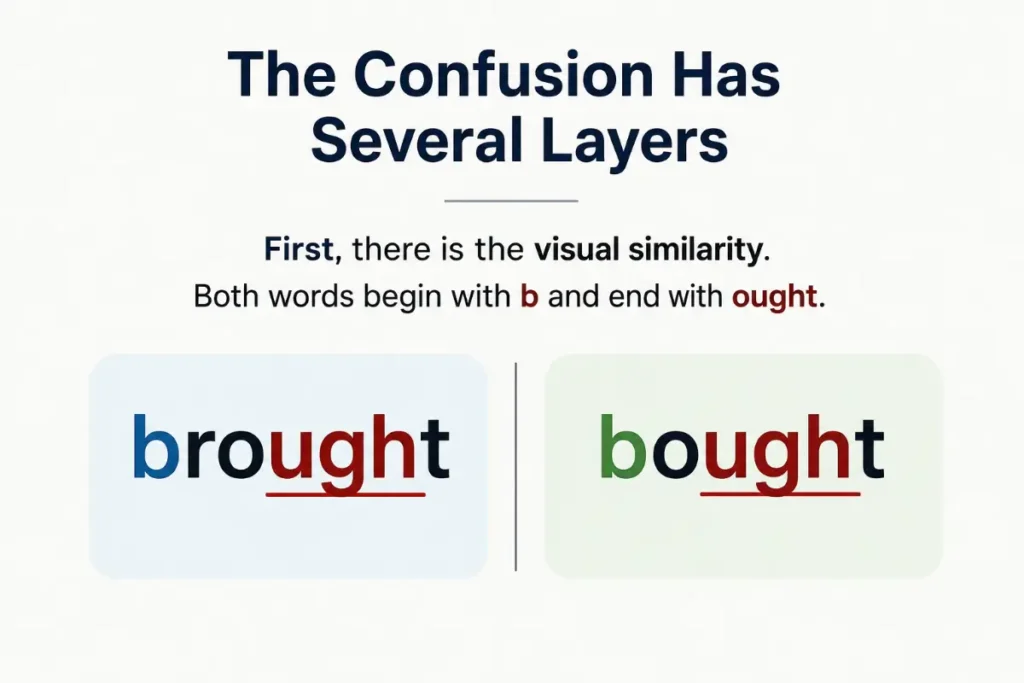
Why Brought and Bought Are So Easy to Confuse
The confusion has several layers.
First there is the visual similarity. Both words begin with b and end with ought.
Second there is the phonetic similarity. Their pronunciation overlaps strongly in many accents.
Third there is grammatical similarity. Both are irregular past forms.
Fourth there is contextual overlap. You can use both words when talking about the same object.
For example a person can buy a cake and then bring the cake to a party.
That creates sentences such as:
She bought a cake.
She brought the cake.
The noun stays the same but the verb changes because the action changes.
This is a classic example of why English vocabulary should be learned through meaning and sentence context rather than spelling alone.
A related grammar guide is Oversite vs Oversight Which Is Correct.
Conclusion
The difference between brought and bought becomes easy once you connect each word to its base verb. Brought is the past form of bring and relates to carrying delivering accompanying or causing. Bought is the past form of buy and relates to purchasing something.
The two words are close in sound but different in meaning spelling and grammar. When you’re unsure which one to use ask yourself what action took place. Did someone bring something or did someone buy it? That small question can prevent the mistake instantly. Remember the simplest pair:
bring becomes brought and buy becomes bought.
FAQs
Is Brought a Real Word?
Yes. Brought is a standard English word and the past tense and past participle of bring. It can mean carried delivered accompanied or caused something to happen. For example you can say She brought her laptop to work. Merriam Webster and Cambridge both identify brought as the past form of bring.
Is Bought a Real Word?
Yes. Bought is the standard past tense and past participle of buy. It means that someone purchased or obtained something by paying for it. For example you can say I bought a new computer last week. Both Merriam Webster and Cambridge recognize bought as the past form of buy.
Brought vs Bought Which Is Correct?
Both are correct words but they have different meanings. Use brought when the base verb is bring and the meaning involves carrying delivering accompanying or causing. Use bought when the base verb is buy and the meaning involves purchasing. A useful test is to replace the word with bring or buy and see which meaning fits.
How Do You Pronounce Brought?
Brought is usually pronounced with one syllable. Cambridge gives /brɔːt/ for British English and /brɔt/ for its American dictionary entry. The beginning contains the br sound which distinguishes it from bought for many speakers.
Can Brought Start a Sentence?
Yes. Brought can start a sentence when the sentence structure allows it. For example you can write Brought to the station by his brother he caught the train. This is a reduced participial construction. In ordinary sentences it is more common to place brought after the subject such as She brought the documents to class.
What Is a Synonym for Bought?
Common synonyms for bought include purchased acquired obtained and paid for. The best choice depends on context. Purchased is more formal and often appears in business or academic writing. Obtained is broader because it doesn’t always mean that money changed hands. Bought remains the most natural everyday word for a completed purchase.
Why Do People Confuse Brought and Bought?
People confuse these words because they look and sound very similar. Both end with the same letter pattern and both are irregular past forms. They can also describe actions involving the same object. Someone can buy a package and then bring the package home. Connecting each word to its base verb is the most reliable way to avoid the mistake.
Is Brought or Bought Better in Formal Writing?
Neither word is more formal than the other. Both are standard words and both work well in professional academic and formal writing. The correct choice depends entirely on meaning. Use brought for the past form of bring and bought for the past form of buy. If you need a more formal alternative to bought you can use purchased when the context supports it.