
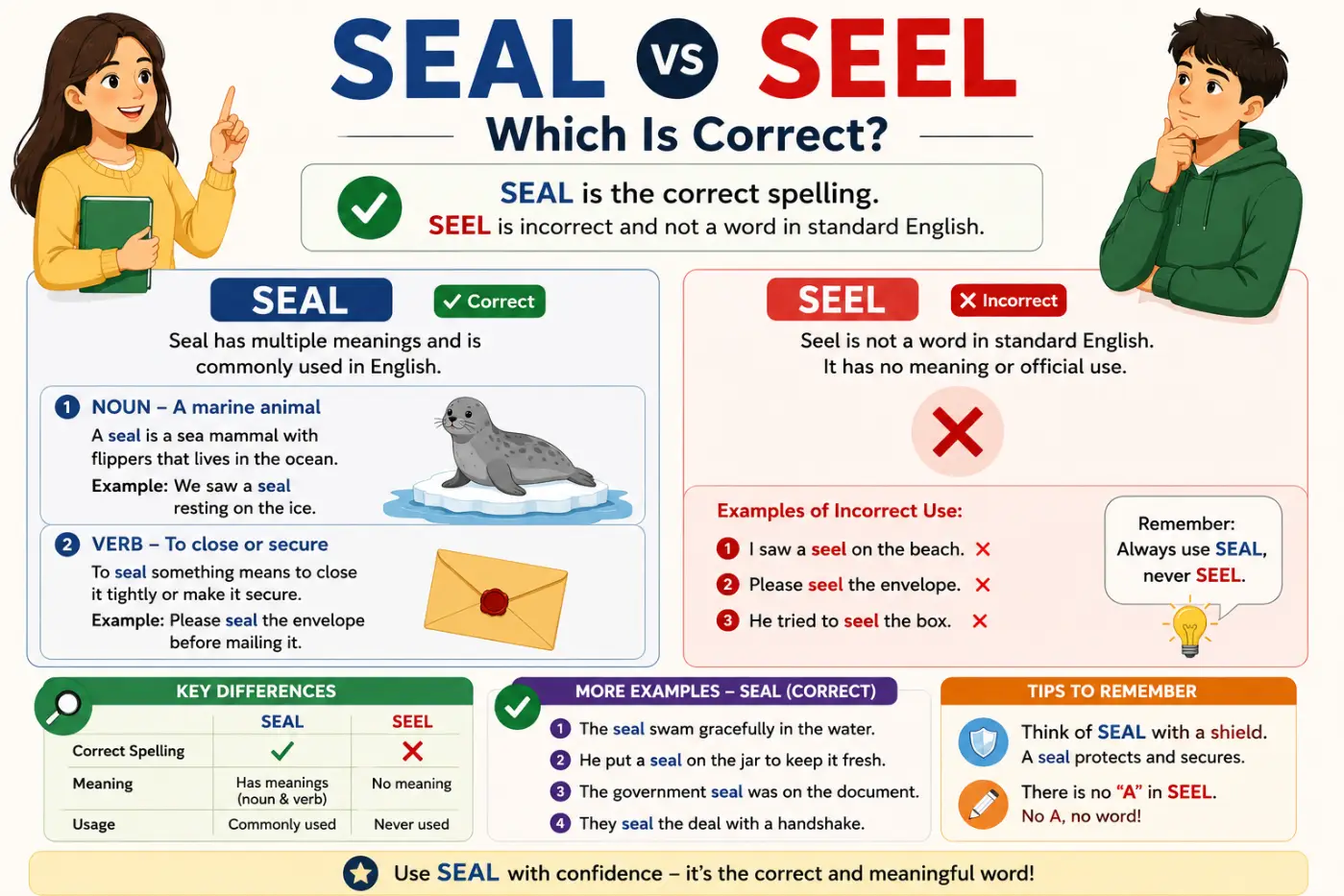
If you’ve searched for seal vs seel, you’re probably trying to figure out if one is a misspelling of the other or if both are real English words. The short answer is that both words exist, but they have very different meanings and are used in completely different contexts. Most of the time, seal is the word you need. Seel is an extremely rare, archaic verb that appears mainly in historical texts, older literature, and discussions of falconry.
This confusion is understandable because the two words differ by only one letter and sound very similar in some accents. Spell checkers, typing errors, and unfamiliar vocabulary can make the distinction even less obvious. Someone writing about official documents, marine animals, containers, or closing something almost always needs seal. On the other hand, readers exploring Shakespeare, medieval history, or traditional falconry may occasionally encounter seel.
In this guide, you’ll learn the meaning of both words, their origins, pronunciation, grammar, examples, and the situations where each one is appropriate. By the end, you’ll know exactly which spelling to use and why seal is the correct choice in almost every modern writing situation.
Still confused? Compare Dysregulated vs Disregulated Which Spelling Is Correct 2026.
Quick Definition
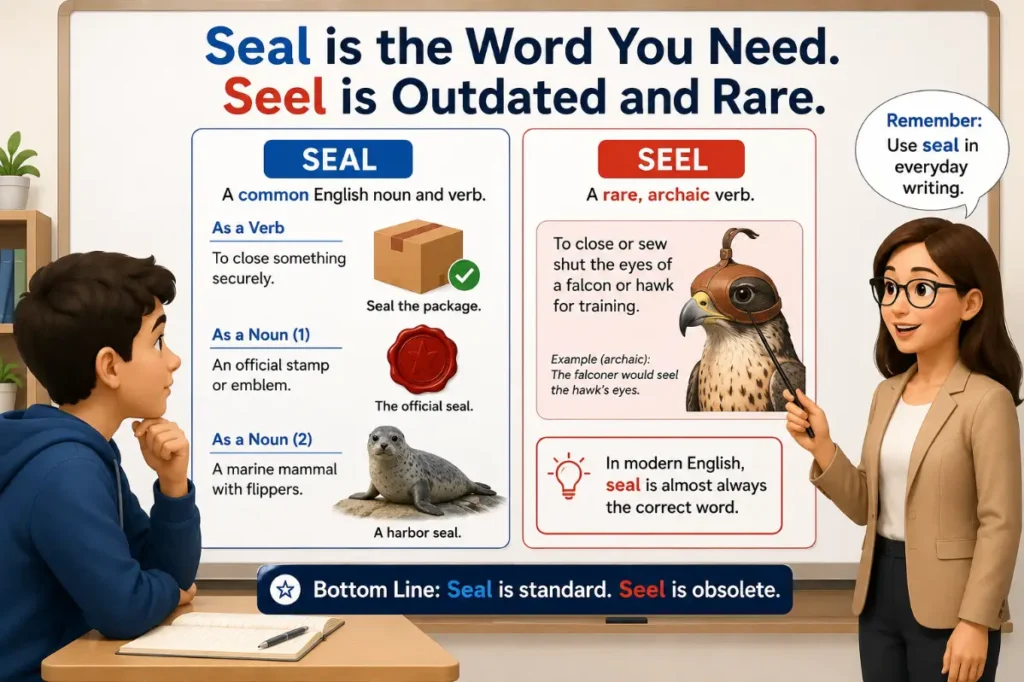
Seal is a common English noun and verb that refers to closing something securely, an official stamp, or a marine mammal. Seel is a rare, archaic verb meaning to close or sew shut the eyes of a falcon or hawk for training. In modern English, seal is almost always the correct word.
Quick Answer
If you’re deciding between seal vs seel, choose seal in nearly every situation.
Use seal when talking about:
- Closing an envelope or package.
- Making something airtight or watertight.
- An official stamp or emblem.
- A marine mammal.
- Confirming or finalizing an agreement.
Use seel only when referring to its historical meaning in older literature or traditional falconry. Outside those specialized contexts, using seel is usually considered a spelling mistake.
Seal Vs Seel Comparison Table
| Feature | Seal | Seel |
|---|---|---|
| Correct modern spelling | Yes | Rare and archaic |
| Part of speech | Noun and verb | Verb |
| Primary meaning | To close securely, an official mark, or a marine mammal | To close or sew shut the eyes of a bird used in falconry |
| Modern usage | Very common | Extremely rare |
| Origin | Old English seolh and Anglo French seal with multiple historical developments | Middle English from Old French ciler and related medieval forms |
| Formality | Used in every style of writing | Historical and literary only |
| Common contexts | Business, law, packaging, engineering, wildlife, medicine | Falconry, Shakespeare, medieval texts |
| Frequency | Extremely high | Extremely low |
| Dictionary status | Standard English word | Standard but archaic English word |
| Recommended for everyday writing | Yes | No |
Meaning Of Seal
The word seal is one of the most versatile words in English. It functions as both a noun and a verb and appears in everyday conversation, business communication, legal writing, science, engineering, and wildlife discussions.
Seal As A Verb
As a verb, seal means to close something securely so that air, water, dust, or other substances cannot pass through. It can also mean to make an agreement final or official.
Examples include:
- Please seal the envelope before mailing it.
- Workers will seal the roof to prevent leaks.
- The company sealed the contract yesterday.
- Make sure you seal the food container tightly.
- Doctors used stitches to seal the wound.
In each example, the idea is to close, secure, or finalize something.
Seal As A Noun
As a noun, seal has several meanings.
1. A Marine Animal
A seal is a semi aquatic mammal that lives in oceans and coastal regions.
Examples:
- The seal rested on the rocks.
- We watched a young seal swim through the bay.
2. An Official Stamp
A seal can be an official mark that proves authenticity.
Examples:
- The document carried the court’s official seal.
- The certificate bears the university seal.
3. A Protective Closure
A seal can also refer to a device or material that prevents leakage.
Examples:
- The rubber seal kept water out.
- Replace the broken door seal immediately.
Common Expressions With Seal
Many familiar English expressions include the word seal.
- Seal the deal.
- Seal of approval.
- Signed and sealed.
- Under seal.
- Break the seal.
These phrases appear frequently in both formal and informal English.
Meaning Of Seel
Unlike seal, seel is an uncommon word that most native English speakers never use in everyday conversation. Historically, seel meant to close or sew together the eyelids of a falcon or hawk during training. Falconers temporarily restricted the bird’s vision to help calm and train it before hunting. Today, this practice is largely obsolete, and the word survives mainly in historical discussions, dictionaries, and classic literature. Because of its limited use, many English speakers encounter seel only when reading older works or studying the history of falconry.
Historical Definition
The traditional meaning of seel includes:
- To sew shut the eyelids of a hunting bird.
- To close someone’s eyes figuratively.
- To blind or obscure vision in poetic language.
Modern dictionaries label this sense as archaic, meaning it belongs to older stages of English rather than contemporary usage.
Literary Usage
One reason seel remains known is its appearance in classic English literature. Writers occasionally used it as a metaphor for blindness, ignorance, or restricted understanding. Rather than describing the physical act alone, the word often suggested someone being prevented from seeing the truth. Because these examples come from historical works, modern writers rarely choose seel unless they intentionally want an old fashioned tone.
Modern Usage
Outside specialized historical writing, you almost never need seel.
Examples where it may appear include:
- A history book discussing medieval falconry.
- A scholarly article analyzing Shakespeare.
- A dictionary entry explaining obsolete English vocabulary.
- Research about traditional bird training.
- A translation of an older English text.
For emails, reports, essays, business documents, websites, and everyday communication, seal is almost always the intended word.
Seal Vs Seel Key Differences
Although the spellings differ by only one letter, the meanings are completely different.
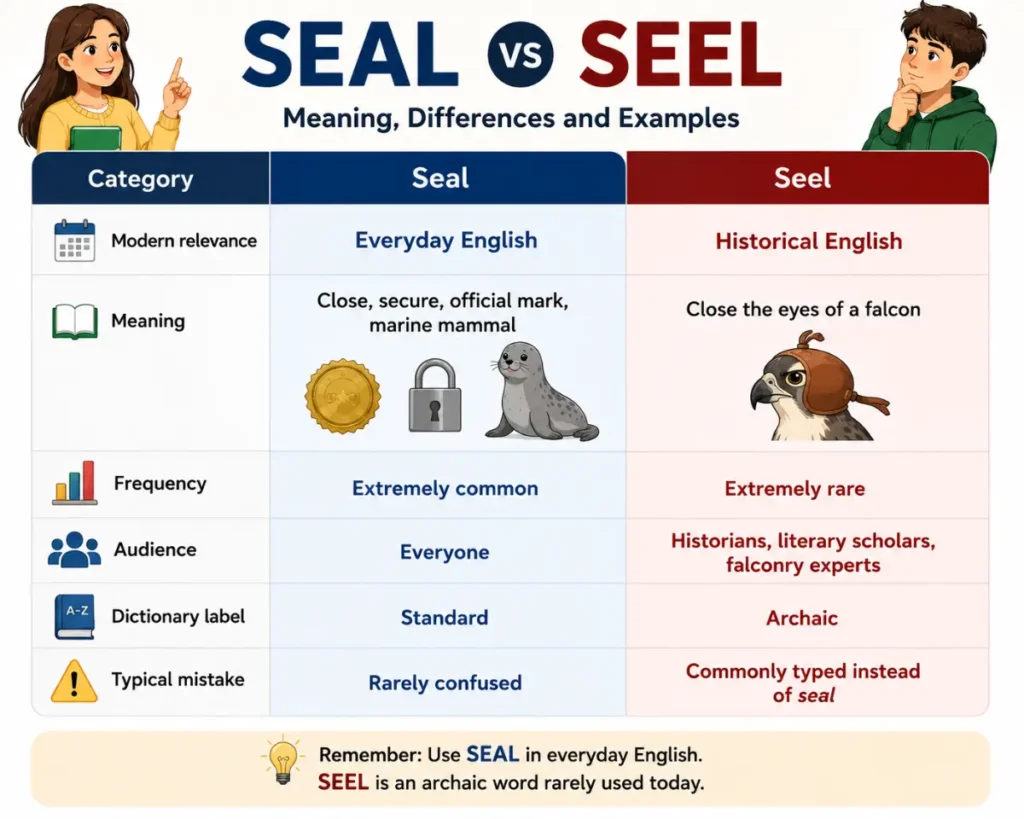
| Category | Seal | Seel |
|---|---|---|
| Modern relevance | Everyday English | Historical English |
| Meaning | Close, secure, official mark, marine mammal | Close the eyes of a falcon |
| Frequency | Extremely common | Extremely rare |
| Audience | Everyone | Historians, literary scholars, falconry experts |
| Dictionary label | Standard | Archaic |
| Typical mistake | Rarely confused | Commonly typed instead of seal |
The biggest difference is practical usage. One word belongs to modern English, while the other survives mainly as a historical term.
Seal Vs Seel Which One Is Correct
The answer depends on what you want to say.
Choose seal if you mean:
- Close a package.
- Close an envelope.
- Finish an agreement.
- Protect something from air or water.
- Refer to an official stamp.
- Name the marine mammal.
Choose seel only if you’re discussing:
- Traditional falconry.
- Medieval history.
- Shakespearean language.
- Archaic English vocabulary.
- Historical methods of bird training.
For more than 99 percent of modern writing, seal is the correct spelling.
Examples In Sentences
Ten Sentences Using Seal
- Please seal the package before sending it.
- The mechanic replaced the damaged seal in the engine.
- We watched a seal swimming near the shoreline.
- The lawyer placed the official seal on the document.
- They used silicone to seal the bathroom tiles.
- A fresh seal kept the container completely airtight.
- The president signed the order with the national seal.
- Be sure to seal the paint can after using it.
- The company sealed the partnership with a formal agreement.
- The aquarium rescued an injured seal.
Seal Vs Seel Examples In Sentences Continued
Ten Sentences Using Seel
These examples use the historical meaning of seel. They sound old-fashioned because the word is archaic.
- The falconer decided to seel the hawk before beginning its training.
- Medieval hunters sometimes seel young birds to keep them calm.
- The old manuscript described how trainers would seel hunting falcons.
- The ancient guide explained when to seel a restless hawk.
- Historians note that some falconers would seel birds as part of traditional training.
- The poet used seel as a metaphor for hiding the truth.
- The play refers to eyes being seeled to symbolize blindness.
- The rare verb seel appears in several historical dictionaries.
- Students encountered seel while studying early English literature.
- Today, writers rarely use seel outside historical discussions.
Editor’s note: If you’re writing modern English, you will almost never need seel. In everyday writing, seal is almost certainly the correct choice.
Need another quick comparison? Read Fare Better Or Fair Better Correct Usage Guide.
Seal Vs Seel Common Mistakes
Because seal is one of the most common English words and seel is extremely rare, confusion usually happens because of typing errors, unfamiliar vocabulary, or autocorrect. Understanding these mistakes can help you avoid using the wrong spelling.
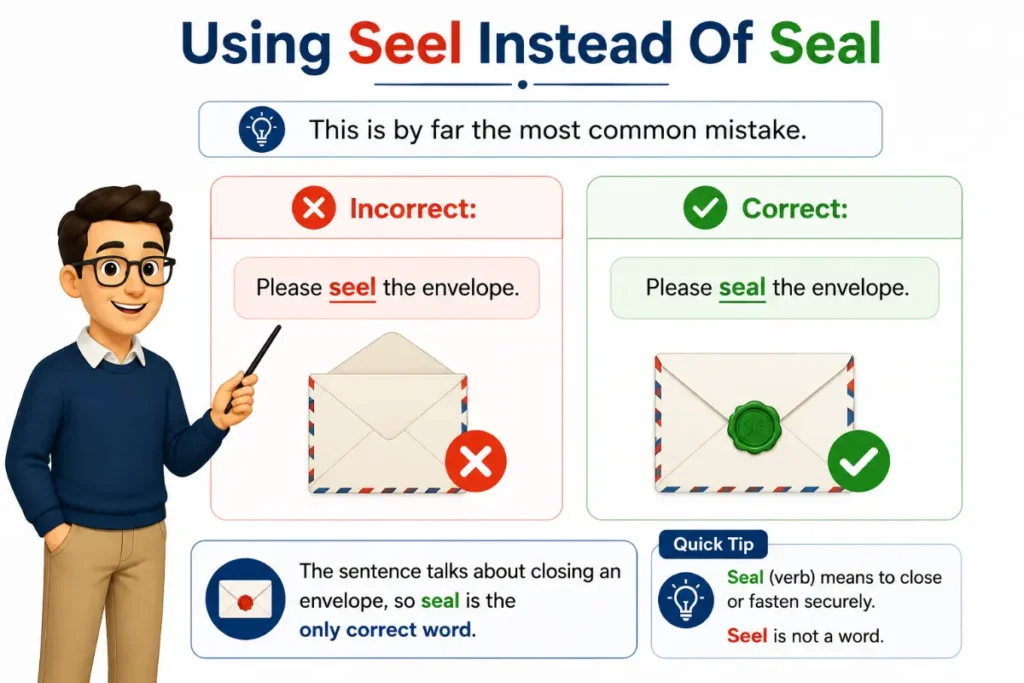
1. Using Seel Instead Of Seal
This is by far the most common mistake.
Incorrect:
- Please seel the envelope.
Correct:
- Please seal the envelope.
The sentence talks about closing an envelope, so seal is the only correct word.
2. Thinking Seel Is A Modern Alternative
Some people assume seel is an older British spelling of seal. It is not. These are two different words with different meanings.
- Seal means to close securely, make official, or refers to the marine animal.
- Seel is an archaic verb connected with falconry.
3. Confusing Pronunciation With Spelling
The words are pronounced almost the same in many accents. Because they sound alike, writers occasionally choose the wrong spelling without realizing it. Always think about the meaning instead of relying on pronunciation alone.
4. Assuming Spell Check Will Catch The Error
Many spell checkers recognize seel because it is a real English word. As a result, software may not flag it as a mistake. Human proofreading remains important.
5. Using Seel In Business Writing
Modern documents should never use seel unless they specifically discuss historical language.
Incorrect:
- Please seel the contract.
Correct:
- Please seal the contract.
6. Confusing The Marine Animal
The animal is always spelled seal.
Incorrect:
- We saw a seel at the zoo.
Correct:
- We saw a seal at the zoo.
Seal Vs Seel Pronunciation Guide
Although the meanings differ greatly, the pronunciation is almost identical.
| Word | IPA | Syllables | Sounds Like |
|---|---|---|---|
| Seal | /siːl/ | One | Seel |
| Seel | /siːl/ | One | Seal |
Syllable Breakdown
Seal
Seal
Seel
Seel
Both words contain only one syllable.
Common Pronunciation Mistakes
Most pronunciation problems are actually spelling mistakes. People generally pronounce both words correctly but write the wrong one.
Remember this simple rule.
- If you mean close, protect, official stamp, or the marine mammal, write seal.
- If you mean the historical falconry verb, write seel.
Seal Vs Seel Etymology And Word Origin
Learning where these words came from makes their difference much easier to remember.
Origin Of Seal
The English word seal has multiple historical sources because it carries several unrelated meanings. The animal name comes from Old English seolh, referring to the marine mammal. The meaning “to close securely” developed through Old French and Latin influences connected with official seals, stamps, and marks of authenticity.
Over time, the verb expanded to include ideas such as:
- Closing something tightly.
- Making an agreement official.
- Preventing air or water from passing through.
- Confirming or guaranteeing authenticity.
Today, these meanings are firmly established in Modern English.
Origin Of Seel
The word seel entered English through Middle English, influenced by Old French. Its original meaning referred to sewing or closing the eyelids of hunting birds during falconry training. Centuries ago, falconry was a respected sport among nobles across Europe. As falconry declined and training methods changed, the word gradually disappeared from everyday speech. Today, dictionaries usually label seel as archaic, obsolete, or historical.
How The Words Evolved
Although seal and seel now look similar, they developed along completely different historical paths. Their spellings eventually became alike, but their meanings never overlapped. That is why modern English treats them as entirely separate words.
Seal Vs Seel Regional Usage
Unlike many spelling differences in English, seal and seel are not regional variants. Every major English-speaking country follows the same standard.
American English
Americans use seal in everyday speech and writing. Seel appears only in historical dictionaries, literary studies, or discussions of falconry.
British English
British English also uses seal as the standard modern spelling. Older British literature is more likely to contain seel, especially in works from earlier centuries.
Canadian English
Canadian English follows the same pattern. Modern writing uses seal, while seel survives only in specialized historical contexts.
Australian English
Australian English treats seal as the normal spelling in every modern context. Readers may encounter seel only in classic literature or historical references.
Regional Preference Summary
| Region | Seal | Seel |
|---|---|---|
| United States | Standard | Historical only |
| United Kingdom | Standard | Archaic |
| Canada | Standard | Historical |
| Australia | Standard | Historical |
No major English dialect prefers seel as a modern alternative to seal.
Seal Vs Seel Grammar Rules
Understanding the grammar of both words helps prevent mistakes.
Seal As A Noun
As a noun, seal names a person, place, thing, or idea.
Examples:
- The seal rested on the beach.
- The official seal confirmed the document.
- The rubber seal prevented the leak.
Seal As A Verb
As a verb, seal describes an action.
Examples:
- Please seal the envelope.
- They sealed the agreement.
- We are sealing the windows today.
Verb Forms Of Seal
| Base Form | Past Tense | Past Participle | Present Participle |
|---|---|---|---|
| Seal | Sealed | Sealed | Sealing |
Examples:
- I seal every package carefully.
- She sealed the letter yesterday.
- They have sealed the container.
- We are sealing the roof today.
Seel As A Verb
Seel functions only as a verb. Its grammatical forms are rarely used because the word itself is uncommon. Traditional forms include:
| Base Form | Past Tense | Past Participle | Present Participle |
|---|---|---|---|
| Seel | Seeled | Seeled | Seeling |
These forms appear almost exclusively in historical writing.
Parts Of Speech Summary
| Word | Noun | Verb | Adjective | Adverb |
|---|---|---|---|---|
| Seal | Yes | Yes | No | No |
| Seel | No | Yes | No | No |
Common Grammar Structures
Correct:
- Seal the envelope.
- The seal was damaged.
- They sealed the package.
- The official seal appears on every certificate.
Historical:
- The falconer seeled the hawk.
- The manuscript described how birds were seeled.
Modern writers almost never need these historical structures.
Seal Vs Seel Real Life Usage Examples
Looking at authentic situations makes the difference much clearer.
Daily Conversation
- Can you seal this bag before we leave?
- The lid will not seal properly.
- We spotted a seal while walking along the coast.
- Make sure the container has a tight seal.
Academic Writing
- Researchers examined the ear seal on the specimen.
- The university document carries the official seal.
- The article explains the historical meaning of seel in medieval falconry.
- Students analyzed the rare verb seel in early English texts.
Professional Communication
- Please seal the shipment before pickup.
- Every legal document requires the company seal.
- Engineers inspected the rubber seal for signs of wear.
- The safety inspection confirmed that every seal remained intact.
Literature
Classical English literature occasionally uses seel to symbolize blindness, ignorance, or hidden truth. Modern novels almost never use the word without explaining it because most readers are unfamiliar with its meaning.
Media And Journalism
News reports overwhelmingly use seal when discussing:
- Wildlife.
- Government documents.
- Industrial equipment.
- Medical procedures.
- Environmental conservation.
References to seel usually appear only in articles about history, Shakespeare, or traditional falconry.
Seal Vs Seel Related Words And Confused Terms
Many English words look or sound similar to seal. Some are genuine spelling mistakes, while others are completely different words. Knowing the difference can help you avoid common writing errors.
| Word | Meaning | Common Confusion |
|---|---|---|
| Seal | To close securely, an official mark, or a marine mammal | The correct word in most situations |
| Seel | An archaic verb related to falconry | Rare historical word |
| Deal | An agreement or transaction | Rhymes with seal but has a different meaning |
| Heal | To recover or make healthy | Similar pronunciation pattern |
| Peal | A loud ringing sound | Often confused in pronunciation exercises |
| Steel | A strong metal | Similar spelling but unrelated |
| Sail | To travel on water using a boat | Different pronunciation and meaning |
| Sign | To write your name | Sometimes confused with seal in legal contexts |
| Stamp | A mark or impression | Similar to an official seal in some contexts |
| Close | To shut something | Shares one meaning with the verb seal |
Other Frequently Confused Word Pairs
If you searched for seal vs seel, you may also find these comparisons helpful.
- Accept vs Except
- Affect vs Effect
- Stationary vs Stationery
- Principal vs Principle
- Complement vs Compliment
- Discrete vs Discreet
- Passed vs Past
- Ensure vs Insure
- Canvas vs Canvass
- Advice vs Advise
These pairs often appear in spelling and grammar searches because they are easy to confuse but have different meanings.
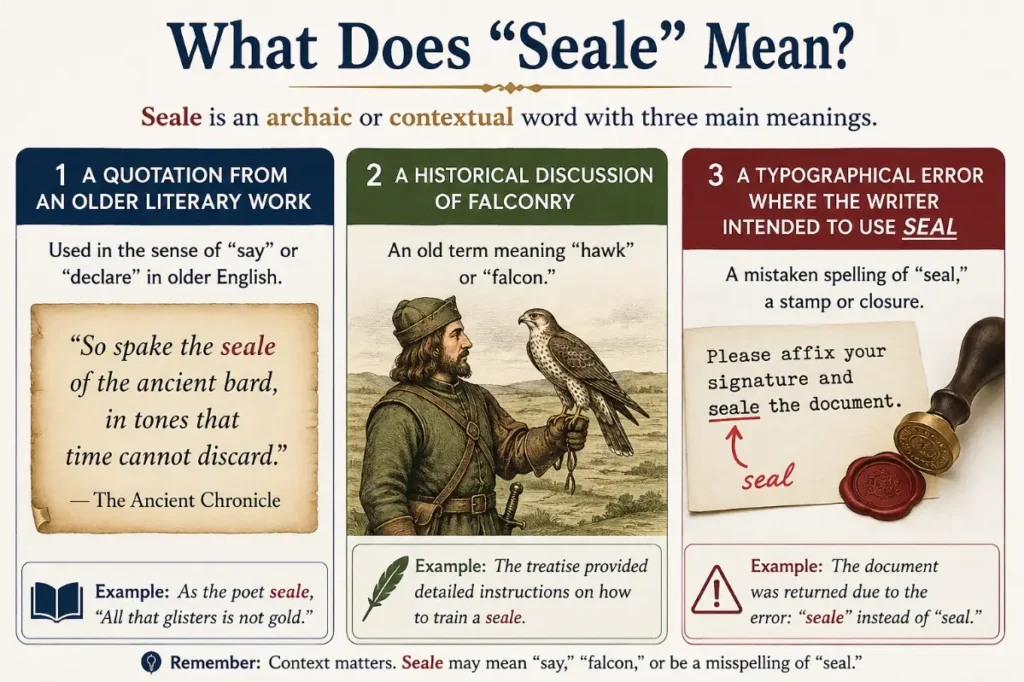
Seal Vs Seel Expert Language Insight
Professional editors rarely encounter seel in modern writing. When they do, it is almost always in one of three situations.
- A quotation from an older literary work.
- A historical discussion of falconry.
- A typographical error where the writer intended to use seal.
From an editorial perspective, seal is the expected choice in virtually every modern document. It appears in business contracts, technical manuals, scientific research, legal writing, news articles, websites, books, and everyday conversation. Because seel is a legitimate dictionary word, some spelling checkers do not automatically flag it as incorrect. This makes careful proofreading especially important. Editors rely on context rather than spelling alone. A useful editing habit is to ask yourself one simple question. Am I talking about closing, protecting, confirming, or the marine animal? If the answer is yes, write seal. If you are discussing historical falconry or quoting early English literature, seel may be appropriate.
Editor’s Recommendation
For clear, natural, and professional English:
- Use seal in all modern communication.
- Reserve seel for historical, literary, or scholarly contexts.
- Proofread carefully because spell check may not detect the mistake.
- Choose the word based on meaning, not pronunciation.
Following these guidelines will make your writing more accurate and easier for readers to understand.
A related grammar guide is cacoon or cocoon Which Spelling Is Correct.
Conclusion
The comparison between seal vs seel is much simpler than many people expect. Although both words exist in English, they belong to completely different parts of the language.
Seal is the standard modern word. It can describe closing something securely, making an agreement official, an official stamp, a protective barrier, or the familiar marine mammal. It is widely used in everyday conversation, academic writing, business communication, journalism, and legal documents.
Seel, on the other hand, is an archaic verb with a specialized historical meaning connected to falconry. Outside discussions of medieval practices, literary analysis, or historical texts, it is rarely used in contemporary English.
Frequently Asked Questions
Is seal or seel the correct spelling?
Seal is the correct spelling in almost every modern situation. It refers to closing something securely, an official mark, or a marine mammal. Seel is a genuine English word, but it is archaic and mainly appears in historical writing and discussions of falconry.
Is seel a real English word?
Yes. Seel is a real English word found in major dictionaries. It is an archaic verb meaning to sew or close the eyelids of a falcon or hawk during traditional training. Modern writers rarely use it outside historical or literary contexts.
Why do people confuse seal and seel?
The confusion happens because the words differ by only one letter and are pronounced almost identically. Many people assume seel is an alternative spelling of seal, but they have different meanings and are not interchangeable.
Can I use seel instead of seal?
No. In modern English, you should not replace seal with seel. If you are writing about envelopes, official documents, containers, agreements, or marine animals, seal is always the correct choice.
How do you pronounce seal and seel?
Both words are commonly pronounced /siːl/ and have one syllable. Since their pronunciation is almost identical, you should rely on context and meaning to choose the correct spelling.
Is seel used in American or British English?
Neither American nor British English uses seel in everyday communication. It survives mainly in historical texts, classic literature, and specialized discussions of falconry. Seal is the standard spelling across all major English varieties.
What does seal mean as a verb?
As a verb, seal means to close something securely, make it airtight or watertight, or make an agreement official. It is widely used in business, law, construction, medicine, and everyday conversation.
How can I remember the difference between seal and seel?
A simple memory trick is to associate seal with things you secure or close. Think of sealing an envelope or sealing a deal. Reserve seel for historical falconry and old literature, where it refers to closing a bird’s eyelids.