
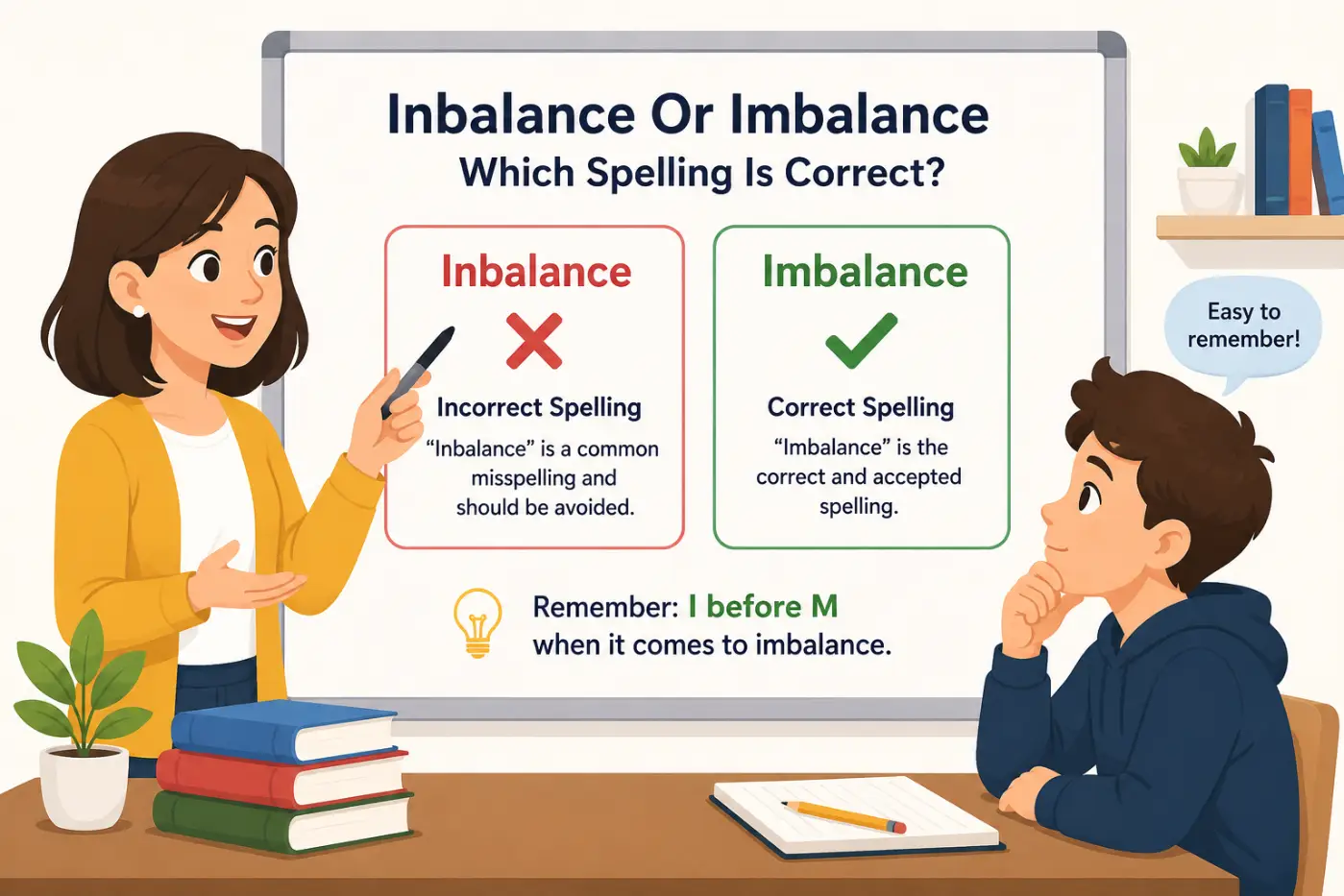
Have you ever stopped while writing and wondered, inbalance or imbalance? The two forms look very similar, so it’s easy to see why inbalance might seem correct at first. English uses the prefix in- in many words, such as inactive, incorrect, and incomplete, which can make this spelling mistake even more tempting.
The correct spelling is imbalance. The word means a lack of balance, equality, or proper proportion. Inbalance is not the standard spelling in modern English, even though it may look logical based on the way some other words are formed.
In this guide, you’ll learn why imbalance is correct, why inbalance is a common mistake, how the word is formed and pronounced, and how to use it naturally in different types of writing. You’ll also see clear examples, grammar tips, comparisons, and practical advice to help you remember the correct spelling.
You may also want to read Dought Vs Doubt Which Word Is Correct (2026).
Quick Definition
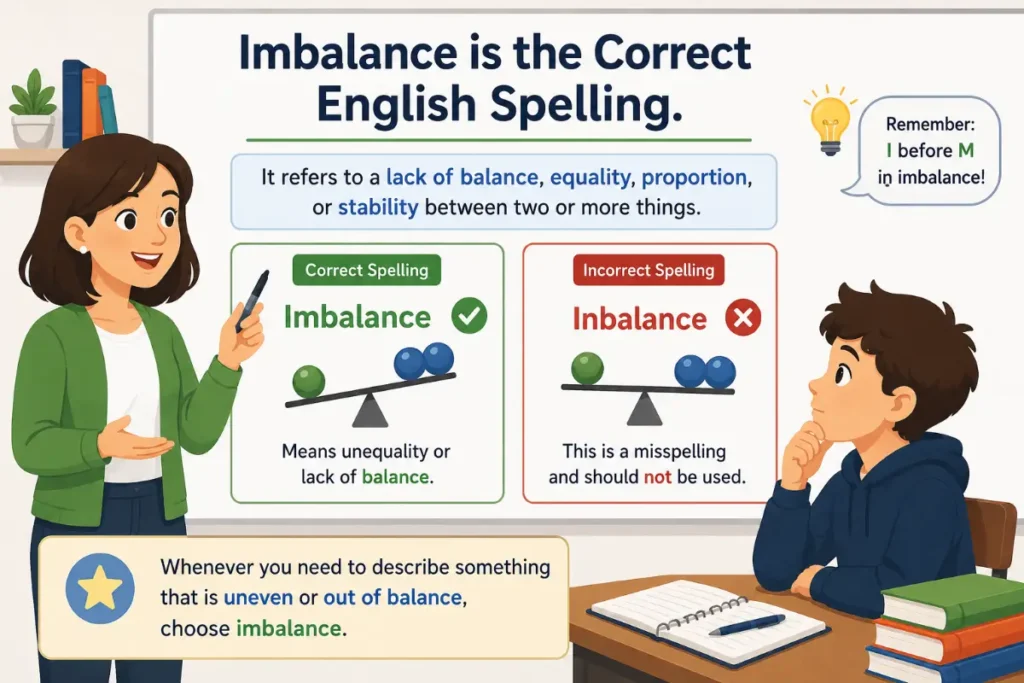
Imbalance is the correct English spelling. It refers to a lack of balance, equality, proportion, or stability between two or more things. Inbalance is a misspelling and should not be used in standard English writing. Whenever you need to describe something that is uneven or out of balance, choose imbalance.
Quick Answer
If you are deciding between inbalance or imbalance, always use imbalance. The word imbalance is recognized by dictionaries, style guides, and English grammar references. Inbalance is simply a spelling mistake that often occurs because people assume the prefix in- should be used instead of im-.
Inbalance Or Imbalance Comparison Table
| Feature | Inbalance | Imbalance |
|---|---|---|
| Correct spelling | No | Yes |
| Dictionary recognition | No | Yes |
| Meaning | None in standard English | Lack of balance or equality |
| Part of speech | Not recognized | Noun |
| Origin | Misspelling | Prefix im- plus balance |
| Usage frequency | Extremely rare and mostly errors | Very common |
| Formality | Not acceptable | Suitable for all writing |
| Common contexts | Typographical mistakes | Health, finance, economics, sports, science, psychology, business, education |
| Example | Incorrect: The market is suffering from inbalance. | Correct: The market is suffering from imbalance. |
Meaning Of Both Terms
Although many people search for inbalance or imbalance, only one of these words belongs to standard English.
What Does Imbalance Mean?
Imbalance is a noun that describes a situation where things are unequal, uneven, or not properly balanced. The word can refer to physical balance, emotional stability, financial conditions, social equality, scientific measurements, or many other situations where harmony is missing.
Examples include:
- A chemical imbalance.
- A hormonal imbalance.
- A budget imbalance.
- A trade imbalance.
- A muscle imbalance.
- An imbalance between supply and demand.
- An imbalance in opportunities.
- An emotional imbalance.
In every example, the word describes something that lacks proper proportion or equilibrium.
What Does Inbalance Mean?
Inbalance has no accepted meaning in modern standard English because it is not a recognized word. When people write inbalance, they almost always intend to write imbalance. Spell checkers, dictionaries, editors, teachers, and professional writers treat inbalance as an error.
Inbalance Or Imbalance Key Differences
Although the answer seems straightforward, understanding the differences helps you remember the correct spelling.
Meaning Difference
Imbalance has a clear meaning. It describes inequality, instability, or an uneven relationship. Inbalance has no accepted meaning because it is not part of standard English vocabulary.
Grammar Difference
Imbalance functions as a noun.
Examples include:
- The doctor diagnosed an imbalance.
- The report revealed a financial imbalance.
Inbalance has no grammatical role because it is not recognized as an English word.
Dictionary Difference
Major English dictionaries include imbalance. They do not list inbalance as a standard word.
Professional Writing Difference
Editors automatically replace inbalance with imbalance. Using the correct spelling improves credibility and prevents unnecessary corrections.
Reader Expectation Difference
Native English speakers expect to see imbalance. Seeing inbalance immediately looks like a spelling mistake.
Which One Is Correct?
The correct spelling is imbalance. There is no situation in standard English where inbalance is preferred.
Use imbalance in:
- Academic essays.
- Medical reports.
- Business documents.
- News articles.
- Scientific research.
- Legal writing.
- Everyday communication.
- Professional emails.
- Books.
- Online publications.
Whenever you need to describe something that lacks balance or equality, imbalance is always the correct choice.
Why Do People Write Inbalance?
This spelling mistake is surprisingly common because English prefixes are not always predictable. Many English words begin with in-, including:
- Inactive.
- Incorrect.
- Incomplete.
- Inaccurate.
- Inability.
Because of these familiar patterns, many writers naturally assume inbalance should follow the same rule. However, English changes some prefixes to make pronunciation smoother. Before words beginning with b, m, and p, the prefix in- often becomes im-.
Examples include:
- Impossible.
- Immature.
- Immoral.
- Impatient.
- Impolite.
- Imbalance.
This spelling pattern has existed for centuries and comes from Latin. Instead of pronouncing inbalance, English naturally shifts the sound to imbalance, making it easier to pronounce.
Why Does Im Become The Correct Prefix?
Understanding this spelling rule makes many English words easier to remember. The negative prefix originally appeared as in-. When it came before certain consonants, pronunciation gradually changed.
Before these letters:
- B
- M
- P
The n sound naturally changed into an m sound. That is why English has words such as:
| Incorrect Form | Correct Form |
|---|---|
| Inpossible | Impossible |
| Inpatient | Impatient |
| Inmature | Immature |
| Inmoral | Immoral |
| Inbalance | Imbalance |
Notice the pattern. Whenever the base word begins with b, m, or p, the spelling usually changes from in- to im-. This is one of the most reliable spelling patterns in English.
Parts Of Speech
Understanding how imbalance functions in a sentence helps you use it naturally.
| Word | Part of Speech | Example |
|---|---|---|
| Imbalance | Noun | The report revealed an imbalance. |
| Imbalanced | Adjective | The team had an imbalanced lineup. |
| Balance | Noun | Good balance improves performance. |
| Balance | Verb | She tried to balance her schedule. |
| Balanced | Adjective | The meal was balanced. |
Notice that imbalance is always a noun. If you need an adjective, choose imbalanced instead.
Examples:
- An imbalanced argument.
- An imbalanced diet.
- An imbalanced economy.
- An imbalanced workload.
Common Contexts Where Imbalance Appears
One reason imbalance is such a useful word is that it appears across many fields.
Health
Doctors frequently discuss imbalance when describing conditions that affect the body.
Examples include:
- Hormonal imbalance.
- Chemical imbalance.
- Muscle imbalance.
- Electrolyte imbalance.
- Nutritional imbalance.
Business
Companies often use the word when discussing markets or finances.
Examples include:
- Budget imbalance.
- Workforce imbalance.
- Revenue imbalance.
- Trade imbalance.
- Resource imbalance.
Economics
Economists regularly analyze:
- Trade imbalance.
- Market imbalance.
- Economic imbalance.
- Supply imbalance.
- Demand imbalance.
Education
Teachers may discuss:
- Skill imbalance.
- Learning imbalance.
- Gender imbalance.
- Resource imbalance.
- Achievement imbalance.
Sports
Coaches commonly mention:
- Muscle imbalance.
- Team imbalance.
- Defensive imbalance.
- Physical imbalance.
- Tactical imbalance.
These examples show how widely accepted and versatile imbalance has become across professional and everyday English.
Need another quick comparison? Read hustle or hussle Correct Spelling and Meaning.
Examples In Sentences
The easiest way to remember the correct spelling is to see it used in natural sentences. Notice that imbalance fits smoothly into every example, while inbalance does not belong in standard English.
10 Sentences Using Inbalance
The following sentences show the incorrect spelling that people sometimes type. Each includes the correct version.
- Incorrect: The doctor found an inbalance in her hormones.
Correct: The doctor found an imbalance in her hormones. - Incorrect: The company reported a financial inbalance.
Correct: The company reported a financial imbalance. - Incorrect: An inbalance between supply and demand raised prices.
Correct: An imbalance between supply and demand raised prices. - Incorrect: The athlete developed a muscle inbalance.
Correct: The athlete developed a muscle imbalance. - Incorrect: The teacher noticed an inbalance in classroom participation.
Correct: The teacher noticed an imbalance in classroom participation. - Incorrect: Poor planning created an inbalance in the budget.
Correct: Poor planning created an imbalance in the budget. - Incorrect: The report highlighted an inbalance in hiring practices.
Correct: The report highlighted an imbalance in hiring practices. - Incorrect: Stress can contribute to an emotional inbalance.
Correct: Stress can contribute to an emotional imbalance. - Incorrect: The market experienced an inbalance after the policy change.
Correct: The market experienced an imbalance after the policy change. - Incorrect: Scientists measured an inbalance in the ecosystem.
Correct: Scientists measured an imbalance in the ecosystem.
10 Sentences Using Imbalance
These examples demonstrate the correct spelling in everyday English.
- The doctor treated a hormonal imbalance.
- The economy showed signs of a growing trade imbalance.
- A muscle imbalance increased the risk of injury.
- The coach corrected the team’s defensive imbalance.
- The survey revealed a gender imbalance in leadership positions.
- Poor nutrition may lead to a vitamin imbalance.
- The report identified an imbalance between costs and revenue.
- The therapist discussed emotional imbalance during the session.
- The market imbalance caused prices to rise quickly.
- The new policy reduced the imbalance in educational resources.
Common Mistakes
Although imbalance is the only correct spelling, people make several related mistakes.
Misspelling The Prefix
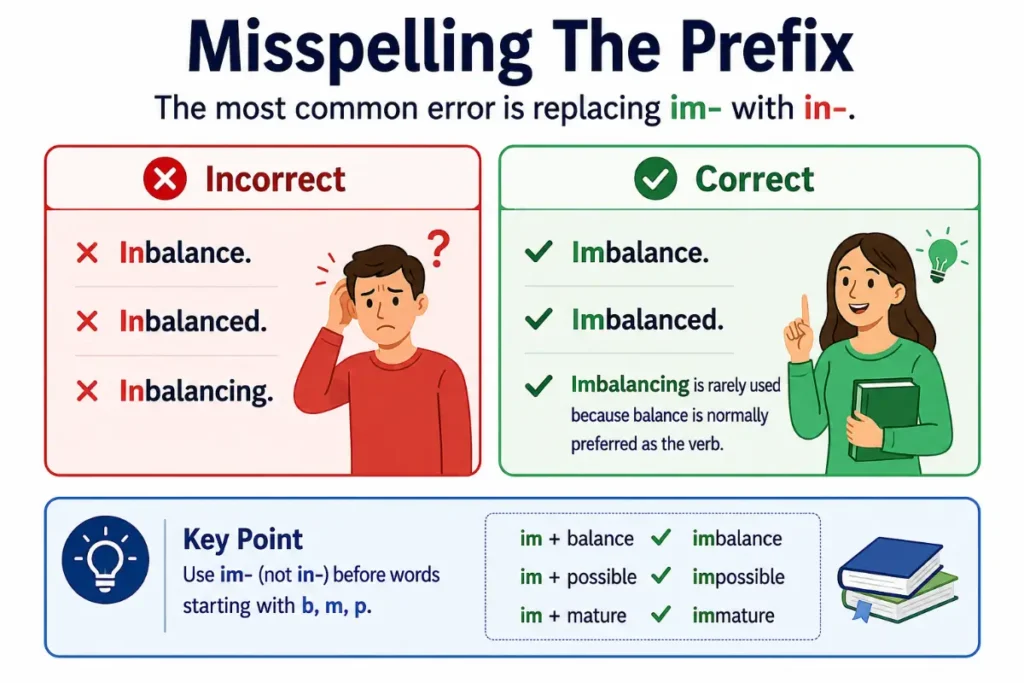
The most common error is replacing im- with in-.
Incorrect:
- Inbalance.
- Inbalanced.
- Inbalancing.
Correct:
- Imbalance.
- Imbalanced.
- Imbalancing is rarely used because balance is normally preferred as the verb.
Assuming Every Negative Prefix Uses In
Many learners believe every negative word begins with in-. That is not how English works. Compare these examples:
| Incorrect | Correct |
|---|---|
| Inpossible | Impossible |
| Inpatient | Impatient |
| Inmature | Immature |
| Inmoral | Immoral |
| Inbalance | Imbalance |
The spelling changes because English inherited these forms from Latin, where the prefix adapts to the following consonant.
Confusing Balance And Imbalance
Some writers accidentally use imbalance when they actually mean balance.
Incorrect:
The engineer achieved excellent imbalance in the design.
Correct:
The engineer achieved excellent balance in the design.
Using Imbalance As An Adjective
Remember that imbalance is a noun.
Incorrect:
The project is imbalance.
Correct:
The project is imbalanced.
Or:
The project has an imbalance.
Pronunciation Guide
Correct pronunciation helps reinforce the correct spelling.
IPA Pronunciation
Imbalance
American English: /ɪmˈbæləns/
British English: /ɪmˈbæl.əns/
Syllable Breakdown
Im • bal • ance
Three syllables.
The primary stress falls on the second syllable.
im BAL ance
Common Pronunciation Mistakes
Many learners pronounce the beginning as in because they mentally picture the incorrect spelling. Native speakers naturally pronounce an m sound before the b. This pronunciation matches the correct spelling:
Imbalance Not:
Inbalance Reading the word aloud several times helps build the correct spelling in memory.
Etymology And Word Origin
Understanding where imbalance came from explains why its spelling looks different from what many people expect. The word combines two historical elements.
- The Latin negative prefix in-, meaning not.
- The English word balance, which ultimately comes from the Latin bilanx, meaning having two scales.
Over time, the Latin prefix changed its spelling before certain consonants. Before b, m, and p, the n changed into m because the sound flows more naturally in speech. This process is called assimilation. It affects many English words, including:
- Impossible.
- Immovable.
- Immortal.
- Immense.
- Impartial.
- Imbalance.
This pattern has been part of English for hundreds of years and remains the accepted standard today.
Regional Usage
One advantage of imbalance is its consistency across major varieties of English. Unlike some spelling differences such as color and colour or organize and organise, this word does not change by region.
| Region | Preferred Form |
|---|---|
| American English | Imbalance |
| British English | Imbalance |
| Canadian English | Imbalance |
| Australian English | Imbalance |
No major English-speaking country recognizes inbalance as the standard spelling. That means you can confidently write imbalance regardless of your audience.
Grammar Rules
Knowing how the word behaves grammatically helps you write more naturally.
Imbalance Is A Countable Noun
Examples:
- The report identified an imbalance.
- We noticed several imbalances.
- A serious imbalance affected the results.
Notice that the noun has both singular and plural forms.
Singular: An imbalance.
Plural: Imbalances.
Common Sentence Structures
Pattern 1
An imbalance in something.
Examples:
- An imbalance in funding.
- An imbalance in nutrition.
- An imbalance in staffing.
Pattern 2
An imbalance between two things.
Examples:
- An imbalance between income and expenses.
- An imbalance between supply and demand.
- An imbalance between work and family life.
Pattern 3
Cause an imbalance.
Examples:
- Poor planning caused an imbalance.
- Drought caused an imbalance in water supplies.
- Inflation caused an imbalance in the market.
Pattern 4
Correct an imbalance.
Examples:
- The therapist corrected the muscle imbalance.
- The company corrected the budget imbalance.
- New policies corrected the workforce imbalance.
These patterns appear frequently in professional writing because they are concise and precise.
Real Life Usage Examples
One sign of a strong English word is that it appears naturally across many situations.
Daily Conversation
- I think there’s an imbalance between work and personal life.
- Too much screen time can create an imbalance in your routine.
- We need to fix the imbalance in household responsibilities.
Academic Writing
- Researchers examined the imbalance between urban and rural education.
- The study focused on hormonal imbalance among participants.
- The paper discussed the imbalance of resources across schools.
Professional Communication
- The audit identified an imbalance in departmental spending.
- Management plans to address the staffing imbalance next quarter.
- We need to reduce the workload imbalance across the team.
Literature
Authors often use imbalance to describe emotional, moral, or social conditions.
Example: The growing imbalance between power and responsibility eventually led to conflict.
News And Media
Journalists frequently write about:
- Trade imbalance.
- Budget imbalance.
- Gender imbalance.
- Market imbalance.
- Global economic imbalance.
These examples show that imbalance is deeply established across modern English and remains the only accepted spelling in professional, academic, and everyday writing.
Inbalance Or Imbalance Related Words And Confused Terms
People searching inbalance or imbalance often confuse this word with other related terms. Understanding these differences will improve your vocabulary and help you choose the most accurate word.
| Word | Meaning | When to Use |
|---|---|---|
| Balance | A state of stability or equality | When things are even or harmonious |
| Imbalance | A lack of balance or equality | When something is uneven or unstable |
| Imbalanced | Not properly balanced | As an adjective describing a noun |
| Equilibrium | A stable state of balance | Scientific and formal contexts |
| Stability | The condition of being steady | Physical, financial, or emotional situations |
| Inequality | Lack of equal treatment or opportunity | Social and economic discussions |
| Disparity | A noticeable difference | Statistics, research, and comparisons |
| Asymmetry | Lack of symmetry | Mathematics, science, design, and biology |
| Disequilibrium | A state of imbalance | Economics, psychology, and science |
These related words share similar ideas, but imbalance remains the most natural choice when describing something that is out of balance in general English.
Expert Language Insight
Professional editors rarely hesitate when they see inbalance because they immediately recognize it as a spelling error. The confusion comes from the way English prefixes work rather than from two competing words. Many English learners expect every negative word to begin with in-, but English inherited several spelling patterns from Latin. Before the letters b, m, and p, the prefix changes to im-, creating forms that are easier to pronounce.
This is why native speakers instinctively write:
- Impossible.
- Impatient.
- Immature.
- Immovable.
- Imbalance.
From an editorial perspective, using inbalance can distract readers and reduce the credibility of your writing. Although many people understand the intended meaning, it signals that the text has not been carefully proofread. If you are writing for school, work, publishing, or online content, always choose imbalance.
A Simple Memory Trick
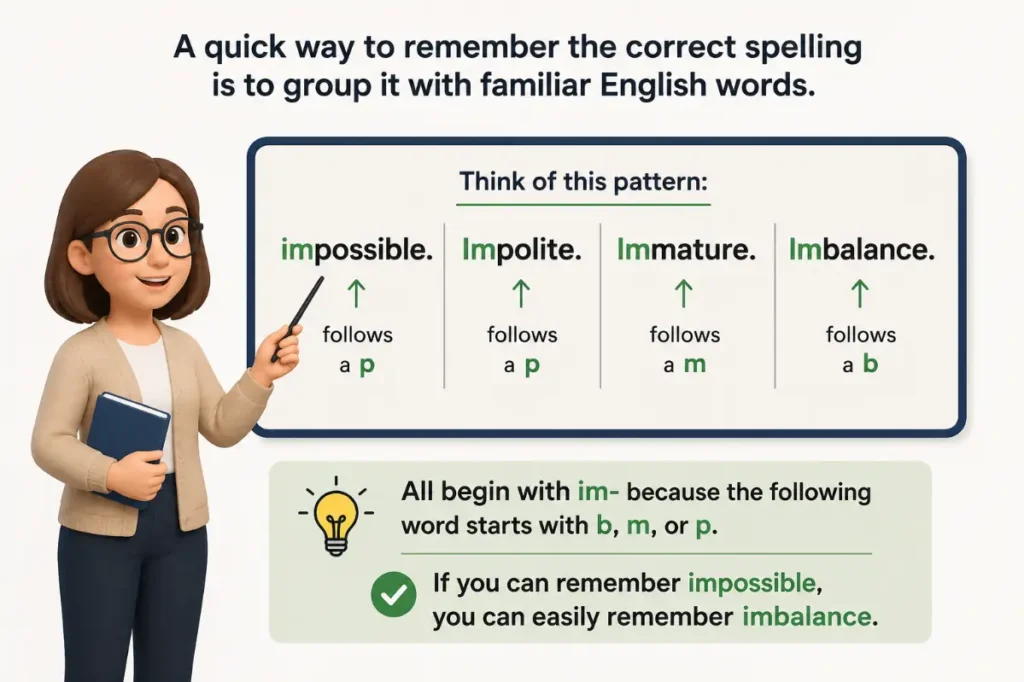
A quick way to remember the correct spelling is to group it with familiar English words.
Think of this pattern:
- Impossible.
- Impolite.
- Immature.
- Imbalance.
All begin with im- because the following word starts with b, m, or p. If you can remember impossible, you can easily remember imbalance.
You may also want to read Commit vs Comit Which Spelling Is Correct(2026).
Conclusion
If you’re wondering inbalance or imbalance, the answer is clear. Imbalance is the standard and correct spelling, while inbalance is a common misspelling that should be avoided. The confusion often comes from the way English prefixes change their form in certain words.
The prefix in- commonly changes to im- before words beginning with b, m, or p. This pattern appears in words such as impossible, immature, impolite, and imbalance.
Use imbalance when you’re describing a lack of balance, equal proportion, stability, or harmony. The word is widely used in everyday and formal English, including academic, professional, medical, economic, and journalistic writing. Once you remember the in- to im- spelling pattern, it becomes much easier to avoid the mistake.
Frequently Asked Questions
Is Inbalance a Real English Word?
No. Inbalance isn’t a standard English word. It’s generally treated as a misspelling of imbalance, which means a lack of balance, equality, or stability.
Why Do People Spell Imbalance as Inbalance?
People may use inbalance because in commonly works as a negative prefix in English. However, the prefix changes to im before words beginning with b, m, or p. That’s why imbalance is the correct spelling.
Is Imbalance a Noun or an Adjective?
Imbalance is a noun. It refers to a condition in which something lacks balance or equality. The adjective form is imbalanced.
Is Imbalance Used in British and American English?
Yes. Imbalance is standard in both British and American English. The spelling doesn’t change between these varieties, and inbalance isn’t the standard form.
Can You Use Imbalance in Formal Writing?
Yes. Imbalance works well in both formal and everyday writing. You can use it in academic papers, business reports, journalism, legal writing, and other professional contexts.
What Is the Plural of Imbalance?
The plural of imbalance is imbalances.
Examples:
- Several imbalances were identified during the study.
- The report examined economic imbalances across different regions.
What Is the Opposite of Imbalance?
The most common opposite of imbalance is balance. Depending on the context, equilibrium, stability, or harmony may also express a similar opposite idea.
How Can You Remember the Correct Spelling of Imbalance?
Remember that balance starts with b, so the negative prefix changes from in to im, giving you imbalance. You can also connect it with words such as impossible, immature, and impatient, which follow the same spelling pattern.