
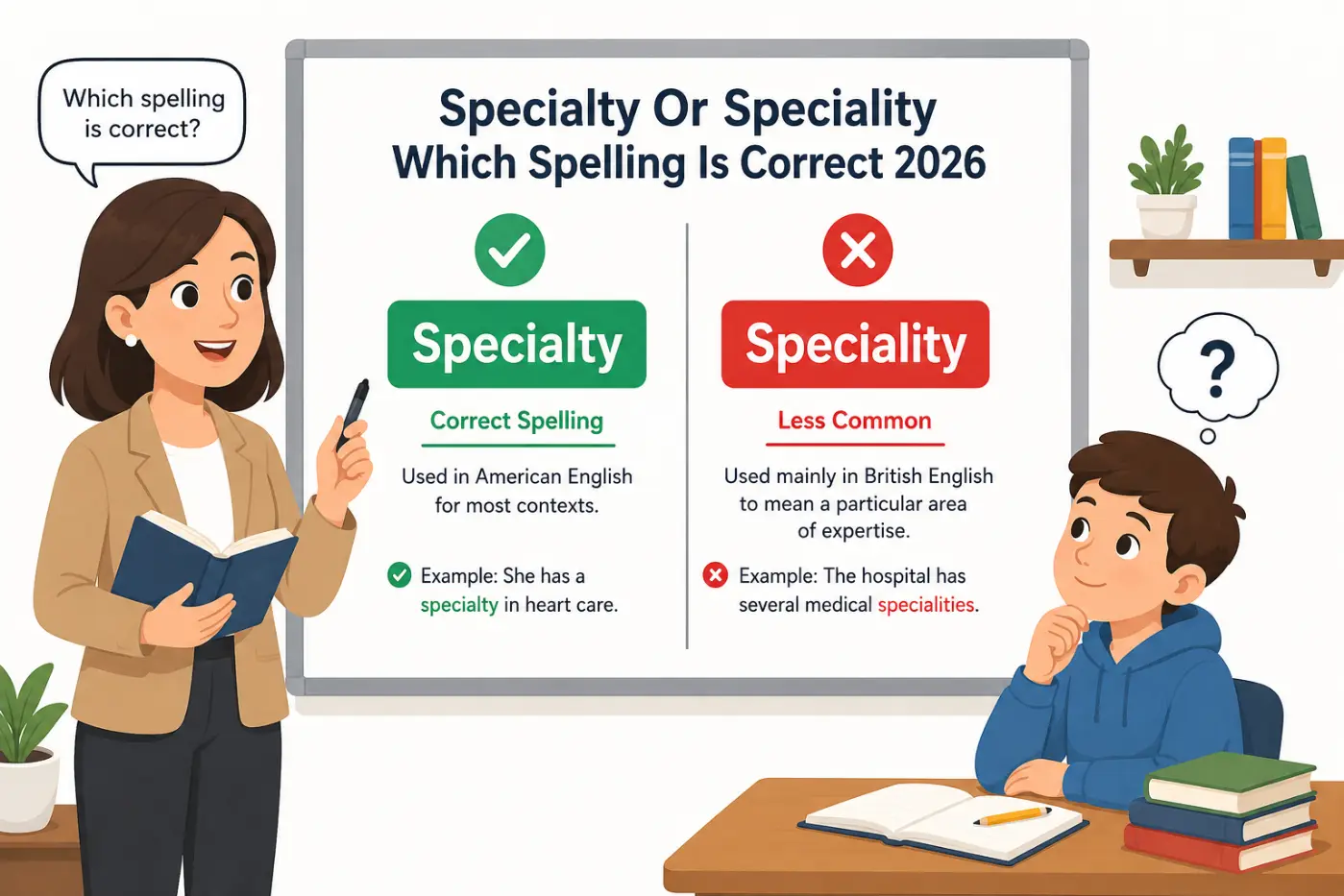
If you’ve ever paused while writing specialty or speciality, you’re not alone. Both spellings appear in dictionaries, books, websites, and professional writing. That makes it easy to wonder if one is wrong or if each has a different meaning.
The confusion exists because English has many words that developed different spellings after American and British English evolved separately. Just like color and colour or center and centre, both forms remain correct in their own regions.
This guide explains the difference between specialty or speciality, shows which spelling fits your audience, explores their history, provides plenty of real examples, and answers the questions people ask most often. By the end, you’ll know exactly which form to choose with confidence.
You may also want to read Dysregulated vs Disregulated Which Spelling Is Correct 2026.
Quick Definition
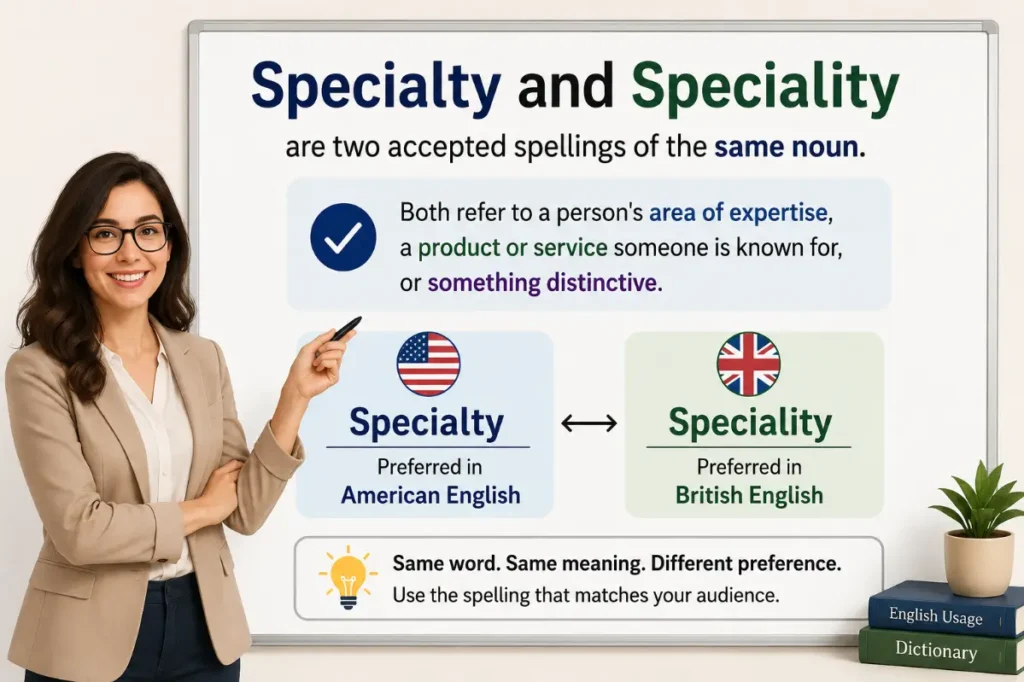
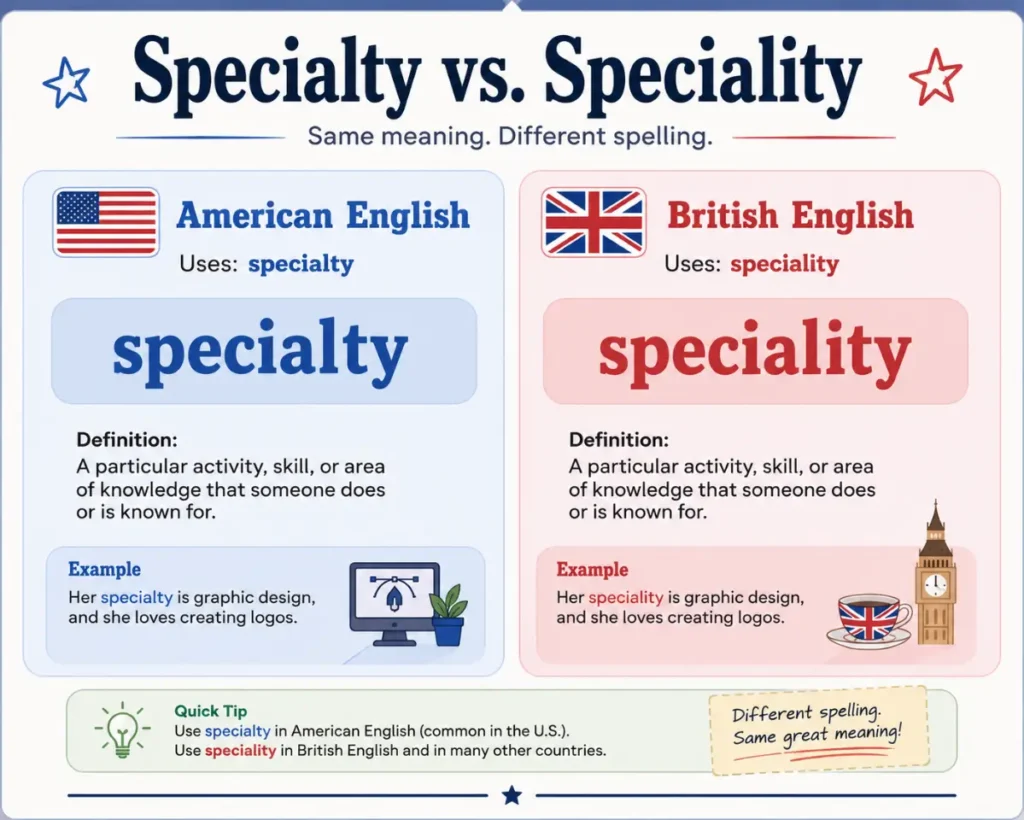
Specialty and speciality are two accepted spellings of the same noun. Both refer to a person’s area of expertise, a product or service someone is known for, or something distinctive. Specialty is preferred in American English, while speciality is generally preferred in British English.
Quick Answer
If you’re writing for an American audience, use specialty. If you’re writing for readers in the United Kingdom or countries that usually follow British English, speciality is often the preferred spelling. Neither spelling changes the meaning. The best choice depends on the variety of English you’re using. Once you choose one spelling, stay consistent throughout your writing.
Specialty Or Speciality Comparison Table
| Feature | Specialty | Speciality |
|---|---|---|
| Correct spelling | Yes | Yes |
| Meaning | Area of expertise or distinctive product | Area of expertise or distinctive product |
| Part of speech | Noun | Noun |
| Origin | From special with the suffix ty | From special with the suffix ity |
| Usage frequency | More common worldwide because of American English | Less common globally but widely accepted |
| Formality | Suitable in all contexts | Suitable in all contexts |
| Most common in | United States | United Kingdom |
| Also used in | Canada in many publications business and healthcare | Australia New Zealand and many British English publications |
| Common contexts | Medicine business education sports restaurants | Medicine business education sports restaurants |
| Example | Cardiology is her specialty. | Cardiology is her speciality. |
Search Intent Analysis
People searching for specialty or speciality are usually trying to answer one simple question. Which spelling should they use? Most readers also want to know if one spelling is incorrect or outdated. Others are curious about regional differences because they write for international audiences or study English as a second language.
The dominant search intent includes:
- Comparing two spellings.
- Finding the correct spelling for a specific audience.
- Understanding the difference in usage.
- Learning pronunciation.
- Seeing real sentence examples.
- Avoiding common writing mistakes.
The good news is that this isn’t a case where one word is correct and the other is wrong. It’s mainly a question of choosing the spelling that matches your readers.
Meaning Of Specialty
Specialty is a noun that describes something a person or organization does especially well. It can also refer to a product, service, subject, or field that receives particular attention. You’ll often hear this spelling in the United States in everyday conversation, newspapers, academic writing, healthcare, business, and advertising.
For example:
- Baking artisan bread is her specialty.
- The restaurant’s specialty is homemade pasta.
- His medical specialty is orthopedic surgery.
- Customer service has become the company’s specialty.
- Marine biology is her academic specialty.
The word often suggests expertise developed through experience, education, or practice. It highlights something that stands out from everything else.
Meaning Of Speciality
Speciality carries exactly the same meaning as specialty. The only meaningful difference is regional spelling. British English dictionaries commonly list speciality as the preferred form. Readers in the United Kingdom usually expect to see this version in newspapers, books, schools, universities, and many professional publications.
Examples include:
- Her speciality is environmental law.
- The bakery’s speciality is sourdough bread.
- Children’s literature became his speciality.
- The clinic has a speciality department for heart care.
- Local seafood is the restaurant’s speciality.
Someone familiar with British English will usually see nothing unusual about this spelling. It feels just as natural as specialty does to American readers.
Specialty Or Speciality Meaning And Usage
Since both spellings share the same definition, understanding how they’re used matters more than memorizing differences. The word commonly refers to one of several ideas.
An Area Of Expertise
This is the most common meaning. Examples include medicine, engineering, law, education, science, sports, and countless other professions.
Examples:
- Pediatrics became her specialty after years of training.
- Tax law is his speciality.
A Signature Product
Businesses often describe a product as their specialty or speciality.
Examples:
- Fresh seafood is the restaurant’s specialty.
- Handmade chocolates are the bakery’s speciality.
A Distinctive Skill
Sometimes the word simply highlights something someone consistently does well.
Examples:
- Solving difficult problems is her specialty.
- Creative storytelling has always been his speciality.
In every case, the meaning stays the same regardless of spelling.
Specialty Or Speciality Key Differences
Although the meanings match, a few practical differences help you choose the right spelling.
Regional Preference
American English strongly favors specialty. British English generally prefers speciality.
Publishing Standards
American publishers, universities, newspapers, businesses, and government organizations almost always use specialty. British publishers typically use speciality, although specialty appears occasionally in international contexts.
Reader Expectations
Using the spelling your audience expects makes your writing feel natural. An American reader rarely questions specialty. A British reader is more accustomed to seeing speciality.
Dictionaries
Modern dictionaries recognize both spellings as correct. Some American dictionaries list speciality as a British variant. British dictionaries often list specialty as an accepted American variant.
Meaning
There is no difference in meaning. Both words describe expertise, a distinctive quality, or something someone is especially known for.
Specialty Or Speciality Which One Is Correct
The most accurate answer is that both are correct.
Choose specialty if you’re writing for:
- American readers.
- American schools.
- American businesses.
- American websites.
- Most international audiences that follow American English.
Choose speciality if you’re writing for:
- British readers.
- British publishers.
- Organizations that follow British English.
- Schools using British spelling standards.
- Publications based in the United Kingdom.
If your audience includes readers from several countries, consistency matters more than the spelling itself. Switching back and forth within the same article makes writing look careless.
Why American English Prefers Specialty
American English gradually simplified many spellings during the nineteenth century. Although specialty wasn’t created overnight, it became the dominant American preference because it aligned with broader spelling trends. Today, you’ll find specialty throughout American dictionaries, university websites, healthcare organizations, government publications, newspapers, and major style guides. It’s also the spelling most Americans naturally write without thinking twice.
Why British English Uses Speciality
British English preserved speciality because it reflects an older spelling tradition connected with similar nouns ending in ity. That pattern appears in many familiar English words.
- Ability.
- Activity.
- Equality.
- Humanity.
- Identity.
Because of that historical pattern, speciality feels perfectly natural to many British writers. Modern British publications still use it regularly, although specialty appears more often than it did several decades ago because of international communication and American influence.
Do Dictionaries Accept Both Spellings
Yes. Major English dictionaries recognize both spellings. Most dictionaries also explain that the preferred spelling depends on the variety of English being used rather than any difference in meaning. This agreement among respected dictionaries is one reason language experts treat the two forms as regional variants instead of separate words.
Still confused? Compare publically or publicly: Correct Spelling and Usage Guide.
How Professional Editors Choose The Right Spelling
Professional editors rarely ask which spelling is better. Instead, they ask who will read the content. An editor preparing a website for customers in New York will almost always choose specialty. An editor working on a magazine published in London will usually choose speciality. That decision isn’t about correctness. It’s about meeting reader expectations and maintaining consistency across every page. Consistency builds trust. Readers notice when spellings change without reason, especially in professional writing.
Specialty Or Speciality Examples In Sentences
Reading real examples is one of the fastest ways to remember the difference between specialty and speciality. Notice that the meaning stays the same in every sentence. Only the preferred regional spelling changes.
Examples Using Specialty
- Her specialty is pediatric medicine.
- The chef’s specialty is grilled salmon with herbs.
- Customer support has become our company’s specialty.
- He chose cardiology as his medical specialty.
- Photography isn’t my specialty, but I’m learning quickly.
- The bakery’s specialty is fresh cinnamon rolls.
- Data analysis has always been her specialty.
- Their specialty coffee attracts customers from across the city.
- Crisis management became his specialty after years of experience.
- That museum’s specialty is local history.
Examples Using Speciality
- Her speciality is family law.
- The restaurant’s speciality is homemade seafood soup.
- Wildlife photography became his speciality after years of travel.
- The clinic has a speciality unit for heart patients.
- Engineering has always been her favourite speciality.
- The bakery’s speciality is traditional fruit cake.
- His academic speciality is medieval literature.
- The hotel’s speciality breakfast is popular with visitors.
- Their speciality products are shipped around the world.
- Marine conservation became her research speciality.
Common Mistakes With Specialty Or Speciality
Even though both spellings are correct, writers still make mistakes. Most problems come from mixing regional styles instead of choosing the wrong word.
Mixing American And British English
This is the most common mistake.
For example:
Incorrect.
Our company’s specialty products are famous across Britain, and each speciality item is handmade.
Correct.
Our company’s specialty products are famous across America.
Assuming One Spelling Is Wrong
Many people think speciality is a misspelling because they grew up using specialty. Others believe the opposite because they learned British English. In reality, both forms appear in respected dictionaries and professional publications.
Using The Wrong Regional Style
If you’re writing for an American university, specialty is usually the better choice. If you’re writing for a British newspaper, speciality fits the expected style. Matching your audience makes your writing feel polished.
Confusing It With Similar Words
Some writers accidentally replace specialty with words like: Specialty or speciality Which spelling is correct Learn the difference meanings pronunciation examples grammar rules regional usage and expert writing tips. These words are related, but they don’t always mean exactly the same thing.
For example, specialization usually refers to the process of becoming an expert, while specialty often refers to the field itself.
Specialty Or Speciality Pronunciation Guide
One interesting fact surprises many learners. Although the spellings differ, the pronunciation is almost identical.
IPA Pronunciation
Specialty.
/ˈspɛʃəlti/
Speciality.
/ˌspɛʃiˈælɪti/ or /ˌspɛʃəˈælɪti/ depending on accent.
Syllable Breakdown
Specialty.
Spe cial ty.
Speciality.
Spe ci al i ty.
British speakers often pronounce every syllable more clearly, while many American speakers naturally shorten the middle sounds.
Common Pronunciation Mistakes
- Adding extra emphasis to the final syllable.
- Pronouncing every letter in specialty separately.
- Skipping important syllables in speciality.
- Confusing it with specialist.
- Stressing the wrong syllable.
Listening to native speakers from your target region is the easiest way to develop natural pronunciation.
Specialty Or Speciality Etymology And Word Origin
The history of these spellings explains why both still exist today. Both words ultimately trace back to the Latin word specialis, meaning particular or individual. From Latin, the word entered Old French before becoming part of Middle English through special. Over time, English developed several noun endings that expressed qualities, conditions, or areas of expertise. One path produced specialty. Another produced speciality. As British and American English gradually evolved into distinct written standards, each spelling became more popular in different regions. Neither spelling replaced the other completely. Instead, both survived and became accepted regional variants.
This pattern appears in many English words.
- Color and colour.
- Honor and honour.
- Theater and theatre.
- Center and centre.
- Flavor and flavour.
The difference reflects spelling traditions rather than meaning.
Specialty Or Speciality Regional Usage
Regional spelling is the biggest difference between these two forms.
American English
American English strongly prefers specialty.
You’ll see it in:
- Medical journals.
- University websites.
- Government publications.
- Business websites.
- Newspapers.
- Marketing materials.
- Restaurant menus.
Finding speciality in American publications is unusual.
British English
British English traditionally prefers speciality.
Common places include:
- Newspapers.
- Schools.
- Universities.
- Government organizations.
- Publishing houses.
- Restaurant menus.
British readers recognize specialty, but speciality usually feels more familiar.
Australian English
Australian English generally follows British spelling conventions. Because of that, speciality appears more often. American spelling has become more common online, so both versions are visible.
Canadian English
Canadian English often blends British and American spelling traditions. Many Canadian organizations use specialty, especially in healthcare and business. Others continue using speciality, particularly in publications following British editorial standards. Editors usually follow their organization’s style guide rather than choosing randomly.
Specialty Or Speciality Grammar Rules
Understanding the grammar behind these words makes them easier to use correctly.
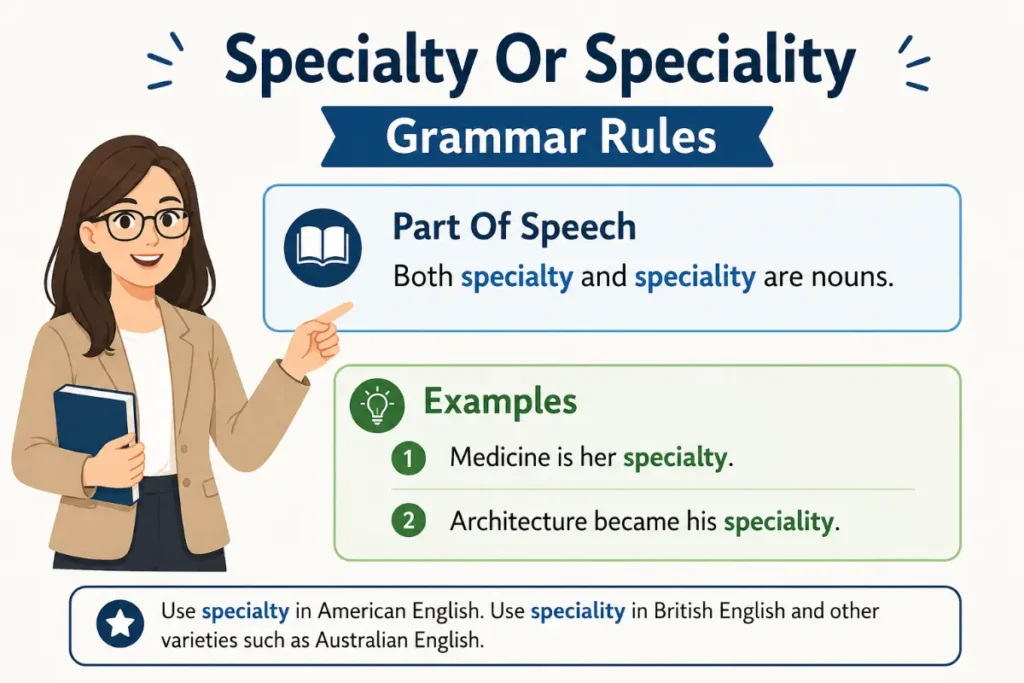
Part Of Speech
Both specialty and speciality are nouns.
Examples.
Medicine is her specialty.
Architecture became his speciality.
Singular Form
The singular form refers to one area of expertise.
Examples.
His specialty is finance.
Her speciality is genetics.
Plural Form
The plural forms are:
Specialties.
Specialities.
Examples.
The hospital offers several medical specialties.
The university provides many academic specialities.
Common Sentence Structures
Both spellings commonly appear after linking verbs.
Examples.
Her specialty is surgery.
His speciality is mathematics.
They also appear after possessive nouns.
Examples.
The doctor’s specialty.
The doctor’s speciality.
They frequently follow descriptive adjectives.
Examples.
A medical specialty.
A medical speciality.
An unusual specialty.
An unusual speciality.
Real Life Usage Examples
Seeing the word in everyday situations helps you understand how naturally it fits different kinds of writing.
Daily Conversation
- Cooking Italian food is my specialty.
- Her speciality is decorating small apartments.
- That’s not really my specialty.
- Ask Sarah because that’s her speciality.
- Everyone knows his specialty is barbecue.
Academic Writing
- She completed her specialty training in emergency medicine.
- His speciality research focuses on renewable energy.
- Students select a specialty after completing the core program.
- The professor’s speciality attracted international recognition.
- Each specialty requires different qualifications.
Professional Communication
- Our specialty services help businesses reduce costs.
- This speciality department handles complex legal cases.
- The company’s specialty products continue growing in popularity.
- Her speciality experience impressed the hiring manager.
- The hospital expanded its specialty care program.
Literature
Authors often use the word to describe characters with exceptional abilities or distinctive talents.
Example.
The detective’s specialty was solving impossible mysteries before sunrise.
Media
Journalists regularly use the word when discussing healthcare, education, sports, restaurants, science, and business. Examples include headlines about medical specialties, restaurant specialties, and athletes known for a particular specialty.
Specialty Or Speciality Related Words And Confused Terms
Several related words appear alongside specialty and speciality. Understanding the differences helps you choose the most precise word.
Expertise
Expertise refers to advanced knowledge or skill gained through experience.
Example. Her expertise in cybersecurity made her the obvious choice.
Specialization
Specialization describes the process of focusing on one subject or profession.
Example. Medical specialization usually requires additional training.
Specialist
A specialist is a person with advanced knowledge in a specific field.
Example. You should consult a heart specialist.
Profession
A profession is a person’s career or occupation.
Example. Teaching is a respected profession.
Field
A field refers to a broad area of study or work.
Example. Artificial intelligence is a rapidly growing field.
Discipline
A discipline is an organized branch of knowledge.
Example. Economics is an important academic discipline.
Niche
A niche usually describes a specialized market or area of focus.
Example. The company found a profitable niche in eco friendly packaging.
Forte
Forte describes something someone does exceptionally well. Example. Public speaking is her forte. Each of these words overlaps slightly with specialty, but none replaces it perfectly in every context. Specialty Or Speciality Expert Language Insight Professional editors rarely think about specialty or speciality as a grammar problem. They see it as a style choice.
Editors also look at the audience before making a decision.
- Writing for the United States. Use specialty.
- Writing for the United Kingdom. Use speciality.
- Writing for an international audience that follows American English. Use specialty.
- Following a company’s style guide. Use the spelling required by that guide.
Consistency makes writing look polished and professional. Readers may not consciously notice the spelling, but they’ll notice when it changes halfway through an article. Another point worth remembering is that search engines understand both spellings. Modern search algorithms recognize them as regional variants. That means you don’t need to force both versions into every paragraph. Use the spelling that fits your audience naturally. If you’re writing a comparison article like this one, mentioning both forms is appropriate because readers are specifically looking for the difference.
When To Use Specialty
Choose specialty in these situations.
- You’re writing for an American audience.
- Your website follows American English.
- Your business operates mainly in the United States.
- Your school or university requires American spelling.
- Your company’s editorial style guide recommends American English.
Examples.
- Emergency medicine is her specialty.
- Our specialty products are available nationwide.
- The restaurant’s specialty changes every weekend.
- His specialty training took five years.
- That software company’s specialty is cybersecurity.
When To Use Speciality
Choose speciality in these situations.
- You’re writing for readers in the United Kingdom.
- Your publication follows British English.
- Your organization uses British spelling.
- Your educational institution requires British English.
- Your audience expects British editorial standards.
Examples.
- Her speciality is marine biology.
- The bakery’s speciality is handmade pastries.
- His medical speciality requires years of additional study.
- The hotel’s speciality breakfast attracts many visitors.
- Their speciality department handles complex cases.
Quick Tips To Remember
Remembering the difference doesn’t have to be difficult.
- Think of specialty as the American spelling.
- Think of speciality as the British spelling.
- The meaning stays the same.
- Match your audience instead of guessing.
- Stay consistent throughout your document.
If you can remember the difference between color and colour, you can remember specialty and speciality just as easily.
Need another quick comparison? Read Stich Vs Stitch Which Spelling Is Correct in 2026?.
Conclusion
Choosing between specialty or speciality is much easier once you know the reason both spellings exist. Neither word is incorrect, and neither carries a different meaning. The only real difference is the variety of English you’re using.
If your audience is in the United States, specialty is the natural choice. If you’re writing for readers in the United Kingdom or other regions that follow British English, speciality is usually the better fit. The most important rule isn’t choosing one spelling over the other. It’s staying consistent. Mixing American and British spellings in the same document can make even well written content feel unpolished.
Frequently Asked Question
Is specialty or speciality correct?
Both are correct. Specialty is the preferred spelling in American English, while speciality is usually preferred in British English. They have the same meaning, so your choice should match the variety of English you’re using.
Which spelling is more common worldwide?
Specialty appears more frequently in global online content because American English has a strong influence on business, education, technology, and digital publishing. Speciality remains common in countries that follow British English spelling conventions.
Do specialty and speciality have different meanings?
No. Both words describe an area of expertise, a distinctive product, or something a person or organization is especially known for. The difference is regional spelling rather than meaning or grammar.
Which spelling should I use for American readers?
Use specialty. It’s the standard spelling in American English and appears in newspapers, universities, businesses, government publications, and most professional writing across the United States.
Which spelling should I use for British readers?
Use speciality. British readers are more familiar with this spelling because it’s widely used in UK publishing, education, healthcare, and professional communication.
How do you pronounce specialty and speciality?
The pronunciation is very similar. Regional accents may change the rhythm slightly, but native speakers generally recognize both words without confusion. The spelling difference doesn’t create a major pronunciation difference in everyday conversation.
Can I use both spellings in the same article?
It’s best not to. Pick the spelling that matches your audience and use it consistently throughout your writing. Consistency improves readability and gives your content a more professional appearance.
Do dictionaries recognize both specialty and speciality?
Yes. Major English dictionaries include both spellings. Most also explain that specialty is the preferred American form and speciality is the preferred British form.