
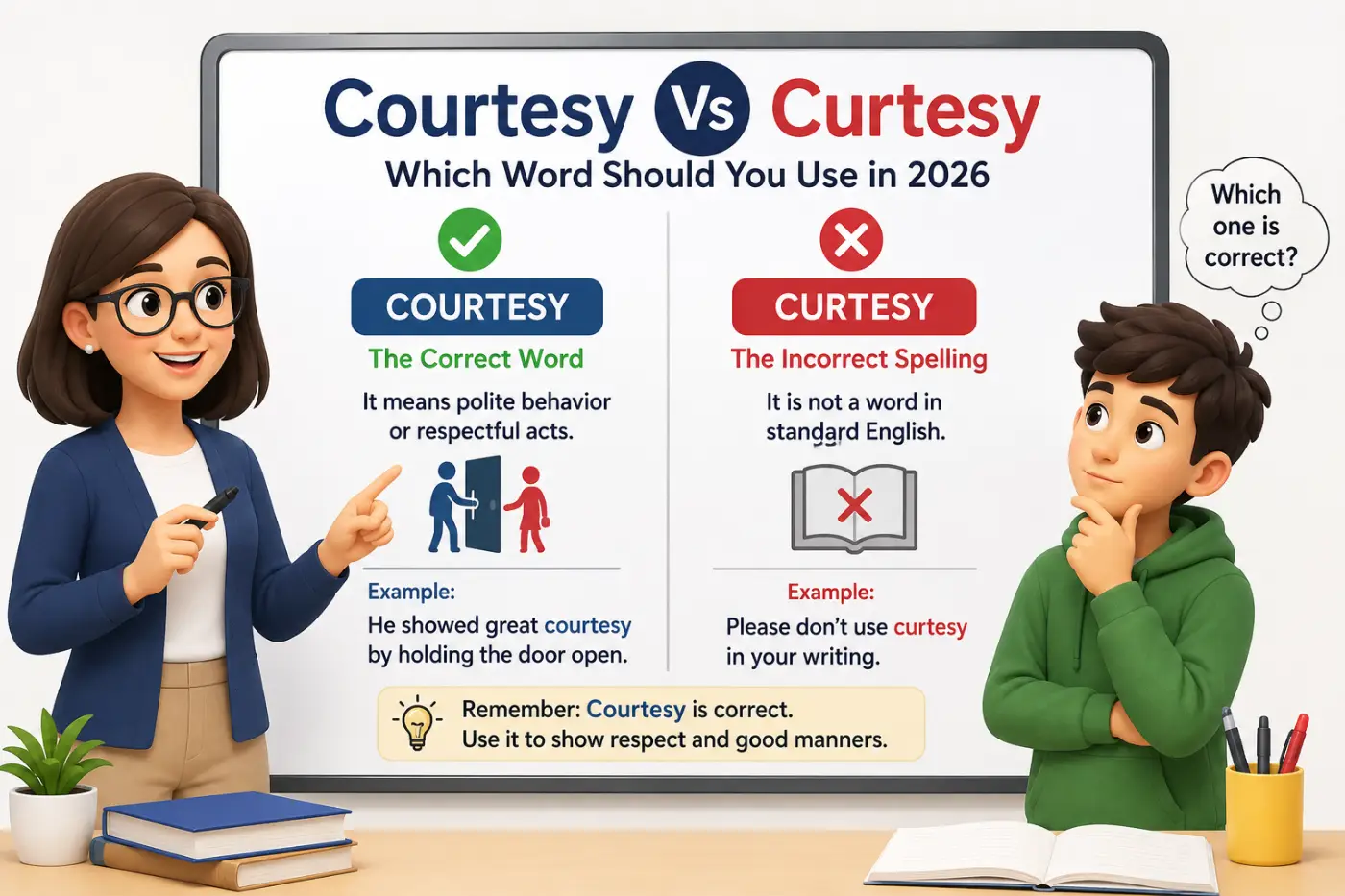
Courtesy vs curtesy is a comparison that catches many English learners and even experienced writers off guard. At first glance, the two words look almost identical. Change one letter, and you have a completely different word with a completely different history.
The short answer is simple. Courtesy is the word you need in almost every modern conversation and piece of writing. It refers to politeness, respect, good manners, or a thoughtful act. Curtesy, on the other hand, is a rare legal term from historical English law. Outside legal history, most people never use it.
The confusion happens because the words share similar spelling and pronunciation. Spell checkers, quick typing, and unfamiliarity with the legal term add to the mix. Many people assume curtesy is just a misspelling of courtesy, but that is not always true. This guide explains what each word means, how they developed over time, when each one is appropriate, and why choosing the right spelling makes your writing clearer and more professional.
Need another quick comparison? Read Leary or Leery Which Word Is Correct in 2026.
Quick Definition
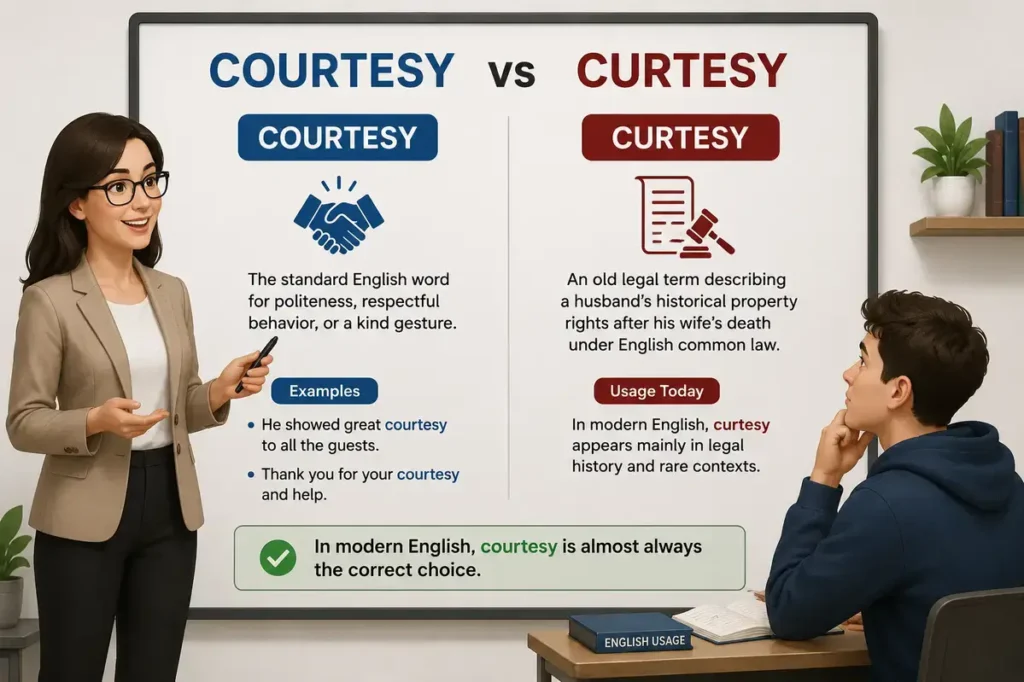
Courtesy is the standard English word for politeness, respectful behavior, or a kind gesture. Curtesy is an old legal term describing a husband’s historical property rights after his wife’s death under English common law. In modern English, courtesy is almost always the correct choice, while curtesy appears mainly in legal history.
Quick Answer
If you are writing about good manners, kindness, respect, or polite behavior, use courtesy. Use curtesy only when discussing historical property law or legal history. For nearly every email, essay, article, conversation, or business document, courtesy is the correct word.
Courtesy Vs Curtesy Comparison Table
| Feature | Courtesy | Curtesy |
|---|---|---|
| Correct modern everyday form | Yes | No for everyday writing |
| Meaning | Politeness kindness respectful behavior | Historical legal right of a husband to inherit a life interest in his wife’s land |
| Part of speech | Noun | Noun |
| Origin | Old French and Latin | Medieval English legal terminology |
| Usage frequency | Extremely common | Very rare |
| Formality | Suitable in every style of writing | Limited to legal and historical discussions |
| Common contexts | Good manners customer service professional communication social etiquette | Legal textbooks historical law academic research |
| Example | Thank you for your courtesy. | The judge discussed the doctrine of curtesy. |
Meaning Of Courtesy
Courtesy is one of the most common words associated with good manners and respectful behavior. It describes the way people treat others with kindness, consideration, and respect. The word can also describe a thoughtful action done to help someone or make life easier.
For example.
- She thanked the receptionist for his courtesy.
- Common courtesy means holding the door for someone carrying heavy bags.
- The company handled every complaint with courtesy and professionalism.
Courtesy appears in every kind of English.
- Everyday conversations.
- Business communication.
- Customer service.
- Schools and universities.
- Government organizations.
- Literature.
- News articles.
The word often appears in common expressions such as:
- Courtesy call.
- Courtesy copy.
- Courtesy notice.
- Courtesy car.
- Courtesy seat.
- Common courtesy.
Etymology Of Courtesy
Courtesy comes from the Old French word courtoisie, meaning refined behavior expected in a royal court. It ultimately traces back to the Latin word cohors, meaning court or enclosed place. Over time, the meaning expanded from noble manners to polite behavior shown by anyone. Today, courtesy is no longer connected only with royal courts. It simply means treating people with respect and consideration.
Meaning Of Curtesy
Curtesy is a genuine English word, but it belongs almost entirely to legal history. Under traditional English common law, curtesy referred to a husband’s right to enjoy his deceased wife’s inherited land during his lifetime, provided certain legal conditions had been met. The full legal expression was often called tenancy by the curtesy.
Although the doctrine played an important role centuries ago, most English speaking countries have abolished or replaced it through modern inheritance laws.
Today, you will mainly find curtesy in:
- Historical law books.
- Legal dictionaries.
- Academic research.
- University law courses.
- Discussions of English common law.
Outside these settings, the average English speaker may never encounter the word.
Etymology Of Curtesy
The exact origin of curtesy remains debated among language historians. It developed within medieval English law and became established as a technical legal term. Unlike courtesy, its meaning never expanded into everyday language. That explains why modern dictionaries classify it as a specialized legal word rather than a common English vocabulary item.
Courtesy Vs Curtesy Key Differences
Although only one letter separates these words, their meanings belong to completely different worlds.
Meaning
- Courtesy means politeness, kindness, respect, or considerate behavior.
- Curtesy refers to a historical legal right connected with inheritance.
Tone
- Courtesy sounds warm, friendly, and professional.
- Curtesy sounds formal, technical, and historical.
Grammar
- Both words are nouns.
- They cannot replace each other because they describe different concepts.
Context
- Courtesy belongs in everyday English.
- Curtesy belongs in discussions of legal history.
Frequency
- Courtesy appears millions of times in books, websites, newspapers, and conversations.
- Curtesy is rare and mostly limited to legal references.
Modern Relevance
- Courtesy remains an essential part of modern English.
- Curtesy survives mainly as a historical legal term.
Courtesy Vs Curtesy Which One Is Correct
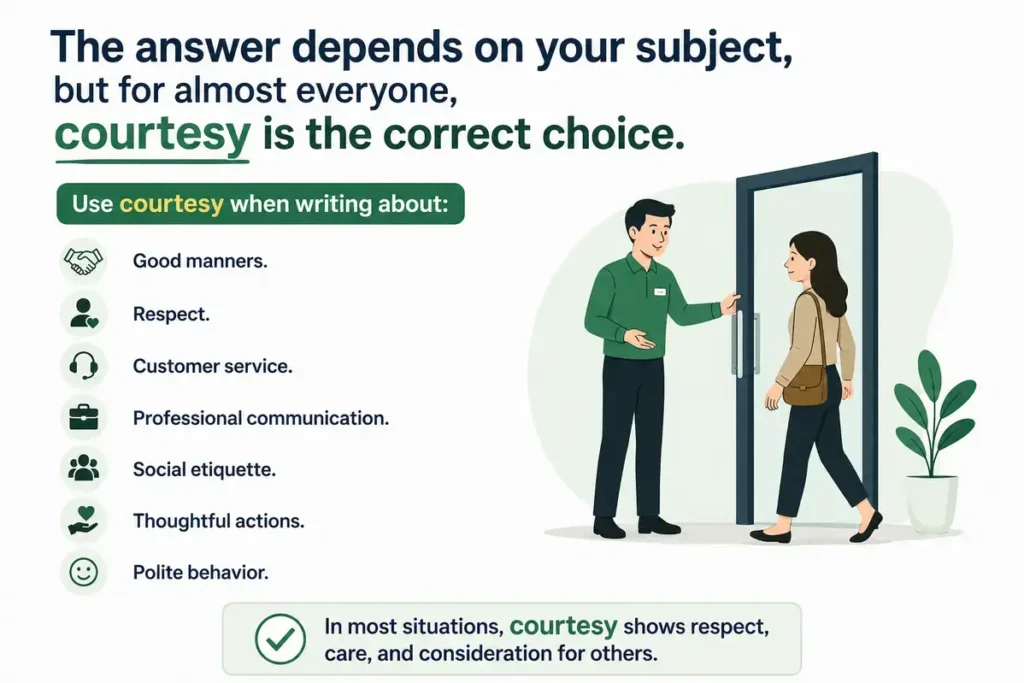
The answer depends on your subject, but for almost everyone, courtesy is the correct choice.
Use courtesy when writing about:
- Good manners.
- Respect.
- Customer service.
- Professional communication.
- Social etiquette.
- Thoughtful actions.
- Polite behavior.
Use curtesy only if you are discussing medieval English law, inheritance law, or the historical doctrine known as tenancy by the curtesy.
As an editor, one mistake appears more than almost any other. Writers accidentally type curtesy instead of courtesy because the words look so similar. In nearly every article, email, report, or school assignment, that spelling is an error. Unless your topic is legal history, replacing curtesy with courtesy is almost always the right decision.
A simple memory trick can help.
- Courtesy contains court, reminding you of polite behavior once associated with royal courts.
- Curtesy belongs to the courtroom of history, not modern everyday English.
That distinction makes choosing the correct word much easier.
Courtesy Vs Curtesy Examples In Sentences
Seeing both words in real sentences makes the difference much easier to remember.
Courtesy Examples
- She thanked the waiter for his courtesy and patience.
- A little courtesy can brighten someone’s day.
- The receptionist greeted every visitor with courtesy.
- He showed great courtesy during the meeting.
- Please extend the same courtesy to your coworkers.
- The airline offered a courtesy upgrade after the delay.
- Out of courtesy, she arrived a few minutes early.
- They treated every customer with courtesy and respect.
- Common courtesy includes saying please and thank you.
- His courtesy earned him the trust of the entire team.
Curtesy Examples
- The professor explained the legal doctrine of curtesy in class.
- The old property dispute involved the law of curtesy.
- The textbook compared dower with curtesy.
- Curtesy gave certain husbands limited rights to inherited land.
- Many countries abolished the doctrine of curtesy long ago.
- The lawyer mentioned curtesy while discussing medieval inheritance law.
- The judge referred to historical rules of curtesy.
- Researchers examined how curtesy influenced property law.
- The legal archive contained several references to curtesy.
- Students learned that curtesy is rarely used outside historical legal discussions.
Many readers also check begun or began The Simple Grammar Rule 2026.
Courtesy Vs Curtesy Common Mistakes
These words cause confusion for several reasons. Knowing the most common mistakes can help you avoid them.
Mistake One
Using curtesy when you mean politeness.
Incorrect.
The staff treated every guest with curtesy.
Correct.
The staff treated every guest with courtesy.
Mistake Two
Assuming curtesy is always a misspelling. That is not completely true. Curtesy is a legitimate English word, but it belongs to legal history. Calling it a spelling mistake in every situation is inaccurate.
Mistake Three
Thinking the words have similar meanings. They do not. Courtesy relates to manners and respect. Curtesy refers to an old legal concept involving property rights.
Mistake Four
Relying only on pronunciation. The words sound similar enough that many people choose the wrong spelling while typing quickly. Always check the meaning before deciding which word fits your sentence.
Courtesy Vs Curtesy Pronunciation Guide
Although the spellings are similar, careful pronunciation can help you recognize each word.
Courtesy
IPA
British English.
/ˈkɜː.tə.si/
American English.
/ˈkɝː.t̬ə.si/
Syllable breakdown.
Cour.
te.
sy.
Common pronunciation mistake.
Some learners place too much stress on the second syllable. Native speakers place the primary stress on the first syllable.
Curtesy
IPA.
/ˈkɝː.tə.si/
Syllable breakdown.
Cur.
te.
sy.
Common pronunciation mistake.
Many speakers pronounce it exactly like courtesy. Since curtesy appears so rarely in everyday speech, pronunciation differences are usually less important than understanding its specialized meaning.
Courtesy Vs Curtesy Etymology And Word Origin
Word origins often explain why similar spellings developed different meanings.
Courtesy
Courtesy comes from Old French courtoisie, meaning the refined manners expected at a royal court. That word developed from courteis, meaning belonging to the court. As English evolved, the meaning broadened to include polite and respectful behavior shown by anyone, not only members of the nobility. Today, courtesy represents kindness, consideration, respect, and good manners in every area of life.
Curtesy
Curtesy developed within medieval English common law. It described a husband’s legal right to enjoy his deceased wife’s inherited property during his lifetime if specific legal conditions had been satisfied. Unlike courtesy, curtesy remained a technical legal expression. Its meaning never expanded into everyday English, which explains its limited modern use.
Courtesy Vs Curtesy Regional Usage
Modern English speaking countries treat these words in almost the same way.
American English
Courtesy is the standard word in conversation, education, journalism, and business writing. Curtesy appears almost exclusively in legal history, legal research, and discussions of historical inheritance law.
British English
British English follows the same pattern. Courtesy is widely used every day, while curtesy survives mainly in historical legal contexts because it originated in English common law.
Canadian English
Canadian English strongly favors courtesy in everyday communication. Curtesy appears only in historical or legal references.
Australian English
Australian English also uses courtesy as the standard spelling for polite behavior. Curtesy is limited to legal scholarship and historical documents.
Across all major English varieties, there is no regional preference that makes curtesy an everyday alternative to courtesy.
Courtesy Vs Curtesy Grammar Rules
Understanding the grammar behind these words helps you use them correctly every time.
Parts Of Speech
- Courtesy is a noun.
- Curtesy is also a noun.
Countability
Courtesy is usually an uncountable noun when referring to politeness.
Example.
She treated everyone with courtesy.
It can also function as a countable noun when referring to a specific polite act.
Example.
The complimentary tickets were a courtesy from the organizer.
Curtesy is generally treated as a countable legal noun because it refers to a specific legal doctrine.
Common Structures
Courtesy commonly appears after prepositions.
- With courtesy.
- Out of courtesy.
- As a courtesy.
- By courtesy of.
Curtesy commonly appears in legal expressions such as:
- Tenancy by the curtesy.
- Estate by the curtesy.
- Right of curtesy.
Plural Forms
The plural of courtesy is courtesies.
Example.
The hotel extended several courtesies during our stay.
The plural of curtesy is curtesies, although it is rarely needed because the word itself is uncommon.
Courtesy Vs Curtesy Real Life Usage Examples
The best way to remember the difference is to see how native speakers naturally use each word.
Daily Conversation
- Thank you for your courtesy today.
- Showing courtesy costs nothing but means a lot.
Academic Writing
- Researchers often study courtesy as part of social behavior and communication.
- Curtesy appears in legal history courses that examine medieval English property law.
Professional Communication
- We appreciate your courtesy and prompt response.
- The customer praised the employee’s courtesy throughout the interaction.
Literature
Many novels describe characters who display courtesy through respectful speech, thoughtful actions, and good manners. Historical novels discussing inheritance law may occasionally mention curtesy when explaining property rights.
Media
News reports, company statements, travel guides, and customer service policies regularly use courtesy. References to curtesy usually appear only in documentaries, legal journals, or historical publications.
Courtesy Vs Curtesy Related Words And Confused Terms
Many English words relate to courtesy or resemble it in spelling. Learning them together builds a stronger vocabulary and reduces mistakes.
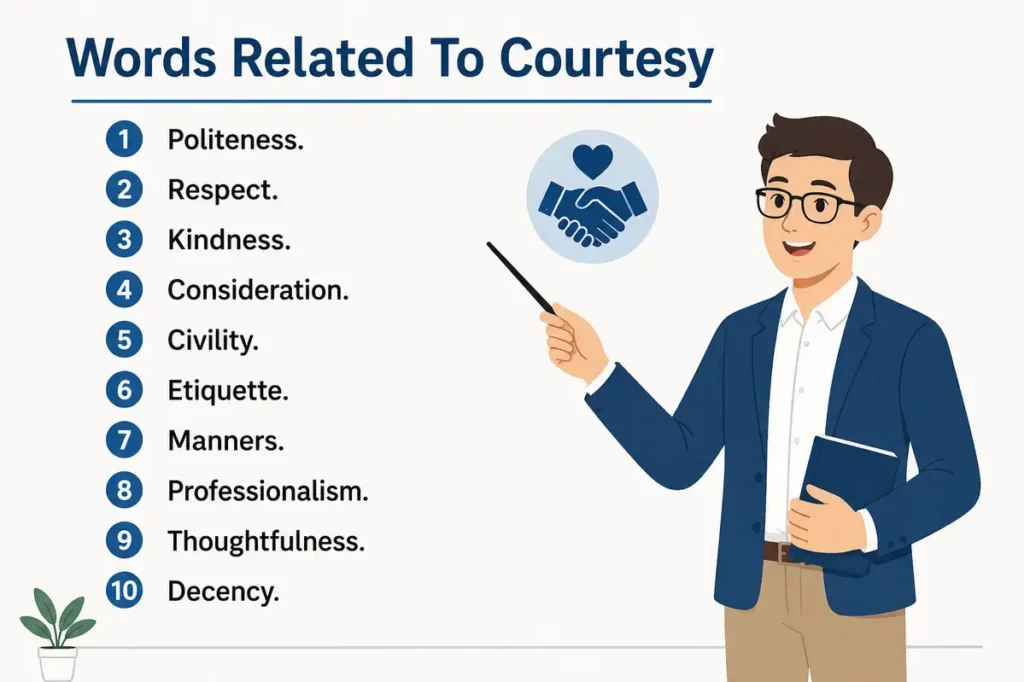
Words Related To Courtesy
- Politeness.
- Respect.
- Kindness.
- Consideration.
- Civility.
- Etiquette.
- Manners.
- Professionalism.
- Thoughtfulness.
- Decency.
These words all describe positive ways people interact with others. Each carries its own shade of meaning, but they share the idea of treating people well.
Words Commonly Confused With Courtesy
- Curtesy.
- Cordiality.
- Courtesyly.
- Courtly.
- Civil.
- Respectful.
Among these, curtesy creates the most confusion because it differs by only one letter. The spelling is real, but its meaning belongs to legal history instead of everyday English.
Words Related To Courtesy
- Politeness.
- Respect.
- Kindness.
- Consideration.
- Civility.
- Etiquette.
- Manners.
- Professionalism.
- Thoughtfulness.
- Decency.
These words all describe positive ways people interact with others. Each carries its own shade of meaning, but they share the idea of treating people well.
Words Commonly Confused With Courtesy
- Curtesy.
- Cordiality.
- Courtesyly.
- Courtly.
- Civil.
- Respectful.
Among these, curtesy creates the most confusion because it differs by only one letter. The spelling is real, but its meaning belongs to legal history instead of everyday English.
Courtesy Vs Curtesy Expert Language Insight
One habit separates confident writers from everyone else. They choose words based on meaning instead of appearance. Courtesy is deeply woven into modern English. Native speakers use it naturally in conversations, emails, customer service, business writing, news articles, and books. It sounds familiar because people encounter it almost every day.
Curtesy is different. Most native speakers never use it outside a law classroom or a historical discussion. In fact, many educated English speakers have never seen the word at all. As an editor, I see writers accidentally type curtesy when they mean courtesy. It usually happens because the fingers move faster than the brain or because spell check misses the mistake. The easiest way to avoid this error is to ask yourself one simple question.
Are you talking about kindness and respect or about medieval property law? If the answer is kindness and respect, the correct spelling is courtesy. If the answer is historical inheritance law, curtesy is the correct legal term. That quick check prevents almost every mistake.
Is Courtesy Or Curtesy Correct?
Courtesy is correct in almost every modern situation involving politeness, respect, or good manners. Curtesy is also a real English word, but it is a specialized legal term connected with historical inheritance law. Unless you are writing about legal history, courtesy is the correct choice.
Learn the difference in Uninclined vs Disinclined Which Word Should You Use? 2026.
Conclusion
The comparison between courtesy vs curtesy becomes simple once you understand the meanings behind the spellings. Courtesy is the standard English word for politeness, respect, kindness, and considerate behavior. It appears every day in conversations, workplaces, schools, customer service, and professional writing.
Curtesy is not a spelling mistake by definition. It is a legitimate legal term with roots in English common law. Today, its use is almost entirely limited to historical and legal discussions. For practical writing, the choice is easy. If you are talking about good manners or respectful behavior, use courtesy. Save curtesy for discussions of historical inheritance law.
Remember the meaning first, and the correct spelling becomes easy to choose every time.
FAQs
Is Courtesy Or Curtesy Correct?
Courtesy is correct in almost every modern situation involving politeness, respect, or good manners. Curtesy is also a real English word, but it is a specialized legal term connected with historical inheritance law. Unless you are writing about legal history, courtesy is the correct choice.
Is Curtesy A Misspelling Of Courtesy?
Not always. Curtesy is an authentic legal word that appears in historical and legal texts. However, when someone intends to write about polite behavior, using curtesy is usually a spelling mistake.
What Does Courtesy Mean?
Courtesy means showing politeness, respect, kindness, and consideration toward other people. It can describe both respectful behavior and thoughtful actions performed to help someone or make a situation more pleasant.
What Does Curtesy Mean?
Curtesy is a historical legal doctrine from English common law. It referred to a husband’s right to enjoy certain property inherited through his deceased wife under specific legal conditions. The term is now largely limited to legal history.
Why Do People Confuse Courtesy And Curtesy?
The words differ by only one letter and sound very similar. Many people assume curtesy is simply another spelling of courtesy. In reality, the words have completely different meanings and belong in different contexts.
Is Curtesy Still Used Today?
Curtesy still appears in legal dictionaries, historical research, and academic discussions of common law. Outside those specialized fields, modern English speakers rarely use the word in everyday communication.
How Can I Remember The Difference Between Courtesy And Curtesy?
Think about the meaning before choosing the spelling. Courtesy relates to politeness and respect. Curtesy belongs to historical property law. If your sentence has nothing to do with legal history, courtesy is almost certainly the correct word.
Can Courtesy Be Used In Formal And Informal Writing?
Yes. Courtesy works naturally in conversations, emails, business communication, academic writing, news articles, and literature. It is one of the most versatile nouns in the English language because it fits almost every level of formality.