
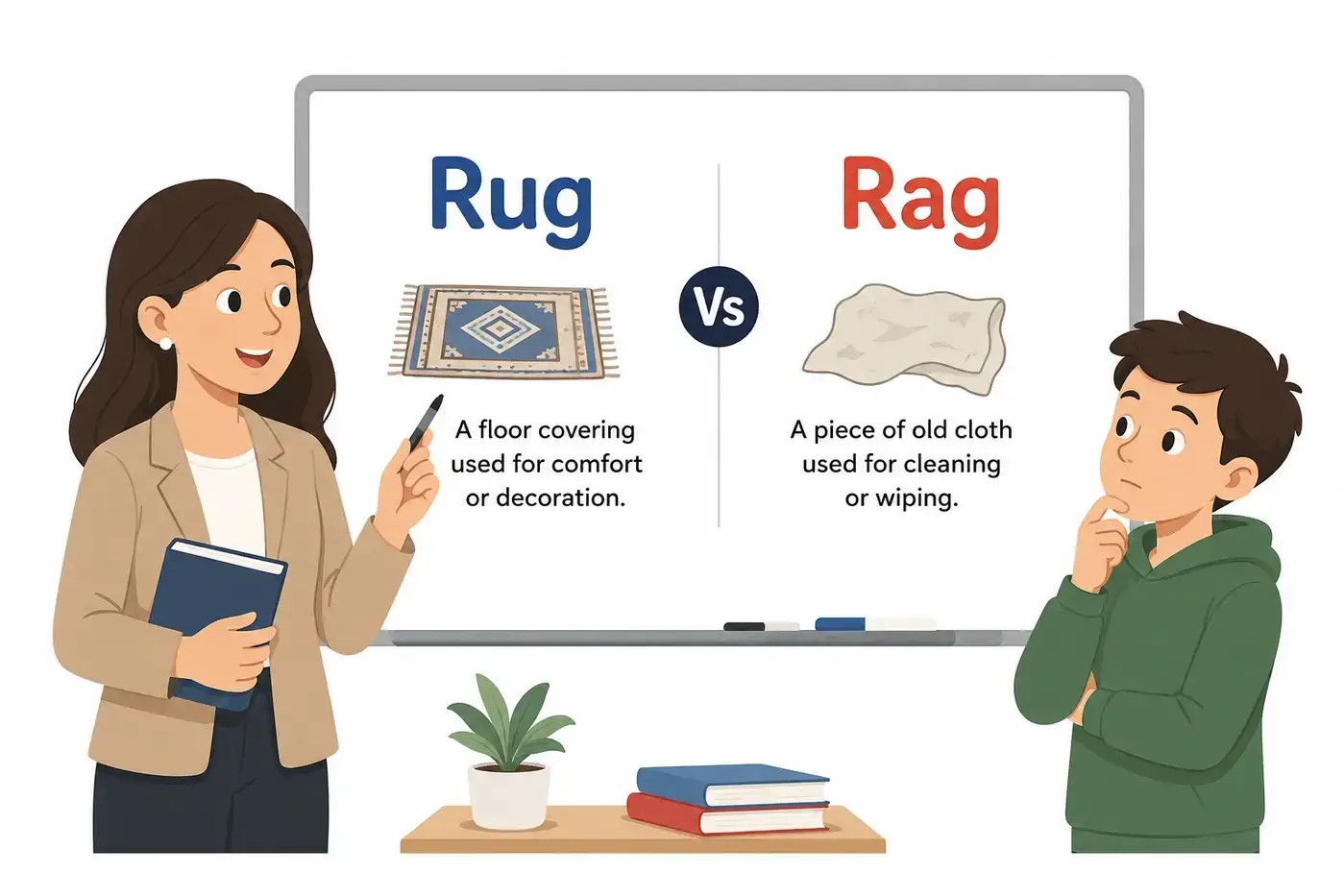
You might have seen rug vs rag while checking your writing, reading a book, or describing something around the house. At first glance, the words look similar because they differ by only one letter. That small spelling difference leads many people to assume they have related meanings. They do not.
A rug is a floor covering that adds comfort, warmth, or decoration to a room. A rag is a piece of old cloth, usually used for cleaning, wiping, polishing, or dusting. They belong to different categories, serve different purposes, and should never replace each other in normal English. The confusion usually happens because both words refer to fabric. Someone learning English may hear them in similar situations around the home and assume they mean the same thing. Fast typing, autocorrect, and unfamiliar vocabulary can also cause mix ups.
This guide explains the meaning of each word, how native speakers use them, their pronunciation, grammar, history, regional usage, and common mistakes. You’ll also find practical examples, expert writing advice, and clear answers to questions people frequently ask. By the end, you’ll know exactly which word fits every situation.
Still confused? Compare half-day vs half day Correct Usage And Meaning.
Quick Definition
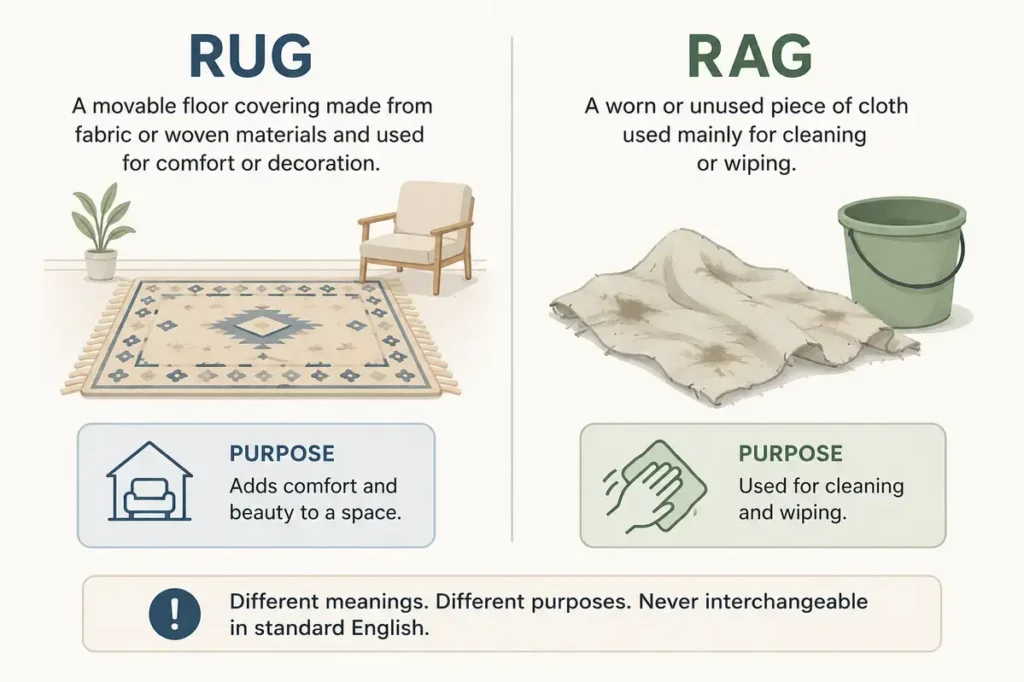
A rug is a movable floor covering made from fabric or woven materials and used for comfort or decoration. A rag is a worn or unused piece of cloth used mainly for cleaning or wiping. The two words have different meanings, different purposes, and are never interchangeable in standard English.
Rug Vs Rag Quick Answer
The correct word depends entirely on what you mean.
If you’re talking about a decorative or functional floor covering, use rug.
If you’re talking about an old piece of cloth used for cleaning, polishing, or wiping surfaces, use rag.
Although both words involve fabric, they describe completely different objects. Native English speakers rarely confuse them because each belongs to its own everyday context.
Rug Vs Rag Comparison Table
| Feature | Rug | Rag |
|---|---|---|
| Correct form | Yes | Yes |
| Meaning | A movable floor covering | A piece of old or unwanted cloth |
| Part of speech | Noun | Noun |
| Main purpose | Decoration comfort warmth | Cleaning wiping polishing |
| Origin | Old Norse and Scandinavian roots | Old English roots |
| Usage frequency | Very common | Very common |
| Formality level | Neutral | Neutral |
| Common contexts | Homes offices hotels interior design | Housekeeping workshops garages painting |
| Typical material | Wool cotton synthetic fibers silk jute | Cotton linen microfiber old clothing |
| Example | The colorful rug brightened the living room. | She cleaned the window with a soft rag. |
Meaning Of Rug
A rug is a piece of thick fabric placed on a floor. Unlike carpet, a rug is movable. You can roll it up, replace it, or move it from one room to another without changing the flooring underneath.
People use rugs for many reasons.
- To make a room more comfortable.
- To protect flooring.
- To reduce noise.
- To add warmth during colder months.
- To improve the appearance of a space.
Rugs come in many materials including wool, cotton, silk, jute, bamboo, and synthetic fibers. Some are handmade works of art, while others are designed for everyday use in busy homes.
Interior designers often choose rugs to define spaces. A large living room, for example, may use one rug beneath a seating area and another beneath a dining table to create visual separation.
Common Examples
- We bought a new rug for the family room.
- The dog loves sleeping on the soft rug.
- She vacuumed the rug before the guests arrived.
- The colorful rug matched the curtains perfectly.
- A handmade wool rug can last for decades with proper care.
Meaning Of Rag
A rag is a piece of cloth that has little value except for practical use. Most rags come from old shirts, towels, sheets, or other fabric items that are no longer suitable for wearing or displaying. People commonly use rags to clean furniture, wash cars, polish metal, wipe spills, remove dust, or apply paint.
Unlike a rug, a rag is rarely decorative. Its purpose is almost always functional. The word can also appear in informal language with different meanings. In some situations, people use rag as a verb meaning to tease someone playfully. In journalism, it has occasionally been used informally to describe a newspaper, though that usage can sound critical or humorous depending on the context.
Common Examples
- Grab a clean rag before you wash the windows.
- He wiped the grease off his hands with a rag.
- The mechanic always keeps several clean rags nearby.
- Use a soft rag to polish the wooden table.
- She turned an old cotton shirt into cleaning rags.
Rug Vs Rag Key Differences
Although the spelling differs by only one letter, the meanings are completely different.
Purpose
A rug improves comfort and appearance.
A rag helps people clean, wipe, polish, or remove dirt.
Condition
A rug is usually new, clean, and intended for display.
A rag is often made from worn or recycled fabric.
Location
A rug stays on the floor.
A rag is stored with cleaning supplies, tools, or household items.
Value
Many rugs are valuable decorative items.
Most rags have little monetary value because they are created from used cloth.
Daily Use
Families walk across rugs every day.
People hold rags in their hands while cleaning.
Which One Is Correct
Both words are correct English nouns. The correct choice depends on the object you’re describing.
Use rug for a movable floor covering.
Use rag for a piece of cloth used mainly for cleaning or wiping.
Professional editors rarely confuse these words because the meanings are completely separate. Most mistakes happen during fast typing or when English learners assume similar spellings always suggest related meanings. English rarely works that way. Tiny spelling differences often signal entirely different ideas.
Pronunciation Guide
Correct pronunciation helps avoid confusion during conversation.
Rug
IPA.
/rʌɡ/
Syllables.
Rug.
The vowel sounds like the one in cup or sun.
Rag
IPA.
/ræɡ/
Syllables.
Rag.
The vowel sounds like the one in cat or apple.
Common Pronunciation Mistakes
Many English learners pronounce both words with the same vowel sound. Native speakers clearly distinguish them. Think of these comparisons.
- Rug rhymes with bug.
- Rag rhymes with bag.
Listening for the middle vowel makes the difference much easier to hear and remember.

Expert Language Insight
After editing thousands of articles, business documents, marketing materials, and academic papers, one pattern appears again and again. Writers almost never confuse these words because they do not understand English. They confuse them because both refer to fabric and appear in everyday household situations.
Experienced editors rely on context before checking spelling. If the sentence talks about decorating a room, comfort, flooring, or interior design, rug is the obvious choice. If the sentence involves wiping, polishing, painting, cleaning, or removing dirt, rag fits naturally.
Native speakers rarely stop to think about this distinction because repeated exposure builds instinct over time. They have seen these words used correctly since childhood in conversations, books, advertisements, product labels, and everyday life.
That habit offers an important lesson for anyone learning English. Instead of memorizing isolated vocabulary lists, connect each word to the situation where people actually use it. Once you picture a cozy living room for rug and a cleaning cloth for rag, the distinction becomes difficult to forget.
Need another quick comparison? Read Theater or Theatre Which Should You Use in 2026.
Etymology And Word Origin
The history of these two words shows that they developed along completely different paths. Their similar spelling is only a coincidence.
Origin Of Rug
The word rug entered English several centuries ago. Language experts trace it to Scandinavian and Old Norse influences, where similar words referred to rough or shaggy coverings. Early English speakers used the term for coarse woolen coverings, blankets, and thick fabrics that provided warmth.
Over time, the meaning became more specific. Instead of describing heavy fabric in general, rug came to mean a movable floor covering. Today, it refers to decorative and practical coverings found in homes, offices, hotels, schools, and public buildings.
Modern rugs come in countless styles, materials, and sizes, but the core meaning has stayed remarkably consistent.
Origin Of Rag
The word rag has much older roots. It comes from Old English, where related words described torn pieces of cloth or worn fabric. The idea has remained almost unchanged for hundreds of years.
As clothing wore out, people reused the remaining fabric instead of throwing it away. Those pieces became useful for cleaning, polishing, and other household jobs. That practical use shaped the meaning people recognize today.
Because the object is so common, the word appears in everyday speech across the English speaking world.
Grammar Rules
Understanding the grammar behind each word makes correct usage almost automatic.
Parts Of Speech
Both rug and rag are primarily nouns.
Examples.
- The rug covered the cold floor.
- The rag removed the dust easily.
Although rag sometimes appears as a verb in informal English, rug almost always functions as a noun.
Singular And Plural Forms
Singular.
- Rug.
- Rag.
Plural.
- Rugs.
- Rags.
Examples.
- The store displayed beautiful rugs.
- Keep several clean rags in the garage.
The plural forms follow standard English spelling rules by adding s.
Articles
Use a or an based on pronunciation.
Examples.
- A rug.
- A rag.
Since both words begin with a consonant sound, a is always correct.
Possessive Forms
Examples.
- The rug’s color matched the furniture.
- The rag’s texture made polishing easier.
Common Sentence Patterns
You can use both words after descriptive adjectives.
Examples.
- A soft rug.
- A colorful rug.
- A clean rag.
- A damp rag.
They also work naturally after verbs.
Examples.
- Buy a rug.
- Wash the rug.
- Fold the rag.
- Replace the rag.

Regional Usage
One advantage of these words is their consistency across major English speaking countries.
American English uses the same meanings.
British English uses the same meanings.
Canadian English uses the same meanings.
Australian English uses the same meanings.
Unlike many vocabulary differences between American and British English, there is no competing spelling or alternative meaning for these everyday nouns. The object itself may differ in style or material from one country to another, but the vocabulary remains stable.
For example, a Persian rug in London, a wool rug in Texas, and a woven rug in Sydney all use the same word. Likewise, a cleaning rag means the same thing in New York, Toronto, Melbourne, and Manchester. That consistency makes these words easy for international communication.
Real Life Usage Examples
Seeing words in natural situations builds confidence much faster than memorizing definitions.
Daily Conversation
- Please move the rug before we paint the floor.
- Can you hand me a clean rag from the cabinet.
- The puppy fell asleep on the living room rug.
- This old rag is perfect for wiping the table.
Academic Writing
- Researchers examined the woven rug to understand traditional textile methods.
- The museum preserved each historical rag as evidence of early manufacturing techniques.
Professional Communication
- Replace the entrance rug before tomorrow’s meeting.
- Always use a lint free rag when cleaning sensitive equipment.
Literature
Authors often describe a rug to create a feeling of warmth, comfort, wealth, or history inside a room. A rag usually symbolizes hard work, poverty, repair, survival, or everyday life depending on the story.
Media
Home improvement shows regularly discuss choosing the right rug for a space. Cleaning tutorials frequently recommend using a soft rag to protect delicate surfaces.
Common Mistakes
These words are simple, yet writers still make predictable mistakes.
Using One Word Instead Of The Other
Some learners assume both words describe any piece of fabric. That creates sentences that sound unnatural.
Incorrect.
Please wipe the counter with a rug.
Correct.
Please wipe the counter with a rag.
Incorrect.
She placed the beautiful rag under the coffee table.
Correct.
She placed the beautiful rug under the coffee table.
Depending On Autocorrect
Autocorrect fixes many spelling mistakes, but it cannot always recognize the meaning you intended. Always read the completed sentence before sending a message or publishing your writing.
Learning Words Without Context
Vocabulary becomes much easier to remember when you connect each word to a real situation. Picture a decorated room.
Think rug.
Picture someone cleaning a window.
Think rag.
That simple mental image prevents confusion.
Related Words And Confused Terms
Many household words appear in similar conversations. Knowing the differences improves vocabulary and writing accuracy.
Carpet
A carpet usually covers most or all of a room’s floor and is often installed permanently.
A rug is movable and covers only part of the floor.
Mat
A mat is generally smaller than a rug and serves a practical purpose near doors, sinks, or work areas.
Cloth
Cloth refers to fabric as a material rather than a finished object.
A rag is usually a piece of cloth used for cleaning.
Towel
A towel is designed for drying people or surfaces.
A rag is intended mainly for cleaning or wiping.
Mop
A mop cleans floors using a long handle and absorbent material.
A rag is held by hand.
Fabric
Fabric is the general material used to make clothing, curtains, rugs, and countless other products. Understanding these related terms makes everyday English much more precise.
Examples In Sentences
Ten Examples Using Rug
- The new rug transformed the entire living room.
- She chose a colorful rug to brighten the hallway.
- We removed the rug before polishing the hardwood floor.
- Every child gathered on the rug for story time.
- The antique rug became the centerpiece of the room.
- He rolled the rug carefully before moving to another house.
- A thick rug helps reduce noise in large rooms.
- They found a handmade rug during their vacation.
- The round rug fit perfectly beneath the dining table.
- The soft rug made the bedroom feel warmer.
Ten Examples Using Rag
- He cleaned the mirror with a dry rag.
- Keep a clean rag beside the paint supplies.
- She folded the rag after wiping the table.
- The mechanic reached for another rag.
- Use a soft rag on delicate furniture.
- The old shirt became a useful rag.
- A damp rag removed the stain quickly.
- He carried a rag in his back pocket while working.
- The child used a wet rag to clean the toy.
- Always wash reusable rags after cleaning chemicals.
Practical Writing Tips
Small vocabulary mistakes can make clear writing feel less polished. Professional editors rarely memorize endless rules. They focus on meaning first. When proofreading, ask yourself one simple question.
What is the object doing in the sentence. If it covers a floor, choose the floor covering word. If it cleans, wipes, or polishes a surface, choose the cleaning cloth word. That habit works better than relying on spell check because software cannot always recognize the meaning you intended.
Reading widely also strengthens your vocabulary. Novels, newspapers, magazines, and quality websites expose you to these words in natural situations. After enough exposure, the correct choice becomes instinctive.
Final Expert Insight
Years of editing teach an important lesson about English. Most mistakes are not caused by difficult grammar. They happen because similar looking words create false connections in our minds. These two words are a perfect example. They share only one letter, yet they refer to completely different objects with different purposes.
Native speakers rarely stop to analyze this distinction because repeated exposure has made it automatic. English learners can build that same confidence by connecting vocabulary to real life situations instead of isolated definitions. Picture a comfortable room with furniture and decoration. Think of the floor covering.
Picture someone cleaning a window, polishing a table, or wiping paint from a brush. Think of the cleaning cloth. That mental connection lasts much longer than memorizing a rule.
Still confused? Compare Tapping Vs Taping Which Word Should You Use in 2026?.
Conclusion
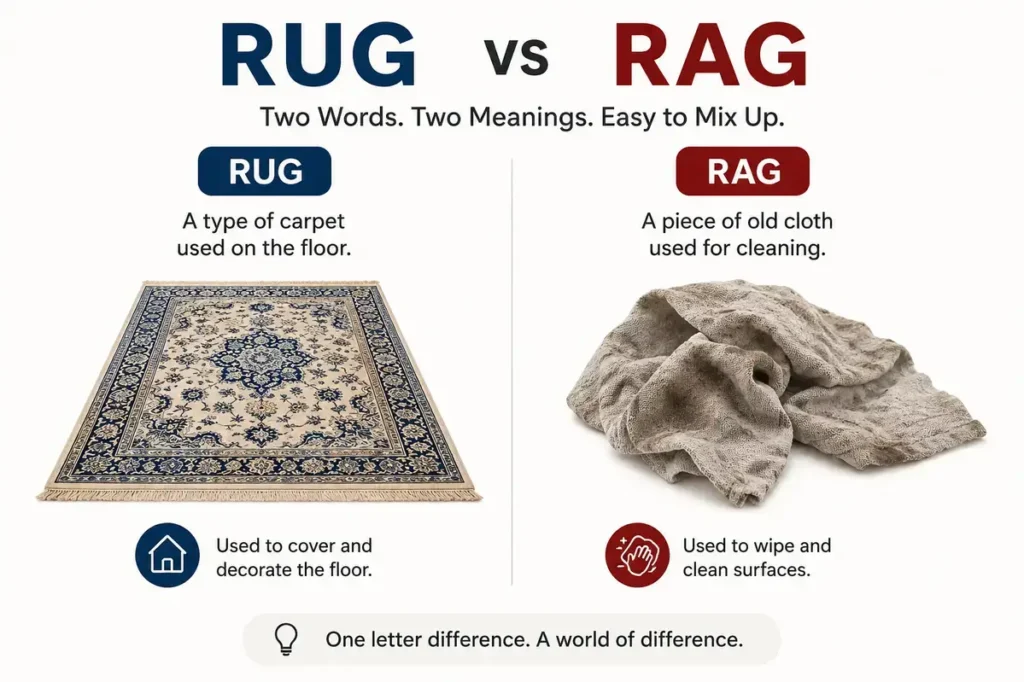
The answer is simple. Both words are correct, but they describe different things. One refers to a movable floor covering that adds comfort, warmth, and style to a space. The other refers to a piece of cloth used for cleaning, wiping, polishing, or similar tasks.
Although the spelling differs by only one letter, the meanings never overlap in standard English. Paying attention to context is the easiest way to choose the right word every time.
If you remember one idea, remember this. People walk on a rug. People clean with a rag. That simple comparison will help you use both words confidently in everyday conversation, professional writing, and academic work.
Frequently Asked Questions
Is rug another word for rag?
No. These words describe different objects. A rug is a movable floor covering used for comfort, warmth, or decoration. A rag is a piece of cloth used mainly for cleaning, wiping, or polishing. They cannot replace each other in normal English.
Can a rug become a rag?
Not in ordinary usage. A damaged rug is still called a rug. If someone cuts an old rug into small pieces for cleaning, those pieces may be used like rags, but the original object does not change its name simply because it becomes worn.
Why do people confuse these words?
The confusion usually comes from their similar spelling. Both words relate to fabric, and they appear in household situations. Once you connect each word to its purpose instead of its spelling, the difference becomes much easier to remember.
Which word is more common in everyday English?
Both words are common, but they appear in different situations. Rug is frequent in conversations about homes, decorating, furniture, and flooring. Rag appears more often in cleaning, maintenance, painting, workshops, and household chores.
Do American and British English use the same meanings?
Yes. American English, British English, Canadian English, and Australian English all use the same meanings. You do not need to learn separate spellings or definitions for these words.
Is rag always used for cleaning?
Most of the time, yes. However, rag also appears in a few informal expressions. For example, people may use it as a verb meaning to tease someone playfully. Those uses depend on context, but the basic noun still refers to a piece of cloth.
How can I remember the difference quickly?
Picture the object before choosing the word. If people walk on it, it is a rug. If people hold it in their hand to clean something, it is a rag. That simple image works far better than memorizing definitions.
Which word should I use in formal writing?
Use the word that matches the object you mean. Both are standard English words accepted in formal writing, academic work, professional communication, and everyday conversation. Accuracy depends on context, not formality.