
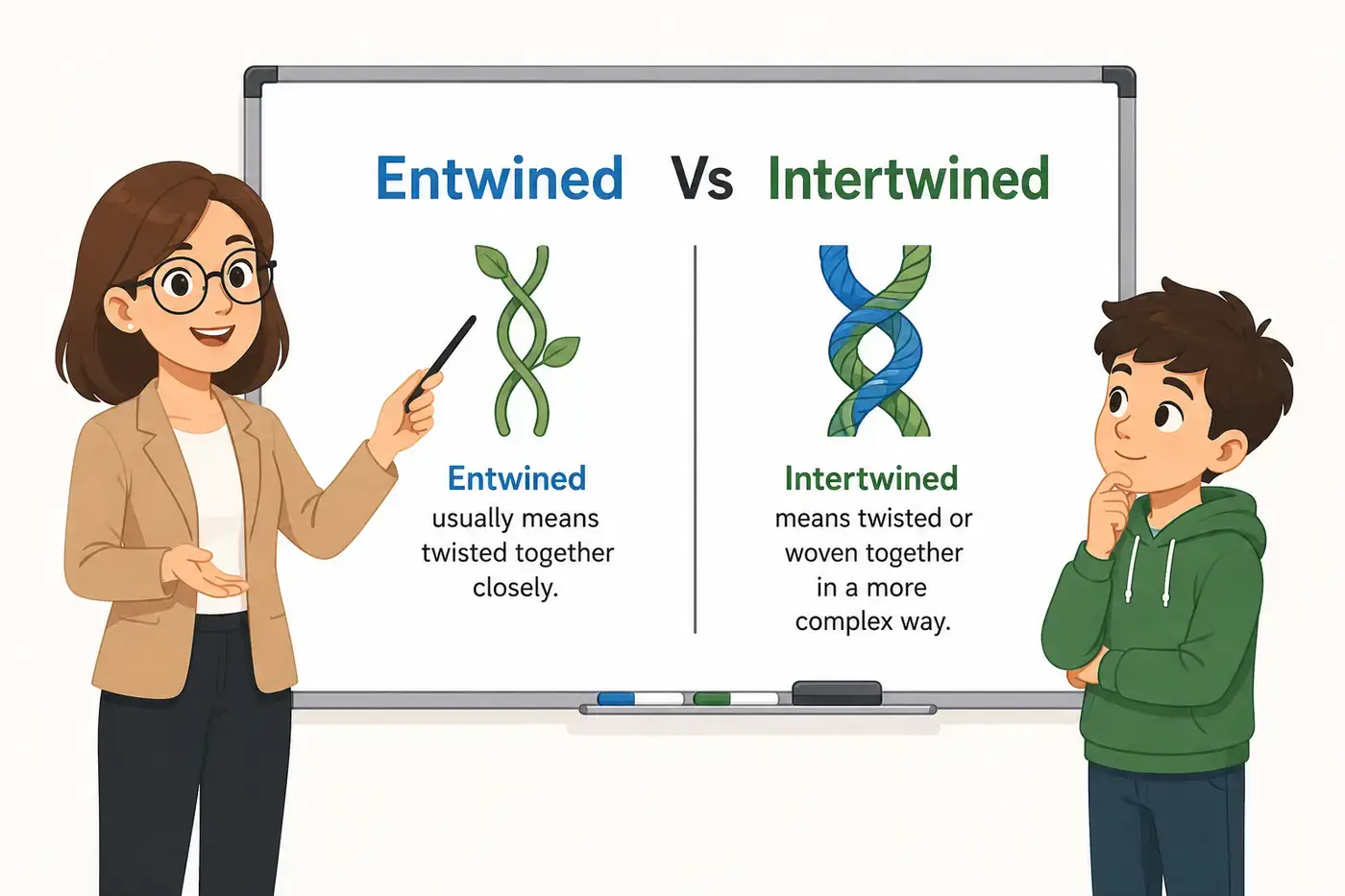
Have you ever wondered whether to write entwined vs intertwined? Both words describe things that twist, wind, or connect with one another, so choosing between them can be confusing. The good news is that neither spelling is incorrect. Both are standard English words, and they are often used interchangeably.
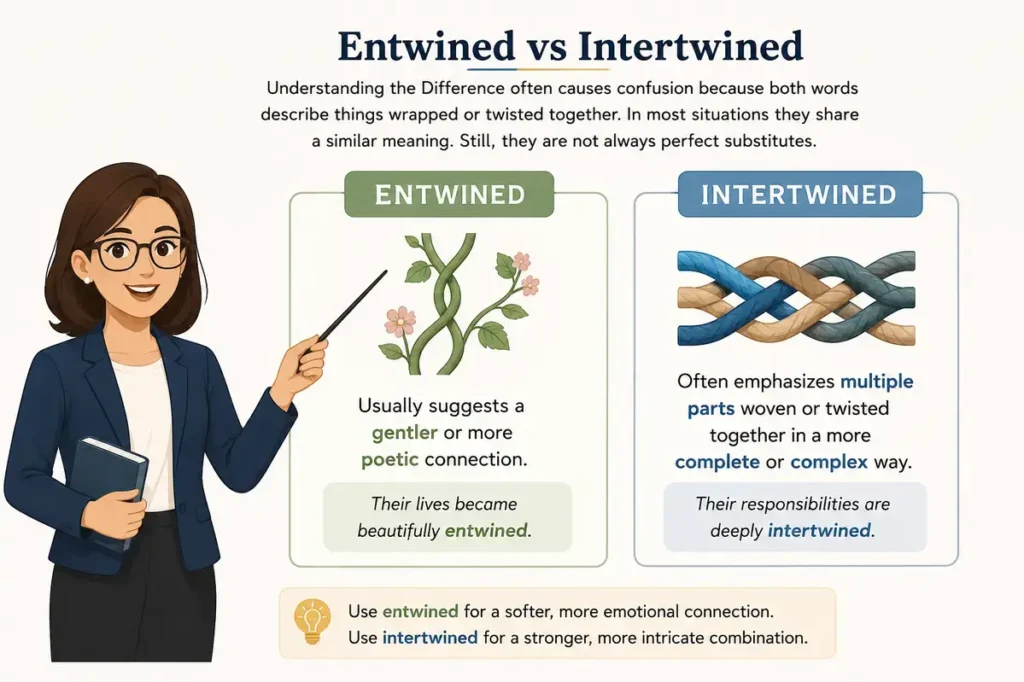
However, there is a subtle difference in emphasis. Entwined generally focuses on things that are twisted or wrapped around one another, while intertwined often suggests a closer, more complex connection between two or more things. This difference becomes especially useful when writing about relationships, ideas, events, and physical objects.
Understanding how each word works will help you choose the right expression for everyday conversations, professional communication, academic writing, and creative work. Below, you will find clear definitions, pronunciation guidance, grammar rules, practical examples, and common mistakes to help you use both words confidently.
You may also want to read Courtesy Vs Curtesy Which Word Should You Use in 2026.
Quick Answer
Both entwined and intertwined are correct English words. They describe things that are twisted, woven, wrapped, or closely connected. However, entwined often emphasizes physical winding or wrapping, whereas intertwined can place greater emphasis on several things being closely connected or interrelated. The best choice depends on the meaning and context of your sentence.
Entwined vs Intertwined: Comparison Table
| Feature | Entwined | Intertwined |
|---|---|---|
| Spelling | Correct | Correct |
| Meaning | Twisted, wrapped, or closely joined together | Woven, twisted, or closely connected with one another |
| Part of speech | Verb form and adjective | Verb form and adjective |
| Base verb | Entwine | Intertwine |
| Word formation | En- + twine | Inter- + twine |
| Pronunciation | /ɪnˈtwaɪnd/ | /ˌɪntərˈtwaɪnd/ |
| Formality | Standard English | Standard English |
| Common contexts | Arms, fingers, vines, hair, physical objects, relationships | Ideas, histories, systems, relationships, events, physical objects |
| Typical emphasis | Winding or wrapping together | Interlacing or forming connected relationships |
| Example | Their fingers were entwined. | Their lives were intertwined. |
Neither word is universally more correct or more formal. Both are suitable for professional, academic, and everyday communication.
Meaning and Definition
Although the two expressions share a similar meaning, understanding their individual definitions makes their differences easier to recognize.
What Does Entwined Mean?
Entwined means twisted, wound, wrapped, or closely joined together. It is the past tense and past participle of the verb entwine. It can also function as an adjective describing something that has become physically or figuratively connected.
The word often brings to mind two or more things winding around each other. For example, imagine two vines growing around the same tree branch. Their stems may cross, wrap, and hold onto one another. You could describe them as entwined.
The word also appears in figurative expressions. Two people’s lives, feelings, or experiences can become so closely connected that separating them becomes difficult.
Consider these examples:
- The couple’s hands were entwined as they walked through the park.
- The tree’s roots were entwined beneath the ground.
- Her childhood memories were entwined with stories about her grandmother.
- Their personal and professional lives had become entwined.
In each sentence, the word communicates a connection that brings separate things together.
Part of speech: Past tense, past participle, and adjective.
Typical grammatical patterns:
- Entwined with something.
- Entwined around something.
- Entwined in something.
- Two things become entwined.
The expression can describe physical objects, emotions, relationships, memories, and events.
What Does Intertwined Mean?
Intertwined means twisted, woven, interlaced, or closely connected with something else. It is the past tense and past participle of intertwine. Like its shorter counterpart, it can also function as an adjective.
The prefix inter- adds an idea of connection between or among separate things. As a result, this expression is especially useful when describing relationships involving multiple parts, ideas, systems, or events.
For example, imagine two pieces of thread woven together. Each thread crosses the other repeatedly, creating a connected structure. You can describe the threads as intertwined.
It also works well when discussing abstract relationships.
Consider these examples:
- Technology and education are increasingly intertwined.
- The company’s history is intertwined with the development of the local community.
- Their professional responsibilities became intertwined.
- Culture, language, and identity are closely intertwined.
The word often suggests that the individual elements influence one another or cannot easily be understood separately.
Part of speech: Past tense, past participle, and adjective.
Typical grammatical patterns:
- Intertwined with something.
- Intertwined in something.
- Intertwined throughout something.
- Two or more things become intertwined.
It is especially common in discussions about social relationships, history, business, culture, science, and complex systems.
Is Entwined an Incorrect Form of Intertwined?
No. These are two legitimate English words, not alternative spellings of the same word.
The difference is mainly one of emphasis. One focuses more naturally on winding or wrapping, while the other can highlight the relationship between connected elements.
For instance:
- The branches were entwined around the fence.
- The country’s economic and political systems are intertwined.
Both sentences are grammatically correct. The choice reflects the particular image or relationship the writer wants to communicate.
Key Differences Explained
The distinction becomes easier to understand when you examine spelling, meaning, grammar, and context separately.
1. Spelling and Word Formation
Both expressions are correctly spelled, but they are formed differently.
Entwined comes from the verb entwine. Its structure includes the prefix en- and the root word twine.
Intertwined comes from intertwine. It combines the prefix inter- with the same root.
The root twine relates to twisting or winding strands together. Both verbs therefore share an idea of bringing separate things together through winding or connection.
The difference in their prefixes helps explain their slightly different emphasis.
2. Meaning and Emphasis
The main difference concerns what the writer wants to emphasize.
Use the first expression when you want to describe something physically or figuratively wound around another thing.
Use the second when you want to emphasize the interconnection of several elements.
For example:
- The flowers were entwined around the garden arch.
- Science and technology are intertwined in modern medicine.
The first creates a clear physical image. The second describes a relationship between two areas of knowledge.
These distinctions are tendencies rather than strict rules. Either word may work in many situations.
3. Grammar and Part of Speech
Both words come from verbs and can function as adjectives.
Their grammatical forms are:
| Verb form | Entwine | Intertwine |
|---|---|---|
| Base form | Entwine | Intertwine |
| Third-person singular | Entwines | Intertwines |
| Present participle | Entwining | Intertwining |
| Simple past | Entwined | Intertwined |
| Past participle | Entwined | Intertwined |
Examples:
- The vines entwine around the wooden posts.
- The vines are entwining around the wooden posts.
- The vines entwined around the wooden posts.
- The vines have become entwined around the wooden posts.
The same pattern applies to the other verb.
4. Pronunciation
The two words share the same final sound, but their beginnings differ.
- Entwined: /ɪnˈtwaɪnd/
- Intertwined: /ˌɪntərˈtwaɪnd/
The second expression has an additional syllable and a slightly longer pronunciation.
In American English, the stress falls on the final main syllable in both words.
5. Formality and Writing Style
Neither expression is inherently more formal than the other.
Both are appropriate in:
- Business reports.
- Academic essays.
- Newspaper articles.
- Professional emails.
- Everyday conversations.
- Fiction and creative writing.
The longer form may sound more precise when discussing complicated relationships or systems. The shorter form can create a more direct image of physical closeness.
However, clarity matters more than word length.
6. Physical and Figurative Contexts
Both expressions can describe physical and abstract connections.
Physical examples include:
- Fingers.
- Arms.
- Tree branches.
- Vines.
- Threads.
- Ropes.
- Hair.
Figurative examples include:
- Relationships.
- Histories.
- Memories.
- Ideas.
- Cultures.
- Emotions.
- Economic systems.
The longer form is particularly useful when the relationship between separate concepts is central to the sentence.
7. Regional Usage
There is no meaningful spelling difference between American and British English for these words.
Both forms are standard in the United States, United Kingdom, Canada, and Australia. Differences in pronunciation may occur between speakers, but neither spelling belongs exclusively to a particular English variety.
Which Form Is Correct?
Both are correct. There is no grammatical rule requiring you to replace one with the other.
The best choice depends on the meaning you want to express.
Choose entwined when:
- You are describing things wrapped around one another.
- You want to create a strong physical image.
- You are describing hands, arms, branches, roots, or vines.
- You want a concise expression for a close connection.
Choose intertwined when:
- You are describing two or more connected ideas.
- You are discussing complicated relationships.
- You want to emphasize how different elements influence each other.
- You are writing about history, culture, society, or systems.
For example, consider these two sentences:
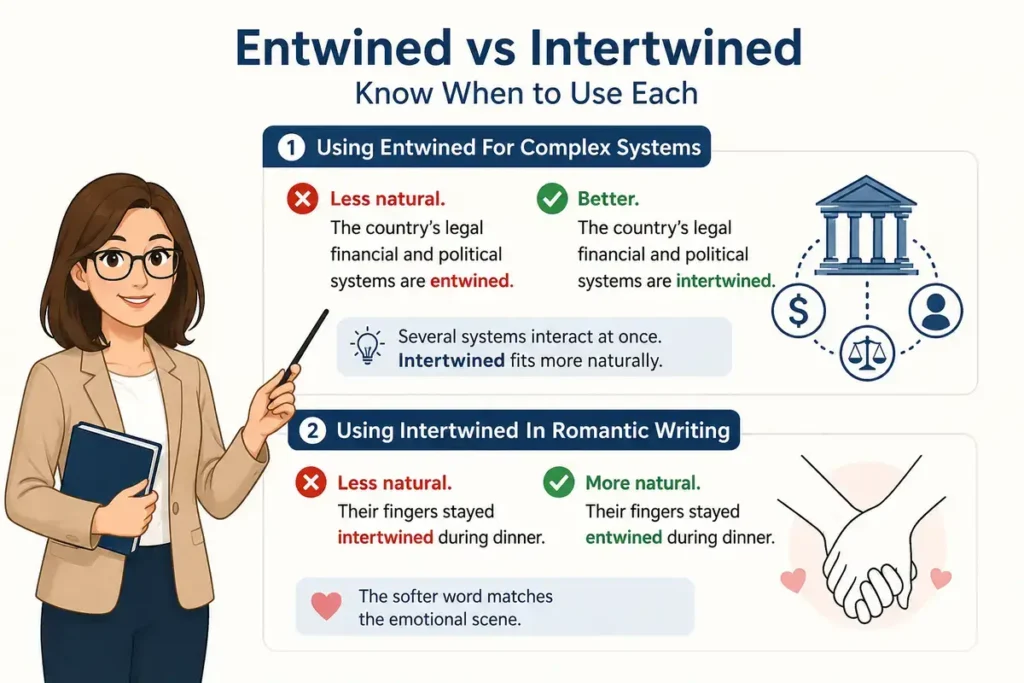
- The couple’s fingers were entwined.
- Their personal histories were intertwined.
The first focuses on a physical action. The second emphasizes a relationship between separate experiences.
These are useful guidelines, not fixed restrictions. You could also describe the couple’s fingers as intertwined or their histories as entwined. Both constructions are acceptable when they express your intended meaning.
Standard dictionary conventions recognize both as established words derived from their respective verbs. There is no reason to treat either one as a spelling error.
10 Natural Sentence Examples
Here are ten examples showing how both expressions work in different situations.
- Everyday conversation: The children sat together on the couch with their arms entwined.
- Romantic relationships: After years of marriage, their lives had become deeply intertwined.
- Nature: The green vines were entwined around the old wooden fence.
- Workplace communication: Our marketing and customer service teams have responsibilities that are closely intertwined.
- School writing: The themes of friendship and loyalty are intertwined throughout the novel.
- Academic writing: Economic development and environmental protection are often intertwined in public policy discussions.
- Text messages: Our schedules are so intertwined that we might as well plan everything together!
- Social situations: The friends stood in a circle, their hands entwined as they celebrated.
- Professional communication: The success of this project is intertwined with effective communication between departments.
- Creative writing: Moonlight fell across the garden, illuminating branches entwined like delicate ribbons.
Notice how the words can describe both visible physical connections and less tangible relationships.
Common Mistakes and Misspellings
Although both forms are straightforward, writers sometimes make errors because of their similar sounds and spelling patterns.
Here are five mistakes worth avoiding.
1. Confusing the Two Words With Misspellings
Incorrect: Intertwinned.
Correct: Intertwined.
The extra letter can appear when writers mistakenly apply a spelling pattern from another word. The standard past-tense form uses -ed after the base verb intertwine.
Example:
- Incorrect: Their stories were intertwin ned together.
- Correct: Their stories were intertwined.
2. Writing Entwinned Instead of Entwined
Incorrect: Entwinned.
Correct: Entwined.
The correct form does not contain a double n. The base verb is entwine, and its past-tense form is made by adding -ed.
Example:
- Incorrect: The branches were entwinned around the tree.
- Correct: The branches were entwined around the tree.
3. Confusing the Base Verb With the Past Participle
Incorrect: The vines are entwined around the fence yesterday.
Correct: The vines were entwined around the fence yesterday.
The problem here is not spelling but tense. The past-time reference requires an appropriate past construction.
You can also write:
- The vines entwine around the fence.
- The vines are entwining around the fence.
- The vines were entwined around the fence.
4. Using the Wrong Verb Agreement
Incorrect: Their lives is intertwined.
Correct: Their lives are intertwined.
The subject lives is plural, so it takes the plural verb are. The participle remains unchanged.
Remember that adjectives and participles do not need to change according to whether the subject is singular or plural.
5. Adding Unnecessary Words
Incorrect: Their ideas are intertwined together with each other.
Better: Their ideas are intertwined.
The verb already communicates a connection between elements. Adding several expressions with the same meaning makes the sentence unnecessarily repetitive.
You can use together when it adds useful emphasis, but it is often unnecessary.
Pronunciation Guide
Correct pronunciation helps distinguish the two words when speaking, although their shared ending can make them sound similar.
How to Pronounce Entwined
- IPA: /ɪnˈtwaɪnd/
- Syllables: en-twined.
- Simple pronunciation: in-TWYND.
- Stress: The second syllable receives the main stress.
Break it into two parts:
- In: A short opening sound.
- Twined: Sounds like the word twined, which rhymes with find.
The final sound is a clear /d/.
How to Pronounce Intertwined
- IPA: /ˌɪntərˈtwaɪnd/
- Syllables: in-ter-twined.
- Simple pronunciation: in-ter-TWYND.
- Stress: The final syllable receives the main stress, with a lighter secondary stress at the beginning.
The word contains an additional syllable because of the prefix inter-.
Common Pronunciation Mistakes
Some speakers make the following mistakes:
- Pronouncing the opening of entwined as though it contains an extra syllable.
- Leaving out the middle syllable in intertwined.
- Placing the strongest stress on the first syllable.
- Pronouncing the final sound without the /d/.
A helpful practice technique is to say each word slowly before using it in a sentence.
For example:
- In-TWYND: Their fingers were entwined.
- In-ter-TWYND: Their lives were intertwined.
You may also want to read Bellies vs Bellys Which Spelling Is Correct in 2026?.
Etymology and Word Origin
Understanding the origins of these expressions explains why they have such similar meanings.
Origin of Entwined
The word entwined comes from the verb entwine, which combines the prefix en- with twine.
The prefix en- has a long history in English word formation. It can express the idea of putting something into a particular state or causing something to become a certain way.
The root twine refers to twisting or winding strands together. It is associated with the idea of a twisted thread or cord.
As a result, the verb developed the sense of winding or twisting things together. Its past-tense and past-participle form became entwined.
The word gradually gained figurative uses, allowing writers to describe emotions, relationships, memories, and experiences as well as physical objects.
Origin of Intertwined
The word intertwined comes from intertwine, which combines the prefix inter- with twine.
The prefix inter- comes from Latin and carries the meaning of between or among. It appears in many familiar English words, including:
- Interact.
- Interconnect.
- Interdependent.
- Interrelated.
- International.
When combined with twine, it creates a verb that describes things twisted, woven, or connected with one another.
Over time, the word also became common in figurative contexts. Writers began using it to explain connections between different subjects, experiences, people, and systems.
Why Do the Words Have Similar Meanings?
Both verbs share the same root. Their prefixes create slightly different shades of meaning, but the central idea remains similar.
One emphasizes the act or condition of winding together. The other can emphasize the relationship between the connected parts.
This shared word history explains why the expressions are sometimes interchangeable in modern English.
Regional Usage
Both forms are established English vocabulary. Their spelling does not change between major English-speaking regions.
American English
In American English, both words are standard.
Entwined frequently appears in descriptions of physical objects, romantic relationships, and emotional connections.
Intertwined is also common in professional, academic, and everyday writing, particularly when discussing relationships between ideas, people, industries, or systems.
Examples:
- Their fingers were entwined during the ceremony.
- Technology and communication are intertwined in modern workplaces.
Neither expression is considered unusual or incorrect in the United States.
British English
British English uses the same spellings and grammatical forms.
There is no special British spelling such as intertwined versus an alternative American form.
Both words appear naturally in British writing, including literature, journalism, and formal communication.
The main differences are matters of individual writing style and pronunciation rather than regional spelling rules.
Australian English
Australian English follows the same standard spelling conventions.
Both expressions can describe physical connections, relationships, and abstract associations. There is no established Australian spelling variation that changes the distinction between them.
Canadian English
Canadian English also recognizes both forms as standard.
Writers can use either word in formal documents, academic work, business communication, and everyday conversation.
In all four varieties, context determines which expression is most suitable.
Grammar Rules and Part of Speech
Understanding the grammatical function of these words will help you use them correctly in sentences.
1. Both Words Are Past-Tense and Past-Participle Forms
The words come from the verbs entwine and intertwine.
They can describe an action completed in the past.
Examples:
- The branches entwined around the fence.
- The two roads intertwined near the village.
They can also appear with auxiliary verbs.
Examples:
- Their paths have entwined over the years.
- Their careers have intertwined since college.
2. Both Can Function as Adjectives
When describing a noun, these words can work as adjectives.
Examples:
- The entwined branches created a natural arch.
- The intertwined stories made the novel more interesting.
They can appear before a noun or after a linking verb.
Before a noun:
- The entwined roots covered the ground.
After a linking verb:
- Their histories are intertwined.
3. Use the Correct Prepositions
The most common prepositions used with these expressions are with, around, and in.
With: Describes a connection between two or more things.
- Her memories were entwined with her childhood.
- Their professional goals were intertwined with the company’s future.
Around: Usually describes something physically winding around another object.
- The vines were entwined around the branches.
In: Can describe involvement in a situation, process, or complicated relationship.
- Several personal interests were intertwined in the decision.
Choose the preposition that communicates the intended relationship most clearly.
4. Understand Active and Passive Constructions
Both verbs can be used in active and passive constructions.
Active:
- The gardener entwined the vines around the wooden frame.
- The author intertwined several stories in the novel.
Passive:
- The vines were entwined around the wooden frame.
- Several stories were intertwined throughout the novel.
The passive construction is particularly common when the writer wants to emphasize the result rather than the person performing the action.
5. Use Subject-Verb Agreement Correctly
The verbs must agree with their subjects.
Examples:
- The thread entwines around the needle.
- The threads entwine around the needle.
- The relationship intertwines two families.
- Their relationships intertwine several generations.
However, when the word is used as an adjective or participle, the auxiliary verb must agree with the subject.
Examples:
- Their lives are intertwined.
- Her life is intertwined with theirs.
6. Avoid Unnecessary Hyphens
Neither word normally needs a hyphen.
Correct:
- Their lives are intertwined.
- The entwined branches blocked the path.
Incorrect:
- Their lives are inter-twined.
- The en-twined branches blocked the path.
Use the standard single-word spelling in ordinary English writing.
Real-Life Usage Examples
The following examples show how these expressions appear in different communication settings.
Daily Conversation
In everyday speech, both words can describe relationships or physical connections.
- Our families have been intertwined for generations.
- Look at those vines entwined around the garden gate!
The first sentence describes a long-standing relationship. The second describes something visible.
Email and Workplace Communication
Professional writing often uses these words to describe responsibilities, departments, and business relationships.
- Our departments have closely intertwined responsibilities, so regular communication is essential.
- The success of this partnership is entwined with our ability to meet customer expectations.
Both expressions are suitable for professional emails and reports.
Academic Writing
Academic writers use these words to explain relationships between theories, subjects, and areas of research.
- Language and cultural identity are deeply intertwined in many communities.
- The study examines how economic and social factors become entwined over time.
The second example also shows how the shorter expression can work in an academic context.
News and Journalism
Journalists often use these expressions to explain complicated events and relationships.
- The region’s political history is intertwined with its economic development.
- The investigation revealed how several business interests had become entwined.
These constructions help communicate connections without requiring lengthy explanations.
Literature and Storytelling
Creative writers use both words to create visual images and express emotional connections.
- Their fingers were entwined beneath the table as the rain fell outside.
- The lives of the two families remained intertwined long after the village had changed.
The words are especially useful in storytelling because they suggest closeness, connection, and complexity.
Related and Confused Terms
Several other English expressions describe similar relationships. However, they are not always interchangeable.
Understanding their differences will help you select more precise vocabulary.
1. Entangled
Entangled means caught, twisted, or involved in something complicated.
It can describe physical objects, difficult situations, or complicated relationships.
Example: The fishing net became entangled in the rocks.
Unlike the two main words, this expression can suggest difficulty, confusion, or an unwanted situation.
2. Interlaced
Interlaced means joined or woven together by crossing separate parts.
It often describes physical structures, patterns, and connected elements.
Example: The artist created an intricate pattern using interlaced lines.
It is especially useful when you want to emphasize a visible crossing pattern.
3. Connected
Connected means joined or associated with something else.
It is a broad term that can describe physical, emotional, social, and logical relationships.
Example: The two research projects are connected by a common goal.
It does not necessarily suggest twisting or weaving.
4. Interconnected
Interconnected describes things linked to one another through a network or system of relationships.
Example: The world’s financial markets are interconnected.
This word is particularly useful when discussing systems with several connected parts.
5. Woven Together
This phrase describes separate strands or elements combined into one structure.
It can also be used figuratively.
Example: Different cultural traditions are woven together in the festival.
It creates a clear image of separate elements becoming part of a whole.
6. Inseparable
Inseparable describes two or more things that cannot easily be separated or considered independently.
Example: The two friends have been inseparable since childhood.
Unlike the main expressions, it emphasizes the strength of a connection rather than the process of twisting or winding.
7. Interrelated
Interrelated describes things that have a connection or influence on one another.
Example: Education and economic opportunity are closely interrelated.
This term is especially useful in academic, scientific, and professional writing.
8. Bound Together
Bound together means joined or held together through a physical, emotional, or figurative connection.
Example: The community was bound together by a shared history.
It often suggests a strong sense of unity, commitment, or shared experience.
Expert Editor Insight
An experienced English editor would not automatically replace one expression with the other. Both are accepted words, and the decision should depend on the sentence’s intended meaning. In descriptions of physical objects, entwined often produces a direct and natural image. For complex relationships between ideas, systems, or experiences, intertwined may communicate the connection more clearly. Editors also check surrounding words, prepositions, tense, and repetition. Most spelling tools recognize both forms, although grammar software may suggest a change based on sentence context. The best editing tip is to ask whether you are describing something winding around another object or emphasizing a relationship between connected elements.
Entwined Vs Intertwined Key Takeaways
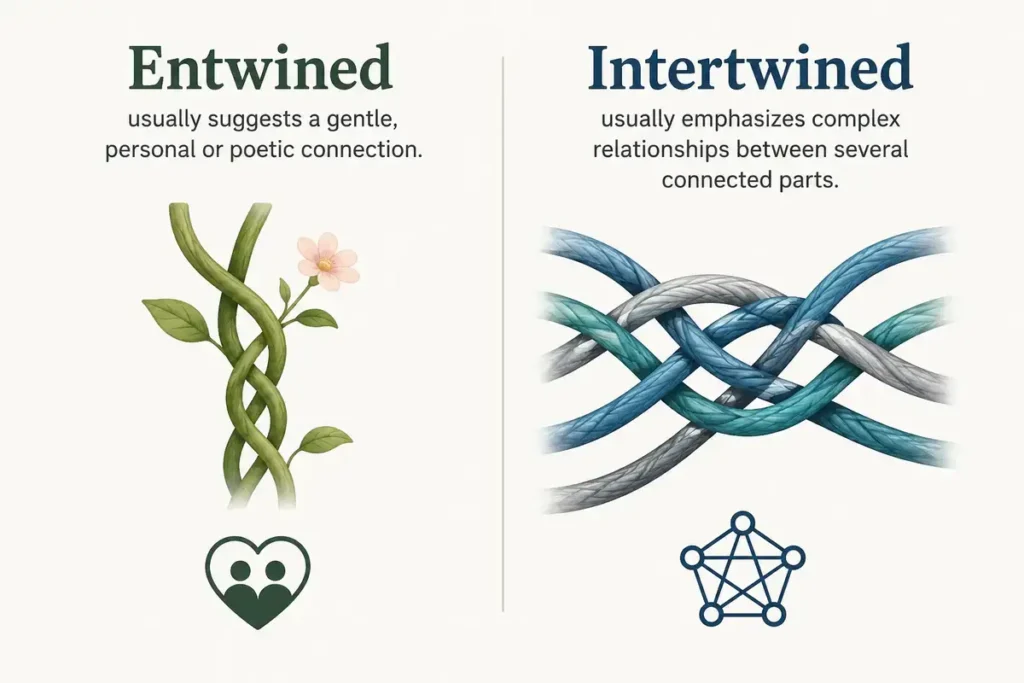
- Entwined usually suggests a gentle personal or poetic connection.
- Intertwined usually emphasizes complex relationships between several connected parts.
- Both words can describe physical objects and abstract ideas.
- Context matters more than grammar when choosing between them.
- Creative writing often favors entwined.
- Academic professional and analytical writing often favors intertwined.
- Neither word is more correct. The better choice depends on the image you want readers to see.
You may also want to read complaint vs complain Meaning Difference And Correct Usage.
Conclusion
Understanding the difference between Entwined vs Intertwined comes down to recognizing two closely related but slightly different expressions. Both are correct, both are widely accepted, and neither should be treated as a spelling mistake. The shorter form often emphasizes things physically or figuratively winding around each other, while the longer form frequently highlights relationships between connected elements. However, their meanings overlap, so context should guide your decision.
A simple editing tip is to picture the relationship you are describing: if you want to emphasize wrapping, consider entwined; if you want to highlight a deeper connection, consider intertwined. Both will serve you well when used thoughtfully.
FAQs
1. Is Entwined a Real Word?
Yes. Entwined is a standard English word and the past-tense and past-participle form of entwine. It can also function as an adjective describing objects or ideas that are twisted, wrapped, or closely connected. It is not a misspelling of intertwined, and it is perfectly acceptable in everyday and formal writing.
2. What Does Intertwined Mean?
Intertwined means twisted, woven, or closely connected with something else. It is the past-tense and past-participle form of intertwine. The word can describe physical objects, such as threads or branches, as well as abstract relationships involving people, cultures, ideas, histories, and systems. It often emphasizes how separate elements influence or depend on one another.
3. Which Is Correct: Entwined or Intertwined?
Both are correct English words. Neither is a spelling mistake, and neither is grammatically superior in every situation. The difference is mainly one of emphasis. The shorter form often highlights physical winding or wrapping, while the longer form frequently emphasizes connections between ideas, people, and systems. Choose the expression that communicates your intended meaning most clearly.
4. How Do You Pronounce These Two Words?
The pronunciation of entwined is /ɪnˈtwaɪnd/, which sounds like in-TWYND. The pronunciation of intertwined is /ˌɪntərˈtwaɪnd/, which sounds like in-ter-TWYND. Both have their main stress on the final syllable. The longer expression contains an additional syllable because of the prefix inter-.
5. Can Entwined or Intertwined Start a Sentence?
Yes. Both words can begin a sentence when used as adjectives or participles. For example, you could write, “Entwined around the old fence, the vines covered the garden entrance.” You could also write, “Intertwined throughout the story, the themes of love and loyalty create a powerful message.” Both constructions are grammatically acceptable.
6. What Is a Good Synonym for Entwined?
Useful synonyms include interlaced, interwoven, entangled, twisted together, and connected. The best alternative depends on the context. For example, interlaced works well when describing crossed physical elements, while connected is more suitable for general relationships. If the connection is complicated or difficult to separate, entangled may be more accurate.
7. Why Do People Confuse These Two Words?
People confuse them because both contain the root twine and describe similar actions or relationships. Their past-tense forms also have nearly identical endings. In addition, both can describe physical objects and abstract connections. Since their meanings overlap, writers sometimes assume that one is incorrect. In reality, both are established English words with slightly different shades of meaning.
8. Are Both Words Appropriate in Formal Writing?
Yes. Both expressions are suitable for formal writing, including academic papers, professional reports, business documents, and journalism. The choice should reflect the intended meaning rather than the level of formality. Use the shorter form when physical winding is the main idea and the longer form when explaining relationships between different concepts, systems, or experiences.