
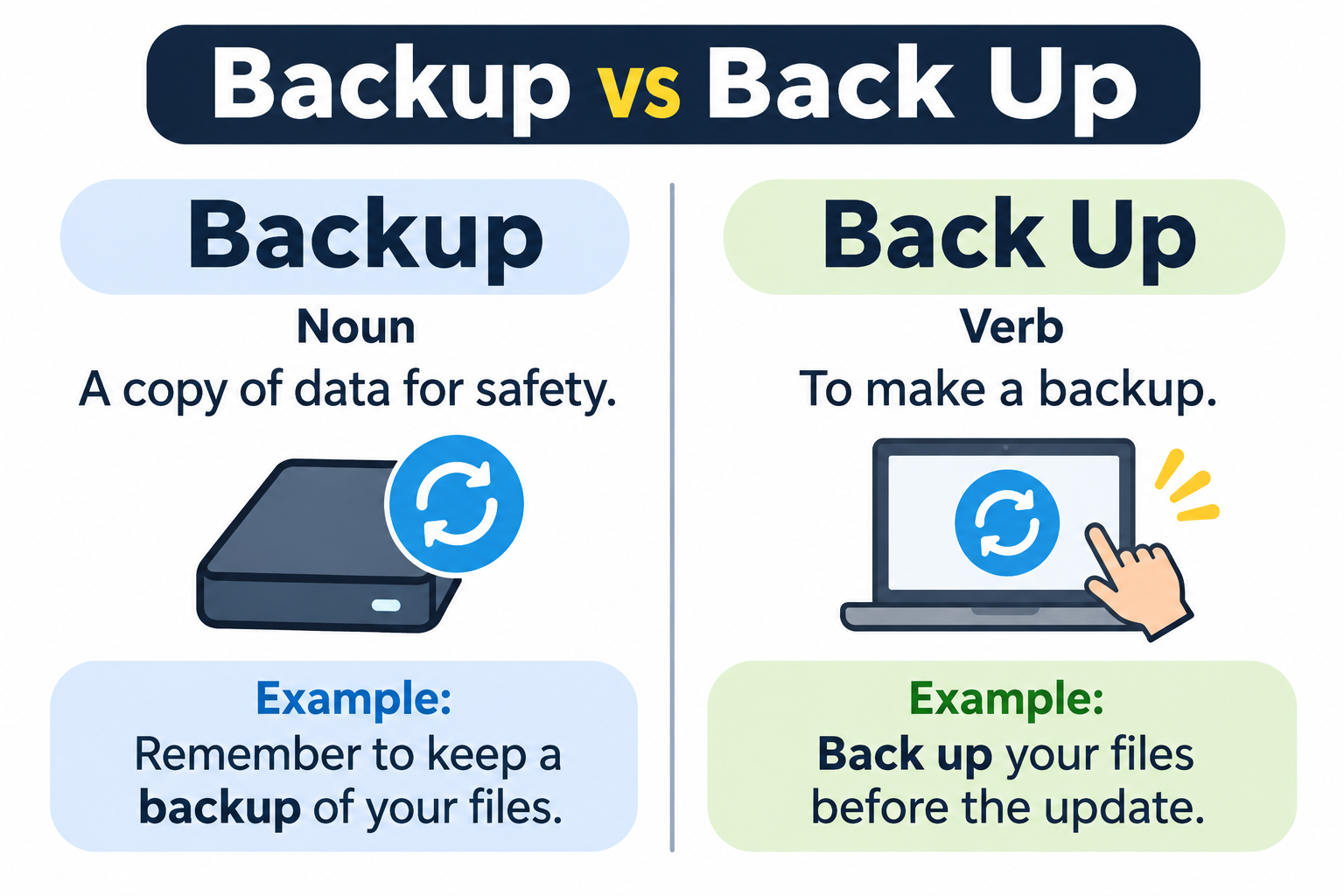
Choosing between backup vs back up can be confusing because both forms are correct, sound alike, and relate to the same general idea. However, they do not perform the same grammatical job. The difference is simple: backup is usually a noun or adjective, while back up is a verb phrase.
For example, you might create a backup of your computer files, but you should back up those files regularly. The first form names a copy or describes something that provides extra support. The second describes an action, such as saving another copy of important information or moving a vehicle backward.
This spelling difference matters in emails, school assignments, business documents, technical instructions, and everyday messages. Using the wrong form can make an otherwise clear sentence look unprofessional. Understanding the role each form plays will help you choose the right spelling without relying on guesswork.
Many readers also check simpler or more simple Which Form Is Correct.
Quick Definition
Backup is a noun or adjective that refers to an extra copy, additional support, or a person or thing kept available as a replacement. Back up is a two word verb phrase that describes creating a copy of information, supporting someone, or moving backward. Both are correct, but their grammatical functions determine which form you should use.
Quick Answer: Which Form Should You Use?
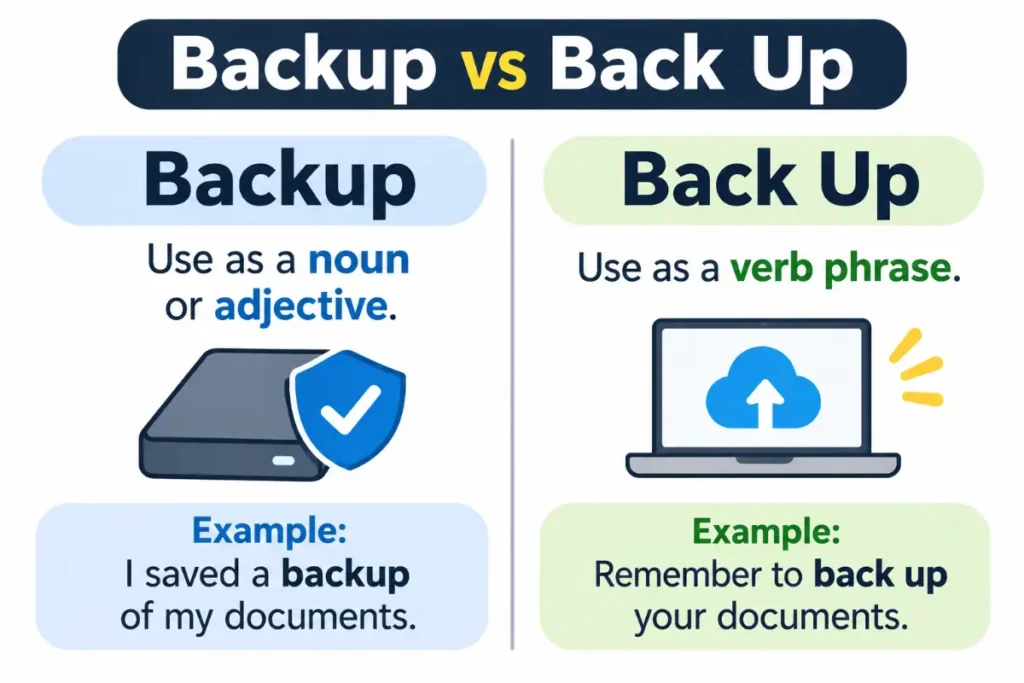
Both spellings are correct, but they are not interchangeable.
- Backup: Use this as a noun or adjective. Example: I saved a backup of my documents.
- Back up: Use this as a verb phrase. Example: Remember to back up your documents.
A simple way to remember the distinction is to look at the action. If you are naming an extra copy or describing additional support, use the single word. If you are describing the act of creating that copy or providing support, use the two word form.
Comparison Table
| Feature | Backup | Back Up |
|---|---|---|
| Spelling | One word | Two words |
| Part of speech | Noun or adjective | Verb phrase |
| Main meaning | Extra copy or additional support | To create a copy or provide support |
| Grammatical function | Names or describes something | Expresses an action |
| Example | I need a backup. | I need to back up my files. |
| Common context | Technology, work, emergencies | Technology, driving, teamwork |
| Formality | Standard in formal and informal writing | Standard in formal and informal writing |
| Plural form | Backups | Does not normally take a plural form |
| Past tense | Not applicable as a noun | Backed up |
| Common mistake | Writing it as two words when used as a noun | Joining the words when used as a verb |
The main difference is grammatical rather than regional. Both forms are accepted in standard American English, and the same basic distinction applies in British, Canadian, and Australian English.
Meaning and Definition of Each Form
Understanding the individual meanings makes the spelling rule easier to apply. Although the two forms are closely related, each has a different function in a sentence.
What Does Backup Mean?
Backup is a noun or adjective. As a noun, it refers to an additional copy, replacement, reserve, or source of support that can be used when the original is unavailable or something goes wrong.
For example:
- I keep a backup of all my important files.
- The company has a backup generator.
- We need a backup plan for the event.
- The main server failed, so the backup system took over.
In each sentence, the word refers to something available as an extra resource or replacement.
As an adjective, it describes something that provides additional help, protection, or support. It commonly appears before another noun.
Examples include:
- Backup camera
- Backup battery
- Backup power
- Backup team
- Backup plan
- Backup system
Notice that the word does not describe an action in these examples. Instead, it identifies the type or purpose of another thing.
What Does Back Up Mean?
Back up is a verb phrase made up of the verb back and the particle up. It describes an action that can have several related meanings depending on the sentence.
The most common uses include:
1. To create an extra copy of information
This meaning is especially common in technology. It refers to copying important files, photographs, documents, or other data so they remain available if the original is lost.
Example: You should back up your phone before installing the update.
2. To support someone or something
The phrase can also mean helping another person, confirming a statement, or providing evidence.
Example: The manager agreed to back up her employee’s explanation.
3. To move backward
It can describe the physical movement of a person or vehicle in the opposite direction.
Example: Please back up the car before opening the garage door.
4. To collect or block movement
The phrase can describe traffic, water, or other things accumulating because movement has slowed or stopped.
Example: Heavy traffic began to back up near the highway exit.
These meanings share the idea of support, reversal, or accumulation. The surrounding sentence tells you which meaning is intended.
Is Backup One Word or Two Words?
It depends on how you use it.
When it names an extra copy, reserve, or source of support, write it as one word. When it describes an action, write it as two words.
Compare these sentences:
- Correct: I created a backup of the presentation.
- Correct: I decided to back up the presentation.
Both sentences are grammatically correct. The difference comes from the role the expression plays in each sentence.
Key Differences Explained
The distinction becomes easier when you examine spelling, grammar, meaning, and sentence structure separately.
1. Spelling Difference
The first difference is the number of words.
Backup combines the two elements into a single word. Back up keeps them separate because they form a verb phrase.
This is not a case of one spelling being correct and the other being a mistake. English uses both forms for different grammatical purposes.
2. Meaning Difference
The single word usually identifies an additional resource or something kept in reserve. The verb phrase describes an action.
Consider the following:
- I need a backup. This refers to an extra resource.
- I need to back up. This describes an action.
The meaning is related, but the grammatical structure changes how the expression works.
3. Grammar Difference
The noun form can appear after articles, possessive words, and adjectives.
Examples:
- A backup is available.
- My backup is ready.
- The emergency backup worked perfectly.
The verb phrase can follow modal verbs, infinitives, and other verb structures.
Examples:
- You should back up your files.
- I want to back up the database.
- They backed up the information yesterday.
These patterns provide a useful way to identify the correct spelling.
4. Part of Speech
This is the most important distinction.
| Form | Part of Speech | Example |
|---|---|---|
| Backup | Noun | The backup is ready. |
| Backup | Adjective | We installed a backup battery. |
| Back up | Verb phrase | Please back up your files. |
If the expression names something, the single word is generally appropriate. If it expresses an action, use the two word phrase.
5. Pronunciation Difference
Both forms have the same standard pronunciation in ordinary speech.
The noun and adjective are pronounced the same way as the verb phrase. This explains why people sometimes confuse them when writing.
You cannot usually hear the difference. You need to examine the grammatical role in the sentence.
6. Formality and Context
Both forms are appropriate in formal and informal writing.
You can use the noun in a business report, technical manual, school assignment, or everyday message. You can also use the verb phrase in all these settings.
The correct choice depends on grammar, not the level of formality.
7. Regional Usage
American, British, Canadian, and Australian English generally follow the same distinction.
There is no major regional spelling rule that makes the noun two words or the verb one word. Writers in these varieties should use the same grammatical test.
Which Form Is Correct?
Both forms are correct English. The correct choice depends on the purpose of the expression.
Use the single word when you need a noun or adjective:
- We purchased a backup computer.
- The backup is stored in a safe location.
- She prepared a backup plan.
Use the two word form when you need a verb:
- Please back up your computer.
- I will back up your decision.
- The driver had to back up slowly.
The distinction follows a common English spelling pattern. Many verb phrases begin as separate words and develop related one word noun or adjective forms over time.
For example, English also uses related pairs such as:
| Verb Phrase | Noun or Adjective |
|---|---|
| Set up | Setup |
| Log in | Login |
| Sign up | Signup |
| Break down | Breakdown |
| Check in | Check-in |
These pairs do not all follow exactly the same punctuation or usage rules, but they demonstrate a useful pattern: grammatical function often affects spelling.
A dictionary can help confirm the part of speech and accepted spelling of a particular expression. However, for this pair, the noun and adjective versus verb distinction is the practical rule to follow.
10 Natural Sentence Examples
The following sentences show how both forms work in everyday English.
Examples Using the Noun and Adjective
1. I always keep a backup of my important documents on an external drive.
2. The office purchased a backup generator to keep essential equipment running during power outages.
3. Our team needs a backup plan in case the original speaker cannot attend the conference.
4. She saved the backup before making changes to the original photograph.
5. The company hired a backup technician to assist the main support team.
Examples Using the Verb Phrase
6. Remember to back up your phone before replacing it with a new one.
7. The manager agreed to back up his employee’s request for additional training.
8. Please back up the car carefully because there is very little space behind it.
9. Students should back up their research claims with reliable evidence.
10. I back up my work every evening so I do not lose important changes.
These examples demonstrate that the same general idea can appear in different grammatical forms. Pay attention to the role of the expression rather than choosing based on how it sounds.
Five Common Mistakes and How to Correct Them
Even experienced writers sometimes confuse these forms. The following mistakes are especially common.
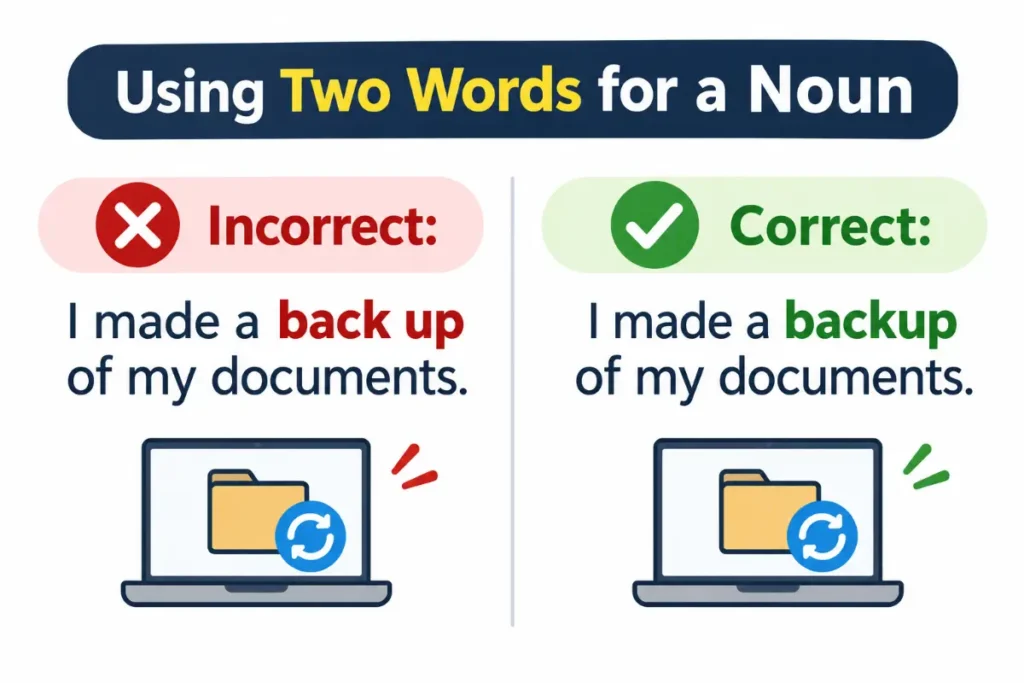
1. Using Two Words for a Noun
Incorrect: I made a back up of my documents.
Correct: I made a backup of my documents.
The expression names an extra copy, so it should be written as one word. A useful test is to replace it with extra copy. If the sentence still makes sense, you probably need the noun form.
2. Using One Word for a Verb
Incorrect: I need to backup my computer.
Correct: I need to back up my computer.
The expression describes an action, so the words must remain separate. The verb is back, and up is the particle that completes the phrase.
3. Writing the Past Tense Incorrectly
Incorrect: I backuped all my files yesterday.
Correct: I backed up all my files yesterday.
The past tense of the verb back is backed. The particle up remains separate, so the complete phrase becomes backed up.
4. Confusing an Adjective With a Verb
Incorrect: Please backup the database before the update.
Correct: Please back up the database before the update.
The sentence gives an instruction to perform an action. Therefore, the two word form is necessary.
However, this sentence is correct:
The backup database is ready.
Here, the single word describes a database kept as an extra resource.
5. Confusing the Plural Noun With the Verb Phrase
Incorrect: We created three back ups for the project.
Correct: We created three backups for the project.
The plural of the noun is formed by adding s to the complete word. The standard spelling is backups, not back ups.
For another common grammar confusion, see alot or a lot: Correct Spelling Meaning and Usage.
Pronunciation Guide
Both forms share the same pronunciation. Their spelling changes according to grammar, not sound.
Pronunciation
/ˈbæk.ʌp/
IPA pronunciation for both forms
Syllable breakdown: BACK + UP
Easy pronunciation: BAK-up
Stress pattern: The first syllable receives the main stress.
How to Pronounce the Expression
- Start with the sound /b/ as in book.
- Say /æk/ as in back.
- Move naturally into the second syllable, /ʌp/, as in cup.
The result is two syllables: BACK-up.
Common Pronunciation Mistakes
Some speakers may place too much stress on the second syllable or pronounce the vowel sounds differently because of their first language. However, the standard pronunciation places stress on the first syllable.
Remember that pronunciation alone cannot tell you which spelling to use. You need to consider the sentence structure.
Etymology and Word Origin
The history of these forms helps explain why they share similar meanings.
The word back comes from Old English bæc, which referred to the rear part of the body or something positioned behind. It developed into the modern English word used for direction, support, and position.
The word up comes from Old English up and has long been used to express direction, movement, and completion.
When combined as a verb phrase, back up developed several related meanings. These include moving backward, supporting someone, and making an additional copy of information.
The noun and adjective form, backup, developed as a compound spelling associated with the idea of additional support or a reserve. Its use became especially familiar in modern technology, where it describes an extra copy of digital information.
Although the forms have related origins and meanings, modern English distinguishes them through their grammatical functions.
Regional Usage in English
The spelling distinction is consistent across the main varieties of English. There is no major regional rule that changes the basic difference.
American English
In American English, the single word is standard as a noun and adjective, while the two word form is standard as a verb.
Examples:
- I made a backup of my laptop.
- You should back up your laptop regularly.
- We need a backup employee for the afternoon shift.
These forms are common in American workplaces, technology instructions, and everyday communication.
British English
British English follows the same general rule. Writers use the noun and adjective form for additional copies or support and the verb phrase for actions.
Examples:
- Keep a backup copy of your files.
- Remember to back up your computer.
There is no major difference in spelling between British and American usage for this pair.
Canadian English
Canadian English generally follows the same conventions as American and British English.
For example:
- The school keeps a backup of its records.
- Teachers should back up important classroom documents.
The choice depends on grammar rather than Canadian spelling preferences.
Australian English
Australian English also uses the single word as a noun or adjective and the two word form as a verb.
Examples:
- The team has a backup player.
- We need to back up the files before the system update.
The same practical rule applies across all four varieties.
Grammar Rules and Part of Speech
Understanding the grammar behind these forms is the most reliable way to avoid spelling mistakes.
1. Backup as a Noun
A noun names a person, place, thing, or idea. In this case, the word refers to an extra copy, replacement, or source of support.
It can function as the subject or object of a sentence.
Examples:
- The backup is complete.
- We need another backup.
- She created two backups of the presentation.
It can also follow articles and possessive words.
Examples:
- A backup is available.
- My backup failed.
- Their backups are stored securely.
2. Backup as an Adjective
An adjective describes a noun. The single word can identify something that provides extra support or serves as a replacement.
Examples:
- Backup power
- Backup camera
- Backup battery
- Backup employee
- Backup plan
In each case, it describes the purpose or function of the noun that follows.
3. Back Up as a Verb Phrase
The two word expression works as a verb phrase. It describes an action and can change tense according to the sentence.
Present tense:
- I back up my files every day.
- They back up their claims with evidence.
Past tense:
- I backed up my files last night.
- The manager backed up the employee’s decision.
Future tense:
- We will back up the database tomorrow.
- She will back up her colleague during the meeting.
Infinitive form:
- I want to back up my photographs.
- They need to back up the new system.
4. Can You Separate Back and Up?
Yes. In many sentences, back up is a separable phrasal verb. This means an object can appear between the verb and the particle.
For example:
- Back up your files.
- Back your files up.
Both sentences are correct.
However, when the object is a pronoun, it normally appears between the two parts.
Correct:
- Back it up.
- Back them up.
- Back your data up.
Incorrect in standard usage:
- Back up it.
- Back up them.
This is a useful rule for anyone who wants to write natural English.
5. How to Form the Past Tense
The verb back is regular. Its past tense is backed.
| Tense | Example |
|---|---|
| Present | I back up my files. |
| Present continuous | I am backing up my files. |
| Past | I backed up my files. |
| Past continuous | I was backing up my files. |
| Present perfect | I have backed up my files. |
| Future | I will back up my files. |
The particle up does not change. Only the verb changes according to tense.
6. How to Form the Plural
The noun form becomes plural by adding s.
- One backup
- Two backups
- Several backups
- Multiple backups
Do not separate the words when forming the plural noun.
7. Punctuation and Sentence Position
Neither form requires special punctuation simply because of its spelling.
The noun can appear at the beginning, middle, or end of a sentence. The verb phrase can also appear in different positions depending on the sentence structure.
Examples:
- Backup copies are stored separately.
- We created a backup yesterday.
- Please back up the files before leaving.
- The system will back up automatically.
The important point is to maintain the correct word form regardless of sentence position.
Real Life Usage Examples
These forms appear in many areas of everyday life. The following examples show how people use them naturally.
Daily Conversation
People often use the noun when discussing extra resources and the verb phrase when describing actions.
- Do you have a backup charger for your phone?
- Can you back up the photos before deleting the originals?
The first sentence identifies an extra item. The second asks someone to perform an action.
Email and Workplace Communication
In professional communication, the distinction is useful when discussing documents, systems, and additional support.
- Please keep a backup copy of the final report in the shared folder.
- Could you back up the client records before the software update?
Both expressions are appropriate in professional emails and workplace instructions.
Academic Writing
Students and researchers may use these forms when discussing research files, evidence, and additional support.
- The research team maintained a backup of the original dataset.
- Researchers should back up their findings with evidence from reliable sources.
The first refers to stored information. The second refers to supporting an argument.
News and Journalism
Journalists may use the noun when reporting on emergency arrangements or technology and the verb phrase when describing an action.
- The hospital activated its backup power system during the outage.
- Officials asked residents to back up important documents before the evacuation.
These examples show how the distinction works in clear, factual writing.
Literature and Storytelling
Writers can also use both forms in stories and dialogue.
- Maya carried a backup key in her bag in case she lost the original.
- He told the driver to back up slowly as the narrow road disappeared behind them.
The first describes an object kept for emergencies. The second describes physical movement.
Eight Related and Confused Terms
Several English expressions follow similar spelling patterns or share related meanings. Understanding them can make your writing more accurate.
1. Setup vs Set Up
Setup is a noun that describes an arrangement or configuration. Set up is a verb phrase that describes arranging or preparing something.
- The computer setup is complete.
- I need to set up the computer.
This pair follows a pattern similar to the one discussed above.
2. Login vs Log In
Login is a noun or adjective that relates to access credentials or the process of entering an account. Log in is the verb phrase describing the action of accessing an account.
- I forgot my login details.
- Please log in to your account.
The grammatical role determines the spelling.
3. Sign Up vs Signup
Sign up is the verb phrase used when registering for something. Signup is also used as a noun or adjective in some modern contexts, although sign-up is common in standard edited writing.
- I want to sign up for the course.
- The signup process takes five minutes.
The hyphenated noun form is also widely used.
4. Backup Plan vs Contingency Plan
A backup plan is an alternative arrangement used if the original plan fails. A contingency plan is a prepared response to a possible problem or emergency.
The meanings overlap, but a contingency plan often refers to a broader response to a specific risk.
5. Backup Copy vs Duplicate
A backup copy is an additional version kept for recovery or protection. A duplicate is simply another copy of something.
A duplicate does not always serve as a backup. The purpose of the copy matters.
6. Support vs Back Up
Support can mean helping someone, providing resources, or agreeing with an idea. Back up can express similar meanings, particularly when someone provides help or evidence.
- I support your decision.
- I will back up your decision.
Both sentences express agreement, but the wording and context differ.
7. Restore vs Recover
Restore means returning something to an earlier condition or state. Recover means getting something back after loss or difficulty.
For example, you may restore files from a backup or recover information after a system failure.
These words often appear in technology instructions, but they are not exact synonyms.
8. Backward vs Backwards
Both words describe movement or direction toward the rear.
Backward is especially common in American English, while backwards is also widely used, particularly in British English.
Examples:
- The car moved backward.
- The child walked backwards.
Unlike the main spelling pair, this distinction involves regional preferences and adverb usage.
Expert Editor Insight
An experienced English editor looks at grammatical function before correcting this pair. The same expression can appear in both forms within a single paragraph without creating a spelling problem. The confusion happens because pronunciation does not reveal the difference, and writers often type the words based on sound alone. Grammar checkers may flag a form when it does not fit the sentence, but automated tools can miss context. A reliable editing habit is to identify the noun, adjective, or verb before deciding how to spell it.
Many readers also check genious or genius Correct Spelling Meaning And Usage.
Conclusion
Understanding backup vs back up comes down to one simple grammar rule. Use the single word when naming an extra copy, replacement, or source of support. Use the two word form when describing an action, such as creating a copy, helping someone, or moving backward. Both forms are correct in American English and other major English varieties.
The easiest way to remember the distinction is to check the sentence before choosing the spelling. If you can replace the expression with an extra copy, use the noun. If you are describing an action, keep the words separate. This small habit will help you write more clearly and confidently.
FAQs
1. Which Is Correct: Backup or Back Up?
Both are correct, but they have different grammatical functions. Use the single word as a noun or adjective when referring to an extra copy, replacement, or additional support. Use the two word phrase as a verb when describing an action, such as creating a copy, supporting someone, or moving backward.
2. Is Backup One Word or Two Words?
The spelling depends on how you use the expression. It is one word when it functions as a noun or adjective, as in a backup copy. It is two words when it functions as a verb, as in back up your files. Both spellings are standard English.
3. Is Back Up a Real Word?
Yes. It is a standard English verb phrase with several meanings. It can describe creating an extra copy of information, supporting a person or statement, moving backward, or accumulating behind an obstruction. Its exact meaning depends on the context. The two word spelling is necessary when the expression describes an action.
4. What Does Backup Mean in Technology?
In technology, the noun refers to an extra copy of digital information stored so it can be recovered if the original becomes unavailable. For example, a computer backup may contain documents, photographs, applications, and other important data. The purpose is to protect information against accidental deletion, hardware failure, or data loss.
5. Is It Backed Up or Backuped?
The correct past tense is backed up, not backuped. The verb back is regular, so its past tense is backed. The particle up stays separate. For example, you should write, “I backed up my files yesterday.” The noun remains backup, and its plural is backups.
6. Can I Write Back It Up or Back Up It?
The correct standard construction is back it up. The verb phrase is separable, but a pronoun object normally goes between the verb and the particle. You can say “Back up your files” or “Back your files up,” but with a pronoun, write “Back it up.”
7. Is Backup Appropriate in Formal Writing?
Yes. The single word is standard in formal writing when used as a noun or adjective. You can use it in business reports, academic documents, technical manuals, and professional emails. The verb phrase is also appropriate in formal writing when describing an action. There is no need to replace either form with a more complicated expression.
8. What Is the Plural of Backup?
The plural is backups. Add the letter s to the end of the single word without separating its parts. For example, “The company stores several backups of its important records.” The plural noun refers to multiple extra copies, reserve resources, or sources of additional support.