
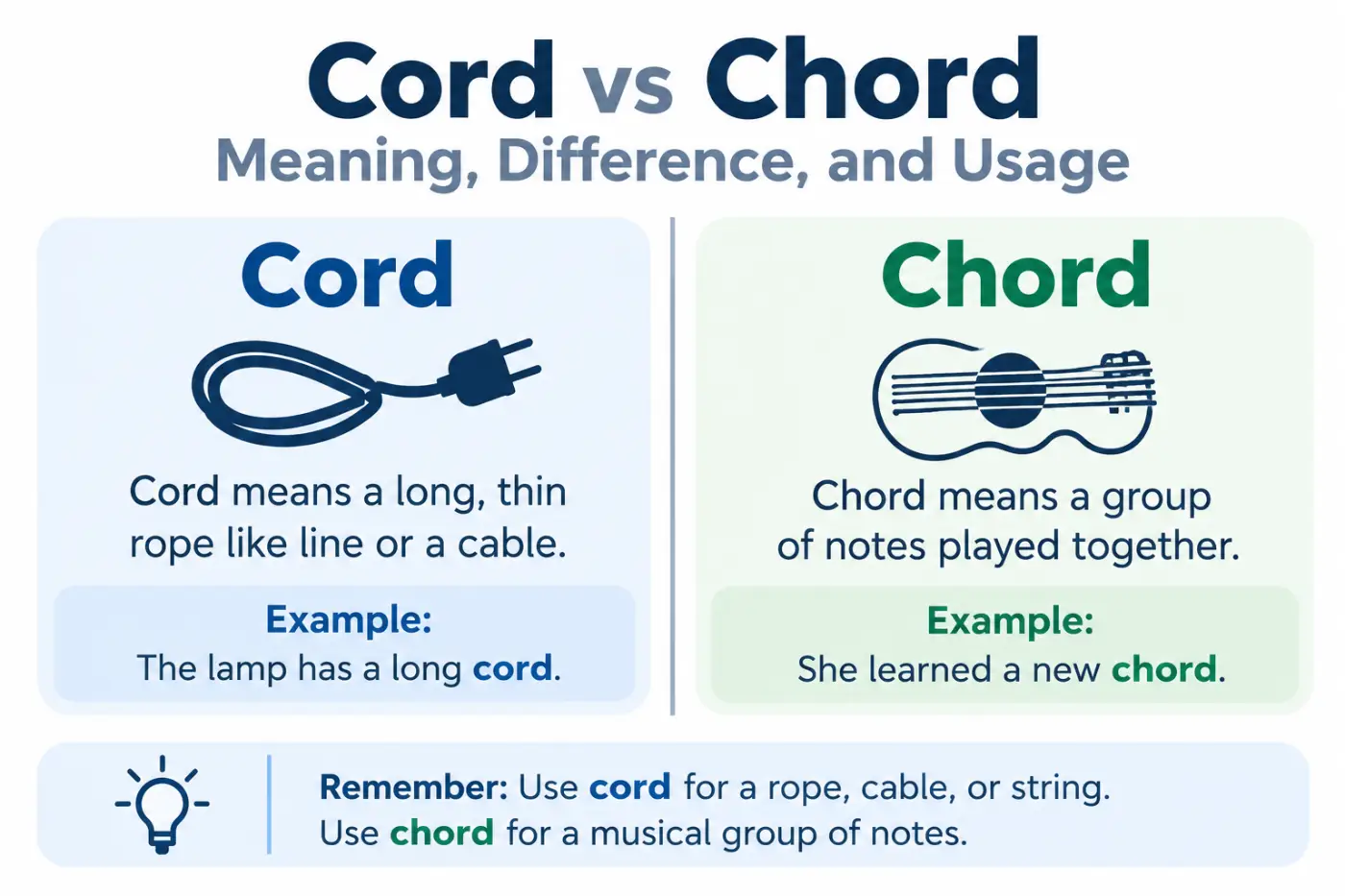
Have you ever stopped while writing because you could not decide between cord and chord? These two words sound exactly alike, but they do not mean the same thing. The correct choice depends on what you want to describe. Cord vs chord is a common English word confusion because both words share the same pronunciation, even though their meanings and spelling patterns are different.
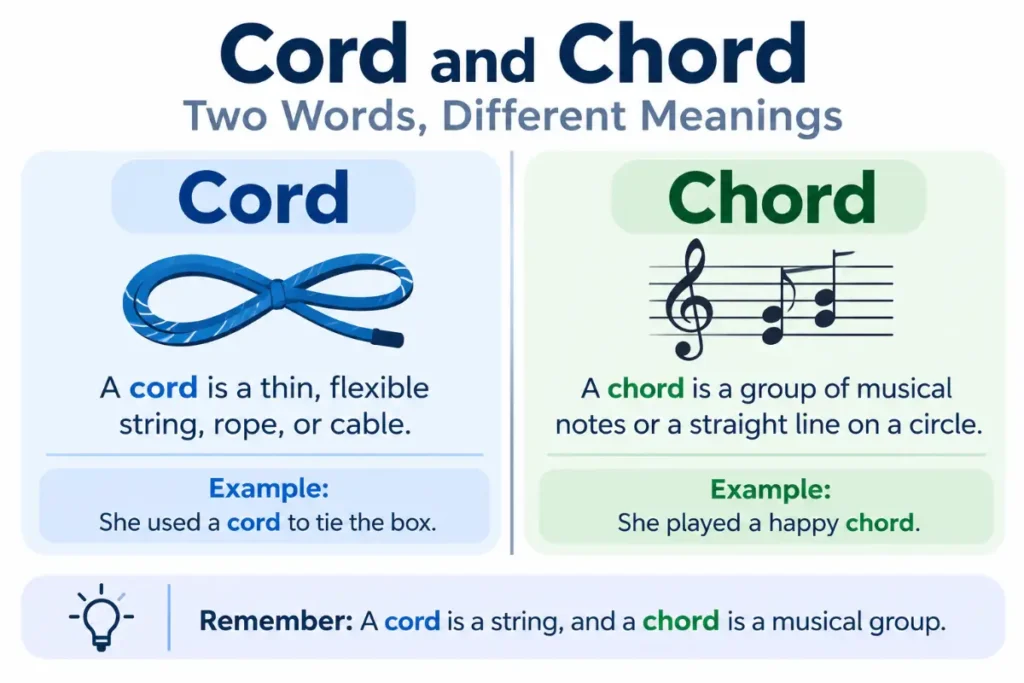
A cord usually refers to a long, thin, flexible piece of material, such as a rope, wire, or electrical cable. A chord, on the other hand, usually refers to a group of musical notes played together or a straight line connecting two points on a circle. The difference becomes easier to remember once you connect each spelling with its meaning.
This guide explains both words in simple American English. You will learn their definitions, grammatical roles, pronunciation, origins, and common uses. You will also see practical examples from everyday conversations, music, mathematics, and professional writing so you can choose the right word with confidence.
Still confused? Compare Dual vs Duel Which Word Should You Use?.
Quick Answer
Cord and chord are both correct English words, but they have different meanings. A cord is a thin, flexible string, rope, or cable used for connecting, tying, or carrying something. A chord is a group of musical notes played together or a straight line connecting two points on a circle.
Comparison Table
| Feature | Cord | Chord |
|---|---|---|
| Main meaning | A thin rope, string, or cable | A group of musical notes or a line in geometry |
| Part of speech | Noun | Noun |
| Pronunciation | /kɔːrd/ | /kɔːrd/ |
| Origin | From Old French and Latin roots | From Greek through Latin |
| Common contexts | Electricity, clothing, tools, household items | Music, mathematics, geometry |
| Formality | Standard in formal and informal English | Standard in formal and informal English |
| Example | The lamp has a long power cord. | She played a beautiful chord on the piano. |
Meaning and Definition
Although these words sound identical, they describe different things. Understanding their individual meanings is the best way to avoid confusing them in writing.
What Does Cord Mean?
A cord is a long, narrow, flexible material used for tying, connecting, supporting, or carrying something. It can be made from cotton, nylon, plastic, or other materials. In everyday life, you may see cords attached to electrical devices, clothing, bags, and household equipment.
For example, a phone charger has a cord that connects the device to a power source. A drawstring cord helps tighten a bag or a pair of sweatpants. A thick cord may also serve as a small rope for lifting or securing objects.
The word can describe several related objects:
- A rope or string: A piece of flexible material used to tie or hold something.
- An electrical cable: A flexible wire that carries electricity to a device.
- A clothing detail: A string or narrow strip used to adjust or fasten clothing.
- A medical structure: A long, narrow structure in the body, such as the spinal cord or vocal cords.
- A unit of measurement: A cord is also a standard unit used to measure firewood.
The word also appears in compound terms. Examples include power cord, extension cord, vocal cord, spinal cord, and corduroy. Each expression has its own meaning, but the spelling remains the same.
What Does Chord Mean?
A chord is most commonly used in music and mathematics. In music, it refers to three or more different notes played together to create harmony. These notes can be played on instruments such as a piano, guitar, or keyboard.
For example, when a guitarist presses several strings at the same time, the instrument produces a chord. A pianist can also play several notes together to create a musical sound.
In mathematics, a chord is a straight line segment that connects two points on the circumference of a circle. It does not need to pass through the center. A diameter is a special type of chord because it connects two points on a circle and passes through its center.
The word has several common uses:
- Music: A combination of notes that creates harmony.
- Geometry: A straight line segment connecting two points on a circle.
- Emotional expression: A phrase such as strike a chord means to create a strong feeling or connection.
- Figurative language: A story, comment, or experience can strike a chord with an audience.
For example, a song may strike a chord with listeners because its lyrics remind them of an important experience. In this expression, the word has a figurative meaning connected to music and emotion.
Is Chord a Real Word?
Yes. Chord is a standard English word. It is not a misspelling of cord. It has established meanings in music and geometry, and it also appears in common expressions such as strike a chord.
The spelling is important because replacing it with cord can change the meaning of a sentence. For example, a musician plays a chord, not a cord. A circle has a chord, not a cord.
Is Cord a Real Word?
Yes. Cord is also a standard English word. It describes a flexible string, rope, or cable and appears in many everyday expressions.
For example, you plug an appliance into an electrical outlet using a power cord. You might also use a cord to tie a package or adjust the waist of a garment.
It is not an incorrect version of the musical term. Both words have their own meanings and should be used in the right context.
Key Differences Explained
The main difference is meaning. Their pronunciation is identical, but their spelling and usage depend on the subject of the sentence.
1. Difference in Spelling
The first word is spelled C O R D. The second is spelled C H O R D.
The additional letter H in chord does not change how the word sounds. It is simply part of its established spelling. You need to remember the complete word instead of relying on pronunciation.
2. Difference in Meaning
Cord describes a physical object, usually something long and flexible. Chord describes a musical combination of notes or a geometric line inside a circle.
Consider these examples:
- The computer’s power cord is damaged.
- The musician played a soft chord.
The first sentence describes an electrical cable. The second describes a musical sound.
3. Difference in Grammar
Both words function mainly as nouns. They can appear as singular or plural nouns and can be used as subjects or objects.
Examples:
- The cord is too short.
- The cords are tangled.
- This chord sounds beautiful.
- The chords create a pleasant melody.
Their grammatical roles are similar, but their meanings remain separate.
4. Difference in Pronunciation
There is no difference in standard pronunciation. Both words are homophones, which means they sound alike but have different meanings and spellings.
This is the main reason people confuse them. You cannot always identify the correct spelling by listening to a sentence. You must understand its meaning.
5. Difference in Context
The surrounding words usually make the intended meaning clear.
Use cord when discussing:
- Electrical devices and cables.
- Ropes and strings.
- Clothing fasteners.
- Body structures such as the spinal cord.
- Measurements of firewood.
Use chord when discussing:
- Musical notes and harmony.
- Guitar and piano playing.
- Circles and geometric shapes.
- Emotional responses in expressions such as strike a chord.
6. Difference in Formality
Both forms are accepted in standard American English. Neither is more formal or more professional than the other.
The important factor is accuracy. A technical report about electrical equipment should use cord for a cable. A music lesson should use chord for a combination of notes.
7. Difference in Regional Usage
There is no major spelling difference between American and British English. Both varieties use cord for a flexible string or cable and chord for the musical and geometric meanings.
The same basic distinction applies in Australian and Canadian English.
Which Spelling Is Correct?
Both spellings are correct. The right choice depends on the meaning you want to express.
Use cord when referring to a physical string, rope, cable, or similar object. Use chord when referring to a combination of musical notes, a line segment in a circle, or an emotional connection expressed through a phrase.
For example:
- Correct: The extension cord reaches the other side of the room.
- Correct: The piano player practiced the same chord repeatedly.
- Correct: The line drawn inside the circle is a chord.
Neither word is a misspelling of the other. They are separate words with different meanings.
A useful way to check your choice is to replace the word with a simple definition. If you mean a cable or string, choose cord. If you mean musical harmony or a geometric line, choose chord.
10 Natural Sentence Examples
The following sentences show how these words work in everyday and professional situations.
Examples Using Cord
- Everyday conversation: Can you move the power cord so nobody trips over it?
- Household use: I need a longer extension cord to reach the wall outlet.
- Clothing: The cord around my hoodie came loose after washing.
- Workplace communication: Please check the printer cord before calling the repair team.
- Science and health: The spinal cord carries messages between the brain and the rest of the body.
Examples Using Chord
- Music: She learned a new guitar chord during her lesson.
- School: The teacher explained how a chord connects two points on a circle.
- Academic writing: The student identified the chord that passed through the center of the diagram.
- Social situations: His honest speech struck a chord with everyone in the room.
- Online communication: That song struck a chord with listeners who had experienced the same loss.
Notice that the surrounding subject helps identify the correct spelling. Words such as guitar, melody, and circle often point toward chord. Words such as cable, charger, and rope usually point toward cord.
Common Mistakes and Misspellings
People often confuse these words because they sound the same. The following mistakes show how to recognize the correct form.
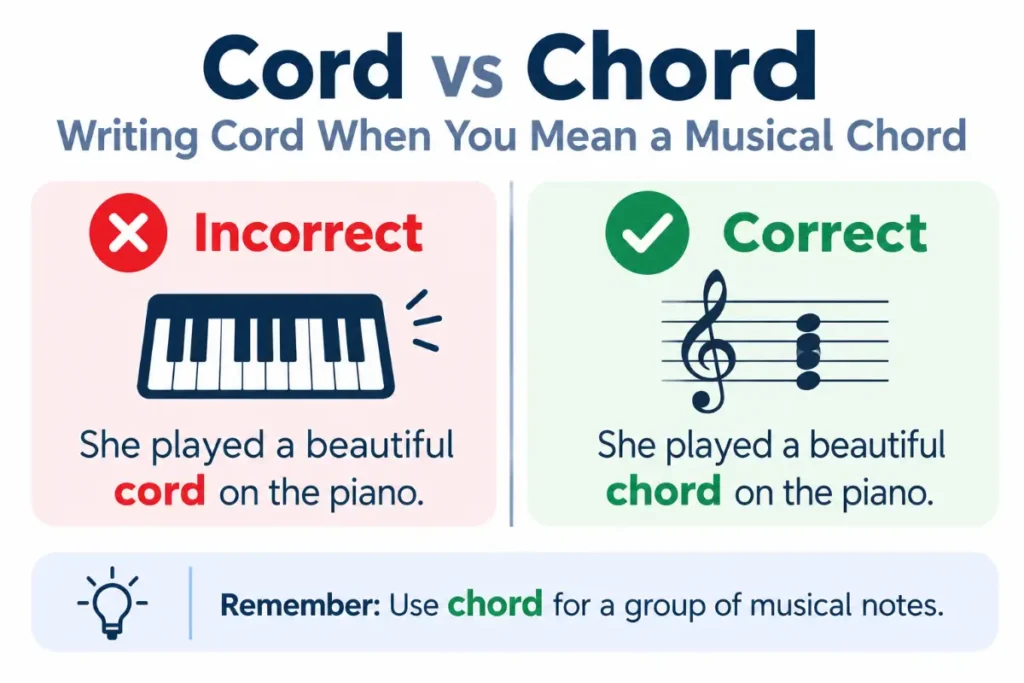
1. Writing Cord When You Mean a Musical Chord
Incorrect: She played a beautiful cord on the piano.
Correct: She played a beautiful chord on the piano.
The sentence refers to a group of musical notes, so chord is the correct spelling. Cord would describe a physical string or cable.
2. Writing Chord When You Mean an Electrical Cable
Incorrect: The computer chord is damaged.
Correct: The computer cord is damaged.
An electrical cable is called a cord. The word chord does not describe an ordinary power cable.
3. Confusing a Circle Chord With a Physical Cord
Incorrect: Draw a cord between two points on the circle.
Correct: Draw a chord between two points on the circle.
In geometry, a chord is a straight line segment joining two points on a circle. The spelling with H is required for this mathematical meaning.
4. Using Cord in the Expression Strike a Chord
Incorrect: Her story struck a cord with the audience.
Correct: Her story struck a chord with the audience.
The expression comes from the idea of a musical chord producing a sound that connects with someone. It means that something creates a strong emotional response or feels personally meaningful.
5. Assuming the H Changes the Pronunciation
Some learners expect chord to have a different sound because it contains an extra letter. However, both words are pronounced the same way in standard English.
The letter H affects the spelling, not the usual pronunciation. You must learn the meanings rather than trying to hear a difference.
Pronunciation Guide
Both words have the same pronunciation in standard American English.
| Word | IPA | Easy Pronunciation | Syllables |
|---|---|---|---|
| Cord | /kɔːrd/ | KORD | One |
| Chord | /kɔːrd/ | KORD | One |
How to Pronounce Cord
Start with the K sound, followed by the vowel sound in words such as more or north in many American accents. Finish with the R sound and a clear D.
The word has one syllable. You do not need to separate it into smaller spoken parts.
How to Pronounce Chord
Pronounce chord exactly like cord. Start with the same K sound, use the same vowel, and finish with R and D.
The H is silent in this word. It does not create a separate sound.
Common Pronunciation Mistakes
- Trying to pronounce the H: The H in chord is not pronounced separately.
- Adding another syllable: Both words have only one syllable.
- Changing the vowel sound: Their standard vowel sounds are the same.
- Relying on sound to choose the spelling: Listening alone will not tell you which word belongs in a sentence.
Because these are homophones, context is the best guide when writing them.
Still confused? Compare one-third or one third Correct Spelling and Usage.
Etymology and Word Origin
The two words have different histories. Their shared pronunciation does not mean they developed from the same word.
Origin of Cord
The word cord entered English through Old French. Its history goes back to Latin chorda, which referred to a string or the string of a musical instrument. The Latin term came from Greek khordē, meaning a string or gut used to make strings.
Over time, English developed the spelling cord for a flexible string or rope. Its meaning expanded to cover cables, electrical connections, and several structures in the human body.
The modern word appears in familiar expressions such as power cord, spinal cord, and vocal cord.
Origin of Chord
The word chord also comes from the Greek word khordē through Latin and French. It developed as a musical term associated with strings and musical sounds.
In English, chord became the established spelling for a combination of musical notes. Its use later expanded into geometry, where it describes a straight line segment connecting two points on a circle.
The expression strike a chord developed from the musical meaning. It now describes something that creates a strong emotional response.
Why Do They Sound the Same?
Both words share historical roots connected with the Greek term for a string. Their spellings developed differently as English adopted and adapted words from other languages.
Today, the H in chord remains part of the spelling, but it is not pronounced. This is why the two words sound alike even though their written forms differ.
Regional Usage
The distinction between these words remains consistent across major English varieties. There is no common regional spelling rule that changes one into the other.
American English
In the United States, cord refers to a rope, string, cable, or similar object. It is common in expressions such as extension cord, power cord, and spinal cord.
Chord is used in music and geometry. American speakers also use the phrase strike a chord to describe an emotional connection.
Examples:
- I bought a new cord for my laptop.
- The guitarist played a major chord.
British English
British English follows the same basic distinction. Cord refers to a flexible string or cable, while chord refers to musical notes or a line in a circle.
Examples:
- The lamp needs a longer electrical cord.
- The pianist practiced the opening chord.
Some related vocabulary may differ between American and British English, but the spelling of these two words does not change.
Australian English
Australian English also uses cord for cables, strings, and ropes. Chord remains the standard term in music and geometry.
Examples:
- The extension cord was too short.
- He learned a new chord on the guitar.
Canadian English
Canadian English follows the same pattern as American and British English. The choice depends on meaning rather than location.
Examples:
- The phone cord was tangled.
- The song begins with a simple chord.
In all four varieties, the words are pronounced alike and have distinct meanings.
Grammar Rules and Part of Speech
Both words are nouns. They can be used in singular and plural forms, and they can appear in several positions within a sentence.
Cord as a Noun
Cord is a countable noun when it refers to an individual string, rope, or cable.
Examples:
- The cord is tangled.
- I bought two new cords.
- She tied the package with a strong cord.
It can also form part of compound nouns. Examples include extension cord, power cord, and vocal cord.
In some expressions, cord refers to a structure or unit rather than an ordinary cable. For example, spinal cord names a part of the nervous system, while a cord of wood describes a standard volume of stacked firewood.
Chord as a Noun
Chord is also a countable noun. In music, it names a combination of notes. In geometry, it names a line segment inside a circle.
Examples:
- This chord sounds cheerful.
- The guitarist played several chords.
- The diagram shows a chord inside the circle.
The word can also appear in figurative expressions. In the phrase strike a chord, it refers to an emotional response rather than a physical musical action.
Singular and Plural Forms
Both words form their plurals by adding S.
| Singular | Plural | Example |
|---|---|---|
| Cord | Cords | The cords are behind the desk. |
| Chord | Chords | The musician practiced several chords. |
Do not add an extra E or change the spelling when forming the plural.
Common Grammatical Patterns
The following patterns can help you use each word naturally.
Cord patterns:
- Power cord.
- Extension cord.
- Electrical cord.
- A cord of wood.
- Tie something with a cord.
Chord patterns:
- Play a chord.
- Learn a chord.
- A major chord.
- A chord in a circle.
- Strike a chord with someone.
Can These Words Be Verbs?
In ordinary modern English, both words are mainly used as nouns. Their common uses do not require you to treat them as verbs.
For example, you play a chord rather than chord a piano. You connect a device using a cord rather than cord the device.
If you need an action word, choose a verb that describes the activity clearly, such as connect, tie, play, or draw.
Punctuation and Formal Writing
Neither word needs special punctuation. Use normal sentence punctuation and choose the spelling that matches the meaning.
In formal writing, accuracy matters especially in technical subjects. A geometry lesson should use chord, while an electrical safety report should use cord.
Real Life Usage Examples
These examples show how the two words appear in different settings.
Daily Conversation
People use cord when talking about common household objects. They use chord when discussing music or describing an emotional reaction.
- Can you unplug the cord before moving the television?
- I love the opening chord of that song.
The meaning is clear from the objects and activities in each sentence.
Email and Workplace Communication
In professional communication, the correct word helps prevent confusion, especially in technical instructions.
- Please replace the damaged power cord before using the machine again.
- The music team should review the final chord progression before the performance.
The first sentence concerns equipment safety. The second concerns the musical structure of a performance.
Academic Writing
Both words appear in academic subjects, but they belong to different areas of study.
- The biology textbook explains how the spinal cord sends signals through the nervous system.
- The geometry problem asks students to calculate the length of a chord.
In the first example, the word belongs to biology. In the second, it belongs to mathematics.
News and Journalism
News articles may use cord in reports about household safety, electrical equipment, and health. Chord can appear in coverage of music, entertainment, and human interest stories.
- Officials advised residents to check damaged electrical cords after the storm.
- The singer’s emotional performance struck a chord with the audience.
The second example uses the common figurative expression.
Literature and Storytelling
Writers use both words to create clear descriptions. A cord can be part of a physical scene, while a chord can help describe music or an emotional connection.
- She pulled the small cord, and the curtains opened slowly.
- The old melody struck a chord in his heart, bringing back memories of childhood.
The first example describes an action. The second uses musical language to express emotion.
Related and Confused Terms
Several words and expressions are connected with these two terms. Learning them can help you understand their meanings more clearly.
1. Cable
A cable is a thick or strong group of wires or fibers used to carry electricity, data, or force. A cord is often more flexible and may be used for smaller electrical connections.
Example: The computer cable connects the monitor to the system.
2. Rope
A rope is a thick, strong length of twisted or braided material. A cord is often thinner, although the exact size depends on its use.
Example: We used a rope to secure the boat.
3. String
String is a thin material used for tying or fastening things. It is often lighter and thinner than a cord.
Example: She tied the gift box with a piece of string.
4. Wire
Wire is a thin strand of metal used for electrical, mechanical, or construction purposes. A cord may contain one or more wires covered by an insulating material.
Example: The electrician checked the exposed wire.
5. Melody
A melody is a sequence of musical notes that forms a recognizable tune. A chord is a group of notes played together.
Example: The melody was easy to remember, and the chords supported it.
6. Harmony
Harmony describes the combination of musical notes that sound pleasing together. Chords are one important part of musical harmony.
Example: The singer added harmony to the main melody.
7. Diameter
A diameter is a line segment that passes through the center of a circle and connects two points on its circumference. It is a special type of chord.
Example: The diameter divides the circle into two equal halves.
8. Radius
A radius is a line segment from the center of a circle to a point on its circumference. Unlike a chord, it connects the center to the edge rather than joining two points on the circumference.
Example: The radius measures half the length of the diameter.
The Meaning of Strike a Chord
One expression deserves extra attention because it is a common source of spelling mistakes.
To strike a chord means to create a strong emotional response or make someone feel personally connected to something. The expression comes from music, where striking or playing notes creates a sound that can affect listeners.
Examples:
- The film struck a chord with people who had lost loved ones.
- Her speech struck a chord with the students.
- The song struck a chord because it reminded me of my childhood.
The correct spelling always uses H in this expression. Writing strike a cord is a common mistake because the two words sound the same.
The expression can be used in casual conversations, news reports, reviews, and formal writing. It is especially useful when describing a story, message, song, or experience that connects with an audience.
Expert Editor Insight
An experienced English editor looks at the subject and meaning before choosing between these spellings. If a sentence discusses a cable, string, or rope, cord is the natural choice. If it discusses musical notes, geometry, or an emotional connection, chord is correct. Spelling and grammar tools may identify a sentence as grammatically correct even when the wrong homophone appears, so automatic checks cannot always catch this mistake. A quick meaning check is often more reliable than a spelling suggestion.
For another common grammar confusion, see atleast or at least correct spelling meaning and usage.
Conclusion
The difference between cord vs chord comes down to meaning, not pronunciation. Cord refers to a flexible string, rope, or cable, while chord refers to musical notes played together or a line connecting two points on a circle. Both are correct English words, and neither is a misspelling of the other.
Remember this simple tip: a power cord connects a device, while a musical chord creates harmony. When you are unsure, look at the subject of your sentence before choosing the spelling. That small habit will help you use both words accurately in everyday and formal writing.
FAQs
Which Is Correct Cord or Chord?
Both are correct English words. Cord refers to a flexible string, rope, or cable. Chord refers to a group of musical notes or a straight line connecting two points on a circle. The correct choice depends on the sentence. Neither spelling is a general replacement for the other.
Is Chord a Real Word?
Yes. Chord is a standard English word used in music and geometry. In music, it means a combination of notes played together. In geometry, it means a straight line segment joining two points on a circle. It also appears in the expression strike a chord, which describes an emotional connection.
What Does Cord Mean?
Cord is a noun that describes a long, narrow, flexible material used for tying, connecting, or supporting things. Common examples include electrical cords, extension cords, and clothing cords. The word also appears in terms such as spinal cord and vocal cord, which describe structures in the human body.
What Does Chord Mean in Music?
In music, a chord is a group of different notes played together to create harmony. Musicians use chords on instruments such as guitars, pianos, and keyboards. A chord can help create the mood of a song and support its melody. Common examples include major chords and minor chords.
How Do You Pronounce Cord and Chord?
Both words are pronounced exactly the same way in standard American English. Their IPA pronunciation is /kɔːrd/, and each has one syllable. The H in chord is silent, so it does not create an extra sound. Since they are homophones, you must use their meanings to choose the correct spelling.
Why Do People Confuse These Two Words?
People confuse them because they have identical pronunciation but different spellings and meanings. English contains many homophones, which can make spelling difficult when you rely only on sound. The best way to avoid mistakes is to connect cord with cables and strings, and chord with music and geometry.
What Does Strike a Chord Mean?
Strike a chord means to create a strong emotional response or connect with someone’s feelings or experiences. For example, a song may strike a chord with listeners because its message reminds them of something personal. The expression always uses chord because it comes from the musical meaning of the word.
Is Cord or Chord More Appropriate in Formal Writing?
Both words are appropriate in formal writing, but they are used in different contexts. Use cord in technical reports about cables, equipment, or anatomy. Use chord in music lessons, mathematical explanations, and figurative expressions. Choosing the correct meaning is more important than choosing one spelling as more formal.