
Choosing between would and will can be confusing because both words help express ideas about the future, intentions, and actions. However, they do not communicate exactly the same meaning. One often describes a future action, a promise, or a strong intention, while the other can express a hypothetical situation, a polite request, or a repeated action in the past.
The difference becomes easier to understand when you look at the situation behind the sentence. For example, I will help you expresses a firm intention. I would help you suggests a condition, a possibility, or a willingness that may depend on something else. A small change in wording can completely change the message.
Understanding would vs will helps you speak more naturally, write clearer emails, and avoid common grammar mistakes. This guide explains their meanings, sentence patterns, pronunciation, and differences with practical examples. You’ll also learn how to choose the right word in conversations, workplace communication, academic writing, and everyday situations.
For another common grammar confusion, see simpler or more simple Which Form Is Correct.
Quick Answer
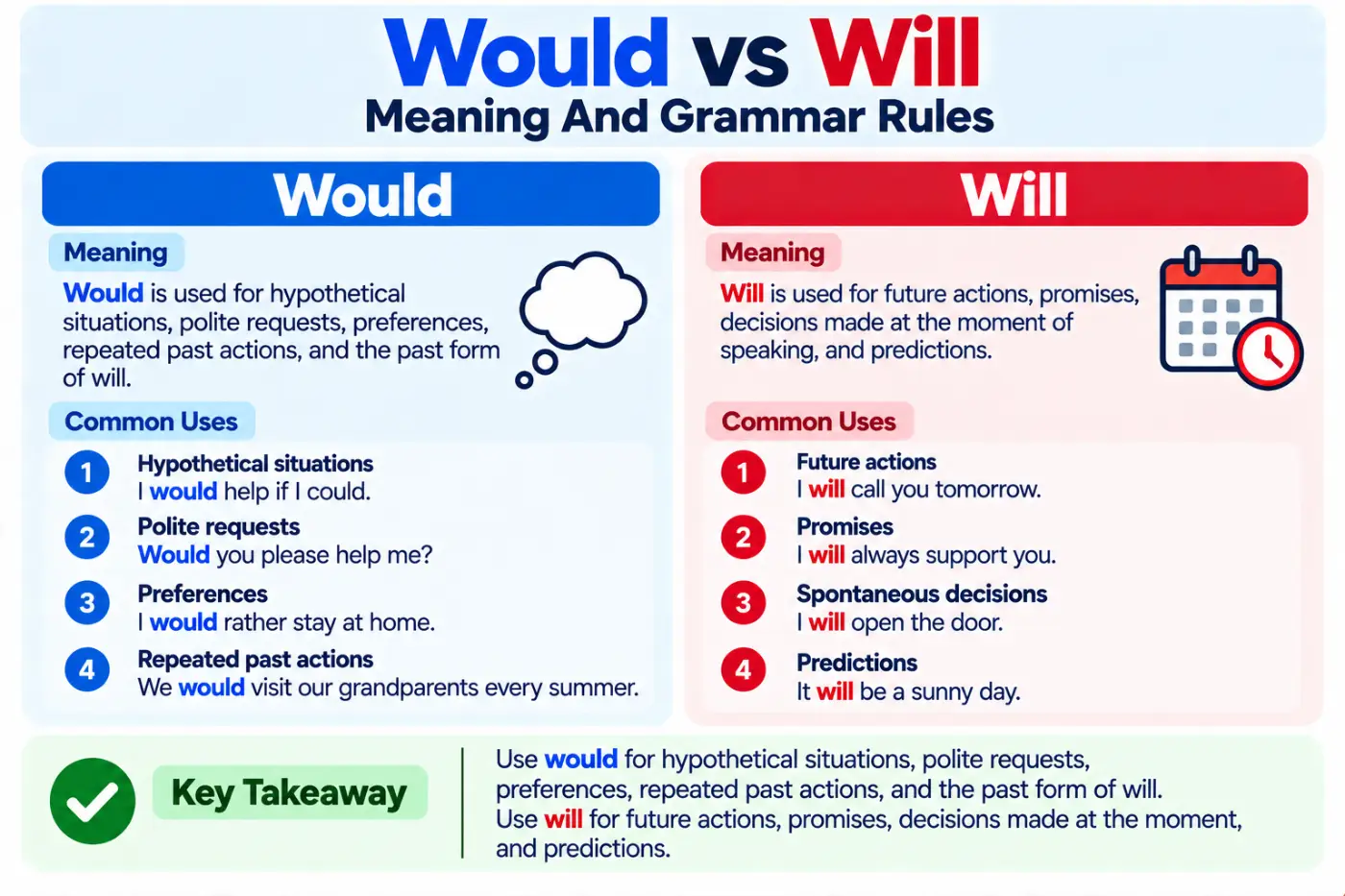
Will expresses a future action, prediction, promise, decision, or willingness. Would commonly expresses a hypothetical result, polite request, preference, future possibility viewed from the past, or repeated past action. Both are correct English modal verbs, but they serve different purposes. The right choice depends on the meaning and context of your sentence.
Comparison Table
| Feature | Will | Would |
|---|---|---|
| Part of speech | Modal auxiliary verb | Modal auxiliary verb |
| Main function | Expresses future actions and intentions | Expresses hypothetical or conditional situations |
| Common meaning | Future certainty, intention, promise | Possibility, politeness, willingness, imagined results |
| Time reference | Often future | Past, present, or future depending on context |
| Grammar pattern | Will + base verb | Would + base verb |
| Formality | Neutral | Neutral, often more polite in requests |
| Conditional use | Common in the main clause of first conditionals | Common in second and third conditional structures |
| Past habits | Not its main function | Describes repeated past actions |
| Example | I will call you tonight. | I would call you if I had your number. |
Meaning and Definition
Both forms belong to a group of helping verbs called modal auxiliary verbs. They come before the main verb and change the meaning of the sentence. They can express ideas such as possibility, intention, willingness, prediction, and imagined situations.
The main difference is the speaker’s meaning. Will often presents something as expected, intended, or decided. Would often creates distance from a direct statement by expressing a condition, a polite attitude, or an imagined outcome.
What Does Will Mean?
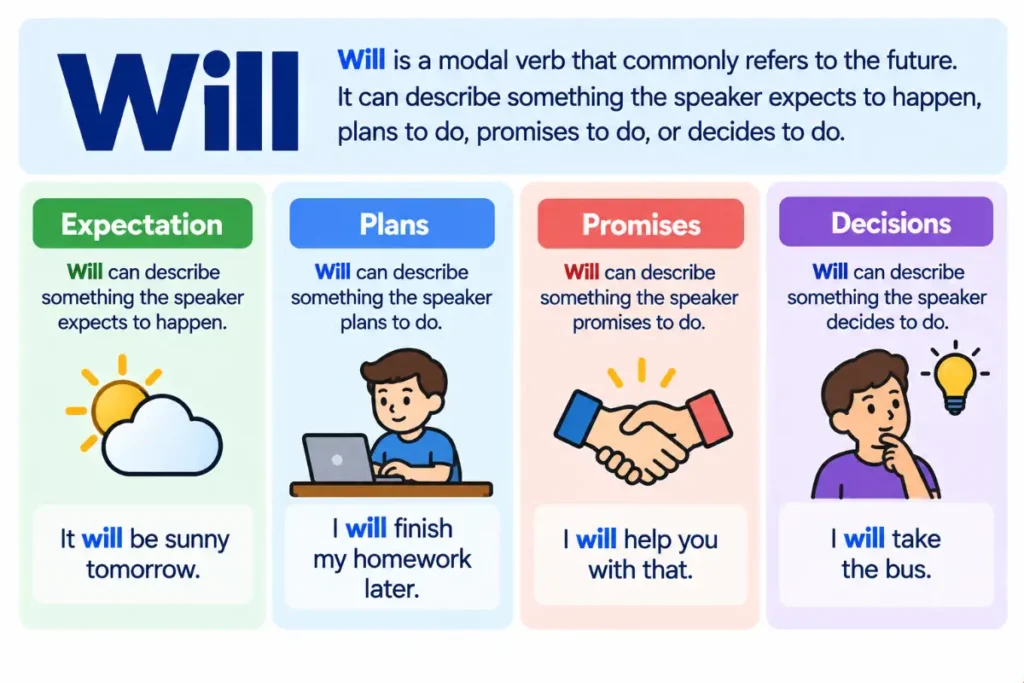
Will is a modal auxiliary verb that commonly expresses future actions, predictions, promises, decisions, and willingness. It helps describe something that the speaker expects, plans, or intends to happen.
Consider these examples.
- I will finish the report tomorrow.
- She will probably arrive before noon.
- We will support your decision.
- I’ll answer the phone.
- The weather will improve later.
In each example, the speaker presents an action or event as a future possibility, intention, or expectation.
Will can also express a spontaneous decision. For example, if someone asks who will make dinner, you might answer, I’ll cook tonight. The decision happens as you speak.
It also communicates a promise or commitment. Saying I will help you sounds more direct than I would help you because the speaker is expressing a clear intention.
What Does Would Mean?
Would is a modal auxiliary verb with several uses. It can describe hypothetical situations, polite requests, preferences, willingness, repeated past actions, and future events viewed from a past point in time.
For example:
- I would travel more if I had enough money.
- Would you please close the door?
- She said she would call me.
- When we were children, we would play outside every evening.
- I would prefer tea instead of coffee.
The word often makes a statement less direct or presents an action as dependent on a condition.
In the sentence I would travel more if I had enough money, the speaker is imagining an action that depends on having more money. The action is not presented as a definite plan.
Would also makes requests sound more considerate. Would you help me with this task? is generally softer than Will you help me with this task?
Is Would a Past Form of Will?
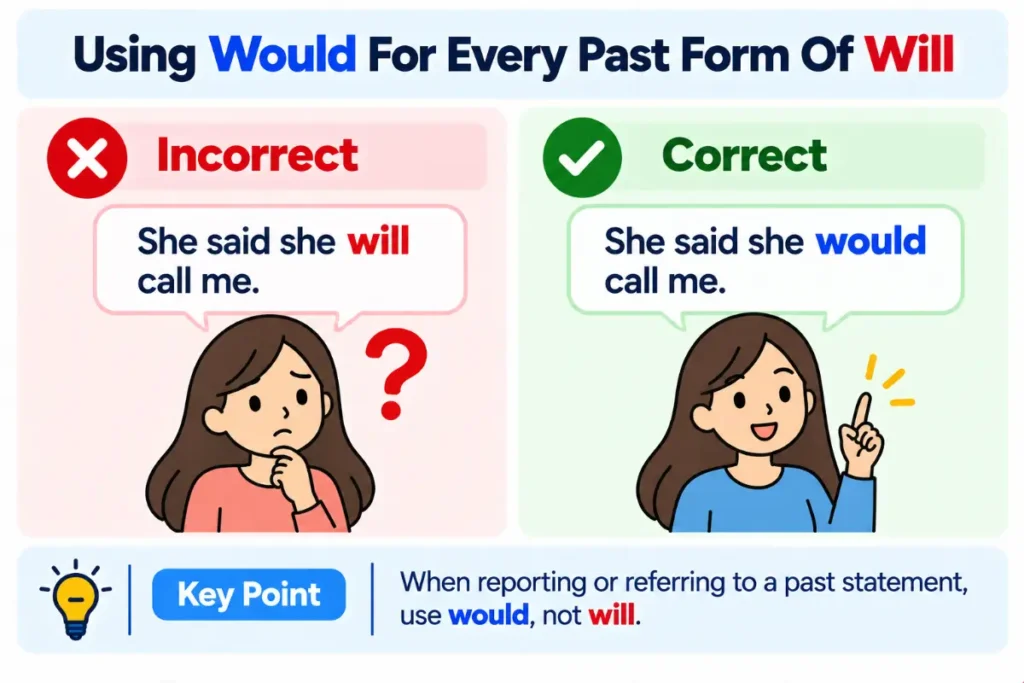
Yes. Would is traditionally described as the past form of will, especially in reported speech and future in the past constructions. However, it has several independent uses in modern English.
Compare these sentences.
- Direct speech: He says, I will visit tomorrow.
- Reported speech: He said he would visit the next day.
The second sentence moves the reporting point into the past. The original future action is now viewed from an earlier moment.
However, would does not always refer to past time. In I would buy that house if I had enough money, it describes a hypothetical present or future situation.
Key Differences Explained
The most useful way to understand these verbs is to compare what the speaker wants to communicate. The difference is not simply that one refers to the future and the other refers to the past. Both can appear in sentences about future events, but their grammatical roles and meanings differ.
1. Future Actions and Intentions
Will is the usual choice for a direct statement about a future action.
Examples:
- I will send the documents this afternoon.
- They will open the new store next month.
Would can describe a future action from a past viewpoint or an imagined situation.
Examples:
- She promised she would send the documents.
- I would visit the store if I had time.
The first pair expresses direct expectations or intentions. The second pair places the action inside a reported statement or a condition.
2. Predictions and Possibilities
Will often communicates a prediction that the speaker considers likely.
For example:
- This plan will work.
- The train will arrive soon.
Would can make a prediction sound conditional or dependent on certain circumstances.
For example:
- That plan would work with more funding.
- The train would arrive sooner if the weather were better.
The second form shows that the result depends on an imagined change.
3. Promises and Willingness
Will often expresses a clear promise or commitment.
- I will always support you.
- I will take care of the problem.
Would can express willingness, especially in conditional or polite statements.
- I would be happy to help.
- I would gladly join your team.
The difference is subtle but useful. The first form makes a direct commitment, while the second often sounds more tentative or courteous.
4. Polite Requests
Both words can appear in questions, but they create different tones.
- Will you open the window?
- Would you open the window?
The first question is direct and natural in everyday conversation. The second usually sounds more polite or less forceful.
Would you mind helping me? is another common polite expression. It asks for cooperation without sounding like an order.
5. Hypothetical Situations
Would is strongly associated with imagined situations and conditional sentences.
For example:
- I would move abroad if I found a good job.
- She would buy the car if it were cheaper.
These sentences describe possible outcomes that depend on conditions.
Will commonly appears in the result clause of a first conditional sentence.
For example:
- If I find a good job, I will move abroad.
- If the price drops, she will buy the car.
The difference is the speaker’s view of the situation. The first conditional presents a realistic future possibility. The second conditional presents a more imaginary or less likely situation.
6. Repeated Actions in the Past
Would can describe habits or repeated actions from an earlier period.
For example:
- My grandfather would tell us stories every night.
- We would visit our cousins during summer vacation.
This use describes repeated behavior, not a single completed event.
Will can also describe habitual behavior in the present, especially when the speaker wants to emphasize a typical or predictable action.
For example:
– He will often forget where he leaves his keys.
This use is less common in basic grammar lessons but is perfectly natural.
7. Formality and Tone
Neither form is automatically more formal in every situation. The tone depends on the sentence.
Will sounds direct and confident in a promise or decision. Would often sounds more considerate in a request or more cautious in a hypothetical statement.
In professional communication, both are useful.
- I will send the revised proposal by Friday.
- I would appreciate your feedback on the proposal.
The first sentence communicates a commitment. The second makes a polite request.
Which Form Is Correct?
Both words are correct. Neither is a misspelling, and neither should replace the other in every sentence. The correct choice depends on the grammatical structure and the intended meaning.
Use will when you want to express:
- A future action.
- A promise or commitment.
- A decision made at the moment of speaking.
- A prediction or expectation.
- A direct offer or statement of willingness.
Use would when you want to express:
- An imagined or hypothetical situation.
- A polite request.
- A preference.
- A future action viewed from a past point.
- A repeated action in the past.
- A conditional result.
A useful editing rule is to identify the meaning before choosing the verb. If the sentence describes a direct future intention, will is often appropriate. If it describes an imagined result, polite request, or past viewpoint, would may be the better choice.
Sentence Examples
The following examples show how both forms work in natural English.
Examples With Will
- Everyday conversation: I will meet you outside the restaurant at seven.
- Text message: I’ll send you the photos when I get home.
- Workplace communication: We will review your application by Friday.
- School: The teacher will explain the assignment tomorrow.
- Academic writing: The next section will examine the main causes of climate change.
- Formal writing: Our office will contact you after reviewing your request.
- Social situations: I’ll bring some snacks to the party.
- Online communication: This update will make the app easier to use.
- Personal promise: I will never share your private information.
- Prediction: The new library will attract more visitors.
Examples With Would
- Everyday conversation: I would love to visit that museum.
- Text message: Would you like to grab coffee later?
- Workplace communication: I would appreciate an update on the project.
- School: I would choose a different topic for my research paper.
- Academic writing: This approach would provide a clearer explanation of the results.
- Formal writing: We would be grateful for your response.
- Social situations: Would you like to join us for dinner?
- Online communication: I would recommend this tool to new users.
- Conditional situation: She would accept the offer if the salary were higher.
- Past habit: My family would spend every winter holiday at my grandparents’ house.
Common Mistakes and Grammar Confusion
Many errors happen because speakers focus on the future meaning of a sentence without considering its structure. Others come from translating directly from another language or using a modal verb that sounds natural but changes the intended message.
Here are five common mistakes to watch for.
1. Using Will in an Imaginary Conditional
Incorrect: If I had more free time, I will learn French.
Correct: If I had more free time, I would learn French.
The sentence describes an imagined situation. The second conditional normally uses a past form in the if clause and would in the main clause. The past form does not mean the situation happened in the past. It signals distance from reality.
2. Using Would for a Direct Future Promise
Less appropriate: I would send the file tomorrow.
Clearer: I will send the file tomorrow.
The first sentence can sound conditional or uncertain without more context. If you are making a direct promise, the second form communicates your intention more clearly.
However, would is correct in a sentence such as I said I would send the file tomorrow. Here, the speaker is reporting an earlier promise.
3. Adding To After a Modal Verb
Incorrect: She will to attend the meeting.
Correct: She will attend the meeting.
Incorrect: He would to help us.
Correct: He would help us.
Modal verbs take the base form of the main verb directly. Do not place to between the modal and the verb. The same pattern applies to can, could, may, might, and must.
4. Changing the Main Verb Into Its Past Form
Incorrect: They would went to the beach.
Correct: They would go to the beach.
Incorrect: I will finished the work.
Correct: I will finish the work.
The main verb stays in its base form after both modals. Do not add a past tense ending or an extra form of the verb simply because the sentence refers to a different time.
5. Using Both Modals Together Incorrectly
Incorrect: I will would help you.
Correct: I will help you.
Correct: I would help you.
In standard English, you cannot normally place one central modal directly after another. Choose the modal that matches your meaning. If you need to express a future action inside a hypothetical situation, restructure the sentence rather than combining the two forms.
Pronunciation Guide
The two words are easy to confuse in speech because they share similar sounds. However, their vowel sounds are different.
| Word | IPA | Syllables | Easy pronunciation |
|---|---|---|---|
| Will | /wɪl/ | 1 | wil |
| Would | /wʊd/ | 1 | wood |
Both words have one syllable and carry no additional syllable stress.
How to Pronounce Will
Will sounds like the beginning of the word window. It has a short vowel sound, similar to the vowel in sit.
To pronounce it:
- Start with the /w/ sound.
- Use the short /ɪ/ vowel.
- Finish with a light /l/ sound.
How to Pronounce Would
Would sounds like wood. The first sound is /w/, followed by the short /ʊ/ vowel and a final /d/ sound.
The letter combination ou does not have the same pronunciation in every English word. In this word, it creates a short vowel sound rather than the sound heard in house.
Common Pronunciation Mistakes
Some learners pronounce would as if it rhymed with loud or could. That is incorrect. Would rhymes with good and should in common American pronunciation.
Another common mistake is making the final d too strong. In natural speech, the ending may be light, especially when another consonant follows.
Many readers also check Tear vs Tare: What is the Difference? (2026).
Etymology and Word Origin
The two forms share a historical connection. Both developed from Old English forms of the verb that became modern will, which expressed ideas related to wanting, wishing, and intending.
The Origin of Will
Will comes from Old English willan, meaning to want, wish, or intend. Over time, the word developed into an auxiliary verb used to express future meaning and other forms of intention.
This historical development helps explain why modern English uses it for promises, willingness, decisions, and predictions. The idea of intention remains part of its meaning.
The Origin of Would
Would developed from the Old English past form wolde of willan. It later became the modern form used in conditional statements, reported speech, polite requests, and descriptions of past habits.
Its connection to an earlier form of will explains the traditional grammar description of would as its past form. Modern usage, however, has expanded beyond simple past time.
Regional Usage
There is no major spelling difference between American and British English for these two words. Both forms are standard in the main English varieties, including American, British, Australian, and Canadian English.
American English
In the United States, both words appear regularly in conversation, business writing, education, and formal communication. Americans commonly use will for future plans and promises, while would appears in polite requests and hypothetical sentences.
For example:
- I’ll call you after work.
- Would you mind sending me the address?
British English
British English follows the same basic grammar rules. Both forms are used for future meaning, reported speech, conditions, and polite requests.
For example:
- I will see you tomorrow.
- I would like a cup of tea.
Some expressions may vary by region or personal preference, but the core distinction remains the same.
Australian English
Australian English also uses both modal verbs according to the same standard grammar patterns. Everyday speech may favor contractions such as I’ll and I’d, but the meaning and basic sentence structure remain consistent.
Canadian English
Canadian English follows the same general rules as American and British English. Speakers use will for direct future statements and would for hypothetical situations, polite requests, and reported speech.
The key difference is grammatical, not regional.
Grammar Rules and Sentence Structure
Both words are modal auxiliary verbs. They help the main verb express the speaker’s attitude toward an action or event. Their grammar is fairly simple, but a few rules are worth learning.
1. Use the Base Form of the Main Verb
After either modal, use the base form of the verb.
- She will arrive soon.
- She would arrive early if she could.
- We will discuss the issue.
- We would discuss the issue if everyone were available.
Do not add to, an s ending, or a past tense ending after the modal.
2. Form Negative Sentences
To make a negative statement, place not after the modal.
With will, use will not or the contraction won’t.
- I will not attend the event.
- I won’t forget your advice.
With would, use would not or wouldn’t.
- She would not agree with that decision.
- I wouldn’t say that in public.
The contractions are common in conversation and informal writing. Full forms can be useful when you want to emphasize the negative meaning or maintain a more formal tone.
3. Form Questions
Place the modal before the subject to create a question.
- Will you join us?
- Would you like some water?
- Will they arrive on time?
- Would she accept the invitation?
This pattern is called subject and auxiliary inversion. It is a normal feature of questions in English.
4. Use Will in First Conditional Sentences
A first conditional sentence describes a realistic or possible future situation.
The usual pattern is:
If + present simple, will + base verb.
Examples:
- If it rains, we will stay home.
- If you study, you will improve.
- If the store is open, I will buy some milk.
The if clause uses the present simple, even though it refers to a future event.
5. Use Would in Second Conditional Sentences
A second conditional sentence describes an imaginary, unlikely, or unreal situation in the present or future.
The usual pattern is:
If + past simple, would + base verb.
Examples:
- If I won the lottery, I would buy a house.
- If she lived closer, we would visit her more often.
- If I were you, I would speak to the manager.
In formal and standard conditional grammar, were is often used for all subjects in unreal statements, as in If I were you.
6. Use Would in Third Conditional Sentences
The third conditional describes an imagined past result. It often refers to something that did not happen.
The usual pattern is:
If + past perfect, would have + past participle.
Examples:
- If I had left earlier, I would have caught the train.
- If they had studied harder, they would have passed the exam.
- She would have joined us if she had known about the event.
This structure expresses regret, criticism, or an imagined alternative to the past.
7. Use Would in Reported Speech
When reporting a statement made in the past, will often changes to would.
Direct speech: Maria said, I will finish the project.
Reported speech: Maria said she would finish the project.
This change is known as backshift. It is common when the reporting verb is in the past, though speakers do not always need to backshift if the original statement remains true or relevant.
8. Use Would for Preferences and Polite Offers
Would is common in expressions that make requests, offers, and preferences sound considerate.
Examples:
- I would like a glass of water.
- Would you like to come with us?
- I would rather stay home tonight.
- Would you mind waiting for a moment?
These expressions are especially useful in customer service, professional communication, and polite everyday conversation.
Real Life Usage Examples
Grammar rules become easier to remember when you see how people use these words in real situations.
Daily Conversation
In everyday conversation, will often communicates plans, quick decisions, and promises.
- I’ll meet you at the entrance.
- Don’t worry. I will help you carry those bags.
Would often appears in polite questions and imagined situations.
- Would you like to sit here?
- I would go out tonight, but I have too much work.
Email and Workplace Communication
Professional writing uses both forms. Will is useful for deadlines, commitments, and clear updates. Would helps make requests and suggestions sound more courteous.
- I will share the updated report before the end of the day.
- We will contact you after the interview process.
- I would appreciate your comments on the attached draft.
- Would you be available for a short meeting tomorrow?
The choice affects the tone. A direct commitment should sound confident, while a request should remain respectful.
Academic Writing
In academic writing, will can describe the structure of a paper, a future research step, or an expected outcome.
- This chapter will examine the relationship between language and identity.
- The next section will explain the research method.
Would is useful when discussing hypothetical results, limitations, or possible interpretations.
- A larger sample would provide stronger evidence.
- This method would produce different results under controlled conditions.
Academic writers should choose the form that accurately reflects the level of certainty and the logic of the argument.
News and Journalism
News writing often uses will to report expected events, announced plans, and future developments.
- The city will open a new public park next month.
- Officials say the new policy will take effect in January.
Would can appear when reporting earlier expectations or describing conditional outcomes.
- The company said the new factory would create hundreds of jobs.
- The project would face delays if funding were reduced.
The context tells readers if the statement is a current prediction or an expectation reported from an earlier point in time.
Literature and Storytelling
Writers use will to create a sense of intention, determination, or prediction.
- I will find the truth, no matter how long it takes.
- One day, the old house will reveal its secrets.
Would can describe past habits, imagined events, or a character’s polite manner.
- Every evening, the old man would sit beside the window.
- She would never admit how much she missed home.
These choices help establish time, character, and mood.
Related and Confused Terms
Several other English words and expressions overlap with the meanings of these two modal verbs. Learning their differences can help you choose more precise language.
1. Shall
Shall is another modal verb used for future meaning, offers, and suggestions. It is more common in certain formal contexts and in questions such as Shall we begin?
In everyday American English, will is usually more common for ordinary future statements.
2. Should
Should expresses advice, expectation, duty, or a recommended action.
- You should get more sleep.
- The package should arrive tomorrow.
It is not a direct substitute for will or would. The sentence You should call her gives advice, while You will call her predicts or states an action.
3. Could
Could expresses possibility, ability in the past, or a polite request.
- I could help you tomorrow.
- Could you open the door?
Would often focuses on willingness or an imagined result, while could emphasizes ability or possibility.
4. Might
Might expresses uncertainty or possibility.
- It might rain this afternoon.
- She might join us later.
Will generally sounds more confident than might. Would can also express possibility, but often places it within a condition or imagined situation.
5. May
May can express permission or possibility.
- You may leave early.
- It may snow tonight.
In formal situations, may can sound more official than can. It does not normally express the same direct intention as will.
6. Going To
Going to is a common way to describe plans and predictions based on present evidence.
- I am going to visit my parents.
- Look at those clouds. It is going to rain.
Will is often used for spontaneous decisions and promises, while going to commonly describes an existing plan or an evidence based prediction. The difference is not absolute, and the forms sometimes overlap.
7. Used To
Used to describes past habits or past situations that are no longer true.
- I used to play tennis every weekend.
- She used to live in Chicago.
Would can also describe repeated past actions, but it does not usually describe a past state in the same way.
For example, I would visit my grandmother every Sunday is natural. I would live in Chicago as a description of a former state is not normally appropriate. I used to live in Chicago is the better choice.
8. Had Better
Had better expresses strong advice or a warning about a likely result.
- You had better leave now.
- We had better check the schedule.
It is stronger than should and has a different purpose from would. It does not simply express a future action or an imagined result.
Expert Editor Insight
An experienced English editor looks at meaning and sentence structure before changing a modal verb. A sentence may be grammatically correct but still communicate the wrong level of certainty, politeness, or intention. Editors pay close attention to conditional clauses, reported speech, and the base form of the main verb. Grammar tools can identify errors such as will to go, but they may not understand the writer’s intended tone. Reading the sentence in context is often the best way to make the right choice.
Key Takeaways
- Will commonly expresses future actions, predictions, promises, decisions, and willingness.
- Would commonly expresses hypothetical situations, polite requests, preferences, reported future actions, and repeated past actions.
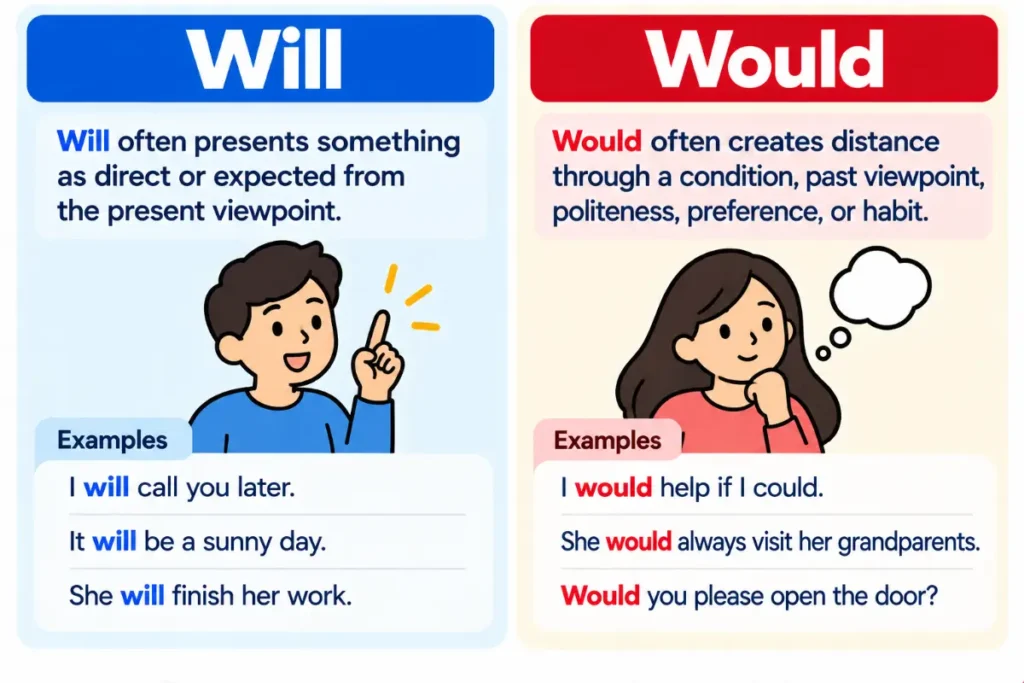
- Will often presents something as direct or expected from the present viewpoint.
- Would often creates distance through a condition, past viewpoint, politeness, preference, or habit.
- Use will in the result clause of a common first conditional.
- Use would in the result clause of a common second conditional.
- Use would when reporting a future statement from a past viewpoint.
- Use would for repeated past actions when the context clearly establishes a past period.
- Use would like for polite desires and requests.
- Use would rather to express a preference.
- Do not treat would as a simple replacement for will in every past sentence.
- Choose the modal that matches the meaning you want the reader or listener to understand.
Learn the difference in Signer or Signor Pronunciation, Meaning and Differences in 2026.
Conclusion
Understanding would vs will comes down to the meaning you want to express. Use will for direct future actions, promises, decisions, and predictions. Choose would for hypothetical situations, polite requests, preferences, reported future actions, and repeated past habits. Both are standard English modal verbs, but they do different jobs.
A simple editing tip can help: check the main verb and ask what the sentence communicates before choosing a form. If you’re making a clear commitment, will is often the right choice. If the action depends on an imagined condition or needs a softer tone, would is usually more suitable.
FAQs
Is would the past tense of will?
Yes. Would developed as the past form of will and commonly appears in reported speech. For example, He said he would call me reports an earlier statement about a future action. However, the word also expresses present or future hypothetical situations, polite requests, and past habits. Its meaning depends on the sentence.
Can I use would to talk about the future?
Yes. Would can describe a future action viewed from a past point or an imagined future result. For example, She said she would visit next week reports an earlier statement. I would travel more if I had time describes an imagined future possibility rather than a definite plan.
Which sounds more polite in a question?
Would usually sounds more polite or less direct than will. Would you help me with this task? is a considerate request, while Will you help me with this task? sounds more direct. Both are grammatically correct. Your choice depends on the relationship, situation, and tone you want to communicate.
Can would and will appear in the same sentence?
Yes, they can appear in the same sentence, but they normally do not sit together as consecutive modal verbs. For example, I will do what I would do in your position contains both forms with different grammatical roles. The first expresses a future action, while the second introduces a hypothetical idea.
Can I start a sentence with would?
Yes. Would can begin a question, a conditional statement, or a polite expression. Examples include Would you like some coffee? and Would I be able to attend the meeting? You can also begin a conditional sentence with Would, as in Would you help me if I asked?
Why do people confuse these two words?
People often confuse them because both are modal verbs and can refer to future events. Their meanings also overlap in expressions of willingness and requests. The confusion becomes easier to avoid when you focus on the sentence’s purpose. A direct promise usually calls for will, while an imagined result often calls for would.
Is would more formal than will?
Not in every situation. Would often sounds more polite in requests and more cautious in suggestions, but both words are suitable for professional and academic writing. Will is appropriate for clear commitments and future statements. Would is useful for courteous requests, hypothetical arguments, and reported expectations.
What is the difference between would and could?
Would often expresses willingness, an imagined result, or a polite preference. Could usually expresses ability or possibility. For example, I would help you suggests willingness, while I could help you suggests that helping is possible. In questions, both can sound polite, but their meanings remain different.