
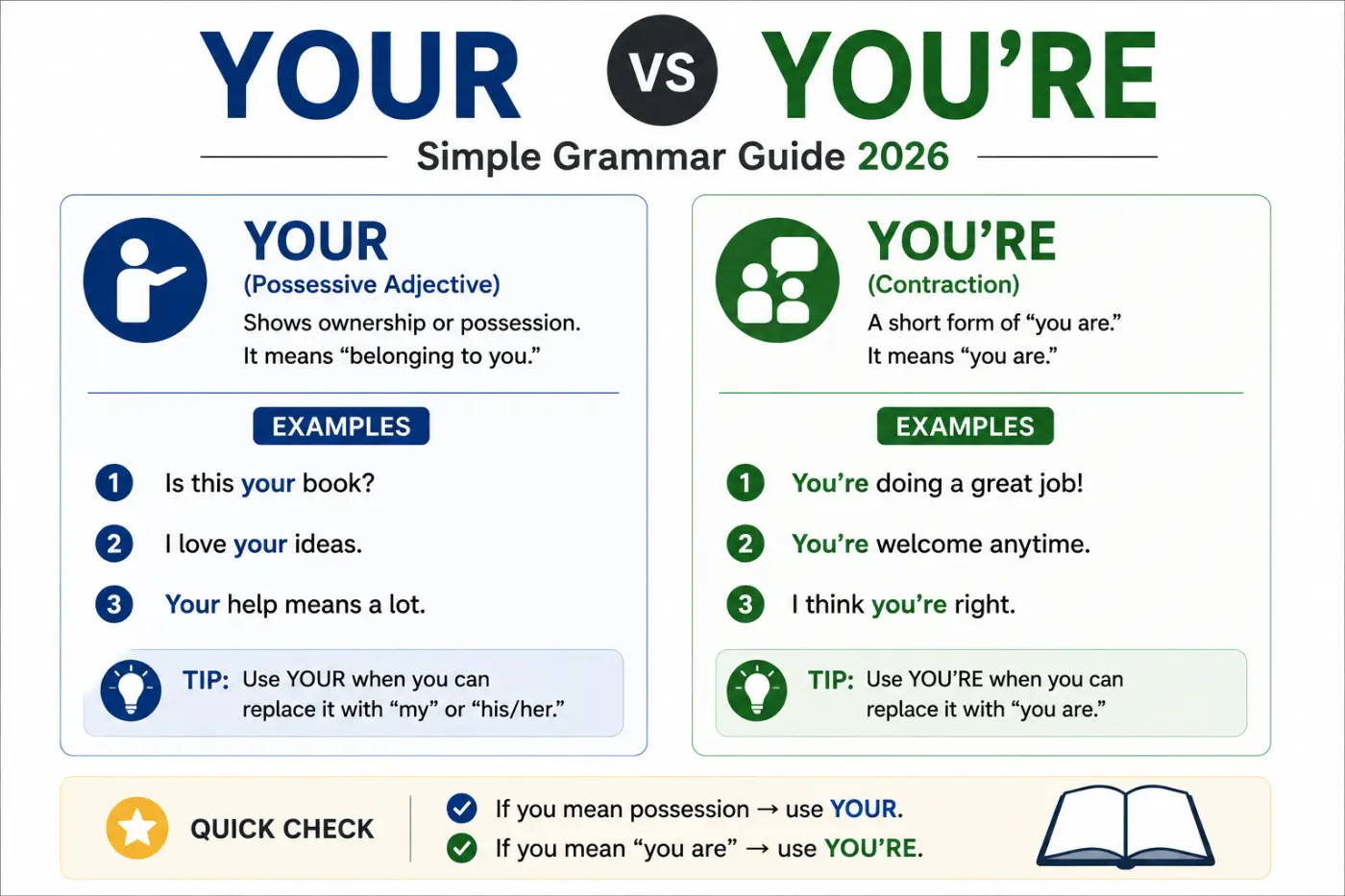
Your vs You’re is a common grammar question because these two words sound exactly alike in most English accents, but they have different meanings and grammatical functions. One shows that something belongs to someone, while the other is a shortened form of two words. Using the wrong one can change the meaning of a sentence or make your writing look less polished.
The good news is that the difference is easy to learn. You do not need to memorize complicated grammar rules or study advanced English to use these words correctly. You only need to understand what each word means and how it works in a sentence.
This guide explains the meaning of both words, shows their differences in a comparison table, and provides examples from everyday conversations, professional communication, academic writing, and published language. You will also learn simple editing tricks, common mistakes, pronunciation details, and regional usage patterns. By the end, you should be able to choose the correct word quickly and write with greater confidence.
Still confused? Compare Lay vs Lie Explained With Grammar Rules and Examples.
Quick Definition
Your is a possessive word that shows something belongs to the person or people being addressed. For example, in the sentence Your bag is on the chair, the bag belongs to you.
You’re is a contraction of you are. It combines the pronoun you with the verb are. For example, in the sentence You’re ready for the meeting, the meaning is You are ready for the meeting.
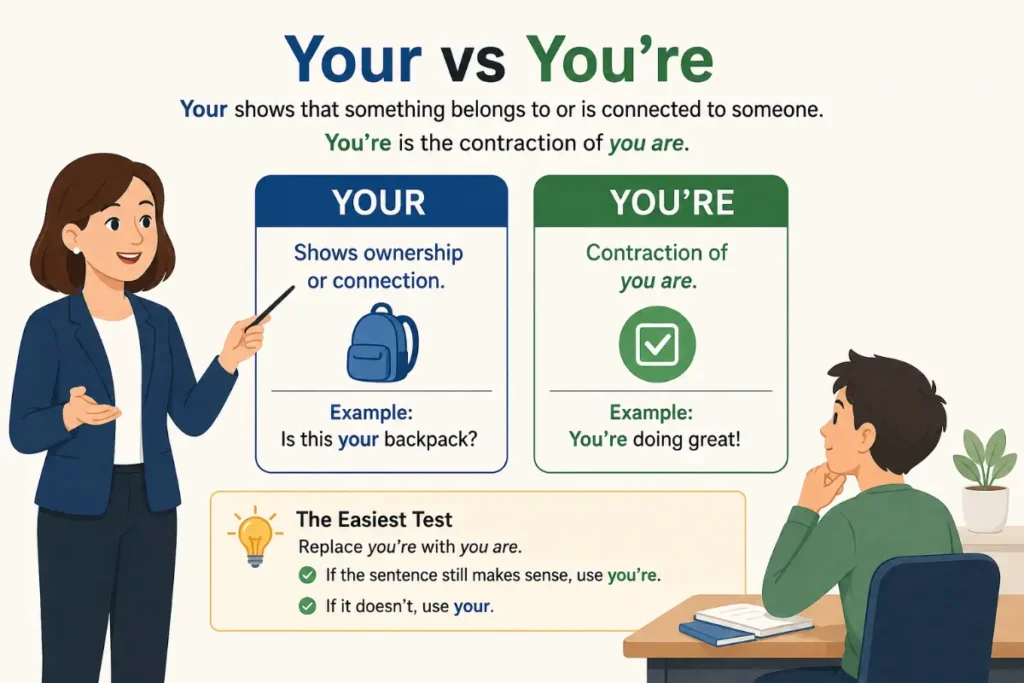
The easiest way to remember the distinction is to replace you’re with you are. If the sentence still makes sense, you’re is usually correct. If the sentence needs to show ownership, use your.
Quick Answer
Use your to show ownership or a relationship to the person you are speaking to. Use you’re when you mean you are.
For example, Your phone is ringing refers to a phone associated with you. You’re calling your friend means you are making a call to your friend.
Your vs You’re: Comparison Table
| Feature | Your | You’re |
|---|---|---|
| Meaning | Shows possession or association. | Means you are. |
| Grammar role | Possessive determiner. | Contraction. |
| Expanded form | No expanded form. | You are. |
| Main purpose | Identifies something connected to you. | Describes you or something you are doing. |
| Followed by | Often a noun. | Often an adjective, a verb form, or a phrase. |
| Example | Your answer is correct. | You’re correct. |
| Ownership | Yes. | No. |
| Can be replaced with you are. | No. | Yes. |
| Common mistake | Using it instead of you’re. | Using it to show possession. |
What Does Your Mean?
Your is a possessive determiner. It shows that something belongs to, relates to, or is associated with the person being addressed. It usually appears before a noun, helping readers understand which person, object, idea, or experience the sentence refers to.
For example, in Your jacket is wet, your identifies the jacket as belonging to or being associated with the person you are speaking to. In Your opinion matters, the word identifies whose opinion is being discussed.
Your does not always mean legal ownership. It can also describe relationships, responsibilities, experiences, or personal qualities.
Consider these examples.
- Your sister called this morning.
- Your homework is on the desk.
- Your advice helped me solve the problem.
- Your seat is near the window.
- Your patience makes difficult conversations easier.
In each example, your connects a noun with the person being addressed.
Your can also appear before words that describe a noun. For example, Your new laptop looks excellent includes the adjective new between your and the noun laptop. The word your still indicates the connection to the person being addressed.
When Should You Use Your?
Use your when you want to identify something connected to the person you are speaking or writing to.
- Use it for personal belongings. Your keys are beside the door.
- Use it for family and relationships. Your brother sent me a message.
- Use it for ideas and opinions. Your suggestion could improve the project.
- Use it for responsibilities. Your next task is to review the report.
- Use it for personal experiences. Your journey sounds interesting.
- Use it for instructions. Please write your name at the top of the page.
A useful rule is that your usually appears before a noun or a phrase built around a noun. If the sentence refers to something associated with you, your is likely the correct choice.
What Does You’re Mean?
You’re is a contraction of you are. A contraction combines two words into a shorter form, usually by removing one or more letters and using an apostrophe to mark the missing letters.
In you’re, the apostrophe replaces the missing letter a from are. The two words become one shorter word, but the original meaning remains the same.
For example, You’re helpful means You are helpful. You’re learning means You are learning. You’re at the right address means You are at the right address.
You’re does not show ownership. Instead, it describes a person, a condition, an action, or a location.
When Should You Use You’re?
Use you’re when you can replace it with you are without changing the basic meaning of the sentence.
- Use it before an adjective. You’re kind.
- Use it before a verb ending in ing. You’re studying.
- Use it before a location phrase. You’re in the right place.
- Use it before a past participle in a passive construction. You’re invited to the event.
- Use it in questions. You’re coming with us, aren’t you?
- Use it in informal communication. You’re going to love this movie.
You’re can appear in casual messages, professional emails, academic writing, and published material. The choice depends on the sentence and the writing style, not simply on how formal the situation is.
For example, You’re responsible for submitting the report is grammatically correct in a workplace email. In a highly formal document, a writer may prefer You are responsible for submitting the report because the expanded form can create a more formal tone.
Key Differences Between Your and You’re
The main difference is grammatical. Your expresses possession or association, while you’re expresses the meaning you are. Their similar pronunciation makes them easy to confuse, but their roles in a sentence are different.
1. Meaning
Your connects something to the person being addressed. You’re describes that person or an action connected to that person.
For example, Your presentation was excellent refers to a presentation associated with you. You’re excellent at presenting describes your ability.
2. Sentence Structure
Your normally comes before a noun or noun phrase. You’re functions as a pronoun and verb combination.
Compare these sentences.
- Your idea is useful.
- You’re sharing a useful idea.
In the first sentence, your modifies the noun idea. In the second sentence, you’re means you are and introduces the action sharing.
3. Apostrophe Use
Your does not contain an apostrophe. You’re needs an apostrophe because it is a contraction.
The apostrophe is important because it signals that letters have been omitted. It does not mean that you’re shows ownership. English uses apostrophes in several ways, and contractions are one of those uses.
4. Replacement Test
The easiest way to check your choice is to expand you’re into you are.
If the sentence still makes sense, you’re is likely correct.
For example, You’re late becomes You are late. The expanded sentence is grammatical.
Now try Your late. Replacing your with you are produces You are late, but that changes the sentence instead of expanding the original word. The original sentence needs a possessive form only if a noun follows, as in Your late arrival surprised us.
5. Formal and Informal Writing
Both forms are standard English and can appear in formal or informal writing. Your is required when showing possession, regardless of the setting. You’re is also grammatically correct, although some formal styles prefer the expanded form you are.
The key is to choose the form that fits the intended meaning and follow any style requirements for the document.
Which One Is Correct?
Both your and you’re are correct English words. Neither is more correct than the other in every situation. The correct choice depends on the meaning of the sentence.
Use your when referring to something connected to the person being addressed.
Example: Your report needs one more revision.
Use you’re when the intended meaning is you are.
Example: You’re making excellent progress.
The mistake occurs when writers use one word in a sentence that requires the other. For example, You’re report needs one more revision is incorrect because you’re cannot show possession. Your making excellent progress is also incorrect when the intended meaning is you are making excellent progress.
A quick check can prevent both errors. First, identify the intended meaning. Then test you’re by replacing it with you are. If the replacement does not work and the sentence refers to something associated with the reader, your is probably the right choice.
10 Example Sentences Using Your and You’re
The following examples show how the two forms work in everyday English.
1. Your coffee is getting cold. The word your identifies whose coffee is being discussed.
2. You’re going to enjoy the concert. You’re means you are.
3. Please bring your notebook to class. Your shows which notebook the speaker means.
4. You’re doing a great job on this assignment. You’re means you are doing.
5. Your appointment begins at three o’clock. Your connects the appointment to the person being addressed.
6. You’re welcome to join us for dinner. You’re means you are welcome.
7. I like your new haircut. Your identifies the haircut associated with the person being addressed.
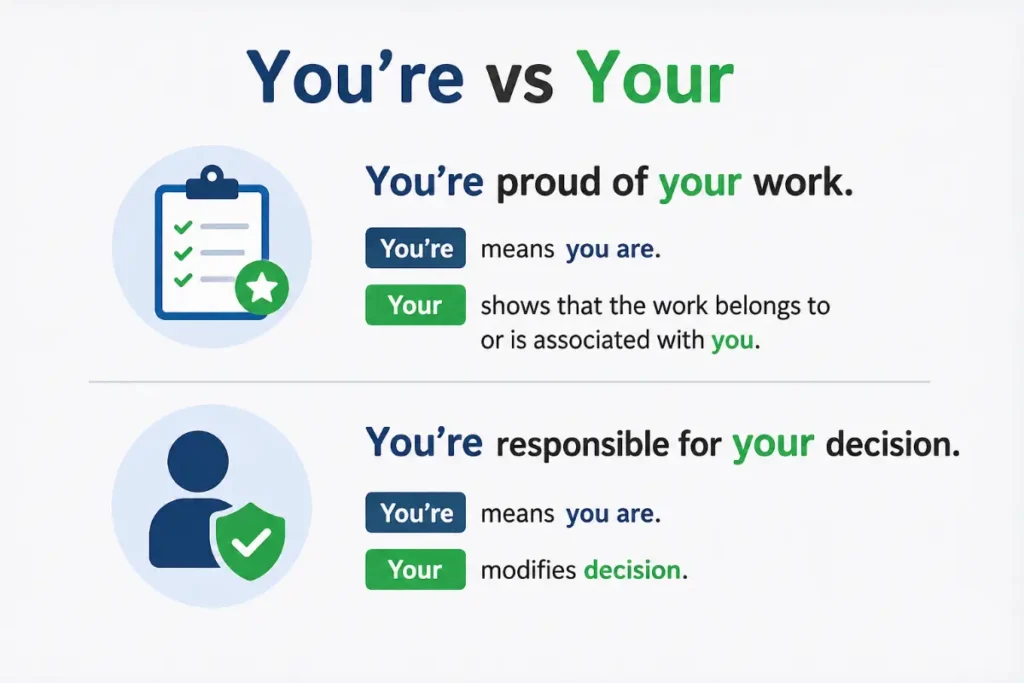
8. You’re responsible for checking the final figures. You’re means you are responsible.
9. Could you share your notes with me? Your refers to the notes belonging to or held by the person being addressed.
10. You’re almost ready to leave. You’re means you are almost ready.
Notice that the sentence structure offers clues. Your generally introduces a noun, such as coffee, notebook, appointment, haircut, or notes. You’re can be followed by a description, an action, or a phrase that completes the meaning of you are.
5 Common Mistakes With Your and You’re
Even fluent English speakers sometimes confuse these words, especially when typing quickly. The following mistakes are common, but each has a simple correction.
Mistake 1. Writing You’re Welcome When Showing Possession
Incorrect: You’re phone is on the table.
Correct: Your phone is on the table.
The sentence refers to a phone associated with the person being addressed. It does not mean you are phone, so the contraction is incorrect.
Mistake 2. Using Your Before an Adjective Without a Noun
Incorrect: Your very kind.
Correct: You’re very kind.
In the intended meaning, the sentence describes the person. Expanding you’re gives You are very kind, which is grammatical. Your would need a noun, as in Your kind words made me smile.
Mistake 3. Assuming Every Word Ending in Are Needs an Apostrophe
Some writers add an apostrophe automatically because the sentence contains a description or a verb. That approach can lead to mistakes.
Incorrect: Your going to be late.
Correct: You’re going to be late.
The sentence means You are going to be late. The contraction is necessary because the sentence contains the meaning you are.
Mistake 4. Confusing Possession With Description
Incorrect: I like you’re style.
Correct: I like your style.
Style is a noun connected to the person being addressed. The sentence does not mean I like you are style. Your is therefore the correct choice.
Mistake 5. Trusting Spell Check Alone
A spell checker may not flag the wrong word because both your and you’re are correctly spelled. The problem is grammatical context rather than spelling.
Incorrect: Your invited to the meeting.
Correct: You’re invited to the meeting.
The intended meaning is You are invited to the meeting. Proofreading for meaning is more reliable than depending on spelling tools alone.
A related grammar guide is World Class vs World-Class Which Form Is Correct.
Pronunciation of Your and You’re
In most varieties of English, your and you’re are pronounced the same way or very similarly. This makes them homophones, which are words that share a pronunciation but have different meanings or spellings.
A common pronunciation for both words is /jʊr/ or /jɔːr/, depending on the speaker’s accent. Some speakers pronounce them with a sound closer to /jər/. The exact vowel can vary across regions and individual speaking styles.
Because their pronunciation is often identical, listening alone may not help you decide which spelling to use. Context and grammar provide the answer.
For example, if someone says Your room is ready, the word before room identifies whose room is being discussed. If someone says You’re ready, the contraction means you are ready.
When speaking, most people do not need to think about the spelling because the meaning is clear from context. When writing, however, you must choose the form that matches the intended sentence.
Etymology and Word Origins
The words your and you’re developed through different paths in English.
Your comes from older forms of English possessive pronouns. Its history is connected to the second person plural forms used in earlier stages of the language. Over time, English developed different forms for addressing people, and your became the standard possessive determiner used with you.
You’re developed through contraction. English speakers commonly shorten combinations of words in speech and writing. You are became you’re, with an apostrophe marking the missing letter. This pattern is similar to contractions such as they’re for they are and we’re for we are.
The apostrophe in you’re is not a marker of possession. It marks the omitted letter in the contraction. This is a useful distinction because apostrophes can serve different grammatical purposes in English.
Although the two forms look and sound similar, their histories and grammatical functions differ. Understanding those functions is more useful for everyday writing than memorizing their origins alone.
Regional Usage in the United States, United Kingdom, Australia, and Canada
The distinction between your and you’re is consistent across major varieties of English. Speakers in the United States, United Kingdom, Australia, and Canada use your to show possession and you’re as a contraction of you are.
United States
American English uses both forms in everyday conversation, workplace communication, education, and publishing. You’re is common in informal and professional messages, while you are may be preferred in some formal contexts.
Examples include Your order has shipped and You’re scheduled for an interview tomorrow.
United Kingdom
British English follows the same grammatical distinction. Your indicates possession or association, while you’re means you are. Differences in pronunciation may affect how the words sound, but they do not change the spelling rules.
Examples include Your train leaves in ten minutes and You’re in the right queue.
Australia
Australian English also uses both forms according to the same rules. In casual messages, contractions are common, but writers still need to distinguish between possession and the meaning you are.
Examples include Your parcel has arrived and You’re doing well.
Canada
Canadian English uses the same standard distinction. Both forms appear in schoolwork, emails, news writing, and everyday communication. Canadian pronunciation can vary, but the grammatical rules remain the same.
Examples include Your appointment is confirmed and You’re welcome to attend.
Across these regions, the main issue is not regional grammar. It is the fact that the words often sound alike. Writers can use the same replacement test regardless of their location.
Grammar Rules for Using Your and You’re Correctly
A few basic grammar rules can help you choose the right word quickly.
Rule 1. Use Your Before a Noun
Your generally comes before a noun or noun phrase.
Examples include your house, your favorite book, your next appointment, and your excellent work.
The noun may be followed by additional information, as in Your new colleague from London is here. Your still indicates a connection to the person being addressed.
Rule 2. Use You’re When You Mean You Are
If the sentence describes the person or an action they perform, you’re may be correct.
Examples include You’re helpful, You’re learning quickly, and You’re at the correct address.
Try expanding the contraction into you are. If the sentence remains grammatical and retains its intended meaning, you’re is appropriate.
Rule 3. Do Not Use Your as a Substitute for You Are
Your cannot perform the grammatical job of a subject and verb combination.
Incorrect: Your making too much noise.
Correct: You’re making too much noise.
The corrected sentence means You are making too much noise. Your would need a noun, as in Your noise is distracting.
Rule 4. Do Not Use You’re to Show Possession
You’re cannot indicate that an object or quality belongs to someone.
Incorrect: You’re shoes are muddy.
Correct: Your shoes are muddy.
The noun shoes requires the possessive determiner your.
Rule 5. Consider the Whole Sentence
Do not decide based on the word immediately after your or you’re alone. Look at the full sentence to understand the intended meaning.
For example, You’re welcome is correct because it means You are welcome. Your welcome was appreciated is also correct, but it has a different meaning because welcome is being used as a noun.
Grammar depends on how words function together, so context matters.
Rule 6. Proofread for Meaning
When editing, pause at each occurrence of your or you’re. Ask yourself what the sentence is supposed to mean. If it refers to ownership or association, use your. If it means you are, use you’re.
This quick check is especially helpful when writing under time pressure.
Real Life Examples of Your and You’re
The distinction becomes easier to understand when you see the words in realistic situations.
Daily Conversation
1. Your umbrella is still in my car.
This sentence refers to an umbrella associated with the listener.
2. You’re going to miss the bus if you do not hurry.
This sentence means You are going to miss the bus.
Workplace Communication
1. Your presentation is scheduled for Thursday morning.
Your identifies the presentation associated with the recipient.
2. You’re responsible for sending the revised document to the team.
You’re means you are responsible. The contraction is grammatically correct in a workplace message.
Academic Writing
1. Your essay needs a clearer thesis statement.
Your refers to the essay written by the student.
2. You’re expected to include evidence from the assigned readings.
You’re means you are expected. In a highly formal academic document, the writer might choose You are expected instead, depending on the style guide.
News Writing
1. Your local council has announced changes to parking rules.
This example addresses the reader directly and refers to the council connected to the reader’s area.
2. You’re likely to see longer delays during the morning commute.
You’re means you are likely. A news article using a conversational style may use the contraction to speak directly to readers.
Literature and Creative Writing
1. Your words will stay with me long after this day.
Your indicates that the words belong to or come from the person being addressed. This sentence could appear in a poem, novel, or personal letter.
2. You’re stronger than you think.
You’re means you are. This kind of direct statement is common in dialogue because contractions often make characters sound natural.
These examples show that both forms can appear in many kinds of writing. The essential difference remains the same regardless of the setting.
8 Related Terms Worth Knowing
Understanding a few related grammar terms can make the distinction easier to remember.
1. Possessive determiner. A word placed before a noun to show possession or association, such as your, my, or their.
2. Contraction. A shortened form of two words, such as you’re for you are.
3. Pronoun. A word that stands in for a noun or refers to a person or thing. You is a personal pronoun.
4. Verb. A word that expresses an action, state, or condition. Are is a form of the verb be.
5. Apostrophe. A punctuation mark used in contractions and some possessive forms.
6. Homophone. A word that sounds the same as another word but has a different meaning or spelling.
7. Noun phrase. A group of words built around a noun, such as your new laptop.
8. Subject and verb agreement. The grammar rule that a subject and its verb must work together correctly. In you’re, the subject is you and the verb is are.
These terms provide a helpful foundation for understanding why the words behave differently in sentences.
Expert Editor Insight
Professional editors often correct your and you’re errors by checking meaning rather than relying only on spelling tools. Both words are valid English forms, so automated software may accept an incorrect choice if the sentence remains technically possible in another context.
For example, the phrase Your welcome can be correct in a sentence such as Your welcome message was thoughtful. However, if the writer intends to respond politely to someone who says thank you, the correct expression is You’re welcome, meaning You are welcome.
This illustrates why context matters. The same sequence of words can be correct or incorrect depending on the intended meaning.
A useful editing habit is to read the sentence aloud while mentally expanding every you’re into you are. If the sentence becomes awkward or changes meaning, check the original wording. Then review every your to confirm that it introduces a noun or noun phrase.
This method is fast, practical, and effective for emails, reports, assignments, and social media posts.
Key Takeaways
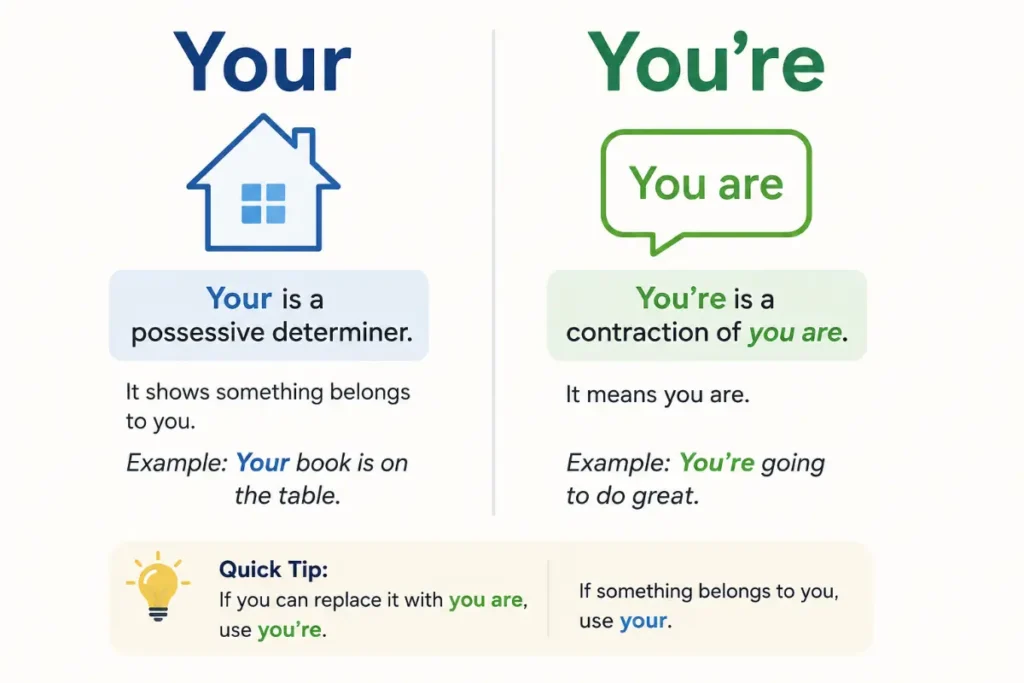
- Your is a possessive determiner.
- You’re is a contraction of you are.
- Your normally appears before a noun or noun phrase.
- You’re can appear before adjectives, verbs, participles, and other structures that follow you are.
- Replace you’re with you are to check the sentence.
- If you are doesn’t work, don’t use you’re.
- The two words usually sound the same or very similar in ordinary speech.
- The apostrophe in you’re signals the contraction.
- Your can show ownership, relationship, association, or connection.
- You’re describes or identifies the person being addressed through the verb are.
Many readers also check Council vs Counsel Which Word Should You Use.
Conclusion
Your vs You’re becomes easy to understand once you focus on meaning instead of pronunciation. Your shows possession or association, while you’re is the contraction of you are. Although these words often sound alike, they perform different grammatical jobs and cannot be substituted for one another in every sentence.
Remember the simplest test. Replace you’re with you are and see if the sentence still makes sense. If it does, you’re is likely correct. If you are referring to a possession, relationship, responsibility, or something associated with the person you are addressing, use your.
With a little practice, you can spot the difference quickly in emails, school assignments, workplace messages, and everyday writing. Read each sentence for meaning, check the word’s role, and proofread before sending. These small habits will help you avoid a common English mistake and communicate more clearly.
Frequently Asked Questions
1. What Is the Main Difference Between Your and You’re?
Your shows possession or association with the person being addressed. You’re is a contraction of you are. For example, Your coat is on the chair identifies whose coat is being discussed. You’re sitting in the wrong chair means You are sitting in the wrong chair. The easiest way to distinguish them is to check the meaning of the complete sentence.
2. Is Your or You’re Correct in You’re Welcome?
You’re welcome is correct when responding to someone who says thank you. The phrase means You are welcome. Your welcome would only be correct if welcome were being used as a noun, such as in Your welcome message was kind. In the common expression used to acknowledge thanks, choose you’re because it represents you are.
3. Can Your and You’re Sound the Same?
Yes. In most English accents, your and you’re sound identical or very similar. That makes them homophones in common usage. Their pronunciation does not determine their spelling, so you need to rely on grammar and context when writing. If the sentence means you are, use you’re. If it shows possession or association, use your.
4. How Can I Remember the Difference Easily?
Use a simple replacement test. Replace you’re with you are. If the sentence still makes sense, you’re is probably correct. If the sentence refers to something connected to the person being addressed, use your. For example, You’re ready becomes You are ready, while Your bag is ready refers to a bag associated with the listener.
5. Is Your a Possessive Pronoun?
Your is usually classified as a possessive determiner because it appears before a noun, as in your book or your idea. Some traditional grammar materials may use the term possessive adjective. A possessive pronoun, such as yours, can stand alone without a following noun. For example, This book is yours uses yours as a possessive pronoun.
6. Is You’re Appropriate in Formal Writing?
You’re is grammatically correct in formal and informal English. However, some academic, legal, or institutional style guides prefer expanded forms such as you are. Follow the style requirements of the document you are writing. Your remains necessary when showing possession, regardless of formality. The important point is to choose the right word for the intended meaning.
7. Why Do People Confuse Your and You’re So Often?
People often confuse these words because they sound the same in speech and typing tools may not detect the grammatical error. When writing quickly, readers and writers may focus on the sound instead of the meaning. Learning the replacement test and proofreading sentences in context can reduce mistakes significantly.
8. Can I Use Your and You’re in the Same Sentence?
Yes. Both words can appear in one sentence when each has a different grammatical role. For example, You’re responsible for bringing your notebook means You are responsible for bringing the notebook associated with you. You’re expresses an action or state, while your identifies the notebook. Using both forms correctly can make a sentence clear and natural.