
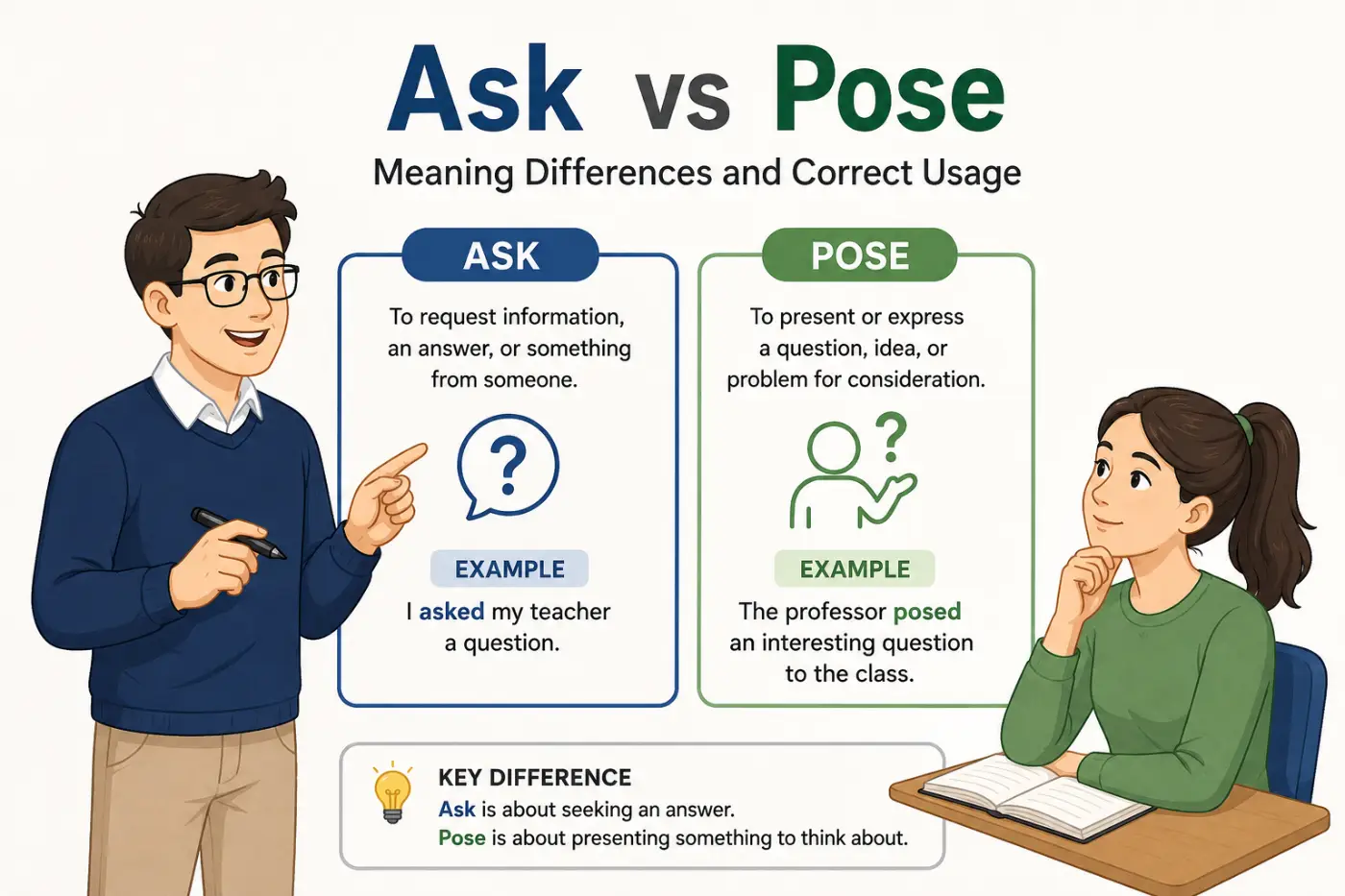
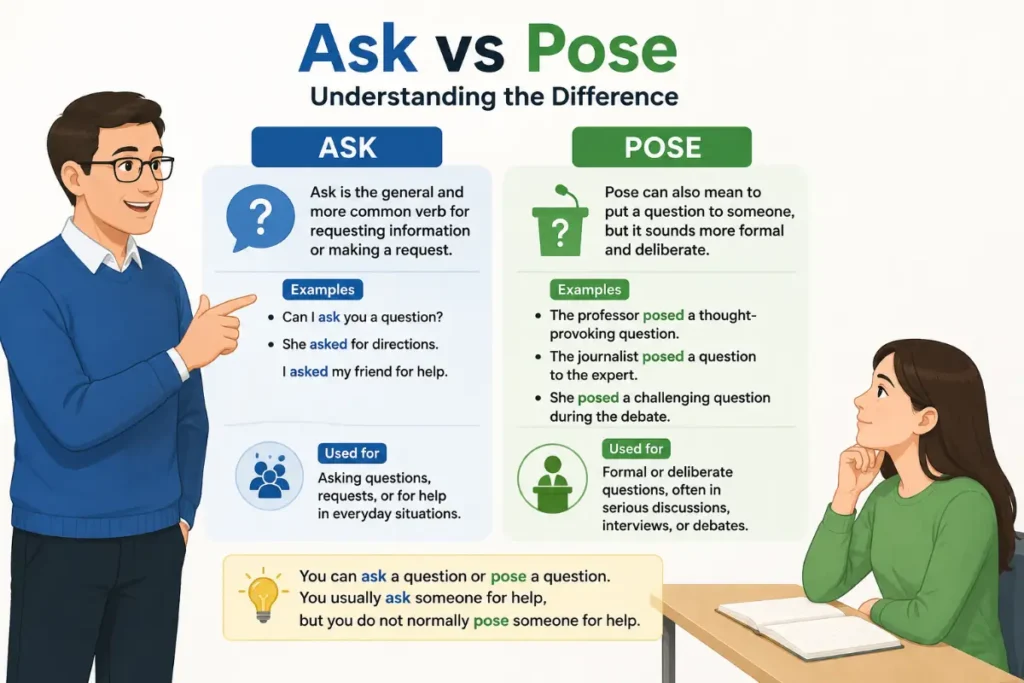
Choosing between ask vs pose can be confusing because both verbs can describe putting a question to someone. The main difference is that “ask” is the everyday, direct choice, while “pose” often sounds more formal and emphasizes presenting a question, problem, or challenge for thought or discussion. Both expressions are correct, but they are not always interchangeable.
You can ask your teacher a question, ask a friend for advice, or ask a coworker for help. You can also pose a question to a class, pose a challenge to a team, or pose a threat to public safety. The best choice depends on what you want to communicate and how formal the situation is.
Understanding this distinction helps you write more clearly and speak more naturally. It also helps you avoid stiff wording in casual conversations and overly informal wording in academic or professional writing. Below, you will find straightforward definitions, a comparison table, pronunciation guidance, grammar rules, examples from different settings, and answers to common questions about these two useful verbs.
Many readers also check To Fast or Too Fast Which Phrase Is Correct.
Quick Answer
“Ask” means to put a question to someone or request information, help, or action. “Pose” means to present a question, problem, or challenge for consideration. Use “ask” in most everyday situations and choose “pose” when you want to emphasize the presentation of an issue for thought, discussion, or analysis.
Comparison Table
| Feature | Ask | Pose |
|---|---|---|
| Main meaning | Request information, help, or action | Present a question, problem, or challenge |
| Part of speech | Verb | Verb |
| Pronunciation | /æsk/ | /poʊz/ |
| Typical tone | Neutral and conversational | Often formal or analytical |
| Common phrases | Ask a question, ask for help, ask permission | Pose a question, pose a problem, pose a threat |
| Everyday conversation | Very common | Less common for questions |
| Academic writing | Common and appropriate | Common when presenting an issue for analysis |
| Workplace writing | Natural and direct | Useful in reports, presentations, and discussions |
| Grammar pattern | Ask someone a question; ask for something | Pose a question to someone; pose a risk to someone or something |
| Example | Maya asked the teacher for help. | The researcher posed a question about the results. |
Meaning and Definition
What Does Ask Mean?
“Ask” is a common English verb that means to request information, seek an answer, request help, or invite someone to do something. It is one of the most useful verbs in everyday communication because it covers many kinds of requests.
For example, you might ask a friend about their weekend, ask your manager for a day off, or ask a store employee where to find an item. In each case, you want information, permission, assistance, or action from another person.
The verb also appears in several common patterns:
- Ask a question.
- Ask someone for advice.
- Ask for permission.
- Ask someone to help.
- Ask about a problem.
- Ask if a meeting is still scheduled.
“Ask” can refer to the act of speaking, but it can also describe a request made in writing. You can ask a question during a meeting, by email, in a text message, or through an online form.
Its broad meaning makes it the safest choice when you want to communicate directly without adding a formal or analytical tone.
What Does Pose Mean?
“Pose” has several meanings, but in discussions about questions, it means to present something for consideration, examination, or discussion. A person who poses a question brings an idea forward and invites others to think about it or respond.
For example, a professor might pose a question to a class before explaining a theory. A journalist might pose a difficult question about a public decision. A researcher might pose a question that guides an entire study.
The verb also appears in expressions that have nothing to do with asking questions. A problem can pose a challenge, a new policy can pose a risk, and a person can pose for a photograph. These meanings share the idea of presenting, creating, or adopting something in a particular way, but the exact sense depends on context.
Common patterns include:
- Pose a question.
- Pose a problem.
- Pose a challenge.
- Pose a threat.
- Pose a risk.
- Pose for a photograph.
When used with “question,” the verb often highlights the question itself rather than the simple act of speaking to another person. It can make a sentence sound more thoughtful, formal, or analytical.
Is Pose a More Formal Version of Ask?
Sometimes, but the distinction is more specific than formality alone. “Pose” can sound more formal when it means presenting a question for discussion, but it does not replace “ask” in every sentence.
For example, “I asked my neighbor for a cup of sugar” sounds natural. “I posed my neighbor for a cup of sugar” is incorrect because the verb does not express that kind of request.
Likewise, “The report poses a serious question about public spending” is natural because the report raises an issue for consideration. “The report asks a serious question about public spending” can also work, especially if the report directly raises the question. The difference is one of emphasis and style, not a strict rule that one verb is formal and the other is informal.
Key Differences Explained
1. Meaning and Purpose
The central difference is the action each verb emphasizes. “Ask” focuses on requesting an answer, information, or action. “Pose” focuses on presenting an issue, question, or challenge for consideration.
Compare these sentences:
- The student asked the teacher why the experiment failed.
- The teacher posed a question about why the experiment failed.
The first sentence describes the student’s request for an explanation. The second describes the teacher presenting a question for the class to consider. Both are correct, but they describe different actions.
2. Grammar and Sentence Structure
Both verbs can take a noun as an object, but their usual patterns differ.
With “ask,” you can use a person and a question together: “She asked the manager a question.” You can also use “ask someone for something,” as in “He asked his manager for feedback.”
With “pose,” the common question pattern is “pose a question to someone.” For example, “The moderator posed a question to the panel.” You can also say “pose a question for discussion.”
The pattern “pose someone a question” is less common in everyday American English than “ask someone a question.” For clear, natural writing, use “ask someone a question” or “pose a question to someone.”
3. Tone and Formality
“Ask” works in nearly every setting. It sounds natural in casual conversation, business communication, schoolwork, and formal documents. You do not need to replace it simply to sound professional.
“Pose” is especially useful when a question introduces an argument, invites analysis, or frames a discussion. It appears often in academic writing, news reporting, essays, and presentations.
Compare “Can I ask you something?” with “I would like to pose a question for the committee to consider.” The first is conversational. The second sounds more formal because of both its wording and its setting.
4. Everyday Use Versus Analytical Writing
In daily conversation, people usually ask questions rather than pose them. You might ask a cashier about a return policy or ask a friend what time to meet.
In a classroom or research paper, “pose” can help show that a question is being introduced as an idea for examination. A writer might say, “This finding poses an important question about the reliability of the test.”
Still, formal writing does not require the word “pose.” “This finding raises an important question about the reliability of the test” is also clear and natural.
5. Other Meanings
“Ask” often describes a request, but “pose” has several additional meanings that are worth recognizing. A person can pose for a picture, an obstacle can pose a challenge, and a chemical can pose a danger to workers.
These phrases cannot usually be rewritten by simply substituting one verb for the other. “The storm poses a threat” means the storm creates or presents a danger. “The storm asks a threat” does not make sense in standard English.
6. Pronunciation
The verbs have different vowel sounds and end differently. “Ask” has the short vowel sound heard in “cat,” followed by an /s/ and /k/ sound. “Pose” has a long o sound, followed by a /z/ sound.
Pronunciation does not determine which word is correct, but it helps distinguish them in speech. Both words are standard in American and British English, though accents can affect the exact vowel quality.
7. Regional Usage
There is no major American versus British spelling difference between these verbs. Both forms are standard in the United States, the United Kingdom, Canada, and Australia.
Differences are more likely to come from writing style, profession, or context than from regional grammar. A research paper in the United States may use “pose a question,” just as a British newspaper might. Everyday speakers in both places generally use “ask a question.”
Which Word Is Correct?
Both “ask” and “pose” are correct English verbs. Neither is a misspelling, and neither is automatically better than the other. The right choice depends on the meaning you intend and the grammatical pattern your sentence needs.
Use “ask” when someone requests information, help, permission, advice, or an action. Use “pose” when someone presents a question, problem, threat, or challenge for others to consider. This distinction follows established English usage and the way these verbs combine with other words.
Consider these examples:
- Correct: “I asked my supervisor for feedback.”
- Correct: “The report poses a question about the project’s cost.”
- Correct: “The new rule poses a risk to small businesses.”
- Correct: “The student asked why the answer was wrong.”
- Correct: “The speaker posed a difficult question to the audience.”
The first and fourth examples describe requests for information or assistance. The other examples present an issue, risk, or question for consideration.
A common mistake is to treat “pose” as a fancy substitute for “ask.” That approach can produce unnatural or incorrect sentences. Instead, choose the verb that matches the action. If someone wants an answer from another person, “ask” will usually be the clearest option. If a statement introduces an issue for analysis, “pose” may fit better.
Sentence Examples
The following examples show how to use both verbs naturally in different situations.
Ten Examples Using Ask
- Everyday conversation: I wanted to ask you about your plans for Saturday.
- Text message: Can I ask you a quick question before you leave?
- Workplace communication: Please ask the client to confirm the delivery date.
- School: The student asked the teacher to explain the math problem again.
- Academic writing: The survey asked participants to describe their experiences with remote learning.
- Formal writing: Applicants may ask the admissions office for further information.
- Social situations: She asked her friends if they wanted to join her for dinner.
- Online communication: A reader asked how the new feature works.
- Customer service: The customer asked for a refund after the product stopped working.
- Family conversation: My brother asked me to help him move a heavy table.
These examples show the range of the verb. It can introduce a question, a request, a favor, or an invitation. Its direct meaning makes it useful across almost every kind of communication.
Five Examples Using Pose
- Classroom discussion: The professor posed a question that made the students rethink their assumptions.
- Research: The study poses an important question about how children learn new words.
- Journalism: The investigation poses serious questions about the agency’s decisions.
- Business: The sudden rise in costs poses a challenge for small companies.
- Public safety: Damaged electrical wires can pose a danger to nearby residents.
Notice that “pose” does not always refer to a spoken question. It can also describe a risk, difficulty, or threat. In these sentences, the verb emphasizes the issue being presented or created.
Can You Use Both Verbs in Similar Sentences?
Yes. Sometimes the two verbs can describe related actions, but they create slightly different impressions.
For example:
- “The teacher asked a question about climate change.”
- “The teacher posed a question about climate change.”
Both sentences are grammatically correct. The first simply reports that the teacher asked. The second gives more attention to the question as a topic for thought or discussion.
The context may make the difference even clearer. If the teacher is checking attendance or asking students to repeat a fact, “asked” is usually the more natural choice. If the teacher introduces a difficult problem for a class debate, “posed” may be more suitable.
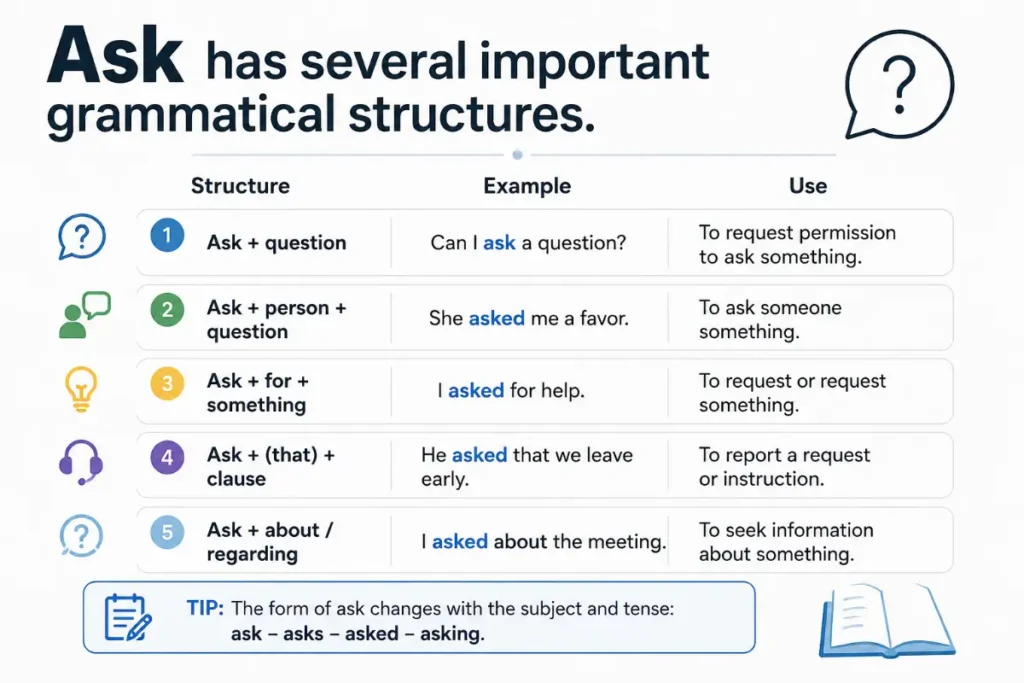
Grammar Patterns With Ask
Ask has several important grammatical structures.
Ask Someone About Something
Use this structure when you want information about a subject.
- I asked him about his new job.
The phrase “about his new job” identifies the topic.
Common Mistakes and Usage Problems
Most errors with these verbs happen because writers focus on formality rather than meaning. They may choose “pose” because it sounds sophisticated, even when the sentence describes an ordinary request.
1. Using Pose for a Simple Request
Incorrect: “I posed my coworker for help with the report.”
Correct: “I asked my coworker for help with the report.”
The phrase “ask someone for help” is a standard expression. “Pose” does not carry the meaning of requesting assistance in this pattern. Choose “ask” when you need another person’s help.
2. Using Ask Instead of Pose in a Fixed Expression
Awkward: “The new policy asks a serious threat to public safety.”
Correct: “The new policy poses a serious threat to public safety.”
The phrase “pose a threat” is well established. In this expression, “pose” means to present or create a danger. The verb “ask” cannot replace it.
3. Mixing Up Object Patterns
Awkward: “The moderator posed the audience a question.”
Clearer: “The moderator posed a question to the audience.”
Also correct: “The moderator asked the audience a question.”
The second sentence follows the common pattern for “pose a question to someone.” The third uses the familiar “ask someone a question” structure. These patterns help readers understand the relationship between the speaker, the question, and the audience.
4. Choosing a Formal Word to Sound More Professional
Awkward: “I would like to pose if you can attend the meeting.”
Correct: “I would like to ask if you can attend the meeting.”
“Pose” does not normally introduce an indirect question in this way. If you want to check information or request a response, use “ask.” A formal tone comes from clear, respectful wording, not from replacing common verbs with less suitable ones.
5. Treating the Words as Exact Synonyms
Awkward: “The broken machine asks a safety risk.”
Correct: “The broken machine poses a safety risk.”
A machine cannot request a risk. It can create or present one. The difference becomes easier to remember when you consider the subject of the sentence and the action it performs.
A Simple Editing Test
When you are unsure which verb to choose, ask yourself what the sentence describes.
- If a person wants information, help, permission, or action, use “ask.”
- If a person presents a question for consideration, “pose” may work.
- If something creates a danger, challenge, or problem, “pose” is often the natural choice.
- If the sentence contains a familiar phrase, check the full expression rather than replacing just one word.
This quick test works for most everyday and professional writing.
Many readers also check Year Old vs Years Old Which Form Is Correct.
Pronunciation Guide
How Do You Pronounce Ask?
The American English pronunciation of “ask” is /æsk/. It has one syllable and rhymes with words such as “mask” and “task.” The vowel sounds like the one in “cat,” followed by the consonants /s/ and /k/.
Say it slowly as “assk,” then blend the sounds into one smooth syllable. In natural speech, the word should not need an extra syllable.
Some speakers use different vowel qualities because of their regional accents. That variation does not change the word’s spelling or grammatical role.
How Do You Pronounce Pose?
The American English pronunciation of “pose” is /poʊz/. It also has one syllable. The vowel is the long o sound heard in “go,” and the word ends with a voiced /z/ sound.
To say it clearly, begin with the /p/ sound, move into the vowel, and finish with a gentle buzzing sound. The final consonant is /z/, not /s/, so the ending sounds like the one in “those.”
Common Pronunciation Confusion
The two verbs are easy to distinguish when you focus on their first sounds and vowels. “Ask” starts with a short vowel sound after the initial open vowel, while “pose” begins with a consonant and has a long o sound.
Neither verb requires special pronunciation in formal speech. Clear pronunciation, normal stress, and a complete sentence are enough for most conversations.
Etymology and Word Origin
The History of Ask
“Ask” is an old English verb with roots in Old English. It appeared in forms such as “ascian” and “acsian,” both associated with seeking information or making a request. The word developed through earlier stages of English and became the familiar modern verb used today.
Its long history helps explain why it is so common across different settings. People use it for direct questions, polite requests, requests for permission, and many other forms of communication. The verb has remained central to everyday English rather than becoming limited to a specialized field.
The History of Pose
“Pose” entered English through French, with roots in Latin “pausare,” meaning to pause or rest, and later historical developments connected with placing or setting something. The modern verb developed several senses, including arranging the body for a photograph and presenting a question or problem for consideration.
The exact history differs across the verb’s meanings, so it is best not to assume that every use developed in a single straight line. In current English, the sense of presenting a question is well established. Phrases such as “pose a problem” and “pose a threat” show how broadly the verb can apply to an issue or condition.
Why the Origins Matter
The word histories help explain the verbs’ different modern roles, but you do not need to memorize their roots to use them correctly. Current grammar and common expressions are more useful guides.
Remember the main contrast: “ask” commonly describes requesting something, while “pose” often describes presenting something for consideration or creating a particular condition.
Regional Usage
American English
In the United States, “ask” is the usual verb for direct questions and requests. People ask for directions, ask a colleague for advice, and ask someone to call them back. The word works in casual conversation and formal writing.
“Pose” is also standard American English. Writers commonly use it in expressions such as “pose a question,” “pose a challenge,” and “pose a threat.” It appears more often in formal discussion, academic work, journalism, and analytical writing than in casual requests.
British English
British English uses the same basic distinction. Speakers ask questions in ordinary conversation and may pose questions during a debate, lecture, or formal discussion. Both verbs follow the same general grammatical patterns as they do in American English.
There is no special British spelling of either verb. The main differences readers notice are usually related to accent, vocabulary preferences, and writing style rather than the core meaning of the words.
Australian English
Australian English also uses both verbs in their standard senses. “Ask” is common for everyday requests, while “pose” appears in contexts involving questions, risks, problems, and challenges. No major regional rule changes the distinction.
Canadian English
Canadian English follows the same pattern. Writers can use “ask a question” in any ordinary setting and “pose a question” when presenting an issue for discussion. The spelling and core grammar remain the same as in American English.
Across these varieties, context matters more than geography. If you are writing for a broad English speaking audience, you can confidently follow the same basic guidelines.
Grammar Rules and Part of Speech
Both “ask” and “pose” function as verbs. They can appear in different tenses, take objects, and form questions or statements. The key is to use the grammatical pattern that matches the intended meaning.
Common Patterns With Ask
Use these structures for questions and requests.
- Ask someone a question. Example: Daniel asked his coach a question.
- Ask someone for something. Example: We asked the hotel for extra towels.
- Ask someone to do something. Example: She asked me to review the document.
- Ask about something. Example: He asked about the schedule.
- Ask if or whether something is true. Example: I asked if the store was open.
- Ask someone why, what, where, when, or how. Example: The child asked why the sky looked orange.
The verb can also introduce reported questions. For example, “She asked where the meeting would take place” is correct. Do not use question word order inside a statement like this. Write “She asked where the meeting would take place,” not “She asked where would the meeting take place.”
Common Patterns With Pose
Use these structures when presenting a question or describing a problem, risk, or challenge.
- Pose a question. Example: The speaker posed a question about fairness.
- Pose a question to someone. Example: The reporter posed a question to the mayor.
- Pose a problem. Example: The delay poses a problem for the delivery team.
- Pose a threat to something. Example: The leak poses a threat to the building.
- Pose a challenge for someone. Example: The new assignment poses a challenge for beginners.
- Pose for a photograph. Example: The family posed for a picture outside the house.
The verb usually takes a direct object in these expressions. You pose a question, a threat, or a challenge. You pose for a photograph because that expression describes arranging yourself for a picture.
Tense and Agreement
Both verbs change form according to tense and subject.
| Form | Ask | Pose |
|---|---|---|
| Present | ask or asks | pose or poses |
| Past | asked | posed |
| Present participle | asking | posing |
| Past participle | asked | posed |
Examples include “She asks thoughtful questions,” “He posed a difficult question,” and “The decision is posing a challenge for the team.” These forms follow ordinary English verb rules.
Punctuation and Indirect Questions
Neither verb requires special punctuation on its own. Use a question mark for a direct question, but use a period for a statement that reports a question.
Direct question: “Can I ask you something?”
Reported question: “I asked him what time the store closed.”
Statement about a question: “The professor posed a question about the experiment.”
The punctuation depends on the sentence structure, not on which verb you choose.
Real Life Usage Examples
Daily Conversation
In everyday speech, “ask” is usually the natural choice because people often request information or help directly.
- “Can I ask you where you bought those shoes?”
- “I asked my sister to pick me up after work.”
Using “pose” in these situations can sound overly formal unless you are deliberately being playful or discussing a question for a group to consider.
Email and Workplace Communication
Both verbs can work at work, but the intended action determines the choice.
- “I wanted to ask if you could send the updated file by noon.”
- “The latest sales figures pose an important question about our pricing strategy.”
The first sentence requests action. The second identifies an issue that deserves analysis. Clear professional writing often benefits from choosing the simplest verb that expresses the intended meaning.
Academic Writing
Academic writers often use “pose” to introduce a question, research problem, or challenge. They also use “ask” to describe what a survey, researcher, or participant requests.
- “The study poses a new question about the relationship between sleep and memory.”
- “The questionnaire asked participants how often they exercised.”
The first sentence frames an issue for investigation. The second reports the content of a questionnaire. Both are suitable for academic writing.
News and Journalism
News writing uses “ask” when reporting a direct request or question from a person. It may use “pose” when highlighting a broader concern or risk.
- “Residents asked city officials to explain the road closure.”
- “The investigation poses serious questions about the use of public funds.”
The distinction lets a journalist report an action in the first example and emphasize an issue in the second.
Literature and Storytelling
In stories, “ask” often describes dialogue and personal requests. “Pose” can help introduce a mystery, dilemma, or difficult choice.
- “Mara asked the stranger why he had returned after so many years.”
- “His sudden arrival posed a question no one wanted to answer.”
The first sentence focuses on what Mara says. The second presents an unresolved issue that drives the story forward.
Related and Confused Terms
These eight words and expressions can help you choose the right verb more precisely.
1. Question
“Question” can function as both a noun and a verb. As a noun, it names something someone asks. As a verb, it means to ask for information or challenge a claim. For example, “The detective questioned the witness” describes a direct line of inquiry.
2. Inquire
“Inquire” means to seek information and often sounds more formal than “ask.” You might inquire about a job opening or inquire into a complaint. It does not usually replace “pose” in expressions such as “pose a threat.”
3. Request
“Request” means to ask for something, often politely or formally. You can request a copy of a report or request permission to leave early. Unlike “pose,” it centers on the act of seeking something from another person.
4. Raise
“Raise a question” means to bring an issue forward for attention or discussion. This expression is close in meaning to “pose a question.” For example, “The results raise concerns about the test” highlights an issue that deserves further thought.
5. Present
“Present” means to show or put something forward. A speaker may present an argument, present evidence, or present a problem to a group. It overlaps with “pose” in some formal contexts, but it has a broader range of uses.
6. Suggest
“Suggest” means to put forward an idea, possibility, or recommendation. A researcher might suggest a new approach, while a result might suggest a connection between two factors. It does not usually mean to request a direct answer.
7. Challenge
“Challenge” can be a noun or a verb. As a noun, it describes a difficult task or problem. As a verb, it can mean to question an idea or test someone’s ability. A difficult situation may pose a challenge, but a person can challenge a decision.
8. Inquire About
“Inquire about” is a useful expression when you need information on a specific topic. For example, “I called to inquire about the application process.” It sounds more formal than “I called to ask about the application process,” but both are correct.
Expert Editor Insight
An experienced editor chooses the verb that best describes the action instead of treating formal language as automatically better. In everyday writing, “ask” is usually clear and natural. In analytical writing, “pose” can frame a question or highlight a risk. Grammar tools may accept both words because both are valid, so a green check mark does not guarantee the sentence sounds right. Read the full sentence and check the meaning, object, and surrounding expression. In particular, review familiar phrases such as “ask for help,” “pose a question,” and “pose a threat.” These combinations are often a better guide than formality alone.
Key Takeaways
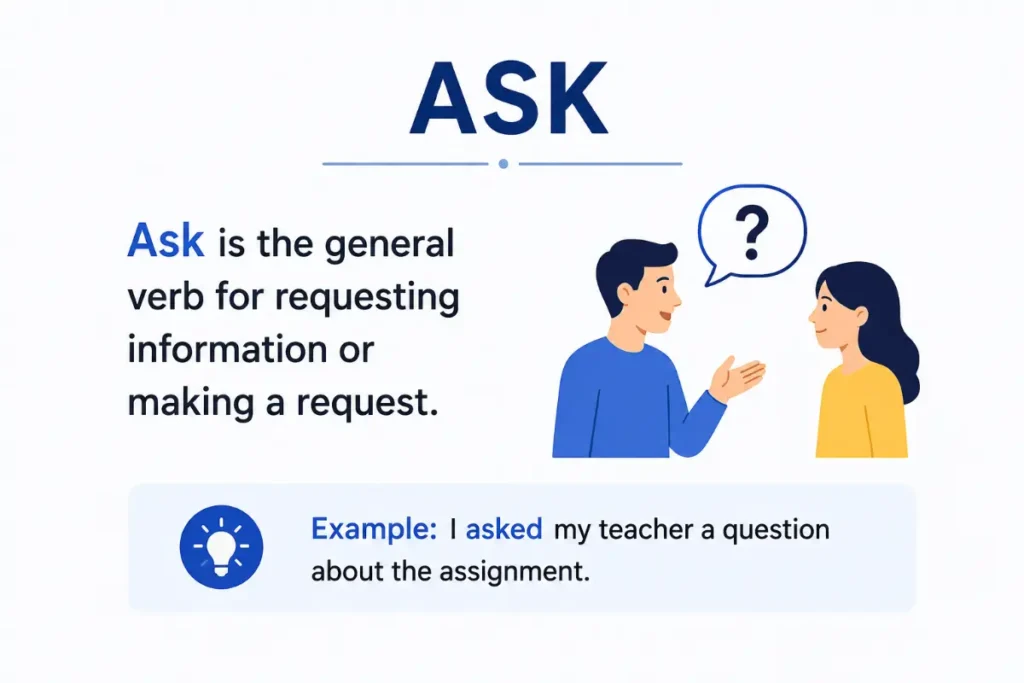
- Ask is the general verb for requesting information or making a request.
- Pose can mean present a question for consideration.
- You can ask a question or pose a question.
- Ask is much more common in everyday English.
- Pose often sounds more formal when it means present a question.
- Use ask for help, advice, permission, information, and requested actions.
- Use pose for problems, challenges, threats, risks, and questions presented for consideration.
- The natural structure is “ask someone a question.”
- The natural structure is “pose a question to someone.”
- Pose has additional meanings related to physical positioning and pretending.
- Ask and pose are not interchangeable in every sentence.
- The simplest memory rule is “Ask seeks. Pose presents.”
Learn the difference in Who’s vs Whose Meaning and Correct Usage.
Conclusion
The choice between “Ask vs Pose” comes down to meaning, grammar, and context. “Ask” is the natural choice for requesting information, help, permission, or action. “Pose” is useful when you present a question for discussion or describe a problem, threat, or challenge. Both verbs are standard English, and neither is automatically better in every situation.
To make the right choice, focus on what the subject is doing and check the expression that follows the verb. A simple editing tip is to use “ask” for requests and “pose” for issues presented for consideration. This habit will help your writing stay clear, natural, and precise.
FAQs
Is Ask or Pose Correct?
Both verbs are correct, but they serve different purposes. Use “ask” to request information, assistance, permission, or action. Use “pose” to present a question for consideration or describe something that creates a problem, threat, or challenge. For example, you ask a coworker for help, but a tight deadline may pose a challenge for the team.
What Is the Difference Between Asking a Question and Posing a Question?
Asking a question usually emphasizes the act of seeking an answer from someone. Posing a question often emphasizes introducing an issue for thought or discussion. For example, a customer asks a clerk about store hours, while a professor poses a question for students to debate. Both expressions are correct, and context determines which one sounds more natural.
Can I Use Pose in Everyday Conversation?
Yes, you can use “pose” in everyday conversation, especially in phrases such as “pose a problem” or “pose a risk.” However, “pose a question” may sound more formal than “ask a question” in casual speech. If you are talking with friends or making a simple request, “ask” will usually sound more natural and direct.
Is Pose More Formal Than Ask?
“Pose” often sounds more formal when it introduces a question for discussion, but it is not simply a formal replacement for “ask.” The two verbs have different meanings and grammatical patterns. “Ask for help” is correct, while “pose for help” is not. Professional writing should focus on precise meaning and natural phrasing rather than choosing a longer or less common word.
How Do You Pronounce Ask and Pose?
In American English, “ask” is pronounced /æsk/, with one syllable and a short vowel sound like the one in “cat.” “Pose” is pronounced /poʊz/, also with one syllable, using the long o sound and a final /z/. The difference is easy to hear when you say the words slowly and focus on their vowel sounds.
Can Pose Replace Ask in Every Sentence?
No. “Pose” cannot replace “ask” in every sentence because the verbs express different actions. You can ask someone for advice, ask permission, or ask someone to call you. You can pose a question, pose a threat, or pose a challenge. Substituting one verb for the other without checking the meaning can make your sentence awkward or incorrect.
What Is a Synonym for Pose a Question?
Useful alternatives include “raise a question,” “put forward a question,” and “present a question.” The best choice depends on the sentence. “Raise a question” is especially natural when an issue needs attention, while “present a question” can work in a formal discussion. “Ask a question” is usually the simplest option when someone directly seeks an answer.
Which Word Should I Use in Formal Writing?
Both verbs work in formal writing when used correctly. Choose “ask” when reporting a request, inquiry, or direct question. Choose “pose” when presenting an issue for analysis or describing a risk or challenge. For example, “The survey asked participants about their habits” is clear, while “The findings pose a question for future research” emphasizes an issue that needs further study.