

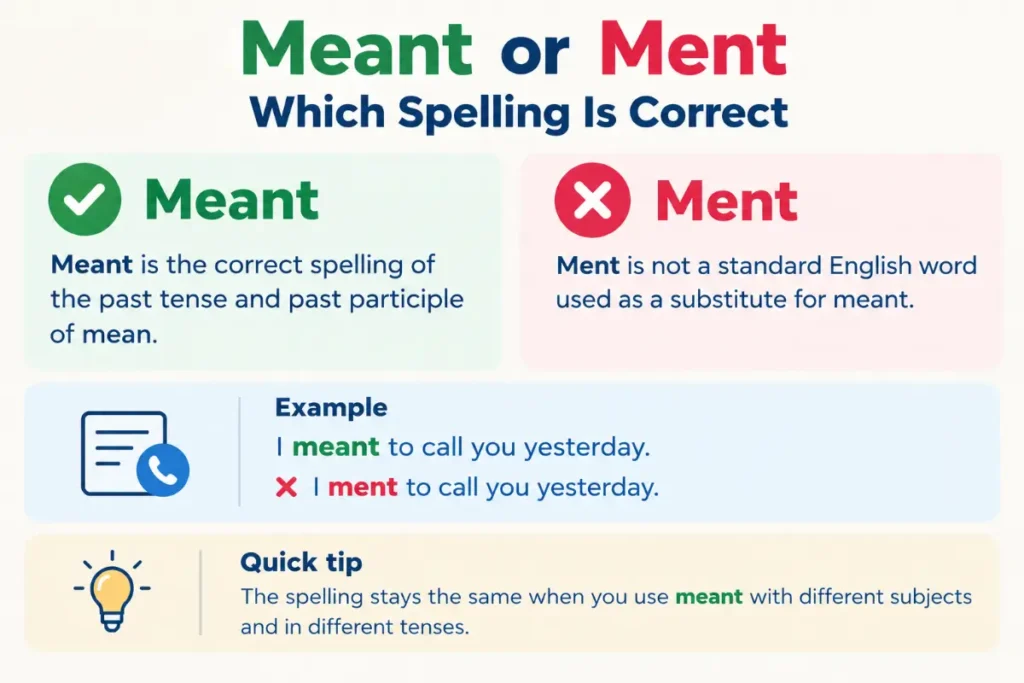
The difference between meant and ment can be confusing because both forms appear in English words and sound similar in some contexts. However, meant is the correct spelling of the past tense and past participle of mean. Ment is not a standard alternative for this verb.
You use meant when you want to explain what someone intended to say, what something represented, or what a person planned to do. For example, you might say, I meant to call you yesterday, or Her advice meant a lot to me. In both sentences, the spelling follows the same established grammar rule.
The confusion often comes from English spelling patterns. Many verbs form their past tense by adding ed, and several English words end in ment. As a result, writers sometimes assume that ment can replace meant. That assumption leads to a spelling error.
Understanding the difference becomes easier once you connect the word to its base form and learn how it works in a sentence. The following guide explains the correct spelling, meaning, pronunciation, grammar, common mistakes, and everyday uses so you can write with confidence.
For another common grammar confusion, see Lay vs Lie Explained With Grammar Rules and Examples.
Quick Answer
Meant is correct when you are using the past tense or past participle of mean. Ment is not a standard spelling of that verb. Write I meant to help, not I ment to help. The ending ment is valid in other words, such as payment and movement, but it does not replace meant.
Comparison Table
| Feature | Meant | Ment |
|---|---|---|
| Standard spelling | Correct form of mean | Not a standard form of mean |
| Meaning | Intended, signified, or had a particular purpose | No standard verb meaning in this context |
| Part of speech | Verb form | Not a standard verb form of mean |
| Base word | Mean | No valid connection to the past tense of mean |
| Pronunciation | /mɛnt/ | Often intended to sound like meant |
| Formality | Standard in formal and informal English | Incorrect when used instead of meant |
| Common contexts | Intentions, definitions, significance, purpose | Mistaken spelling in sentences about intention |
| Example | I meant every word I said. | I ment every word I said. |
The key distinction is simple. Meant is an established English word with a clear grammatical role. Ment may appear as part of another word or as a name or abbreviation in a special context, but it does not serve as the standard past tense of mean.
What Does Meant Mean?
Meant is the past tense and past participle of the verb mean. It describes an intention, an idea expressed through words, the significance of something, or the purpose behind an action. The exact meaning depends on the sentence.
For example, I meant to bring my notebook describes an intention. The sentence This gift meant a lot to her describes emotional value. In the sentence What did he mean by that comment, the present tense mean asks about the intended meaning, while What did he meant would be grammatically incorrect.
The word can express several related ideas.
Meant as an Expression of Intention
Use meant when someone intended to do something or planned an action in the past.
Examples include the following.
- I meant to send you the address last night.
- She meant to finish her homework before dinner.
- We meant no harm by our suggestion.
In each example, the word points to an intention. The action may or may not have happened. Saying I meant to call you does not prove that the call took place. It tells the listener that calling was the intention.
Meant as the Past Form of Mean Something
Meant can also describe what a word, statement, gesture, or event communicated.
Consider these examples.
- What did you mean by that message.
- His expression meant that he was worried.
- The sign meant that visitors had to stop.
The first sentence is a question about the intended meaning. The second and third explain what an expression or sign communicated. In all three cases, meant connects an action or signal with its meaning.
Meant as a Description of Importance
Another common use appears in expressions about personal value and emotional significance.
For example, Her support meant everything to me explains how much that support mattered. Your kind words meant a great deal describes the effect of those words. This use is common in conversations, personal letters, speeches, and other forms of writing.
Meant in Passive Constructions
Meant also appears in passive structures that describe a purpose or expected use.
For example, This room was meant for guests describes the room’s intended purpose. The phrase The message was meant to reassure everyone describes what the message was intended to accomplish.
These patterns are common in both spoken and written English. They can describe a plan, a design, a purpose, or an expectation.
What Does Ment Mean?
Ment is not the standard past tense or past participle of mean. If you want to express a past intention or explain the meaning of something, use meant.
For instance, I ment to tell you the truth is incorrect in standard English. The correct sentence is I meant to tell you the truth.
Still, the letters ment are not meaningless in every context. They appear at the end of many established English words. Payment, agreement, development, and improvement are familiar examples. In those words, ment functions as a word ending that helps form a noun. It does not act as a replacement for meant.
The distinction matters because spelling depends on the role a word plays in a sentence. A familiar group of letters can appear in several words without carrying the same grammatical function in each one.
Why the Confusion Happens
Several factors make this error easy to understand.
- Similar sound. Meant and the incorrectly written ment are often intended to represent the same spoken word. In ordinary American English, the expected pronunciation of meant is /mɛnt/.
- Familiar word endings. Readers see ment in words such as treatment and statement. They may mistakenly apply the same ending to the verb mean.
- Typing habits. When people write quickly, they may leave out a vowel or choose a familiar letter pattern without checking the word.
- Uncertainty about past tense forms. Many English verbs add ed to form the past tense, but others change their spelling in different ways. Mean becomes meant rather than meaned in standard modern English.
- Spell checking limits. Some writing tools may miss errors when the intended word is unclear or the incorrect form appears in a name, code, or specialized context.
The best solution is to learn the connection between mean and meant rather than rely on the appearance of the ending alone.
Key Differences Explained
The main difference is grammatical rather than stylistic. Meant is a standard verb form. Ment does not perform that function in modern standard English.
Spelling
Mean changes to meant in the past tense and past participle. The spelling changes inside the word instead of adding ed to the end.
- Present tense: I mean what I say.
- Past tense: I meant what I said.
- Past participle: I have meant to contact you for days.
The word keeps its spelling as meant in all standard uses of these past forms. Writing ment does not follow the established spelling pattern for this verb.
Meaning
Meant can refer to intention, significance, or the meaning communicated by a statement. Its sense depends on the surrounding words.
For example, I meant to leave early describes a plan. The word freedom meant something different to each character describes an idea or value. The spelling stays the same even though the meaning changes.
Ment does not carry these meanings as an independent standard verb form. If you want to express one of these ideas, choose meant.
Grammar
Meant is the past tense of mean and also its past participle. It can stand alone in a simple past sentence or follow a helping verb.
Examples include I meant to call, I have meant to ask you something, and It was meant as a joke. Each sentence uses the correct form for its grammatical structure.
A common mistake occurs when writers use ment after a subject and treat it as a past tense verb. The problem is not the sentence’s intended meaning. The problem is the spelling of the verb.
Pronunciation
In standard American English, meant is pronounced /mɛnt/. It has one syllable and rhymes with sent, went, and tent for many American speakers.
The incorrect spelling ment is often intended to represent the same sound. Pronunciation alone therefore cannot help a writer distinguish the correct spelling. The reliable method is to connect the spoken word to the base verb mean.
Formality
Meant is appropriate in every major style of English writing. You can use it in a text message, a school assignment, a business email, a news report, or an academic discussion.
Ment is inappropriate when it replaces meant in ordinary writing. The mistake can make an otherwise clear sentence appear careless. In professional or academic work, correct spelling helps readers focus on your ideas instead of stopping to interpret an error.
Context
The word meant appears in several common patterns, including meant to do something, meant for someone, and meant a great deal.
- I meant to tell you earlier.
- This seat was meant for the guest speaker.
- Her encouragement meant a lot to us.
Recognizing these patterns helps you choose the correct form quickly. If the sentence uses the past form of mean, write meant.
Regional Usage
American, British, Canadian, and Australian English all use meant as the standard past tense and past participle of mean. There is no established regional spelling difference that makes ment correct in these contexts.
Local accents may affect the exact sound of the vowel, but the spelling rule remains the same. You do not need a different spelling for a US audience or a British audience.
Which Form Is Correct?
Meant is the correct form when you need the past tense or past participle of mean. This follows the standard conjugation of the verb in modern English.
The present tense mean changes to meant when you describe an intention or meaning in the past. For example, I mean to help expresses a present intention, while I meant to help describes an intention in the past. You can also write I have meant to speak with you for some time, using meant after the helping verb have.
The form ment does not follow this verb’s standard conjugation. Although the same letters appear at the end of many English nouns, that pattern does not make ment a valid substitute for meant.
A quick way to check your sentence is to replace the past form with mean and see if the sentence expresses the intended idea. If the sentence requires the past tense of that verb, meant is the form you need.
Sentence Examples
The following examples show how the word works in everyday situations and more formal writing.
Everyday Conversation
- I meant to ask you about your weekend.
- She meant every word of her apology.
- We meant to arrive before the movie started.
These examples cover a plan, a sincere statement, and an intended action. Notice that meant can describe the intention even when the planned action did not happen.
Text Messages and Online Communication
- Sorry I missed your call. I meant to call you back.
- That message meant more to me than you know.
In the first example, meant explains an intention that was not completed. In the second, it describes emotional importance.
Workplace Communication
- I meant to include the updated figures in the report.
- The new policy was meant to reduce delays.
The first sentence describes an intended action. The second explains the purpose behind a policy. Both sound natural in professional communication.
School and Academic Writing
- The author meant to show how fear can influence decision making.
- The term meant something different in the original passage.
These examples demonstrate two useful academic patterns. One describes the writer’s intention, while the other explains a change in meaning.
Formal Writing
10. The agreement was meant to protect the interests of both parties.
This sentence uses a passive construction to explain the agreement’s purpose. The same structure works in legal discussions, reports, and other formal documents.
Incorrect Examples and Their Corrections
The following examples illustrate common spelling errors. The incorrect form is shown only to help you recognize and correct it.
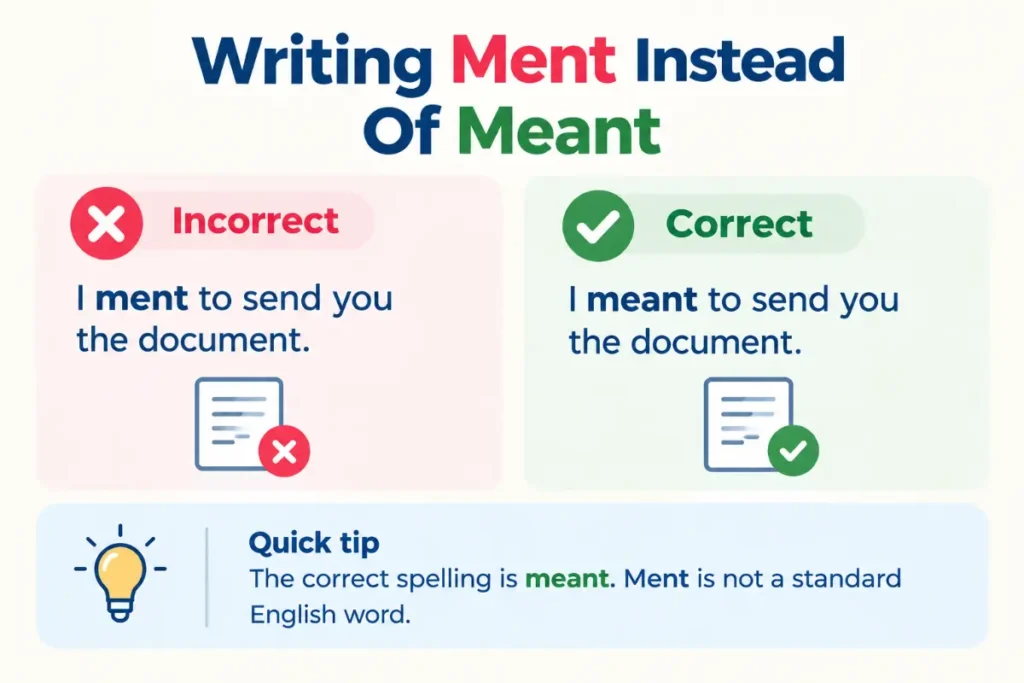
- Incorrect: I ment to finish the report. Correct: I meant to finish the report.
- Incorrect: She ment no harm. Correct: She meant no harm.
- Incorrect: What he ment was clear. Correct: What he meant was clear.
- Incorrect: The gift ment a lot to me. Correct: The gift meant a lot to me.
- Incorrect: They ment to arrive early. Correct: They meant to arrive early.
In each case, the sentence needs the past tense of mean. Changing ment to meant fixes the spelling without changing the intended message.
Common Mistakes and Misspellings
Several errors can occur when writers use this verb. Learning the correct form and its grammar makes them easier to spot.
Using Ment Instead of Meant
Incorrect: I ment to send the email.
Correct: I meant to send the email.
This is the main spelling error. The writer knows the intended word but leaves out the letter a. Remember that the past tense of mean is meant.
Using Meaned Instead of Meant
Incorrect: I meaned to help my friend.
Correct: I meant to help my friend.
Many English verbs form the past tense by adding ed. However, mean is an irregular verb, so it changes to meant. The regular pattern does not apply here.
Using Meant After Did
Incorrect: What did you meant?
Correct: What did you mean?
The helping verb did already marks the past tense. The main verb returns to its base form, mean. This rule applies to questions and negative sentences as well.
For example, Did she mean that comment is correct. Did she meant that comment is not.
Confusing Meant With Meaning
Incorrect: I meant what I am meaning to say.
Better: I meant what I wanted to say.
Meant is a past form, while meaning can function as a noun or as the ing form of mean. The best choice depends on the sentence structure and the intended message.
For example, What is the meaning of this word uses meaning as a noun. I meant to explain the rule uses meant as a verb.
Using the Wrong Helping Verb
Incorrect: I have mean to call you.
Correct: I have meant to call you.
The present perfect tense uses have or has followed by the past participle. Since meant is the past participle of mean, it follows have in this construction.
A useful check is to look at the word immediately before the verb. If you see have, has, or had and the sentence needs this verb’s past participle, meant is usually the form to use.
A related grammar guide is Council vs Counsel Which Word Should You Use.
Pronunciation Guide
Meant has one syllable and is pronounced /mɛnt/ in standard American English. The vowel is the short e sound found in words such as sent and tent. The final nt sound closes the syllable.
The pronunciation is straightforward, but it does not reveal the spelling difference between meant and the mistaken form ment. In speech, listeners usually understand the intended word from context. In writing, you must remember the established spelling.
Syllable Breakdown
Meant contains one syllable. You pronounce the word as a single unit rather than separating it into smaller spoken parts.
The word has no separate stress pattern because it consists of only one syllable. In a sentence, speakers may emphasize it to show contrast or correct a misunderstanding.
For example, I MEANT to call you places extra emphasis on the intention. This emphasis changes the tone of the sentence, not the spelling.
Common Pronunciation Errors
Some learners may use a vowel that sounds closer to the one in mint or may pronounce each letter too carefully. These variations can depend on a person’s accent or first language.
For standard American English, aim for the vowel sound in sent. Keep the final nt sound clear, and avoid adding an extra syllable.
The spelling rule remains the same across accents. Even if a speaker’s vowel sounds different from yours, the standard written form is still meant.
Etymology and Word Origin
The word meant comes from the verb mean, which has a long history in English. The verb developed from earlier forms of English and has Germanic roots. Over time, it came to express ideas related to intention, significance, purpose, and communication.
The past tense form meant reflects an older pattern of English verb formation. Rather than adding the regular past tense ending ed, the verb developed a changed form that became established in standard English.
This type of verb is known as an irregular verb. English has many irregular verbs, including go and went, see and saw, and take and took. Their past forms do not follow the usual pattern of adding ed.
The historical spelling helps explain why mean becomes meant instead of meaned or ment. Modern writers do not need to know the full history of the word to use it correctly, but understanding that it is irregular makes the spelling easier to remember.
Regional Usage
The standard spelling does not change across major English varieties. American, British, Australian, and Canadian writers use meant for the past tense and past participle of mean.
American English
In the United States, meant is the standard spelling in everyday speech, workplace communication, education, journalism, and formal writing.
For example, I meant to send the document yesterday is correct American English. Writing I ment to send the document yesterday is a spelling error.
American speakers generally pronounce meant with the vowel sound in sent. Individual accents can affect the sound slightly, but the spelling stays the same.
British English
British English also uses meant as the past tense and past participle of mean. There is no standard British spelling that replaces it with ment.
For example, I meant to speak with the manager is correct in both British and American English. Differences in vocabulary and pronunciation between the two varieties do not affect this verb form.
Australian English
Australian English follows the same spelling rule. Writers use meant to describe a past intention, a communicated idea, or the significance of something.
For example, We meant to arrive earlier is standard Australian English. The spelling is the same as in American and British writing.
In Canadian English
Canadian English also uses meant. Canadian spelling includes some differences from American and British conventions in other words, but this verb does not have a regional spelling variation.
For a Canadian school assignment, business email, or formal report, meant is the correct form when the sentence requires the past tense of mean.
Grammar Rules and Part of Speech
Meant is a verb form. More precisely, it is the simple past tense and the past participle of mean. Its grammatical role depends on the tense and sentence structure.
Understanding these roles will help you avoid errors beyond the basic spelling mistake.
Simple Past Tense
Use meant to describe a past intention, past meaning, or past significance.
Examples include the following.
- I meant to tell you the news.
- Her words meant a great deal to him.
- The instructions meant that everyone had to wait.
In each sentence, meant describes something related to the past. It can stand on its own as the main verb in a simple past sentence.
Past Participle
Meant also appears after helping verbs such as have, has, and had.
Examples include I have meant to ask you something, She had meant to leave before sunset, and They have meant well from the beginning.
In these sentences, the helping verb establishes the tense or structure. Meant supplies the past participle form of the main verb.
The Pattern Meant To
One of the most common structures is meant to followed by a base verb. This pattern can describe an intention, an expected action, or an obligation, depending on context.
For example, I meant to call you describes a past intention. The train was meant to arrive at noon describes an expectation. You were meant to submit the form yesterday may express an expected or required action.
The meaning comes from the full sentence rather than the word meant alone. Context helps the reader understand the intended relationship.
The Pattern Meant For
Meant for often describes a person, purpose, or intended recipient.
Examples include This package is meant for you and The room was meant for meetings. In both sentences, the phrase identifies the intended recipient or use.
The tense depends on the surrounding verb. This package is meant for you uses the present form, while The package was meant for you places the idea in the past.
The Pattern Meant As
Meant as explains how a statement, gesture, or action was intended to be understood.
For example, My comment was meant as a joke explains the speaker’s intention. The warning was meant as a reminder describes the purpose of the warning.
This structure is useful when someone misunderstands a message or action. It lets the writer explain the intended meaning without changing the original event.
Meant in Questions
When a question uses did, the main verb must return to its base form.
Correct: What did you mean.
Incorrect: What did you meant.
The same principle applies to negative statements. I did not mean to upset you is correct because did already marks the past tense. I did not meant to upset you is incorrect.
Meant in Negative Sentences
You can also use meant directly in a negative past statement without did when the sentence structure requires it only in a different grammatical construction, but ordinary negative simple past sentences use did not mean.
For example, I did not mean to interrupt is correct. In contrast, I never meant to hurt your feelings uses meant because never modifies the verb without the helping verb did.
The key is to pay attention to the complete verb structure. Do not choose meant simply because the sentence describes the past. Check the helping verbs first.
Real Life Usage Examples
The word appears naturally in conversations, professional messages, academic writing, journalism, and storytelling. These examples show how its meaning shifts with context.
Daily Conversation
- I meant to bring snacks, but I forgot them at home.
- Your advice meant a lot to me during that difficult week.
The first example expresses an intention that was not completed. The second explains the personal value of someone’s advice.
Email and Workplace Communication
- I meant to attach the revised file to my previous email.
- The new schedule was meant to give the team more time to prepare.
The first sentence explains a missed action. The second describes the purpose behind a workplace decision. Both are suitable for ordinary professional communication.
Academic Writing
- The researcher meant to examine how sleep affects memory.
- In the passage, the phrase meant something different from its modern use.
Academic writing often uses meant to explain a writer’s purpose or interpret the meaning of a term. The word is not limited to casual conversation.
News and Journalism
- The statement was meant to reassure residents after the announcement.
- The policy meant higher costs for some small businesses.
The first example describes an intended effect. The second explains a consequence or significance. In journalism, meant can help connect a decision or event with its impact.
Literature and Storytelling
- He meant to tell her the truth, but fear stopped him.
- The old photograph meant more to the family than anyone realized.
The first sentence develops a character’s intention and conflict. The second adds emotional depth by showing the value attached to an object.
These examples demonstrate why meant is useful across different forms of writing. It can describe intention, explain a message, or show how much something matters.
Related and Confused Terms
Several English words are closely connected to meant or can be confused with it. Understanding their differences helps you choose precise language.
Mean
Mean is the base form of the verb. It can describe an intention, the significance of something, or the idea expressed by a word or statement.
Example: I mean to finish the task today.
Use mean for the present tense with I, you, we, and they. After did, use mean rather than meant.
Meaning
Meaning is usually a noun that refers to the idea or message conveyed by a word, statement, sign, or action. It can also be the ing form of the verb mean.
Example: The meaning of the sentence was unclear.
Use meaning when you are naming the idea itself. Use meant when you are describing a past intention or significance.
Meant To
Meant to is a common phrase that can describe an intention or expectation.
Example: I meant to visit you last weekend.
The phrase is useful for explaining plans, missed actions, or expected outcomes. It does not require a special spelling beyond the standard word meant.
Meant For
Meant for describes an intended recipient or purpose.
Example: This message was meant for the whole team.
The phrase can refer to a person, group, place, or intended use. It is common in conversation and formal writing.
Intended
Intended is a near synonym of meant when discussing plans or purpose.
Example: The change was intended to improve safety.
The words often overlap, but intended can sound more formal or precise in some contexts. Meant is common in everyday speech and works well in most types of writing.
Signified
Signified means indicated, represented, or expressed a particular idea. It can replace meant in some sentences about symbols or signs.
Example: The red light signified danger.
This word is more formal and may fit academic or technical writing better than meant. It is not a direct substitute in every sentence.
Implied
Implied means suggested something without stating it directly.
Example: Her silence implied that she disagreed.
Implied differs from meant because it focuses on an indirect message or suggestion. A speaker may mean something directly or imply it through tone, silence, or context.
Ment
Ment is not the standard past tense of mean. However, the letters appear at the end of established words such as payment, movement, and agreement.
Example: The payment arrived on Friday.
In this example, ment is part of the noun payment. It does not function as the past tense of mean. That distinction helps explain why the spelling pattern should not be transferred to meant.
Expert Editor Insight
An experienced English editor looks at the sentence before correcting the spelling. If the writer is describing a past intention, an earlier meaning, or the purpose of an action, meant is usually the right choice. Editors also check helping verbs because a sentence such as What did you mean requires the base form. Spell checkers can catch many spelling errors, but they cannot always identify the intended grammar. Reading the sentence aloud and checking the verb pattern often reveals the problem. The simplest editing habit is to connect meant with mean and check the full sentence before making a correction.
Key Takeaways
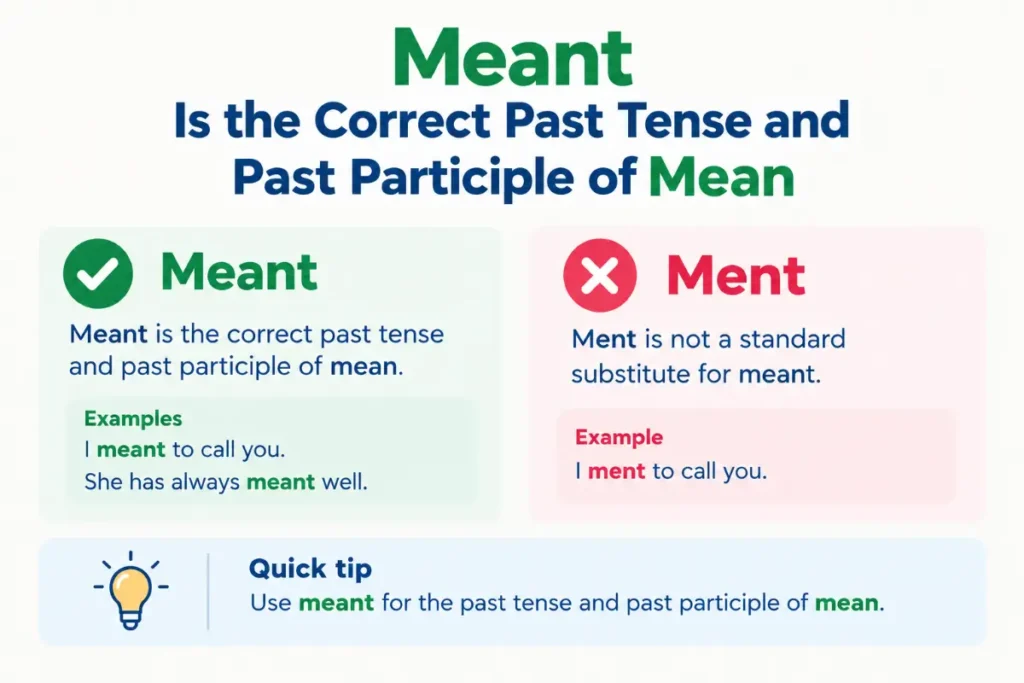
- Meant is the correct past tense and past participle of mean.
- Ment is not a standard substitute for meant.
- Mean can express intention, significance, or the message conveyed by something.
- Use meant for past statements such as I meant to call.
- Use mean after did, as in What did you mean?
- Use meant after have, has, and had when the sentence requires the past participle.
- The correct spelling is the same in American, British, Canadian, and Australian English.
- Meant rhymes with sent and has one syllable.
- Remember the pattern mean, meant, meant to avoid common spelling and grammar errors.
- Always check the complete sentence when a spelling or grammar tool misses an error.
Many readers also check Cancelation vs Cancellation Which Spelling Is Correct?.
Conclusion
The difference between meant or ment comes down to standard spelling and verb grammar. Meant is the correct past tense and past participle of mean. It describes a past intention, the meaning of a statement, or the importance of something. Ment is not a correct substitute for this verb form, even though the same letters appear in many established English nouns.
To avoid the mistake, remember the simple pair mean and meant. When you write about something you intended, said, or understood in the past, choose meant. A quick check of the verb and its helping words will help you write accurately and confidently.
FAQs
Is Ment A Real Word?
Ment is not the standard past tense or past participle of mean. However, the letters appear in many valid English words, including payment, movement, and agreement. They can also appear in names, abbreviations, or specialized contexts. If you want to express a past intention or explain what something meant, use meant.
What Does Meant Mean?
Meant is the past tense and past participle of mean. It can describe something a person intended to do, the message conveyed by words or actions, or the importance of an event. For example, I meant to call describes an intention, while Your help meant a lot to me describes personal significance.
Which Is Correct In A Sentence?
Meant is correct when you need the past tense of mean. For example, She meant to help is standard English. She ment to help is incorrect. The spelling remains meant in ordinary past tense and past participle constructions. The correct choice depends on grammar, not on the writer’s preferred spelling style.
How Do You Pronounce Meant?
In standard American English, meant has one syllable and is pronounced /mɛnt/. It rhymes with words such as sent and tent for many speakers. The vowel is the short e sound. Because the incorrect spelling ment is often intended to represent the same sound, pronunciation alone cannot reliably distinguish the correct spelling.
Can Meant Start A Sentence?
Yes. Meant can begin a sentence when the surrounding grammar supports that structure. For example, Meant as a warning, the message was taken seriously is possible, although it sounds formal and compressed. In everyday writing, a clearer sentence would be The message was meant as a warning. Sentence position does not change the spelling.
What Is A Synonym For Meant?
Useful synonyms include intended, signified, indicated, and implied. The best choice depends on the sentence. Intended often works for plans and purposes, while signified fits signs and symbols. Implied describes an indirect message. Meant is more flexible in everyday English because it can describe intention, significance, and communicated meaning.
Why Do People Misspell Meant?
People often misspell meant because English uses many words ending in ment, such as payment and treatment. They may also assume that all past tense verbs follow the same spelling rule. However, mean is irregular and changes to meant. Remembering the pair mean and meant helps prevent this common error.
Is Meant Appropriate In Formal Writing?
Yes. Meant is standard in formal and informal English. You can use it in academic essays, professional reports, business emails, and everyday messages. The word is not too casual or informal. The main concern is using the correct grammatical form. In a question with did, for example, write What did you mean rather than What did you meant.